Arthur Rowland Taylor was born on 21st March 1896 in Ilford, Essex. He was the third of five children – all of them boys – to land agent Robert Taylor and his wife, Edith. Robert’s work took the family around the country: the 1901 census found them living in Connah Quay, Flintshire, and this is where Arthur’s two younger brothers were born.
By 1911, the family had moved again, to the 15-roomed Bagle Gate House in Bridlington, Yorkshire. Robert and Edith were living with their three youngest children – including Arthur – and two servants: cook Sarah Leatham and housemaid Lucy Patchett.
At some point after leaving school, Arthur was also drawn to a new adventure. By the time war broke out, he had moved to America and settled in Denver, Colorado.
In June 1917, with war raging across Europe, Arthur had stepped up to play his part. He crossed the border to Toronto, Canada, and enlisted in as an Air Mechanic 3rd Class in the Canadian Royal Flying Corps. Sent to Britain, just three months later, he accepted a commission, taking the rank of Second Lieutenant in the British Royal Flying Corps.
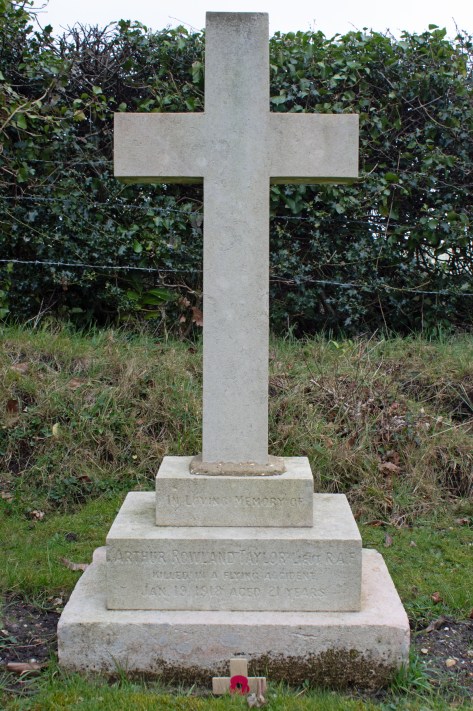
Arthur was based in East Boldre, Hampshire, and was attached to the 79th Training Squadron. On 19th January 1918, he had taken off in his Sopwith 5F1 Dolphin, when the engine stalled. He did not have enough height to try and restart the engine, and the aircraft crashed to the ground, bursting into flames on impact. Second Lieutenant Taylor was killed: he was 21 years of age.
The body of Arthur Rowland Taylor was laid to rest in the peaceful graveyard of St Paul’s Church in East Boldre, not far from the base at which he had served.
John Dobson Thomas was born in Leechburg, Pennsylvania, on 26th August 1889. He was the youngest of nine children to John and Isabella Thomas. John Sr was a steel inspector from Glamorganshire, while Isabella had been born in Newcastle-upon-Tyne: they emigrated to the United States in 1881, and John Jr was the second of their children to be born there.
When John Jr left school, he found work as a clerk, eventually getting into bonds and stocks. His father died in 1910, by which time the family had moved to Chicago, Illinois.
When war broke out, John stepped up to play his part. He enlisted on 6th January 1917, his service records showing that he was of medium height and build, with brown hair and brown eyes.
The American Army may not have met John’s needs as, just six months later, he enlisted again, this time joining the Canadian Expeditionary Force in Toronto. Along with his banking role, he was recorded as being an aviator cadet, his papers shoring that, at 23 years and 10 months old, he was 5ft 6ins (1.77m) tall.
Air Mechanic 3rd Class Thomas was shipped to Britain, and stationed near East Boldre, Hampshire. In October 1917, he took a commission in the Royal Flying Corps, with the rank of Second Lieutenant.
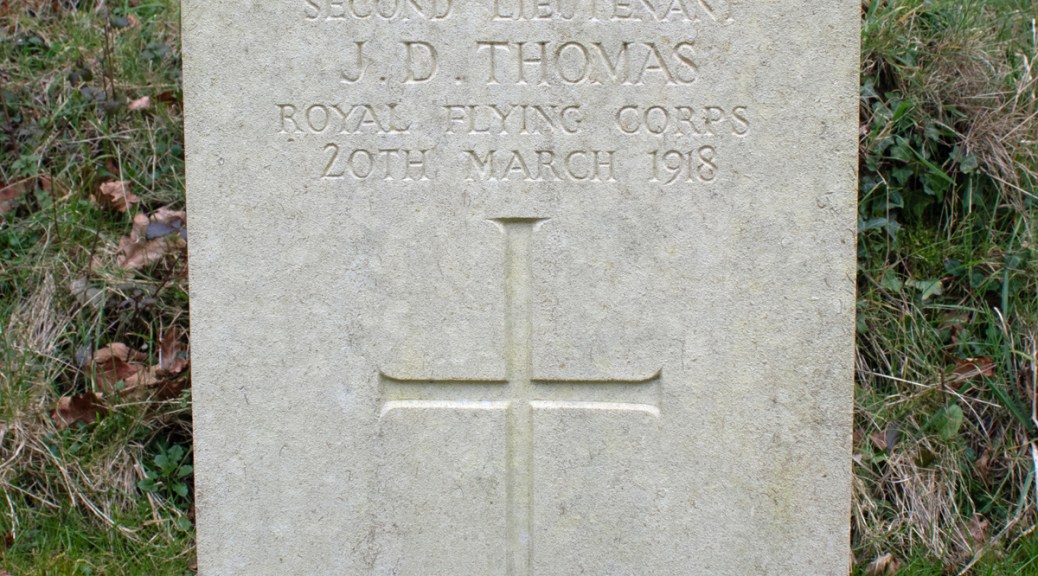
On 20th March 1918, John was flying his Sopwith Dolphin biplane, when he hit trouble. Practicing a dive, he appeared to have been unable to pull the aircraft up again and crashed into the ground. He was killed instantly.
The RAF Casualty Card cited a potential error of judgement on the part of Second Lieutenant Thomas: “[he] had proved himself a skilful pilot and well capable of handling his machine. He had previously practised many dives, but had, in his stunting, reduced his margin of safety to a minimum.”
John Dobson Thomas was 28 years of age when he died. Being thousands of miles from his family, he was laid to rest in the quiet setting of St Mary’s Churchyard, East Boldre, not far from the airfield at which he had been based.
Walter William Stead Pawson was born in South Shields, County Durham, on 7th October 1895. The second of six children, his parents were Albert and Louise Pawson. Albert was a joiner by trade, and his work took the family north for a while. The 1901 census found them living in Glasgow, but by the time Walter’s youngest sibling was born in 1905, they were back in County Durham once more.
Little further information is available about Walter’s early life, but in around 1912, he sought a new life for himself, and emigrated to California. When war broke out, however, he felt the need to serve his home country and enlisted on 5th June 1917. His US draft card show that he was working as a clerk at the Hotel de Luxe in Long Beach, California. He was noted as being tall and slender with blue eyes and light brown hair. The document also confirms two years’ voluntary service in the militia while in Scotland, during which time he reached the rank of Lance Corporal.
The next record for Walter is a second enlistment document, this time on 6th September 1917. Signing up in Toronto, Canada, he was now joining the country’s Royal Flying Corps. Whether he had been turned down for US service, of whether he felt joining the Canadian Expeditionary Force offered him better options is unclear.
Returning to Britain, he took a commission in the Royal Flying Corps, and was attached to the 70th Training Squadron based in Hampshire. His service papers do not give much detail of the man he had become, but do note his height as 6ft (1.83m).
Second Lieutenant Pawson spent the next few months training. On the 6th Mary 1918, he was piloting an Avro 504J biplane, when things went wrong. He was looping the aircraft, when it fell into a spin and he was unable to recover it. The aeroplane crashed to the ground and Walter was killed.
The RAF Casualty Card noted that: “The court having carefully considered the evidence and having viewed the wreckage are of the opinion that the accident… resulting the fatal injuries to the pilot… was due to an error of judgement on the part of the pilot who was under instruction at the time.”
Walter was 22 years of age when he died. An obituary stated that he was a “bright promising youth, and a splendid type of British manhood he us but one of the many precious lives lost through this terrible war.” [Jarrow Express: Friday 24th May 1918]
Walter William Stead Pawson was laid to rest in the graveyard of St Mary’s Church, East Boldre, Hampshire, not far from the airfield he had so recently called home.
Thomas Alexander Talbot was born in Wellington, Ontario, Canada, on 16th February 1896. The youngest of seven children, he was one of two sons to Thomas and Jean Talbot. To avoid any confusion with his father, he was known by his middle name.
Before Joining the forces of the empire, Alex. Talbot was a student for three years at the University of Alberta. At the time of enlistment he was a student at law with A. G. MacKay, KC. He was well known in Edmonton and always took an active part in all sports connected with the university.
[Edmonton Journal: June 1918]
When war broke out, Alexander was keen to play his part. He enlisted in the Royal Flying Corps in 1917, although as his service records no longer exist, the above newspaper expands on his military career: “He trained at Camp Mohawk, ON., and after receiving his commission was instructor at Camp Borden, later going in the same capacity to Fort Worth, Texas. In February last he went overseas where he was a most efficient and painstaking officer and gained promotion rapidly.”
By the spring of 1918, he had gained a commission in the Royal Flying Corps and was based in East Boldre, Hampshire.
On 3rd June, Lieutenant Talbot was piloting a Sopwith Camel, when the engine stalled. The RAF Casualty Card noted: “The cause of the accident was in our opinion due to the choking of engine after being opened out following an overshooting in landing and stalling in turn and spinning to earth owing to an error of judgement on the part of the pilot.”
Lieutenant Alexander Talbot was killed in the aircraft crash. He was 22 years of age. His body was laid to rest in the graveyard of St Mary’s Church in East Boldre, not far from the airfield which he called home.
Vernon Monroe Kidd was born in Waco, Missouri, on 6th December 1896. One of nine children, his parents were William and Frances Kidd. William was a blacksmith and, by the time of the 1900 census, he had moved the family to Delaware, Indiana.
Details of Vernon’s life are a challenge to uncover, but a later newspaper report sheds some light on him:
Lieutenant Vernon Kidd, formerly of Yorktown, was killed August 30 in France, the news coming to Yorktown yesterday to his two brothers, J Wesley and William E Kidd. He was serving with the Canadian Aviation Corps and was but 21 years old. Only last April, while visiting Yorktown, Lieutenant Kidd spoke there at the ME Church. He sailed on June 18 for overseas service. He had tried numerous times to enlist in the United States army but was rejected and later went to Canada, enlisting at Toronto. He had another brother now serving in the army against Germany.
[The Star Press: 2nd September 1918]
Vernon’s service papers give a bit more information. He enlisted in Toronto on 12th October 1917, joining the Canadian Royal Flying Corps. He gave his next of kin as his father, who by now, was living in Port Angeles, Washington. Just short of his twentieth birthday, he was noted as being 5ft 9ins (1.75m) tall.
Sent to Britain, Vernon was based at the 29th Training Depot Station in East Boldre, Hampshire. When the Royal Air Force was founded in April 1918, he transferred across, and just a month later, he received his commission.
On the 30th August 1918, Second Lieutenant Kidd was piloting an Avre 504J biplane. It had just taken off, but the engine cut out. He had little choice but to crash land, and was killed in the impact. Vernon was 21 years of age.
Thousands of miles from home, the body of Vernon Monroe Kidd was laid to rest in the graveyard of St Paul’s Church in East Boldre.
Second Lieutenant Vernon Kidd (from findagrave.com)
Malcolm Gifford Boggs was born on 14th August 1894 in Brooklyn, New York. The second of four children, his parents were Seth and Anna Boggs. Seth died in 1905, and Anna married again, to widower lawyer Charles Vande Water: her children took his name.
The next record for Malcolm is that of his Royal Flying Corps service records. Interestingly, they note that he enlisted on 10th September 1917, and did so in Toronto, Canada. While the United States had entered the First World War by this point, it may have been easier for him to join via a colonial route.
Malcolm’s papers show that he was 5ft 11ins (1.81cm) tall, and was a student aviator at the time he joined up. He was recorded as being an Air Mechanic 3rd Class, but that came to an end when, on 2nd February 1918, he was accepted for a commission.
Second Lieutenant Vande Water was attached to the 29th Training Depot Station in Hampshire. There is little information about his time there, but a later American newspaper provided details of what happened to him:
Intelligence reaching relatives of Lieutenant Malcolm G Vande Water, of the Royal flying corps, a former Passaic newspaper man, is that he was killed in a fall while testing a new airplane at the British airdrome in Beaulieu, France. Wande Water was the first member of the Pica club to pay the supreme sacrifice. He was on leave in England, after six months’ active service at the front, having operated a machine across the English channel to France on the day before his fatal fall. His machine gun shot off a propellor blade while he was flying 100 feet in the air and the airplane dove to the earth.
[The Morning Call: 17th December 1918]
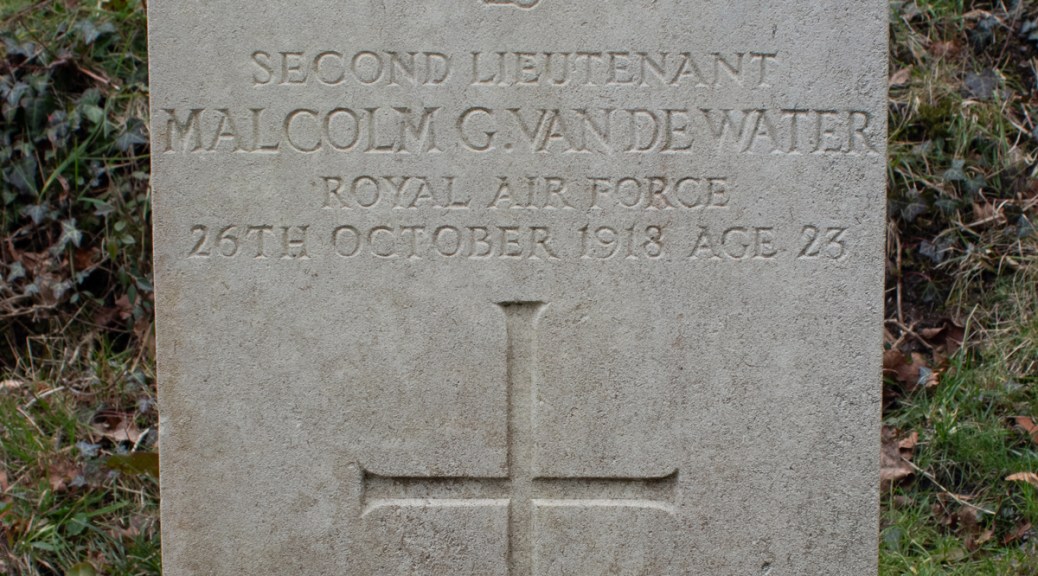
The accuracy of the information included in the article is variable to say the least. Malcolm may have enlisted in the Royal Flying Corps, but, by the time of the accident on 26th October 1918, that had become the Royal Air Force. The Beaulieu aerodrome mentioned was in Hampshire, not France. The RAF’s records for the incident do confirm, however, that the propellor of his Sopwith Camel was indeed shot through, causing the aircraft to fall to the ground.
Second Lieutenant Vande Water was taken to the Forest Park New Zealand General Hospital in Brockenhurst, Hampshire, for treatment, but his injuries would prove too severe. He died later that day, at the age of 24 years old.
The body of Malcolm Gifford Vande Water was laid to rest in the graveyard of St Paul’s Church in East Boldre, Hampshire, not far from the base he had called home.
The life of a WW1 pilot was notoriously dangerous. On the same day of Malcolm’s death, and at the same airfield, Flight Cadet Douglas Baker was also killed, in a separate incident.
Anyone who attended the funeral of Captain George Lee, IMT (late Rifle Brigade), held in the churchyard of his old home, Yetminster, on Wednesday could not but have been impressed by the wonderful sense of peace and rest that pervaded the place. After a life of unique adventure in Africa, India, America, and Canada his worn and suffering body was laid to rest beside his beloved father. The solemn service was taken by his uncle, Red. EHH Lee (vicar of Whitchurch Canonicorum) and his cousin, Rev. E Hertslet (vicar of Ramsgate), and Rev. MJ Morgan (vicar of Yetminster), there being also present his old schoolfellow, Rev. J Lynes, and Rev. Hall, curate of Yetminster. Besides the chief mourners Captain Lee’s mother, sister and brother-in-law, there were many friends present and numerous villagers who had known him from boyhood. The coffin was attended throughout the service and for many hours before by his most faithful servant and friend, Rajab Ali Khan, who was with his master through India, Persia, Beluchistan, and Afghanistan, and came to England as his personal attendant when Captain Lee was sent home on sick leave. After the service in the churchyard Rajab, through the kindness of Mr Hall, who translated for him, was able to tell everybody what his master had been to him.
Dorset County Chronicle: Thursday 9th September 1920
George Johnston Lee was born in the summer of 1886, the second of four children to Reverend Robert Lee and his wife, Elizabeth. Robert was the vicar of St George’s Church in Fordington, Dorset, when George was born, but moved west to Toller Porcoram not long after he was born.
Tantalisingly little information about George’s early life remains. He does not appear on the 1901 or 1911 census records, and it is likely that he was already away travelling the world by this point. It seems clear that he followed a military, rather than a clerical, career and, by the end of the First World War he was serving in the Indian Army Reserve of Officers. Attached to the Rifle Brigade, George had reached the rank of Captain.
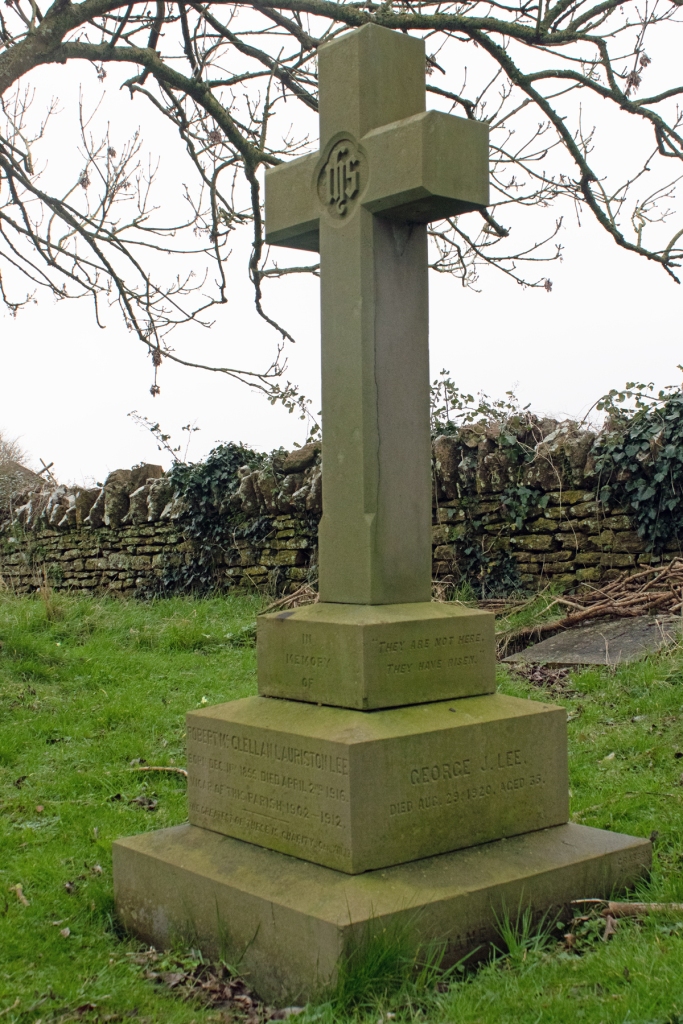
George’s father had become ill in the early 1910s, and having moved to St Andrew’s Church in Yetminster, he retired from the post in 1912. He and Elizabeth moved to Dorchester, but when he passed away in 1916, at the age of 59, his last wishes were to be buried in Yetminster, the village having held a special place in his heart.
Captain Lee survived the First World War, but, as the newspaper report suggests, he became unwell. George had contracted amoebic dysentery, and returned to England to recuperate. The condition was to prove too severe, and he passed away in London on 29th August 1920, at the age of 34 years old.
In accordance with the family’s wishes, George Johnston Lee’s body was taken back to Dorset, and he was laid to rest next to his father, in the tranquil St Andrew’s Churchyard, Yetminster.
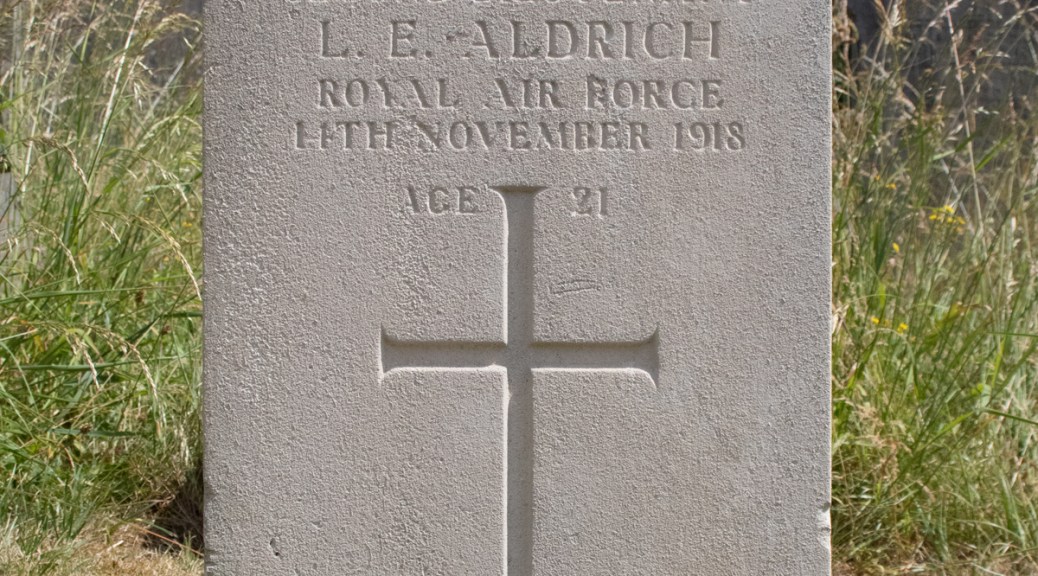
Leo Edwin Aldrich was born on 14th July 1897 in the Ohio city of Elyria, and was the only child to Hiram and Agnes Aldrich. Hiram was a machinist from New York and, by the time of the 1910 census, he had found work as a toolmaker for a motor company, and the family has moved to Detroit, Michigan, 150 miles (240km) along Lake Erie’s coastline.
When war came to Europe, Leo seemed keen to get involved. Full details of his military service are lost to time, but it seems that he enlisted in the Canadian Royal Engineers. By the summer of 1918, Leo was in Britain, and had transferred to the Royal Air Force. He had reached the rank of Second Lieutenant and was based at Yatesbury Airfield in Wiltshire.
On 14th November 1918, just three days after the Armistice was signed, he was flying in a Bristol F2b fighter aircraft, when it nosedived into the ground. Both Second Lieutant Aldrich and his passenger Second Lieutenant McDougall were seriously injured, and were taken to Bath War Hospital for treatment.
Sadly, Leo’s injuries were to prove to be too severe. He passed away the same day: he was just 21 years of age.
Leo Edwin Aldrich was laid to rest in Locksbrook Cemetery, not far from the hospital in which he passed.
Leo’s service records suggest that his next of kin was his wife, Mrs Leo Aldrich of 480 East 112th Street, Cleveland, Ohio. There are no identifiable marriage records for him although, intriguingly another one does exist.
This confirms the wedding of a George L Aldrich to a Helen J Seymour on 6th August 1918 in Cuyahoga, Ohio. As the names do not match, the record would normally be dismissed, but the parents’ names – Hiram and Agnes – match Leo’s, as does the place of birth – Elyria – and his occupation – Second Lieutenant.
Further details for Helen Seymour, and why Leo may have given the name George, are lost to time.
The life of Forrest Dinnett Evans is a challenge to uncover, although his service records shed tantalising glimpses into his history.
Forrest enlisted in the Canadian Royal Flying Corps on 8th August 1917. He joined up in Toronto, Canada, but gave his address as 26 Leicester Drive, Boston, Massachusetts.The same document gives his middle names as Dennett, and that his father was called George William Evans. It also suggests that both men were British subjects. While it’s not clear when the Evans family moved to North America, there are no UK census or birth records for either man.
Forrest was 19 years 9 months old when he enlisted and stood 5ft 10ins (1.77m) tall. He gave his trade as an student aviation cadet. He was mobilised straight away, and sent to Britain. His time in the Canadian Royal Flying Corps came to an end on 18th December 1917, when he received a commission in the Royal Flying Corps.
Second Lieutenant Evans, as he was now known, was based at Boscombe Down, Wiltshire. It was here, on 27th March 1918, that he was in charge of an Armstrong Whitworth FK8 two-seater biplane. Shortly after take off, the aircraft span into the ground: Forrest was killed instantly. He was 20 years of age.
With his family overseas, Forrest Dinnett Evans was laid to rest in Amesbury Cemetery, just a few miles from Boscombe Down.
Charles Walter Lavis was born in Iowa, USA, on 2nd April 1888. The second of eleven children, his parents were James and Martha Lavis. The only census record Charles appears from – the return from 1901 – shows that James was an agricultural labourer from Long Sutton in Somerset. The family’s move to America seemed not to have lasted for long – Charles’ immediate siblings – Mabel, who was two years older, and George who was two years younger – were both born in Long Sutton.
Charles was drawn to a life of adventure and, on 11th April 1906, he enlisted in the Royal Navy. His service records confirm that he was 5ft 5ins (1,65m) tall, with brown hair grey eyes and a fresh complexion. As a Stoker 2nd Class, he was initially sent to the training ship HMS Nelson, before moving to what would become his shore base, HMS Victory, the Royal Naval Dockyard in Portsmouth, Hampshire.
Over the next year, Charles serves on HMS Hecla and HMS King Edward VII, where, on 17th May 1907, he was promoted to Stoker 1st Class. He remained on the King Edward VII for more than four years, before returning to Portsmouth in August 1911.
Back on shore, Stoker 1st Class Lavis was promoted to Leading Stoker, and spent the next nine months training for the role at HMS Fisgard, also in Portsmouth. He spent six months on the battleship HMS Revenge, before moving again to another battleship, HMS Britannia.
Charles spent two years on the Britannia, and it was while assigned to her that he got married. He wed Bessie Patten on 31st May 1914 in Martock, Somerset: the couple would go on to have a daughter, Eileen, who was born the following April.
It was while Charles was serving on HMS Britannia that was broke out. In November 1914, he returned to Victory for further training and, in the spring of 1915, he was promoted to Stoker Petty Officer.
Over the next three years, Charles served on three more vessels, before finally returning to Portsmouth in April 1918. The reason for his return was because of his health, and he was soon admitted to the Royal Naval Hospital in Haslar, Gosport, suffering from tuberculosis of the neck. The condition necessitated an operation, but Stoker Petty Office Lavis was not to survive the procedure. He suffered from heart failure, and died on 2nd May 1918. He had not long turned 30 years of age.
Charles Walter Lavis was taken back to Somerset for burial. He was laid to rest in the quiet graveyard of All Saints’ Church in Martock.
Records suggest that the Lavis family could not settle. Passenger lists from March 1912, show James and Martha travelling with nine children to Portland, Maine, before moving on to Huron in Ontario. James was still recorded as being a farm labourer, so it seems that opportunities for the family were better in North America than in Britain.
When war broke out, citizens of the Commonwealth were called upon to play their part and, despite being under age, Charles’ younger brother Arthur, stepped up to serve. Details of his time in the army are scarce, but he was assigned to the 14th Battalion of the Canadian Infantry. His troop set sail for Britain in October 1914: Arthur was just 14 years old at this point, and had lied when he joined up, giving his date of birth as 20th May 1897.
Private Arthur Lavis was in France by August 1916, taking up position on the Front Line at Coucelette. They met heavy troops, even before a full offensive got underway on 16th September. Ninety-two soldiers from the 14th Battalion were killed during the attack, Arthur included. He was just 16 years old, and his remains were never recovered. He is commemorated on the Vimy Memorial in France.









 Death and Service