Category Archives: story

Private James Hayden

Private James Hayden

James Hope Hayden was born in Shorncliffe Military Camp in 1875, the son of Mary Anne Hayden. The youngest of five children, James’ father appears to have died when he was just a toddler; there are no records for him, and Mary Anne – who preferred to caller herself Annie – was listed a a widow by the time of the 1881 census.

The document confirms that Annie was lodging in a house near the Naval Dockyard in Chatham, working as a seamstress. She was living there with her landlady Anne Roberts and her five children, John, William, Annie, Charles and James, who seems to have gone by the name of Mathew.

By the time of the nest census, Annie had moved and was lodging in another house in the same road. She was still employed as a seamstress, and was sharing the rooms with her two youngest children and her brother, William.

The 1901 census finds Annie living in an adjacent road to her previous houses. Head of the household this time, she was working as a laundress. Her brother William was also living there – he was listed as an army pensioner. Mathew is the only one of her children still living with her; he had, by this time, found employment as a labourer in the dockyard.

Moving forward another ten years, and the family have moved one street over. Annie, at 69 years old, remained the head of the household, while Mathew is living there with his wife and three children.

Mathew’s wife is listed as Florence, but there is no record of their wedding, other than the census document which confirms they have been marred for ten years. Mathew is listed as an ex-soldier although again, there is no longer any documentation to confirm this.

From this point, Mathew’s/James’ life goes a bit hazy. The next available record is his army pension document. This confirms that he was a Private in the Royal Marine Light Infantry, under the name James Hope Hayden. By this time, he and Florence had had seven children, although it seems to suggest that they were not actually married.

Sadly, it also confirms that Private Hayden had passed away on 1st May 1917, having been suffering from pneumonia, contracted whilst on active service. He was 42 years old.

Mathew was laid to rest in the Grange Road Cemetery in Gillingham, Kent, under the name James. The cemetery has since been turned into a public park, and he is commemorated in the nearby Woodlands Cemetery.


Chief Stoker John Seager

Chief Stoker John Seager

John Edward Seager was born in Gillingham, Kent, in March 1869. One of eight children, his parents were labourer William Seager and his wife Maria (who was known by her middle name, Elizabeth).

John was keen to have adventure in his life, and the local Naval Dockyard in Chatham gave him that opportunity. on 23rd April 1887, he enlisted in the Royal Navy for the standard twelve years’ service. During that time, he served on six different ships, begging his career as a Stoker and rising through the ranks to become a Leading Stoker at the end of his time.

In April 1899, John re-enlisted and was given the rank of Chief Stoker. After completing his initial training at the on-shore establishment HMS Pembroke, he was assigned to HMS Cossack. Over the next ten years, he served on five more ships, before being moved over the Royal Naval Reserve in 1909.

During this time, John had gotten married. Emmeline Ada Driver was also born in Gillingham, and had found work as a nurse in the Surrey County Asylum. The couple married on 8th August 1903 in New Brompton, and set up home in a cottage close to the centre of Gillingham, close to their families and within walking distance of the dockyard.

When war broke out, John was called back into active service. He spent a year on board HMS Wildfire and five months on HMS Attentive. Most of his time, however, was spent at HMS Pembroke in Chatham. It was while he was here in January 1918 that he was admitted to hospital with pneumonia and tuberculosis. Sadly, Chief Stoker Seager was to succumb to these conditions; he died on 1st February 1918 at the age of 49 years old.

John Edward Seager was laid to rest in the Grange Road Cemetery in Gillingham, Kent. He is commemorated in the Woodlands Cemetery, which replaced this now park.


Serjeant Albert Romain

Serjeant Albert Romain

Albert William Romain was born in Gillingham, Kent, at the start of 1888, the middle of three children to Henry and Florence. Henry was a Sergeant in the Royal Engineers and is seemed inevitable that his son would follow suit.

Henry died in 1896, and was buried in the Grange Road Cemetery, Gillingham (now a public park). The 1901 census recorded Albert as a pupil at the Duke of York’s Royal Military Asylum in Chelsea. This was, in fact, a school for the children of soldiers, and it is likely that Albert was sent there to be educated when his father died.

The Royal Engineers obviously proved too great a lure for the young Albert. While full details of his service are not available, he had definitely enlisted early on, and was listed as a Lance Corporal in the Tempe barracks in Bloemfontein, South Africa in the 1911 census.

When war broke out, he was called back to Europe, as was on the Western Front by November 1914. Little further information on Albert is available – during the conflict he was assigned to D Company of the Royal Engineers, but the end of the war, he had become a Sergeant in the 1st Reserve Battalion.

In November 1918, back on UK soil, he was admitted to the Fort Pitt Military Hospital in Chatham, Kent. His condition is unclear, but sadly it was to be one to which he would succumb. Sergeant Romain died on 8th November 1918; he was just 30 years old.

Albert William Romain was laid to rest with his father in the Grange Road Cemetery. He is commemorated in the Woodlands Cemetery in his home town of Gillingham, Kent.


Private William Ridley

Private William Ridley

William Frederick Ridley was born on 7th April 1887 in the New Brompton area of Chatham/Gillingham, Kent, one of eight children to John and Elizabeth Ridley. John was an engine fitter in the nearby naval dockyard and, as the key employer in the area, William followed in his father’s footsteps.

Sadly, John died in 1904, and this seems to have been what spurred his son on to a better life. In 1907 William emigrated to Canada, settling in the town of Wentworth, on the banks of Lake Ontario.

It was in Ontario that William met his future wife. Edith Wass was the daughter of a local labourer; the young couple married on 5th June 1909, and went on to have two children, John, born in 1910, and Wilfred, who was born five years later.

During this time, William was putting his engineering skills to the test; his marriage banns confirm he was a machinist. While there is nothing to confirm any specific trade, given his proximity to the coast, dockyard employment seems probable.

On the other side of the Atlantic, war was breaking out; keen to do his part for King and Country, William enlisted in the Canadian Expeditionary Force on 28th July 1915. Initially enlisting in the 76th Overseas Battalion of the Canadian Infantry, he was shipped to England a year later and transferred across to the 4th Battalion.

Once on the Western Front, Private Ridley was thrown right into the thick of things. His battalion fought at the Battle of Flers-Courcelette – part of the Battle of the Somme – and it was here, on 18th September 1916, that he was wounded.

William received shrapnel wounds to his head, hand and right leg. Initially treated on site, he was quickly evacuated back to England, and admitted to the 2nd London General Hospital in Chelsea. Sadly, however, his wounds appeared to have been too severe; Private Ridley passed away from them on 30th November 1916, aged just 29 years old.

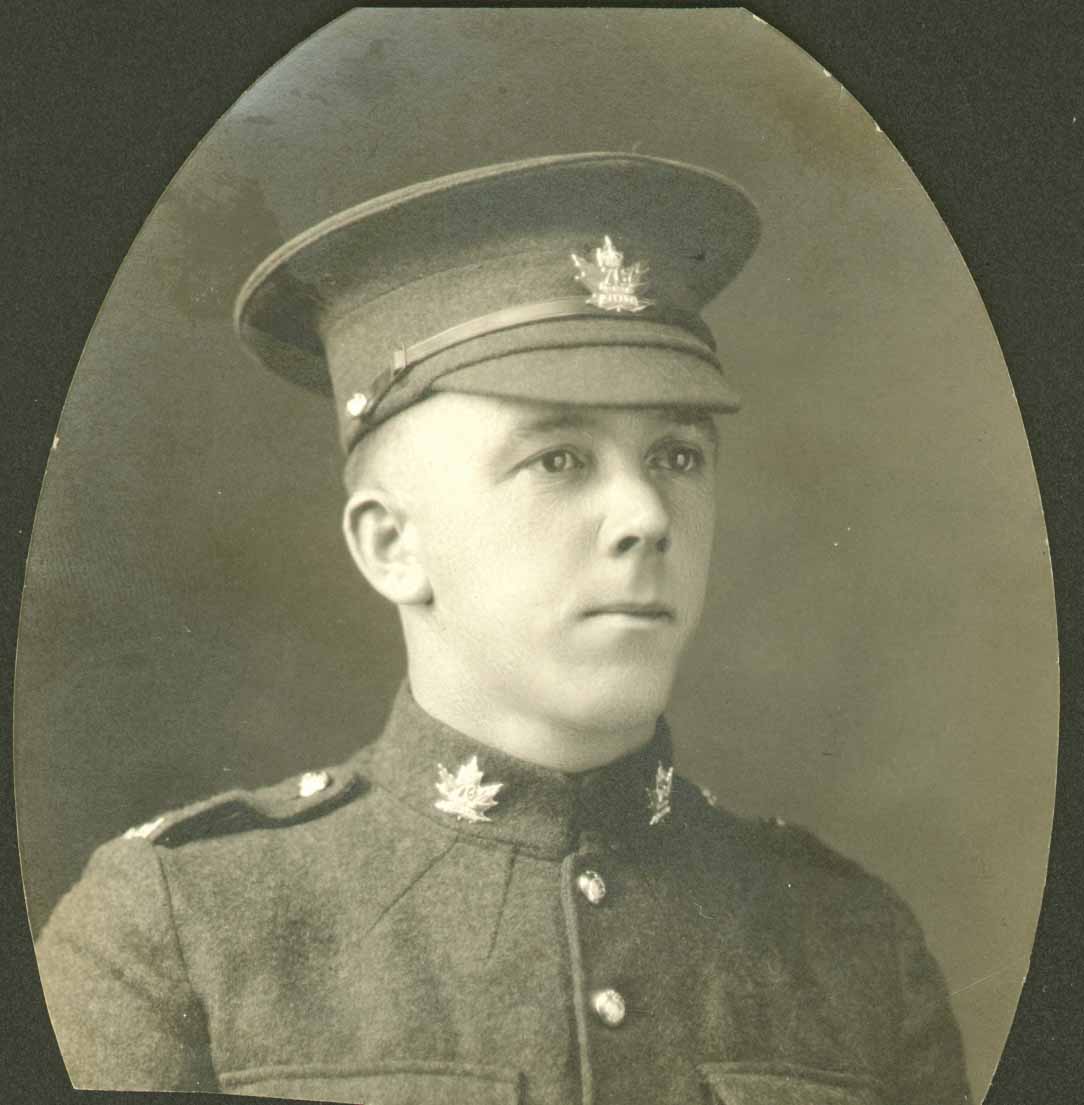
With his widow and children still in Canada, William’s body was taken back to Kent. He lies at rest in the Woodlands Cemetery in Gillingham, close to where his mother was still living.


Larger memorial image loading...
Private William Ridley
(from findagrave.com)

Private Joseph Redgrave

Private Joseph Redgrave

Joseph Redgrave was born at the start of 1897, the youngest of nine children to Charles and Hannah. Tragically, five of Joseph’s siblings passed away and, by the time of the 1911 census, the family were living in a three-roomed cottage within a few minutes’ walk of Charles’ place of work, the Naval Dockyard in Chatham, Kent.

Sadly, little documentation about Joseph remains. When it comes to his military service, his records confirm that he enlisted prior to November 1916, joining the Army Veterinary Corps as a Private. There is no evidence that he served overseas, but documents place him at the Larkhill Camp just north of Stonehenge in Wiltshire.

Tragically, Private Redgrave died from unrecorded causes at the camp’s hospital on 15th May 1917, at the age of just 20 years old.

Joseph’s body was brought back to Kent; he was laid to rest in the Woodlands Cemetery in Gillingham.


Private William Osborne

Private William Osborne

William Osborne is sadly one of those names that seems destined to be lost to time.

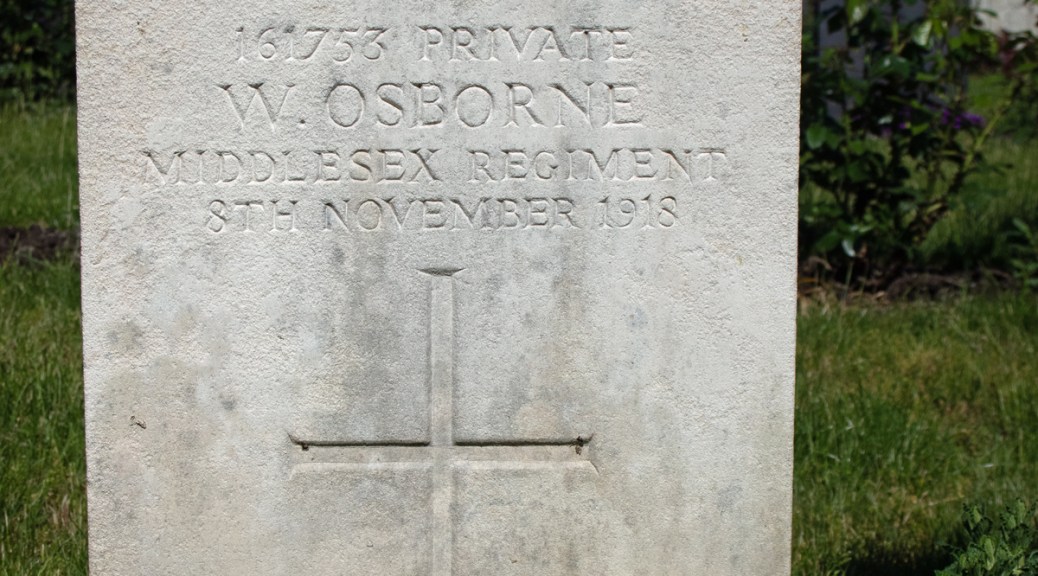
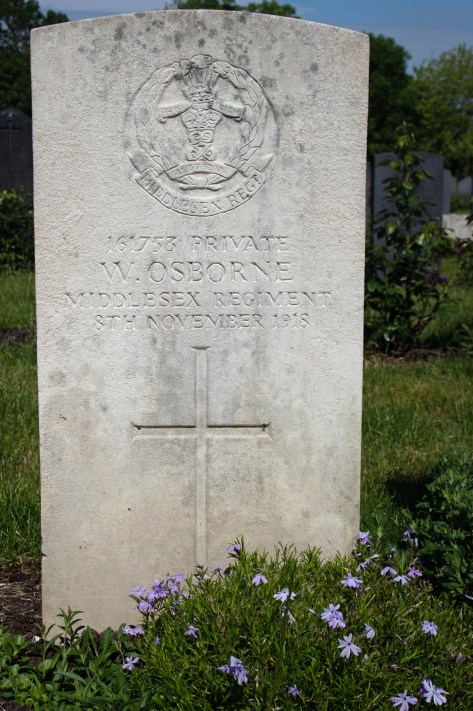
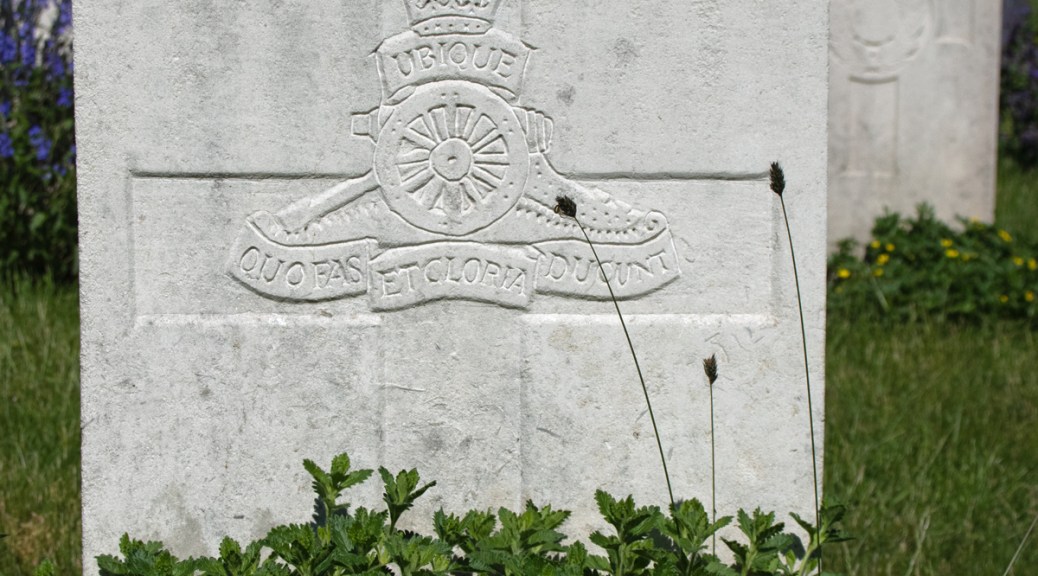
The starting point for any research is always going to be the gravestone; this is situated in the Woodlands Cemetery in Gillingham, Kent and confirms his service number, rank and regiment and the date of his death.

The service number helps confirm his first name, and that his widow was called Eliza, but without his age and confirmation of when he was married, there are too many potential Williams and Elizas/Elizabeths to confirm a definite identity.

The only thing that can be confirmed, therefore, is that William enlisted in the Middlesex Regiment at some point before April 1918, and subsequently transferred across to the Labour Corps. He passed away on 8th November 1918 at the Second Eastern General Hospital in Brighton, Sussex, having contracted pneumonia.

William Osborne lies at rest in that Gillingham Cemetery, not far from where his widow was living.


Private William Jennings

Private William Jennings

William Gladstone Jennings was born in Kent, in the summer of 1898, the only child of James and Emma Jennings. James was a marine engineer in the Naval Dockyard in Chatham, and it was here that the family lived.

Sadly, due to his age, and the lack of military service documentation, there is little written about William’s life. He was still at school by the time of the 1911 census, and the next records available confirm that he enlisted in the army. The date for this is not available, but it would have been by May 1917 at the latest and he seems to have enlisted with the surname Hickson, which was possibly his mother’s maiden name.

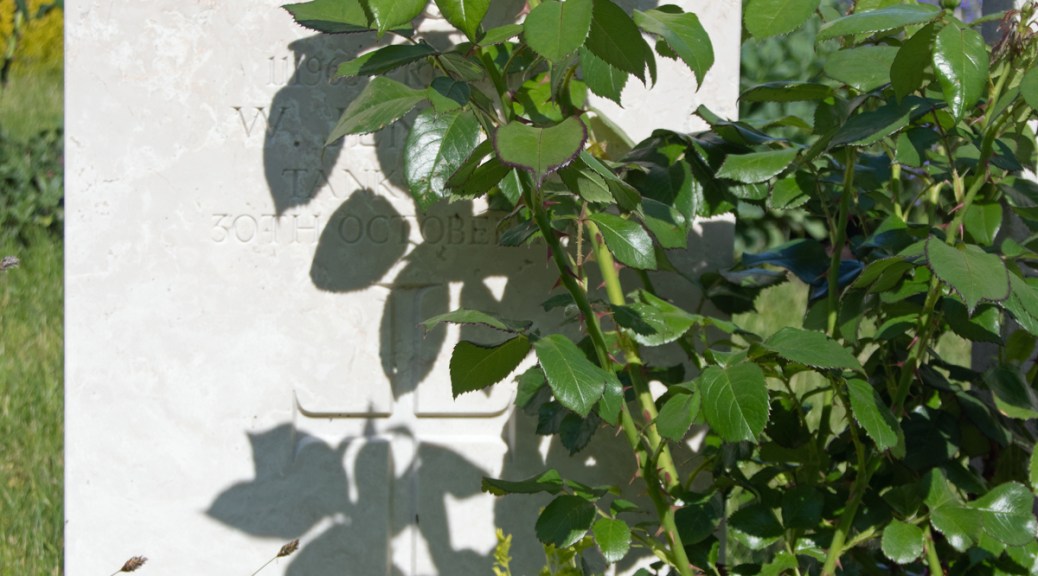
Private Jennings transferred to the Tank Corps when it was formed in July 1917. What his specific role was is lost to time, but it appears that his time in the regiment was short. The next available document is the Army Register of Soldiers’ Effects; this confirms that William passed away on 30th October 1917, in the Military Hospital in Woolwich.

There is no confirmation of the cause of his death, but Private Jennings was just 19 years old.

William Gladstone Jennings was brought back to his home town for burial, and he lies at rest in the Woodlands Cemetery in Gillingham.


Private Charles Debney

Private Charles Debney

Charles William Debney was born in the spring of 1887, one of eight children to George Debney and his wife Susannah. George was a cooper for a cement works, who had brought his family from Norfolk to Kent in the mid-1890s, presumably for employment.

When Charles left school, he found work as a bricklayer; war was on the horizon, though, and when the call came, he signed up quickly.

While full details of Charles’ service are not available, it is evident that he had joined the Northamptonshire Regiment by November 1914. He was assigned to the 5th Service Battalion as a Private. Formed in Northampton, the battalion moved to Kent in the early months of the war, before moving to the Western Front at the end of May 1915.

Sadly, there is limited additional information available on Private Debney. He passed away on 29th May 1915, but there is no confirmation of the cause of his death. He was just 28 years of age.

Charles William Debney was laid to rest in the Woodlands Cemetery, in his home town of Gillingham, Kent.


Serjeant Thomas Myers

Serjeant Thomas Myers

Thomas Francis Myers is destined to be one of those people whose story is destined to be lost to the annals of time. The only definite documents available for him are his pension records, which give his wife’s name as Ellen.

Sadly, with no date of birth for Thomas, no location other than his place of burial, and the potential for any number of alternative spellings for his surname, it’s impossible to track down any further details on his life.

His records show that he was a Serjeant in the Royal Engineers, and that he was discharged on medical grounds on 12th October 1918. Sadly, he succumbed to the conditions just a few days later, passing away from phthysis (tuberculosis) and exhaustion on 23rd October.

Thomas lies at rest in in the Woodlands Cemetery in Gillingham, Kent.


Gunner William Morgan

Gunner William Morgan

William Francis Morgan was born on 22nd January 1884 in Bengal, India. The youngest of three children, he was the son of James Morgan and his wife Mary. Both came from Ireland, marrying in 1876. They moved to London, before James was posted to India as part of his role in the Royal Horse Artillery.

Sadly James died when William was just a toddler; this prompted Mary to move the family back to England. She married again in 1887, to Edward Curling, who was a carpenter in the Royal Artillery, and the family settled on the Isle of Grain in Kent, living in the fort where Edward worked.

Surrounded by those in military service and with an army heritage himself, is it no surprise that William felt drawn to the life. In September 1898 he enlisted in the Royal Garrison Artillery. Though not yet fifteen years old, he stood 5ft 11ins (1.69m) tall and weighed in at 101lbs (46kg). He had a fresh complexion, grey eyes and light brown hair and four distinctive marks were noted – three scars on his head and one on his right knee.

Trumpeter Morgan certainly got to see a lot of the world during his time in the army. After a period on home soil, he was sent to Egypt on Christmas Eve 1901, staying there for just over a year. He moved on to India, returning to England five years later, by which time he had achieved the rank of Gunner.

War was imminent, and in September 1914 he was sent to France as part of the British Expeditionary Force. Barring a short period at home, Gunner Morgan remained on the Western Front for the remainder of the war, finally returning to the UK in January 1919.

William’s time in the army was one of two halves. He had several bouts of illness during his service, coming down with phimosis in 1901, scarlet fever and gonorrhoea in 1902, a fractured clavicle in 1903, pneumonia in 1904, rheumatism in 1906, ague in 1908, pleurisy in 1909, and had to return from France to England for an operation to remove a carbuncle between his shoulder blades in the summer of 1915.

Gunner Morgan was also pulled up for his conduct a few times too. He was punished for neglect of duty in August 1908, disobeyed orders in May 1909, was pulled up for being improperly dressed while in Portsmouth’s Highbury Arms Pub in November 1909 and went AWOL for ten hours on 31st July 1913.

There were positives to William’s service too, however. He was awarded the British and Victory Medals as well as the 1914 Star during the First World War. He was mentioned in dispatches and received the Military Medal in 1917 an the Long Service and Good Conduct Medal two years later.

Sadly, though, after Gunner Morgan’s positive and lengthy military service, his time out of the army was to be brief. Returning to England on 13th January 1919, he contracted influenza and pneumonia and succumbed to the lung conditions within weeks. He passed away on 27th February 1919, at the age of just 35 years of age.

William Francis Morgan was laid to rest in the Woodlands Cemetery, Gillingham, Kent, just minutes’ walk from where his mother now lived.