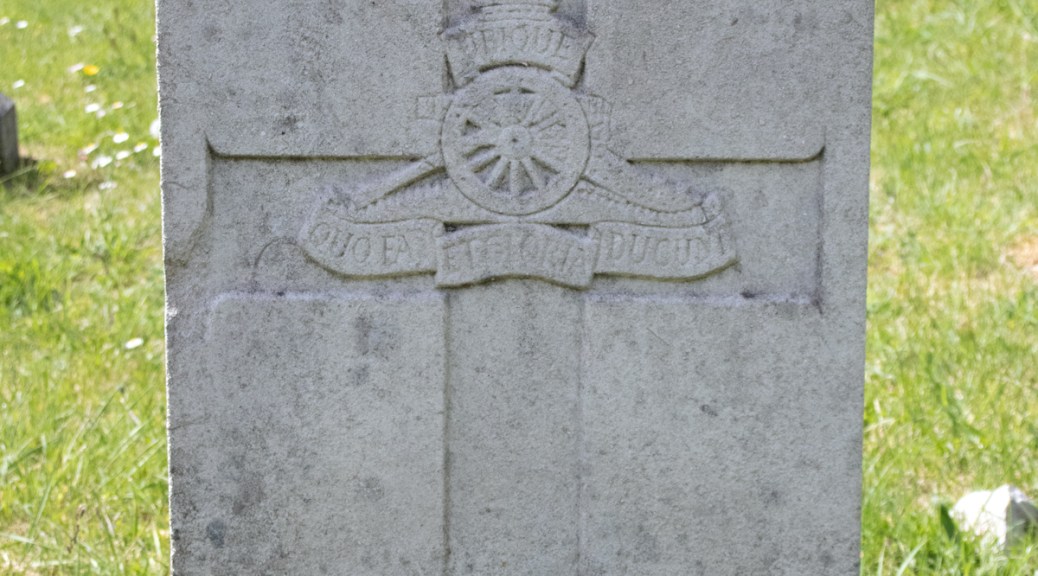
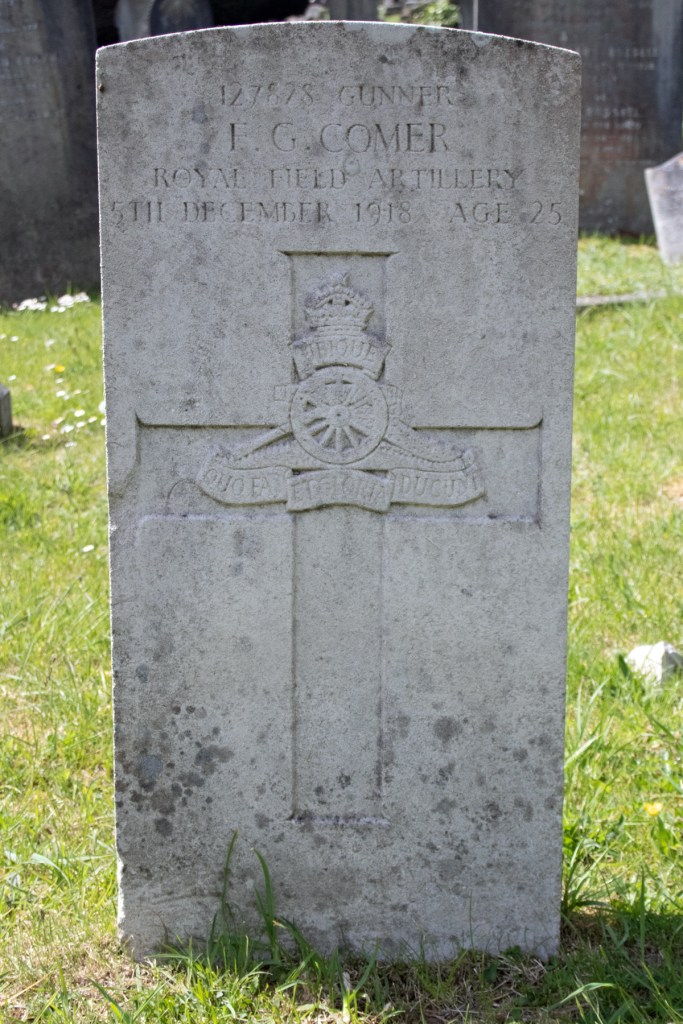
Frederick George Comer was born on 8th July 1893, the older of two children to Fred Comer and his wife Fanny. Fred Sr was a decorator, and raised his family in his town of his birth, Weston-super-Mare.
While his younger brother Clifford followed in his father’s footsteps and became a decorator, Frederick Jr had set his sights elsewhere. The Western-super-Mare Gazette and General Advertiser reported on 31st December 1910, that he had gained a certificate by Pitman’s Shorthand with a speed of 60 words per minute. Within a year, he was working as a news reporter in the local area.
War was on the horizon, but sadly this is where Frederick’s trail goes a bit cold. He enlisted in the Royal Field Artillery, although existing documents do not confirm a date for this. Gunner Comer definitely served overseas, however, and was wounded in action.
Sadly, the other information available confirms that Gunner Comer died from his wounds on 5th December 1918. He was just 25 years old.
Frederick George Comer’s body was brought back to Weston-super-Mare; he lies at rest in the Milton Cemetery in his home town.
Arthur Reginald Lavender was born in Bath on 17th January 1889, the second of two children to George Charles (or Charles George) Lavender and his wife, Elizabeth. George raised the family in Bath and seems to have been a jack of all trades, finding work where he could, as a porter in a warehouse according to the 1891 census and a stationary engine driver ten years later.
On 1st December 1907, at the age of just 18, Arthur married Kate Pearce, a painter’s daughter from Weston-super-Mare. The young couple went on to have a son, Sidney, who was born the following year.
By 1911, Arthur was working in Weston-super-Mare as a warehouseman at a local laundry and, on the day of that year’s census, was staying with his father-in-law. Kate, meanwhile, had taken Sidney to see her brother, Frank, who lived in Bristol.
War was coming to Europe, and, in November 1915, Arthur signed up, joining the Royal Army Medical Corps as a Private. After initial training – including a course on First Aid, he was sent overseas on 11th April 1916, where he was assigned to the 27th Casualty Clearing Station.
Private Lavender’s time in the RAMC seems to have been a complicated one. He was admitted to a field hospital within a month of arriving in France with a double inguinal hernia, a condition that continued to dog him over the coming months.
Arthur was eventually shipped to England in March 1917 for an operation at the Metropolitan Hospital in London. The operation itself seemed to have been a success, but, while admitted, he contracted pneumonia, and it was this lung condition that was to end his life. Private Lavender passed away on 7th May 1917, aged just 28 years old.
Arthur Reginald Lavender was laid to rest in the Milton Cemetery in Weston-super-Mare.
Charles William Dyer was born on 12th May 1895, the youngest of seven children to Harry and Mary Dyer.
Harry was a farmer, who brought his family up in the village of Kewstoke, just to the north of Weston-super-Mare, Somerset. He seems to have been keen to try new things because he and Mary lived for a while in Australia, and their first two children were born there. They then moved back to the UK in around 1887, settling back in Somerset.
By the time of the 1911 census, Charles was 16 years old, and all of the family were helping out on the farm. He seemed to share his father’s sense of adventure; in 1913, he emigrated to Canada, setting himself up as a farmhand in Winnipeg.
War was coming to Europe, however, and Charles joined up. He enlisted in October 1917, joining the Canadian Infantry. Leaving Canada on a troop ship on 19th February 1918, he arrived back in England on 4th March.
Private Dyer was soon installed at the Canadian Infantry camp at Bramshott in Hampshire. Within weeks of arriving in England, however, he had contracted influenza; this developed into pneumonia, and was admitted to the camp’s Military Hospital on 22nd May. Sadly, a week later, Private Dyer was dead. He was just 23 years old.
Charles William Dyer was taken back to Weston-super-Mare and laid to rest in the Milton Cemetery there.
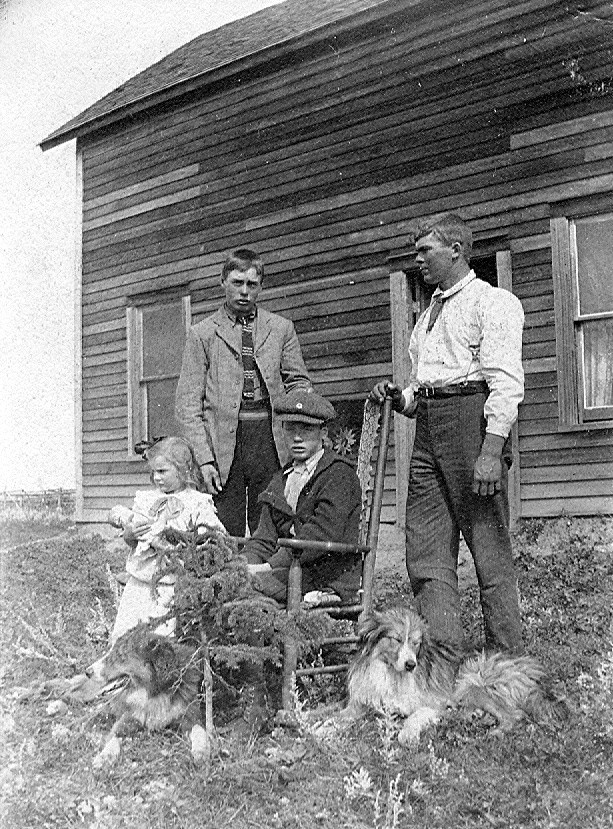
Charles Dyer (on right) in Canada (Courtesy of ancestry.co.uk)
John Thomas Harriss was born on 22nd February 1878, one of seven children to George and Mary. George was a jeweller, who moved the family from London to Weston-Super-Mare when John was three or four years old.
Following in his father’s footsteps was not something John was going to do, and the move to the coast seemed to have sparked an interest in the sea. He enlisted for twelve years’ service in the Royal Navy in March 1900, working as a stoker.
After initial training at HMS Pembroke in Chatham, Kent, Stoker 2nd Class Harriss was assigned to HMS Terpsichore and, over the length of his service, he worked on a further ten vessels. During this time, he was promoted a couple of times, reaching the role of Leading Stoker by 1911, while he was serving aboard HMS Magnificent.
With war imminent, when John completed his period of service, his term was extended until the end of hostilities. He had, by the beginning of 1914, attained the rank of Stoker Petty Officer, and was assigned to HMS Russell.
After the start of the war, this ship was assigned to the Grand Fleet and worked on the Northern Patrol, and in November 1914, she bombarded German-occupied Zeebrugge. The following year, HMS Russell was sent to the Mediterranean to support the Dardanelles Campaign, though she did not see extensive use there.
On 27 April 1916 HMS Russell was sailing off Malta when she struck two mines laid by a German U-boat. Most of her crew survived the sinking, though 125 souls lost their lives. Stoker Petty Office Harriss was one of the survivors; his service records note that he was ‘commended for [the] great coolness shown on the occasion of the loss of HMS Russell’.
Brought back to the UK, John contracted pneumonia, and spent time at home with his family, in Weston-Super-Mare. It was here, sadly, that he was to succumb to the lung condition, and he passed away on 7th June 1916. He was 38 years old.
John Thomas Harriss lies at rest in Milton Cemetery in Weston-Super-Mare.
Arthur George Poole was born in Brislington, Somerset, in April 1893. His father, George, was a master builder, and with his mother, Rhoda, the family raise their five children in the Bristol suburb.
Arthur was obvious a bright lad; he attended the Bristol Grammar School, excelling at football, hockey and cricket. After finishing school, he joined a firm of Bristol solicitors and was also appointed secretary of the Bristol Law Society. He went on to continue his studies, when he was accepted to read law at Emmanuel College, Cambridge.
The war was on the horizon, however, and he was called upon to do his duty.
He joined Bristol’s Own (12th Gloucester Regiment) in 1914, and was musketry officer at Chiseldon for some months before going to France in 1915, where he was attached to the 6th Gloucester Regiment.
Within three months he had a severe attack of trench fever, and was home on sick leave for a few weeks. He was severely wounded in October 1917, and came back to England for good. Some months later he was mentioned in despatches. He spent a year in hospital, and although not discharged, was allowed to resume his law studies.
Gloucestershire Echo: Saturday 14th December 1918
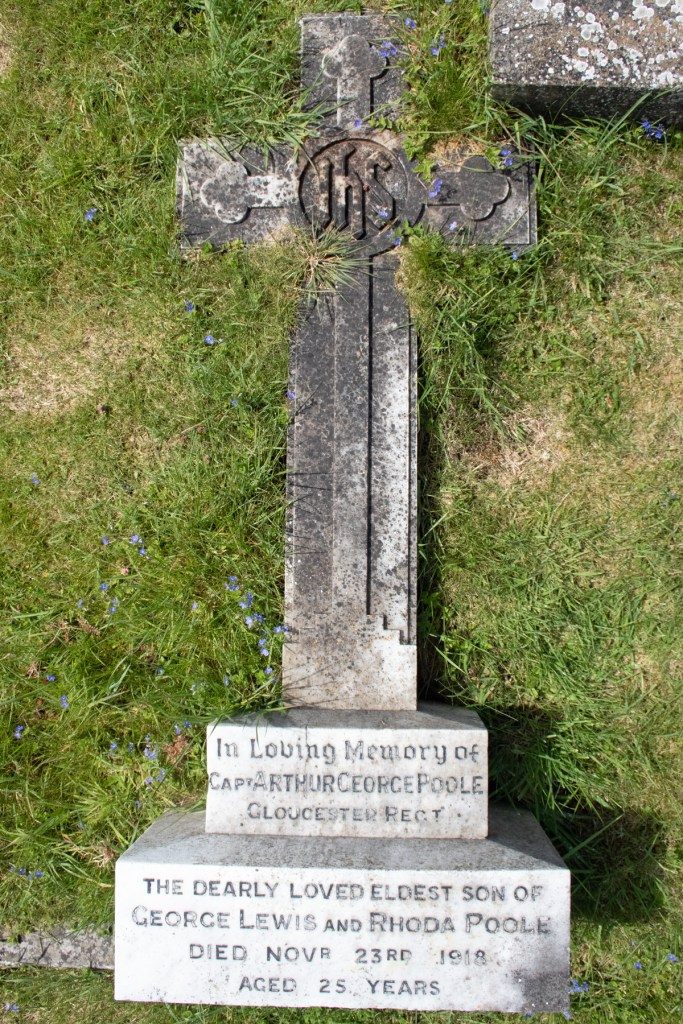
While in hospital, Captain Poole contracted influenza, which then became pneumonia. Although recovering from his injuries, it was these conditions that were to get the better of him, and he passed away on 23rd November 1918, at the age of 25 years old.
Arthur George Poole was laid to rest in the pretty graveyard of St Andrew’s Church in Clevedon, Somerset, where his parents now lived.
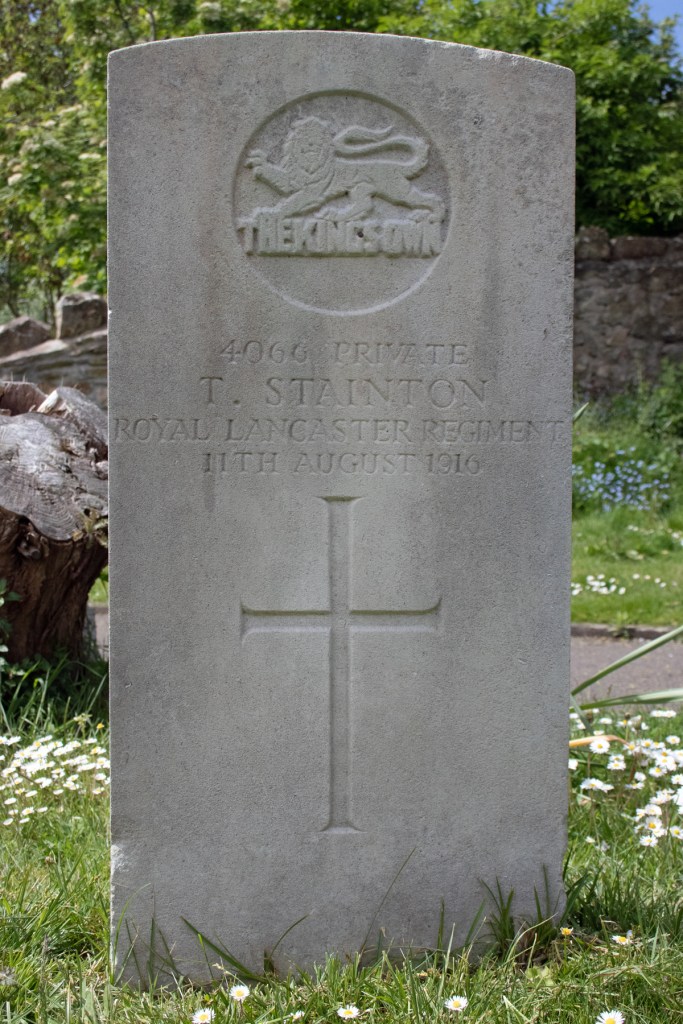
John Stainton was born in the Cumbrian village of Ambleside in January 1871. He was one of seven children to George and Mary Stainton, a labourer and his wife. John followed in his father’s footsteps as a labourer, as they took him to where the work was – by the time John was ten, the family were living in Barrow-in-Furness.
The 1911 census found John married to a woman called Mary. The couple wed in 1909 and were boarding with Maybrooke Cole, a fellow labourer, and his family.
The next record for John comes in the form of his enlistment papers. He joined up on 31st August 1914, but the document throws up a couple of anomalies.
To the question “Are you married?” John marked “No”. The fact that he didn’t confirm he was a widower presents more questions than answers.
The document also confirms that he has previous military experience. He served with 2nd Battalion King’s Own (Royal Lancaster Regiment), which fought in the Second Boer War, and was involved in Battle of Spion Kop in January 1900.
John re-enlisted in the same battalion on 31st August 1914, and remained part of a territorial force for the best part of a year. It was during this time that he married Rhoda Selina Cooper. She was born and brought up in Clevedon, Somerset, and it can only be assumed that John was stationed in the county at this time.
Private Stainton seemed to have a bit of a rebellious streak, and his service records identify three times when he was pulled up for dereliction of duty. In December 1914, he was admonished for overstaying his leave pass; in June 1915 he was reported for being absent from the base; a year later, he was admonished again, this time for losing a pair of handcuffs.
The battalion were sent to France in July 1915, and, in the end, Private Stainton served on the Western Front for just over a year. On 27th July 1916, he was sounded by shrapnel in the right shoulder, face and thigh, and was evacuated back to England for treatment. Admitted to the English General Hospital in Cambridge, sadly his wounds proved too much for him. Private Stainton died on 11th August 1916, at the age of 45 years old.
John Stainton’s body was brought back to his widow; he lies at rest in the picturesque churchyard of St Andrew’s in Clevedon, Somerset.
The Commonwealth War Grave for John Stainton incorrectly gives his name as T Stainton.
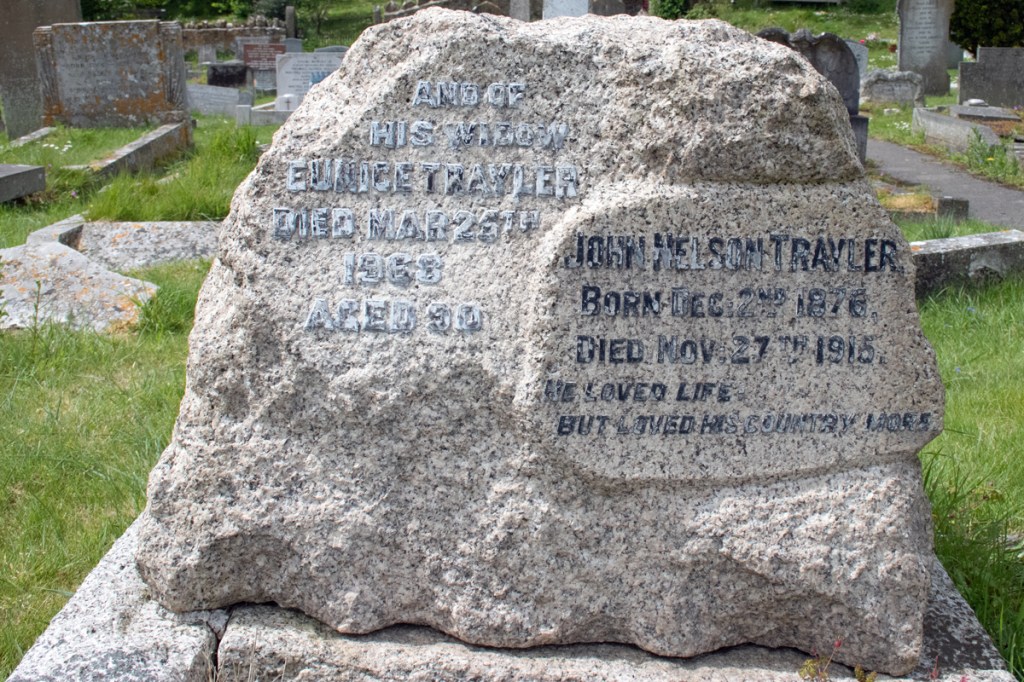
John Nelson Trayler was born on 2nd December 1876, the oldest of seven siblings. His father, Jonas Trayler, was born in London, but moved to South Wales to become a farmer. He married Elizabeth Green, who was from Haverfordwest, and John was their eldest child, born in Pembrokeshire.
In December 1895, having just turned 19, John joined the 1st Devonshire Volunteer Corps. He seemed eager for a life of action; given that the 1901 census lists his profession simply as ‘farmer’s son’, it’s easy to see why. By this time, the family had moved to a farm in Broadclyst, to the north east of Exeter in Devon.
There was a change of direction for the family, however. By 1908, both father and son were working as tanners; John had moved back to Wales, while Jonas had set up work in Bridgwater, Somerset.
John, by this time, had met Eunice Sully; she was the daughter of a gentleman, and her family lived in Wembdon, near Bridgwater. They married in July 1908, and lived in the village of Lamphey in Pembroke.
John was, by now, the managing director of a tannery and obviously had the business acumen to run a company. He joined the local freemason’s – the Lodge of Perpetual Friendship – but, in January 1914, it was reported in the local newspaper that the business was to be voluntarily wound up.
John’s father Jonas was also forging ahead with his ambitions, and was a councillor for the Bridgwater area.
When the Great War broke out, John’s time with the Devonshire Volunteer Corps was such that he had attained the rank of Captain. Assigned to the 11th (Reserve) Battalion, John was based out of Exeter and it is unlikely that he saw any active service in France.
In August 1915, the Exeter and Plymouth Gazette reported that Captain Trayler had relinquished his commission on account of poor health, and this seems to have been an ongoing issue. In fact, when he was staying with Eunice’s parents in Clevedon later that year, he fell seriously ill. While his medical condition is lost to time, sadly it was one he succumbed to. He died at his in-laws’ house on 27th November 1915, at the age of 39 years old.
John Nelson Trayler was laid to rest in the picturesque graveyard of St Mary’s Church in Clevedon, Somerset.
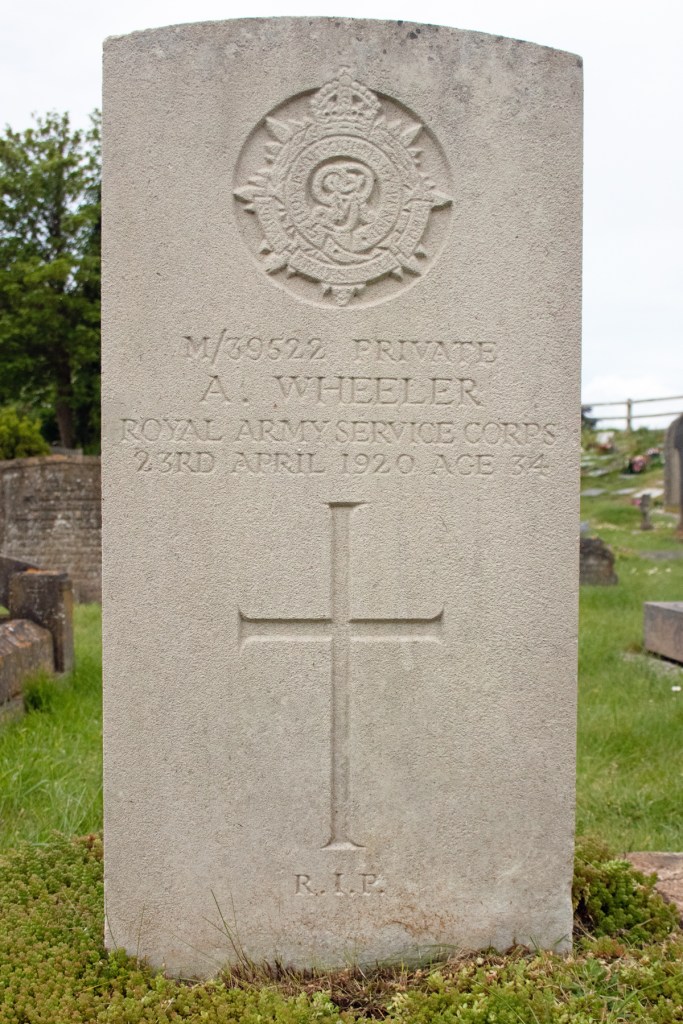
Alfred Wheeler was born in Binstead, on the Isle of Wight, in the summer of 1886. One of three children, his parents were John, a labourer from the Isle of Wight, and his wife Emily.
When he left school, Alfred found work at the London City Mission in Ventnor. By this point, tragically, both of his parents had passed away, and the young siblings were finding their own ways in life.
The 1911 census found Alfred living with his uncle back in Binstead. His trade was given as a Motor Car Driver for the local Carriage & Motor Works; while he was obviously brought up with a spiritual side, he seems to have had a sense of adventure too.
When war broke out, Alfred was keen to do his bit. He enlisted in the Gloucestershire Regiment and was attached to the 1st Battalion. Sent to France within weeks of the war commencing, Private Wheeler was awarded the Victory and British Medals and the 1914 Star.
With his background with cars, Alfred subsequently transferred over to the Royal Army Service Corps in the 615th Motor Transport Company. While full dates are not readily available, the 615th were formed in January 1916, so it was likely after this that Private Wheeler moved across. The company were based in Dublin, and it was in Ireland that he saw out the remainder of the conflict.
On 11th July 1919, Alfred married Rose England. She was the daughter of an organ tuner from Bristol, although there is no obvious connection to Clevedon for him. It seems likely, therefore, that the couple may have met around through the church, possibly as Private Wheeler was travelling between Ireland and Hampshire.
Alfred wasn’t demobbed as soon as the war ended, remaining part of the Royal Army Service Corps through until 1920. It was while he was in Ireland that he contracted influenza. Admitted to hospital in Dublin, he sadly succumbed to the condition on 23rd April 1920. He was 34 years old.
Alfred Wheeler’s body was brought back to England. He lies buried in St Andrew’s Churchyard in Clevedon, Somerset.
William John Neads was born on 16th December 1892, the middle of three children to cab driver and groom William Neads and his wife Ellen. Both William Sr and Ellen were from Somerset, although William Jr and his brother Charles – who was eleven months older – were both born in the Monmouthshire village of Cwmcarn.
William’s parents soon moved the family back to Clevedon in Somerset, and, when he left school, he found work as a farm labourer. He was eager to see more of the world, however and, in April 1913, he emigrated to Canada.
After working as a labourer there for a year or so, back in Europe war was declared. Keen to do his bit for King and Country, William enlisted in the 1st Battalion of the Canadian Infantry in January 1915. He soon found himself caught up on the Front Line.
In October 1916, he was involved in the Battle of the Somme – either at Le Transloy or The Battle of the Ancre Heights – and received a shrapnel wound to his left shoulder. Initially admitted to the Canadian General Hospital in Etaples, he was subsequently evacuated to England and the Northern General Hospital in Leeds. He spent three months recovering from his injuries, and was back on the Western Front in January 1917.
Later that year, William – now a Lance Corporal – was involved in the fighting at the Second Battle of Passchendaele (part of the Third Battle of Ypres). He was wounded again, this time receiving a rather unceremonious gunshot wound to the right buttock. Treated at the scene, he was evacuated back to England and admitted to the Fusehill War Hospital in Carlisle on 17th November.
Sadly, despite treatment, Lance Corporal Neads’ health deteriorated, and he passed away from his injuries on 16th December 1917, his 25th birthday.
William John Neads was brought back to his family’s home of Clevedon, and buried in the clifftop churchyard of St Andrew’s, overlooking the sea.
Tragically, William’s father had died in May 1917, at the age of 51. While no details of his passing are recorded, it meant that Ellen had, in just over a year, seen her son wounded, her husband die and her son wounded again and die as a result.
Bertram Noel Coates was born in the sleepy Somerset village of Walton-in-Gordano in the spring of 1890. He was the middle of three children to Herbert and Florence Coates. Herbert was a solicitor, and clerical work seemed to have been in the Coates blood.
While he did not follow in his father’s exact footsteps, by the time of the 1911 census, Bertram had found work as a bank clerk, and was boarding with his employer, James Barry, in Chipping Sodbury, Gloucestershire.
Bertram was obviously made very welcome in Chipping Sodbury, as, on 27th May 1914, he married his employer’s daughter, Mary Barry. The couple would go on to have a daughter – Eileen – who was born in February 1916.
By the time of his wedding, Bertram had moved to London, and was working as a bank clerk in South Woodford, so was obviously showing an ambitious streak.
War was beckoning, however, and in December 1915, Bertram enlisted. Placed in the Army Reserve, he was finally mobilised in January 1917, and assigned to the 28th Battalion of the London Regiment, which was also known as the Artists Rifles.
Tragically, Private Coates’ military service was to be a short one. While training, he contracted measles, which turned septic with additional complications. He sadly passed away on 31st March 1917, less than three months after being mobilised. He was just 27 years old.
Bertram Noel Coates was brought back to Somerset. He lies at peace in the churchyard of St Mary’s in Walton Clevedon, near his parents’ home in Somerset.










 Death and Service