Category Archives: story

Private Bertie Parsons

Private Bertie Parsons

Bertie James Parsons was born in the summer of 1889, and was the fourth of six children to James and Elizabeth Parsons. James was a quarryman and slate-maker from Somerset, and he and Elizabeth raised their family in the parish of Ashbrittle.

While his older siblings found farm work in this peaceful part of the county, Bertie found employment as a baker’s assistant. This meant a move away from Somerset, and, by the time of the 1911 census, he was apprenticed to a bakery in the Crediton area of Devon.

The following year proved a tragic one for the Parsons family. Bertie’s younger brother, Richard, had found work as a hall boy for an estate in Wheathampstead, Hertfordshire. This was to prove a springboard for him, and he landed work for one of the new class of liners ploughing the waters of the Atlantic. Employed as a 2nd Class Steward, he was employed on the RMS Titanic and, like most of the ship’s 900 crew, he perished on that fateful night of 15th April 1912.

Among the large number of souls who perished with the Titanic recently we regret to report that among that number was a young man named Richard Parsons, aged 18, a native of Ashbrittle, and whose relatives still live in the neighbourhood, his father, James Parsons, being an invalid.

The deceased, who a couple of years ago embarked on a seafaring life, was on board the Olympic when it collided with the Hawke, and he left his home about a month ago, and journeyed to Belfast to assist in getting the Titanic ready for her maiden voyage.

He was particularly pleased at being appointed to a post on the largest ship in the world.

Deceased, who was a bright lad and much respected in the village, occupied the position of lift steward on his previous boat, and on the Titanic was a steward in a second-class dining saloon.

He was unable to swim.

Somerset County Gazette: Saturday 27th April 1912

Steward 2nd Class Richard Parsons

Back in Devon, Bertie was still working as a baker. When war came to Europe, however, he stepped up to play his part. While full service details are not available, it is clear that he enlisted in the Royal Army Service Corps as a Private. He was attached to the 2nd/1st Wessex Field Ambulance, who were sent to France in January 1916.

Private Parsons saw action – or helped treat the results of it – at some of the key battles on the Western Front: the Somme, Ypres, Cambrai, Givenchy and Festubert. In the autumn of 1917, Bertie returned home to marry Florence Riddaway, a milliner from Bow, Devon, who he had courted while working in nearby Crediton. The couple went on to have a son, Douglas, who was born on 26th May 1918.

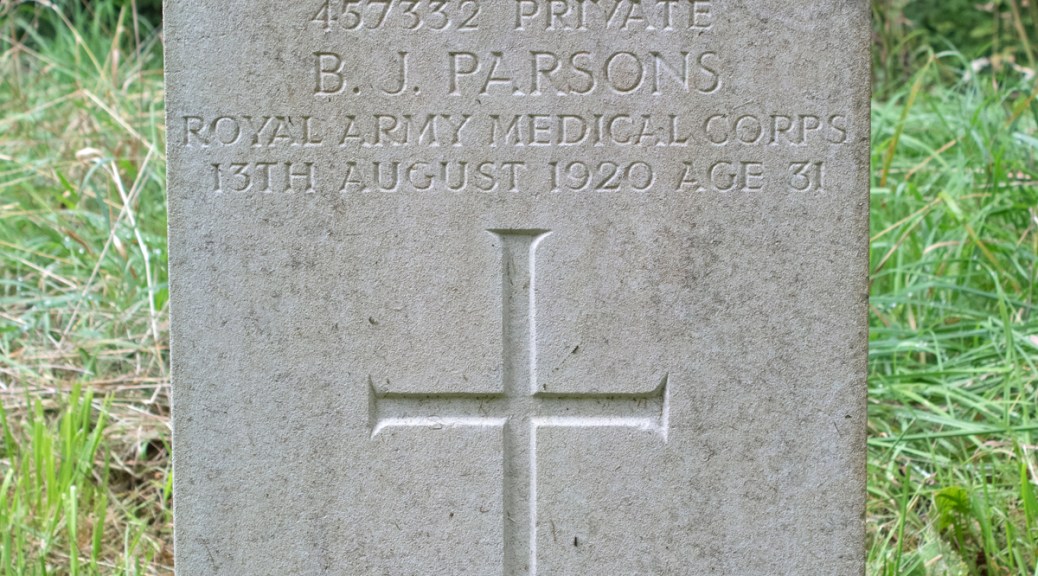
It is unclear how long Bertie remained in the army after the Armistice was signed. By the summer of 1920, he was back on British shores, and had fallen ill. He was admitted to hospital in Bath with acute staphlococcic infection and a cerebral embolism. He died in hospital on 13th August 1920, at the age of 31 years old.

The body of Bertie James Parsons was taken back to Ashbrittle for burial. He was laid to rest in the village’s St John the Baptist Churchyard.


Tragedy was to remain close by for the Parson family. Florence was a couple of months pregnant when Bertie died. Bertie Jr was born on 26th March 1921, but both mother and son died during childbirth. They were laid to rest near her family in Devon.


Douglas, just two years old, was now an orphan. There is little information about his life in the aftermath of his parents’ passing, but by the time of the 1939 Register, he was working as a motor mechanic in Wellington, Somerset. He lived on until 1993, passing away in Taunton Deane, at the age of 74.

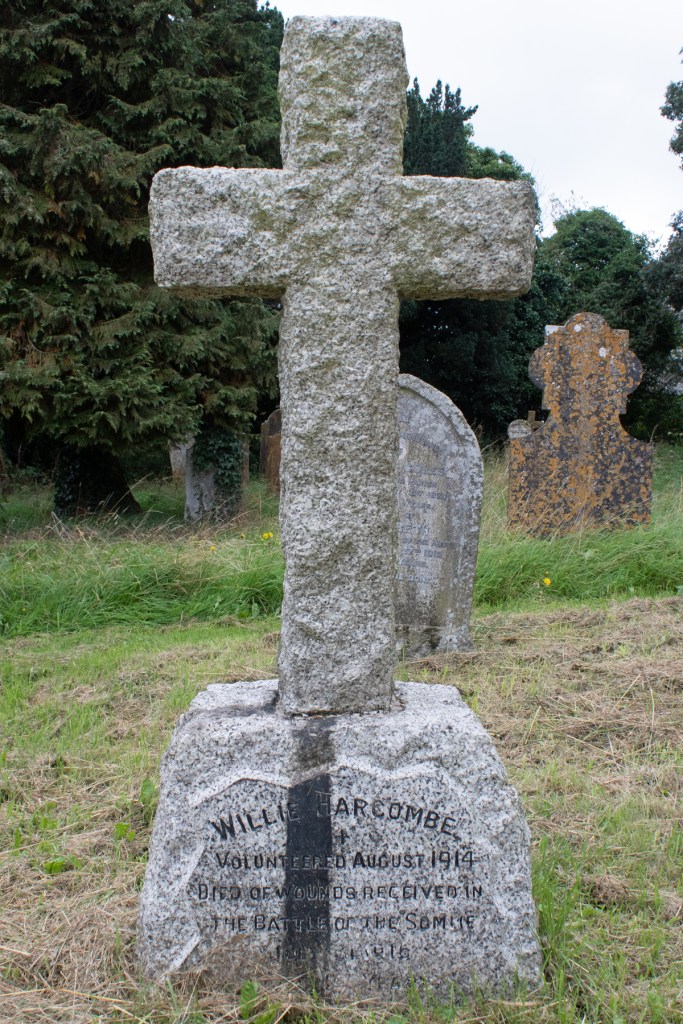
Private William Harcombe

Private William Harcombe

William Harold Harcombe was born on 25th September 1897 in Sampford Arundel, Somerset. One of twelve children, his parents were William and Jane Harcombe. William was an agricultural engine driver who, by the time of the 1911 census, had moved the family five miles north west to Ashbrittle.

When war came to Europe, William was one of the first to enlist, joining the Devonshire Regiment in August 1914. He was assigned to the 8th Battalion, and after nine months’ training, he found himself in Northern France.

Private Harcombe’s troop was involved in some of the fiercest skirmishes of the conflict, at Loos in the autumn of 1915, and at the Somme the following year. It was during this battle – probably at Delville or High Wood – that he was injured.

William was medically evacuated to Britain for treatment, and was admitted to a military hospital in Mile End, London. His injuries were to prove too severe, however, and he succumbed to them on 31st July 1916: he was just 18 years of age.

The body of William Harold Harcombe was brought back to Somerset for burial. He was laid to rest in the tranquil graveyard of St John the Baptist Church in Ashbrittle.


Corporal Herbert Wear

Corporal Herbert Wear

Herbert Francis Wear was born in the summer of 1895, one of twelve children to Charles and Harriet Wear. Charles was a farmer from Congresbury, and when he died in 1907, aged just 51 years old, it fell to Harriet and her children to keep the farm running.

At this point, however, much of Herbert’s trail goes cold, and it is a challenge to piece together anything concrete. When war broke out, he stepped up to play his part, enlisting in January 1917. He was assigned to the Military Police Corps and initially served in the Military Foot Police.

However, at some point during the conflict, Corporal Wear transferred to the Labour Corps, where he was attached to the 449th Agricultural Company. This meant he remained relatively close to home, as he was based in the Taunton area of Somerset.

The next record for Herbert is the British Army Register of Soldiers’ Effects, which confirms that he passed away in Somerset. An entry in the Bristol Times and Mirror (Wednesday 4th December 1918) states that “The funeral of the late Lance-Corporal HF Wear, Stonewell Farm, Congresbury, will take place to-day… 2:30pm.”

Herbert’s death certificate confirmed that he died at home from a combination of influenza and pneumonia. He was 23 years of age when he breathed his last.

Herbert Francis Wear was laid to rest close to his father in the graveyard of St Andrew’s Church in Congresbury.


Private George Stevens

Private George Stevens

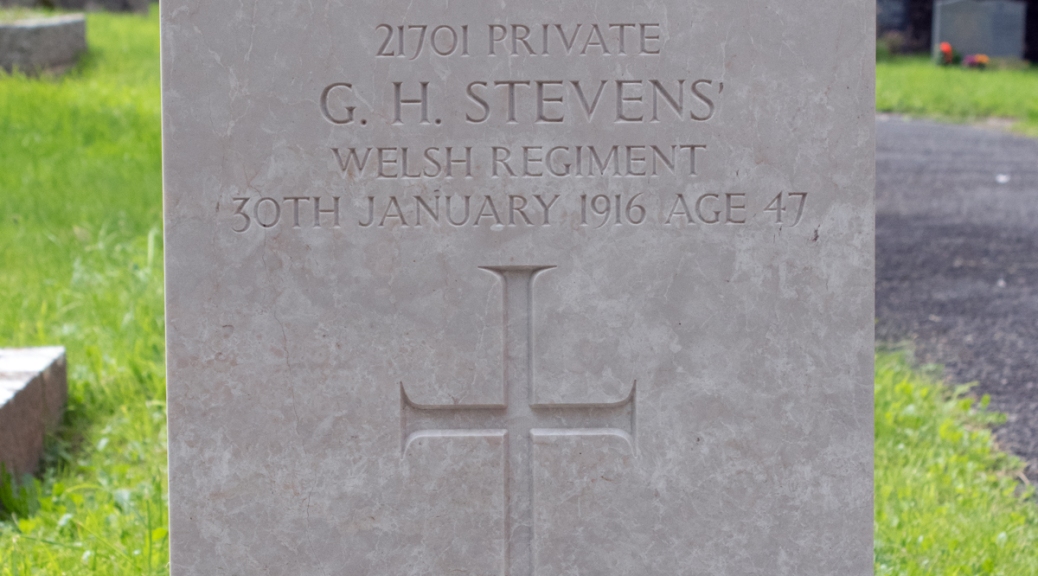
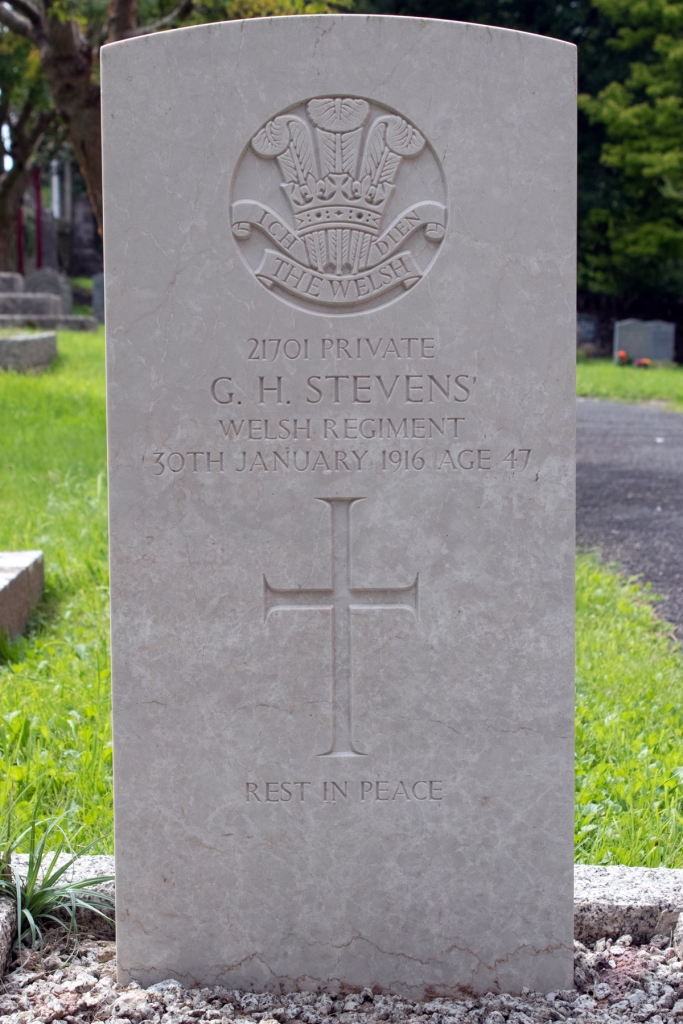
George Henry Stevens was born in Winscombe, Somerset, in the spring of 1869. The oldest of four children, his parents were blacksmith Joseph (or John) Stevens and his wife, Eliza.

When he finished his schooling, George found work as a collier. In 1893, he married a woman called Maria, and went on to have three children: Edward, Mary and Charlie. By 1900 the family had moved to South Wales for his work. They settled in Llanwonno, Glamorganshire, and went on to have three more children: John, Cyril and George Jr.

By 1911, George and Maria had been married for eighteen years. George was working as a repairer for the colliery, while Edward had followed his father into the mines.

When war came to Europe’s shores, George stepped up to play his part. He enlisted in the Welch Regiment, and was assigned to the 1st/5th Battalion. While his full service records no longer exist, his troop served in Gallipoli during 1915, so it is possible that he spent times overseas.

By January 1916, however, Private Stevens was back in Britain, and had become unwell. Again, little specific information remains, but he passed away on 30th January 1916, having fallen into a diabetic coma. He was 47 years of age.

George Henry Stevens was brought back to Somerset for burial. He was laid to rest in the graveyard of Holy Trinity Church in Cleeve, where Maria had moved back to with the family when her husband went to war.


Private Frederick Hopkins

Private Frederick Hopkins

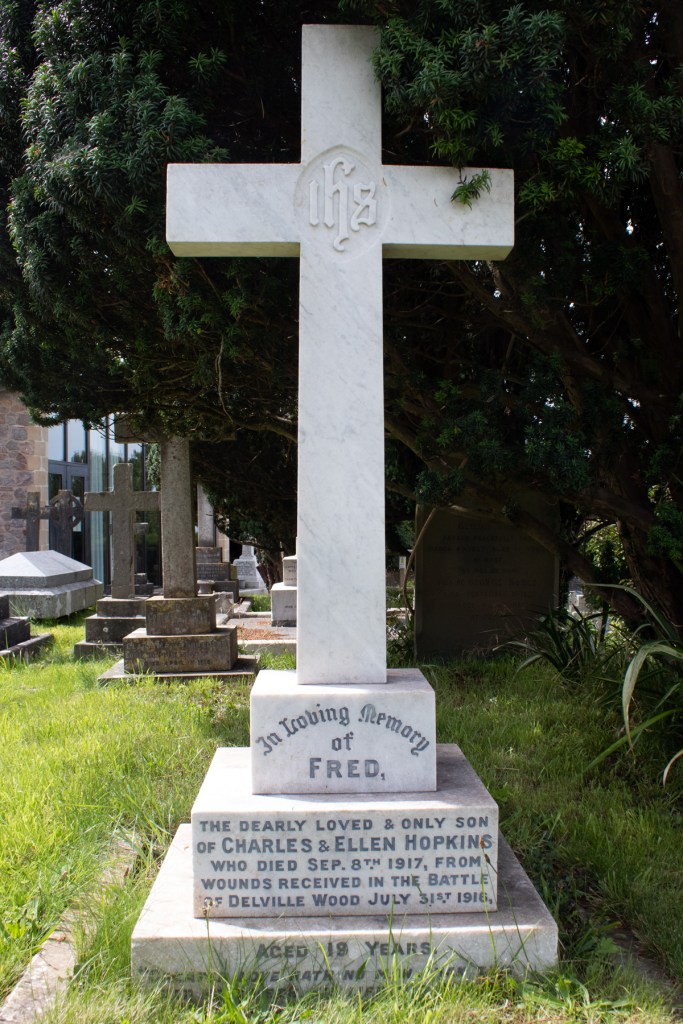
Frederick Charles Hopkins was born in the spring of 1898 in the sleepy Somerset village of Hinton Charterhouse. The younger of two children, his parents were Charles and Ellen Hopkins. Charles was a gardener who, not long after the 1911 census, moved the family west, to the village of Backwell.

When Frederick finished his schooling, he found work as a porter. When war broke out, however, he was keen to play his part, and enlisted at the end of December 1914. His service records note that he was 5ft 4ins (1.63m) tall, and that his apparent age was 19 years and one month. This highlights Frederick’s keenness to fight, as he was actually over two years younger than this at the time he signed the paperwork.

Private Hopkins was attached to the Gloucestershire Regiment, and assigned to the 12th (Service) Battalion. After his initial training on Salisbury, his troop was sent to the Western Front on 21st November 1915.

Frederick would have been involved in a number of the key skirmishes at the Somme, in July 1916, including at Albert and Bazentin. An epitaph on his gravestone suggests that he was injured at Delville Wood, although while his battalion was not actually involved in that specific battle, it is likely that he was injured at around the same time.

Wherever he was wounded, Private Hopkins was sent back to Britain. His service records suggest that he was transferred to the regimental depot but by July 1917, he was medically discharged from the army as being no longer fit for active service.

At this point, Frederick’s trail goes cold. He passed away on 8th September 1917, aged just 19 years old. He was buried in the peaceful St Andrew’s Churchyard in his adopted home village of Backwell.


Private Hamlyn Perham

Private Hamlyn Perham

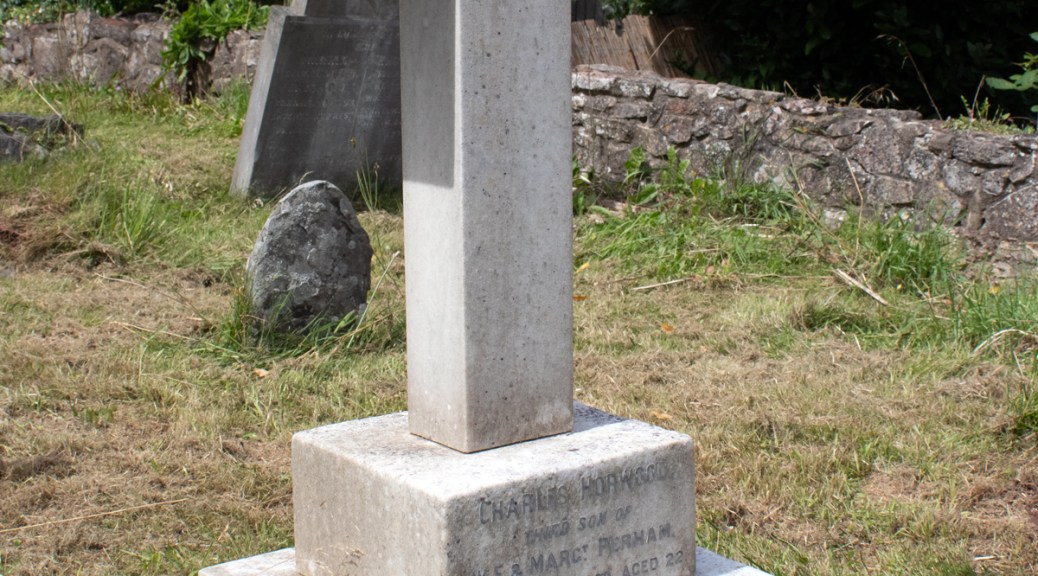
Hamlyn Horwood Perham was born in the autumn of 1872, one of seven children to William and Margaret. William was a solicitor from Wrington in the north part of Somerset, but it was in the village of Flax Bourton that the family settled.

Expectations were high for Hamlyn, who was the Perhams’ oldest son: the 1881 census found him boarding as a student in a private school in Weston-super-Mare. Ten years later, he was back home, but listed as a law student. The 1901 census recorded him as living with his family, but a practicing solicitor, presumably alongside his father (who, the document notes, was a solicitor and a Lieutenant Colonel in the Somerset Light Infantry).

Colonel WE Perham, the commanding officer of the 3rd Volunteer Battalion Somerset Light Infantry, had just been retired, after a connection with the corps dating from the year 1861, when he joined as a private. His retirement will occasion within the regiment universal regret, for he deservedly held the esteem and respect of all ranks. That Colonel Perham was well qualified to command is shown by the high state of efficiency in which he leaves the 3rd Battalion. He had taken the higher examinations, and in tactics passed with distinction. An officer who has worked through all grades from private to commander should, indeed, be a practical administrator and leader, and Colonel Perham was essentially both, and his knowledge of military matters singled him out for the important divisional and other commands. Latterly he was foremost in organising officers’ rides through the West Country – an instruction much valued at the War Office.

Somerset Standard: Friday 15th February 1907

The next census, taken in 1911, found Hamlyn still living with his parents and older sister. The family were supported by three live-in staff: a cook, a parlour maid and a housemaid. Hamlyn’s younger brother, Herbert, had also followed their father into law and, according to the same census, had set up a practice in Nailsea, where he lived with his wife of three years.

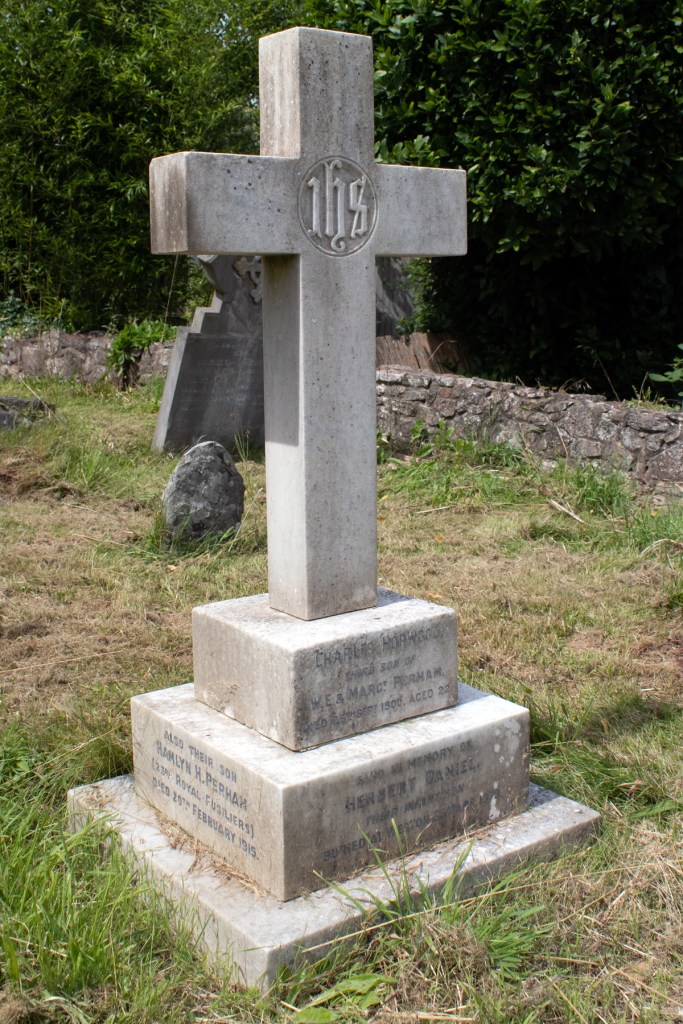
When war came to Europe, Hamlyn quickly stepped up to play his part. He enlisted in the Royal Fusiliers as a Private, and was assigned to the 23rd Service Battalion, also known as the 1st Sportsmen’s. Based at a camp in Hornchurch, Essex, Private Perham’s service was not to be a long one. He contracted meningitis, and was admitted to the South Western Hospital in Southwark. Sadly, the condition was to get the better of him: he died in hospital on 20th February 1915, at the age of 42 years old.

Hamlyn Horwood Perham’s body was brought back to Somerset for burial. He was laid to rest in the family plot in St Michael’s Church, Flax Bourton.


Serjeant George Vowles

Serjeant George Vowles

George Joseph Vowles was born in Winsley, Wiltshire, on 18th September 1881. The older of two children, his parents were Joseph and Sophia Vowles. Joseph was an agricultural labourer from Bedminster, who was 46 when his son was born, and twenty years older than his wife. By the time George’s sister was born, in 1890, the family had moved west, and had settled in Wraxall, near Nailsea in Somerset.

George found work as a gardener when he finished his schooling, but he had his sights set on bigger and better things. Sophia had died in 1894 and on 21st March 1900, he enlisted in the Royal Marine Light Infantry. His service records show that he was 5ft 6ins (1.68m) tall, with light brown hair, brown eyes and a fresh complexion. He was also noted as having a scar on the back of his neck.

For the next ten years, George seemed to flourish, serving on a number of ships, including HMS Niobe and HMS Andromeda. In between voyages, he was based at the RMLI depot in Plymouth. During this time he was promoted twice, to the rank of Corporal in September 1902 and Serjeant five years later.

Serjeant Vowles’ contract of service ended in 1911, but with his father now also having passed, he was re-engaged. He continued to make great strides, and, as war broke out, served on HMS Medea and HMS Theseus.

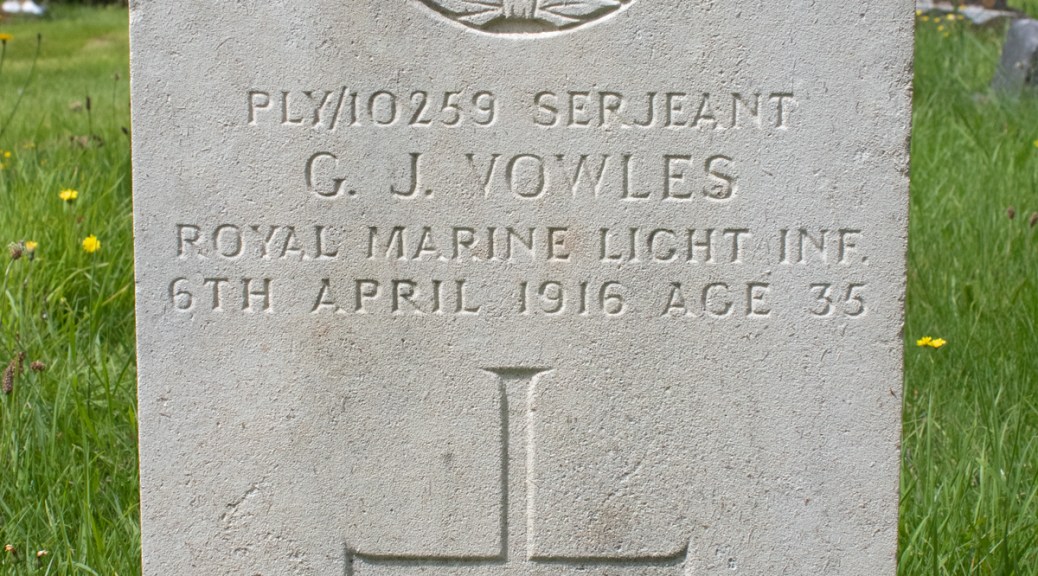
George’s service was cut short in the spring of 1916. Based back at the Plymouth Depot at the time, he fell ill with pulmonary tuberculosis. Sadly, the condition was to get the better of him, and he passed away on 6th April 1916, at the age of 35 years old.

George Joseph Vowles’ body was brought back to Somerset for burial. He was laid to rest in the graveyard of All Saints’ Church in Wraxall, alongside his parents, and not far from where his now-married sister, Dorothy now lived.


Driver Albert Partridge

Driver Albert Partridge

Albert Victor Partridge was born in the spring of 1885, in the north Somerset village of Abbots Leigh. The younger of two children, his parents were agricultural labourer James and his laundress wife, Elizabeth.

The family don’t appear on any surviving 1891 census records, but by the next return in 1901, James had been widowed and was living with his two children in Wraxall, near Nailsea. James was working as a carter on a farm, while Albert was employed as a domestic gardener.

Ten years later, and James had also passed away. Albert was now head of the household, and was working as a carter as his father had. Emily was sharing the home, and was employed, in the terminology of the day, as her brother’s housekeeper.

When war broke out, Albert was called upon to play his part. Details of his service are scant, but he joined up as a Driver in the Royal Army Service Corps and was attached to one of the Horsed Transport units. It is unclear whether he served on the home front or overseas, but what records remain suggested that he had enlisted by November 1917.

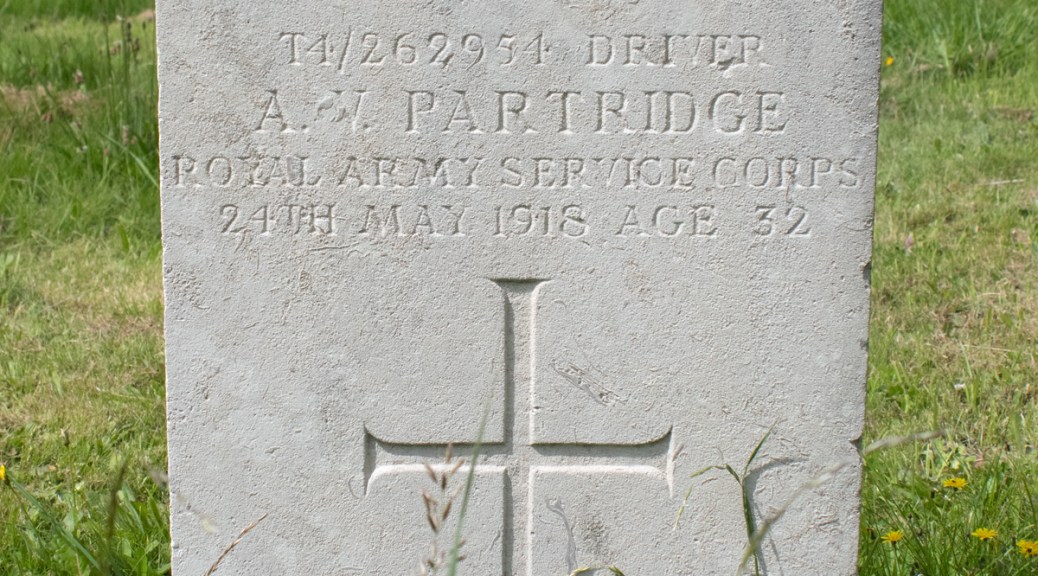
Driver Partridge was admitted to a hospital in London in May 1918. The only suggestion as to why comes through his Pension Ledger Card, which simply says ‘disease’. The condition was severe enough for him to pass away: Albert died on 24th May 1918, at the age of 32 years old.

Albert Victor Partridge was brought back to Somerset for burial. He was laid to rest in the peaceful grounds of All Saints’ Church in Wraxall.


Emily disappears from records at this point. She was 38 years old when her brother died, and it is unclear what became of her.


Private Albert Pearce

Private Albert Pearce

Albert Edwin Pearce was born on 12th November 1883 in Bristol. Gloucestershire. One of nine children, his parents were William and Mary Pearce. William was a farmer and grazier and, when he finished his schooling, Albert followed him into farm work.

In 1908, when Albert was 25, his older sister Olive was widowed: the following year, their mother, Mary, also passed away. Olive’s late husband had been a farmer in Tickenham, near Clevedon, and so Albert and his older brother Walter moved in with Olive and her four children to help run the farm.

When war came to Europe, Albert stepped up to play his part. Full service details are not available, he served with the Labour Corps. Attached to the 446th Agricultural Company, towards the end of the conflict, he seems to have been serving in the West Midlands.

By the autumn of 1918, Private Pearce was admitted to the Military Hospital on Dudley Road in Birmingham. Details of his condition are not available, but they were to take his life. He passed away on 19th November 1918: he had celebrated his 35th birthday just a week before.

Albert Edwin Pearce’s body was brought back to Somerset for burial. He was laid to rest in the quiet graveyard of St Peter & St Paul’s Church in Weston-in-Gordano. He was buried in the family plot, reunited with his mother: his father, William, would be interred there just five months later, when he died in April 1919.


Driver Reginald Langford

Driver Reginald Langford

Reginald Cuthbert Langford was born in Frome, Somerset, in the spring of 1899, the youngest of thirteen children to Albert and Charlotte Langford. Albert was a chalk seller turned jobbing gardener, who, by the time of the 1911 census, had moved the family to Bath.

Reginald appears to have helped his father with his work when he finished his schooling, but, during the First World War, he enlisted in the Royal Engineers as a Driver. His service records no longer remain, but a later newspaper report shed some light onto his time in the army: “[He] enlisted when he was just over 16, and went to the Wessex Engineers to Salonica. He returned to England and then went to France with the Glamorgan Engineers.” [Bath Chronicle and Weekly Gazette: Saturday 16th October 1920]

All did not fare well for Driver Langford: he contracted malaria and dysentery, and a combination of the conditions led to his ultimate discharge from the army. He left the Royal Engineers on 24th June 1919, and returned home to Somerset.

When he had recovered his health, Reginald took up employment as a gardener once more. On September 1920, he was in the employ of a Mr J Milburn, in Bath, when he felt a nail drive through his boot, scratching his foot. The following Tuesday, he visited his doctor – a Mr John Jarvis – complaining that his malaria had returned. According to a later inquest:

[He] did not make any mention of a wound in the foot. On Thursday, at about 10 o’clock, [Jarvis] was asked to go and see Langford, who was in bed. He was covered with a cold sweat, he could speak only with difficulty, and complained that he could not swallow anything, especially the medicine… His limbs were rigid, but he had not all the symptoms of tetanus. [Jarvis] decided to send Langford to the hospital at once, suspecting that he was suffering from tetanus. He did not know till later that there was an injury to [Reginald’s] foot.

Bath Chronicle and Weekly Gazette: Saturday 16th October 1920

Reginald’s landlady, Amelia Baily, also gave evidence at the inquest:

Langford had lodged with her for about nine months. His inly complaint was of his head when he had malaria… He came home saying his foot was sore and that he had thought it was gathering. He had hot water to soak it, and he did the same the next night, an afterwards sad it was alright… he went to work, but returned at dinner time again complaining of his head and perspiring terribly. He was ill and witness looked after him during the night. He complained of pains in the stomach and aid they were going up to the throat. Next morning [Amelia] sent for the doctor.

Questioned as to the injury to Langford’s foot, [she] said he told her he had a nail enter the toe while he was in the army, and that it was festering again. He wad worn the army boots up to just before he became ill, when he bought new ones.

Bath Chronicle and Weekly Gazette: Saturday 16th October 1920

Admitted to the Pensions Hospital, Bath, Reginald was to be there only one day. He passed away on 8th October 1920, aged just 21 years old. Medical evidence at the inquest diagnosed tetanus as the cause of his death, but Reginald’s older brother, George, contested this.

George’s challenge was that, having some medical background, he felt that his brother’s death was caused not by tetanus, but by malaria. He was a sufferer himself, and he knew the symptoms. He had examined Reginald’s body, and could not see how the small scratch on his foot could have induced tetanus to the extent of causing his brother’s passing.

The Coroner at the inquest, a Mr F Shum, declined George’s assertion, on the basis that separate medics had determined tetanus as the cause:

“It may not have been from the foot, but the evidence is clear. Dr Jarvis said he formed the opinion before any suggestion was made to him, that the man was suffering from tetanus. He saw the symptoms, and the man was brought here [to the Pensioner’s Hospital]. Two doctors saw him here and came to the same conclusion, and a medical specialist confirmed the diagnosis. Therefore, it is quite clear to me, and my verdict will be that he died from tetanus. It is a very unfortunate thing, and I am sorry for you.

Bath Chronicle and Weekly Gazette: Saturday 16th October 1920

George’s challenge was as much about the financial aspect as it was his late brother’s wellbeing. Had Reginald’s death been the result of malaria, it could have been attributable to his military service, and therefore any funeral costs – or at least a proportion of them – would have been paid for by the army. As the inquest had identified tetanus as the cause of his passing, however, the family would have to pay for the burial themselves.

Following the inquest, Reginald’s funeral was held: he was laid to rest in the sweeping Locksbrook Cemetery, Bath, not far from where his bereaved family still lived.


There are two other intriguing aspects of Reginald’s case.

The first is that of his being awarded a war grave. Amongst other criteria, which can be seen here, the Commonwealth War Graves Commission (CWGC) are responsible for the commemoration of personal who died after they were discharged from a Commonwealth military force, if their death was caused by their wartime service.

Based on the inquest, Reginald’s passing was clearly not – the tetanus having come on after his medical discharge for malaria and dysentery. Technically, therefore, his should not be designated a war grave.

The second confusing thing is that of the date on Reginald’s headstone. The CWGC headstone gives the date of his death as 13th October 1920, as do his grave registration documents. While newspaper reports are not always a reliable source of information, the first media report of the inquest came on Tuesday 12th October.

The Bath Chronicle and Weekly Gazette article confirms that Dr Jarvis’ visit to Reginald was on Thursday 7th October. He was admitted to hospital straight away, “where he died the following day” [Bath Chronicle and Weekly Gazette: Saturday 16th October 1920]. This would suggest that Reginald died on Friday 8th October.

While the newspapers do not confirm the date of the inquest, it is likely to have been held soon after Reginald’s passing. The date provided by the CWGC, therefore, looks to be either that of the conclusion of the inquest, or of Reginald’s burial.