Thomas Clarke was born on 18th July 1893 in the Cheshire town of Altrincham. The second of nine children, his parents were Irish-born couple Thomas and Mary Clarke. Thomas Sr worked in the building trade as a bricklayer, but, by the time of the 1911 census, his older children had found other trades. His oldest child, Nora, was a shop assistant, Thomas Jr was a shorthand typist, while the next two Clarke children worked in the printing industry.
Thomas Jr, however, wanted to see the world and, on 3rd October 1911, he took his first step towards that aim, enlisting in the Royal Marine Light Infantry. His service records note that he was 5ft 6ins (1.68m) tall, had blue eyes, fair hair and a fresh complexion. They also record a scar on his left hand and a tattoo on his right arm.
Private Clarke was first sent for training in Deal, Kent, and his swimming ability tested there on 6th December, presumably in the freezing English Channel. In August 1912 he moved to barracks in Portsmouth, Hampshire. Over the next couple of years, he served on two ships – HMS Prince of Wales and HMS Dido – returning to the Royal Naval Dockyard in Portsmouth after each assignment.
In July 1914, Thomas was assigned to the battleship HMS Bulwark. The ship patrolled the English Channel when he first came on board. By that autumn, however, she had moved to North Kent, guarding the waters around the Isle of Sheppey against potential German invasion.
Thomas was on board Bulwark on the morning of 26th November 1914, when an explosion ripped through the ship and sinking it. More than 740 lives were lost, Private Clarke among them. He was just 21 years of age.
Thomas Clarke was laid to rest in a marked grave in Woodlands Cemetery, Gillingham, not far from a mass grave where scores of his colleagues had been buried.
Note: While Thomas’ surname is spelt Clark on his headstone, all documents relating to him – and the Commonwealth War Graves Commission website – give the correct spelling as Clarke.
Daniel Johnson was born in Dingle, County Kerry, Ireland, on Christmas Day 1883, one of nine children to John and Ellen Johnson. John was a general labourer in the town, but while he initially followed suit, his son was destined to see the world.
On 3rd April 1903, Daniel joined the Royal Navy as a Stoker 2nd Class. His service records show that he was 5ft 7ins (1.70m) tall, with auburn hair, grey eyes and a sallow complexion.
Stoker Johnson was initially sent to HMS Vivid – the Royal Naval Dockyard in Devonport – for training. He was given his first posting in December, and was assigned to the battleship HMS Empress of India. She was to be his home for the next fifteen months.
In February 1905, Daniel was moved to another battleship, HMS Hannibal. Over the next eight years, he would go on to serve on six further vessels. His conduct was noted as Very Good throughout his time in the Royal Navy, and this was matched with the promotions he received. In July 1906, while on board HMS Suffolk, he was given the rank of Stoker 1st Class, and four year later, while serving on HMS Commonwealth, he was promoted to Leading Stoker.
In between voyages, Daniel’s base was HMS Vivid, but in February 1913, he was assigned to HMS Victory – the Royal Naval Dockyard in Portsmouth, Hampshire. He had been serving for ten years by this point, and his records hint at the man he had become. His height was now 5ft 10ins (1.78m), his hair recorded as dark brown and his complexion was noted as being fresh.
On 16th April 1913, Daniel seems to have been assigned to the Northern Irish Inniscrone Battalion, remaining with them for some fifteen months. Based at Inniscrone (now Enniscrone, Co. Sligo), this posting seems to have been with the Coastguard, patrolling the western coast of Ireland.
August 1914 saw Leading Stoker Johnson return to the Royal Navy. He was assigned to the battleship HMS Bulwark, which patrolled the English Channel when he first came on board. By that autumn, however, she had moved to North Kent, guarding the waters around the Isle of Sheppey against potential German invasion.
Daniel was on board Bulwark when, on the morning of 26th November 1914, an explosion ripped through the ship, tearing it apart and sinking it. In all 741 souls were lost, Leading Stoker Johnson among them. He was just 30 years of age.
The majority of those who died in the explosion aboard HMS Bulwark were buried in a mass grave in Woodland Cemetery, Gillingham, Kent. Daniel’s body, however, was not recovered until 24th January 1915, some two months after the explosion.
The sixteenth inquest on the victims of the Bulwark disaster was held at Chatham Naval Hospital on Monday. A body clothed in the dress of a patty officer was identified as that of Thomas Henry Treacher, who was a gun-layer. Two stokers were identified by marks on their clothing as Daniel Johnson, of Blackfields, Co. Kerry. and Edward Henry Buckingham of Nunhead, London, and an able seaman’s body proved to be that of John Griffin, of Kilrush, Co. Clare. The jury returned a verdict of accidental death in each case. Twenty-five bodies have now been recovered.
Westerham Herald: Saturday 30th January 1915
Daniel Johnson was laid to rest in a marked grave in Woodlands Cemetery, not far from his fellow servicemen.
Interestingly, the Coastguard station at Enniscrone would feature in history again a few years after Daniel’s death. Based next to the town’s pier, it was manned by up to five guards and was home to them and their families.
The coastguard station at Enniscrone, County Sligo, was raided on Thursday night, and arms and ammunition taken. The streets of Enniscrone were cleared by the Volunteers prior to the raid. One coastguard is stated to have fired several shots at the attackers, but he was eventually overpowered, and the garrison were then marched out. The arms and ammunition were removed to a waiting motor car, and the furniture and personal belongings of the coastguards taken from the building, which was then set fire to and destroyed.
John Griffin was born on 26th November 1885, one of six children to John and Mary Griffin. John Sr was a shoemaker from Limerick, Ireland, but it was in neighbouring County Clare, in the coastal town of Kilrush, that he and Mary raised their family.
John Jr’s siblings found labouring work when they left school, but he was after bigger and better things. In July 1901 he enlisted in the Royal Navy, set for a life at sea. As he was only fifteen years old at this point, he was not formally enrolled in service, but given the rank of Boy 2nd Class. He was initially posted to the training ship HMS Black Prince, which was based in Queenstown – now Cobh – County Cork.
Boy Griffin spent nine months on board the Black Prince, rising to the rank of Boy 1st Class in the process. In May 1902 he was given his first posting, aboard the battleship HMS Minotaur. After six months he transferred to the frigate HMS Agincourt, before moving again – to HMS Russell – on 18th February 1903.
It was while John was assigned to this battleship that he came of age. On his eighteenth birthday, he was formally enlisted into the Royal Navy for a period of 12 years’ service. He was given the rank of Ordinary Seaman and his records give an indication of the man he had become. They note that he was 5ft 4.5ins (1.64m) tall, with dark brown hair, brown eyes and a fresh complexion.
In April 1904, Ordinary Seaman Griffin was transferred to the battleship HMS Queen. He spent two years on board, gaining a further promotion – to Able Seaman – in September 1905.
Over the next nine years, John served on seven further vessels and, when not at sea, was based primarily at HMS Vivid, the Royal Naval Dockyard in Plymouth/Devonport, Devon. In July 1914, with Europe on the brink of war, he was given another transfer, to the battleship HMS Bulwark. Boarding in Portsmouth, Hampshire, the ship sailed to the North Kent coast, off Sheerness.
Able Seaman Griffin was on board Bulwark when, on the morning of 26th November 1914, an explosion ripped through the ship, tearing it apart and sinking it. In all 741 souls were lost, John among them. He should have been celebrating his 29th birthday.
The majority of those who died in the explosion aboard HMS Bulwark were buried in a mass grave in Woodland Cemetery, Gillingham, Kent. John’s body, however, was not recovered until 24th January 1915, some two months after the explosion.
The sixteenth inquest on the victims of the Bulwark disaster was held at Chatham Naval Hospital on Monday. A body clothed in the dress of a patty officer was identified as that of Thomas Henry Treacher, who was a gun-layer. Two stokers were identified by marks on their clothing as Daniel Johnson, of Blackfields, Co. Kerry. and Edward Henry Buckingham of Nunhead, London, and an able seaman’s body proved to be that of John Griffin, of Kilrush, Co. Clare. The jury returned a verdict of accidental death in each case. Twenty-five bodies have now been recovered.
Westerham Herald: Saturday 30th January 1915
John Griffin was laid to rest in a marked grave in Woodlands Cemetery, not far from his fellow servicemen.
Anthony Eames was born on 29th October 1876 in the village of Newhall, Derbyshire. He was one of four children to James and Mary Eames, although Mary passed away in 1880, not long after Anthony’s younger brother was born. James remarried, and he and his new wife (and possibly his late wife’s sister), Theresa Barlow went on to have twelve children of their own.
James was a coal miner, and while Anthony initially followed in his father’s footsteps, he sought bigger and better things. In September 1896, just short of his twentieth birthday, he joined the Royal Navy as a Stoker 2nd Class. His service records show that he was 5ft 3.5ins (1.61m) tall, had brown hair, grey eyes and a fresh complexion. The document also noted that he had tattoos on both of his arms.
Stoker Eames’ initial posting was at HMS Victory, the Royal Naval Dockyard in Portsmouth, Hampshire. He spend a year there, honing his skill, before being assigned to HMS Powerful in September 1897. Three months later, he was transferred to the cruiser HMS Alacrity and, over the remainder of his twelve years’ service, he worked on eight further vessels, rising to the rank of Stoker 1st Class in the process.
It was during this time that Anthony met and married Frances Pelley, a young woman from Portsmouth. The couple went on to have three children and, when Stoker Eames was stood down from active service at the end of his contract in 1908, the family moved to Sheffield. Anthony found employment in the mines again and the family settled in to a small terraced house in the then village of Darnall.
The sea continued to call to Anthony, though, and, on 8th March 1912, he re-enlisted. For the next couple of years he was based at HMS Victory, but when war broke out he was transferred to the battleship HMS Bulwark.
Stoker Eames was on board Bulwark when, on the morning of 26th November 1914, an explosion ripped through the ship, tearing it apart and sinking it. In all 741 souls were lost, Anthony amongst them. He was 38 years of age.
The majority of those who died in the explosion aboard HMS Bulwark were buried in a mass grave in Woodland Cemetery, Gillingham, Kent. Anthony Eames’s body, however, had been identified, and so he was laid to rest in a marked grave in the cemetery.
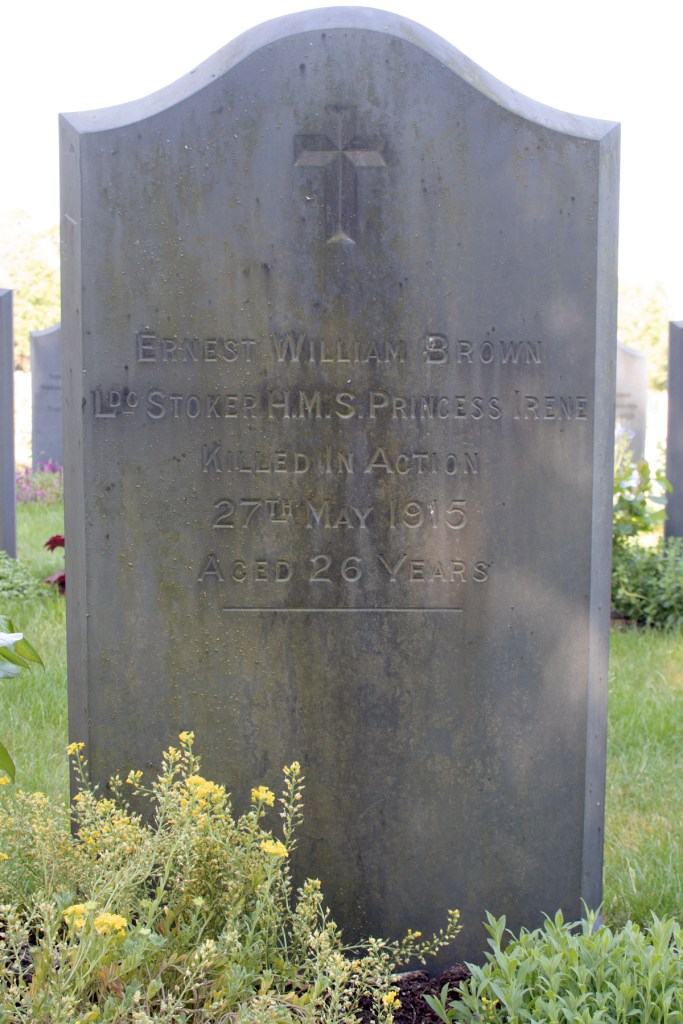
Ernest William Brown was born on 5th April 1889 in Halstead, Essex. One of twelve children, his parents were carpenter Edward and silk weaver Elizabeth Brown.
Ernest initially found work as an errand boy, then as a house painter. He wanted bigger and better things, however, and the Royal Navy offered him that opportunity. He enlisted as a Stoker 2nd Class on 12th March 1908 for a period of twelve years’ service.
Ernest’s early service records are lost to time, but he received a promotion to Stoker 1st Class on 12th March 1909, exactly a year after a joined up. At this point he was assigned to the dreadnought battleship HMS Russell, on board which he served until August 1912.
After a short period at HMS Pembroke, the Royal Naval Dockyard in Chatham, Kent, Stoker 1st Class Brown was transferred to the Apollo-class cruiser HMS Iphigenia. She was to be his home for the next two-and-a-half years, during which time he was promoted again, this time to Leading Stoker.
Returning to HMS Pembroke in March 1915, this was to be his shore base for the next couple of months. On 27th May, Leading Stoker Brown was helping out on the steamer Princess Irene. Tragically, while on board an explosion ripped through the ship, while moored off Sheerness, Kent and he was one of the 352 souls killed. He was just 26 years of age.
Ernest William Brown was laid to rest in the Woodlands Cemetery in Gillingham, Kent. His body having been identified, he was given his own grave, unlike those who were buried in a mass grave nearby.
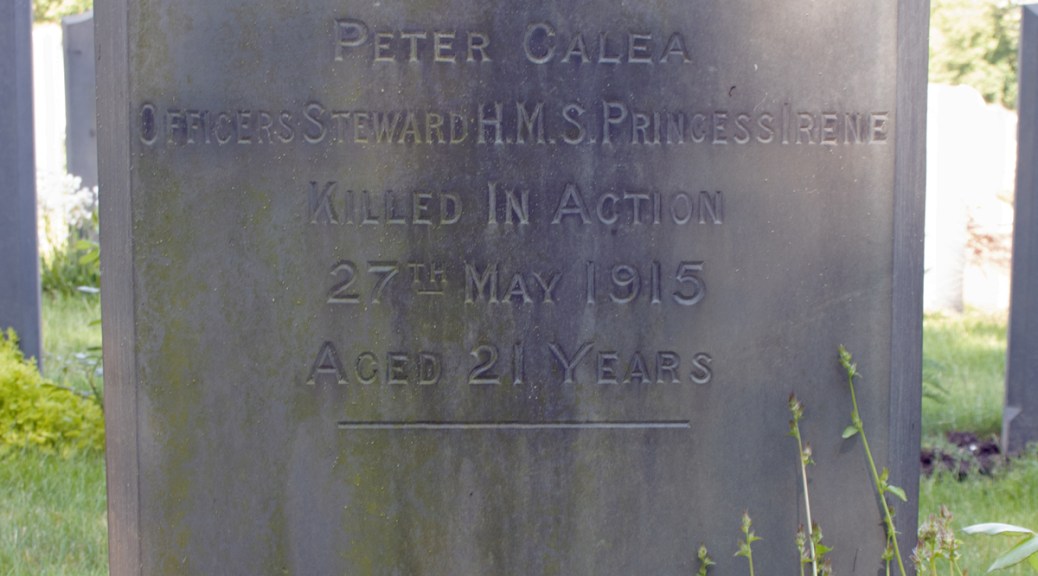
Peter Galea was born in the Maltese town of Senglea on 25th August 1893. His mother’s name was Carmela, but there is little further concrete information about his early life.
What is clear is that Peter found employment by enlisting in the Royal Navy. He joined up on 2nd January 1912 as an Officer’s Steward 3rd Class. His service records show that he was 5ft 9.5ins (1.66m) tall, had brown eyes, black hair and a dark complexion.
Officer’s Steward Galea’s first assignment was on board the dreadnought battleship HMS Orion. He was to spend more than three years on board, although his continuous service was interrupted by three days spent in the cells in May 1913: unfortunately his misdemeanour is not recorded.
In February 1914, Peter was transferred to the Apollo-class cruiser HMS Thetis. She was to be his home for the next year, during which time war was declared across Europe. In March 1915, Officer’s Steward Galea was assigned to another ship, the ocean liner Princess Irene.
Tragically, Peter was on board when, on 27th May 1915, an explosion ripped through the ship, while moored off Sheerness, Kent and he was one of the 352 souls killed. He was just 21 years of age.
Peter Galea was laid to rest in the Woodlands Cemetery in Gillingham, Kent. His body having been identified, he was given his own grave, unlike those who were buried in a mass grave nearby.
In the naval section of the Woodlands Cemetery in Gillingham, Kent, stands a headstone to a John Donoghue. The stone states that he was a Fireman on board HMS Princess Irene and that he was killed in action on 27th May 1915. He was 25 years of age.
Further research confirms that he was part of the Mercantile Marine Reserve, but there are no records to confirm his service at sea. While John was born in around 1890, with no confirmation of his place of birth, or the names of his parents, it is impossible to narrow down any further details for him.
Records of the Princess Irene’s crew do not include a John Donoghue, although this does not necessarily mean that he was not serving on board, only that records no longer exist. The fact that he was granted an individual headstone, rather than being commemorated in the mass grave that is also situated in the Woodlands Cemetery suggests that his body was able to be identified.
Sadly, however, Fireman John Donoghue’s life is destined to be lost to time, his legacy to be one of the 352 souls lost during the explosion and sinking of the ship on board which he served.
Philip Johnson was born in the summer of 1891 in Wrexham, Denbighshire. One of eight children his parents were Samuel and Mary Johnson. Samuel was a wine merchant from Scotland, while Mary had been born in Cheshire. When Philip was born the family were living and running the town’s Lion House inn on the High Street.
Mary died in 1897 and, in 1909 Samuel moved his family on. He bought the Royal Hotel in Llangollen, which occupied a large plot on the riverside, and which included a large garden.
The Royal Hotel was a busy business: to look after the guests, there were eleven members of staff living in. This was to be a Johnson family business, however, with Philip’s older sibling Elizabeth managing the hotel with her father, his brother Samuel Jr assisting, his sister Ethel acting as bookkeeper and Philip himself managing the bar.
In the spring of 1914, Philip married Elizabeth Kelsall, whose family ran the Eivion Hotel, down the road from The Royal. The couple set up home in the town – possibly even still living at Samuel’s hotel – and had two children.
When war came to Europe, Philip stepped up to play his part. Sadly, full details of his military service are lost to time, although it is clear from other documents that he had enlisted in the Royal Army Service Corps.
For The Royal Hotel, this was a challenging time. By December 1916, two of Samuel’s sons – including Philip – were away on service, as were nine of the hotel’s seventeen staff. Samuel applied for Samuel Jr’s exemption from war service on the basis that he was the hotel’s manager, but this was refused. A year later, he applied for another of the hotel’s servant’s, an Evan Edwards, exemption, but again this was refused.
Philip, meanwhile, was attached to the 728th Coy of the Motor Transport section of the Royal Army Service Corps. His troop served the RE Signal Service Training Centre, but it is unclear whether he saw any action overseas. By the end of the war, however, he was based in Hitchin, Hertfordshire.
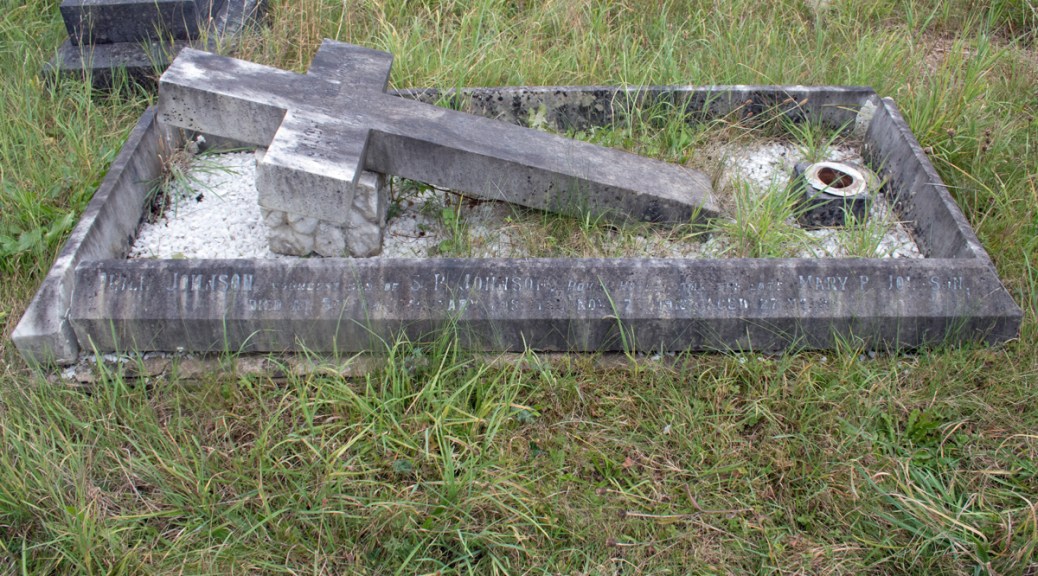
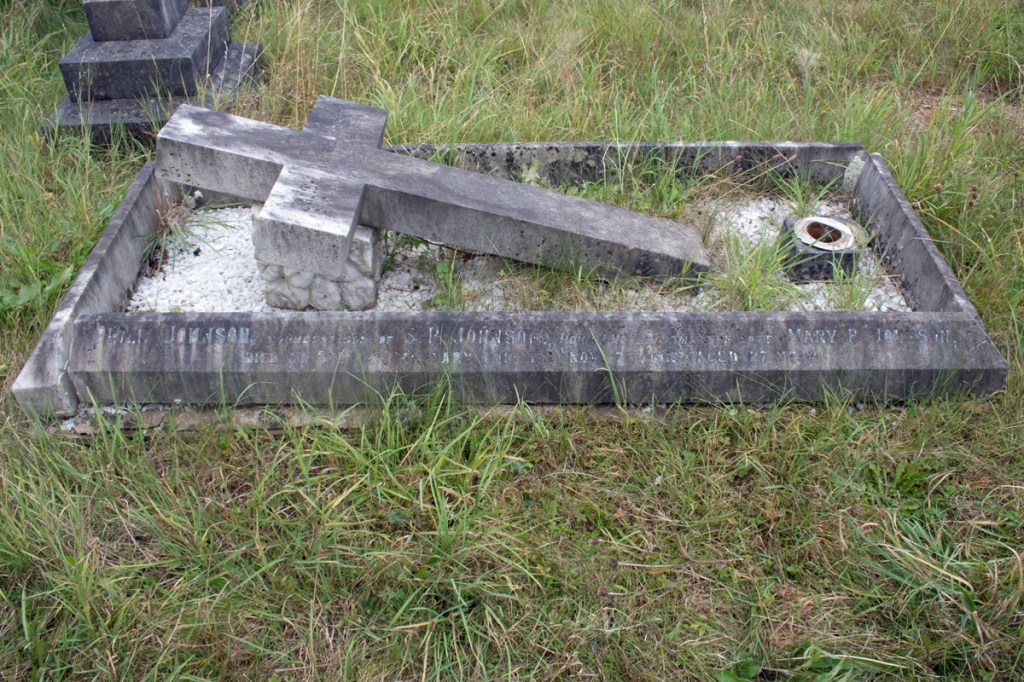
With winter closing in, illness became rife in the cramped condition of army barracks. Private Johnson contracted pneumonia, and was admitted to the Bedford Military Hospital, not far from where he was based. Sadly, the lung condition was to get the better of him, and he succumbed to it, passing away on 7th November 1918, aged just 27 years old.
Philip Johnson’s body was brought back to Wales for burial. He was laid to rest in a family plot in the graveyard of St John’s Church in his adopted home town of Llangollen.
William Thomas Hughes was born on 4th August 1898 in Llangollen, Denbighshire. One of twins, he was also one of seven children to William and Margaret Hughes. William Sr was a bricklayer and the family lived on Fron Bache, a land to the south of the town, leading into the hills. The Hughes’ baptised their first five children on the same day – 5th October 1904 – in the parish church.
Little further information on young William’s life remains. When war broke out, he stepped up to play his part: details of when have been lost to time, but, according to later records, he had enlisted by December 1917.
Private Hughes joined the Royal Welch Fusiliers, and was assigned to one of their depots, possibly on the North Wales coast. Certainly this is where he was based by the spring of 1918 as, in May of that year, he was admitted to the Red Cross Hospital in Colwyn Bay, having contracted malaria.
Tragically, this condition was to get the better of him: Private Hughes passed away on 7th May 1918, at the tender age of just 20 years old.
William Thomas Hughes was brought back to Llangollen for burial He was laid to rest in the graveyard of the town’s St John’s Church.
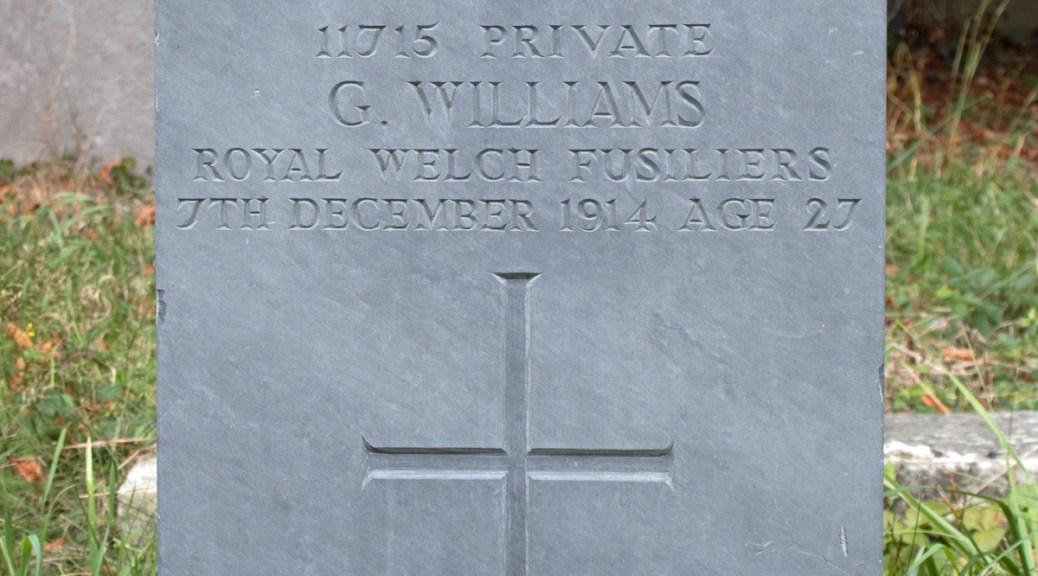
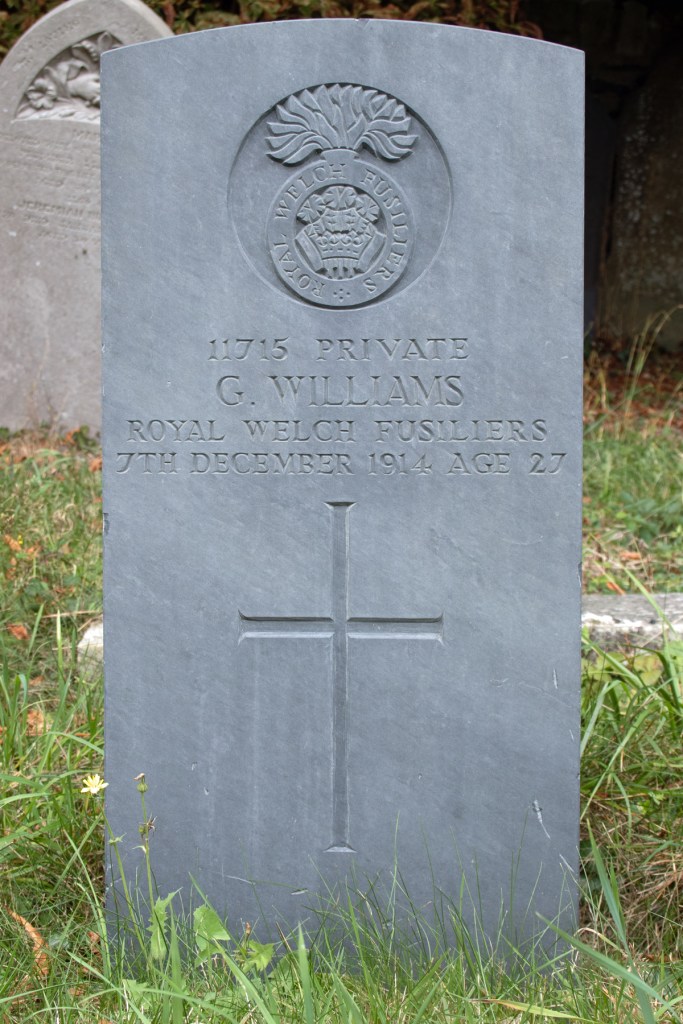
George Williams was born in 1887 in Ruthin, Denbighshire. One of thirteen children – of whom sadly only seven survived – his parents were John and Martha Williams. John was a carpenter and joiner and, when the children had grown a little, he and Martha took on the Registered Tramp Lodging House in Church Street, Llangollen.
The 1911 census recorded George living with his parents and working as a carter. His younger brother John was employed as a labourer, while the rest of his siblings were at school. The boarding house was full as Martha’s brother was staying there, along with four lodgers.
George married Catherine Edwards on 27th May 1911. She was an engineer’s daughter, also from Llangollen, and the couple tied the knot in St Collen’s Church, which was on the same street as the Williams’ boarding house. The newlyweds moved to Ruabon, six miles (10km) to the east of Llangollen, and had a daughter, Martha, who was born in 1912.
When war was declared, George was quick to enlist. He joined the 8th (Service) Battalion of the Royal Welch Fusiliers, and was sent to Salisbury Plain for his training. While here, however, Private Williams passed away. The cause of his passing is not readily available, but it seems likely that he succumbed to illness, possibly brought on by the sudden influx of men from across the country suddenly billeted together in the confines of an army camp. He died on 7th December 1914, aged just 27 years of age.
George Williams’ body was brought back to Wales for burial. He was laid to rest in the graveyard of St John’s Church in Llangollen.
Tragically, just six days after George’s death, Catherine gave birth to their second child. George Jr would never know his father.







 Death and Service