Category Archives: accident

Ordinary Seaman Frank Green

Ordinary Seaman Frank Green

Frank Ernest Green was born in Stratford, Essex on 14th November 1889. One of nine children, his parents were printer’s compositor John Green and his wife, Susan. The family were raised in Leytonstone and, by the time of the 1911 census, they were living in a house in Elsham Road.

Frank found work as a clerk for a financial company when he finished his schooling. On 31st August 1912, he married sailor’s daughter Charlotte Greenland, who was four years his senior. The couple settled in Gibbon Road, Peckham, Surrey, where Frank continued his work.

When war broke out, Frank was called upon to play his part. On 3rd January 1917, he enlisted in the Royal Navy for the duration of the war. His service records show that he was 5ft 6.5ins (1.69m) tall, with brown hair, blue eyes and a fresh complexion.

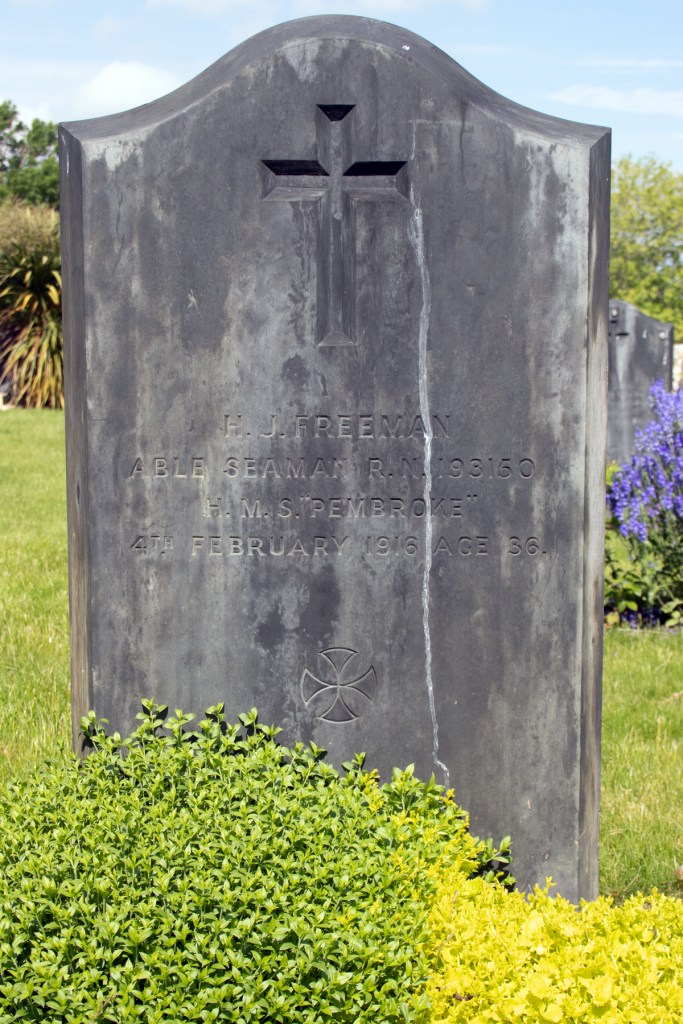
Ordinary Seaman Green was initially sent to HMS Pembroke, the Royal Naval Dockyard in Chatham, Kent, for training. He spent short periods of time on two ships before being assigned to HMS Racoon, a Beagle-class destroyer,

Initially patrolling the Mediterranean, by the time Frank joined the crew the Racoon she was part of the Second Destroyer Flotilla, based from Northern Ireland. In January 1918, she struck harsh weather:

HMS Racoon, Lieut. George LM Napier RN, in command, struck some rocks off the north coast of Ireland at about 2am on the 9th [January], and subsequently foundered with all hands.

Nine of the crew had been left behind at her last port of call, and these are the sole survivors.

Seventeen bodies have been picked up by patrol craft, and are being buried at Rath Mullan. Five more bodies have been washed ashore, and are being buried locally.

All the next of kin have been informed.

Exeter and Plymouth Gazette – Monday 14 January 1918

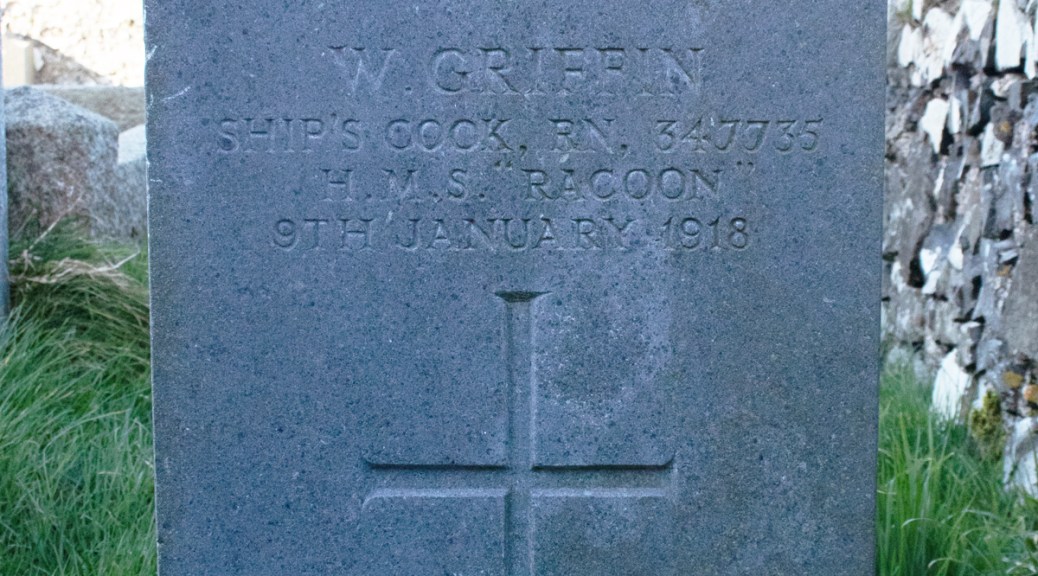
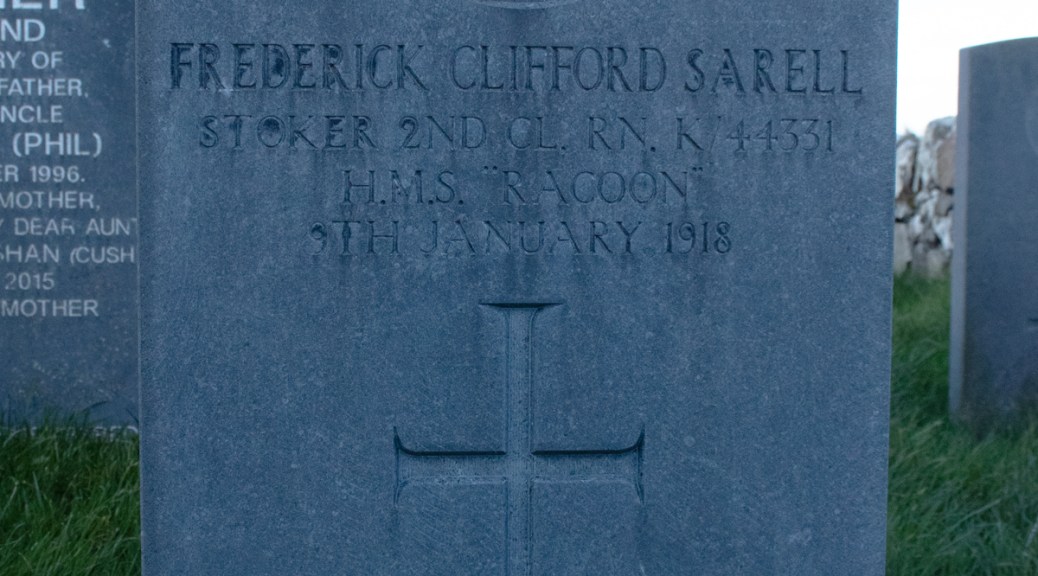
Ordinary Seaman Frank Ernest Green was one of those to be washed ashore. He was just 28 years of age. He was laid to rest in the peaceful and picturesque graveyard of Ballintoy Church, County Antrim, not far from where he had come to land. He was buried next to two other crew members, Ship’s Cook Walter Griffin and Stoker 2nd Class Frederick Sarell.


Lance Corporal George Carey

Lance Corporal George Carey

George Edward Carey was born at the start of 1877 and was the oldest of eight children to Samuel and Hester Carey. Samuel was a solicitor’s clerk from Clevedon in Somerset, and this is where the family were born and raised. Samuel was not one to sit on his laurels, however, and the 1891 census recorded his occupations as law clerk, innkeeper and insurance agent.

George followed a different path to his father, and found work as a printer’s apprentice when he finished his schooling. He worked up to being a full compositor quite quickly, and was employed as such when, on 30th January 1899, he married Lizzie Taylor. A civil engineer’s daughter, she was working as a teacher when the couple wed: they set up home in Clevedon, and went on to have four children.

By 1911, the Carey family were living in a seven-room house on Strode Road, Clevedon. George was still working as a compositor, but was employed by the local sanitary works. His widowed brother, Albert, who was lodging with his brother and sister-in-law also did the same job.

With storm clouds brewing over Europe, George stepped up to play his part. He enlisted in the Royal Engineers in the autumn of 1914 and was attached to the 503rd Field Company in Exeter. Little information is available about his time in the army, and he only comes to light again a year or so later.

Lance-Corporal Carey, 2nd Wessex RE, who has been employed at the office in Colleton-crescent, Exeter, was found dead, with his neck broken, at the bottom of a flight of stairs at the Grapes Inn, South-street, on Thursday morning. The discovery was made by Mrs Dorothy, wife of the licensee of the inn. Information was given to the police, and Dr Pereira visited the scene, and subsequently the body was removed to the mortuary by PCs Wise and Barrett. Carey was fully dressed. He was about 48 years of age, and leaves a widow and four children. For about fourteen months he had been engaged on the Wessex RE staff, and was billeted at a house in the Friars. His home is at Clevedon, Somerset, where he was engaged as a compositor before mobilisation with the Territorials. He was under orders for transfer to another station.

Taunton Courier and Western Advertiser: Wednesday 12th January 1916

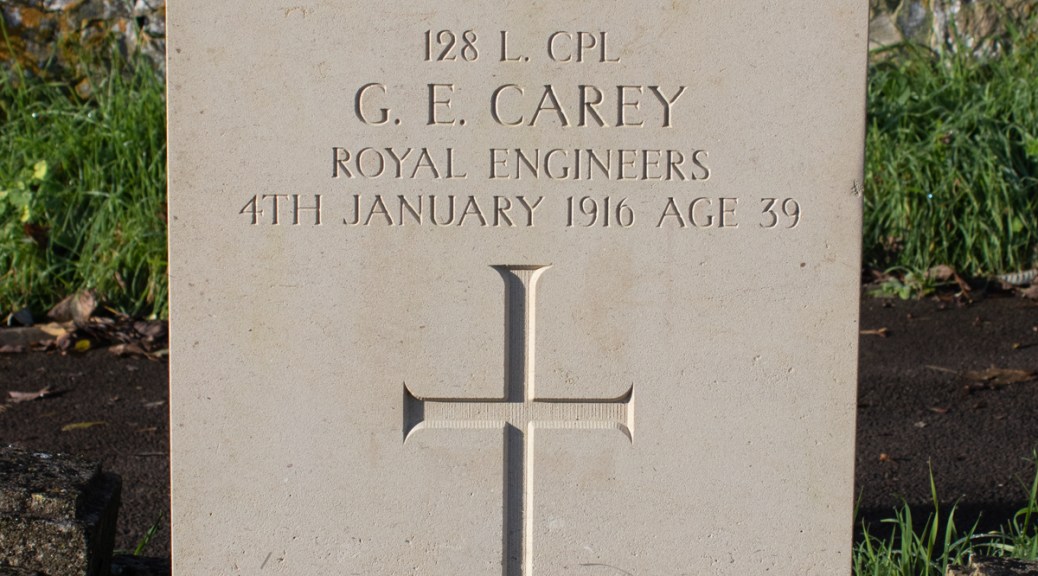
George Edward Carey died on 4th January 1916: he was, in fact, not quite 39 years of age. His body was brought back to Somerset for burial and was laid to rest in the stunning graveyard of St Andrew’s Church in his home town of Clevedon.


Pioneer William Hamilton

Pioneer William Hamilton

William John Hamilton was born in Urney, County Tyrone, in 1870. One of ten children, his parents of John and Bella. Little further information is available about his early life, but on 29th September 1895, William married Sarah McLaughlin.

The couple set up home in Ballycolman Lane, Strabane, and had at least six children. William worked as a shop porter, while Sarah kept house for the family.

By the time of the 1911 census, William was working as a general labourer. War was brewing over the continent by this point, however, and when hostilities were declared, he stepped up to play his part.

Full details of William’s service are lost to time. What documents remain, however, confirm that he enlisted no earlier than June 1917, and that he joined the Royal Engineers as a Pioneer. He was attached to an Inland Water Transport unit and sent to Salisbury Plain, Wiltshire, for training.

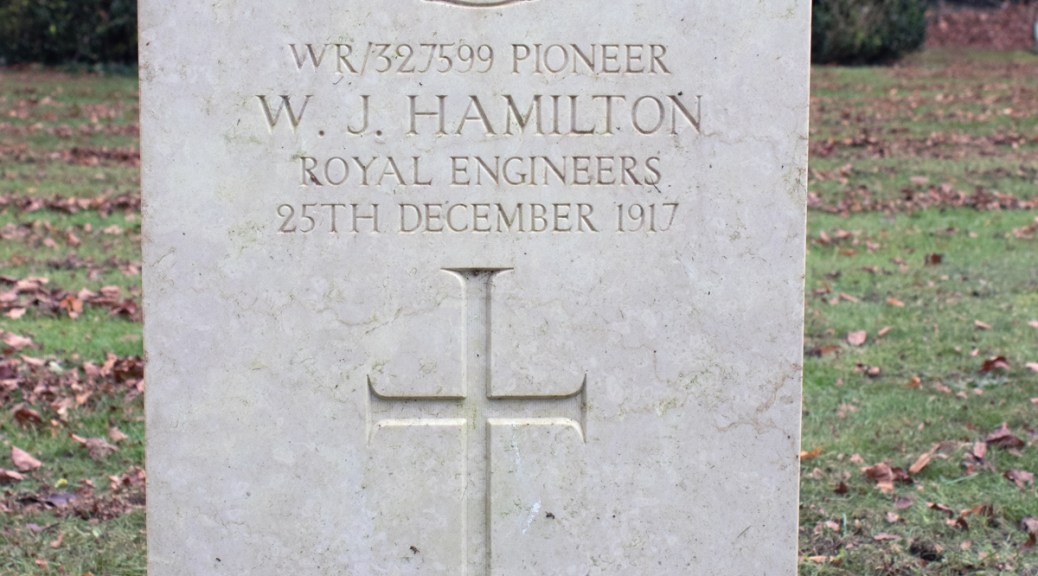
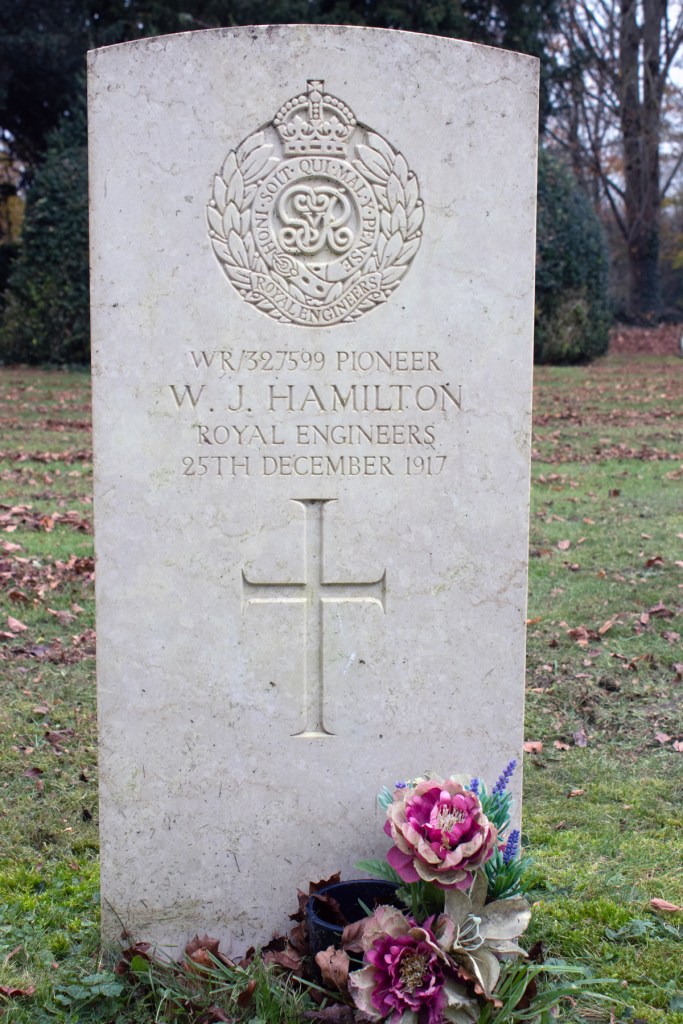
Pioneer Hamilton’s Pension Ledger Card provides a tantalising insight into his passing. On 25th December 1917, he died from “suffocation from submersion accidentally drowned while on active service.” There is no other documentation to expand on what happened, and no contemporary newspaper report on his passing. William was 47 years of age.

It would appear that Sarah was unable to afford the cost of bringing her late husband’s body back to Ireland for burial. Instead, William John Hamilton was laid to rest in Amesbury Cemetery, close to where he had passed away.


Second Lieutenant Henry Fleming

Second Lieutenant Henry Fleming

On Tuesday morning another member of the Royal Flying Corps, Second Lieutenant Henry Roland Fleming, lost his life at Upavon. Lieutenant Fleming, who was 28 years of age, and married, having his home at Ripley, Surrey, was attached to the Central Flying School early last month, having volunteered for service on the outbreak of war, joining the Special Reserve Air Service. Nearly four years ago he gained the Aero Club’s certificate at Brooklands, but for nearly two years prior to the outbreak of war had not practiced aviation. On Tuesday morning the conditions were very favourable for flying, and the deceased’s flight was watched by Major Webb-Bowen, assistant commandant at the school, and Captain Stopford, who was flying at the same time. Lieutenant Fleming was about 1200ft [365m] up when the attitude of his machine first attracted the attention of the officers. They noticed it dive in an almost vertical position, after which it turned over on its back and glided for some distance upside down. Then it turned its nose to ground again, and from a height of some 450 feet [137m] dived straight into the earth. Death was instantaneous. The officers found Mr Fleming dead in the remains of the machine, with the strap broke in the fall still about his waist. Medical examination showed that he had dislocated his neck and fractured his skull. Lieutenant Fleming, who comes from a well-known family, was one of the first in the country to take up aviation. His father went through the Crimean Campaign in the 4th Irish Dragoon Guards, and a brother was killed in the South African War.

Salisbury and Winchester Journal: Saturday 28th November 1914

Henry Roland Fleming was born in the summer of 1884 in Farnham, Surrey. There is scant information about his early life, but the 1911 census recorded him as boarding at the New Inn in Amesbury, Wiltshire, where he was employed as an aviator.

Henry gained his wings on the 25th April 1911 – shortly after the census – flying a Bristol biplane. He married Ivy Wyness-Stuart, a widow six years his senior, in the spring of 1913, but after this, the couple’s trail goes cold.

When war broke out, Henry stepped up to play his part. He gained a commission to the Royal Flying Corps and, once again found himself based on Salisbury Plain. Tragically it was only a matter of months because the fatal accident.

While his widow was living in Surrey, her Henry Roland Fleming was laid to rest in Amesbury Cemetery, not far from airfield where he had developed his flying skills.


Second Lieutenant Henry Fleming
(from findagrave.com)

Second Lieutenant Forrest Evans

Second Lieutenant Forrest Evans

The life of Forrest Dinnett Evans is a challenge to uncover, although his service records shed tantalising glimpses into his history.

Forrest enlisted in the Canadian Royal Flying Corps on 8th August 1917. He joined up in Toronto, Canada, but gave his address as 26 Leicester Drive, Boston, Massachusetts.The same document gives his middle names as Dennett, and that his father was called George William Evans. It also suggests that both men were British subjects. While it’s not clear when the Evans family moved to North America, there are no UK census or birth records for either man.

Forrest was 19 years 9 months old when he enlisted and stood 5ft 10ins (1.77m) tall. He gave his trade as an student aviation cadet. He was mobilised straight away, and sent to Britain. His time in the Canadian Royal Flying Corps came to an end on 18th December 1917, when he received a commission in the Royal Flying Corps.

Second Lieutenant Evans, as he was now known, was based at Boscombe Down, Wiltshire. It was here, on 27th March 1918, that he was in charge of an Armstrong Whitworth FK8 two-seater biplane. Shortly after take off, the aircraft span into the ground: Forrest was killed instantly. He was 20 years of age.

With his family overseas, Forrest Dinnett Evans was laid to rest in Amesbury Cemetery, just a few miles from Boscombe Down.


Private Samuel Smith

Private Samuel Smith

Samuel Herbert Smith was born on 15th March 1886 in Liverpool, Lancashire. He was one of six children to parents Henry – a road labourer for the local council – and Elizabeth.

There is little concrete information about Samuel’s early life. While the 1901 census confirms he was employed as an apprentice, the writing is not legible enough to identify the trade he was in. A later record suggests he spent two years in the Royal Engineers, although, again, no supporting documents evidences this.

Samuel married a woman from South Wales. Her details are lost, but his war pension record gives the name Mrs SH Smith, and gives her address as 34 Albany Street, Newport, Monmouthshire.

It would seem that Samuel was keen to build a bigger and better life for the couple, and left Britain to find work overseas. By 1914 he was living in Valcartier, Quebec, and working as a bartender. War was declared in the summer of that year, however, and he immediately stepped up to serve his country.

Samuel enlisted in the Canadian Expeditionary Force on 23rd September, and was assigned to the 13th Battalion of the Canadian Infantry. His service records suggest he cut a striking figure: he stood 6ft 1in (1.85m) tall and weighed 168lbs (76.2kg). He had light brown hair, hazel eyes and a medium complexion, and his records note that he had a crossed hands tattoo on his right arm.

His unit set sail for England and, by the end of October, Private Smith was installed at Bustard Camp on Salisbury Plain, Wiltshire.

An enquiry was led into the death of Samuel Herbert Smith… Private Smith was travelling… in a motor car, and while the car was passing over uneven ground he fell into the road and was almost instantaneously killed.

George William Hincks, a private in the Canadian Force… was driving from Salisbury… in a motor car, which was meant to carry a machine gun, and was, therefore, open at the sides. Private Smith was seated next to [him] and was inclined to be rather sleepy. He had travelled in the train from Liverpool on the previous day. hey had gone some distance on their journey when deceased said “I want to get out of this.” [Hincks] said “Sit still, Bert. We will be soon be there,” Smith smiled and said “Oh, all right.” Almost immediately the car jolted on a rough piece of road, and Smith pitched on his head in the road. The car was immediately stopped, and [Hincks] went back to him and found him lying with his knees up, on his back, with wounds in his head. He was dead. [Hincks] returned to Salisbury and reported the occurrence to superior officers. The road on which fatality happened was rough and had been badly cut up, more especially at the place where deceased fell from the car.

Salisbury and Winchester Journal: Saturday 31st October 1914

The accident occurred on 29th October, Private Smith was just 28 years of age.

Samuel Herbert Smith’s widow was unable to cover the cost of bringing her husband back to Wales for burial. Instead, he was laid to rest in Amesbury Cemetery, not car from Bustard Camp.


Lieutenant Keith Beddy

Lieutenant Keith Beddy

Keith Charles Beddy was born in Port Elizabeth, South Africa. His parents were Walter and Isabella Beddy, and he was the sixth of eight children.

Little additional information is available about Keith’s early life. When war broke out, he enlisted in the army, eventually becoming assigned to the 5th Battalion of the Hampshire Regiment. Rising through the ranks to the rank of Lieutenant, he eventually transferred to the Royal Flying Corps.

Lieutenant Beddy was based on Boscombe Down, near Amesbury, Wiltshire. On 6th February 1918, he was flying his RAF BE 2e aircraft when he attempted a turn at a low altitude. The plane nose-dived and crashed into the ground, and Keith was killed instantly. He was just 21 years of age.

With his family on the other side of the world, Keith Charles Beddy was laid to rest in Amesbury Cemetery, not far from the airfield where he had been based.


Pioneer Patrick Craven

Pioneer Patrick Craven

Patrick Craven was born in the summer of 1898 in Drogheda, County Louth. The oldest of three children, his parents were Francis (or Frank) and Mary Craven. Mary died in 1909, and the following year Patrick’s father remarried, to widow Kate Devin. The 1911 census found the extended family living in a cottage on North Road, Frank, Kate and their seven children.

Frank was a farm labourer, and this is work that Patrick also went into when he finished his schooling. War came to Europe in 1914, and he was to be called upon to play his part.

Patrick enlisted in the Royal Engineers on 6th June 1917. His service records confirm that he was 5ft 6ins (1.68m) tall, and weighed 127lbs (57.6kg). Pioneer Craven was assigned to the Inland Waterways Transport Division, and sent to Henbury, on the outskirts of Bristol, Gloucestershire, for training.

There was one blip on Patrick’s otherwise spotless service when, on 1st October 1917, he was confined to barracks for two days for ‘conduct to the prejudice of good order and military discipline, leaving the ranks without permission‘. Shortly after this, Pioneer Craven was assigned to a unit in Portbury, Somerset.

The wet summer of 1917 had given way to a cold, harsh winter, and the conditions were to lead to Pioneer Craven’s tragic demise on 27th December. The detailed report from the Medical Officer explained what had happened:

This man was found dead… in a small harness room at the Lodway Brewery, Pill, a room occupied by the IW&D, Portbury. I was called in to see him and pronounced him dead, the body was quite stiff and cold and death had probably taken place several hours before. When first discovered the body was fully pronated, with the mouth flattened against the floor, the hands were gripping the Army greatcoat which he had pulled over himself.

The harness room was heated by a coke stove the flue of which passed through the room to the ceiling and was cracked, allowing the fumes of the burning coke to emanate into the room. There was no ventilation except through a door communicating with the stables, which was found shut at the time the cadavre [sic] was found. The stove was situate[d] between the position where the body lay and the door, in a cul-de-sac.

One other man slept in the same room the same night, the deceased man having evidently entered the place after the former had fallen asleep. The second man was not affected by the fumes to any degree, but was lying between the stove and the door under which there was a certain amount of draught.

Sheltering himself from the cold winter night, Private Craven had passed away in his sleep from carbon monoxide poisoning. He was just 19 years of age.

Patrick Craven’s family were unable to afford to bring him back to Ireland for burial. Instead, he was laid to rest in the peaceful graveyard of St George’s Church in Easton-in-Gordano, not far from the brewery stables where he had passed.


Shipwright 1st Class Thomas Collins

Shipwright 1st Class Thomas Collins

Thomas Collins was born in the Blackfriars area of Glasgow on 12th March 1877. His was a common name, and it is a challenge to find identify much about his early life. He did, however, have a brother called Andrew, and, when he finished his schooling, he found work as a carpenter and joiner.

Thomas sought new opportunities and, on 21st January 1899, he enlisted in the Royal Navy. Working as a Carpenter’s Crew, he was initially assigned to HMS Vivid, the Royal Naval Barracks in Devonport, Devon. His service records show that he was 5ft 5ins (1,65m) tall, with dark brown hair, grey eyes and a dark complexion.

Devonport was to become Thomas’ base, but, over the twelve years of his initial navy contract, he went on to serve on eight separate vessels. He records suggest that he was good at what he did, and his moved up through the ranks as a result. However, he seemed to have another side to him, which occasionally revealed itself.

Thomas was promoted to Leading Carpenter’s Crew on 19th December 1901, but what had been noted as a very good character seemed to take a downturn at this point. He was committed to cells for two weeks in January/February 1903, while serving on HMS Highflyer, with an incident leading to his demotion to Carpenter’s Crew once more. This also appears to match with a drop in his character: noted as Very Good in his reviews of 1899 to 1901, he slipped to Good in 1902 and fair in 1903 and 1904.

His imprisonment seems to have been the shake up Thomas needed. From here on in, his character was consistently recorded as Very Good and, by August 1909, he had regained the rank of Leading Carpenter’s Crew. There was, however, a serious blip in this good behaviour, noted in his service records:

This man was tried for the manslaughter of Richard Ernest Bell, blacksmith, on [illegible date], who died from injuries received in a fight with Collins on HMS Cambridge. Verdict of Jury at Assizes: “Not guilty”. Judge in summing up stated that he considered Collins was technically guilty of manslaughter.

Thomas had been on the mess deck of HMS Cambridge on 26th August 1905, when he became embroiled in a fight with Petty Officer Bell. Medical evidence showed that Bell died as a result of a blow behind his ear, the punch delivered by Leading Carpenter’s Crew Collins. While it seems likely that he unintentionally caused the Petty Officer’s death, he was cleared by the jury, and remained assigned to HMS Cambridge until November 1905.

Thomas’ initial term of service came to an end on 20th January 1911, and he had no hesitation in re-enlisting. On board HMS St George at the time, his new contract brought with it the rank of Shipwright 2nd Class. Over the next five years, he served on four more ships, and rose a rank to Shipwright 1st Class.

On 8th January 1916, Thomas married Flora Peacock. Little information is available about here, although the wedding took place in Harwich, Essex. Thomas was serving on board the cruiser HMS Conquest by this point, and was based out of the Royal Naval Dockyard in Chatham, Kent.

On Tuesday evening, March 28th, a cutter belonging to HMS Conquest, which was taking forty liberty men off to the ship, was caught in a blizzard and nothing was seen or heard of her again till the morning, when she was found cast up on shore many miles away. All hands were drowned.

The cutter was being towed out by a steam-launch. The hawser broke and the boat drifted away ad capsized.

Westerham Herald: Saturday 8th April 1916

Shipwright 1st Class Thomas Collins was one of those lost from the cutter. He had not long turned 39 years of age. He was laid to rest in the Roman Catholic section of Woodlands Cemetery, Gillingham, not far from the dockyard at which he had been based.


Thomas’ headstone incorrectly gives his surname as Collings.


Private Thomas Besley

Private Thomas Besley

The short life of Thomas Besley is a challenge to unpick. He was born in Bampton, Devon, early in 1896, one of ten children to farm labourer Steven Besley and his wife, Fanny.

Steven’s work took the family around the region, and the 1901 census found the Besleys living on Cordings Farm in Wiveliscombe, Somerset. The document records Thomas as being 5 years of age, sharing the accommodation with his parents and six of his siblings.

The 1911 census records Thomas working as a live-in labourer at Manor Farm in Huish Champflower, a village just three miles outside of Wiveliscombe.

Meanwhile, his family are still recorded as living in Wiveliscombe itself, Steven and Fanny residing with four of their children. Now, however, another Thomas is listed with them: seven years old, he is the only child of their oldest son, William and his late wife, Elizabeth. She had died in 1904, around the same time as young Thomas’ birth, and it would appear that Steven and Fanny adopted their grandson (he is listed on the census as their ‘son’). William went on to marry again, but his new wife, a widow called Hannah, had seven children from her first marriage. The couple would go on to have a son of their own, but it was a crowded house, and so Thomas lived permanently with his grandparents.

The older Thomas Besley signed up almost as soon as war was declared in 1914. While his service records are sparse, he joined the 3rd/5th Battalion of the Somerset Light Infantry.

What can be determined from the records is that Private Besley drowned. His death certificate – which mistakenly records his surname as Beasley – confirms that Thomas’ body was found in the River Tone in Taunton on 16th February 1915, and the cause of death noted as ‘found drowned’.

While research for Besley draws a number of blanks about the circumstances of his death, the misspelled surname featured in a contemporary newspaper report:

On Tuesday afternoon, around four o’clock, MJ Chapman… while passing the Locks at Firepool, Priory, Taunton, observed what appeared to be the body of a man floating in the swirl caused by the overflow of the Locks into the pool. The police were immediately informed… and proceeded to the spot with the ambulance and recovered the body of a man, dressed in khaki uniform. The body had evidently been in the water for a considerable time and was much decomposed. The deceased was subsequently identified as Thomas Beasley, son of Mr Stephen Beasley, of Langley Marsh, Wiveliscombe. He was a private in the 5th Battalion of the Somerset Light Infantry, and was 40 years of age. He had been in ill-health for a considerable period, and latterly had been depressed. He disappeared on January 16th, and despite all enquiries his whereabouts remained a mystery until Tuesday…

[At the inquest] Stephen Beasley, a farm labourer… gave evidence of [Thomas’] identification. He said that his son had lately been ill. Three months ago he was taken from Salisbury Plain to Bristol Hospital, where he remained for about a month. After his discharge from Hospital he went home, where he remained about a fortnight, and for the last two months he had been quartered at Taunton. In this time witness had seen his son twice, but he could not say that he had been well since he came out of Hospital. He was low-spirited, but never told witness that anything troubled him.

Florence Beasley… sister of deceased, said she last saw her brother about a month ago in Taunton. He seemed very strange and low and would not speak unless spoken to first. He seemed to be troubled, and would not shake hands with her when she left him. He seemed to be always ‘studying.’ There was no suicidal tendency in the family…

Captain Burridge stated that deceased was sent to hospital from the Plain about September. About the middle of October he had a wire from Bristol Infirmary informing him that he was dangerously ill and dying. However, he got over that, and he was discharged on October 28th. He was sent for 22 days’ furlough to his home and returned to duty on November 22nd. Ever since that time he had not been in the best of health, but nothing had been noticed of his mental condition. He believed at one time there was a talk of his being discharged as medically unfit. He disappeared on January 16th.

The Coroner asked [how] long deceased had been in the service, and witness answered that he joined on June 1st, 1913. His complaint when removed to Bristol Hospital was double pneumonia.

On the suggestion of the Coroner, the jury returned an open verdict.

Taunton Courier and Western Advertiser: Wednesday 24th February 1915

In addition to the Besley/Beasley surname, the report features a couple more discrepancies. Thomas’ father’s name is given as Stephen, when it was Steven. The deceased is also recorded as being 40 years old when he died, when he was actually half that age.

Thomas Besley was laid to rest in the peaceful graveyard of St Andrew’s Church in Wiveliscombe. It gives his age as 17 years old and the date of his death as 16th February 1917.