Category Archives: Cheshire

Private Frank Perryman

Private Frank Perryman

Frank Harry Tom Perryman was born in Axminster, Devon, on 16th October 1889. The third of six children – and the only boy – his parents were Barnabas and Emily. Barnabas was a carpenter and joiner, and the family lived in the centre of the town: first next door to the Red Lion Inn on Lyme Street, then around the corner on South Street.

By the time of the 1911 census, an opportunity had arisen to take Frank away from Devon. The document records him as one of four servants (in addition to a maid, butler and cook) for Eumenia Hime and her law student son, Stanley. Eumenia’s husband, Edward, was a merchant in Brazil, and their son had been born in Rio de Janeiro. Ste Georgian Croyland House on Cornwall Gardens in South Kensington, was the family’s London residence, and this is where young Frank was employed.

When war came to Europe, Frank was called upon to play his part. Sadly, his service records have been lost to time, but it is evident that he enlisted in the Royal Army Ordnance Corps. Private Perryman’s Medal Roll suggests that he served on home soil, and certainly by the end of the war – presumably while waiting to be demobbed – he was based in Cheshire.

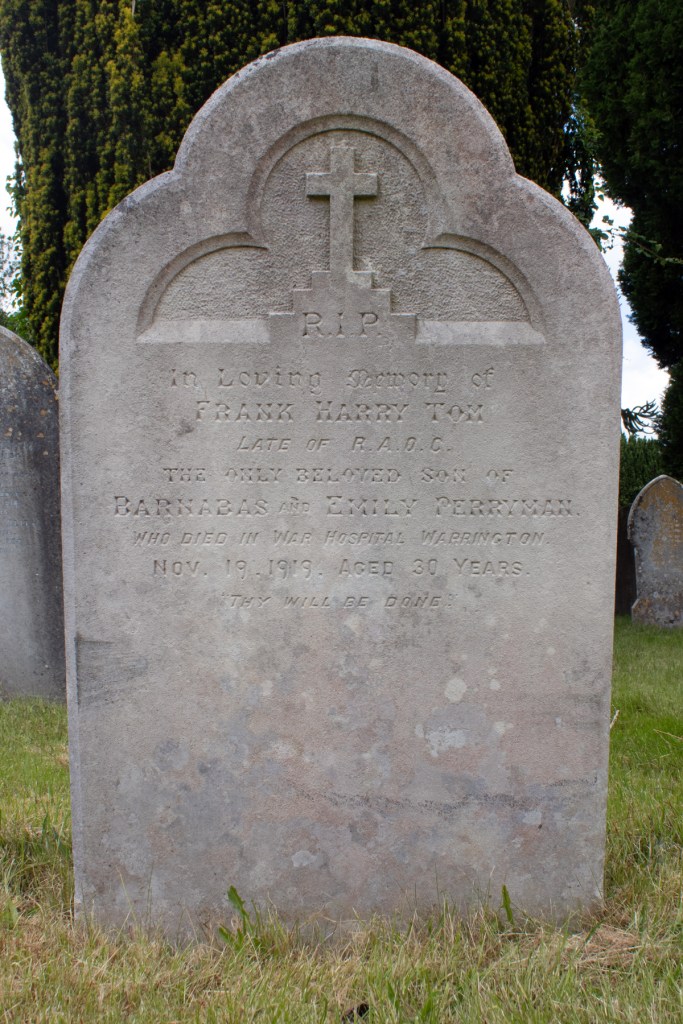
In November 1919, Frank was admitted to the War Hospital in Warrington. Details are unclear, but it is likely that he had contracted one of the many lung conditions prevalent at the time. He passed away while still admitted on 19th November: he had not long turned 30 years of age.

The body of Frank Harry Tom Perryman was taken back to Devon for burial. He was laid to rest in Axminster Cemetery, on the outskirts of the town that had been his childhood home.


Private Alfred Wallis

Private Alfred Wallis

Alfred Edward Wallis was born on 7th February 1876, the youngest of five children to Charles and Mary. Charles was a carpenter and joined from Bruton in Somerset, but the family were born and raised in the Walcot area of Bath.

By the time of the 1901 census, Alfred was the only one of the Wallis siblings to remain living with his parents. They were living at 14 Belgrave Crescent, to the north of the city, and, at 25 years of age, Alfred had taken on work as a printer’s compositor.

On Christmas Day 1907, Alfred married Caroline Little. She was a farmer’s daughter from Cheltenham, Gloucestershire, and, at the time of their nuptials, the young couple were living at 8 Seymour Road, the next road over from his parents.

Alfred and Caroline would go on to have three children: Harold, Winifred and Lilian. The 1911 census found that they had moved again, and were now settled in a small terrace at 22 Cork Street, in the Weston area of Bath.

War broke out across Europe in the summer of 1914, and, in on 19th December 1915, Alfred enlisted in the Army Service Corps. His records noting that he was 39 years and 10 months old, stood 5ft 5ins (1.65m) tall, and weighed 128lbs (58kg).

Private Wallis was not formally mobilised until the August 1916. Attached to the 19th Company, he was sent for duty to the Queen Mary’s Military Hospital in Whalley, Cheshire. Full details of his duties are unclear, although he would remain in the area for the next couple of years.

As the war progressed, it is likely that Alfred was exposed to the illness with which the patients were being admitted. In October 1918, he became unwell, and was admitted to hospital with a combination of influenza and pneumonia. The hospital he was sent to was the King’s Lancashire Military Convalescent Hospital in Blackpool, Lancashire, so it is likely that he had left Whalley by this point.

Private Wallis’ illness was to prove too much for his body to bear. He passed away while still admitted, on 29th October 1918. He was 42 years of age.

The body of Alfred Edward Wallis was brought back to Somerset for burial. He was laid to rest in the majestic setting of Bath’s Locksbrook Cemetery.


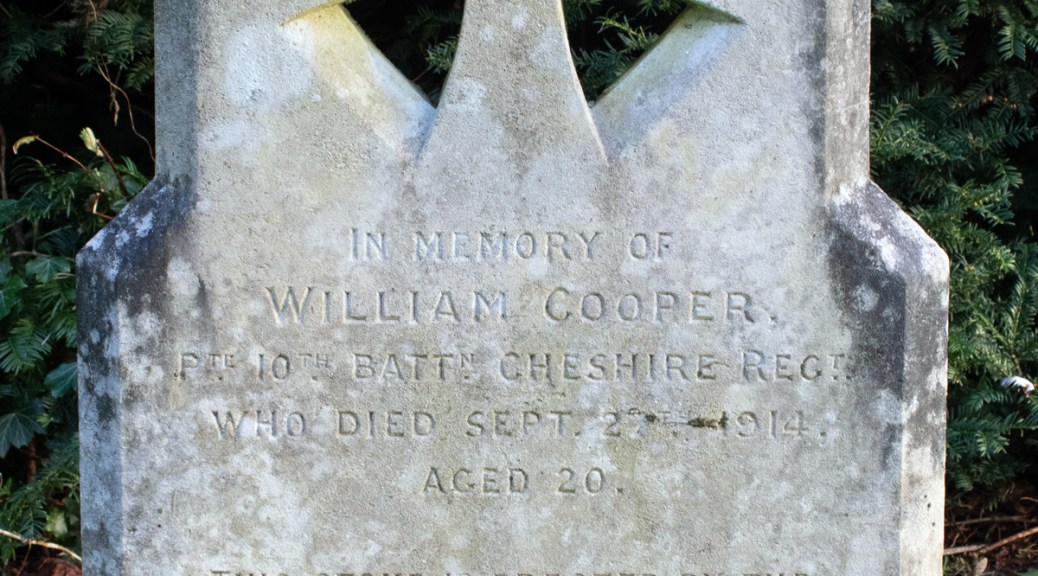
Private William Cooper

Private William Cooper

William Cooper was born in Mobberley, Cheshire, in 1894. Little information is available about his family life, but records suggest that his father was called John.

The first document that can be attributed to William is the 1911 census. This recorded him as living in Newton Hall Lane in Mobberley, with his widowed aunt and two cousins.

William’s trail goes cold again at this point, and can be picked up again when war broke out in the summer of 1914. He enlisted early on, joining the Cheshire Regiment. Attached to the 10th (Service) Battalion, his unit moved to Codford on the edge of Salisbury Plain, Wiltshire, by September.

William Cooper… was taken suddenly ill while on parade on Sunday morning at 8.30, and dropping out of the lines, was carried to the Army Medical Corps tent in the Chitterne Road, but on arrival there death had already taken place.

Lieutenant Spraight, of the Army Medical Corps, stated having examined the body of deceased, want he came to the conclusion that death was due to asphyxia and an epileptic fit.

[Devizes and Wilts Advertiser: Thursday 1st October 1914]

Private William Cooper died on 27th September 1914: he was just 20 years old when he died. It seems that his family were unable to cover the cost of the funeral: he was laid to rest in the peaceful graveyard of St Mary’s Church, Codford, his headstone being erected by his comrades in the battalion.


Private William Moore

Private William Moore

On Saturday last an inquest was held at the Seaman’s Institute on the body of Gunner Wm. Moore, RNTS.

Mrs Brennan, sister of the deceased, stated that he was 43 years of age, and lived when off duty with her at Somerville, Seacombe, Cheshire. He joined the Royal Marine Light Infantry over 20 years ago.

Mr R Sussex Langford, Lloyd’s agent, stated that he saw deceased on landing. He help to get him into a cart, but found he was too ill to travel that way, so he had him put on an ambulance and taken to the Royal National Mission for Deep Sea Fishermen, and immediately sent for the doctor. Deceased was semi-conscious and very sick. He was a gunner from a torpedoed ship. Deceased died on Thursday [25th July 1918] at 6 o’clock.

Dr Sargent stated that he was called on the 23rd to see deceased, and found him semi-conscious, complaining of great pain in the abdomen and vomiting. He lay in that condition until the 25th, when death took place. The cause of death was acute traumatic peritonitis, the result of injuries received by the explosion of an enemy torpedo.

[Newquay Express and Cornwall County Chronicle – Friday 02 August 1918]

Other than the details outlined in the newspaper report, little concrete information is available about the life of William Moore. The name does crop up in the 1891 census in Seacombe, Cheshire, and, if this relates to Gunner Moore, then he was one of five children to widowed lithographer Margaret Moore. Beyond that one census, however, it is not possible to find any more specific details.

William was on board the steam ship SS Anna Sophie in the summer of 1918, which was sailing from Rouen to South Wales, On 23rd July, she was torpedoed by the German submarine U-55 off Trevose Head, Cornwall. The Anna Sofie was sunk, Gunner Moore was one of those who subsequently passed from their injuries.

William Moore’s sister may not have been able to pay for her brother to be brought back to Cheshire for burial. Instead, he was laid to rest in Padstow Cemetery, and shares his resting place with another member of the crew, Lance Corporal William Whitmore.

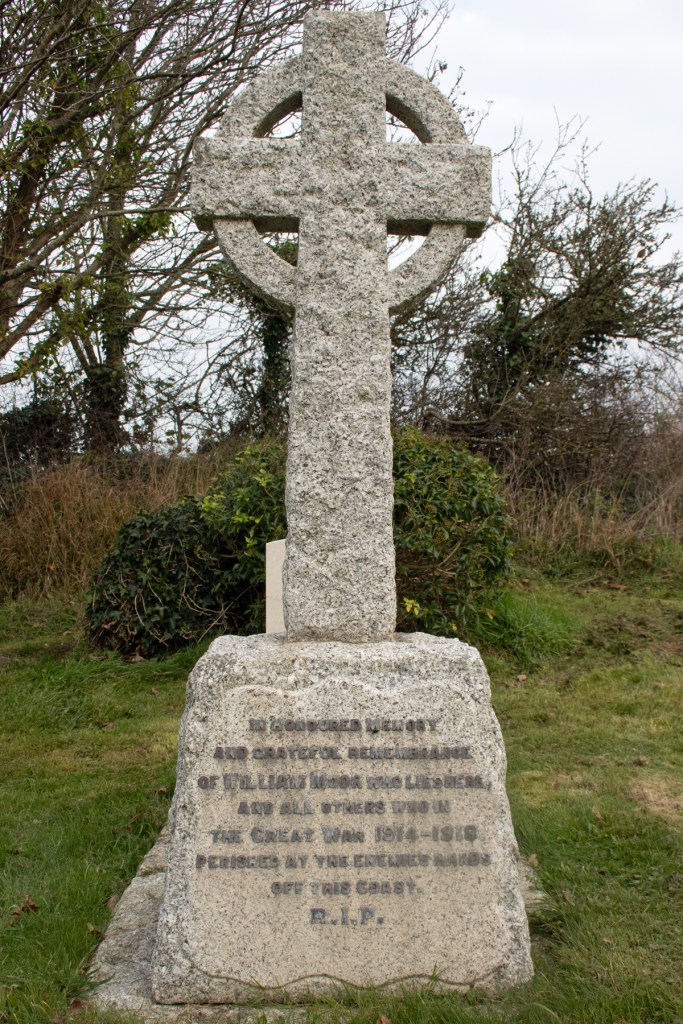
William’s headstone reads: “In honoured memory and grateful remembrance of William Moor [sic] who lies here, and all others who in the Great War 1914-1918, perished at the enemies hands off this coast. RIP.”


Private James Pyatt

Private James Pyatt

James Douglas John Pyatt was born in the spring of 1881 in Tranmere, Cheshire. The older of two children, his parents were Somerset-born John and Clara Pyatt. John was a coal merchant, and, by the time of the 1901 census, the family had moved back south, settling in the Clifton area of Bristol.

According to that census record, the family were living at 33 Pembroke Road, which Clara ran as a boarding house. James, by this point, was employed as a butcher, while his younger brother, Hubert, was a grocer. At the time the census was taken, the family had two boarders: Emmeline Blake, who was a music teacher, and Archibald Archer, a dentist.

Happiness is Bristol was destined to be short-lived. John died in 1902, aged just 49 years old. The same year, Hubert emigrated to Canada, settling in Brandon, Manitoba. Clara and James both followed the following year, setting up home in the same town.

Clara died in December 1908, but not before seeing both of her sons marry, James to Edith Gillam in June 1907, and Hubert to Lilian Pearce twelve months later.

James was working as a shipping clerk for a brewery by this point, and he and Edith were living on Park Street, to the east of the city. This was an ideal spot for their young family – John, born in 1908, Sidney, born in 1912, and Dennis, born in 1914 – as it overlooked a park and had space around it. Hubert lived down the road with his own family, so the brothers still had each other close by.

When war came to Europe, James felt compelled to play his part for King and Empire. He enlisted in the Canadian Expeditionary Force on 7th July 1915. Private Pyatt’s service records confirm that he was 33 years of age, and stood 5ft 10ins tall. He was noted as having brown hair, brown eyes and an average complexion.

James arrived back in England on 25th March 1916. Once there, he was attached to the 44th Battalion of the Canadian Infantry and by August that year, he was stationed on the Western Front. That autumn, however, he was dogged by illness and was admitted to field hospitals four times, suffering from diarrhoea, myalgia twice, and laryngitis.

By the start of 1917, however, Private Pyatt was back to full fitness. Details of his service over the next couple of years are unclear, although he remained on the Front Line. In December 1918, James was back in England on leave, and had returned to Somerset, possibly to see friends or relatives.

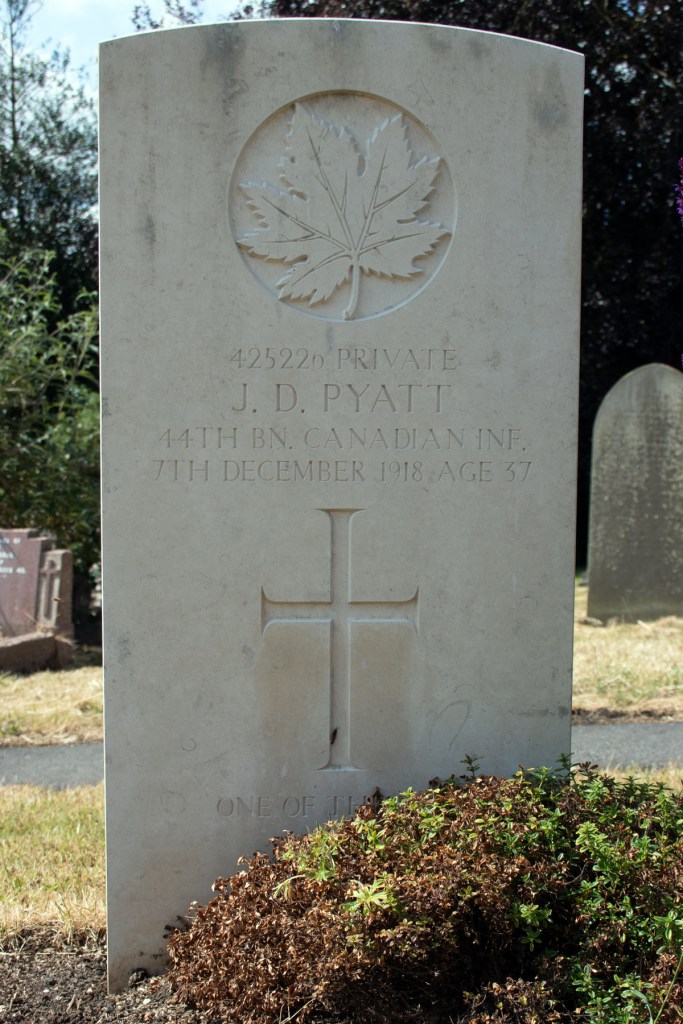
While here, James contracted influenza, and was admitted to the Bath War Hospital. The condition was to get the better of him, however, and he died on 7th December 1918, days after going in. He was 37 years of age.

With his surviving immediate family all in Canada, James Douglas John Pyatt was laid to rest in Locksbrook Cemetery, Bath, not far from the hospital in which he had passed away.


Lance Corporal John Harris

Lance Corporal John Harris

John Henry Harris was born at the turn of 1879, the oldest of eight children to John and Florence Harris. John Sr was a mason’s labourer from Somerset, and his and Florence’s three oldest children were born in Bishop’s Hull, near Taunton. By 1890, however, the family had moved to Monkton Combe, on the outskirts of Bath, presumably to follow John Sr’s work, and this is where they settled.

When John Jr completed his schooling, he followed in his father’s trade and when the 1901 census return was completed, he was employed as a mason’s labourer, while his father had moved into carpentry.

Florence died in April 1901, and six years later, John Sr remarried. His new wife was Ann Gibbs, and the couple went on to have three children, new half-siblings to John Jr.

In the autumn of 1905, John Jr married in Eliza Mundy, a cowman’s daughter from Monkton Combe. The couple settled in a small cottage on Mill Lane, and had a son, Frank, who was born in 1907. By this point, John had found new employment as a gardener to the local vicar, Reverend Pitcairn.

When war came to European shores, John quickly stepped up to enlist. He joined the 7th Battalion of the Somerset Light Infantry and arrived in France in July 1915 after his training.

Private Harris was wounded during the opening weeks of the Battle of the Somme, but recovered and returned to the Front Line. He was promoted to the rank of Lance Corporal, but in March 1917 he was wounded again. “A piece of his steel helmet was driven into his head at the temple, and little hope of his recovery was entertained from the first.” [Bath Chronicle and Weekly Gazette: Saturday 24th March 1917]

Medically evacuated to Britain, Private Harris was admitted to a hospital in Stockport, Cheshire. His “wife (who has been dangerously ill in hospital), Mr John Harris (his father) and a sister proceeded to Stockport, but, unfortunately, did not arrive until shortly after death had occurred.” [Bath Chronicle and Weekly Gazette: Saturday 24th March 1917]

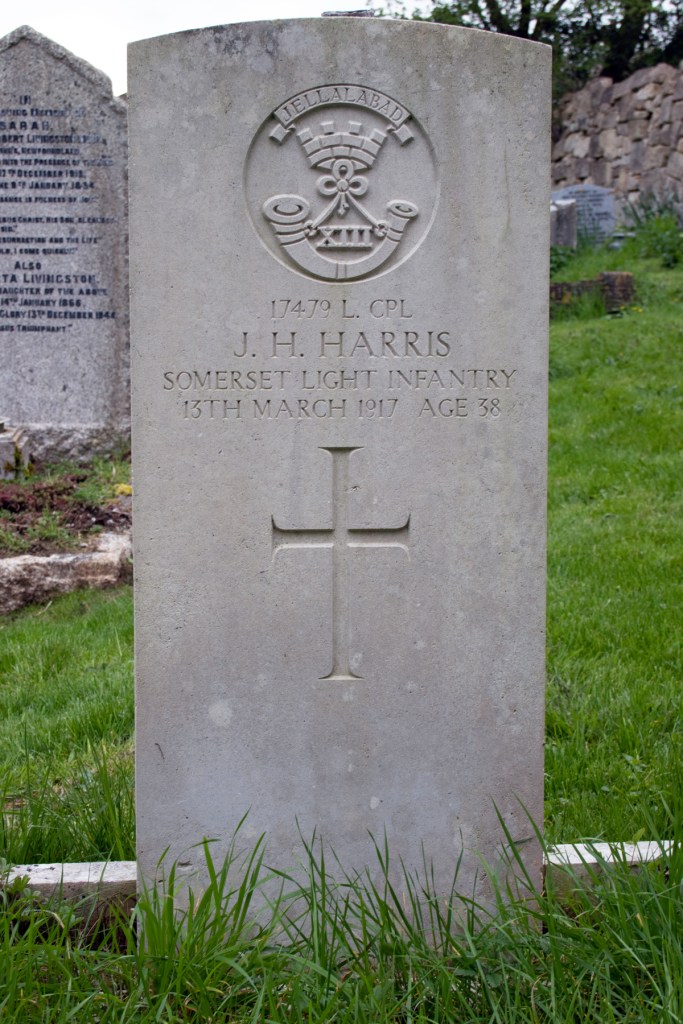
Private Harris passed away on 13th March 1917, at the age of 38 years of age.

John Henry Harris’ body was brought back to Monkton Combe for burial and he was laid to rest in the peaceful graveyard of St Michael’s Church, his funeral being officiated over by his former employer, Reverend Pitcairn.


Eliza went on to marry again, wedding Walter Giggs in 1921. The couple went on to have a daughter, Margery, who was born two years later. Eliza lived on until 1949, when she died at the age of 69 years old. She was also laid to rest in St Michael’s Churchyard.


Private Thomas Clarke

Private Thomas Clarke

Thomas Clarke was born on 18th July 1893 in the Cheshire town of Altrincham. The second of nine children, his parents were Irish-born couple Thomas and Mary Clarke. Thomas Sr worked in the building trade as a bricklayer, but, by the time of the 1911 census, his older children had found other trades. His oldest child, Nora, was a shop assistant, Thomas Jr was a shorthand typist, while the next two Clarke children worked in the printing industry.

Thomas Jr, however, wanted to see the world and, on 3rd October 1911, he took his first step towards that aim, enlisting in the Royal Marine Light Infantry. His service records note that he was 5ft 6ins (1.68m) tall, had blue eyes, fair hair and a fresh complexion. They also record a scar on his left hand and a tattoo on his right arm.

Private Clarke was first sent for training in Deal, Kent, and his swimming ability tested there on 6th December, presumably in the freezing English Channel. In August 1912 he moved to barracks in Portsmouth, Hampshire. Over the next couple of years, he served on two ships – HMS Prince of Wales and HMS Dido – returning to the Royal Naval Dockyard in Portsmouth after each assignment.

In July 1914, Thomas was assigned to the battleship HMS Bulwark. The ship patrolled the English Channel when he first came on board. By that autumn, however, she had moved to North Kent, guarding the waters around the Isle of Sheppey against potential German invasion.

Thomas was on board Bulwark on the morning of 26th November 1914, when an explosion ripped through the ship and sinking it. More than 740 lives were lost, Private Clarke among them. He was just 21 years of age.

Thomas Clarke was laid to rest in a marked grave in Woodlands Cemetery, Gillingham, not far from a mass grave where scores of his colleagues had been buried.


Note: While Thomas’ surname is spelt Clark on his headstone, all documents relating to him – and the Commonwealth War Graves Commission website – give the correct spelling as Clarke.


Lance Corporal Colin Clarke

Lance Corporal Colin Clarke

Colin Lewis Clarke was born in the spring of 1879 in Cardiff, South Wales. He was one of seven children to Bernard and Elizabeth Clarke. Bernard was a carpenter, but after Elizabeth died in 1886, he took over the running of the Windsor Hotel in Penarth.

When he left school, Colin found work as a clerk. Bernard also died in 1908, and the 1911 census records Colin and his brother Thomas living with his sister, Beatrice. They were sharing the house with Beatrice’s second husband, Charles, and her six children from her first marriage in the Cheshire village of Poulton.

Colin’s trail goes tantalisingly cold at this point. When war broke out, he enlisted to play his part, joining the 16th (Transport Workers) Battalion of the York and Lancaster Regiment by the summer of 1916. This troop was a territorial force, and Private – and then Lance Corporal – Clarke was based in the Yorkshire Dales.

At some point during the autumn Colin fell ill, and was admitted to the Military Hospital in Middlesbrough. His condition is unclear, but he was to succumb to it, passing away on 5th November 1916, the age of 37 years old.

Colin Lewis Clarke’s body was brought back to Wales for burial. He was laid to rest in the graveyard of St Augustine’s Church in Penarth, Glamorganshire.


Lieutenant Alan Lloyd

Lieutenant Alan Lloyd

Alan Edward Lloyd was born in around 1899, the second of five children – all boys – to William and Edith Lloyd. Both of his parents were Welsh, and his older brother was born in Cardiff. Railway clerk William moved around the country with work, however, and Alan was born in Lydney, Gloucestershire, his younger brother in Paddington, London, and his two youngest siblings were born in Windsor, Berkshire.

There is little information about Alan’s early life; what is clear is that, by the autumn of 1918, he had been in the army, reaching the rank of Lieutenant. He transferred across to the newly formed Royal Air Force and, in December that year was training as a Flight Cadet at Shotwick Airfield near Chester.

On the 4th December, Alan was flying his Sopwith Camel, when he got into a flat spin; the aircraft crashed and Alan was killed. He was just 19 years old.

Alan Edward Lloyd was brought to Devon – where his family were now living – for burial. He was laid to rest in the graveyard of All Saints Church in Highweek, near Newton Abbot.


Lieutenant Alan Lloyd
(from ancestry.co.uk)

Guardsman Joseph Steadman

Guardsman Joseph Steadman

Joseph Richard Steadman was born in Ellesmere Port, Cheshire, in 1892. One of seven children to William and Mary Ann Steadman, his father worked as a slab maker for the local council.

Sadly, Joseph’s mother died in 1899, at the age of just 40. William had moved the family to Birmingham by this point, and, on leaving school, Joseph found work at a jeweller’s as a scratch brusher.

Moving to London, Joseph met Ethel May Tambling, who was originally from Somerset, and the couple married at the beginning of 1914. Ethel already had a child – Frederick – and the young couple also had a son, Alfred, who was born in July 1914.

War was on the horizon, and Joseph was quick to enlist. He joined the Coldstream Guards, embarking for France a month after Alfred was born. An elite force, the Coldstream Guards were involved in some of the heaviest fighting of the war, including the Battles of Mons, Ypres, Loos, Somme, Passchendale and Cambrai. It is likely that Guardsman Steadman was caught up in many of these engagements.

His luck was to run out, however, and Joseph was injured towards the end of October 1917. Shipped back to England for treatment, he was admitted to the King George Hospital in London. Sadly, Guardsman Steadman did not recover from his wounds; he died on 1st November 1917, aged just 25 years old.

Joseph Richard Steadman lies at rest in the Wembdon Road Cemetery in Bridgwater, Somerset.


Joseph and Ethel Steadman (from Ancestry.com)

As a sad aside to this story, two of Joseph’s brothers also died in the war. William Steadman was 29 when he was killed at Ypres in April 1915, while Charles Steadman was just 19 when he died at Armentieres.