Category Archives: Kent

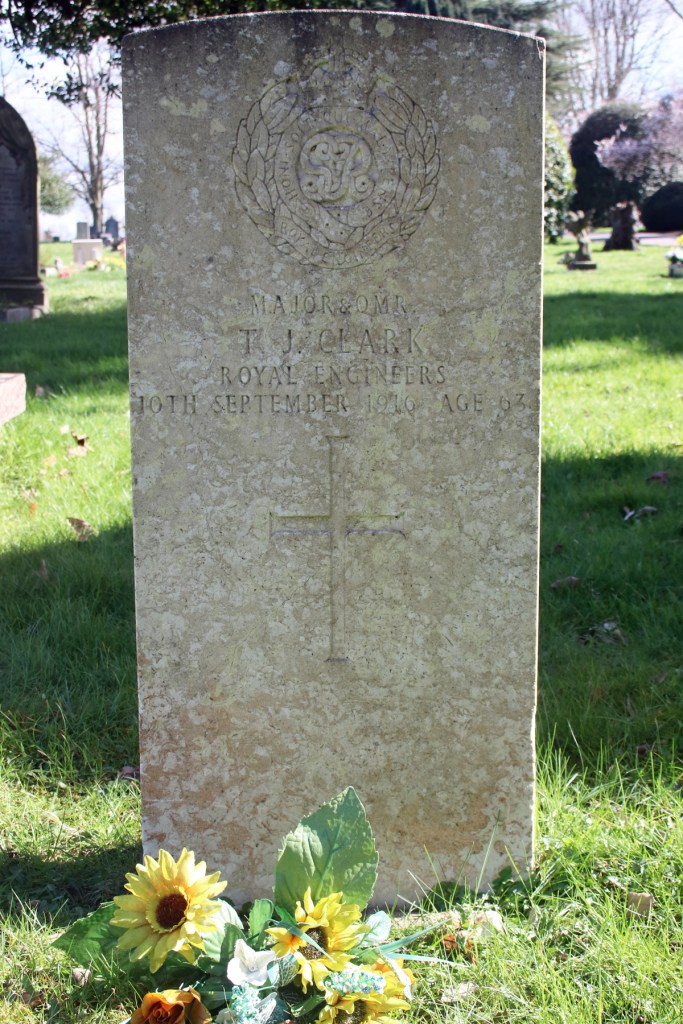
Major Thomas Clark

Major Thomas Clark

Thomas James Clark was born in Worcester at the beginning of 1853, the oldest of two children to James Clark and his wife Sarah. James was an engine smith and gas fitter, and moved the family with his work, initially to London, then on to the Kent coast.

Documentation relating to Thomas’ early life is difficult to track down; the 1871 census has him listed as a gas fitter like his father, but it is likely that he enlisted in the army fairly shortly after this date.

In 1875, he married a woman called Emily Ann. There life was to take on a grand new adventure as their first child, a boy named after his father, was born in Bombay, India, later that year.

It seems likely that it was Thomas’ military service that took the young family overseas. This was to be the case for at least a decade, as Emily gave birth to four further children in India. James, their fifth child, was born in Bombay in 1884. Their sixth, and last child, Ellen, was born in Gillingham, Kent, ten years later.

Given that the standard time for military service was twelve years, it is possible that Thomas served all of that time overseas, returning to England in around 1887.

Back home in Kent, Thomas is given the commission of Quartermaster in November 1897. By this point, he has been in the Royal Engineers for just under 21 years. He and his family are living in central Gillingham, within easy walking distance of the Royal Engineers Barracks and School of Engineering.

The 1901 census also lists Thomas as Quartermaster for the regiment, while three of his sons are by this time working in the Naval Dockyard as shipwrights and engine fitters.

Ten years later and the family are still living in the same house. By now, and aged 57, Thomas is recorded as a Retired Captain and Quartermaster for the Royal Engineers. He and Emily have been married 36 years, and their three youngest children (now aged 29, 26 and 17) are still living with them.

War was looming by now, although, age 61 when it broke out, it is unlikely that Retired Quartermaster Clark would have been involved in any front line activity. While no military records survive for Thomas, it seems possible that he may have been recalled for a training or administrative role at the barracks nearby.

Any re-commission would not have lasted for long, however, as Quartermaster Clark passed away at home on 10th September 1916. He was 63 years old.

Thomas James Clark lies at peace in the Woodlands Cemetery in Gillingham, Kent.


Thomas’ widow, Emily, passed away just two years after her husband. She was also laid to rest in the Woodlands Cemetery.

Thomas left his estate in the hands of his youngest son, James, who was still living at his parents’ home when they passed away.


Petty Officer 1st Class Albert Brooks

Petty Officer Albert Brooks

Albert Brooks was born in February 1877 in Cambridge. Sadly, a lot of the documentation for his early life is lost to time, but he enlisted in the Royal Navy in July 1893, at the rank of Boy 2nd Class.

He formally enrolled in naval service in February 1895, initially for a period of twelve years. Beginning as an Ordinary Seaman aboard HMS Thunderer, during his initial time in the navy, he was promoted to Able Seaman and then Petty Officer 2nd Class, while serving on vessels including Hawke, Wildfire, Eclipse and Vernon.

In 1904, Albert married Rosina Wise. A couple of years younger than her new husband, she had been born in Camberwell, South London. The couple had a daughter, Gwendoline, and they set up home in Gillingham, Kent, where Albert was based when not at sea.

War was on the horizon, however, and Petty Officer Brooks’ naval service was extended until the end of the conflict.

Albert was promoted to Petty Officer 1st Class, and continued his service on vessels that included Andromache, London and Hibernia. He transferred to what would be his final ship, HMS Agamemnon, in November 1917.

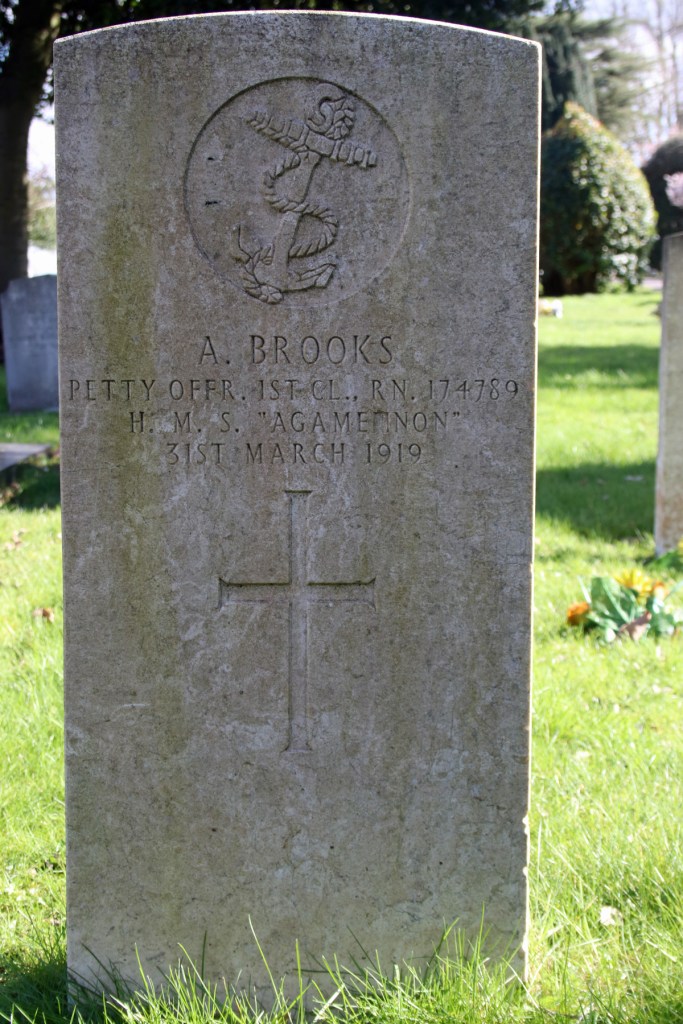
Petty Officer Brooks served aboard Agamemnon for eighteen months, but it was while stationed at the Naval Dockyard in Chatham that he fell ill. He passed away from aortic disease of the heart – more than likely a heart attack or cardiac arrest – on 31st March 1919. He had just turned 42 years of age.

Albert Brooks lies at rest in the Woodlands Cemetery in Gillingham, Kent.


Chief Stoker Ernest Ware

Chief Stoker Ernest Ware

Ernest George Ware was born in the autumn of 1871 in Marylebone, London. Details of his early life are scant, but records show that he enlisted in the Royal Navy in February 1895, serving as a Stoker for an initial period of twelve years.

During this time, he worked on a number of different vessels – Wildfire, Theseus, Warspite, Amphion, Acheron and Sapphire. He was also based on a number of shore vessels; potentially Southsea in Hampshire and Pembroke in Wales.

In 1905 he married Mary Emery; she was the same age as Ernest, and was born in Hampshire. The young couple had a daughter, Muriel, and, by the time of the 1911 census, the family were living in Pembroke Dock, in South Wales.

War was inching closer, and Stoker Ware’s service was extended for the duration; he served on a number of other vessels – Leander, Blenheim, Blake and Tyne – before being promoted to Chief Stoker on HMS Blonde in 1911. He transferred to HMS St George two years later, before moving on shore to the training vessel HMS Victory II (based in Crystal Palace, South London) in 1915.

Chief Stoker Ware’s health seemed to have been in decline by this point; he was admitted to the Royal Naval Hospital Haslar in Gosport in early 1916, suffering from malignant endocarditis. Sadly, he passed away on 16th February, aged 44 years old.

Ernest George Ware was buried in the Woodlands Cemetery in Gillingham, Kent, close to where his widow was now living.


Private Richard Taylor

Private Richard Taylor

Richard Edmundson Taylor was born in 1895, one of nine children to Frederick and Emma Taylor. Frederick was from Portsmouth, Emma from Blackburn, but the couple had settled their family in Kent, where Frederick worked as an engineer and pattern maker at the Naval Dockyard in Chatham.

When he left school, Richard took work as an apprentice photographer – his older sister Mildred worked as a re-toucher in the same studio. The 1911 census reveals that his eldest sister, Alice, was working as a governess; the family of eleven were living in a small terraced house in Seaview Road, Gillingham – a road that, ironically, had no view of the nearby River Medway or Thames Estuary.

At this point, Richard’s trail goes cold. He enlisted in the Royal West Surrey Regiment – also known as the Queen’s – but there is no documentation to confirm when this was.

Private Taylor’s battalion, the 2/4th, would go on to fight at Gallipoli, but he would not have been involved, and, more than likely, did not see any overseas service. The prefix to his service number (T/2711) may well have indicated he was in training when he passed away, although, again, there is no physical evidence to confirm this.

Nor is there any indication of the cause of Private Taylor’s death. His name does not appear on any contemporary newspaper reports, so it is unlikely that it was due to any misadventure; more probably, he passed away from one of the many communicable diseases that became common in the training camps of the 1910s.

Whatever the cause, Private Taylor died at home on 4th February 1915. He was just 19 years old.

Richard Edmundson Taylor lies at rest in the Woodlands Cemetery in his home town of Gillingham, Kent.


Sergeant Ernest Coombs

Serjeant Ernest Coombs

Ernest Frederick Coombs was born in the summer of 1866. One of four children to cabinet maker Frederick Coombs and his wife Julie, the family lived in Leatherhead, Surrey.

Unfortunately, the documentation around Ernest’s life is a little scattered. What we do know is that he married Alice Amelia Kinnear in June 1889, and the couple went on to have fourteen children.

Jumping forward, and by the time of the 1911 census, the family were living in a small terraced house on the outskirts of Dover. Ernest listed his trade as a canteen managed for a provision merchant.

Sadly, Ernest’s military records are also lost to time. He enlisted in the Royal Marines Light Infantry, and was promoted to Serjeant during his time there.

The only other information available about him comes from the obituaries section of a local newspaper in March 1917:

COOMBS: On February 13th, at the Royal Naval Hospital, Chatham, after a short illness, Ernest Frederick Coombs, aged 50 [sic] years (late of 14 Leighton Road, Dover). RIP

Dover Express: Friday 2nd March 1917

Ernest Frederick Coombs was actually 49 when he died; he lies at rest in the Woodlands Cemetery in Gillingham, Kent.


Ernest’s grave was also the last resting place for his youngest son, Raymond, who died aged just twelve years old, two months after his father, and his widow, Alice, who passed away in 1954, at the age of 82.


Serjeant Frederick Wickens

Serjeant Frederick Wickens

Frederick Albert John Wickens was born in Newbury, Berkshire, in the summer of 1889. The oldest of four children to Alfred and Emily Wickens, his father was a brewer’s labourer.

The military life proved more of a draw to Frederick, however. While his full records no longer exist, by the time of the 1911 census, he was recorded as being a Sapper with the 2nd Field Troop of the Royal Engineers. He was based at Potchefstroom, around 75 miles (120km) south east of Johannesburg in South Africa, and his trade was listed as a tailor.

Sadly, it is at this point that Frederick’s trail goes tepid, if not cold.

From a personal perspective, he married a woman called Rose, who was a year younger then him. Her details are scarce, and there is nothing to confirm when or where they married (other than the 1911 census, when Frederick was listed as ‘single’).

The couple must have had some connection to Gillingham, as this is where they lived; given the proximity of the Royal Engineers Barracks in neighbouring Chatham.

Sapper Wickens’ military service continued into the Great War. He was awarded the medaille militaire by Belgium, and achieved the rank of Serjeant during his career. Unfortunately, there are no details of the actions around either the award or his promotion.

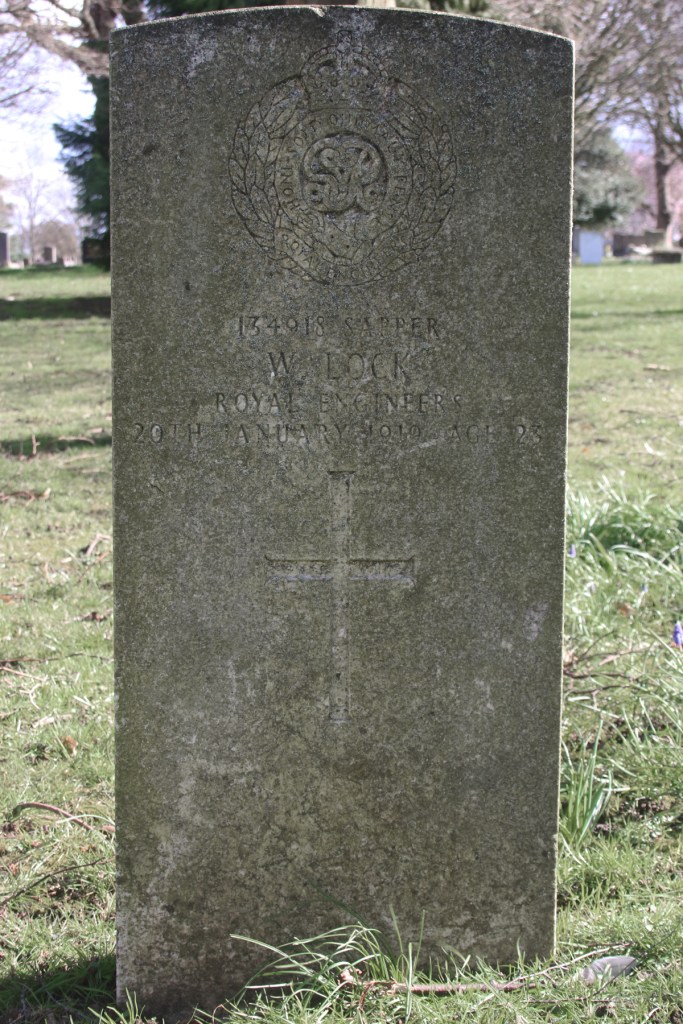
Serjeant Wickens passed away on 27th February 1921; he died in Chatham, although the cause was not recorded. He was 31 years old.

Frederick Albert John Wickens lies at rest in the Woodlands Cemetery in Gillingham, Kent.


Frederick’s younger brother Thomas, also served in the Great War. He enlisted in the Princess Charlotte of Wales’s (Royal Berkshire) Regiment, and was involved in the battles on the Western Front. Sadly he was killed in the fighting on 24th May 1916, at the age of 19 years old.


Musician Henry Selley

Musician Henry Selley

Henry Louis Selley was born in 1876, one of nine children to Richard and Mary Ann Selley. His father was an agricultural labourer and the family lived in Exminster, Devon.

Initially, Henry followed his father in becoming an agricultural labourer, but the military life seems to have sparked an interest. While Henry’s military records no longer exist, he is recorded as having completed 24 years’ service with the Royal Engineers at the time of his death. He would have enlisted, therefore, in around 1897, when he was about 21 years of age.

As to his duties while in the military, these can only be guessed at. He is intriguingly noted as Musician, although there is no documentation to expand on Henry’s role any further. There were many professional musicians in the army, and they performed table music, serenades, and home concerts, mainly for high-ranking officers.

Musician Selley’s role may also have to be set timing for marches, etc, although, again, this is purely speculation on my part, as there is no evidence to suggest this was the case.

Henry married a woman called Constance in 1905; she had been born in Devon, but there is no further information on her. The 1911 census records the young couple as living in a terraced house not far from the Royal Engineers Barracks, where Henry would have been based. The couple did not go on to have any children.

And there, Musician Selley’s trail goes cold. The next that he appears in any documentation is in 1921, when his army pension record confirms that he passed away. He had been admitted to the Royal Herbert Hospital in Woolwich with pulmonary tuberculosis, and succumbed to the disease on 26th May 1921. He was 45 years old.

Henry Louis Selley lies at rest in the Woodlands Cemetery in Gillingham, Kent.


Chief Artificer James Davidson

Chief Artificer James Davidson

There are some lives that just don’t want to be discovered, that just hide tantalisingly out of reach. James Davidson’s was one of those lives.

The main two research websites I use – cwgc.org and findagrave.com – only have his initial and surname, which is understandable, as this is what is inscribed on his headstone. Unfortunately, that doesn’t act as a good base on which to carry out further research.

HMS Gunner was the wartime moniker for Granton Harbour, near Edinburgh. A naval history website managed to identify Chief Artificer Davidson’s first name – James – but again, with no other information to go on, this is still too common a name – particularly in Scotland – to narrow down any real results.

Sadly, then, the story behind James Davidson is destined to remain a mystery. All that can be confirmed for certain is that he passed away on 23rd January 1919, though the cause of his passing is lost to time, as is his age.

James Davidson lies at rest in the Woodlands Cemetery in Gillingham, Kent.


Private George East

Private George East

George East was born in 27th May 1879 to George and Agnes East. Agnes was George Sr’s second wife, which led to George Jr having four siblings and a further eight half-siblings. George’s father was a painter and handyman, who sadly passed away when his son was only seven years old.

Sadly, a lot about George remains a mystery, as a lot of documentation about him no longer exists. The snippets that are available give a tantalising glimpse into his life.

He married a woman called Jessie, and they had a daughter, Vera, who was born in July 1912.

George enlisted in the Royal Marine Light Infantry on 29th September 1915, and served at the Naval Dockyard in Chatham, Kent. Private East was based there for most of the war, but fell ill, succumbing to stomach cancer on 22nd June 1918. He was 39 years old.

George East lies at peace in the Woodlands Cemetery in Gillingham, Kent.


Captain Francis Cowley

Captain Francis Cowley

Francis Llewellyn Cowley – also known as ‘Frank’ was born in July 1877 on the Isle of Man. He was one of ten children to Thomas and Ann Cowley, farmers who owned 133 acres on the northern tip of the island.

Frank’s trail goes cold for a few years; he was still living on his father’s farm in 1891, but by 1913, had moved to to the mainland, settling in Kent.

It was here, in Gillingham, that Frank married Lily Matilda Carrington in the summer of 1913. Sadly there is little information about Lily, but the couple do not appear to have had any children.

Frank enlisted shortly after war broke out; he joined the Royal Engineers on 27th October 1914, and within a couple of years has reached the rank of 2nd Lieutenant.

Sadly again at this point Frank’s trail goes cold. He next appears in a newspaper article from 1st March 1919, when he is listed as having attended the funeral in Rainham, Kent, of Air Mechanic Herbert Holdstock. He is now listed as Captain F Cowley RE.

That was resolved to be a tantalising glimpse into Captain Cowley’s final few weeks. From this point, all the documents tell us is that he worked at the School of Military Engineering in Chatham.

Frank passed away on 18th March 1919, although no cause of death is recorded. He was 41 years old.

Francis Llewellyn Cowley lies at rest in the Woodlands Cemetery close to his home in Gillingham, Kent.