Harold William Vernon was born on 23rd March 1896. The older of two children, his parents were John and Julia Smith. Harold’s early life is a bit of a mystery: the 1901 census found him living with mother, who was running their newsagent and tobacconist on Wilberforce Road, in their home town of Leicester, Leicestershire. John is absent from the census, and Julia died in 1908. On the following census return, taken in 1911, all of the remaining members of the Vernon family are noticeable only by their absence.
In January 1913, Harold joined the Royal Navy. He had been working as a turner by this point, but a life on the oceans seemed too good an adventure to pass up. Und the age to formally enlist, he was given the rank of Boy 2nd Class, and sent to HMS Vivid, the Royal Naval Dockyard, for his training.
Boy Vernon must have shown promise, because he was promoted to Boy 1st Class just four months after enlisting. He was assigned to the battleship HMS Prince of Wales in May 1913, and transferred to HMS Bulwark, another battleship, that autumn. In March 1914, Harold came of age, and was formally inducted into the Royal Navy. His service papers show that he was 5ft 3ins (1.6m) tall, with light brown hair, brown eyes and a fresh complexion. He was also recorded as having a scar on the middle of his right arm, a large mole above his navel and two further moles on either side of his neck.
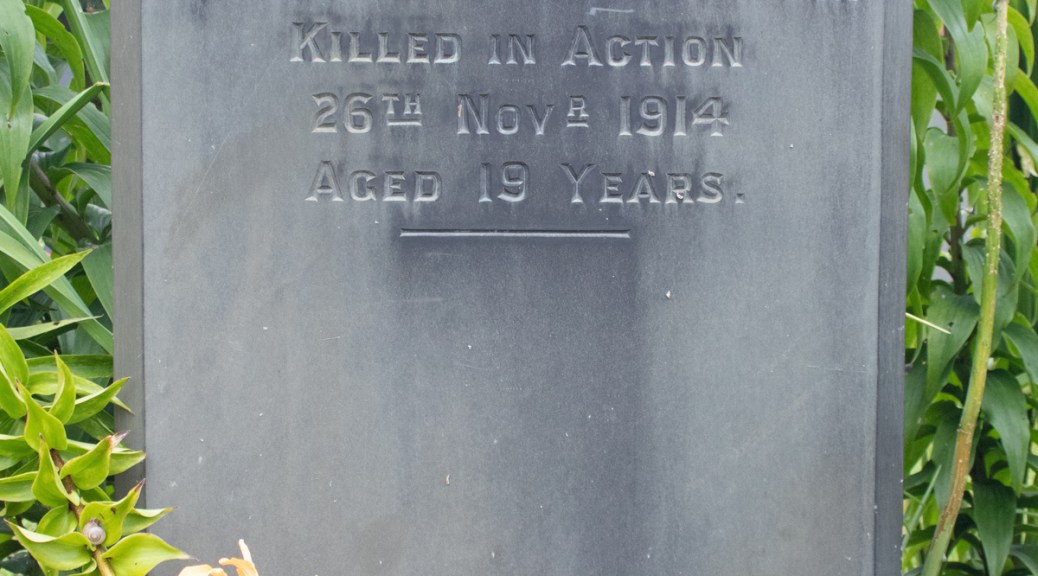
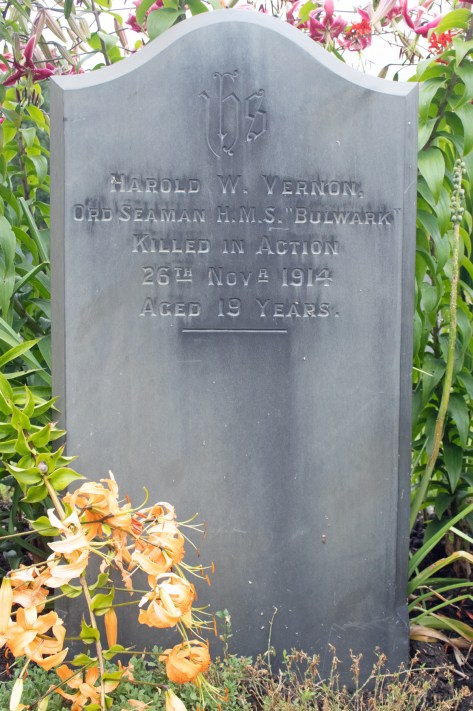
When war broke out, Bulwark was assigned to the Channel Fleet, whose task was to protect Britain’s southern shores. On 26th November 1914, she was moored in the River Medway, close to Sheerness, and was being reloaded with ammunition. Deep in the ship’s stores, a number of the charges overheated and detonated, causing a chain reaction in the bowels of the battleship. The resulting explosion ripped through the battleship, and more than 740 crew were killed. Ordinary Seaman Vernon amongst them: he was just 18 years of age.
A mass funeral was held in the Woodlands Cemetery, Gillingham, Kent, not far from the dockyard in Chatham. Harold William Vernon was laid to rest in a marked grave, a burial not afforded to the those unfortunate individuals whose bodies had not been identified.
John Henry Bellamy was born in Leicester, Leicestershire, on 14th August 1890. The oldest of four children, his parents were Joseph and Alice Bellamy. Joseph worked as an iron moulder, and the couple lived at 70 Friars’ Causeway when their first child was born.
By the time of the next census, taken in 1901, the Bellamy family had moved, and were living at 19 Pingle Street. Close to the river, this was presumably also close to the foundry where Joseph was employed. John sought a more regular income, however, and, on 22nd November 1907, he gave up his work as a shoe dresser, and enlisted in the Royal Marine Light Infantry.
John’s service records show that he was just over 5ft 5ins (1.65m) tall, with light brown hair, grey eyes and a fair complexion. He had a number of scars, including one by his left elbow and another on the right side of his chin.
Private Bellamy was sent to Deal, Kent, for his training. He spent a year at the Royal Marines base there, and this is where his ability to swim was tested. Over the next seven years, he would go on to serve aboard five ships, more often than not being based in Portsmouth, Hampshire, between assignments.
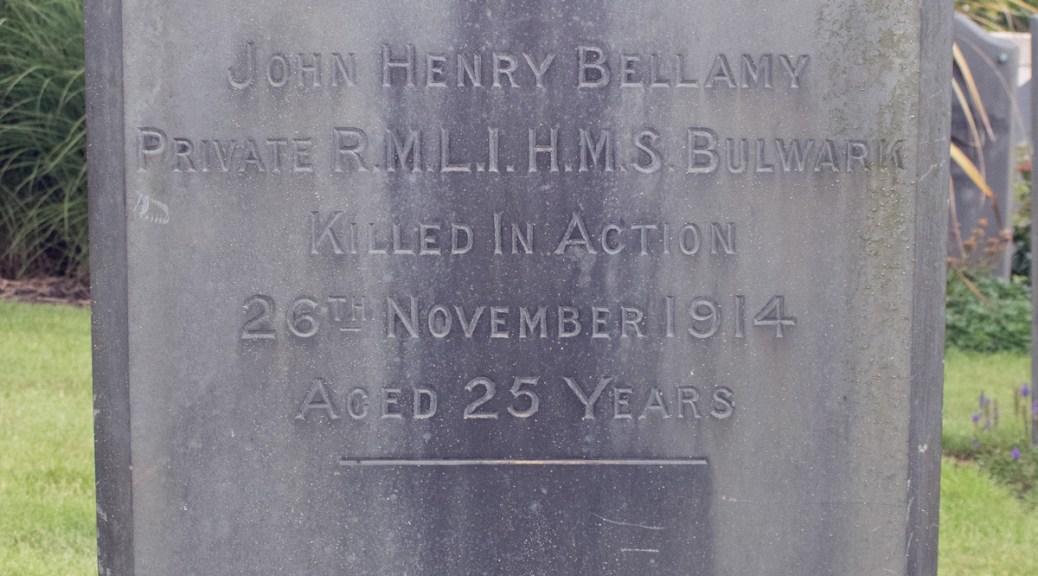
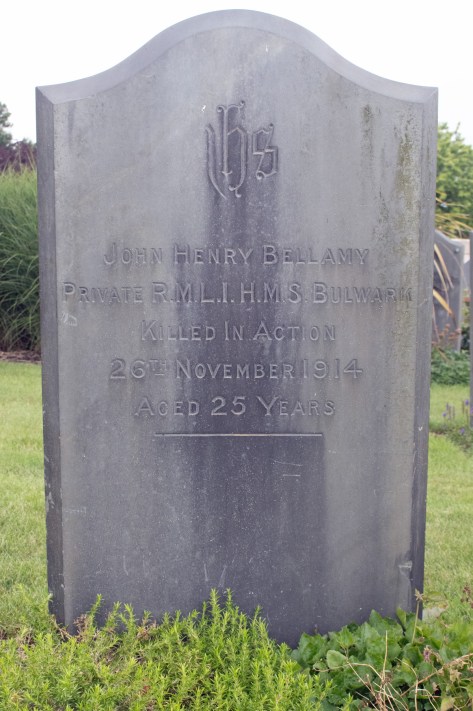
In July 1914, John was assigned to HMS Bulwark, and would remain with her for the next few months. Indeed, he was on board Bulwark on the 26th November 1914, when she was moored close to Sheerness, Kent. That morning, an explosion ripped through the ship, sinking it and killing more than 740 people. Private Bellamy was amongst them: he was just 24 years of age.
The body of John Henry Bellamy was laid to rest in a marked grave in the naval section of Woodlands Cemetery, Gillingham, Kent.
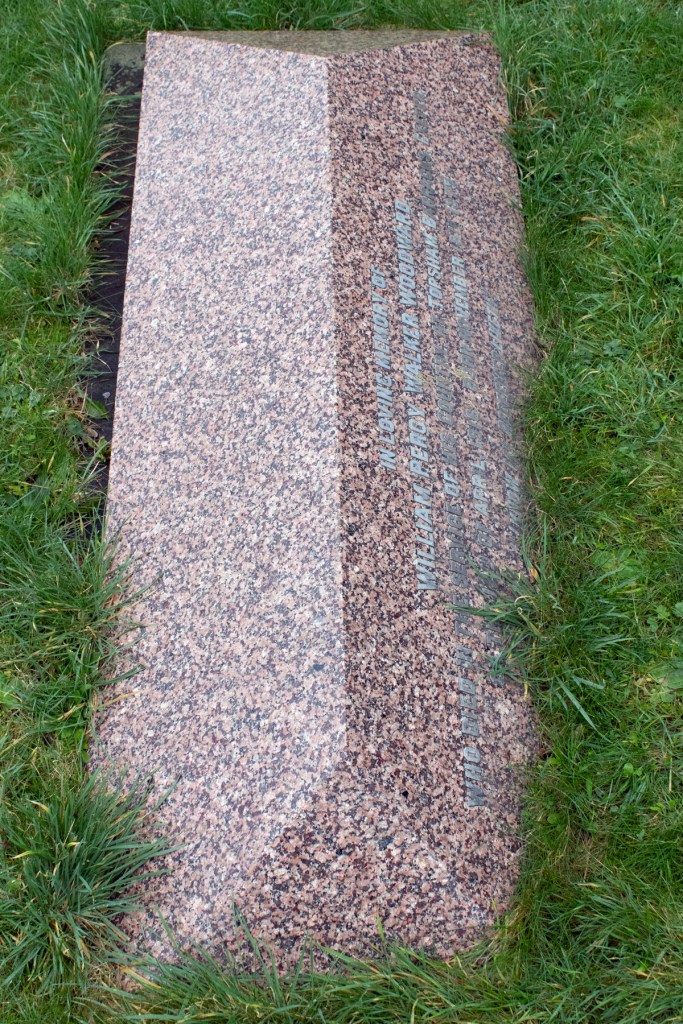
William Percy Walker Woodward was born on 18th November 1879, and was the third of six children to James and Mary Woodward. James was a manufacturer of sanitaryware and had been born in Derbyshire, but it was in Ashby-de-la-Zouch, Leicestershire that he and Mary raised their family.
James passed away in the spring of 1886, leaving Mary to raise the family on her own. His obituary in the local media underlined the business that he had built up: “Mr Woodward succeeded his father and eldest brother to the fire brick business, established by the late Mr John Hunt of Swadlincote, of 1790.In 1856 Mr Woodward added to the above trade that of glazed sewerage pipe and terra cotta earthenware, and in 1873 that of general sanitary appliances, and by industry, perseverance, and foresight developed the same into one of the largest manufactories of the kind in the Midland counties, and became well known throughout the greater part of the kingdom as a leading manufacturer of these goods. He was a large employer of labour, kind and considerate, always manifesting great interest in the welfare of his employees.” [Hinckley News – Saturday 15 May 1886]
Mary was left to raise six children, but, thanks to the business, did not do so without support. The 1891 census found the family living at High Fields in Ashby, with a cook, housemaid, children’s maid and a coachman and his family living next door. William and his siblings were all taught at home by their governess.
By the time of the next census, William seemed to have taken on the running of his late father’s business, along with two of his brothers, James and Harold. Things were to change for the Woodward family, however, as they began to go their separate ways.
The 1911 censes shows a divide: James was living on his own means in Snarestone, Leicestershire, with his young family and household retinue. Harold, meanwhile, had emigrated to Canada with another sibling, younger brother Ernest, where they had both set up as farmers.
Mary had also moved, setting up home in Weston-super-Mare, Somerset. She lived on Clarence Road South with William and her daughter, Lilian. The house – Glencathara – was twelve-roomed property, and they had a live0in cook, Emily Young, supporting them. Notably, William’s employment was listed as ‘none, on account of health’, so the move to the coast may have been brought about for medical reasons.
When war came to Europe in summer of 1914, William stepped up to play his part. His service records have been lost, but he had enlisted in the Royal Field Artillery no earlier than the autumn of 1915. He was attached to the 18th Reserve Battery, and came to be based in Topsham Barracks in Exeter.
Little is known of Gunner Woodward’s time in the army, but it was to be brief. He passed away, through causes unknown, on 13th April 1916, at the age of 36.
It is unclear where Mary was living at this point. The body of William Percy Walker Woodward was taken to Dorset for burial, and he was laid to rest in the peaceful graveyard of St Hippolyte’s Church, in Ryme Intrinseca. Interestingly, the parish records note that William was ‘a personal friend of [the] rector’.
Frederick Reginald Channing was born in the autumn of 1869, in Bath, Somerset. He was one of five children to carpenter Allen Channing and his dressmaker wife, Sarah. When Frederick was just a toddler, Allen moved the family south to Chard, and this is where his younger siblings were born.
When Frederick left school, he found work as a lace machine operator and, in fact, all of Allen’s children found work with their hands: Frederick worked alongside one of his brothers, while his two other brothers built on their father’s woodworking skills, one as a coachbuilder, another as a cabinet maker.
By the autumn of 1905, Frederick had moved back to Bath. This is where he met Elizabeth Scammell, a farm labourer’s daughter from Wiltshire. The 1901 census appears to record her as being a servant to a surgeon’s family in Wincanton, and this may have prompted a further move to the larger city where the couple met.
The couple married in Bath towards the end of 1905, and had a son, Frederick Jr, who was born in November the following year. Frederick Sr was doing general labouring work by this point, and the family had moved to Wedmore by the time a second boy, William, was born in 1910. Frederick and Elizabeth had a daughter, Eva, in 1911, and another, Gwendoline, in 1913, tragically, the same year that Eva died.
When war came to Europe, Frederick stepped up to play his part. He enlisted in September 1914, joining the Somerset Light Infantry as a Private. His service records confirm that he was 5ft 6ins (1.67m) tall, and weighed 154lbs (69.9kg). The document also gives his age as 35, although he was actually ten years older than that by this point.
Private Channing spent a year on home soil, during which time Elizabeth gave birth to their fifth child, Percival, who was born in May 1915. Based at a camp in Aylesbury, Buckinghamshire, he was hospitalised twice in this time, suffering from a contusion of his left shoulder.
By September 1915, Frederick was in France, and he remained on the Western Front, apart from when on leave, for the next three-and-a-half years. At some point during this time, he was promoted to the rank of Lance Corporal, and transferred across to the Royal Engineers.
Back at home, Elizabeth was doing her best to raise the family. She didn’t always do the right thing, though, and this resulted in her being taken to court.
Elizabeth Mary Rose Channing, 30… was indicted for having been delivered of a certain female child, did unlawfully by a secret disposition of the deceased child, endeavour to conceal the birth thereof at Wedmore the same day in the month of September 1916.
Mr Wethered prosecuted, and said that the prisoner was a married woman. Her husband was a soldier now on active service. He was last home on leave in April or May, 1917. Previously to that he had not been home for 18 months or two years, so the child could not have been his. Some boys found a parcel in the well, and they discovered the body of the child. The boys communicated with the police, who searched the well and found some pieces of carpet which agreed with a similar carpet in the possession of the prisoner. When arrested she confessed to the crime.
Frederick Channing, husband of the prisoner, said he was home on leave five months ago – May 27th. He went back on June 4th. Previously he had not been home for twenty months. He pleaded for the prisoner in the interests of their four children. He was very sorry for her to think she had thrown herself away like that.
His Lordship, addressing the prisoner, said that while her husband was away doing his duty for her any everybody, she was not faithful to him, and the result was the birth of the child which had been concealed and not revealed till a year afterwards. His Lordship understood that prisoner was already legitimately in a certain condition, and he did not wish her child to be born in prison. She would be sent to prison therefore for three months.
Wells Journal: Friday 26th October 1917
Elizabeth was released in February 1918, and the couple’s last child, Kathleen, was born the following month.
Frederick, meanwhile, returned to the Western Front. He remained in France through to the end of the conflict and beyond, only returning to Britain in February 1919, having fallen ill. Admitted to the North Evington War Hospital in Leicester with influenza, he remained there for two months.
In April 1919, Lance Corporal Channing was transferred to the Bath War Hospital, back in Somerset. This was presumably so that he could be closer to his family, although there is no evidence of whether he was fully reconciled with Elizabeth. His condition did not improve, however, and by this point he was also suffering from myalgia.
Frederick remained in hospital for eighteen months. As time passed, carcinoma of the liver was identified, and this, eventually, was the condition that would take his life. Lance Corporal Canning passed away on 5th September 1920. He was 49 years of age.
Sarah and the children were still living in Wedmore, by this point. Frederick Reginald Channing’s last journey was not to be that far, however. He was moved only a short distance from the hospital, and was laid to rest in the sweeping grounds of the Locksbrook Cemetery in Bath.
Alan James Howland was born in the spring of 1897 in Plymouth, Devon. One of nine children, his parents were pianist and musician Harman Howland and his Irish wife, Ellen.
The Howland family moved around as, presumably, Harman followed where his work was needed. The 1901 census records them living in Devonport: ten years later they had moved to Barnstaple. Alan, by this time, had left school and was working as an errand boy.
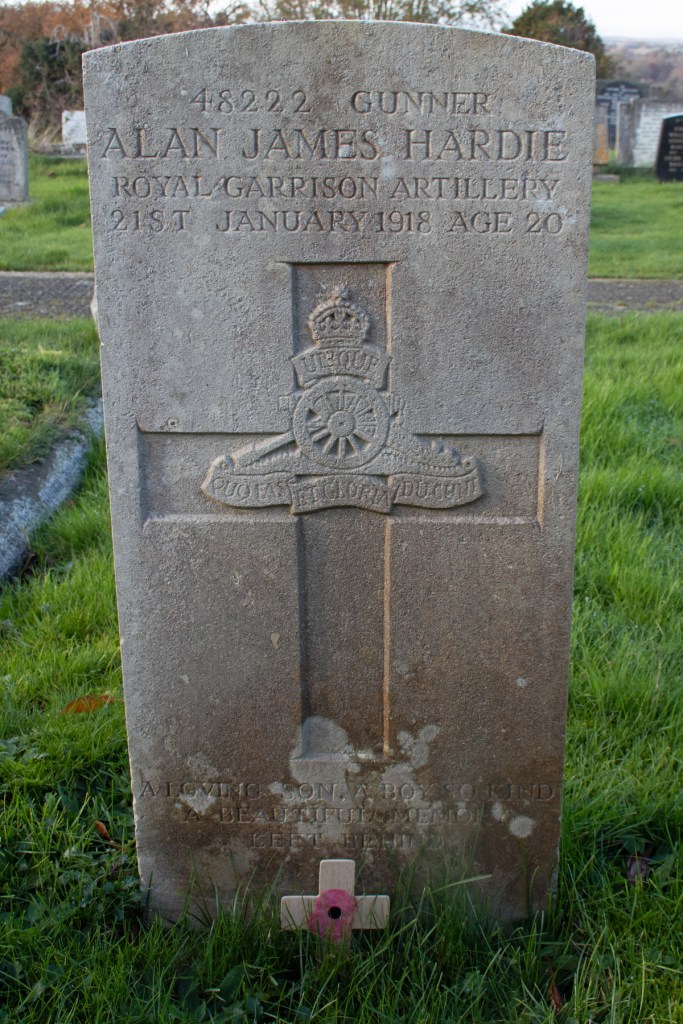
War came to Europe in 1914, and, at some point, Alan stepped up to play his part. Full details of his military service are no longer available, but from what remains it is clear that he enlisted in the Royal Garrison Artillery at some point before the summer of 1917.
Alan enlisted using his mother’s maiden name of Hardie, and was assigned to the 274th Siege Battery. His troop saw action at the Somme and Arras, and a later newspaper report confirmed that Gunner Hardie saw action overseas:
[He] had been previously wounded but was gassed and entered Leicester Hospital on November 2nd 1917.
Taunton Courier and Western Advertiser: Wednesday 30th January 1918
Gunner Hardie had been admitted to the 5th Northern General Hospital following his injury. He seemed to be improving, but developed pneumonia and the lung condition was to take his life. He passed away on 21st January 1918, at the age of just 20 years old.
Alan James Hardie/Howland was brought back to Somerset for burial. He was laid to rest in the cemetery of the town where his family now lived, Ilminster, Somerset.
Alan’s older brother, William Harman Howland, also fought in the First World War. He enlisted in the 1st Battalion of the Hertfordshire Regiment, also using his mother’s maiden name. Again, details of his service are sparse, and Private Hardie seems to have transferred to the Royal Army Service Corps at some point during his military career.
William passed away on 18th August 1918, while in Germany. The cause of his death is not clear, but he was 28 years old. He was laid to rest in the Ohlsdorfer Cemetery in Hamburg.
Walter Wigginton was born in the Leicestershire village of Illston-on-the-Hill in the summer of 1880. The second of seven children, his father John was a grazier, managing cows over a six-acre pasture. His mother, Rebecca, who was also born in Leicestershire, raised the family and managed the home.
Walter turned his hand to carpentry, and, by the time of the 1901 census, he was boarding with a widow in Frimley, Surrey, employed for his woodworking skills. By 1905, his journeyman life had taken him to the Somerset village of Trull. It was here that he met and married Annie Oaten, and here that the couple settled down to raise their family. They had two children, Dorothy, born in 1906, and Winifred, who was born two years later.
War was closing in on Europe and, by the summer of 1916, Walter had joined up to play his part. Initially assigned to the 65th Training Reserve Battalion, he had not long transferred across to the Royal Engineers as a Sapper when he fell ill.
Sapper Wigginton was admitted to the Kinmel Park Military Hospital near Abergele on the North Wales coast, suffering from bronchial pneumonia. Sadly, this lung condition was to get the better of him, and he passed away at the hospital on 29th December 1916, at the age of 36 years old.
Walter Wigginton’s body was brought back to Somerset for burial. He was laid to rest in the graveyard of All Saints’ Church in Trull, where his widow and children still lived.
Archibald Henry Mills was born in the summer of 1895, the oldest of six children to John and Edith. John was a commercial traveller, selling veterinary wares around the country; he was born in Derby, Edith was from Leicester and, for the for the first seven years of their married life they lived in Edith’s home town – this is where Archibald was born. By the turn of the century, however, they had relocated to Somerset, and set up home in Weston-super-Mare.
When he left school, Archibald found work as an errand boy for a local tailor, but change was on the horizon. By the summer of 1914, he had based himself in Nottingham – the reason is lost to time – and this is where he was when he volunteered for military service.
Archibald enlisted as a Private in the Notts and Derby Regiment – the Sherwood Foresters – and was assigned to the 7th Battalion. He was sent to France as part of the 46th Division and, over the next couple of years, he evidently served his regiment well.
In August 1915, Private Mills was promoted to Lance Corporal; three months later he was again promoted, to Corporal. By May the following year, he received another rise, this time to Serjeant. These promotions were against the backdrop of some fierce fighting – the Sherwood Foresters were involved at Hooge, Hohenzollern and Gommecourt, and were briefly sent to Egypt.
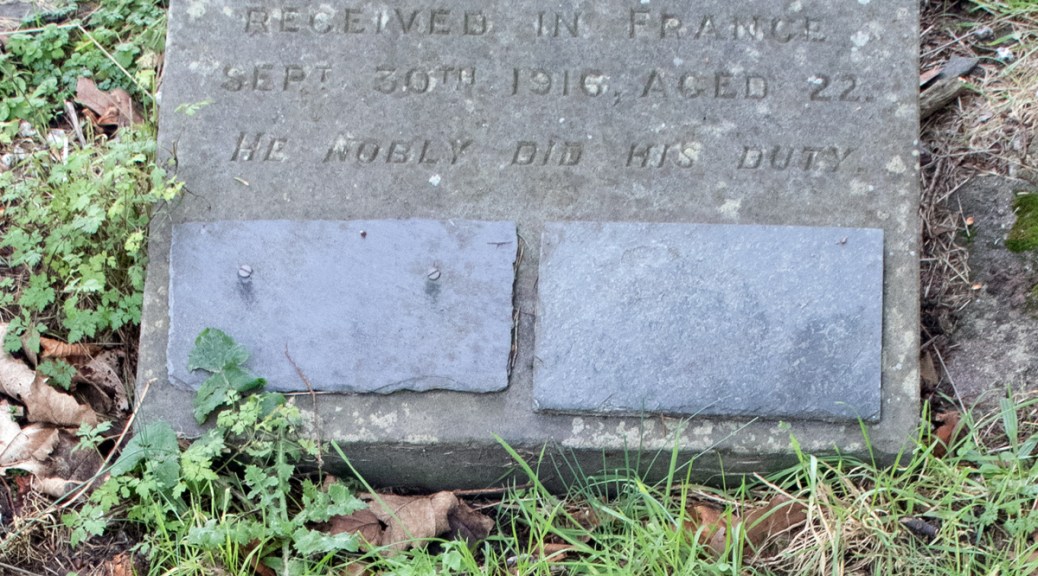
At some point during the summer of 1916 – possible at Gommecourt – Archibald was injured, and medically evacuated to the No.2 Western General Hospital in Manchester. Sadly, however, his wounds were to prove too much: Serjeant Mills passed away on the night of 30th September 1916. He was just 21 years old.
The body of Archibald Henry Mills was brought back to Somerset; he was laid to rest in the Milton Road Cemetery of his adopted home town of Weston-super-Mare.







 Death and Service