Category Archives: Middlesex

Stoker Henry Souter

Stoker Henry Souter

Henry Souter was born in Thornaby, Yorkshire, on 10th August 1887 and was the youngest of four children. His father, John, died when he was just a year old, leaving his mother, Jane to raise the family single-handedly. To do this she found piecemeal work as a charwoman, sharing their home – 3 Edward Street – with two other families.

Henry is absent from the 1901 census, but his mother had moved to Willesden, Middlesex. His sister, Isabella, had married the year before, and she and her husband had relocated to London, presumably for work, taking Jane with them.

By the 1911 return, Henry was boarding with his brother James and his family. The siblings were living at 44 Spring Street, and both were working at a local iron works, James as a pipe moulder, Henry as a rolling miller.

When war came to Europe in the summer of 1914, Henry was called upon to play his part. His service records are long since lost, but he was attached to the Royal Naval Reserve as a Stoker, suggesting previous employment in the navy.

By the end of the year Stoker Souter had been assigned to the battleship HMS Formidable. A key vessel in the Channel Fleet, her role was part of a convoy patrolling the seas of the southern coast of Britain.

Early on the morning of 1st January 1915, while off the Dorset coast, the battleship was torpedoed by a German submarine. Other ships in her convoy came to her aid, but it would prove fruitless. After a couple of hours – and another torpedo strike – she sank, taking more than 540 officer and crew – including Stoker Souter – were lost. He was 27 years of age.

Henry Souter’s body was recovered, and was able to be identified. He had been brought ashore in Lyme Regis, Dorset, and he was laid to rest in a communal grave in the town’s cemetery.


Henry’s next-of-kin were identified as his sister, Annie, who was living in Thornaby, and his mother, Jane. Her address was given as 25 Melville Road, Stonebridge Park, London: she was still living with Isabella and her family – husband George and their six children.


Boy 1st Class Bernard Smyth

Boy 1st Class Bernard Smyth

Bernard Arthur de Plumley Smyth was born in Erith, Kent, on 16th September 1897. The second of four children – all of them boys – his parents were Reginald and Emily Smyth.

Bernard’s early life was a delicate one, and he spent at least some time at Great Ormond’s Street Hospital in Camden, London. His weakened health was such that he was baptised at the hospital’s local church – St George the Martyr – on 11th February 1900.

It is intriguing to see Reginald Smyth’s life develop over the years. His son’s baptism record gives his line of work as labourer, but by the following year’s census, he had moved the family to Ifield, West Sussex, where he was noted as living on his own means. Moving forward another decade, and the family had moved again, settling in a 9-roomed villa in Burgess Hill. Reginald was now listed as being a nurseryman and the family of six were sharing their home with boarder Horatio Jacoby, who was living by private means.

Bernard was still a schoolboy at this point. His health had seeming recovered over the years, and he was ready to make his mark on the world. On 6th March 1913, he enlisted as a Boy 2nd Class in the Royal Navy. His service records show that he was 5ft 3ins (1.59m) tall, with brown hair, brown eyes and a fresh complexion.

Boy Smyth was initially sent to HMS Ganges, the shore-based establishment in Suffolk, for his training. He remined there for six months, and was promoted to Boy 1st Class for his work.

On 26th September 1913, Bernard was given his first posting, on board the cruiser HMS Grafton. He remained on board for nine months, before returning to shore – this time to the Royal Naval Dockyard in Chatham, Kent – for the summer.

In August 1914, war was declared and by the end of that month, Boy 1st Class Smyth was given his second assignment, aboard the battleship HMS Formidable. She was a key vessel in the Channel Fleet, her role part of a convoy patrolling the seas of the southern coast of Britain.

Early on the morning of 1st January 1915, while off the Dorset coast, the battleship was torpedoed by a German submarine. Other ships in her convoy came to her aid, but it would prove fruitless. After a couple of hours – and another torpedo strike – she sank, taking more than 540 officer and crew – including Boy 1st Class Smyth – were lost. He was just 17 years of age.

We regret to record that a former scholar of the London Road Council Schools, Burgess Hill, lost his life through the disaster which came to HMS Formidable on January 1st. This was Bernard Arthur de Plumley Smith, the second son of Mr and Mrs Smyth, of Edward cottage, Brook Road, Prittlewell, Southend-on-Sea, late of Elgin Villa, Crescent Road, Burgess Hill. He was 17 years of age, and a first-class boy on board the ship. He bore the reputation of being smart, steady ad industrious, and was well known in Burgess Hill…

[Mid Sussex Times: Tuesday 12th January 1915]

Bernard Arthur de Plumley Smith was laid to rest in a communal grave in Lyme Regis Cemetery, in the hills above the Dorset town where he had been brought ashore following his ship’s sinking.


Petty Officer William Feldon

Petty Officer William Feldon

William Feldon was born on 16th October 1878, the middle of three children – and the only son – to William and Jessie Feldon. William Sr was a carpenter from Highgate, Middlesex, but it was south of the Thames, in Lambeth, Surrey, that the family were raised.

When he finished his schooling, William Jr found work as a general labourer. He was drawn to bigger and better things, however, and a life at sea was to catch his eye. In June 1894, he enlisted in the Royal Navy as a Boy 2nd Class. His service records noted that he was 5ft 2ins (1.57m) tall, with brown hair, brown eyes and a fresh complexion.

By the time William had completed his initial training, he had been promoted to Boy 1st Class. He was then moved to HMS Pembroke, the Royal Naval Dockyard in Chatham, Kent.

By October 1895, he was given his first posting, on board the torpedo cruiser HMS Archer, and he would remain assigned to her for the next two years. During this time, William came of age and was formally inducted into the Royal Navy, and was given the rank of Ordinary Seaman. His commitment to the service was pretty clear, and, within seven months he had been promoted again, to Able Seaman.

After a short spell back at Pembroke, William was assigned to HMS Wildfire, another shore establishment just along the coast in Sheerness. He remained there for nine months, during which time he was promoted again, to the rank of Leading Seaman.

In May 1899, William was moved to another posting, on board the gunboat HMS Partridge. This assignment provide him with the route to further promotion: he remained on board until July 1901, having risen to Petty Office 2nd Class on 1st July 1899 and Petty Officer 1st Class on 23rd September 1900.

Over the remainder of his initial term of service, William served on six further vessels. The sea was in his blood by this point, and when his contracted ended on 15th October 1908, he re-enlisted without any hesitation.

Away from the Navy, William fell in love. On 23rd October 1909, he married Ada Plumpton, who was 25 years old, and who lived in Battersea, Surrey. The couple exchanged vows at St Faith’s Church in Southwark, but settled down in the village of Dovercourt, Essex. They went on to have two children, Doris, who was born in 1910, and Elsie, who came along the following year.

Back at sea, Petty Officer Feldon was assigned to the cruiser HMS Boadicea. He spent two years on board, before moving to another cruiser, HMS Blonde, for another two years. In between voyages, William returned to the Royal Naval Dockyard in Chatham.

On 13th January 1914, Petty Officer Feldon was posted to the battleship HMS Formidable, part of the Channel Fleet patrolling the seas of the southern coast of Britain.

Early on the morning of 1st January 1915, while off the Dorset coast, she was torpedoed by the German submarine U-24. Other ships in her convoy came to help, but after a couple of hours – and another torpedo strike – the damage was too great and she sank. 120 members of the crew were saved, but more than 540 officer and crew – including Petty Officer Feldon – were lost. He was 36 years of age.

William Feldon’s body was one of those recovered and identified. He was laid to rest in a communal grave in Lyme Regis Cemetery, in the hills above the Dorset town where he had been brought ashore.


Stoker 1st Class Horace Bernthall

Stoker 1st Class Horace Bernthall

Horace Frank Bernthall was born in Clapton, Middlesex, on 19th February 1893. One of twelve children, his parents were Henry and Ellen. Henry was a general labourer, and this is work into which his sons followed.

By the time of the 1911 census, the Bernthall family were living on Folly Lane in Walthamstow, Essex. Henry and Ellen were sharing three rooms with six of their children – of which Horace was the eldest. The census return confirms that, of their twelve children, four had died by this point. Three of the family were working – Henry, Horace and another sibling, 16 year old Arthur.

Horace set his sights on bigger and better things, and on 30th August 1912, he enlisted in the Royal Navy. He took up the role of Stoker 2nd Class, his records confirming that he was 5ft 5ins (1.65m) tall, with brown hair, grey eyes and a fresh complexion.

Stoker Bernthall was initially sent to HMS Pembroke, the Royal Naval Dockyard in Chatham, Kent, for his training. He remained there for the next five months, before being assigned to the pre-dreadnought battleship HMS Formidable. She was to remain his home for the nest two years, and was where he gained promotion to Stoker 1st Class in August 1913.

HMS Formidable was attached to the Channel Fleet, primarily guarding the waters separating Britain from France. Early on the morning of 1st January 1915, while off the Dorset coast, she was torpedoed by the German submarine U-24. Other ships in her convoy came to help, but after a couple of hours – and another torpedo strike – the damage was too great and she sank. 120 members of the crew were saved, but more than 540 officer and crew – including Stoker 1st Class Bernthall – were lost. He was just 21 years of age.

Horace Frank Bernthall’s body was one of those recovered and identified. He was laid to rest in a communal grave in Lyme Regis Cemetery, in the hills above the Dorset town where he had been brought ashore.


The spelling of the family surname varies across the documents that cover Horace’s life – Bernthal, and Burnthall being two other suggestions – but I have gone with Bernthall, as that is what is recorded on his baptism record.


Captain Francis Leach

Captain Francis Leach

Francis James Leach was born on 27th June 1878 in the Somerset village of Martock. He was the middle of four children to John and Louisa Leach. John was a solicitor who was 17 years older than Louisa, who was his second wife, and by whom he had had two children. The 1881 census found the family living in a house called The Lawn on Church Street, supported by five servants: a nurse, an under-nurse, a cook, a housemaid and a footman.

The next census return, taken in 1891, recorded the family having moved to Seaton in Devon. Louisa was living at 7 West Cliff Terrace with five of the children and a domestic servant. John, however, is not noted on the document, although Louisa is still recorded as married, which would suggest that he had not passed away.

A later newspaper report helps build a picture of Francis’ life growing up:

…Leach was educated at Allhallows School, Honiton, was a thorough sportsman in every sense of the word, a good shot, a keen rider to hounds, a polo player, and cricketer.

[Exeter and Plymouth Gazette: Friday 7th May 1915]

When he finished his schooling, Francis felt drawn to an army career, and the newspaper confirmed his progress:

He served through the Boer War with the R Battery, Royal Horse Artillery, and was present at the relief of Kimberley and at the actions at Paardeberg, Poplar Grove, Zand River, Johannesburg, Pretoria, Diamond Hill and Wittebergen, and was awarded the Queen’s medal with six clasps and the King’s Medal with two. He was given his commission in the Shropshire Light Infantry in 1901, attained the rank of Captain last August and was appointed Adjutant of his Battalion February 2nd, 1914.

[Exeter and Plymouth Gazette: Friday 7th May 1915]

The 1911 census found Francis back with his mother. She was now living in the village of Hawkchurch, near Axminster, living in a 9-roomed house called The Vineyard. Louisa also had her daughter and two servants – a cook and a housemaid – supporting her. The census return also confirmed that Louisa was a widow, John having died some rears previously. Francis’ visit may have been a fleeting one, as his fiancée, Doris Maunsell-Smyth, was also visiting in preparation for a wedding.

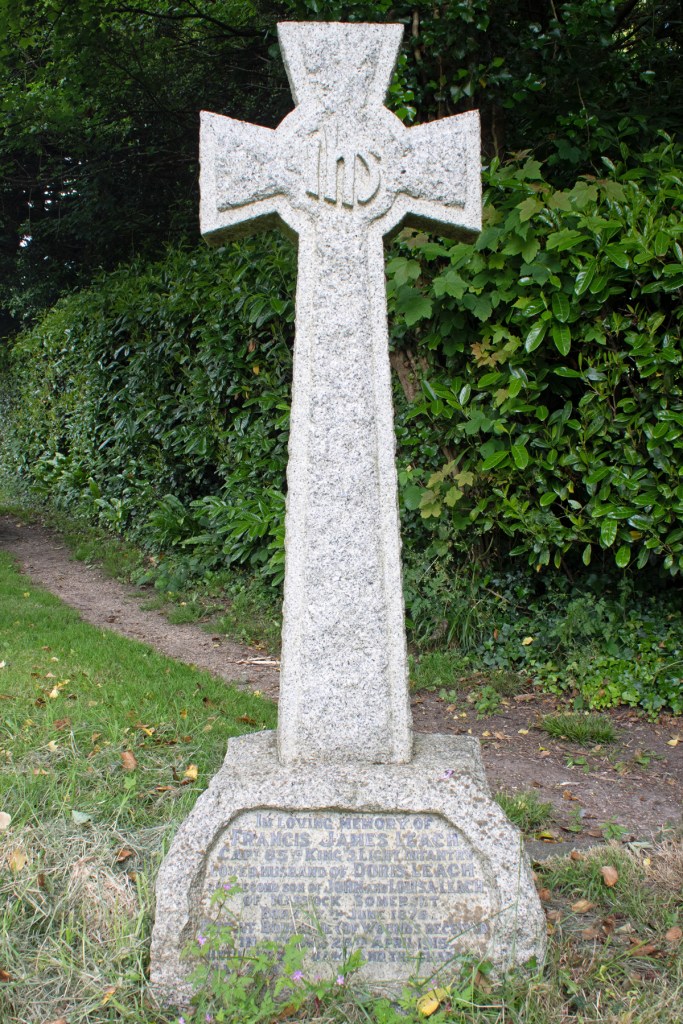
Francis and Doris exchanged vows on 29th July 1911, the wedding taking place in Christ Church, Paddington, Middlesex. Their marriage certificate confirmed that the groom was an army officer, while the bride’s father, George Maunsell-Smyth, was noted simply as a gentleman.

When war broke out in the summer of 1914, Captain Leach and his unit was called up to play their part. Full details of his service have been lost to time, but he was sent to the the Western Front by December that year. Over the coming months, the battalion was involved in the Battle of Eloi and the Second Battle of Ypres.

The funeral of Captain Francis Leach of the 2nd Battalion Shropshire Light Infantry, as taken place in the village churchyard amid every token of respect and sympathy. The officer died at Boulogne of wounds received in action in Flanders.

[Exeter and Plymouth Gazette: Friday 7th May 1915]

Captain Leach died of his injuries on 26th April 1915. He was 36 years of age.

Interestingly, despite a decree that the conflict’s fallen would be buried overseas if that was where they died, it seems that Captain Leach’s family were able to circumvent that ruling. Whether that was because he died in a hospital ship in Boulogne’s harbour is unclear, but had he died in the town itself, he should have been laid to rest in France.

Either way, the body of Francis James Leach was brought back to Devon for burial. He was laid to rest in the graveyard of St John the Baptist Church, Hawkchurch, not far from where his mother still lived.


Ship’s Corporal Thomas Berry

Ship’s Corporal Thomas Berry

Details of the civilian life of Thomas Joseph Berry are a challenge to piece together. He is not recognisable in any census returns, and baptism records don’t tally either.

The main resource for building a picture of Thomas’ life is the service record for his time in the Royal Navy. This provides his date of birth – 6th May 1882 – and suggests that he was born in Hornsey, Middlesex. He was working as a cabinet maker when he enlisted, the document also confirming that he was 5ft 4ins (1.62m) tall, with brown hair, brown eyes and a fresh complexion.

Thomas began his naval career on 29th July 1898. Below the age to formally enlist, he was given the rank of Boy 2nd Class. Over the next eighteen months, his time was split between two training ships based in Devonport, Devon, HMS Impregnable and HMS Lion. In April 1899 he was promoted to Boy 1st Class.

In February 1900, Thomas moved to HMS Vivid, the Royal Naval Dockyard in Devonport. On 6th May he came of age, and was formally enrolled in the navy, receiving the rank of Ordinary Seaman. From this point his career took off and, over the next sixteen years, he would go on to serve on board fifteen ships, seeing the world.

At his annual reports, Thomas’ conduct was regularly identified as Very Good, and his commitment was reflected in the progress he made through the ranks. By June 1901, he had been promoted to Able Seaman Berry. The summer of 1907 saw him move up to Leading Seaman, and three years later, Thomas was a Petty Officer. In November 1911 he was made Ship’s Corporal 2nd Class, and by the following spring he had been promoted again, this time to Ship’s Corporal 1st Class.

Away from the Royal Navy, Thomas’ personal life was developing. Again there is little documentation to provide any specifics, but he married a woman called Albertine Elizabeth in the early 1910s. The couple went on to have a son, Bernard, who was born on 15th January 1913, and the family seemed to settle down in Paignton, Devon – a later record giving Albertine’s address as 3 Alma Terrace, Well Street.

When war broke out in the summer of 1914, Ship’s Corporal Berry was serving on board the protected cruiser HMS Blake. In February 1916, he was assigned to the battleship HMS Revenge which served in the English Channel.

By this point, Thomas’ health seemed to be taking a downturn. He was posted back to HMS Vivid on 7th March, but was then transferred to Devon County Asylum in Exminster, suffering from “general paralysis of the insane“. His condition worsened and he passed away on 29th April 1916: he was days away from his 34th birthday.

Thomas Joseph Berry’s body was brought back to Paignton for burial. He was laid to rest in the town’s cemetery.


Stoker 2nd Class John Gearing

Stoker 2nd Class John Gearing

John Gearing was born in Paddington, Middlesex, on 12th August 1894. There is little concrete information about his early life, although a later document confirms he was the son of Mrs E Gearing, of 5 York Place, Hammersmith.

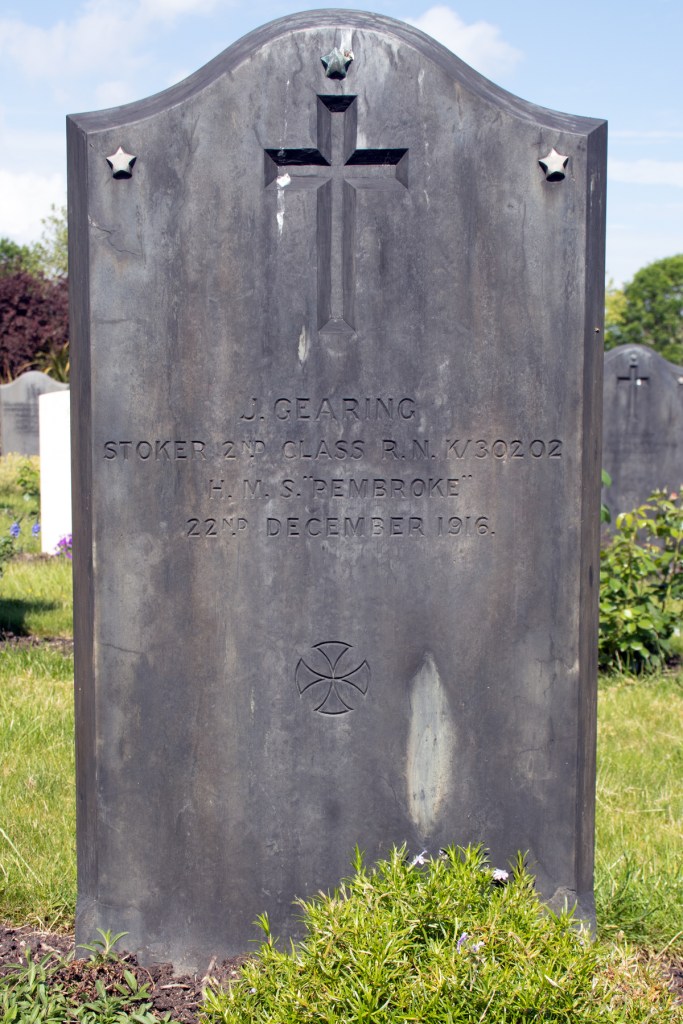
John was working as a fireman when war was declared. When he was called upon to serve his King and Country, he chose to enlist in the Royal Navy, joining up on 5th January 1916. His service records show that he was 5ft 9.5ins (1.76m) tall, with brown hair, blue eyes and a fresh complexion.

Stoker 2nd Class Gearing was initially sent to HMS Pembroke, the Royal Naval Dockyard in Chatham, Kent, for his training. He would remain attached to the base, and was assigned to HMS Victorious, the dockyard’s repair ship, from April 1916.

John’s time in the navy was not to be a lengthy one. Transferred back to HMS Pembroke in September, it seems that his health was becoming affected by the work he was doing. He was admitted to the Royal Naval Hospital in Chatham, suffering from what was later identified as carcinoma of the intestines. He passed away from the condition on 22nd December 1916, aged just 22 years old.

John Gearing was laid to rest in the Woodlands Cemetery, Gillingham, not far from the naval base he had come to call home.


Able Seaman Horace Freeman

Able Seaman Horace Freeman

Horace James Freeman was born in Hackney, East London, on 16th September 1879. The second of five children, his parents were Archibald and Mary Freeman. According to the 1891 census, Archibald was employed as a carman, but the next document had him listed simply as a ‘traveller’.

When he completed his schooling, Horace found work as a baker’s assistant. He sought bigger and better things, however, and, on 13th February 1897, he enlisted in the Royal Navy. His service records show that he was 5ft 5.5ins (1.66m) tall, with brown hair, hazel eyes and a fresh complexion.

A few months under full age, Horace was initially given the rank of Boy 2nd Class. He was sent to the training ship HMS Northampton, and seemingly impressed his superiors, rising to Boy 1st Class within a couple of months. He moved to another training vessel, HMS Calliope, in July 1897, and was serving on board when he came of age that September.

Now formally inducted into the Royal Navy, Ordinary Seaman Freeman began what was to be an eighteen year career at sea. He would become based at HMS Pembroke, the Royal Naval Dockyard in Chatham, Kent, and went on to serve aboard nine ships during his time.

Promoted to the rank of Able Seaman in October 1899, Horace’s time in the navy was not to be without incident. He spent eight separate periods of time in the cells, 158 days in total. Full details of his misdemeanours are lost to time, but at least on at least one occasion he was placed in the brig for refusing orders.

On Christmas Day 1911, Horace married Sarah Byatt. She was a bricklayer’s daughter from Tottenham, and the couple went on to have two children: Clifford, born in 1913, and Leslie, born two years later.

While Sarah was looking after their young family, Horace spent a lot of his time at sea. As time moved on, however, he was based at HMS Pembroke for longer spells, and it was while he was in Chatham early in 1916 that fate befell him.

The body of Horace J Freeman, an able seaman of the RFR, who had been missing from his ship since February 25th, was found floating in South Lock at Chatham Dockyard on Saturday.

[South Eastern Gazette: Tuesday 11th April 1916]

Little additional information is available about Horace’s death, and it is unclear how he had fallen into the lock. He was 36 years of age.

The body of Able Seaman Horace James Freeman was laid to rest in Gillingham’s Woodlands Cemetery, not far from the naval base he had called home for so long.


Private John Roche

Private John Roche

In the middle of the military section of the Woodlands Cemetery in Gillingham, Kent, is a headstone commemorating the life of John David Roche.

Details of John’s life are a challenge to piece together, although a later document gives his next-of-kin as Mrs E Roche of 108 Osnaburgh Street, Regent’s Park, London. There is a baptism record from 1897 for John David Roche, whose mother’s name was given as Lizzie. John’s father is listed as David, and the christening took place in Chelsea. There are no other records or census returns to give any further family background.

John’s time in military service is also hard to determine. That he joined the Royal Marine Light Infantry is clear, although when he enlisted and where he served are sadly lost to time.

Details of Private Roche’s passing are also unclear. He is noted as having died of disease, although the specific cause is not detailed. Given the location of his burial, it seems likely that he passed either at the Royal Naval Dockyard in Chatham, Kent, or at the hospital in the town connected to it.

John David Roche passed away on 2nd June 1916. If the baptism was correct, he was a day short of his 19th birthday.


Captain George Lee

Captain George Lee

Anyone who attended the funeral of Captain George Lee, IMT (late Rifle Brigade), held in the churchyard of his old home, Yetminster, on Wednesday could not but have been impressed by the wonderful sense of peace and rest that pervaded the place. After a life of unique adventure in Africa, India, America, and Canada his worn and suffering body was laid to rest beside his beloved father. The solemn service was taken by his uncle, Red. EHH Lee (vicar of Whitchurch Canonicorum) and his cousin, Rev. E Hertslet (vicar of Ramsgate), and Rev. MJ Morgan (vicar of Yetminster), there being also present his old schoolfellow, Rev. J Lynes, and Rev. Hall, curate of Yetminster. Besides the chief mourners Captain Lee’s mother, sister and brother-in-law, there were many friends present and numerous villagers who had known him from boyhood. The coffin was attended throughout the service and for many hours before by his most faithful servant and friend, Rajab Ali Khan, who was with his master through India, Persia, Beluchistan, and Afghanistan, and came to England as his personal attendant when Captain Lee was sent home on sick leave. After the service in the churchyard Rajab, through the kindness of Mr Hall, who translated for him, was able to tell everybody what his master had been to him.

Dorset County Chronicle: Thursday 9th September 1920

George Johnston Lee was born in the summer of 1886, the second of four children to Reverend Robert Lee and his wife, Elizabeth. Robert was the vicar of St George’s Church in Fordington, Dorset, when George was born, but moved west to Toller Porcoram not long after he was born.

Tantalisingly little information about George’s early life remains. He does not appear on the 1901 or 1911 census records, and it is likely that he was already away travelling the world by this point. It seems clear that he followed a military, rather then a clerical, career and, by the end of the First World War he was serving in the Indian Army Reserve of Officers. Attached to the Rifle Brigade, George had reached the rank of Captain.

George’s father had become ill in the early 1910s, and having moved to St Andrew’s Church in Yetminster, he retired from the post in 1912. He and Elizabeth moved to Dorchester, but when he passed away in 1916, at the age of 59, his last wishes were to be buried in Yetminster, the village having held a special place in his heart.

Captain Lee survived the First World War, but, as the newspaper report suggests, he became unwell. George had contracted amoebic dysentery, and returned to England to recuperate. The condition was to prove too severe, and he passed away in London on 29th August 1920, at the age of 34 years old.

In accordance with the family’s wishes, George Johnston Lee’s body was taken back to Dorset, and he was laid to rest next to his father, in the tranquil St Andrew’s Churchyard, Yetminster.