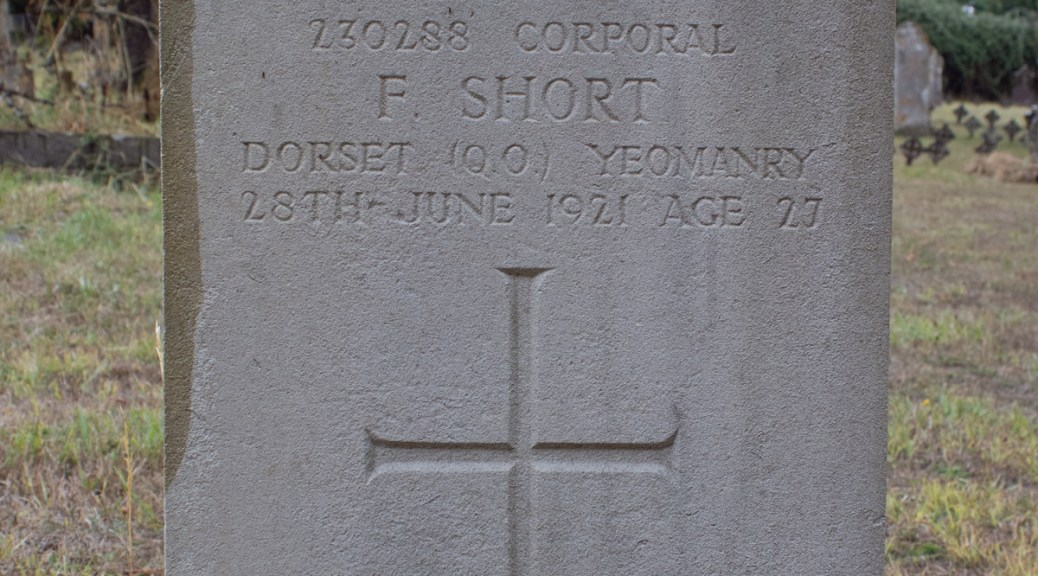
Frederick Short was born in Sturminster Newton, Dorset, in the spring of 1894. The oldest of five children, he was one of three sons to John and Martha Short. John was the caretaker of the village’s cemetery, and the family lived in a cottage on site.
When Frederick completed his schooling, he found work as a groom and, by the time of the 1911 census, he was boarding with John and Clara Binning in the village of Weare, Somerset.
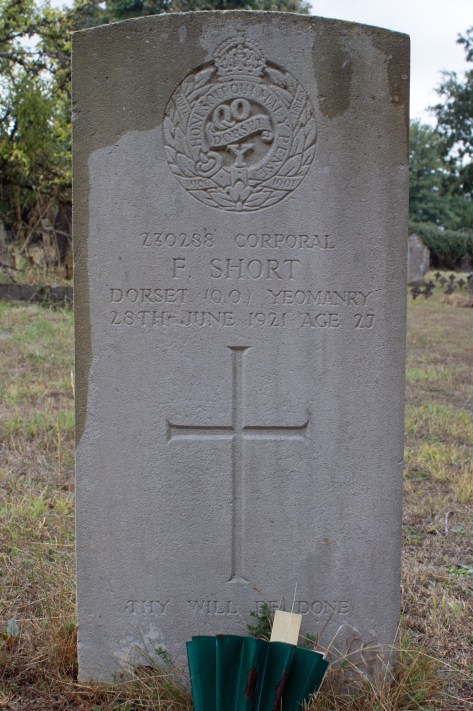
War came to Europe in the summer of 1914, and Frederick was called upon to play his part. Full details of his military service have been lost to time, but it is clear that he enlisted in the Queen’s Own Dorset Yeomanry. By the end of the conflict, he had risen to the rank of Corporal.
Frederick survived the conflict, and returned home. At the start of 1919, he married Mabel Heritage, a soldier’s daughter from Somerton, Somerset. Her father, George, had died by the time of the 1901 census, and Mabel moved with her mother to Milborne Port, on the Somerset-Dorset border. The 1911 census found her working as a leather glove machinist, in a four-roomed cottage on Paddock Walk, to the north of the town centre.
The war had had a negative impact on Frederick’s health. The 1921 census shows him and Mabel visiting his parents in Sturminster: his occupation was given as unfit (formerly a groom). It was only a matter of weeks later that his condition worsened. Frederick passed away from a combination of malaria and heart disease on 28th June 1921: he was 27 years of age.
The body of Frederick Short was laid to rest in Sturminster Newton Cemetery, close by, and in the care of, his caretaker father, John.
Alfred James Newman was born in around 1874 in Westbury, Wiltshire. One of six children, his parents were coke burner and agricultural labourer James Newman and his wife, Virtue.
Alfred followed his father into farm work, and would remain living with his parents until they were in their seventies. The 1911 census found the family living in Westbury Leigh, to the south of Westbury itself, James and Virtue as pensioners and Alfred as a general farm labourer. Also living with them was adopted child James Ellery, although it isn’t clear who had adopted him, and whether he had any other familial connection to them to the Newmans.
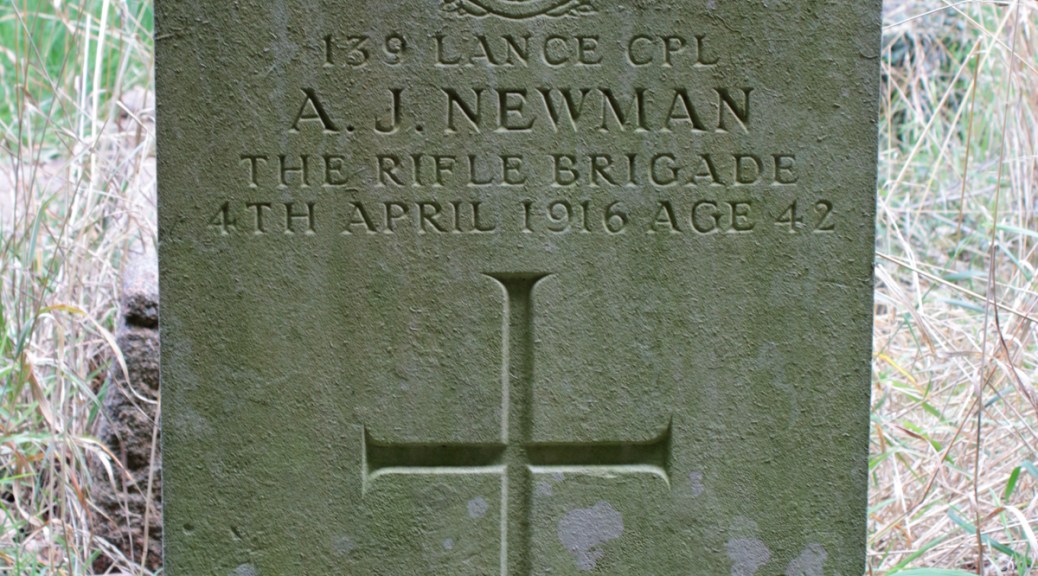
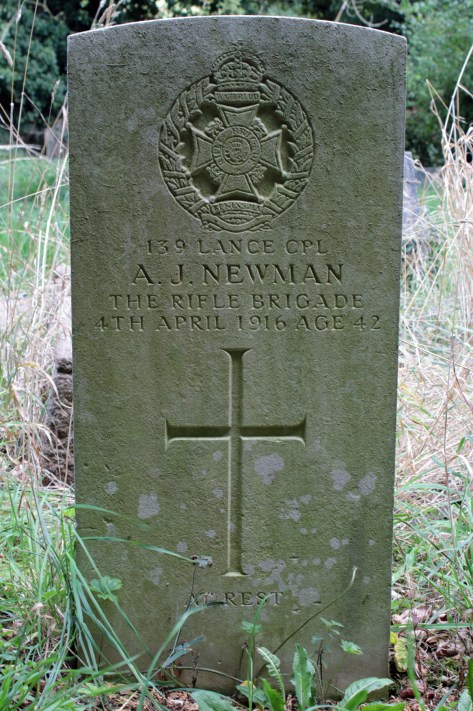
When war broke out, Alfred stepped up to play his part. Full details of his military service have been lost to time, but it is clear that he joined the Wiltshire Regiment, and was attached to the 4th Battalion. He was then transferred to the 22nd (Wessex and Welsh) Battalion of the Rifle Brigade. It is unclear whether he spent time overseas, but, by the spring of 1916, he had been promoted to the rank of Lance Corporal.
On Tuesday last week, Mr James Newman… received a telegram from the military authorities stating that his son, Lance-Corporal Alfred James Newman had died the same day in the 2nd Southern General Hospital at Bristol… He, having obtained leave, went to Bristol to pay a visit to some friends and evidently caught a chill. His death took place on Tuesday morning. He was conveyed to his home on Friday, and the funeral took place on Saturday afternoon.
[Wiltshire News: Friday 14th April 1916]
Alfred’s Pension Ledger Index Card suggests that, rather than a chill, he had, in fact, died following the rupture of an aortic aneurysm. He passed away on 4th April 1916, and was 47 years of age.
The body of Alfred James Newman was laid to rest in the peaceful setting of the Provident Baptist Chapelyard in Penknap, to the south west of Westbury.
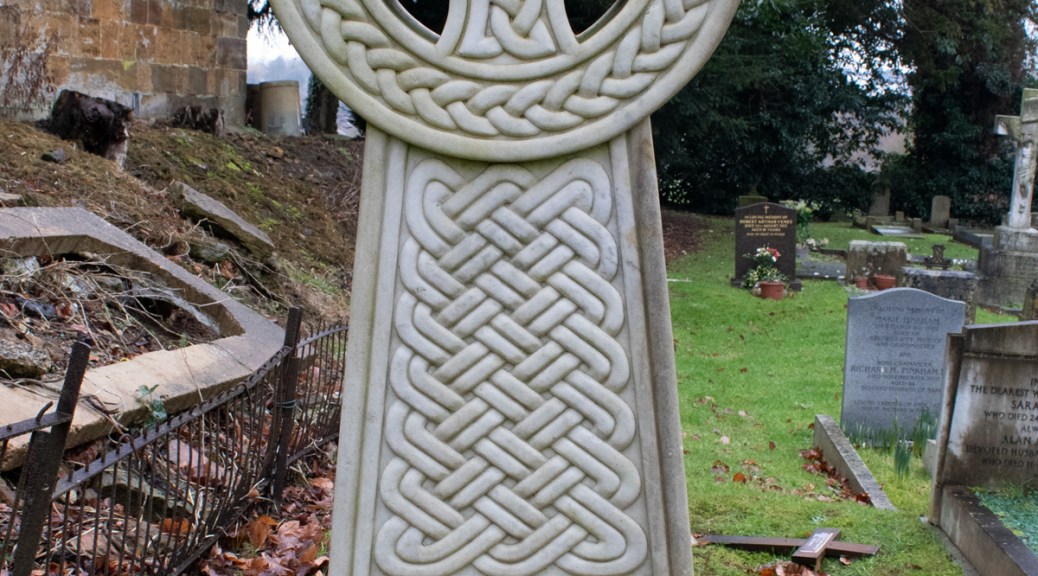
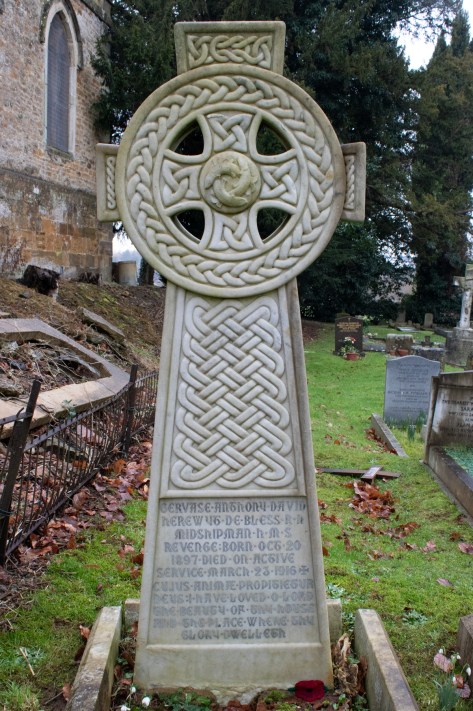
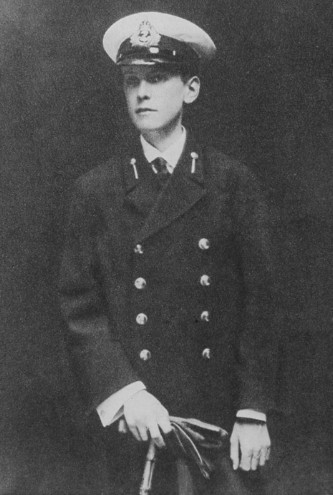
Gervase Anthony David Herewyt de Bless was born on 20th October 1897 in Westminster, Middlesex. One of two children, he was the surviving son of barrister Alfred de Bless and his wife Maud, born Maud Cary-Elwes. Both were renowned families – Maud’s brother going on to become the Bishop of Northampton. The family do not appear in the 1901 census, but by 1911 Gervase’s parents were living at 156 St James’ Court, with French lady’s maid Henriette Forestier.
Alfred died not long after the census was taken. Gervase, meanwhile, was installed as a boarder at Downside College, Somerset. One of 168 students, he was taught by twelve schoolmasters and a handful of Roman Catholic priests from the local abbey.
An exceptionally clever boy of very active minds and many interests, during his time in the School he distinguished himself in all branches of study, winning the Gregorian Medal in 1912. He passed the Higher Certificate three times, twice gaining distinction in French and twice in Roman History. For three years he played in the Junior Cricket Eleven, which he captained in 1912. From 1908 to 1912 he sang in the choir as a treble, and he took a leading part with much success in “The Gondoliers,” and in “HMS Pinafore.” In 1914 he was Editor of The Raven, and he was on the committee of the Petre Library. In this year also he was awarded the Higher Certificate Latin Prose Prize given by St Gregory’s Society. On leaving Downside he spent two terms at Cambridge under the tuition of Mgr Barnes. Sensitive and somewhat retiring, and with health far from robust, he faced the situation created by the war with splendid courage, and obtained a cadetship in the Royal Navy. A skilful angler, fishing had ever been his favourite recreation, and on this pleasant pastime he wrote some charming verses which were afterwards collected in a little booklet.
[Baliol College War Memorial Book]
Gervase was given the rank of Midshipman in February 1916, and was assigned to the battleship HMS Revenge the following month. Before his posting he had suffered a bout of influenza, and had a relapse within days of boarding. He died from a combination of influenza and diabetes on 23rd March 1916, just two days after joining Revenge. He was just 18 years of age.
…rites of the Church… were administered to him by Dom Jerome Tunnicliffe, of St Mary’s, Liverpool, a monk of Downside.
[Baliol College War Memorial Book]
The body of Gervase Anthony David Herewyt de Bless was taken to Northamptonshire for burial. He was laid to rest in the ground of St Andrew’s Church, Great Billing, the last resting place of the Cary-Elwes family and de Bless families.
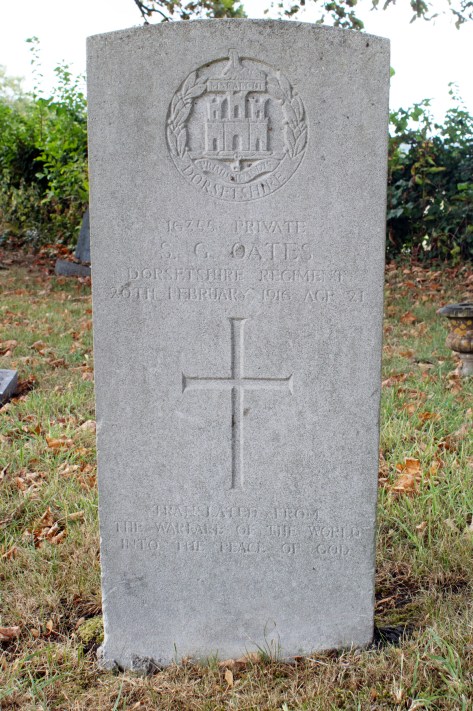
Sidney George Oates was born in the spring of 1895, and was the oldest of three children – all boys – to John and Eliza Oates. John was a general labourer from Parkstone, Dorset, but it was in the village of Odcombe in Somerset that the family were born and raised.
Eliza died in 1899, and John was left to raise three young children on his own. He re-married, to a Lucy Moores, but the a split of the family followed the wedding. Sidney’s younger brothers stayed with their father and his new wife, while Sidney himself was looked after by his maternal grandparents. Job and Elizabeth Green lived in Buckhorn Weston, a village to the west of Gillingham, Dorset.
When he finished his schooling, Sidney was apprenticed to a carpenter. War was on the horizon, however, and he soon stepped up to play his part. As with many others, his service papers have been lost to time, but it is clear that he had enlisted in the Dorsetshire Regiment no earlier than August 1915.
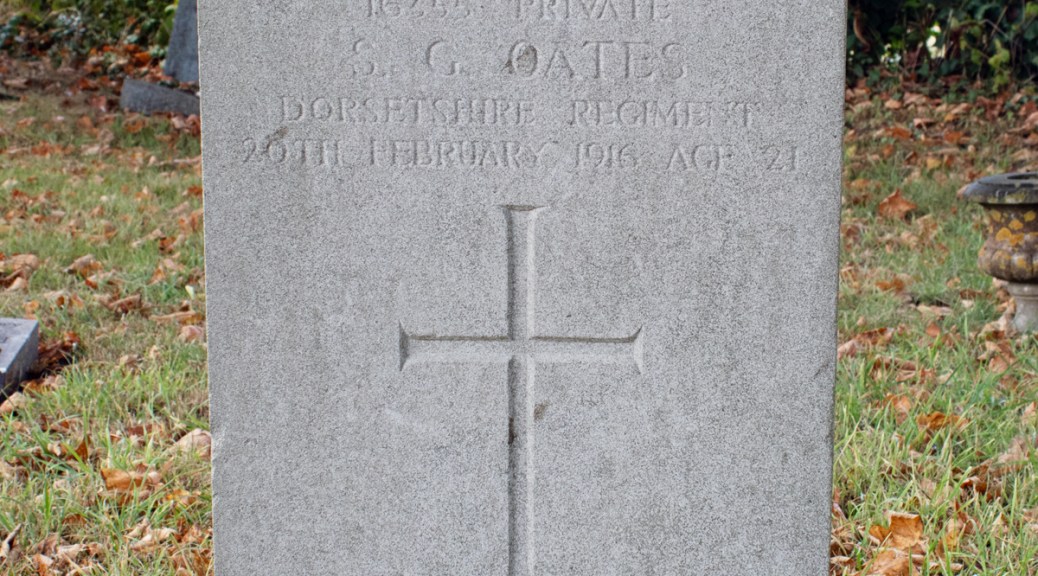
Private Oates was assigned to the 7th (Reserve) Battalion and sent to a training camp near Wool, Dorset. While there, however, he caught pneumonia, and was admitted to a military hospital in the village. The condition was to prove fatal: he passed away on 20th February 1916, aged just 21 years old.
The body of Sidney George Oates was taken back to Buckhorn Weston for burial. He was laid to rest in the village’s cemetery.
Sidney’s younger brother Edward also served in the First World War. A Pioneer in the Royal Engineers, he was killed in action in northern France on 12th April 1917. He was buried in Mory Abbey Military Cemetery to the north of Bapaume.
John Adlam was born in the spring of 1883 in Warminster, Wiltshire. The youngest of seven children, his parents were William and Emily Adlam. William was a maltster’s labourer, and the family lived in a small cottage at 66 Pound Street, to the south west of the town centre.
When John finished school, he found work as a garden labourer. By this point the Adlam family had moved, and home was 29 Chapel Street. William himself wasn’t recorded there, however. Work had taken him away and he was living at Holcombe Malthouse, on the outskirts of Kilmersden, Somerset.
On Christmas Day 1906, John married Ethel Brown, a plasterer’s daughter from Westbury, Wiltshire. The couple would go on to have three children, and 1911 census shows them living at 24 Chapel Street, Warminster with John’s recently widowed mother.
When war broke out, John stepped up, or was called upon, to play his part. His service records no longer exist, although it is clear that he served as a Private in the Dorsetshire Regiment as a Private. He was based at on of the regimental depots, and served through to the end of the war.
The only other record for John are those relating to his passing. He died on 29th November 1918 and, as his death was registered in Warminster, it seems likely that he died at or close to home. He was 35 years of age.
The body of John Adlam was laid to rest in the graveyard of Christ Church in his home town of Warminster.
Interestingly, while an initial grant was paid to Ethel, John’s entry on the Pension Ledger stated that they had been “instructed to cease [temporary] payment as widow not eligible for pension in respect of her late husband.” There is no indication as to whether this was later overturned.
The early life of George John Ball is a challenge to piece together.
His naval records confirm that he was born in Bedminster, Somerset, on 11th October 1865. There are census records that link his name to parents coal miner Luke Ball and his wife, Ann, but these cannot be confirmed.
George’s papers show that he found work as a butcher when he finished his schooling. He was set on a life at sea, however, and, on 25th November 1880, he joined the Royal Navy. Given the rank of Boy 2nd Class, he was sent to the training base HMS Impregnable for his induction. The Devon establishment would remain his home for the next two years, and, during this time, he rose to the rank of Boy 1st Class.
On 10th October 1882, George was given his first sea-faring assignment, on board the armoured cruiser HMS Northampton. He stayed with her for the next two years, during which time he came of age. Now formally inducted to the Royal Navy, he was promoted to Ordinary Seaman. His service records from the time give an indication as to the man he had become. Short of stature, he was just 5ft 1.5ins (1.56m) tall, and had light brown hair, hazel eyes and a fresh complexion.
Ordinary Seaman Ball signed up for a ten-year contract. Over that time, he would serve on a total of eight vessels, rising to the rank of Able Seaman in January 1889. George’s slate was not completely clean, however, and his record notes three serious demeanours in that time.
In the spring of 1888 George spent 27 days in Canterbury Gaol for ‘breaking out of [the] ship’ he was then serving on, HMS Duncan. He was sent to the brig for a further fourteen days in January 1892 for an undisclosed crime.
Able Seaman Ball was also fined £3 10s (£575 in today’s money) for staying away beyond his allotted shore leave. His papers note an absence of seventeen weeks from 10th October 1893, and this time would have been added to the end of his contract.
George re-enlisted on 9th February 1894, and his service record noted that he had grown half and inch (1.3cm) since he enlisted. He had also had a number of tattoos in that time, including an anchor on his right arm and a bracelet and sailor on his left.
Over the next decade, Able Seaman Ball continued his steady progression through the ranks. He would serve on seven ships, returning to what had become his shore base – HMS Victory, the Royal Naval Dockyard in Chatham, Kent – in between assignments. In October 1897, George was promoted to Leading Seaman: by the following July he was given the rank of Petty Officer 2nd Class.
On 29th April 1904, after more than twenty years in service, George was formally stood down to reserve status. The next document for him – the 1911 census – gives an insight into his life away from the sea. By this point, George was living in a small terraced house at 234 Luton Road, Chatham, Kent.
The document confirms he had been married for fourteen years, to a woman called Sarah. The couple had a daughter – six-year-old Doris – and Sarah’s son from a previous marriage, Albert, was also living with them. George had not distanced himself too far from the sea, however. He was employed as a Ship’s Canteen Manager, a position his stepson also held.
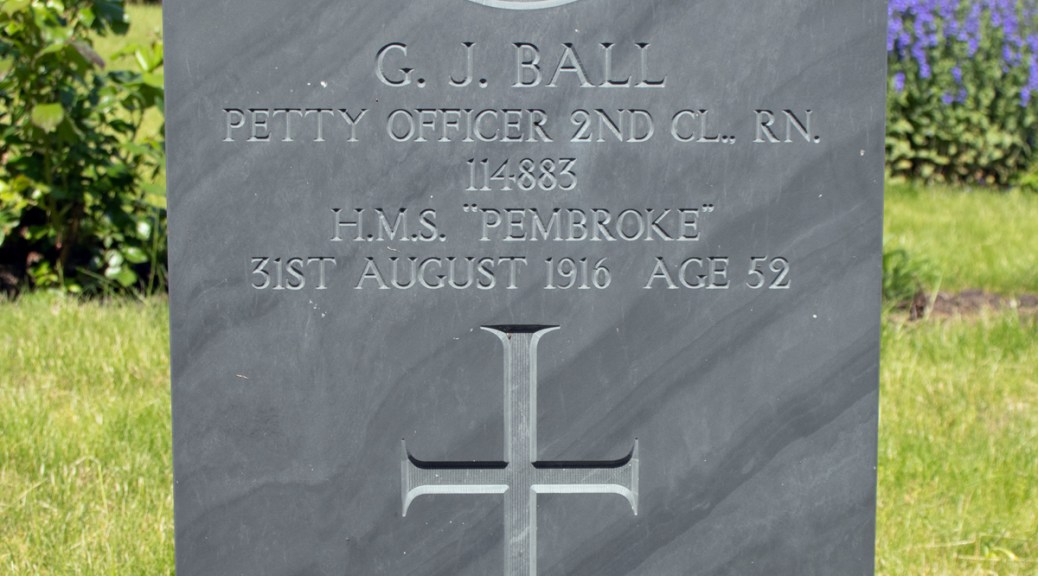
When war came to Europe, George was called upon to play his part once more. Taking up the rank of Petty Officer 2nd Class again, he would be based at HMS Pembroke – Chatham Dockyard – and he remained in service for the next two years.
In August 1916, George was admitted to the Royal Naval Hospital in Chatham, with a combination of pychtis and a stricture. The conditions were to prove fatal: he breathed his last on 31st August 1916, at the age of 50 years old.
George John Ball was laid to rest in the military section of Woodlands Cemetery, Gillingham, Kent, not far from the dockyard that had been his home for many years.
George Bailey was born in Bedminster, Somerset, on 20th August 1871. One of six children, his parents were George and Anna (or Hannah) Bailey. George Sr was a labourer and, when he died in 1876, Anna moved the family to Clifton, near Bristol.
The 1881 census found the family living in a small cottage at 5 Crosby Row in the then village. Hannah was listed as a late general labourer’s wife, while her three older children were all working for a dairy.
When George finished his schooling, he sought out a career. Joining the Royal Navy, this would prove a long-term role, bringing in a relatively decent wage for him and his family, but also gave him some adventure, not surprising given the number of ships he would have seen going to and fro from Bristol.
George was only 15 years old when he joined up on 25th September 1886, and so was below the age to formally enlist in the navy. Taken on with the rank of Boy 2nd Class, he was sent to HMS Impregnable, the training ship based in Devonport, Devon. Over the next three year he learnt his craft, and served on a few ships, including the battleship HMS Iron Duke.
In October 1887, George was promoted to Boy 1st Class and, on 20th August 1889, while assigned to the Iron Duke, he came of age, and was formally inducted into the Royal Navy. Ordinary Seaman Bailey’s service records show that he was 5ft 5.5ins (1.66m) tall, with auburn hair, blue eyes and a fresh complexion. He was also noted as having a spot tattooed between the finger and thumb of his left hand, a scar on his left leg and another in the centre of his back.
Over the next seven years, George served on a total of ten ships, and saw the world. In between voyages he returned to HMS Vivid, the Royal Naval Dockyard in Devonport. In 1895 he married Elizabeth Bull, from Burrington, Somerset, and the couple went on to have six children.
George’s naval career continued, and he rose through the ranks, to Able Seaman in September 1890, Leading Seaman in June 1895, and to Petty Officer 2nd Class and 1st Class the following year.
In January 1899, George’s life took a different direction. After some time training at HMS Collingwood in Hampshire, he joined the Coastguard service, and would spend the next twelve years serving on the coast of Southern Ireland. This opportunity allowed him to have his family with him, and his and Elizabeth’s four youngest children were born in County Clare and County Cork.
By 1911, the family returned to Britain, setting up home in Brixham, Devon. That year’s census found the Baileys living at 6 Coastguard Station on the waterfront. The family remained there through to October 1913, when George was transferred to the Royal Naval Reserve, having served for 26 years.
George found work as the caretaker of the Electric Theatre in Tiverton, Devon, and this is where he and Elizabeth settled down.
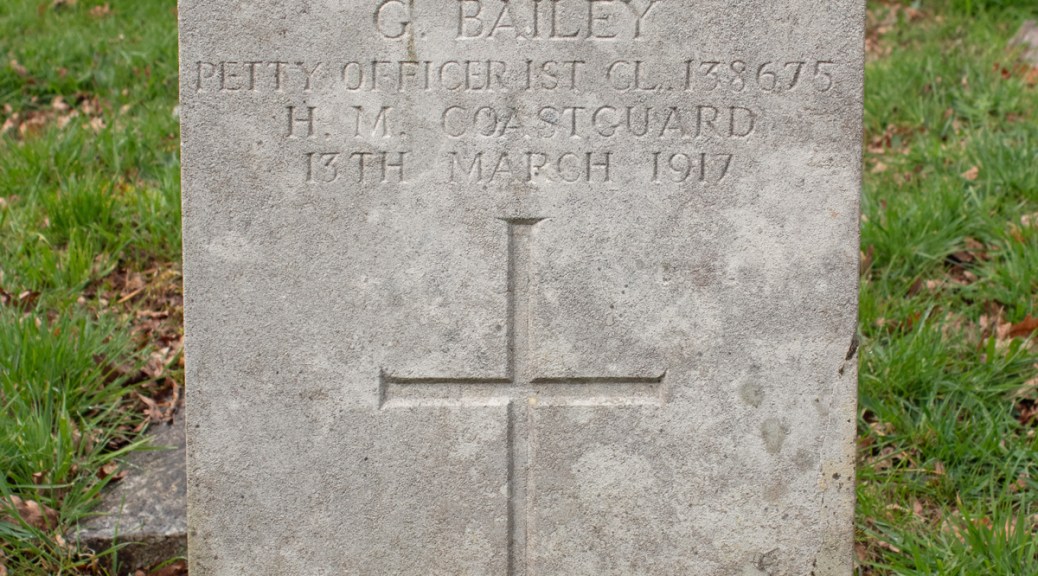
Petty Officer Bailey’s time out of active service was to be limited, however, as, just nine months later, war was declared. Called back into action, he was sent to Western Stack Fort in Milford Haven, Pembrokeshire.
An interesting personality has passed away in First-Class Petty Officer George Bailey, who died suddenly on Tuesday… He came home about a fortnight ago on sick leave, and seemed to be improving in health, and on Tuesday went out for a walk. After retiring to bed his death came suddenly as a result of heart failure.
[Crediton Gazette: Saturday 24th March 1917]
George Bailey died on 13th March 1917: he was 45 years of age. He was laid to rest in Tiverton Cemetery.
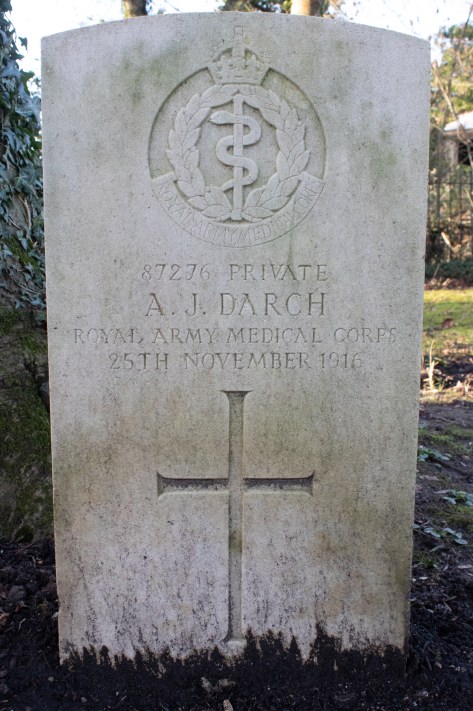
Alfred James Darch was born early in 1884, the second of seven children to James and Emily Darch. James was a postman and labourer from Somerset, but the family were brought up in Devon village of Clayhidon.
By the time of the 1901 census, the family had moved over the border to Wellington. Alfred had completed his schooling, and was working as a showmaker’s assistant. He committed himself to the role, and by 1911 was a shoemaker in his own right. By this point he was one of two of the Darch children to still be living with his parents: the family were settled at 22 Eight Acres Lane in Wellington.
When war broke out, Alfred stepped up to play his part. On 19th October 1916 he enlisted, joining the Army Medical Corps. His service records show that he was 5ft 4ins (1.63m) tall. They also suggested that his right leg was slightly shorter than his left, following an old dislocation. Private Darch had also had an operation for appendicitis five years previously.
Alfred was sent to Codford, Wiltshire, where the No. 3 New Zealand General Hospital was located. His time there was to be tragically short, however. On 17th November he was admitted himself, suffering with some breathing complications. The medical report noted that he was “vaccinated a fortnight ago. Bad, sore, inflamed arm. Reported sick eight days later with general malaise, slightly sore throat, slight headache – some cough. He had one anti-typhoid inoculation 2 or 3 days before vaccination… Has had no [previous] chest trouble… Face flushed. Temp 104.8. Pulse 100. Tongue white in centre, red at sides. Breath extremely foul. Voice hoarse. Breathing quiet. Not distressed.”
Over the nest week, Private Darch’s health deteriorated. Pleurisy was suggested, but when he passed away, at 5:45am on 24th November 1916, the diagnosis was pneumonia. He was 32 years of age.
Alfred James Darch was laid to rest in the extension to St Marys Church, Codford, not far from the base to which he had been sent just weeks before.
Robert Kennedy Grogan Graves was born on 1st January 1878. An announcement in the local newspaper confirmed that “at Baronne Court, County Tipperary, the wife of Lieutenant-Colonel W. Grogan Graves, 82nd Regiment, of a son (prematurely).” Robert was the older of two children, while his parents were William Graves, a Justice of the Peace in Ireland, and his wife, Georgianna Graves.
William died in 1890, and Georgianna moved the family to London. The 1891 census found her residing at the Golden Hotel in St Martin in the Fields, while her two boys, Robert and his younger brother, Geoffrey, were boarding students at Francis Napier’s classics school on Shooter’s Hill Road in Kidbrooke, Kent.
Robert found his calling through education. He studied medicine, and by January 1896 he was a student at St George’s Hospital in Tooting, Surrey.
By 1906 Robert had set himself up in an infirmary on Southgate Street in Gloucester, Gloucestershire. That same year, he married Kathleen Schofield: the couple went on to have two children, Robert Jr in 1912, and Bernard the following year.
Graves, Robt. Kennedy Grogan, Scison Lodge, Clevedon, Somerset (Tel. 11 Y Clevedon) – MRCS, LRCP London 1904; (St Geo.); Hon, Med, Off. Clevedon Cott. Hosp.; Med. Off Mutual Insur. N.Y. & Clevedon Hydro. Estab.; late Sen. Ho. Surg. & Asst. Ho. Surg., & Surg. Gloucester Co. Infirm., & Asst. Med. Regist. & Obst. Clerk St Geo. Hosp.
[The Medical Directory, 1910]
Robert had set himself up well during his life. The 1911 census found him and Kathleen – who was better known by her middle name, Gladys – living in their 17-room house on Linden Road in Clevedon. They afforded themselves three servants, including a housemaid, a cook and a motor driver. By the outbreak of war, Robert has an entry in the town’s Kelly’s Directory, and seemed to be a focal member of the community, joining the local Grand Lodge in September 1908.
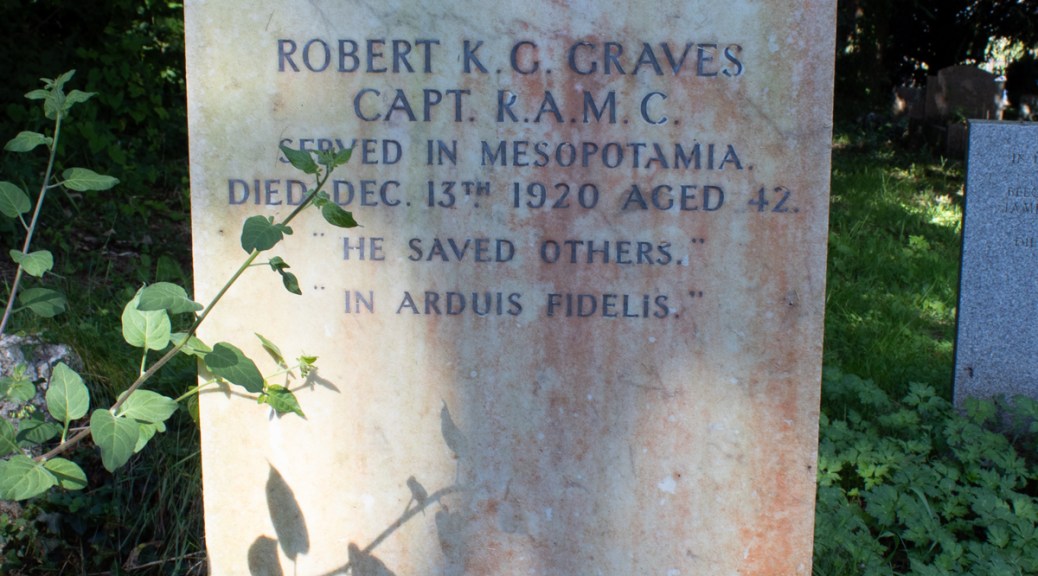
Robert’s time in the army, is hard to piece together. He joined the Royal Army Medical Corps as a Captain, and appears to have been connected to the air force. His headstone suggests that he served in Mesopotamia, but when and exactly where, however, is lost to time.
After the war, Robert returned to Britain. Leaving the Somerset coast, however, he and Kathleen appear to have set themselves up in Dorset. He died, through causes not detailed, on 12th December 1920, at 42 years of age. His entry on the probate register states:
GRAVES Robert Kennedy Grogan of 1 Charnwood Chambers Seabourne-road West Southbourne Hampshire died 12 December 1920 at The Grange Buckfastleigh Devonshire…
It is unclear whether Charnwood Chambers was his working address, with The Grange being the family’s official home, or if Buckfastleigh served as a place of convalescence.
Robert Kennedy Grogan Graves left an estate totalling £370 14s 7d (approximately £21,100 today) to Kathleen. He was buried in the graveyard of Holy Trinity church, Buckfastleigh.
Joseph Frederick Yeoman was born on 28th December 1880, the sixth of eight children to John and Eliza. John was a brewer’s drayman from Harbertonford in Devon, but it was on the coast in Paignton that the Yeoman family were born and raised.
When he finished school, Joseph found work as a mason’s apprentice. The 1901 census found the family of seven living in a small terrace cottage on Hill Park Terrace, to the south of Paignton town centre, with all but Eliza bringing in a wage.
In 1906, Joseph married Lydia Gill. She was the daughter of a general labourer from Chudleigh, Devon, who was working as a domestic servant for an architectural surveyor and his wife. The couple went on to have two children – Joseph Jr, who was born the following year, and Lilian, who was born in 1910, but who died when just a babe-in-arms.
The 1911 census found Joseph and Lydia living at 20 Nuneham Terrace, Joseph Jr is missing from the document, and it seems likely that, with his sister’s death, he had been taken in by another relative to allow his grieving parents some space.
When war broke out, Joseph stepped up to play his part. Full details of his military service have been lost to time, and a clear chronology is a challenge to piece together. Lydia passed away in January 1915, but it is not clear whether Joseph had enlisted by this point. His entry in the Army Register of Soldiers’ Effects confirms that he had joined up by September 1915 at the latest, and that he was in the Royal Engineers.
Sapper Yeoman was assigned to the 1st/3rd (Wessex) Field Company. It is unclear from his records whether he served overseas, but by the spring of 1916, he was in Kent.
The news will be received with deep regret of the death of Sapper JF Yeoman… which took place on Sunday from enteric fever at Nackington Hospital, Canterbury. Deseased was in the employ of Mr WF Pearce before joining up, and frequently assisted the old Rugby Football Club.
South Devon Weekly Express: Friday 10th March 1916
Joseph Frederick Yeoman was 35 years of age when he died on 5th March. His body was brought back to Devon for burial, and he was laid to rest in Paignton Cemetery.
Joseph Yeoman Jr was just nine years old when his father, and had lost both of his parents within a space of just over a year. Emma Augusta Gill, possibly Lydia’s sister-in-law, was given guardianship of him, and he moved to East Brent, Somerset, for a new life.







 Death and Service