Category Archives: Somerset

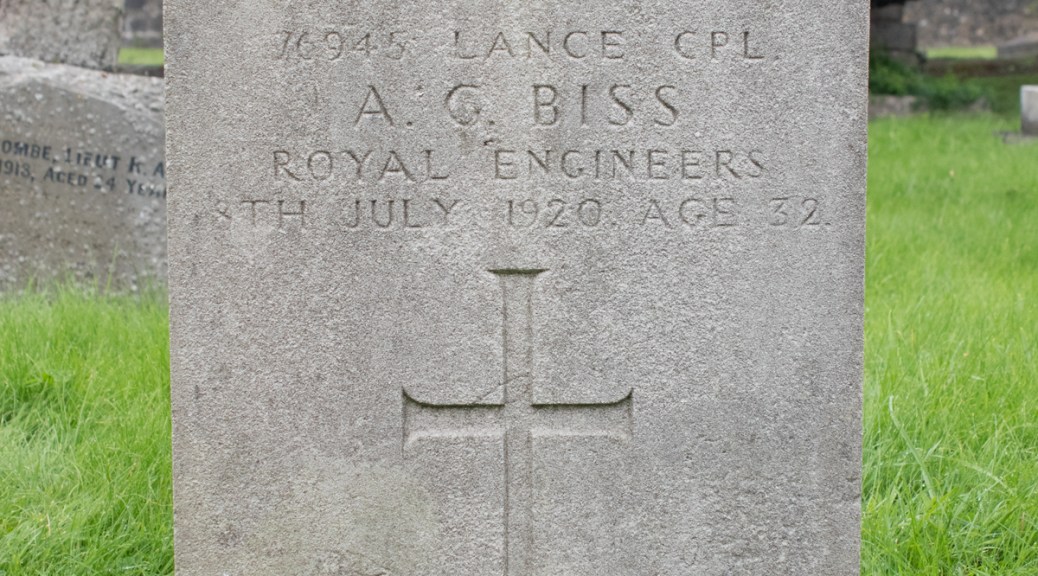
Lance Corporal Albert Biss

Lance Corporal Albert Biss

Albert Gillard Biss was born in Highbridge, Somerset, on 3rd July 1888. The middle of five children, he was the oldest surviving son of Richard and Rosanna Biss. Richard was a tin worker twelve years older than his wife and when he died, in September 1907, Rosanna was left to raise her family alone.

By the time of the 1911 census, Rosanna was living in a five-roomed cottage in Highbridge. Albert and his two younger brothers were living with her, and all three were working as building labourers to bring in money for the family. They also had a boarder, 87-year-old widow Henrietta Crandon, to bring in a little extra each month.

Albert was also saving up for other things. On 15th November 1911, he married Ada Alice Vincent. The couple went on to have three children – Albert Jr, Richard and Irene – before Ada’s untimely death in August 1915, just five weeks after Irene’s birth. At this point Albert had enlisted in the army, and it seems that his sister, Sarah, took on responsibility for her nephews and niece.

Albert was working as a telegraphist for the Post Office when he signed up. He had previously volunteered for the 3rd Somersets, but was assigned to the Royal Engineers when he enlisted. His service records show that he joined up in Weston-super-Mare, was 27 years and three months old, and stood 5ft 10.5ins (1.79m) tall.

Sapper Biss initially served on home soil, but was subsequently moved to the Base Signal Depot as part of the East Africa Expeditionary Force. He was promoted to Lance Corporal in April 1918, but over the next twelve months his health began to deteriorate.

On 6th April 1919, Albert was medically discharged from the army, suffering from a combination of malaria, epileptic fits and tuberculosis. He returned home to Somerset, and moved back in with Rosina. His sister Sarah was living in London by this point, and it is not clear whether Albert’s children came back to Highbridge or not.

Over the next year Albert’s health went from bad to worse. On 8th July 1920 he finally succumbed to a combination of pulmonary tuberculosis, acute nephritis, meningitis and uraemia. He had just turned 32 years of age.

Albert Gillard Biss was laid to rest in the sweeping grounds of Highbridge Cemetery.


After Albert’s death, his two sons fell under the guardianship of their aunt Sarah. Responsibility for Irene, however, was given to an Ebenezer and Eliza Monks, who lived in Clapham Common, London. The 1938 Electoral Register found Irene, who went by the name Monks-Biss, still living with here adopted family.


Lieutenant David Slocombe

Lieutenant David Slocombe

David William Slocombe was born on 9th November 1893, the oldest of seven children to William and Kate. William was a tin worker from Huntspill, Somerset, and it was in nearby Highbridge that the family were born and raised.

David appears to have been a bright lad, receiving a sponsorship from the King James Foundation to attend Dr Morgan’s School in Bridgwater. He spent six years there, from September 1906 to July 1912, and went on to become a customs and excise clerk when he left.

When war arrived in Europe, David was called upon to play his part. He initially enlisted on 1st December 1915, but was placed on reserve for nearly a year. His service records show that he was 22 years of age and 5ft 8.5ins (1.74m) tall. When he was finally mobilised, he was given a commission in the Royal Flying Corps.

At this point, David’s trail goes cold. Later documents confirm that he transferred across to the Royal Air Force when it was founded in April 1918, and that he rose to the rank of Lieutenant. He served in France and Italy and, by the end of the war, was attached to the 44th Training Depot Station in Oxfordshire.

By the autumn of 1918, Lieutenant Slocombe had come down with pneumonia. He was admitted to the 3rd Southern General Hospital in Bicester, and this is where he was to breathe his last. David died on 24th October 1918, aged just 24 years old.

David William Slocombe was brought back to Somerset for burial. He was laid to rest in Highbridge Cemetery.


Private William Lock

Private William Lock

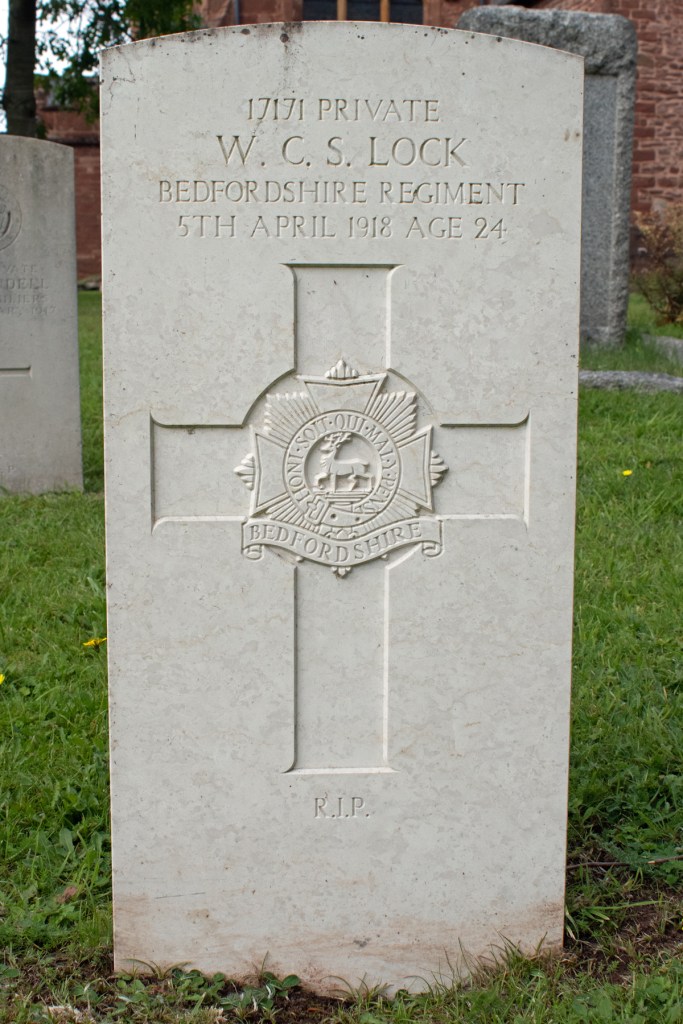
William Charles Shallis Lock was born in the spring of 1894, the eldest child to Harriet Lock. Born out of wedlock, Harriet went on to marry William’s father, Charles Shallis, in 1897. The couple would go on to have two more children – Walter and Lilian – before Harriet’s untimely death in 1900.

The 1901 census recorded William living with his maternal grandparents, Daniel and Ellen Lock, in the family’s home village of Bishops Lydeard, Somerset. Daniel was a farm labourer and, by the time of the 1911 census, William was making his own way in the world, boarding at Rainbow Wood Farm in Claverton, to the east of Bath. The document seems to indicate that William had ditched his first name, and was now using Charles as his preference.

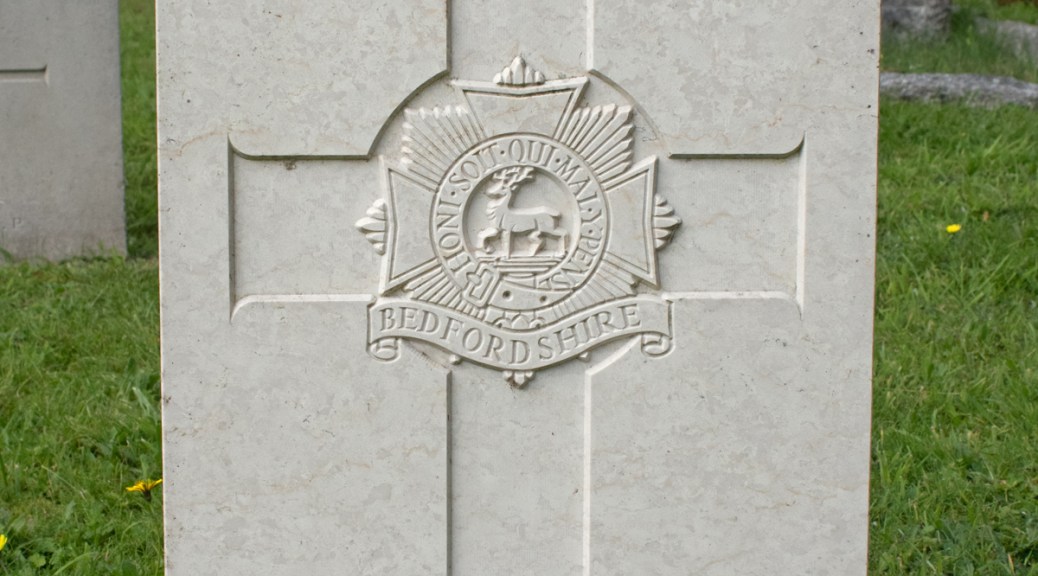
War came to Europe in the summer of 1914, and Charles stepped up to play his part. Sadly, full service records are no longer available for him, but it is clear that he had enlisted in the opening months of the conflict, and that he joined the Bedfordshire Regiment.

Assigned to the 7th (Service) Battalion, Private Lock found himself in France by the end of August 1915. Charles would have found himself in the thick of the fighting, and was entrenched at both the Somme in 1916 and Passchendaele the following year.

It seems likely that Private Lock’s luck ran out at either the Battle of St Quentin in March 1918, or at the Battle of the Avre, just a few weeks later. That he was wounded is certain, as he was medically evacuated back to Britain, and admitted to Liverpool Infirmary. Charles’ injuries were to prove too severe, however, and he died while admitted on 5th April 1918. He was just 24 years of age.

The body of William Charles Shallis Lock was taken back to Somerset for burial. He was laid to rest towards the front of the graveyard of St Mary’s Church, in his home village, Bishops Lydeard.


Private George Rawle

Private George Rawle

George Rawle was born on 26th April 1867 in the Somerset village of Milverton. One of nine children, his parents were William and Ann. William was a shepherd turned general labourer and, when he first finished his schooling, George was sent north to Nether Stowey, where he worked as a stable boy at Castle Hill House.

The 1891 census found George back living with his parents, who had moved to Milverton, presumably following William’s work. George, by this time, was employed as a domestic groom, although the next census found both him and William – now 74 years of age – working as general labourers.

William died in 1902, and Ann passed away seven years later. By 1911, George had moved just up the road to Wiveliscombe. He was living in a four-roomed cottage and employed as a jobbing gardener. He shared his home with two of his sisters: Jane was 46 years old and working as a housemaid; Alice, 33 years of age, was a housekeeper.

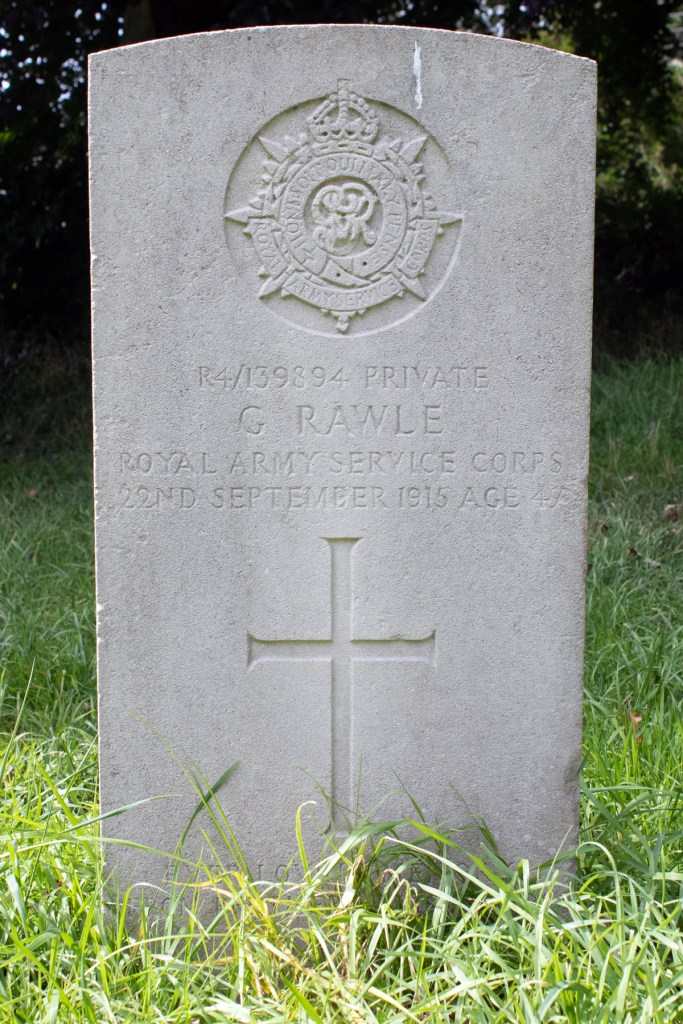
When war came to European shores, George felt the need to step up and play his part. He joined up at an enlistment drive at the brewery in Wiveliscombe, and was assigned to the Royal Army Service Corps as a Private. While waiting for his medical he returned to the home he shared with his sisters. It was here, just five days later, that he ended his life.

A painful sensation was caused in Wiveliscombe on Wednesday morning, through the action of Priv. George Rawle, of the E Squadron, Somerset Mule Depot, who took his own life under distressing circumstances at his residence at Higher Nunnington.

Deceased… had been restless through the night, and about five o’clock in the morning he told his sister he was going to get up to write a letter. The sister begged him to put his clothes on, but he would not do so, and went downstairs. She followed him in her nightdress. He picked up a gun in the hall, and she tried to take it away from him, but failed. Rawle went out to the path in front of the door of the house. His sister took hold of his arm, but he wrenched himself away, put the muzzle of the gun in his mouth, pulled the trigger, and fell down beside her, having blown out his brains.

Dr WH Randolph was in attendance shortly after, but could only pronounce life extinct.

The inquest took place on Friday, before Mr Foster Barham, coroner for West Somerset.

Jane Rawle, deceased’s sister, said her brother had suffered from nervous depression for many years, and seventeen years ago was a patient at Cotford Asylum. Lately he had been worried about the house in which he lived.

Taunton Courier and Western Advertiser: Wednesday 29th September 1915

The jury at the inquest returned a verdict of suicide while of unsound mind. George was 48 years of age.

George Rawle was laid to rest in the quiet graveyard of St Andrew’s Church, Wiveliscombe. His estate was shared between two of his sisters, Jane and Hannah.


Private Thomas Besley

Private Thomas Besley

The short life of Thomas Besley is a challenge to unpick. He was born in Bampton, Devon, early in 1896, one of ten children to farm labourer Steven Besley and his wife, Fanny.

Steven’s work took the family around the region, and the 1901 census found the Besleys living on Cordings Farm in Wiveliscombe, Somerset. The document records Thomas as being 5 years of age, sharing the accommodation with his parents and six of his siblings.

The 1911 census records Thomas working as a live-in labourer at Manor Farm in Huish Champflower, a village just three miles outside of Wiveliscombe.

Meanwhile, his family are still recorded as living in Wiveliscombe itself, Steven and Fanny residing with four of their children. Now, however, another Thomas is listed with them: seven years old, he is the only child of their oldest son, William and his late wife, Elizabeth. She had died in 1904, around the same time as young Thomas’ birth, and it would appear that Steven and Fanny adopted their grandson (he is listed on the census as their ‘son’). William went on to marry again, but his new wife, a widow called Hannah, had seven children from her first marriage. The couple would go on to have a son of their own, but it was a crowded house, and so Thomas lived permanently with his grandparents.

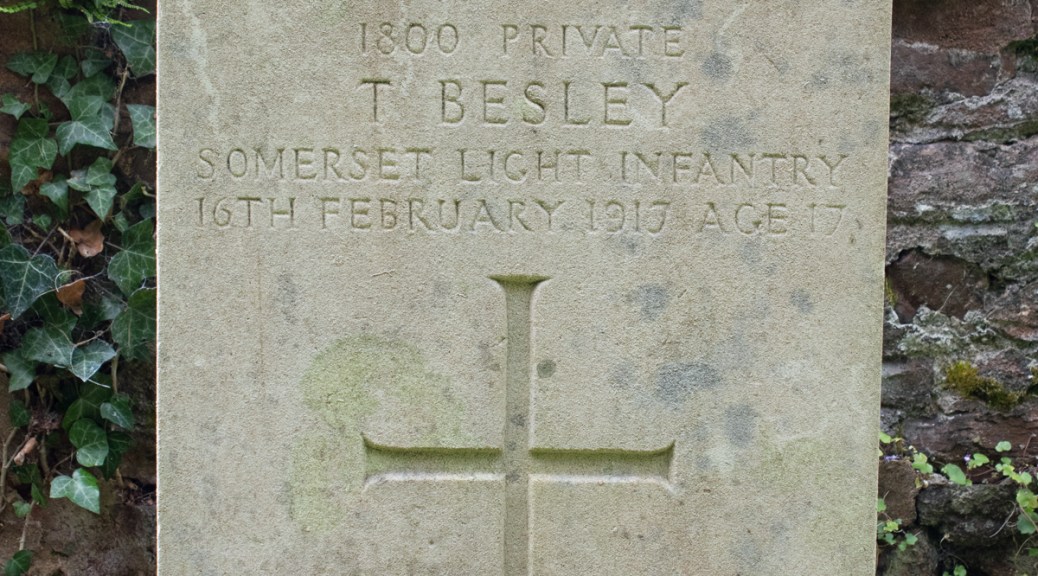
The older Thomas Besley signed up almost as soon as war was declared in 1914. While his service records are sparse, he joined the 3rd/5th Battalion of the Somerset Light Infantry.

What can be determined from the records is that Private Besley drowned. His death certificate – which mistakenly records his surname as Beasley – confirms that Thomas’ body was found in the River Tone in Taunton on 16th February 1915, and the cause of death noted as ‘found drowned’.

While research for Besley draws a number of blanks about the circumstances of his death, the misspelled surname featured in a contemporary newspaper report:

On Tuesday afternoon, around four o’clock, MJ Chapman… while passing the Locks at Firepool, Priory, Taunton, observed what appeared to be the body of a man floating in the swirl caused by the overflow of the Locks into the pool. The police were immediately informed… and proceeded to the spot with the ambulance and recovered the body of a man, dressed in khaki uniform. The body had evidently been in the water for a considerable time and was much decomposed. The deceased was subsequently identified as Thomas Beasley, son of Mr Stephen Beasley, of Langley Marsh, Wiveliscombe. He was a private in the 5th Battalion of the Somerset Light Infantry, and was 40 years of age. He had been in ill-health for a considerable period, and latterly had been depressed. He disappeared on January 16th, and despite all enquiries his whereabouts remained a mystery until Tuesday…

[At the inquest] Stephen Beasley, a farm labourer… gave evidence of [Thomas’] identification. He said that his son had lately been ill. Three months ago he was taken from Salisbury Plain to Bristol Hospital, where he remained for about a month. After his discharge from Hospital he went home, where he remained about a fortnight, and for the last two months he had been quartered at Taunton. In this time witness had seen his son twice, but he could not say that he had been well since he came out of Hospital. He was low-spirited, but never told witness that anything troubled him.

Florence Beasley… sister of deceased, said she last saw her brother about a month ago in Taunton. He seemed very strange and low and would not speak unless spoken to first. He seemed to be troubled, and would not shake hands with her when she left him. He seemed to be always ‘studying.’ There was no suicidal tendency in the family…

Captain Burridge stated that deceased was sent to hospital from the Plain about September. About the middle of October he had a wire from Bristol Infirmary informing him that he was dangerously ill and dying. However, he got over that, and he was discharged on October 28th. He was sent for 22 days’ furlough to his home and returned to duty on November 22nd. Ever since that time he had not been in the best of health, but nothing had been noticed of his mental condition. He believed at one time there was a talk of his being discharged as medically unfit. He disappeared on January 16th.

The Coroner asked [how] long deceased had been in the service, and witness answered that he joined on June 1st, 1913. His complaint when removed to Bristol Hospital was double pneumonia.

On the suggestion of the Coroner, the jury returned an open verdict.

Taunton Courier and Western Advertiser: Wednesday 24th February 1915

In addition to the Besley/Beasley surname, the report features a couple more discrepancies. Thomas’ father’s name is given as Stephen, when it was Steven. The deceased is also recorded as being 40 years old when he died, when he was actually half that age.

Thomas Besley was laid to rest in the peaceful graveyard of St Andrew’s Church in Wiveliscombe. It gives his age as 17 years old and the date of his death as 16th February 1917.


Leading Stoker Leonard Gulliford

Leading Stoker Leonard Gulliford

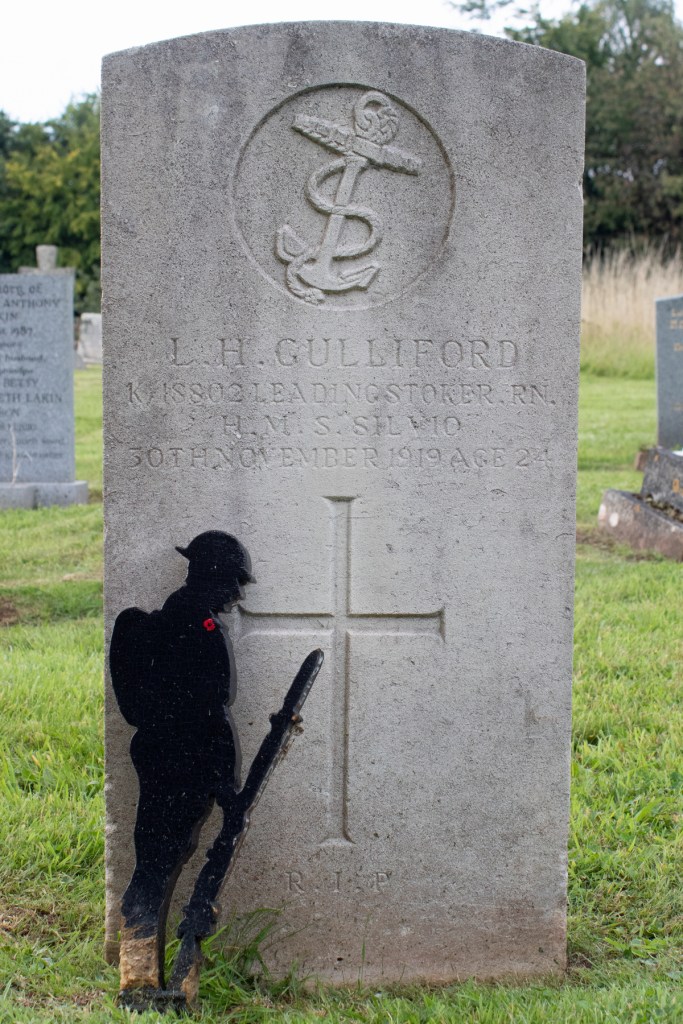
Leonard Henry Gulliford was born on 26th January 1895 in the village of Cothelstone, near Bishops Lydeard, Somerset. One of eleven children, he was the son of farm labourer William Gulliford and his wife, Jane.

When he completed his schooling, Leonard also found employment on the farm. However, it seemed he wanted bigger and better things and, on 7th April 1913, he enlisted in the Royal Navy as a Stoker 2nd Class. His service records show that he was 5ft 4.5ins (1.64m) tall, with fair hair, blue eyes and a fresh complexion.

Stoker Gulliford spent the first six months of his naval career at HMS Vivid, the Royal Naval Dockyard in Devonport, Devon. This was to be the base to which he would return in between voyages. His records show unusual activity for his time, as he was assigned to just one ship – the battle cruiser HMS New Zealand – during his six years’ service. Leonard spent five years on board, from September 1913 to February 1919, with just one month based back in Devonport during this time.

Leonard rose through the ranks over the years, receiving a promotion to Stoker 1st Class in April 1914, Acting Leading Stoker in July 1918 and Leading Stoker in July 1919, by which point he was, once again, based at HMS Vivid.

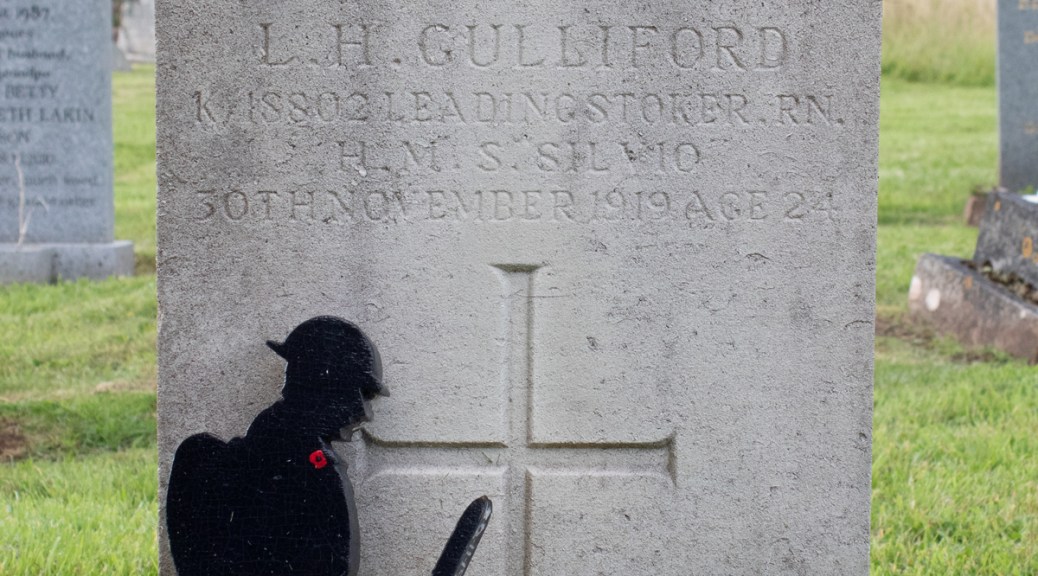
In November 1919, Leonard was attached to the sloop HMS Silvio, based in the River Tamar. A party of the crew, Leading Stoker Gulliford included, left the ship without leave, taking a boat to shore.

The bodies of the seven men who were missing from two warships in the Tamar Estuary were recovered this morning, and a mystery has thus been cleared up.

The men left two ships, HMS Swindon and HMS Silvio, on Sunday evening, and it is believed visited Saltash, a riverside town. Later an upturned boat and two naval caps were found…

The bodies were found close together on the mudflats in shallow water in Tamar Creek, on the eastern side of the River Tavy, near the Tavy railway bridge.

Daily News (London): Friday 5th December 1919

A subsequent inquest into the sailors’ deaths determined that, after their time in Saltash, they took their boat, which, at just 13.5ft (4.1m) long, proved too small for seven man, back to their ships. The wind and choppy waters proved too much, and the boat capsized, throwing all of them into the water to their doom. A verdict of accidental death was recorded.

The body of 25-year-old Leonard Henry Gulliford was taken back to Somerset for burial. He was laid to rest in the graveyard of St Mary’s Church in Bishops Lydeard.


Driver Henry Gibbs

Driver Henry Gibbs

Henry Gibbs was born in Wiveliscombe, Somerset at the start of 1871. The youngest of five children, he was the second son to John and Emma Gibbs. John was a farm labourer, but when he finished his schooling, Henry went in a different direction.

By the time of the 1891 census, Henry was boarding with his sister Lucy and her husband and young son. The extended family were living in Taunton, Somerset, where Henry was employed as a boot and shoemaker. This appears not to have satisfied him, however, and he soon found other work, enlisting in the Royal Field Artillery. While his army records are lost to time, he seems to have spent twelve years in service.

By the early 1900s Henry living back in Somerset, settling in Bishops Lydeard, to the west of Taunton. On 2nd May 1906, he married a young woman called Florence Gange. Fifteen years his junior – she was 20 years old to her husband’s 35, even though the marriage certificate gave his age as 30 – she a labourer’s daughter from the village, who was working at the Lethbridge Arms public house at the time of their marriage. The couple set up home in a small cottage, and went on to have four children: Ernest, Florence, Mabel and Arthur.

Henry’s work seems to have been transient. On his marriage certificate, he was noted as being a groom, but the next census return, taken in 1911, gave his employment as a labourer for a corn miller.

When war came to European shores, despite his growing family, Henry felt the pull to serve once more. He enlisted in the Royal Army Service Corps in the summer of 1915, with the rank of Driver. As with his previous time in the army, details are scarce, but Henry seems to have been based in Aldershot, Hampshire, or at least this is where he was based towards the end of the conflict.

Driver Gibbs had become unwell by this point, and he was suffering from oesophageal cancer. He was admitted to the military hospital in Farnham Hill, but was to succumb to the condition. He passed away on 1st September 1918, at the age of 47 years of age.

Henry Gibbs was brought back to Somerset for burial. He was laid to rest in the quiet graveyard of St Mary’s Church in his adopted home village, Bishops Lydeard.


Private Amos Vickery

Private Amos Vickery

Amos Vickery was born in the autumn of 1886 in Bishops Lydeard, Somerset. He was the youngest of six children to William and Annie Vickery. William was a farm labourer, but when he finished his schooling, his son found work as a groom.

On 23rd February 1909, Amos married Alice Gratton. She was the daughter of a farm labourer from Halse, Somerset, who had taken up domestic duties in Bishops Lydeard. Not long after they were married, Amos took up new employment as publican of the Tynte Arms Inn in Enmore, and this is where he and Alice brought up their two children, Evelyn and William.

Amos’ time as a landlord seems not to have lasted long. By the time war broke out, the family had moved to Wiveliscombe, where he was working as a postman. Amos stepped up to play his part for King and Country, but was initially rejected. There are no longer any documents to confirm why this was the case, but it may have been based on any medical carried out.

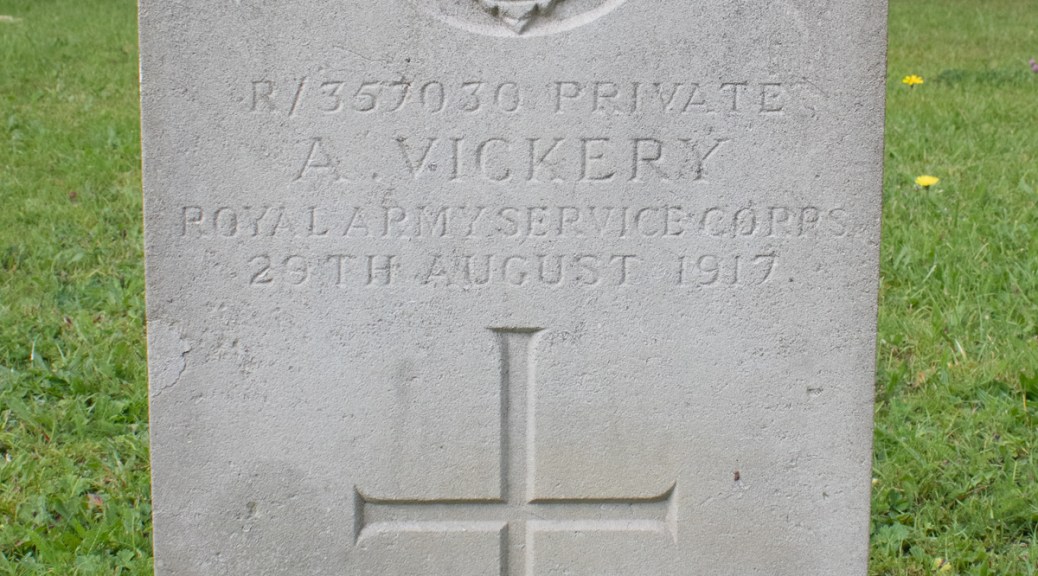
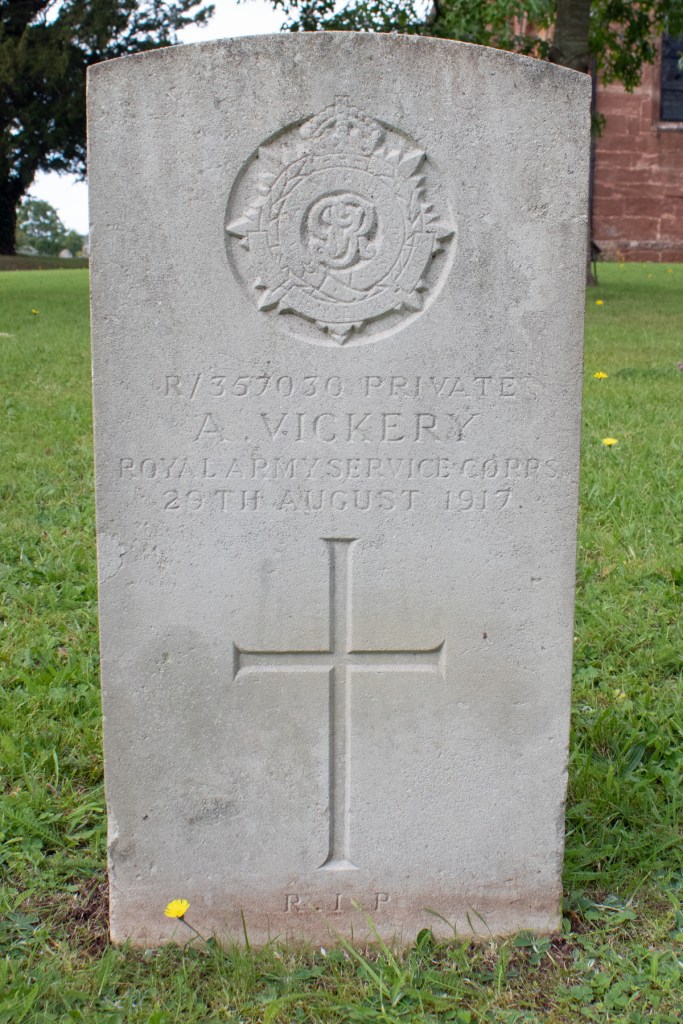
Amos was finally accepted for armed service in June 1917, and was assigned to the Royal Army Service Corps. Private Vickery was attached to the Remounts Unit, and seems to have been posted around Bristol, Gloucestershire.

On Monday afternoon last the funeral took place… of the late Private Amos Vickery, ASC, who died somewhat suddenly from paralysis… at No 2 General Hospital, Bristol, at the age of 31, after a few days’ illness.

Taunton Courier and Western Advertiser: Wednesday 12th September 1917

Private Vickery’s service documents gave an official cause of death as hemiplegia and cerebral thrombosis: in effect, a stroke. He had been in the army for just ten weeks.

Amos Vickery was laid to rest in the graveyard of St Mary’s Church, Bishop’s Lydeard.


Private William Yandell

Private William Yandell

William Daniel Yandell was born in 1884 in Bishops Lydeard, Somerset. The second of four children, his parents were Samuel and Jane Yandell. Samuel was a farm labourer, and this is work that William and his younger brothers, wins Sam and Walter, also went into.

The 1911 census found William living with Walter, who had found employment as a labourer at Cotford Asylum, not far from the village. The brothers also had a boarder, Samuel Chaffey, a carter, who brought in some more money to the household. Samuel Sr and Jane were all that remained in the family home. Samuel Jr had married three years before, and was living in a small cottage with his wife, Rosina, and their two children. The oldest of the Yandell siblings, Alice, had been married for ten years by the time of the census, and was living with her husband and son in Minehead.

Samuel Sr died in the spring of 1914. By the summer, war had been declared, and the three Yandell brother enlisted to serve their king and heir country.

William, by this point, had found work at the Goodlands Coal Yard and volunteered for the local fire brigade. He did not enlist immediately but joined the Royal Fusiliers in the spring of 1916. Attached to the 3rd Battalion, Private Yandell found himself in France that summer.

On 1st October 1916, he was badly wounded in the right arm and shoulder, and was medically evacuated to the 2nd Western General Hospital in Manchester for treatment. This proved to be long-term support, and on 21st January 1917, he underwent an operation on the injury. Private Yandell was not to come round from the surgery: he passed away the following day at the age of 33 years of age.

William Daniel Yandell was brought back to Somerset for burial. He was laid to rest in the peaceful graveyard of St Mary’s Church in his home village of Bishops Lydeard.


The deepest sympathy is felt for [William’s] widowed mother and relatives, as the widow has another son a prisoner of war in Turkey, who was taken with General Townshend’s force at Kut, and no news has been heard since they were taken prisoner. Another son is somewhere in Salonica, from whom no news has been heard for some weeks past.

Taunton Courier and Western Advertiser: Wednesday 31st January 1917

Walter was the son being held in Turkey. He had joined the Somerset Light Infantry as a Private, and was assigned to the 1st/5th Battalion. His troop was caught up in the Siege of Kut in the spring of 1916. He died on 31st May 1916, soon after being taken prisoner, a fact his mother would not be made away of for at least nine months, based on the newspaper report. Private Walter Yandell is commemorated on the Basra Memorial in Iraq.

Sam Jr was the son who was based in Salonika. Full details of his military service are not available, but later records confirm that he survived the war. By the time of the 1939 England and Wales Register, he was living back in Bishops Lydeard with Rosina, and was working as a Mess Orderly at a military camp. Sam died in January 1951, at the age of 63.


Serjeant Robert Oborne

Serjeant Robert Oborne

Robert Oborne and his twin, William, were born in the summer of 1880, two of ten children to John and Elizabeth Oborne. John was an agricultural labourer, and the family were raised in Bishop’s Lydeard, Somerset.

Death was to surround Elizabeth Oborne: William died when he was only three years old and John also passed away in 1886. This was around the time that she gave birth to their last child, who she also named William. The 1891 census recorded Elizabeth as living in the centre of Bishops Lydeard with four of her children: John, who was a farm labourer, Elizabeth, an errand girl, and Robert and William, both of whom were still at school.

When he completed his schooling, Robert found work as a coal hewer. He moved to South Wales, and boarded with the Hampshire family, in Ystradyfodwg, Glamorganshire. Further details of his life before the outbreak of war are scarce, although it seems that he changed career, taking up work as a groom. Known as Bobbie, later reports suggest that he was a genial young man, and had a large number of friends.

1915 proved a pivotal year for Robert: that summer he married Amy Lyons in Taunton. Elizabeth died in October, and his next oldest sibling, a sister also called Elizabeth, passed away just weeks later.

“Just before the war he joined the Somerset Light Infantry [Territorial] and went through the Gallipoli campaign, and then went to Egypt… he acted [in the capacity of a groom] to his officer commanding, and whilst in Egypt had the misfortune to get thrown from his horse, which caused internal trouble.” [Taunton Courier and Western Advertiser: Wednesday 14th April 1920]

The now-Serjeant Oborne was medically discharged from 3rd/4th Battalion on 21st August 1916, and returned to Somerset. He took up employment with Colonel Dennis Boles MP, acting as his groom from him from Watts House, on the outskirts of Bishops Lydeard.

Robert appears to have continued with this life for the next few years, but his wartime injuries continued to dog him.

…on Tuesday, March 2nd [1920], he gave up work and went to the doctor, who advised his removal to the hospital, where he was taken the following Friday, and underwent an operation the same evening. Hopes were held out for his recover, and he lingered until 1:30 on Wednesday morning [7th April], when he passed away.

Taunton Courier and Western Advertiser: Wednesday 14th April 1920

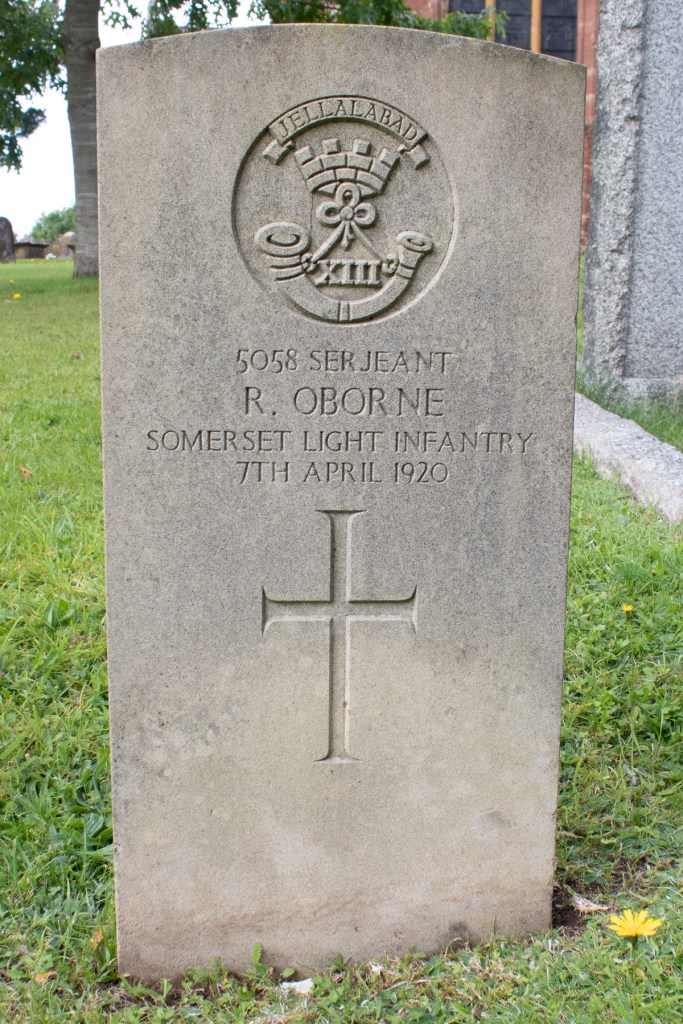
Robert Oborne was 39 years old when he died. He was laid to rest in the grounds of St Mary’s Church in his home village, Bishops Lydeard.