Category Archives: Royal Defence Corps

Private Nicholas Paice

Private Nicholas Paice

Nicholas John Paice was born in the spring of 1867, the second of five children to John and Olive Paice. John was a railway policeman from Aldermaston in Berkshire, but his oldest son, Nicholas, was born in Poole, Dorset where Olive came from.

The Paice family seemed to move to wherever John’s work took him. The 1871 census found them living back in the Berkshire village of Shrivenham, while a decade later they were to be found in Longfleet, to the north of Poole. By this point, John was employed as a groom, and Olive a laundress.

When he completed his schooling, Nicholas found work as a butcher. He had also enlisted in the local militia, joining the 3rd Dorset Regiment. The army life seemed to suit him and, on 12th July 1886, he enlisted in the Rifle Brigade. His service records show that he was 5ft 7ins (1.7m) tall and weighed 148lbs (67.1kg). At 19 years and three months old, he was noted as having a fresh complexion, grey eyes and brown hair. The papers show that he had a scar on his left eyebrow, and tattoos on his forearms and the middle finger of his left hand.

Joining up for a period of twelve years, Private Paice would spend nearly seven of those in India and Burma. His time in the army was not without incident, however. Just three weeks after enlisting he deserted, and remained at loose for nearly a month. When he was captured, he was imprisoned for desertion for four weeks, his term of service extended to reflect the time he was AWOL.

In August 1896, having been back on home soil for just over two years, Nicholas was arrested again. Convicted of ‘begging’, he was confined for a week, before being released back to duty.

On 16th September 1898, Nicholas completed his contract, and was formally discharged from the army.

The next few years are a mystery for Nicholas. He had married Maria Andrews in 1896, and the couple would go on to have eight children, of which five would survive childhood. By the time of the 1911 census – the next document where we can pick him up – Nicholas and the family were living in two rooms at 2 New Corn Street, Bath, Somerset. Nicholas was working as a cattle drover, along with Maria, the household included her daughter Annie, and granddaughter Lily, and John and Maria’s son, Earnest.

When war came to Europe, Nicholas stepped up to play his part. He enlisted in the Somerset Light Infantry on 26th October 1915 but, with his age against him, he was transferred to the 263rd Coy. of the Royal Defence Corps the following April.

It seems that Private Paice’s health was also being impacted and he spend a month in the Red Cross Hospital in Portishead, having contracted influenza. Released to duty on 16th May 1916, just a month later he was re-admitted for three weeks, this time suffering from bronchial catarrh. On 10th September he was admitted to the hospital for a third time. This time it was identified that he had come down with pulmonary tuberculosis, and on 12th October 1916, he was formally discharged on medical grounds.

It is unclear what happened to Nicholas next. His service records suggest that he wasn’t immediately discharged from the Portishead hospital, and it seems likely that he would have returned home to Bath at some point. The next record for him is that of his passing, from tuberculosis, on 20th December 1919. He was 52 years of age.

Nicholas John Paice was laid to rest in the sweeping Locksbrook Cemetery in his adopted home town of Bath, Somerset.


Second Lieutenant Algernon O’Donoghue

Second Lieutenant Algernon O’Donoghue

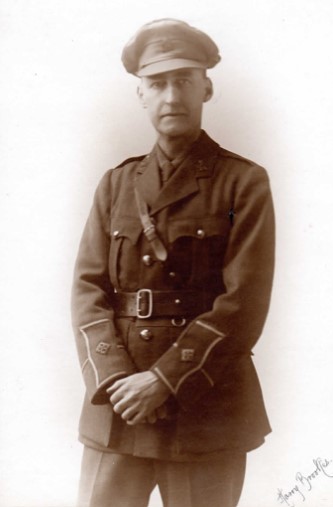
Algernon Leopold O’Donoghue was born on 4th June 1869 in Plymouth, Devon. The youngest of five children, his parents were Charles and Frances O’Donoghue. Charles had worked for the East India Company and the family travelled a lot while the children were growing up. He was in India when, in the spring of 1872, he passed away.

By the time of the 1881 census, Frances had moved the family to the Walcot area of Bath, Somerset. She was working as an assistant, and employed a servant of her own to help support the four children.

Over the next few years, Algernon’s trail goes cold. In 1900, he married Janette Hay, the daughter of a Justice of the Peace, who had been born in Ceylon. It seems likely that they met overseas: the 1911 census return records that she had been born in Ceylon, while he was a retired forest manager whose job had taken him to Burma (now Myanmar).

The census document found the couple living in a seven-room villa in Combe Down, on the outskirts of Bath. The had had a son by this point, with Algernon Jr making up the family.

Algernon was working for the Bombay Trading Company, and back out in India, when war broke out. He returned home, and stepped up to serve his King and Empire. While his service records have been lost to time, Private O’Donoghue joined the Royal Defence Corps, and quickly rose through the ranks: by the spring of 1917, he was a Second Lieutenant.

It was while serving in the north west of Britain that he fell ill: “[he got] wet while out in heavy rain, pneumonia following, and then double pneumonia.” [Bath Chronicle and Weekly Gazette: Saturday 26th May 1917] Second Lieutenant O’Donoghue was admitted to the Whitman Military Hospital in Manchester, but his condition was too severe. He passed away on 22nd May 1917, two weeks before his 48th birthday.

The body of Algernon Leopold O’Donoghue was taken back to Somerset for burial. He was laid in the family plot in Bath’s panoramic Locksbrook Cemetery, reunited with his mother, Frances, who had died a decade before.


Second Lieutenant Algernon O’Donoghue
(from findagrave.com)

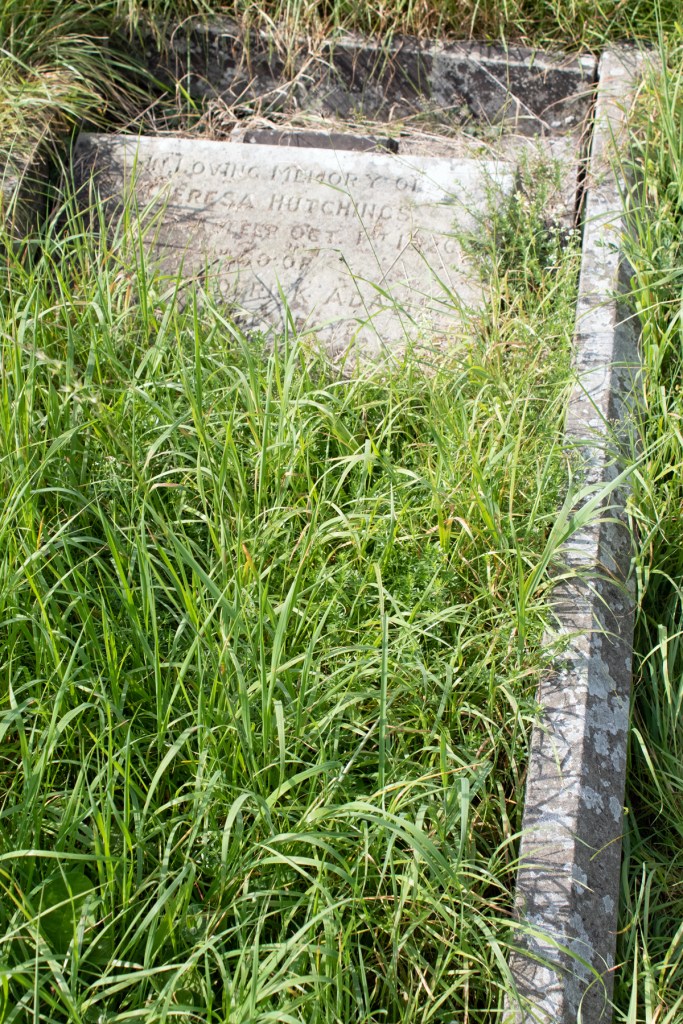
Private Henry Hutchings

Private Henry Hutchings

The funeral of Mr Henry Hutchings, the Zulu war veteran, who died suddenly at Lower Weston on Tuesday, took place on Saturday afternoon…

The principal mourners were: Mrs Hutchings (widow), Sergt. Hutchings (son)(who wore the Mons ribbon and a Zulu war medal), Mr AE Adams (step-son), Mrs A Hutchings (daughter-in-law), Mr David Adams (step-son), and Mrs Emily Pickworth (step-daughter).

In order to attend the funeral Mr AE Adams had returned from France, where he has been carrying out work for a local firm.

Bath Chronicle and Weekly Gazette: Saturday 16th February 1918

Tracking down Henry Hutchings’ early life is a bit of a challenge, but working backwards through census records sheds some light onto his later years.

The Commonwealth War Graves Commission record states “Hutchings, Pte. Henry, 14475. Royal Defence Corps. 5th Feb., 1918. Age 59. Husband of Theresa Hutchings… Served in the Zulu War (1877-79) with Army Service Corps.”

The 1911 census recorded Henry and Theresa living in Shepherd’s Bush, Hammersmith. The document confirms they had been married for less than a year and, unusually, suggests both were twice married. Henry had been born in Notting Hill, and was employed as a smith’s hammerman. Theresa was born in Byfleet, Surrey, and the couple were living with Henry’s son, Henry Jr, and Theresa’s daughter, Alice.

Turn the clock back ten years, and the 1901 census tells a more confused story. Henry was living in Edmonton, Middlesex, where he was employed as a general labourer. Theresa is noted as being his wife – in contrast to the later census return – and the couple were living in Gilpin Crescent with Henry’s sons – Henry Jr, Edward and Sidney – and Theresa’s two children – Alice and Albert.

Going back a further ten years leads to a dead end. Neither Henry nor Theresa are readily identifiable on the 1891 census, even though both should have had their older children by that point.

An 1877 military record confirms Henry’s earlier time in the army. It was in July of that year that he enlisted, joining the Army Service Corps. At 18 years of age, he had been working as a carman, but a dedicated career is what he sought out. His record confirms he was 5ft 4ins (1.63m tall, with brown hair, blue eyes and a fresh complexion. Henry lists his next of kin as brother Robert Hutchings, although, again further family details are lost in the mists of time.

Private Hutchings spent twelve years in the army. After eighteen months on home soil, he was dispatched to South Africa, as the later newspaper report suggests, and spent a year overseas. He returned home in March 1880, and was stood down to reserve status until the end of his contract in July 1889.

The documentation uncovers details of Henry’s second period of time in the military. He enlisted in the Royal Defence Corps in September 1915, and was based at Alexandra Palace in London. His time there was limited, however, as he began to show signs of heart disease. By the following summer, Private Hutchings suffered from breathlessness and chest pains, to the point where he was medically discharged from service on 21st August 1916.

Henry and Theresa had moved to Somerset by January 1917, presumably for the cleaner air that their home in Bath would provide. This was not to be enough, however. Henry died a little over a year later, at the age of 59 years old.

Henry Hutchings was laid to rest in the sweeping grounds of Locksbrook Cemetery, Bath. He was to be reunited with Theresa when she passed away in 1926.


Serjeant Thomas Wood

Serjeant Thomas Wood

Thomas Wood was born in Bristol, Gloucestershire, in the summer of 1862. The third of ten children, he was the oldest son to Thomas and Emma Wood. Thomas Sr was a cabinet maker, but his son was not to follow in his father’s footsteps, seeking a life of adventure instead.

Thomas enlisted in the army and, while documents relating to his early life are not readily available, the 1891 census recorded him as being billeted at the Cambridge Barracks in Portsmouth, Hampshire. A member of the Royal Artillery, he seems to have been enlisted for a while, as he had risen to the rank of Corporal.

In 1894, Thomas married Leah Barrett, who was born in Oxfordshire. The army life underscored where the family would settle. They had four children and, according to their ages, the Woods were in Liverpool by 1895, Gosport, Hampshire, in 1896 and Cork in Ireland by 1899. The 1901 census found the family living in Wicklow, with Thomas having now achieved the rank of Company Sergeant Major.

Ten years later, and Thomas had stepped away from the army life. Now 48 years of age, he and Leah had been married for 17 years. The couple had settled in the Worle, on the outskirts of Weston-super-Mare, Somerset, where Thomas had set himself up as a butcher, with Leah assisting him.

War came to Europe in 1914, and it seems that Thomas felt drawn to play his part once more. He joined the Royal Defence Corps as a Serjeant when it was formed in the spring of 1916, and was assigned to the regiment’s 263rd Company.

Little information is available about Serjeant Wood’s army service, but by the autumn he had been admitted to the Shell Shock Hospital (now the Maudsley Hospital) in Denmark Hill, London. His entry to the hospital, however, was actually due to kidney disease, and this was what would claim his life. Thomas died from a combination of nephritis and uraemia on 21st November 1916. He was 54 years of age.

Thomas Wood was brought back to Somerset for burial. He was laid to rest in the graveyard of St Martin’s Church in Worle.


Serjeant Thomas Wood
(from ancestry.co.uk)

Serjeant Major Frederick Pearce

Serjeant Major Frederick Pearce

Frederick Charles Pearce was born in the spring of 1873 in the Gloucestershire town of Thornbury. The youngest of six children, his parents were Thomas and Elizabeth Pearce. Thomas was an agricultural labourer and, when he finished school, Frederick found work as a ‘rural messenger’.

This was only a step towards the career that Frederick sought, however, and on 12th July 1892, he enlisted in the Gloucestershire Regiment a a Private. His service records show that he was 5ft 5ins (1.65m) tall and weighed 128lbs (58kg). He was noted as having a fresh complexion, blue eyes and brown hair.

Private Pearce spent twelve years in the army, serving in Malta, Egypt, India and Ceylon (Sri Lanka). He had two stints in South Africa, including the 1899-1900 campaign, during which he was wounded in his chest in the battle at Farquhar’s Farm.

By the time he was discharged on 11th July 1904, he had risen through the ranks to Sergeant, his service records noting that his conduct had been “very good” (in capitals and underlined).

Thomas had died in 1896, and Frederick’s widowed brother William moved back in with his mother to help support her. Frederick also returned to Gloucestershire and, on 30th March 1905, he married Mary Rugman in the parish church in Olveston. The couple may have been childhood sweethearts, as the Pearces and Rugmans were Thornbury neighbours.

The marriage certificate noted Frederick as a groom, and it is likely that he was able to turn his hand to any role after his army career. The couple had a son Leslie, who was born in 1909, and, with the new responsibility of fatherhood, Frederick sought a more permanent career.

The 1911 census found the family living in Somerset, where Frederick was employed as a gardener at the Kingswood Reformatory School. This was a boarding school on an estate to the north of Bath, set in 57 acres of grounds, and again it seems likely that his military career stood him in good stead for such a prestigious role.

When war came to Europe, Frederick felt the pull of his military career once more. While his age did not compel it, on 20th November 1914, he re-enlisted in the Gloucester Regiment. He was enlisted with his previous rank, but within a year has been promoted to Acting Colour Sergeant.

In the spring of 1916, the Royal Defence Corps was formed, and, given his experience and age, Frederick was transferred across to the new regiment. Colour Sergeant Pearce was based in London and, over the next eighteen months served in four troops: 109, 149 and 150 Protection Companies and the 10th City of London Volunteers’ Regiment.

Frederick’s age and the demands of his role were beginning to take their toll by this point, and by the end of 1917, he had developed nephritis, or inflamed kidneys. The condition was severe enough to warrant his discharge from service, and the now Sergeant Major Pearce’s military career came to an end on 17th January 1918.

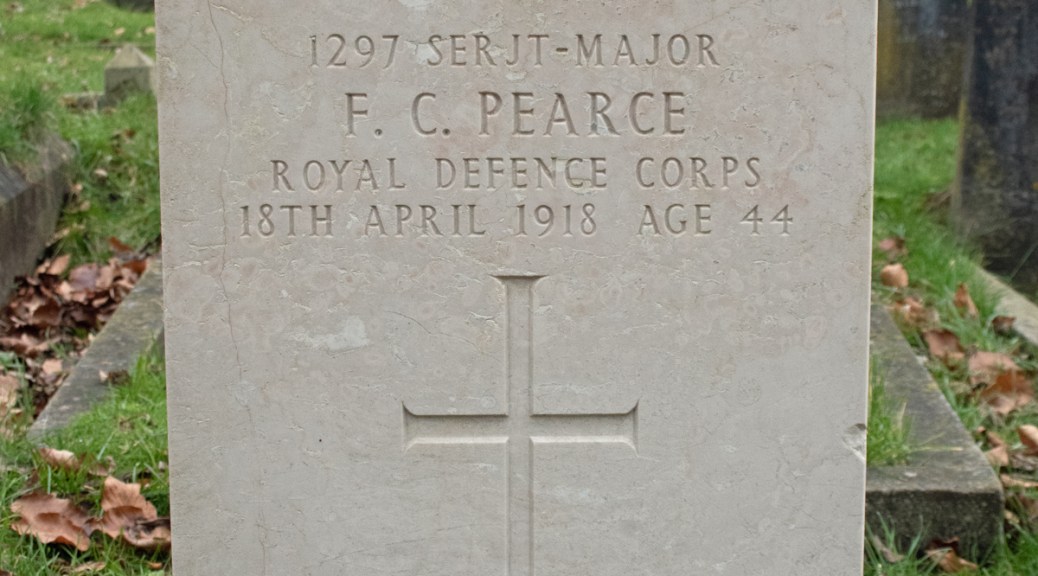
Frederick returned home to Bath, to the bosom of his family. He and Mary three children by this point, Violet and Freddie being two younger siblings to Leslie. Tragically for the Pearces, however, the family life was not to to last for long: Frederick’s condition was to get the better of him just three months later. He passed away on 18th April 1918, at the age of 44 years old.

Frederick Charles Pearce was laid to rest in St James’ Cemetery in Bath; a man of duty resting at last.


Tragedy was to strike again for poor Mary, when just six months later her youngest child, Freddie, also passed away. Details of his death are vague, but he was buried with his father, the two Fredericks reunited too soon.


Private John Sherrin

Private John Sherrin

John Sherrin was born in Langport, Somerset, in the summer of 1874. The youngest of three children, his parents were Arthur and Elizabeth Sherrin. Arthur was a cowman and farmer, and John was to follow him into agricultural labouring when he left school.

Arthur took the family where the work was: by the time of the 1891 census, they were living in Broadchalke, a village to the west of Salisbury, Wiltshire. Ten years later, the census notes Arthur and Elizabeth living in Dorset, while John was in Swindon, Wiltshire, working on a farm as a butter churner.

John’s father died in 1906, and Elizabeth went to live with her daughter’s family in Devon. The same year, John returned to Somerset, where he married Bessie Kingsbury. She was a labourer’s daughter from Henstridge, who was working as a domestic servant. The couple went on to have four children – Marleen, Arthur, Albert and Grace.

John’s dairy work kept the family moving, and, according to the 1911 census, the Sherrins were living in a five-room cottage in Sturminster Marshall, Dorset.

When war came to Europe, John had turned 39 years old. He did not initially enlist – presumably because of his farm work – and it seems that he was only conscripted in the closing months of the conflict. He was called up to the Royal Defence Corps during the summer of 1918, and was assigned to 254 Company.

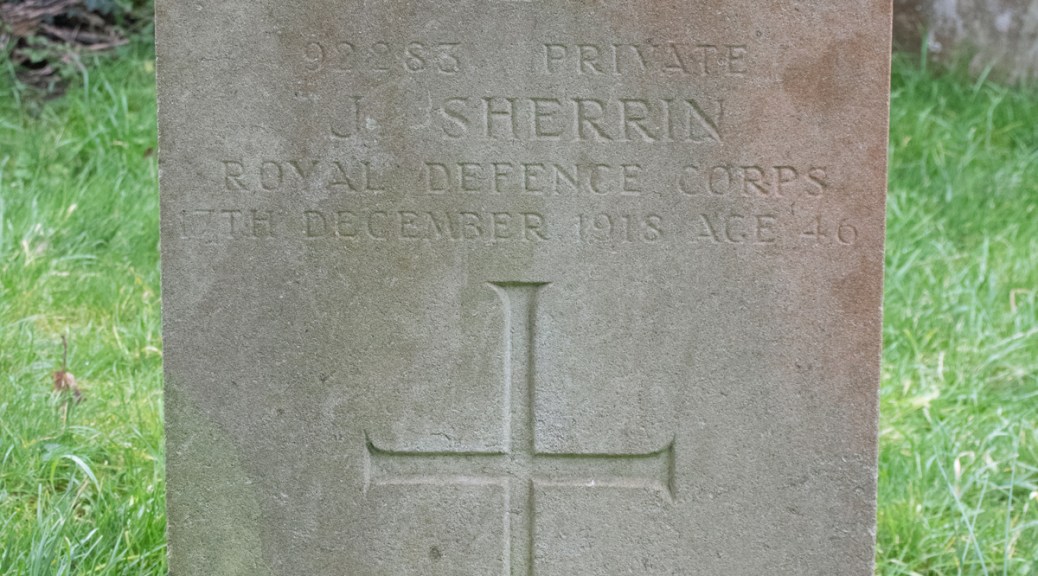
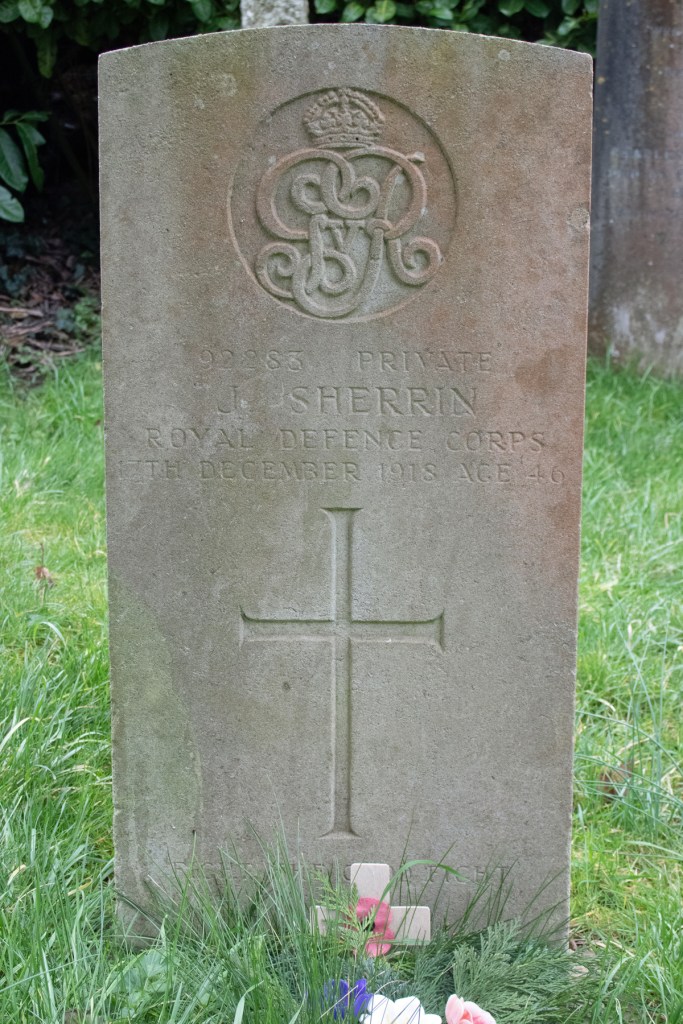
Private Sherrin was sent to an army camp in Tidworth, Wiltshire, and it was here that he served through the Armistice. He was waiting to be demobbed in December 1918, when he was admitted to the camp’s hospital. Details of his condition are unclear, but it was in the hospital that he passed away on 17th December 1918. He was 44 years of age.

While her late husband was serving, Bessie had returned to her family in Henstridge, and it was there that John’s body was brought. He was laid to rest in the graveyard of St Nicholas’ Church in the village.


Private Arthur Gentle

Private Arthur Gentle

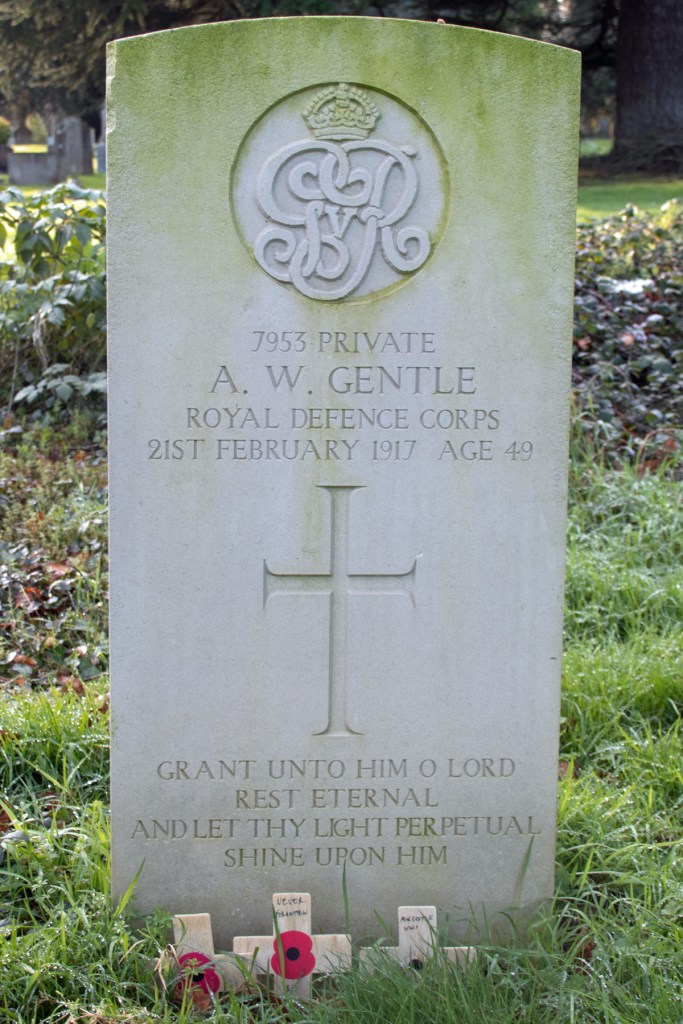
Arthur William Gentle was born in 1867 in Whitelackington, Somerset. The son of Maria Gillard, his father is not noted, although he was accepted as one of the family when Maria married Richard Gentle in 1873. The couple went on to have eleven children of their own, giving Arthur a large family of siblings.

Richard was an agricultural labourer, and this was a trade into which Arthur followed. On 23rd October 1897, Arthur married Mary Marsh, a labourer’s daughter from South Petherton. The couple tied the knot in her local church, the illiterate Arthur marking his intent with a cross.

The couple set up home just off Silver Street in South Petherton, and went on to have ten children of their own. The 1911 census recorded Arthur still employed as an agricultural labourer, his oldest son following suit, and Mary – who was also known as Polly – raising the family.

War came to Europe, and, despite his age, Arthur felt a need to play a part. While full service records are no longer available, what remains confirms that he had enlisted by the summer of 1916, and had joined the 300th Protection Company of the Royal Defence Corps.

Sadly, Private Gentle’s military career was to end in the same way as so many of his army colleagues. He contracted pneumonia during the winter of 1916, and passed away at home on 21st February 1917. He was 49 years of age.

Arthur William Gentle was laid to rest in the cemetery of his adopted home town, South Petherton.


Arthur’s brother Frank Gentle also fought in the Great War. Assigned to the 1st Battalion of the Somerset Light Infantry, he was caught up in the fighting in the Somme, and was killed on 14th July 1916. He was just 26 years of age.

Private Frank Gentle is commemorated on the Thiepval Memorial in Northern France.


Private James Toms

Private James Toms

James Toms was born in Tintagel, Cornwall, early in 1886, and was the youngest of seven children to Lavinia Toms. Lavinia’s husband, quarry worker John Toms had passed away a few years before, and she had moved her young family in with her mother, Mary Emmett, by the time James was born.

James found work in the local slate quarry when he left school and, by the time of the 1911 census, he was living with his mother and two of his siblings in the town.

When war came to Europe, James stepped forward to play his part. While his service records are no longer available, other documents confirm that he enlisted in the Duke of Cornwall’s Light Infantry, and was on the Western Front by October 1915.

At some point, Private Toms transferred to the Royal Defence Corps: as this regiment was not created until March 1916, his move could obviously not have been before this point in the conflict. He was based back on home soil, and, by the end of the war, he was serving in Oxfordshire.

In the closing weeks of the war, Private Toms was admitted to the 3rd Southern General Hospital in Oxford, having contracted pneumonia. The condition was to get the better of him and, he passed away on 6th November 1918. He was 33 years of age.

Brought back to Cornwall for burial, James Toms was laid to rest in the quiet and picturesque graveyard of St Materiana’s Church. His epitaph reads: Home at last thy labour done, safe and blest the victory won.


Private Michael Barton

Private Michael Barton

Michael Barton was born in the spring of 1863 in the Kent village of Hadlow. The youngest of three children, his parents were farm labourer William Barton and his wife Annie. Michael became a farm labourer when he left school and, when William died in 1890, he remained at home to support his mother.

Annie passed away in 1905, and this proved a turning point for Michael. By the time of the next census in 1911, he was recorded in the Tonbridge Union Workhouse, one of its 600 inmates.

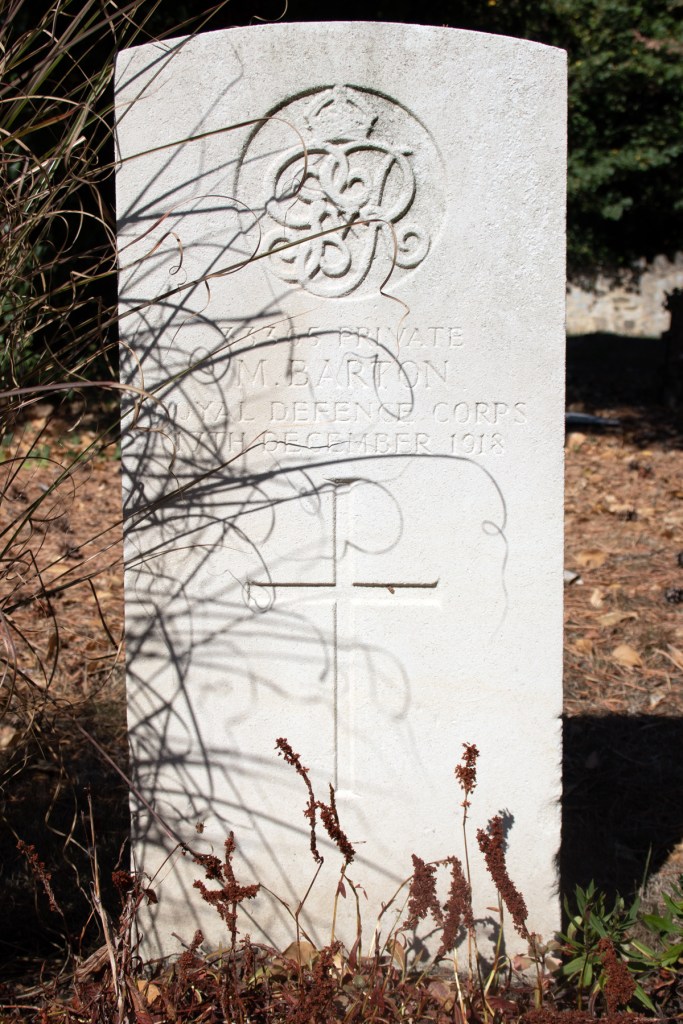
Michael’s trail is harder to pick up at this point. Despite his age, it seems that he sought a way out of his situation when war broke out and had certainly enlisted in the army by the last year of the conflict. Initially joining the Royal Defence Corps, Private Barton was soon transferred to the Labour Corps, and was assigned to 572nd Agricultural Coy.

The next document relating to Michael is that of his passing. He died on 17th December 1918 at the Preston Hall Military Hospital in Aylesford, Kent, although the cause of his death is not readily available. He was 55 years of age.

Michael Barton was laid to rest in the graveyard of St Peter & St Paul’s Church in Aylesford, not far from the hospital in which he had passed.


The Army Register of Soldiers’ Effects records that Michael’s belongings passed to a Miss Kate Burley when he died. Not one of his immediate relatives, it is likely that she was a friend or other relation.


Private Hubert Fox

Private Hubert Fox

Hubert Edward Fox was born in the spring of 1865, the youngest of five children to Alfred and Eliza Fox. Alfred was a baker, from Faversham, and it was in the town that he and Eliza raised their young family.

When he finished school, Hubert found work as a carter and labourer. He served in the King’s Royal Rifles for eight years, spending two of those stationed in Egypt.

In 1894 John married Elizabeth Rebecca Harris in their home town. The couple set up home in the Abbey Road, to the north of the town, and went on to have six children between 1896 and 1909.

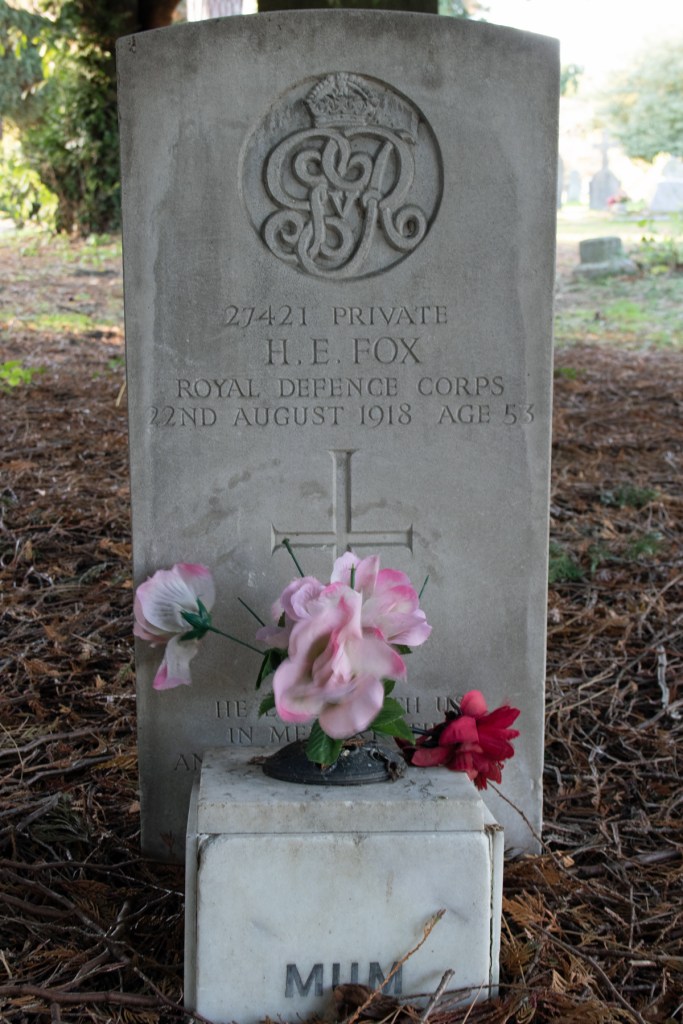
When war broke out, Hubert enlisted to play his part once more. He joined up in 1915, and was assigned to the Royal Defence Corps. Private Fox was on guard duty at the Uplees Munitions Factory on 2 April 1916, when a series of explosions ripped through the base. The loss of life was horrific – more than 100 men and boys were killed – and Hubert was fortunate enough to escape serious injury.

In May 1918, Private Fox was invalided out of the army on medical grounds. He was sent to a hospital in Reading, Berkshire, returning to Kent after around six weeks. He was treated in the town’s nursing home, but never fully recovered from his illness: he passed away on 22nd August 1918, at the age of 53 years of age.

Hubert Edward Fox was laid to rest in the Borough Cemetery of his home town, Faversham, not far from the family home in Abbey Road.


At the time of Hubert’s funeral, his eldest son, also called Hubert, was reported as missing in action.

Hubert Jr had enlisted in the 10th Battalion of the Queen’s Own (Royal West Kent Regiment) in August 1915, embarking for France the following May. After two years, Private Fox Jr moved to Italy with his division, but returned to the Western Front just a few months later.

In April 1918, Hubert was reported missing in action; he was later confirmed to be a Prisoner of War, and was eventually released and repatriated home in December 1918.

Hubert found work as a labourer and night watchman; the 1939 Register records him living in his Abbey Road home with his mother. He died the summer of 1968, at the age of 71 years old.