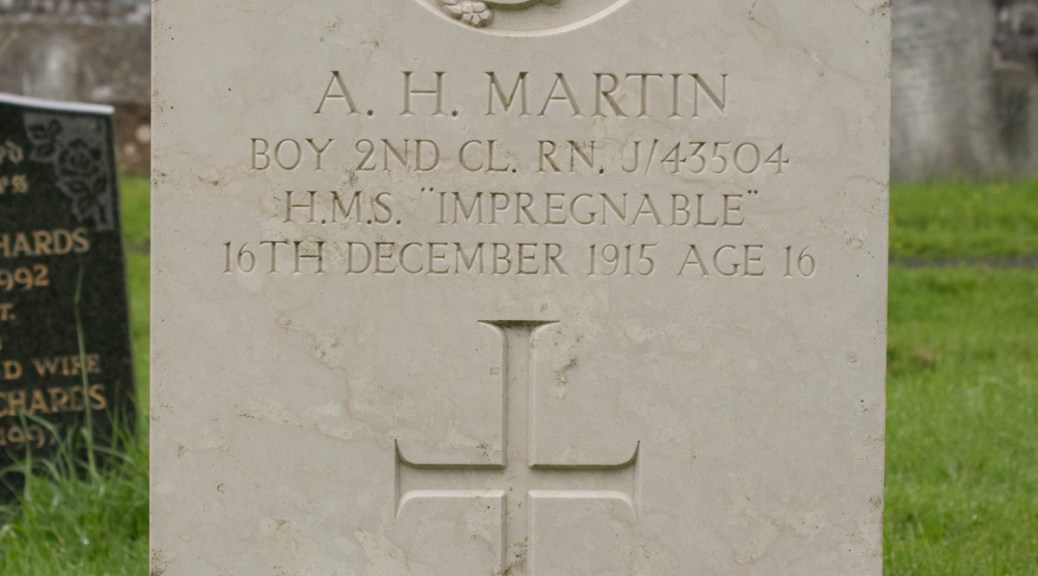
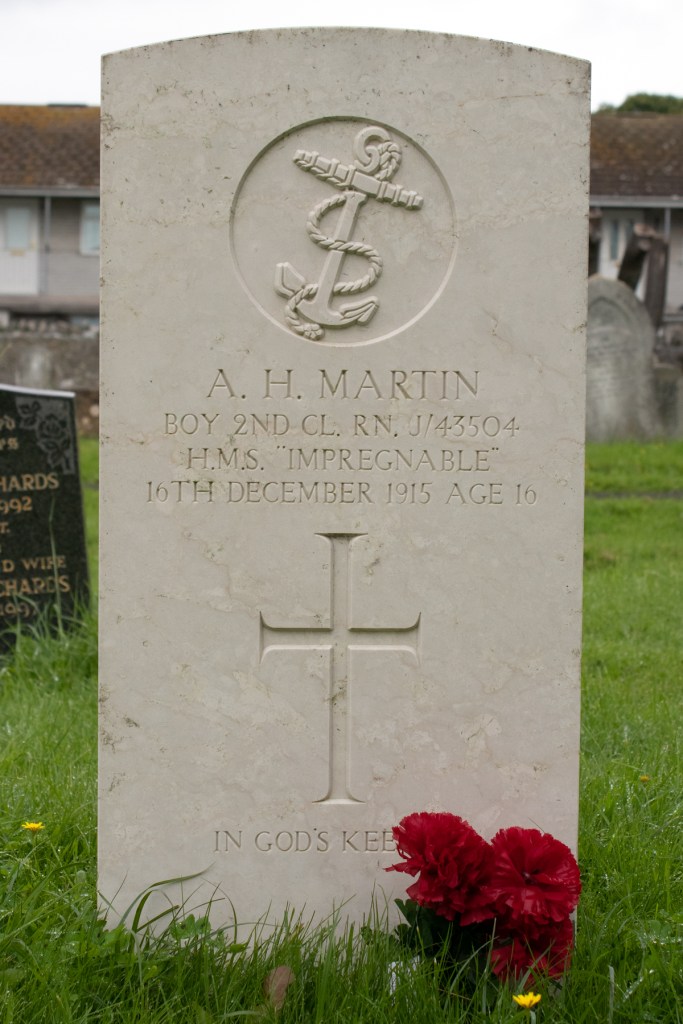
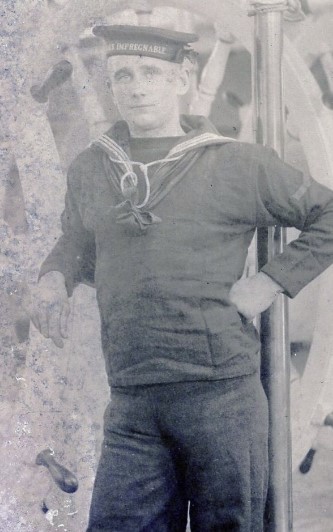
Alan Harold Martin was born on 24th May 1899 in Burnham-on-Sea, Somerset. The oldest of six children, his parents were bricklayer Clifford Martin and his wife, Augusta. The 1911 census found the family living at 64 Abingdon Street in the town, a terraced house not far from the seafront.
When war broke out, Alan was not long out of school. He had found work as a painter’s mate, but with adventure waiting for him, he had an obvious need not to miss out. He enlisted in the Royal Navy on 28th August 1915 and, as he was too young to be formally inducted into the service, he was given the rank of Boy 2nd Class.
Alan was sent to HMS Impregnable, shore-based establishment in Devonport, Devon, for his training. His service records show that he was 5ft 3.5ins (1.61m) tall, with brown hair, blue eyes and a fresh complexion.
Tragically, Boy Martin’s time in the Royal Navy was not to be a long one. Billeted in tightly-packed barracks, with new recruits from across the country, he quickly fell ill. Contracting pneumonia, he was admitted to the Royal Naval Hospital in Plymouth. The condition was to get the better of him, and he passed away on 16th December 1915, at the age of just 16 years old.
Alan Harold Martin’s body was taken back to Somerset for burial. He was laid to rest in Burnham-on-Sea Cemetery, a short walk from where his grieving family lived.
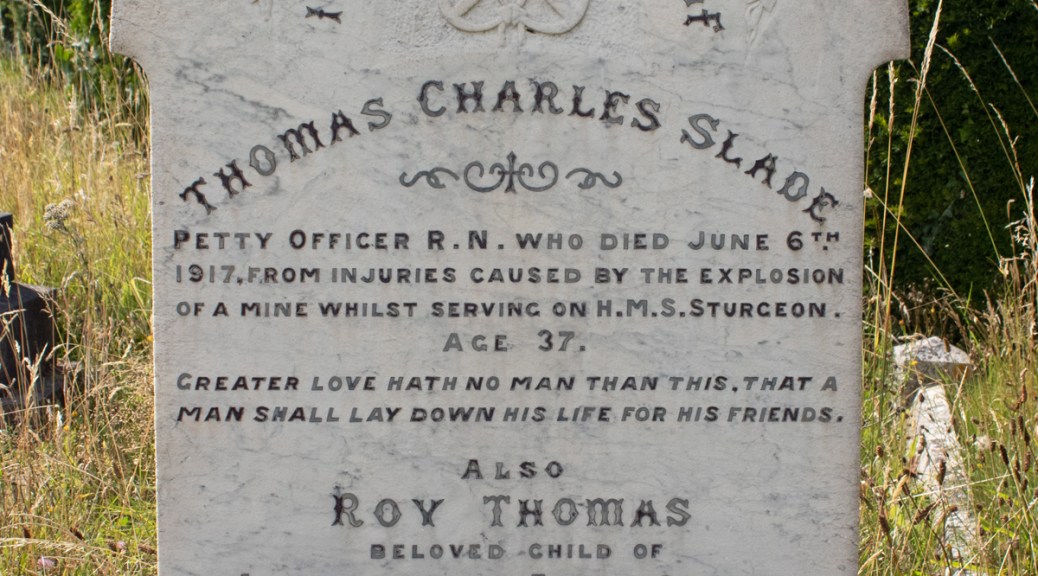
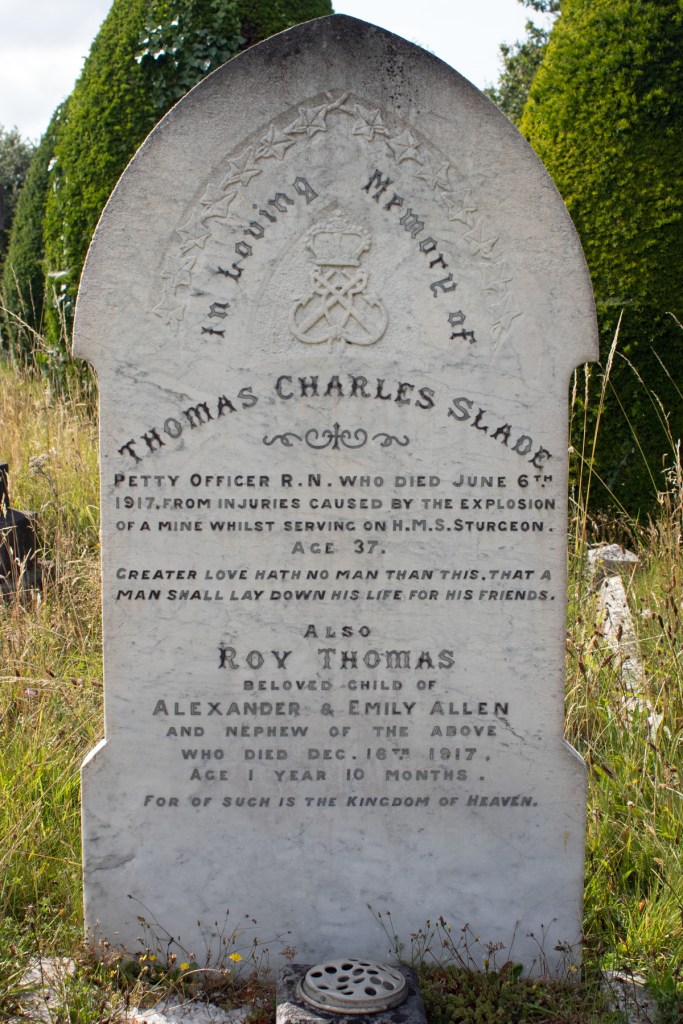
Thomas Charles Slade was born in Bristol, Gloucestershire, on 13th March 1880. One of twins, he and his sibling Ernest were two of nine children to Charles and Elizabeth Slade. Not long after the twins were born, the family had moved to Minehead, Somerset, where both Charles, who was a mason and bricklayer, and Elizabeth had hailed from.
Whilst Ernest seemed content to remain in Somerset – going on to become a poultry farmer – Thomas sought a life of adventure. Foregoing his gardening job, he enlisted in the Royal Navy, setting his sights on a life at sea.
Thomas’ service records show that he joined up on 12th November 1895. He stood just 5ft 2ins (1.57cm) tall, with brown hair, blue eyes and a ruddy complexion. As he was to young to formally join up, he was give the rank of Boy 2nd Class, and sent to HMS Impregnable, the shore-based training establishment in Devonport, Devon.
Boy Slade seemed to create a good impression. He was promoted to Boy 1st Class in July 1896, and the follow February was given his first posting, on board the battleship HMS Benbow. This was the ship he was serving on when he turned 18 and, having come of age, he was officially inducted into the navy, and given the rank of Ordinary Seaman.
And so began a glittering career for young Thomas. Over the twelve years of his contract, he served on nine different ships, returning to HMS Vivid – the Royal Naval Dockyard in Devonport – between voyages.
Small in stature, Thomas appears to have been a dedicated young man. His annual reviews noted his character was ‘very good’ every year, and his ability was either ‘very good’, ‘superior’, or ‘excellent’. He was promoted to Able Seaman in September 1898, just eighteen months after becoming an Ordinary Seaman. By June 1906 he rose in rank again, ending his initial term of service as a Leading Seaman.
Thomas was not done with the navy yet, however. He immediately re-enlisted and, over the ensuing years served on a further four vessels. He spent more and more time on board HMS Defiance, the torpedo and mining school ship in Devonport. Whether this was because he was being taught, or was supporting incoming students is unclear, but by September 1912, he had been promoted again.
In November 1915, the now Petty Officer Slade had moved to the depot ship HMS Dido. His new posting supported the Tenth Destroyer Flotilla in the North Sea, patrolling the waters off the East Anglian coast. In February 1917 he moved to another of the support vessels, HMS Sturgeon.
In June 1917, a mine exploded on board, injuring a number of the crew, including Petty Officer Slade. The wounded were transferred to a hospital near Ipswich, and it was here that Thomas was to pass away. The only one of those caught up in the incident to die, he was 37 years of age.
Thomas Charles Slade was brought back to Somerset for burial. He was laid to rest in the sweeping Minehead Cemetery, close to the grave of his mother, Elizabeth, who had passed away nine years before.
Thomas’ headstone also includes an inscription to Roy Thomas Allen, who died six months after him. Roy was the young son of Thomas’ younger sister Emily: an uncle and nephew reunited.
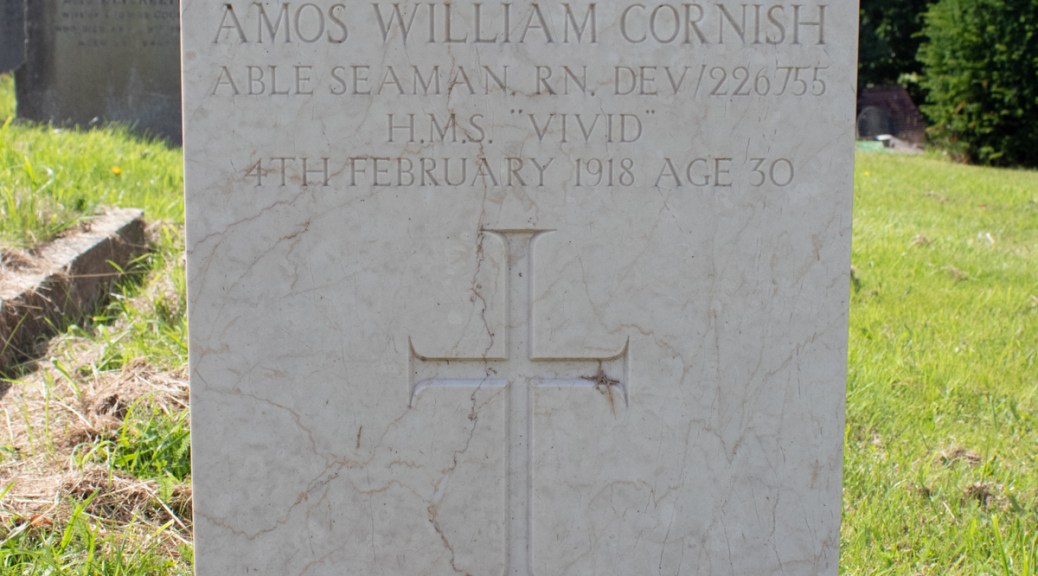
Amos William Cornish was born on 16th August 1887 in Dunster, Somerset. One of five children, his parents were George and Elizabeth Cornish. George, who was a brickmaker, died in 1893, and at this point the family relationships seemed to have broken down.
By the time of the 1901 census, Elizabeth had remarried, and was living with her new husband and Amos’ youngest sibling, sister Lily. Two of Amos’ brothers, Walter and George, were living with his maternal grandparents, while Amos himself was one of three hundred inmates at the Horton Kirby Home for Homeless Boys in the Dartford area of Kent.
Amos’ schooling would have finished by the time he was 14 years old, and he quickly sought work that allow him to support himself as a young man with no home to go to. A career in the Royal Navy seemed to provide that regular pay and, on 4th June 1902, he enlisted.
As he was under age, Amos was given the rank of Boy 2nd Class, and sent to the shore-based training ship HMS Impregnable in Devonport, Devon. His service records show that he stood just 5ft 4ins (1.63m) tall, had brown hair, brown eyes and a fresh complexion. He was noted as having a scar in the centre of his forehead, and a tattoo of clasped hands over a heart on his right forearm.
Boy Cornish transferred to another training vessel – HMS Lion – after a month or so, and it was here, in February 1904, that he was promoted to Boy 1st Class.
Over the next eighteen months, Boy Cornish served at two more training bases – HMS Boscawen and HMS Vivid. He was given his first sea-going posting in April 1905, aboard the cruiser HMS Blake. It was on his next assignment, however, that he came into his own.
In May 1905, Amos boarded HMS Carnarvon, an armoured cruiser that had been launched a couple of years before. He was to spend the next two years as part of her crew, gaining the rank of Ordinary Seaman when he came of age in August 1905, and Able Seaman a year later.
When his time on board Carnarvon came to an end, Amos returned to shore, to HMS Pembroke, the Royal Naval Dockyard in Chatham, Kent, which was to be his base on and off for the next eight years. During that time, he served on six more ships, and rose to the rank of Leading Seaman in December 1911. This new rank, however, seemed not to suit Amos, and he reverted back to his previous rank eight months later.
Able Seaman Cornish’s longest posting was on board the cruiser HMS Antrim. He joined her crew in September 1913 and, over the next three-and-a-half years he travelled far and wide. Initially patrolling the North Sea – particularly around the Scottish Isles – Amos was on board for a journey to Arkhangelsk in Russia. The ship then transferred to the Western Atlantic, patrolling around America and the West Indies.
Able Seaman Cornish returned to British shores in April 1917, to be based at HMS Vivid, the Royal Naval Dockyard in Devonport, for the nest nine months. During this time, he became ill and was admitted to the Royal Naval Hospital in Truro with double pneumonia. Tragically, this was something he was not to recover from: Amos passed away on 4th February 1918, at the age of 30 years old.
While somewhat stretched, Amos’ family bond still remained. Elizabeth was living in Minehead by this point, with husband Alfred and their two children. It was to the Somerset town, therefore, that Amos William Cornish’s body was brought. He was laid to rest in the town’s sweeping cemetery.
George’s death in 1893, and Elizabeth’s remarriage a few years later split the family, and Amos’ siblings all followed separate paths.
The oldest of his siblings, Walter, also followed a military path. He joined the Royal Garrison Artillery as a Gunner and, by the time of the census, was based in Gibraltar. On completing his service, he returned to Somerset, marrying Florence Peddle in 1925. The 1939 Register found the couple living with his cousin, Amelia, while he worked as a gardener. Walter died in Weston-super-Mare in 1962, at the age of 74.
Amos’ next sibling, brother Harold, seems to have had a less fortunate time of things. Absent from the 1901 census, he appears in prison records four years later. He was incarcerated for six months’ hard labour in Brecon Prison, having been found guilty of “Gross Indecency with another male person”. Harold was 14 years and three months old at the time. A newspaper report from around this time suggests that the other party was a George Williams, but there is no further information about him. Harold seems to have come out the other side of his experience, however: the 1911 census recorded him as living and working with draper and grocer James Ridler and his family in Dunster, Somerset.
Amos’ third sibling, sister Lily, found work as a servant to bakers Joseph and Minnie Bagley in Minehead. She married painter and decorator William Whitting in 1916 and the couple went on to have a daughter, Kathleen, eight years later. The family settled in Weston-super-Mare, Lily passing away in 1968, at the age of 75.
The youngest of the Cornish siblings was George. He remained living with his maternal grandparents in Dunster, and found work as a printer. In the spring of 1921, he married Clara Govier and, by the time of the 1939 Register, they couple were living in Aylesbury, Buckinghamshire, where George was working as a printer and compositor. He died in 1957, at the age of 62 years old.
Harold Cane was born in Minehead, Somerset, on 10th August 1898. One of nine children, his parents were Henry and Mary Cane. Henry was a stone mason from Minehead, but he was working in Ireland when he met his future wife. The couple married in 1891, only moving back to Somerset the mid-1890s, by which time they had two children, Harold’s oldest siblings.
The 1911 census recorded Henry and Mary living with their children at 3 Church Steps in Minehead, a short row of houses leading to St Michael’s Church. Henry was a mason and his oldest son, also called Henry, has working with him.
Harold, meanwhile, dreamed of a bigger and better life. When he finished his schooling, he joined the Royal Navy, looking for a life of adventure on the high seas. He signed up on 22nd September 1914, just a month after the declaration of war, and was sent to the shore-based training ship, HMS Impregnable, based in Devonport, Devon.
As he was just 16 years of age, Harold was given the rank of Boy 2nd Class. However, his commitment to the role was evident and led to a promotion – to Boy 1st Class – after just three months. In September 1915, Harold as assigned to the dreadnaught battleship HMS Iron Duke, where he served as an Ordinary Seaman. He spent just under a year on board, during which time the Iron Duke was caught up in the Battle of Jutland. She was involved in the sinking of the German destroyer SMS S35, after which she and the rest of the fleet moved on.
Ordinary Seaman Cane remained on board HMS Iron Duke until the summer 1916. He had fallen ill by this point, having contracted tuberculosis. The condition was enough for Harold to be invalided out of the navy, and he was stood down on 9th August 1916.
At this point, Harold’s trail goes cold. It seems that he returned home to Somerset, as this is where he passed away. He died on 14th November 1917, at the age of just 19 years old.
Harold Cane was laid to rest in the peaceful landscape of Minehead Cemetery.
Harry Payton Gadd was born on 3rd November 1899, one of ten children to Elijah and Ada Gadd. Elijah was a stone mason from the Somerset village of Dundry, and this is where the family were born and raised.
Harry found work as a farm hand when he finished his schooling but he seems to have been eager to play his part for King and Country. As soon as he turned 18, he enlisted in the Royal Navy. His service records show that he joined up as a Stoker 2nd Class on 6th November 1917. He was 5ft 3.5ins (1.61m) tall, with brown hair, grey eyes and a fresh complexion.
Stoker Gadd was initially sent to HMS Vivid, the Royal Naval Dockyard in Devonport, for training. On 28th January 1918, he was assigned his first ocean-going post, on board the frigate HMS Leander. He spent a couple of months on board, before transferring to the store ship HMS Tyne, then moving to HMT Wallington (also branded as HMS Sylvia), a requisitioned trawler, on 15th April 1918.
Stoker Gadd was on board Wallington for six weeks, when he was killed in an accident. No other information is available, and his service records state that “the death of this man… was caused… from an accident on board. No blame attributable to anyone.”
A contemporary newspaper echoes this, but gives no further information: “News has been received that Stoker Harry (Joe) Gadd, the 18-year-old son of Mr and Mrs E Gadd, of Dundry, has been killed by accident on one of his Majesty’s ships.” [Bristol Times and Mirror: Saturday 6th July 1918]
The body of Harry Payton Gadd was brought back to Dundry for burial. He was laid to rest in the graveyard of St Michael’s Church.
John Renouf was born in Bedminster, Bristol, on 26th June 1875. Hiss parents, Charles and Emily Renouf, had been born in St Helier, Jersey, and had moved to the mainland with their older children in around 1874. Charles was a blacksmith, initially working on naval vessels in Jersey, he continued his smithing when the family had settled in Bedminster.
John was one of seven children and became apprenticed to his father when he finished his schooling. Charles’ trade offered him an opportunity for a career, however, and, on 23rd September 1893, he enlisted in the Royal Navy as a Blacksmith’s Mate. His service records show that he was 5ft 7.5ins (1.71m) tall, with black hair, grey eyes and a fresh complexion.
John signed up for a 12-year contract, and was primarily based out of HMS Vivid, the Royal Naval Dockyard in Devonport. His records confirm that he was not shore-bound, however, and he spent time on eleven ships up to 1905. At this point, his contract came to an end, and he chose not to re-enlist.
At this point, John’s trail becomes a little hazy. He returned to Bristol, and seems to have continued working as a blacksmith. The 1911 census recorded him as being one of a number of residents at the city’s Salvation Army Hostel on Tower Hill. According to the same census, Charles, now 71 and a widower of three years, was living with his youngest son, Ernest, and family.
When war came to European shores, John’s skills as a blacksmith were to be called upon once again. His service records are no longer available, but it is clear that he chose not to re-join the navy, instead enlisting in the Royal Engineers as a Sapper.
Sapper Renouf’s trail goes cold again: he was assigned to one of the Waterways and Railway Troops, but it is unclear whether he spent his time on home soil or overseas. Either way, he survived the conflict, and was back in Britain soon after the Armistice.
The next record for John Renouf is that of his passing. He died in Bath, Somerset, on 30th December 1919, at the age of 44 years old. John was laid to rest in the sweeping grounds of the city’s Locksbrook Cemetery.
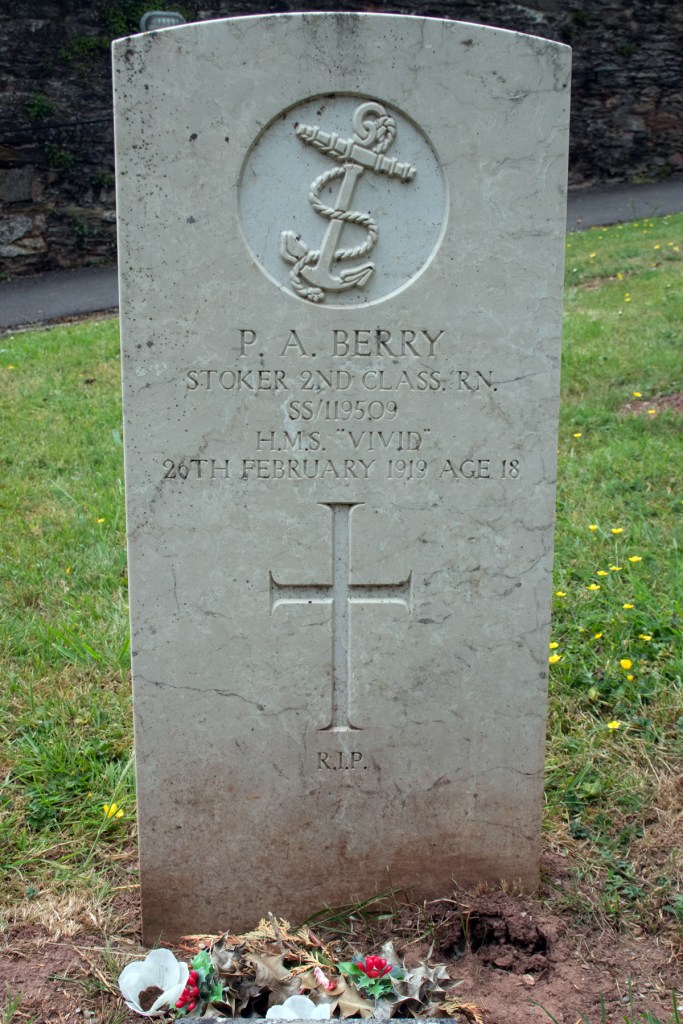
Percival Arthur Berry was born in January 1902, one of five children to Henry and Elizabeth Berry. Henry was a bricklayer from West Monkton in Somerset, and this is where the family were born and raised.
Percival seems to have had a roaming soul, or itchy feet. When he finished his schooling, he worked as a farm labourer, but in January 1918, he found employment as an engine cleaner for Great Western Railways in Taunton. This was not to last, however, and hi employment ended on 15th March, his work records stating that he just left.
Percival went back to farm labouring, but still sought a way out of that life. In January 1919, he enlisted in the Royal Navy. So keen was he to escape Somerset, he added a year to his age, to ensure that they allowed him to enlist. His records show that he was 5ft 6ins (1.68m) tall, with brown hair, blue eyes and a fresh complexion.
Assigned the rank of Stoker 2nd Class, Percival was sent to HMS Vivid, the Royal Naval Dockyard in Devonport. Within a matter of weeks, however, Stoker Berry had fallen ill. The details are a little confusing at this point – he was stationed at HMS Vivid, but admitted to the Dreadnought Seaman’s Hospital in Greenwich, Kent, his admission records stating that he had come from HMS Harlech. It is likely, therefore, that he was on a voyage from Devon, on board the converted trawler Harlech, when he fell ill. Docking in London, he was then admitted to the Greenwich hospital.
Stoker 2nd Class Berry had contracted influenza, and this was to take his life. He died on 26th February 1919, aged just 17 years old. He had served in the Royal Navy for just 47 days.
Percival Arthur Berry was brought back to Somerset for burial. He was laid to rest in the peaceful graveyard of St Mary’s Church in Kingston St Mary, a few miles from his old family home.
Hidden away above the busy A371 to the north of Axbridge, Somerset is an unassuming graveyard. Overgrown and haunting, with headstones lining the boundary of the copse, this is the cemetery for the former St Michael’s Sanatorium, now the St Michael’s Cheshire Home. In the middle of the plot, next to the central memorial, is a headstone dedicated to Sidney Gordon, notably buried somewhere else in the grounds.
Sidney Vincent Gordon was born in Upton Park, Essex, on 7th May 1897. There is little information about his early life, other than his mother’s name, May.
The 1911 census recorded Sidney as being an inmate at the Scattered Home for the West Ham Union, the workhouse that covered the area. At 13 years of age, he was one of the older of the thirteen students boarding in the home, which was overseen by Emma Caroline Simpson, the House Mother.
When Sidney completed his schooling, he managed to find employment as an undertaker’s boy. But he sought out bigger things and, on 8th June 1914, he enlisted in the Royal Navy. His service records note that he was 5ft 6ins (1.68m) tall, with brown hair, blue eyes and a fresh complexion.
Being under-age when he enlisted, Sidney was given the rank of Boy. He was first sent to HMS Pembroke, the Royal Naval Dockyard in Chatham, for training, and remained there for a couple of months. In August 1914, Boy Gordon was moved down the coast to HMS Actaeon, a torpedo school based in Sheerness, Kent.
After five months, he moved to HMS Wildfire, another part of the Sheerness base, and it was while there he turned 18, and could formally join the Royal Navy. He was given the rank of Officer’s Steward 3rd Class and remained at Wildfire until the end of 1915. After a short stint back in Chatham, Sidney was given a new posting on board the supply ship HMS Tyne, where he remained until the following May.
Officer’s Steward Gordon returned to HMS Pembroke once more, and was assigned to his final sea-going ship, the newly launched monitor, HMS Erebus. She was to be his home until June 1917, when, having become unwell, he was posted back to HMS Pembroke.
Sidney had contracted pulmonary tuberculosis, which led to him being invalided out of the Navy on 1st August 1917. At this point his trail goes cold once more, but it is likely that, by the start of 1919, his condition had led to his admission to St Michael’s.
When he died there, on 5th March 1919, Sidney was just 21 years old. Given his background, it seems probable that his mother, if she was still alive, would not have been able to afford for his remains to be brought back to Essex. Sidney Vincent Gordon was laid to rest in the sanatorium’s cemetery, in the foothills of the Mendips, finally at peace.
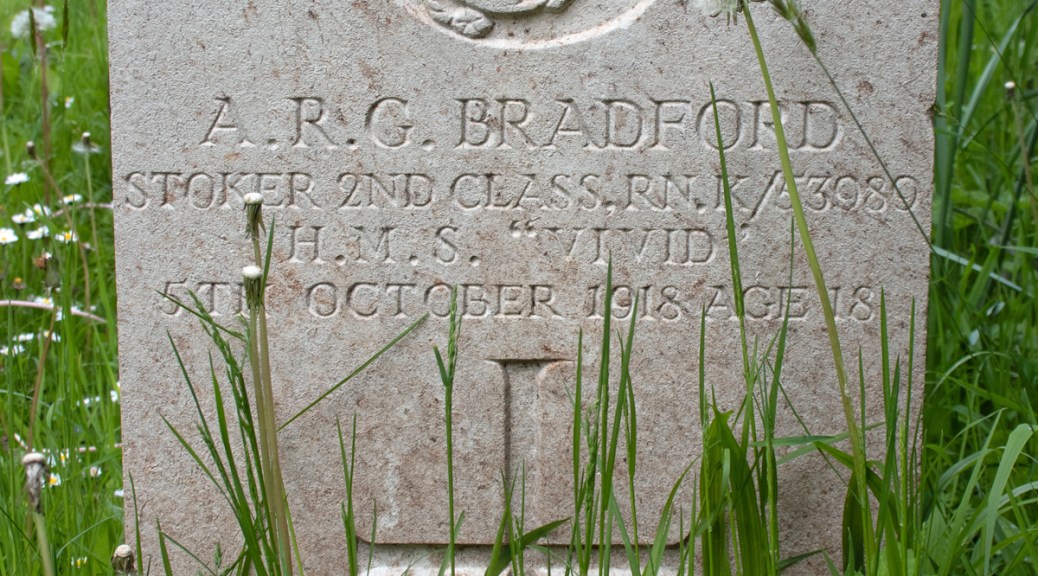
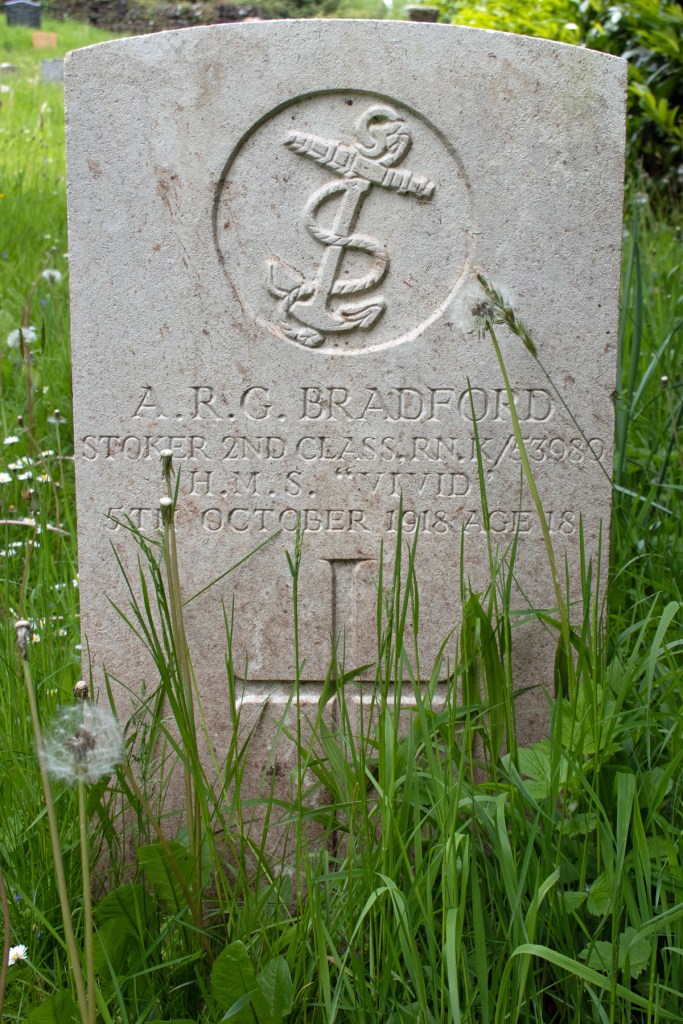
Arthur Redvers George Bradford was born in the Somerset village of Winscombe on 16th September 1900. He was second of six children to George Bradford, who was a postman, and his wife, Louisa.
When he finished his schooling, Arthur found work as a carter. War was raging across Europe by this point, however, and he was evidently keen not to miss out on the excitement. On 18th September 1918, just two days after his 18th birthday, he enlisted in the Royal Navy.
Stoker 2nd Class Bradford was noted as being 5ft 3.5ins (1.61m) tall, with brown hair, grey eyes and a fresh complexion. He was sent to HMS Vivid, the Royal Naval Dockyard in Devonport, for training, but his time there was to be tragically short.
Cramped barracks prove to be the perfect breeding ground for illness, and in early October 1918, influenza and pneumonia were rife. Around a dozen of Stoker Bradford’s colleagues died from the diseases in the time he was at the base, and, on 5th October 1918, he too was to succumb to them. He was just eighteen years old, and had been in the Royal Navy for just 17 days.
The body of Arthur Redvers George Bradford was brought back to Somerset for burial. He was laid to rest in the quiet graveyard of St James the Great Church in his home village of Winscombe.
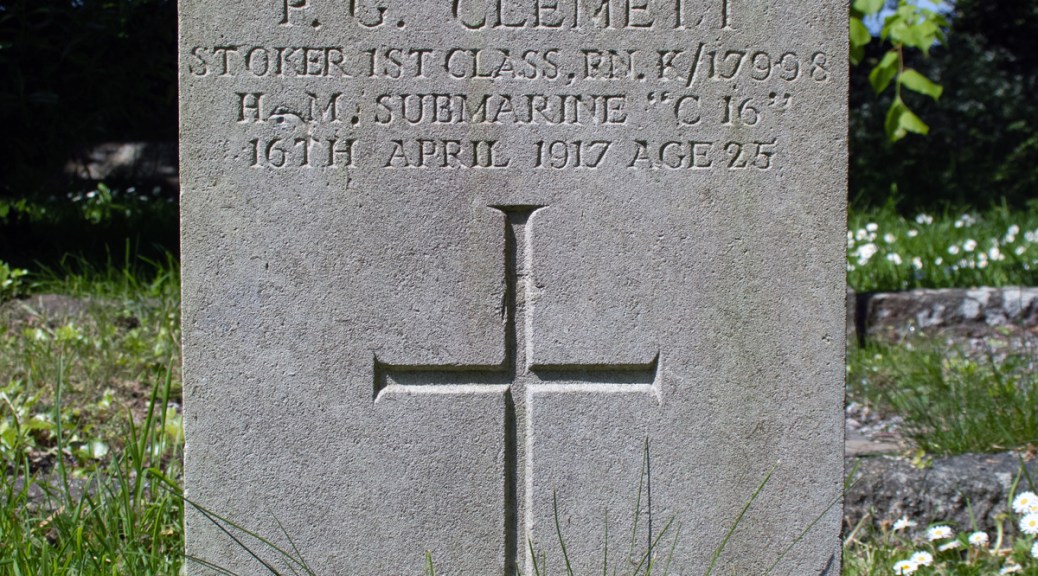
Phillip George Clemett was born on 5th December 1891, one of eight children to Albert and Mary Jane Clemett. Albert was a carpenter from Devon, Mary Jane came from Somerset, but by the time Phillip was born, the family had moved to Fulham in Middlesex.
The 1911 census records the family as having moved back to Somerset. Mary Jane had been born in the village of Huntspill, and it was here that the Clemetts returned. Albert was now working as a farmer, so it is possible that they had moved to work on the family farm.
Labouring was not a job to satisfy Phillip, though, and he sought a career on the high seas. On 3rd February 1913, he enlisted in the Royal Navy as a Stoker 2nd Class. His service records show that he was 5ft 4ins (1.63m) tall, with brown hair, brown eyes and a fresh complexion.
Stoker Clemett’s was initially sent to HMS Vivid, the Royal Naval Dockyard in Plymouth, Devon. Here he received a few months’ training, before being given his first posting, on board the battleship HMS Indefatigable. He remained on board for the next fifteen months, gaining a promotion to Stoker 1st Class in the process.
Over the next couple of years, Phillip served on a couple more vessels, but on 11th February 1917 he was assigned to the submarine HMS C16. Stoker Clemetts was on board for a couple of months, as she was patrolling off the Essex coast. On 16th April 1917, the C16 was accidentally rammed by the destroyer HMS Melampus. She sank to the bottom and a couple of attempts were made for the crew to escape, but they became trapped and all perished, including Stoker 1st Class Clemetts. He was 25 years of age.
Contemporary newspaper reports give little detail about the accident – stating simply that Phillip ‘perished at sea’ [Western Daily Press – Tuesday 01 May 1917] His service documents are equally cagy about the incident, confirming jus that he ‘lost his life on duty.’ The records, however, show that on each of his five annual reviews, his character was noted as ‘very good’, while his ability was ‘superior’.
When the submarine was salvaged, Phillip George Clemett’s body was brought back to Somerset for burial. He was laid to rest in the peaceful graveyard of St Peter’s Church in Huntspill.








 Death and Service