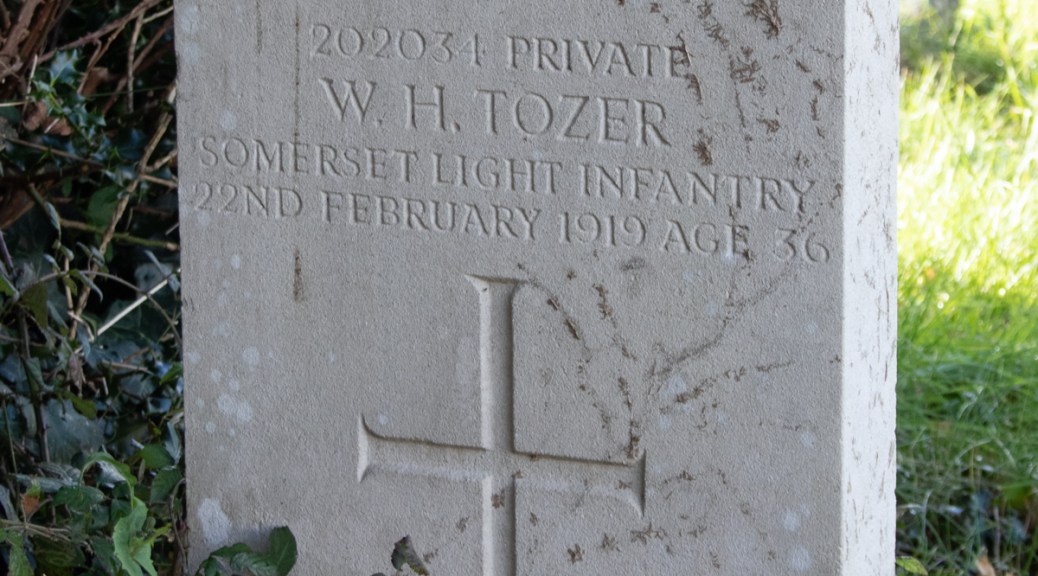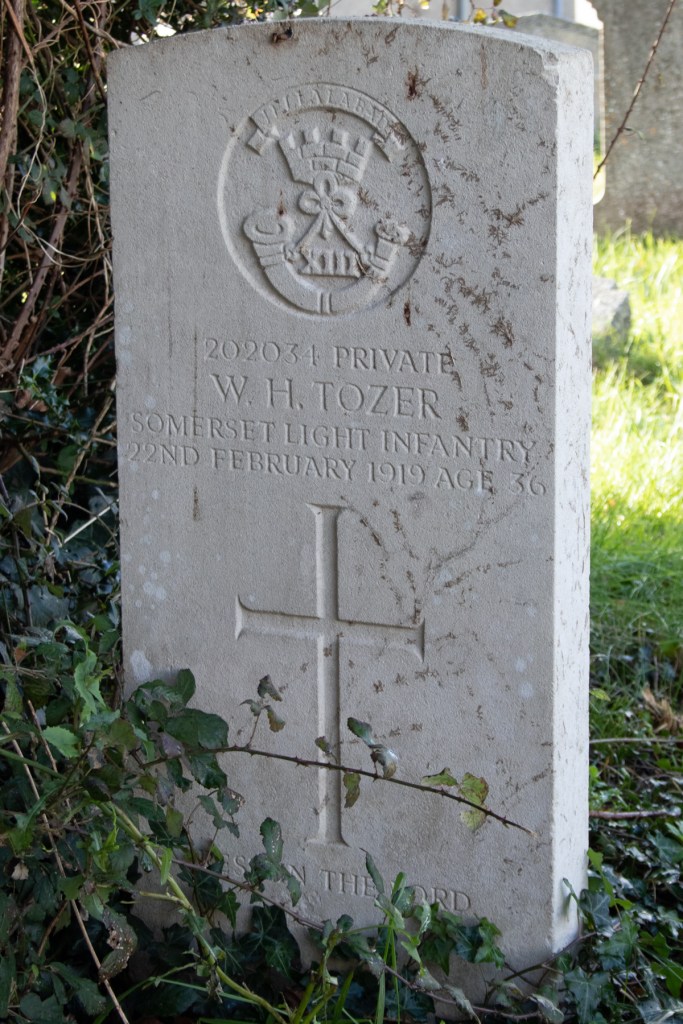
William Henry Tozer was born in the spring of 1882, and was one of four children to Elias and Thirza Tozer. Elias was a clay worker from Dawlish in Devon, and but the family were raised in nearby Kingsteignton.
William made his own way early on in life. By the time of the 1901 census he was working as a farm labourer and boarding with the family. Ten years later, he was employed as a porter at the Royal Hotel in Dawlish, and was again living on site.
At this point, William’s trail goes cold. War was approaching Europe, and it is documented that he enlisted in the Somerset Light Infantry at some point before the summer of 1918. Private Tozer was assigned to one of the regiment’s depots, but whether that was as part of the British Expeditionary Force, or on home soil is unclear.
William did survive the war, however, but was admitted to a military hospital at the start of 1919. Again, his condition is unclear, but the record of his passing confirms that he died of ‘disease’. He passed away on 22nd February 1919, at the age of 36 years old.
William Henry Tozer was brought back to Kingsteignton for burial. He was laid to rest in the graveyard of St Michael’s Church.
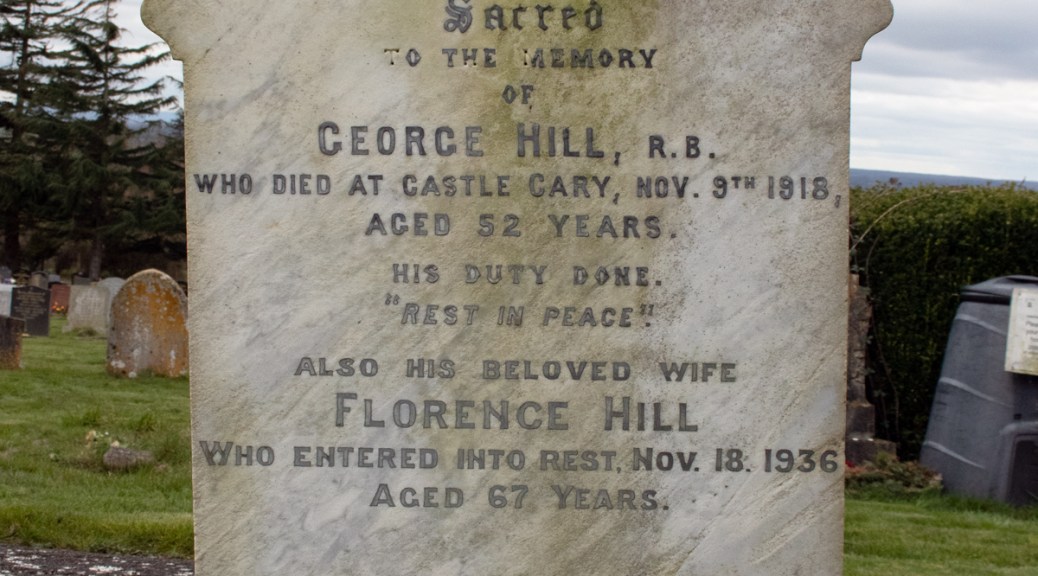
George Hill was born in Castle Cary, Somerset, in 1868. Documents relating to his early life are hard to pin down and, as his is a common name, it is not possible to identify any parental relationships.
The first document that can be categorically connected to George is the 1891 census. This confirms that he was living in his home town, and was married to a woman called Ellen. The couple had a year-old daughter, Elsie, and were both employed as horsehair workers, getting the material ready for use in upholstery.
It seems that Ellen must have died soon after the census as, in the autumn of 1893, he married Florence Cave, a stonemason’s daughter, who was also from Castle Cary. The 1901 census finds George and Florence living with Elsie, but with two children of their own, Laura and Edward.
By the time of the following census, in 1911, the family had grown again, with two more children, Percy and Doris. George’s eldest daughter was, at this point, working as a housemaid for a family in Winchester, while Laura was employed as a tailoress. George himself was still working as a horsehair curler, a trade he had been in for more than twenty years.
War was on its way, and despite being in his mid-forties, George appeared to have been keen to play his part. Full details are not available, but it seems that he had enlisted by May 1918, initially joining the Somerset Light Infantry, where he was assigned to the 4th Battalion. He was soon transferred over to the Rifle Brigade, however, and was attached to the 22nd (Wessex and Welsh) Battalion.
This particular troop initially served on home soil but was sent to Salonika in the Eastern Mediterranean in 1916. There is nothing in Rifleman Hill’s records to suggest that he went with them, however, and it may be that he had not yet enlisted at this point in the conflict. His medal records show that he was awarded the Victory and British Medals, but that these were for his territorial work, rather than anything overseas.
Rifleman Hill served until near the end of the war. He had returned home by November 1918, and it was here, on the 9th, that he passed away from pneumonia. He was 52 years of age.
George Hill was buried in the cemetery of his home town, in the family plot. Florence was also laid to rest there, some eighteen years later, husband and wife together again at last.
Frederick Davis was born in Street, near Glastonbury, in February 1876. One of four children, his parents were Frank and Ann. Frank was an agricultural labourer, while Ann worked as a shoe binder in the local Clark’s Factory.
By the 1891 census, Frederick had left school, and had also left home, boarding with a farmer in nearby Walton, where he also worked as a labourer on the farm. Ten years later, he was living with his paternal grandmother and his older brother in the village, with both brothers working as labourers.
During this time, it seems that Frederick had his sights on bigger and better things. Full details are not available, although it appears that he enlisted in the Army and served in India and South Africa between at least 1897 and 1902. He was awarded the Distinguished Conduct Medal in 1902 for his actions, although again little information around this survives.
Confirmation of his service overseas at this time appears on Frederick’s later military service records as, in January 1909, he again enlisted in the army. Frederick’s 1909 records show that his next of kin was his wife, Mrs AL Davis, although no marriage documents are apparent. He is also recorded as living in Castle Cary, just to the south of Glastonbury.
This time he was assigned to the 4th Battalion of the Somerset Light Infantry, serving for five years on home soil. During this time, he rose through the ranks from Private to Lance Corporal to Corporal to Sergeant.
When war was declared, the 4th Battalion was sent out to India. Sergeant Davis spent the next eighteen months there, before being moved to the Persian Gulf. He was obviously well thought of as, with the move came a further promotion, this time to Company Sergeant Major.
In June 1917, Frederick returned to England from overseas, and, at the end of his term of service two months later, he was demobbed. He returned home to Somerset, but, within a couple of months, on 2nd October 1917, he passed away. The cause of his death is not recorded, but he was 42 years of age.
Frederick Davis was laid to rest in the peaceful surrounds of the Castle Cary Cemetery.
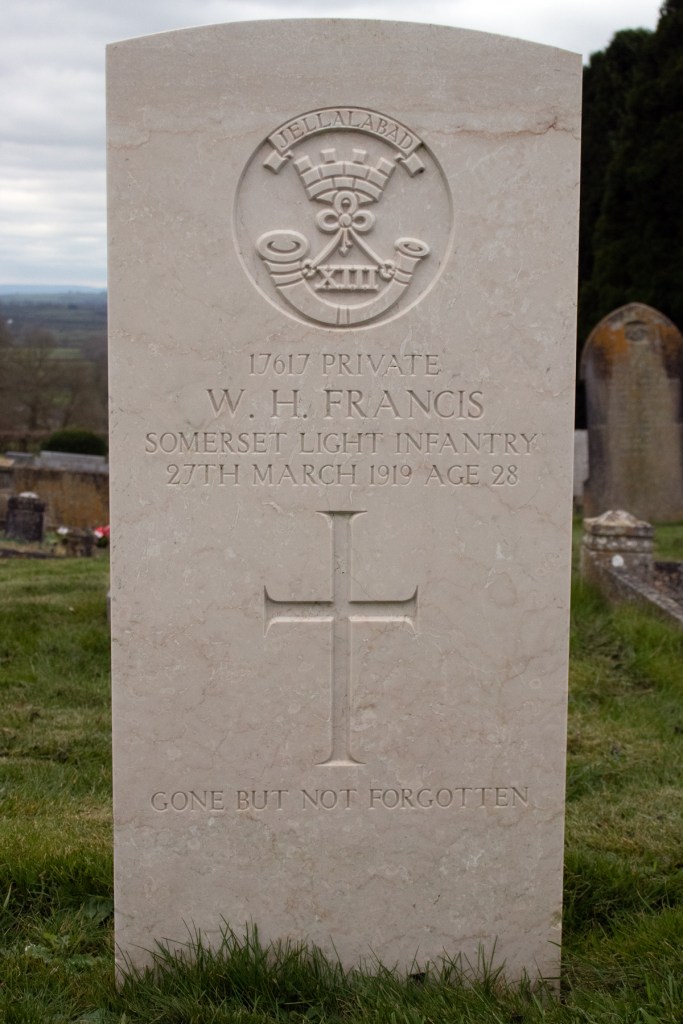
Wilfred Harry Francis was born in October 1890 in Castle Cary. He was the oldest of eight children to Edward and Rosina Francis, both of whom had also been born in the Somerset Town. Edward was a baker in his younger days, but, by the 1911 census he was employed as a builder’s labourer. Wilfred was recorded in the same document as a tailor.
War was coming to Europe, and Wilfred enlisted. He had been a volunteer in the Somerset Light Infantry, but on 6th April 1915, he made this a formal role. His service records show that he stood 5ft 6ins (1.68m) tall had light blue eyes and light brown hair.
Private Francis was assigned to the 6th Battalion and sent to France in the summer of 1915. His battalion was immediately thrown into the thick of the fighting at Ypres. The intensity of the battles of Hooge and Bellewaarde seemed to impact Wilfred as, on 7th October, he was admitted to the 4th London General Hospital, suffering from shell shock.
Wilfred was discharged after two weeks, and signed off as fit for light duties. It seems that he didn’t return to the Western Front, but instead was transferred to the 3rd (Reserve) Battalion of the regiment, based in Devonport.
The memories still seemed to haunt Private Francis, however. He was admitted to hospital again – this time the County of Middlesex Hospital in Napsbury, near St Albans – with mania. This time his ‘mental deficiency’ proved to much for the army, and he was discharged from military service on 18th July 1916. His discharge papers show that he gave the hospital as his address and recommended that he be admitted to a civil asylum.
Wilfred’s trail goes cold for the next few years. He seems to have been brought back to Somerset for ongoing treatment, but passed away in Wells on 27th March 1919; the cause of his passing is not known. He was 28 years of age.
Wilfred Harry Francis was laid to rest in the Castle Cary Cemetery, hopefully finding peace at last.
Edward Foster was born in the spring of 1887, one of eight children to Alfred and Eliza. Alfred was an agricultural labourer, born and bred in North Newton, Somerset, and this is where he raised his family.
When he left school, Edward found work in the village as a basket maker, and this is a trade he continued in until war broke out. He enlisted early on, and was assigned to the Somerset Light Infantry as a Private.
His battalion was shipped to India in October 1914, but records are sparse, and it is not clear whether Private Foster also set sail. All that can be confirmed is that he was at home on 21st December 1914, as this is where he sadly passed away from heart failure. He was just 27 years of age.
Edward Foster was laid to rest in the graveyard of St Peter’s Church in his home village, North Newton.
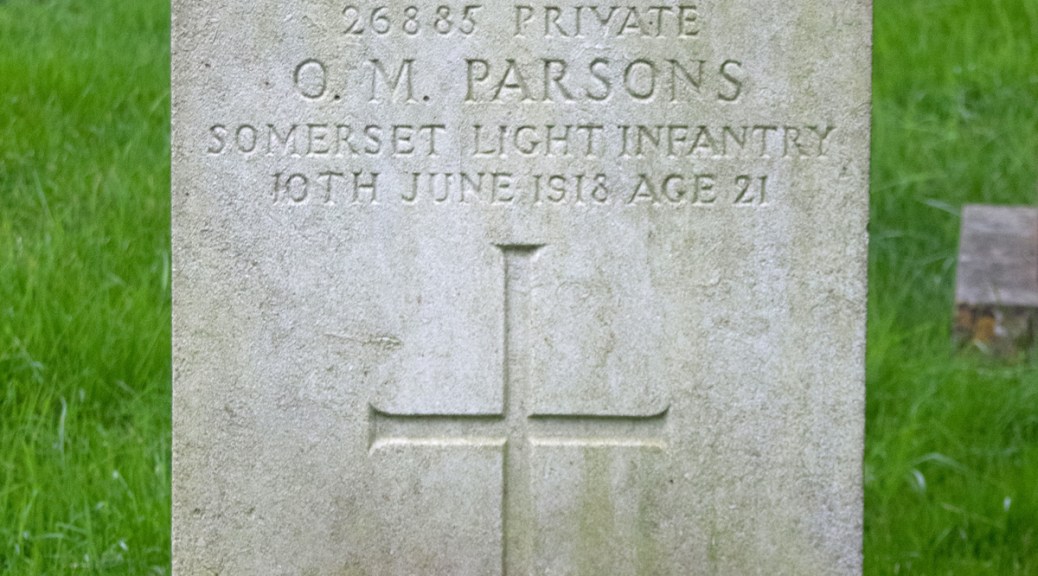
Oliver Metford Parsons was born in North Newton, Somerset, on 3rd January 1897. His parents were Thomas and Lily Parsons, and he was one of four children.
Thomas was a carter and labourer on a farm, and this is the trade his son took up when he left school. The 1911 census recorded Oliver as living with the market gardener Edmund Durridge and his family – who lived in the same village – and working as a labourer for them.
Lily had passed away in 1907, so this move may have had something to do with a change in family circumstances – the 1911 census recorded Thomas living in the village with Hannah Parsons, having been married for just a year.
When war came to Europe, Oliver was keen to play his part for King and Country. While full service records are not available, documents confirm that he enlisted in the Somerset Light Infantry in the spring of 1917. Private Parsons was assigned to the 7th (Service) Battalion and soon found himself on the Front Line.
While it is not possible to pinpoint exactly where Oliver fought, his battalion fought at the Third Battle of Ypres and, in April 1918 moved to Amiens.
It was in June 1918 that Private Parsons was caught up in a gas attack. He was injured and medically evacuated to England for treatment, where he was admitted to the Ipswich Hospital in Suffolk. Sadly, his injuries proved too severe, and he passed away at the hospital on 10th June 1918. He was just 21 years of age.
Oliver Metford Parsons’ body was brought back to his Somerset home. He was laid to rest in the graveyard of St Peter’s Church in North Newton.
Albert Edward Sparrow was born in Frome, Somerset, in March 1880. One of four children, his parents were Albert and Louisa Sparrow. Albert Sr was a labourer at an iron foundry, and the family were raised close to the centre of the town.
When he left school, Albert Jr found work as a labourer. However, after his father passed away in 1895, he sought longer term prospects. On 11th November 1898 he enlisted in the Royal Fusiliers as a Private for a period of twelve years. His service records show that he stood 5ft 6in (1.67m) tall, weighed 115lbs (52.2kg), had brown eyes, curly brown hair and a sallow complexion.
During his time in the army, Private Sparrow served in Gibraltar, South Africa and Burma. He returned home in March 1903, was placed on reserve in November 1906, and then ended his contract four years later.
At this point, Albert’s trail goes cold. However, when war was declared, he was keen to play his part. He re-enlisted on 27th August 1914, and was assigned to the Somerset Light Infantry. Assigned to the 6th (Service) Battalion, he was sent to France in December that year.
In July 1916, while fighting at the Somme, he was hurt when he received a gunshot wound to his right buttock. The injury proved enough for him to be medically evacuated back to England, and he spent the next five months recovering, and then working, on home soil.
In December 1916, Private Sparrow was sent back out to France. Six months later, he contracted bronchitis and was again evacuated back to England. He was admitted to the Royal Infirmary in Liverpool and, after a month there, he was moved to the Plas Tudno Nursing Home in Llandudno to recover.
Albert’s condition meant that he could not continue in military service, and he was discharged from the army on 18th December 1917. He returned home to Somerset, but his lung condition proved too much; he passed away on 19th January 1918, at the age of 37 years old.
Albert Edward Sparrow was laid to rest in the graveyard of Holy Trinity Church in his home town of Frome.
William Talbot’s early life is destined to remain a mystery. He was born in Street, Somerset, in around 1869, although there is no concrete information about his family. When he left school, he found work in the local shoe factory – as did the majority of Street residents – and he appears to have married at some point in the late 1890s.
By the time of the 1911 census – the first that can be directly connected to him – William had moved to Frome. He was widowed by this point, and was living in a small cottage with his two sons – Edward, who was sixteen, was labouring in the local flour mill; Albert, who was a year younger, was working as a hairdresser.
William seems to have married again, this time to a widow called Alice; she had four children, and the two of them went on to have another child together.
When war broke out, William joined the National Reserves. He subsequently transferred to the Somerset Light Infantry, and was assigned to the 4th (Reserve) Battalion as a Private. He served on guard duty on the Kent coast, although specific details are not available.
Reporting on Private Talbot’s passing, the Somerset Standard stated that he “did not enjoy good health, and had been several times in hospital” [Friday 29th September 1916]. He had been admitted to the military hospital in Herne Bay, but passed away from ‘disease‘ on 21st September 1916. He was 47 years of age.
William Talbot’s body was brought back to Frome for burial. He lies at rest in the graveyard of the town’s Holy Trinity Church.
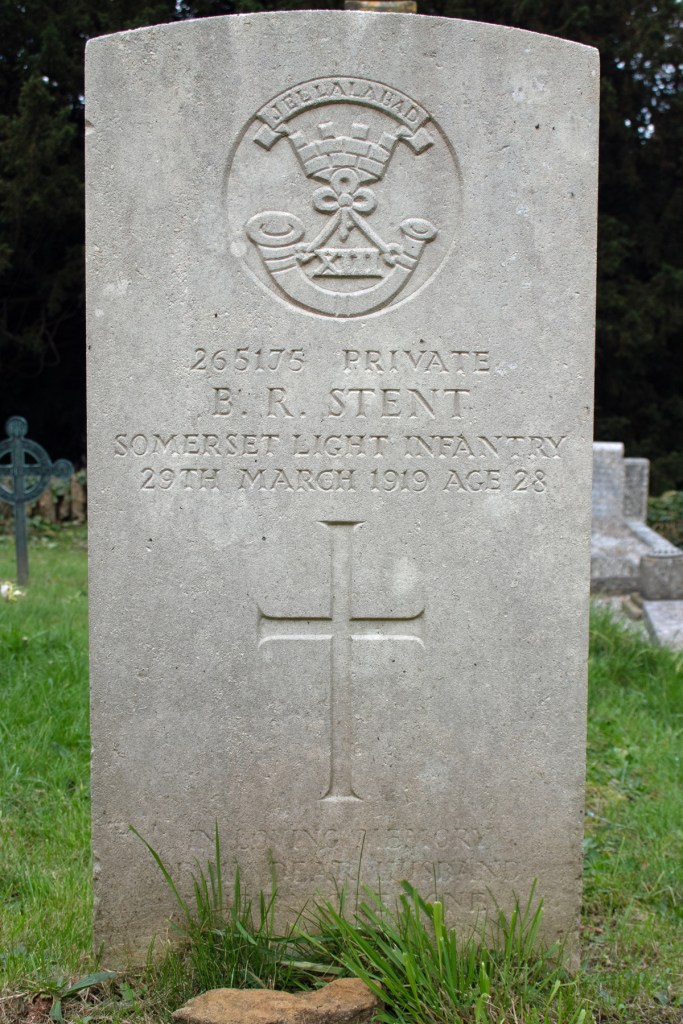
Bertie Reginald Stent was born early in 1892, one of fifteen children to Henry and Emily. Henry was a painter – initially for the railways, and then a house painter – from Frome, Somerset, and the family were raised on The Mint in town.
When he left school, Bertie also left an overcrowded home. He found work as a carter, and moved to Wellow, near Bath, where he boarded with stonemason Albert Barnes and his family. War was coming to Europe, however, and things were about to change.
Bertie enlisted in the 85th Provisional Battalion of the Territorial Force early on in the conflict. He was initially based on home soil, serving in Herne Bay in Kent and Wrentham in Suffolk. His troop became the 11th Battalion of the Somerset Light Infantry at the start of 1917 and, by the spring of the following year, he found himself in Northern France.
By this point, Bertie had met and married a woman called Ethel May. Sadly, little further information about the wedding is available, but the couple set up home in the same road as his parents and went on to have two children.
Private Stent was involved in some of the final battles of the war – the Battle of Albert and the advances in Artois and Flanders. When the Armistice was signed, he remained in France, returning home in the following spring.
Tragically, he had contracted influenza while waiting to be demobbed and, on 29th March 1919, he passed away at home from pneumonia. He was just 27 years old and had been back in Frome for just a week.
Bertie Reginald Stent was laid to rest in the churchyard of Holy Trinity Church in Frome, within sight of his family home.
While there is little information about Bertie and Ethel’s marriage, there is some detail about her life after her husband’s death. Ethel continued to live in Frome, on the same road as her marital home. The 1939 Register lists her as an unpaid domestic worker – in effect, a housewife – and she is living with Reginald, her and Bertie’s second child, who was a land worker.
Bertie’s sister, Annie, married Albert Withey, who also died after coming home from war. Read his story here.
Charles Franklin Flower was born in Walcot, Bath, at the end of 1879. The middle of five children, his parents were stonemason John Flower and his dressmaker wife, Elizabeth.
John died when his son was only eleven years old, and Elizabeth passed away just two years later, leaving Charles an orphan at just 13 years of age.
He disappears off the radar for a time, only reappearing again when, in the summer of 1895, he enlisted in the 13th Battalion of the Somerset Light Infantry. Charles’ service records show that he stood 5ft 7ins (1.69m) tall, weighed 121lbs (55kg) and had grey eyes, light brown hair and a fair complexion. He was also noted as having a tattooed ring on his left ring finger.
After eighteen months on home soil, Private Flower was sent out to the East Indies, where, apart from a short stint back in England, he spent the next twelve years. He was promoted to Lance Corporal in May 1898, but though his own volition, reverted to the rank of Private seven months later. Charles was destined for bigger things, though, and was again promoted to Lance Corporal in September 1900. Over the next few years, he received further promotions – to Corporal in September 1905 and Lance Serjeant eighteen months later.
In the autumn of 1908, Charles returned to home soil, but his military service continued. On 12th April 1909, he married Elizabeth Ann Wills, a gamekeeper’s daughter from Cannington, Somerset. They set up home in Portland, Dorset, where Charles was based, and went on to have a son, Herbert, a year after they married.
By 1910, Charles had again been promoted, and was now a Serjeant. In the next couple of years, the family moved from the Dorset coast to the Somerset town of Frome. Serjeant Flower’s service continued, but he remained on home soil, even when war broke out.
All was not well with Charles’ health, however, and by the summer of 1915, he was admitted to hospital. He was thin and anaemic, with an enlarged liver and an ‘enormously swollen’ spleen. This was discovered to be a malignant growth, and Serjeant Flower was discharged from military service on medical grounds on 20th December 1915. He had been in the Somerset Light Infantry for more than two decades.
Charles Franklin Flower was not to recover from his illness. He passed away at home on 27th February 1916, at the age of just 37 years old. He was laid to rest in the graveyard of Holy Trinity Church in Frome.