Category Archives: Stoker

Stoker Petty Officer Albert Symes

Stoker Petty Officer Albert Symes

Albert Symes was born in Dorset on 6th March 1887. Details of his early life are a challenge to piece together, as his was not an uncommon name in the county – the 1891 census has at least two potential matches, and the 1901 record at least three.

The first concrete information for Albert is that of his military service. Having been working as a general labourer, he enlisted on the 22nd September 1906, joining the Royal Navy as a Stoker 2nd Class. His service records show that he was 5ft 5ins (1.65m) tall, with brown hair, blue eyes and a fresh complexion. He was also noted as having the letters BS (presumably for Bert Symes) tattooed on his right forearm.

The service document gives his place of birth as Yeovil, Dorset, although the town is actually in Somerset. The next census, taken in 1911, suggests he was born in the village of Bradford Abbas, three miles south east and over the Dorset border.

Stoker 2nd Class Symes was first sent to the training ship HMS Nelson. Based in Portsmouth, Hampshire, this is where Albert spent three months, before being assigned to the cruiser HMS Eclipse. Over the next nine years, Albert served on eight ships, returning to a land base – HMS Victory in Portsmouth – in between voyages.

Albert’s commitment to the job is evident – his character was continually noted as being Very Good, while his ability was Superior as each of his annual reviews. In May 1907 he was promoted to Stoker 1st Class; five years later he made Acting Leading Stoker, with a full promotion to the rank in June 1913; on 1st June 1915, while serving on board HMS Hampshire, Albert was promoted again, to Stoker Petty Officer.

Things would change rapidly for Albert, however. Within a matter of weeks, he had contracted pneumonia. He was transferred to the hospital ship Garth Castle, but the condition was to prove too severe. Stoker Petty Officer Symes passed away from the condition on 3rd October 1915: he was 28 years of age.

Albert Symes’ body was brought back to Dorset for burial. He was laid to rest in the peaceful graveyard of St Mary’s Church in the village of Bradford Abbas.


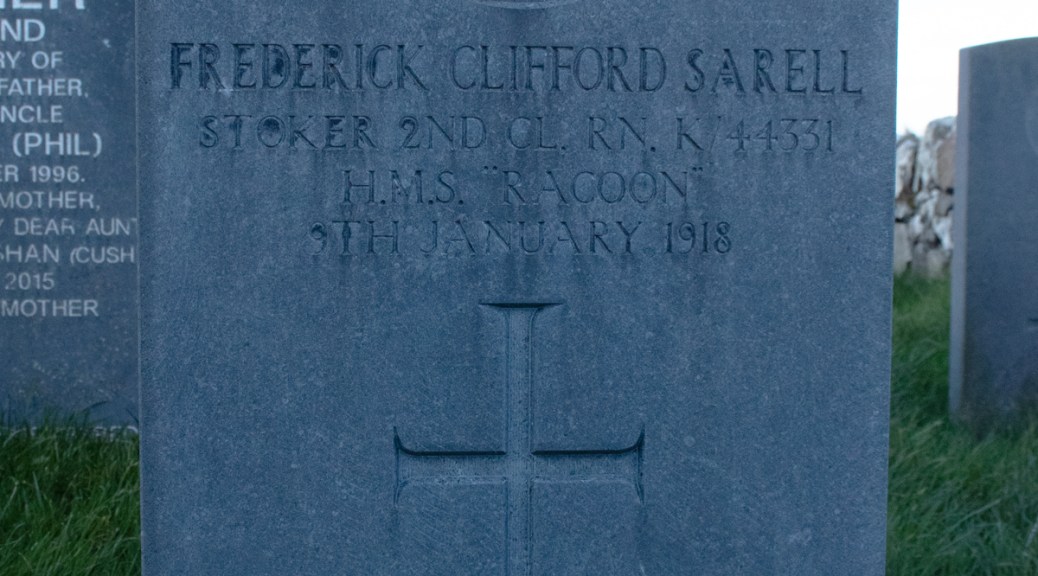
Stoker 2nd Class Frederick Sarell

CWG: Stoker 2nd Class Frederick Sarell

Frederick Clifford Sarell was born on 6th July 1899, one of six children to James and Theresa. James was a general labourer from East London, and the family were born and brought up in West Ham, Essex.

The Sarell family were beset by tragedy: Frederick’s oldest brother, James, died in 1903, at the age of 23, while James Sr passed away three years later. By the time of the 1911 census, Theresa was raising her five remaining children in a small house in Fife Road, Canning Town, with her oldest three children bringing in some money to support the family,

In 1913, another of Frederick’s brothers, George, passed away, and the following year his oldest sister, Theresa Jr, also died. By the summer of 1917, with war raging across Europe, Frederick stepped up to play his part. It is unclear whether his motives were to support his mother, or because he was conscripted, but either way he enlisted in the Royal Navy.

Frederick had been working as a dock labourer when he signed up. He Employed as a Stoker 2nd Class, his naval records show that he was 5ft 6.5ins (1.69m) tall, with brown hair, grey eyes and a fresh complexion. He was noted as having a scar on his right knee, a distinguishing mark that would tragically help to identify his body before the year was out.

Stoker Sarell was initially sent to HMS Pembroke, the Royal Naval Dockyard in Chatham, Kent, for his training. On 10th October 1917, he was given his first posting, on board the destroyer HMS Racoon, which patrolled the seas between Ireland and Scotland.

Frederick was on board when, on 9th January 1918, the Racoon struck rocks off the coast of Northern Ireland in heavy seas and blizzard conditions. All of the crew – more than 90 men – were lost. Stoker 2nd Class Sarell was just eighteen years old when he died: he had been in the Royal Navy for less than six months.

The body of Frederick Clifford Sarell washed ashore near Ballintoy, County Antrim. He was laid to rest in the graveyard of the village’s church next to two other crew members, Ordinary Seaman Frank Green and Ship’s Cook Walter Griffin.


Stoker 1st Class John Stone

Stoker 1st Class John Stone

John Edward Stone was born on 10th April 1894 in Torquay, Devon. The oldest of seven siblings – of whom three survived childhood, his parents were John and Hannah Stone.

John Sr was a masons labourer, but when his son finished his schooling, he found work initially as a grocer’s errand boy, then as an outdoor porter. John Jr sought bigger and better things, however, and, in February 1913, he enlisted in the Royal Navy.

Stoker 2nd Class Stone’s service records show that he was 5ft 5ins (1.65m) tall when he joined up, and that he had brown hair, grey eyes and a fresh complexion. He was based at HMS Vivid, the Royal Naval Dockyard in Devonport, and this is where he spent the first six months training.

John’s first sea-going posting was on board the armoured cruiser HMS Defence and she was to be his home from 2nd September 1913 to May 1916, when she was sunk during the Battle of Jutland. During his month aboard, he was placed in the brig for 14 days due to ‘absence’. This imprisonment seemed to have refocused John’s priorities, however, and he was promoted to Stoker 1st Class on 26th February 1914.

Rescued from the lost Defence, John was taken back to Devonport, and he remained there until the end of August 1916. From here he transferred to the depot ship, HMS Blake, which was to be his home until the end of the war.

In the spring of 1917, John married Sarah Juliff in St Columb, Cornwall. The couple went on to have a daughter, Christiana, a few months later.

Stoker 1st Class Stone fell ill towards the close of the war, contracting pneumonia. He passed away while still on board HMS Blake, on 15th November 1918. He was 24 years of age.

Sarah was living in Middle Street, Padstow when her husband passed. He was brought back to the county, and was laid to rest in the town’s cemetery.


The official documents go on to say that Sarah moved to the Caerwilliam Hotel in Cabres Bay. However, there are no records for the hotel or location, although it could refer to Carbis Bay in St Ives, Cornwall.


Stoker 1st Class Samuel Graham

Stoker 1st Class Samuel Graham

Samuel Robert Graham was born in Cork, Ireland, in 1895. He was one of six children to Samuel and Alice Graham. Samuel was a postman from Liverpool, while Alice had been born in St Helier, Jersey.

Information about Samuel Jr’s early life is scarce: the 1901 census found Alice and the children visiting her mother in Jersey, while he husband is missing from census records. The next return in 1911 recorded Samuel Sr, Alice and three of their children living in the Trinity area of Jersey, but Samuel Jr is missing.

On 9th September 1913, Samuel Jr enlisted in the Royal Navy. He had been working as a blacksmith, and sought a career at sea. His service records show that he was 5ft 5ins (1,65m) tall, with brown hair, hazel eyes and a fresh complexion.

Stoker 2nd Class Graham signed up for a period of twelve years’ service. Based at HMS Victory, the Royal Naval Dockyard in Portsmouth, Hampshire, his first formal posting was on board the cruiser HMS Bristol. He remained on board for nearly two years, and was promoted to Stoker 1st Class in the process.

During the First World War, Samuel served on two more ships and, by the end of the conflict, he was based at HMS Columbine, the naval base at Port Edgar on the Firth of Forth, Scotland. He fell ill while barracked there, and was admitted to the Royal Naval Hospital in nearby Queensferry. Whatever Stoker 1st Class Graham’s condition, it was to prove too severe: he passed away on 1st December 1918, at the age of 23 years old.

Samuel Robert Graham’s body was taken back to Jersey for burial. He was laid to rest in Trinity Churchyard, not far from where his family still lived.


Stoker Louis Theobold

Stoker Louis Theobold

Louis Theobald was born on 27th January 1898 in Soho, Middlesex. There is little information available about his early life, and the only document that can be directly connected to him is his military service records.

Louis enlisted in the Royal Navy on 7th September 1915. He had been working as a miner at the time, and the document gives an insight into the man he was. He stood 5ft 5ins (1.65m) tall, had brown hair, brown eyes and a fresh complexion. The service records also confirm that he had a tattoo on his right arm.

Stoker 2nd Class Theobald was sent to HMS Pembroke, the Royal Naval Dockyard in Chatham, Kent, for his training. He spent three months there, before being given his first posting, on board the minesweeper HMS Alyssum. He remained on board for three months, before transferring to the cruiser HMS Wallington in February 1916.

Louis’ health was starting to be impacted by this point: he had developed bronchitis, probably exacerbated by heat and dust of the confined engine room he worked in. By April 1916 he was transferred back to HMS Pembroke, and within two months, he was medically discharged from service.

Stoker 2nd Class Theobald had been admitted to the Royal Naval Hospital in Chatham by this point, and his health began to deteriorate. He passed away from a combination of bronchitis and empyema on 15th September 1916: he was just eighteen years of age.

Louis Theobald was laid to rest in the Roman Catholic section of the Woodlands Cemetery in Gillingham, Kent, not far from the dockyard where he had been based.


Stoker James Hurley

Stoker James Hurley

James Hurley was born in Timoleague, County Cork, Ireland, on 1st August 1894. His was not an uncommon name so full details of his early life are a challenge to unpick. However, later records confirm that his father was also called James Hurley, and when he finished his schooling, he found work as a farm labourer.

When war broke out in Europe, James Jr was quick to step up and play his part. He enlisted in the Royal Navy on 12th January 1915, and took the role of Stoker 2nd Class. His service records show that he was 5ft 5.5ins (1.66m) tall, with dark brown hair, grey eyes and a fresh complexion.

Stoker 2nd Class Hurley was sent to HMS Pembroke, the Royal Naval Dockyard in Chatham, Kent, for his training. However, his time there was to be tragically brief. He was admitted to the Welcome Hospital when he contracted pneumonia and empyema, but the condition was to prove too severe. He passed away on 6th February 1915, at the age of just 20 years old. He had been in the Royal Navy for just 25 days.

James Hurley’s parents were unable to bring him back to Ireland for burial. Instead, he was laid to rest in the Roman Catholic section of the Woodlands Cemetery in Gillingham, not far from the dockyard in which he had so briefly served.


Stoker Thomas McCall

Stoker Thomas McCall

Thomas McCall was born in Bootle, Lancashire, in 1892 and was one of two children to Francis and Elizabeth. Frank was a stoker on the steamers leaving Liverpool docks and, after working at the docks himself, Thomas soon followed his father onto the ships. By the summer of 1911, he had worked as a trimmer on at least two liners, the RMS Carmania and the RMS Empress of Britain.

When war came to Europe, Thomas stepped up, joining the Mercantile Marine Reserve – now better known as the Merchant Navy. By the summer of 1915, he was assigned to the seaplane carrier HMS Vindex, which spent most of the war in the North Sea.

Stoker McCall’s time there was to be brief. Details are sparse, but he passed away on 14th October 1915, with records suggesting this was due to disease. He was just 23 years of age.

Finances may have limited Frank and Elizabeth from bringing their son back to Lancashire: Thomas McCall was instead laid to rest in the Roman Catholic section of Woodlands Cemetery in Gillingham, Kent, not far from the dockyard in which he had been based.


Thomas’ headstone gives MaCall as his surname. This is an error: his name was spelt McCall.


Stoker Petty Officer Charles Lavis

Stoker Petty Officer Charles Lavis

Charles Walter Lavis was born in Iowa, USA, on 2nd April 1888. The second of eleven children, his parents were James and Martha Lavis. The only census record Charles appears from – the return from 1901 – shows that James was an agricultural labourer from Long Sutton in Somerset. The family’s move to America seemed not to have lasted for long – Charles’ immediate siblings – Mabel, who was two years older, and George who was two years younger – were both born in Long Sutton.

Charles was drawn to a life of adventure and, on 11th April 1906, he enlisted in the Royal Navy. His service records confirm that he was 5ft 5ins (1,65m) tall, with brown hair grey eyes and a fresh complexion. As a Stoker 2nd Class, he was initially sent to the training ship HMS Nelson, before moving to what would become his shore base, HMS Victory, the Royal Naval Dockyard in Portsmouth, Hampshire.

Over the next year, Charles serves on HMS Hecla and HMS King Edward VII, where, on 17th May 1907, he was promoted to Stoker 1st Class. He remained on the King Edward VII for more than four years, before returning to Portsmouth in August 1911.

Back on shore, Stoker 1st Class Lavis was promoted to Leading Stoker, and spent the next nine months training for the role at HMS Fisgard, also in Portsmouth. He spent six months on the battleship HMS Revenge, before moving again to another battleship, HMS Britannia.

Charles spent two years on the Britannia, and it was while assigned to her that he got married. He wed Bessie Patten on 31st May 1914 in Martock, Somerset: the couple would go on to have a daughter, Eileen, who was born the following April.

It was while Charles was serving on HMS Britannia that was broke out. In November 1914, he returned to Victory for further training and, in the spring of 1915, he was promoted to Stoker Petty Officer.

Over the next three years, Charles served on three more vessels, before finally returning to Portsmouth in April 1918. The reason for his return was because of his health, and he was soon admitted to the Royal Naval Hospital in Haslar, Gosport, suffering from tuberculosis of the neck. The condition necessitated an operation, but Stoker Petty Office Lavis was not to survive the procedure. He suffered from heart failure, and died on 2nd May 1918. He had not long turned 30 years of age.

Charles Walter Lavis was taken back to Somerset for burial. He was laid to rest in the quiet graveyard of All Saints’ Church in Martock.


Records suggest that the Lavis family could not settle. Passenger lists from March 1912, show James and Martha travelling with nine children to Portland, Maine, before moving on to Huron in Ontario. James was still recorded as being a farm labourer, so it seems that opportunities for the family were better in North America than in Britain.

When war broke out, citizens of the Commonwealth were called upon to play their part and, despite being under age, Charles’ younger brother Arthur, stepped up to serve. Details of his time in the army are scarce, but he was assigned to the 14th Battalion of the Canadian Infantry. His troop set sail for Britain in October 1914: Arthur was just 14 years old at this point, and had lied when he joined up, giving his date of birth as 20th May 1897.

Private Arthur Lavis was in France by August 1916, taking up position on the Front Line at Coucelette. They met heavy troops, even before a full offensive got underway on 16th September. Ninety-two soldiers from the 14th Battalion were killed during the attack, Arthur included. He was just 16 years old, and his remains were never recovered. He is commemorated on the Vimy Memorial in France.


Leading Stoker Leonard Gulliford

Leading Stoker Leonard Gulliford

Leonard Henry Gulliford was born on 26th January 1895 in the village of Cothelstone, near Bishops Lydeard, Somerset. One of eleven children, he was the son of farm labourer William Gulliford and his wife, Jane.

When he completed his schooling, Leonard also found employment on the farm. However, it seemed he wanted bigger and better things and, on 7th April 1913, he enlisted in the Royal Navy as a Stoker 2nd Class. His service records show that he was 5ft 4.5ins (1.64m) tall, with fair hair, blue eyes and a fresh complexion.

Stoker Gulliford spent the first six months of his naval career at HMS Vivid, the Royal Naval Dockyard in Devonport, Devon. This was to be the base to which he would return in between voyages. His records show unusual activity for his time, as he was assigned to just one ship – the battle cruiser HMS New Zealand – during his six years’ service. Leonard spent five years on board, from September 1913 to February 1919, with just one month based back in Devonport during this time.

Leonard rose through the ranks over the years, receiving a promotion to Stoker 1st Class in April 1914, Acting Leading Stoker in July 1918 and Leading Stoker in July 1919, by which point he was, once again, based at HMS Vivid.

In November 1919, Leonard was attached to the sloop HMS Silvio, based in the River Tamar. A party of the crew, Leading Stoker Gulliford included, left the ship without leave, taking a boat to shore.

The bodies of the seven men who were missing from two warships in the Tamar Estuary were recovered this morning, and a mystery has thus been cleared up.

The men left two ships, HMS Swindon and HMS Silvio, on Sunday evening, and it is believed visited Saltash, a riverside town. Later an upturned boat and two naval caps were found…

The bodies were found close together on the mudflats in shallow water in Tamar Creek, on the eastern side of the River Tavy, near the Tavy railway bridge.

Daily News (London): Friday 5th December 1919

A subsequent inquest into the sailors’ deaths determined that, after their time in Saltash, they took their boat, which, at just 13.5ft (4.1m) long, proved too small for seven man, back to their ships. The wind and choppy waters proved too much, and the boat capsized, throwing all of them into the water to their doom. A verdict of accidental death was recorded.

The body of 25-year-old Leonard Henry Gulliford was taken back to Somerset for burial. He was laid to rest in the graveyard of St Mary’s Church in Bishops Lydeard.


Stoker Petty Officer Henry Cordas

Stoker Petty Officer Henry Cordas

Much of Henry John Cordas’ early life is destined to remain a mystery. The first record for him is the 1881 census, which gives is his address as St Mary’s Orphanage in Heston, Middlesex, where he was one of 650 children.

The 1891 census recorded Henry as living in Humber Street, Grimsby, Lincolnshire, right next to the town’s docks. He is noted as being a fisherman, and is married to a woman called Mary, who was born in Deptford, Surrey.

The next available census record for Henry adds confusion to his story. The document, dating from 1911, confirms that he and Mary are now living in Hotwell Road, Bristol, Gloucestershire, again within spitting distance of the docks. Henry was employed as a marine fisherman in the merchant service. The document suggests that the couple had been married for ten years, and give Mary’s place of birth as Swansea, Glamorganshire.

While the document matches previous information for Henry, it seems unlikely that the Marys in the 1891 and 1911 censuses are one and the same. Either way, the couple were sharing their house with Mary’s niece, Ellen.

Henry seems to have joined the merchant fleet in a more official capacity in the autumn of 1900. His records show that he was 5ft 11ins (1.8m) tall, with blue eyes and a fair complexion. He served out of Bristol and, in the years leading up to the outbreak of war, he was assigned to a number of ships, travelling the Atlantic to Montreal and Jamaica, amongst other far-flung places.

When hostilities commenced, Henry was assigned to the Royal Naval Reserve. Over the next few years, he served on a number of ships, including the armoured cruisers HMS Suffolk and HMS Doris. He worked as a Stoker, but by the end of the conflict had been promoted to Stoker Petty Officer.

In December 1918, Henry’s service came to an end. He was, by now, based at HMS Vivid, the Royal Naval Dockyard in Devonport, but his health was suffering. Medically discharged with a combination of chronic bronchitis and rheumatic pain, he seems to have returned to Bristol.

On 6th December 1920, Henry was admitted to Bath War Hospital in Somerset, as he was coughing up blood. The plan was to transfer him to Greenwich Hospital in Surrey, but he suffered an aneurysm before that move could be made. He passed away on 11th December 1920, at the age of 50 years old.

The body of Henry John Cordas did not travel far for burial. He was laid to rest in the peaceful expanse of Bath’s Locksbrook Cemetery.