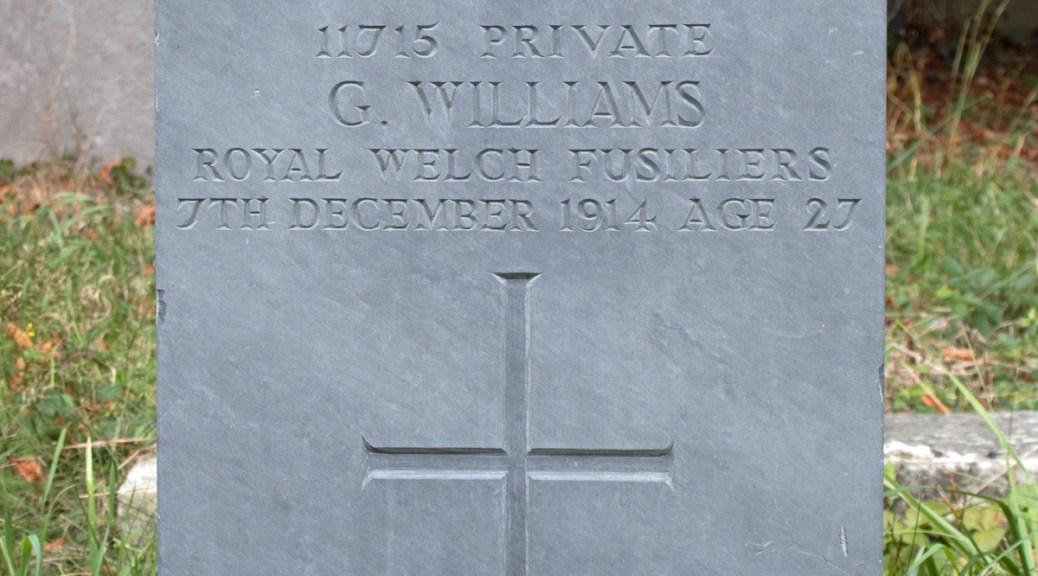
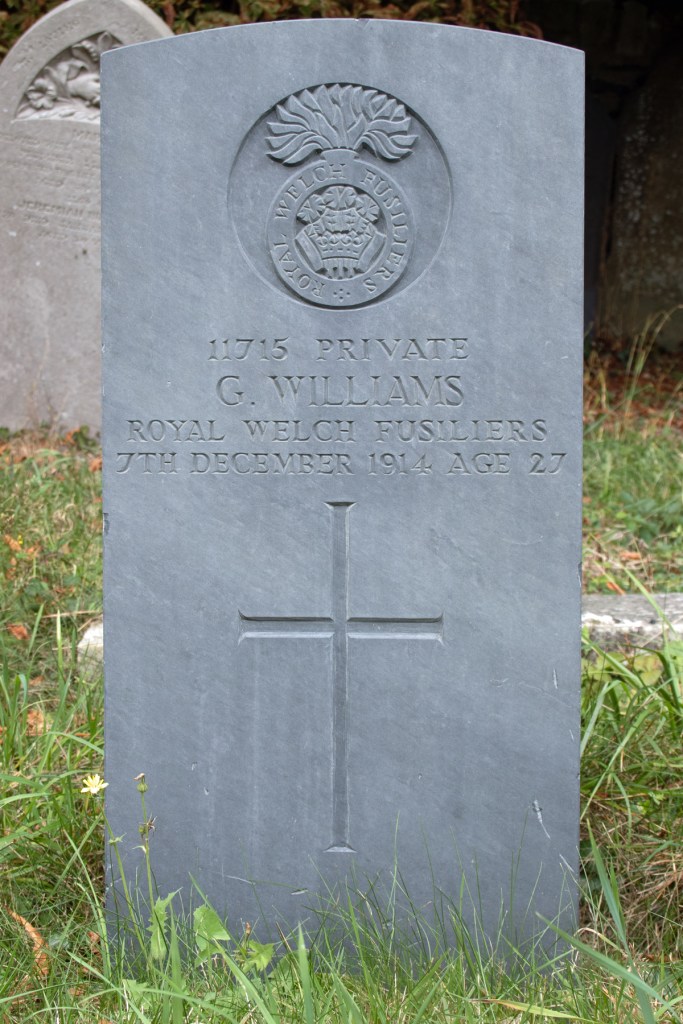
George Williams was born in 1887 in Ruthin, Denbighshire. One of thirteen children – of whom sadly only seven survived – his parents were John and Martha Williams. John was a carpenter and joiner and, when the children had grown a little, he and Martha took on the Registered Tramp Lodging House in Church Street, Llangollen.
The 1911 census recorded George living with his parents and working as a carter. His younger brother John was employed as a labourer, while the rest of his siblings were at school. The boarding house was full as Martha’s brother was staying there, along with four lodgers.
George married Catherine Edwards on 27th May 1911. She was an engineer’s daughter, also from Llangollen, and the couple tied the knot in St Collen’s Church, which was on the same street as the Williams’ boarding house. The newlyweds moved to Ruabon, six miles (10km) to the east of Llangollen, and had a daughter, Martha, who was born in 1912.
When war was declared, George was quick to enlist. He joined the 8th (Service) Battalion of the Royal Welch Fusiliers, and was sent to Salisbury Plain for his training. While here, however, Private Williams passed away. The cause of his passing is not readily available, but it seems likely that he succumbed to illness, possibly brought on by the sudden influx of men from across the country suddenly billeted together in the confines of an army camp. He died on 7th December 1914, aged just 27 years of age.
George Williams’ body was brought back to Wales for burial. He was laid to rest in the graveyard of St John’s Church in Llangollen.
Tragically, just six days after George’s death, Catherine gave birth to their second child. George Jr would never know his father.
George Herbert Reardon was born on 29th March 1890 in St Pancras, Middlesex. The second of four children, his parents were tailor Thomas Reardon and his dressmaker wife, Mabel.
When he left school, George worked as an errand boy, presumably for his parents’ business. However, he wanted bigger and better things and, on 6th April 1906, he enlisted in the Royal Navy.
Initially underage, George was given the rank of Boy 2nd Class, and was sent to the training ship HMS Impregnable. After nearly a year there, he was promoted to Boy 1st Class and, on 5th March 1907, was given his first sea-going assignment. Over the following nine months, Boy 2nd Class Reardon served on five ships, the last being the battleship HMS Venerable.
It was while he was assigned to this ship that George came of age, and was formally inducted into the Royal Navy, on a twelve year contract. His service records show that he stood 5ft 5.5ins (1.66m) tall, had brown hair, brown eyes and a fresh complexion. He was also noted to have two moles, one on his right upper arm and another on the third finger of his left hand.
The now Ordinary Seaman Reardon remained on HMS Venerable until 1st February 1909, when he was transferred to another battleship, HMS Implacable. He was to spend the next eighteen months on board, and, while there, was promoted again, to Able Seaman.
In September 1910, George came on shore, and was assigned to HMS Pembroke, the Royal Naval Dockyard at Chatham, Kent. This was to be his base for the next few years, and he would return there in between voyages.
Over the next four years, he served on four more vessels – HMS St George, Vindictive, Forte and Ganges. Able Seaman Reardon’s last trip, however, was to be on HMS Arethusa, which he boarded on 11th August 1914, just a week after war had been declared.
The Arethusa was a light cruiser built at HMS Pembroke, and was the lead vessel of the Harwich Force, whose aim was to patrol the North Sea. On 28 August 1914, a fortnight after leaving port, she fought at the Battle of Heligoland Bight, and was seriously damaged by two German cruisers, SMS Frauenlob and Stettin.
Eleven souls were lost in the incident, Able Seaman Reardon among them. He was just 24 years of age.
The extent of the damage to HMS Arethusa meant she had to be towed back to England. Once on dry land, George Herbert Reardon was laid to rest in Woodlands Cemetery, Gillingham, not far from the dockyard at which he had been based.
James Kirby’s life is one of intrigue and speculation. Born in Laytown, Ireland on 30th August 1867, the earliest documents relating to him are his Royal Naval Service Records.
He enlisted on 1st March 1883, while just fifteen years old, and was assigned the rank of Boy 2nd Class. Over the next couple of years, he served on two ships – HMS Lion and HMS Briton – and was promoted to Boy 1st Class.
On 30th August 1885, James came of age, and was formally enrolled in the Royal Navy. He enlisted for ten years’ service, and his records show that he stood 5ft 3ins (1.60m) tall, had brown hair, blue eyes and a fresh complexion. He was also noted as having a tattoo of an anchor on the back of his left hand.
Over the next ten years, Ordinary Seaman Kirby served on nine different vessels, and was obviously committed to his work. He rose through the ranks, making Able Seaman in January 1886, Leading Seaman (1889), Petty Officer (also 1889) and Chief Petty Officer (1895).
When his initial contract ended, he voluntarily continued with the Royal Navy, although his service record ends on 14th June 1896, at the point that he was promoted to Acting Boatswain.
A second service record picks up James’ details from 5th December 1902. Still serving as a Boatswain, he was assigned to the cruiser HMS Lancaster. His health, by this point, was beginning to suffer, and, it seems, his life was beginning to unravel.
In August 1904, he was injured in an accident involving a “hook rope” and “slightly amoral judgement”. Over the next couple of years his behaviour became increasingly erratic.
In December 1910, he was admitted to Shotley Hospital near Durham, suffering from acute mania and gonorrhoea, and was not be be fit for duty for a few weeks.
Just before Christmas that year, Boatswain Kirby was again admitted to hospital, this time in Chatham, Kent, remaining there for a number of months. He was deemed unfit for further service in March 1911, and was medically discharged with neurasthenia.
However, when war broke three years later, James volunteered his services once more, and was again employed by the Royal Navy. Tragically, this was a decision that would prove to be fatal.
The extraordinary death of a naval boatswain names James Kirby, aged 47, was the subject of an inquest at the Royal Naval Hospital, Chatham… Deceased, whose home was at Dublin, had retired, but had volunteered for service and was anxious to go to sea. On Friday evening [28th August 1914] he was watching a game of billiards in the warrant officers’ mess at the Royal Naval Barracks, Chatham, and appeared perfectly rational and sober. Suddenly he was observed to disappear through an open window beneath which he had been sitting. He went down, as one witness stated “with a smile on his face,” and called out “Good-bye.” A crash of glass below indicated that he struck the dining room window as he fell.
Kent Messenger & Gravesend Telegraph: Saturday 5th September 1914
The article gave further information about the injury James sustained previously: “It transpired that deceased fell out of a window at the Hospital eight years ago through walking in his sleep. He was then suffering from neurasthenia and had delusions.“
The inquest concluded that Boatswain James Kirby had committed suicide during temporary insanity. He was laid to rest in the Woodlands Cemetery, Gillingham, not far from the dockyard at which he was based.
James Kirby’s grave is maintained by the Commonwealth War Graves Commission on behalf of the Royal Navy Admiralty. However, as the naval authorities did not confirm Boatswain Kirby was a war casualty – possibly because of the nature of his death – he was never formally commemorated with a Commonwealth War Grave. However, I have included his story as it remains as pertinent as those of his contemporaries.
Ernest Millgate was born in late 1893, the fifth of six children to Henry and Agnes. Henry was a brewer’s drayman from Boughton, Kent, but it was in nearby Faversham that he and Agnes raised their family.
Ernest found work as a labourer in the town’s Cotton Powder Works, but when war was declared, he was one of the first to enlist. He joined the Royal Garrison Artillery as a Gunner on 5th September 1914, and was billeted nearby on the Isle of Sheppey. His service records show that he stood 5ft 9ins (1.75m) tall, had fair hair, blue eyes and a fresh complexion.
Gunner Millgate’s military service was to be tragically short, as a contemporary local newspaper was to report:
A terrible tragedy occurred at Minster, Sheppey, on Tuesday morning last, Ernest Millgate… who joined the Kent Heavy Battery barely a fortnight ago, being accidentally shot by a comrade, George Walter Cornelius… a gunner of three years’ service in the same Battery.
Gunner Cornelius, it appears, was handling a rifle preparatory to going on sentry duty shortly after eleven o’clock on Tuesday morning. On examining the rifle he had found that the magazine was charged but that there as no charge in the bore. Apparently the cut-off was in operation, for he pulled the trigger and there was no discharge. He examined the breech a second time and, afterwards pulled the trigger again. To his dismay there was this time a discharge and Millgate, who was standing near, fell dead, having been shot through the head. The theory is that Cornelius’ great coat, which he was wearing, caught in and released the cut-off, thereby bringing the magazine into operation.
Faversham Times and Mercury and North-East Kent Journal: Saturday 19th September 1914
An inquest was held, and it was a verdict of accidental death was given.
Gunner Ernest Millgate was just 21 years old, and had been in the service of the army for just eleven days. His body was brought back to Faversham, and he lies at rest in the town’s Borough Cemetery, just a few minutes walk from the home he had left just a fortnight before.
The same newspaper also ran a report on on Ernest’s older brother, Henry.
Private Millgate was a volunteer for the Northumberland Fusiliers, and was called into active service a couple of weeks before his brother. He had been caught up in the fighting at Mons, le Cateau and the Marne, and was, according to the newspaper, injured.
Medically evacuated to England for treatment, at the time of his brother’s funeral he was in a hospital in Newcastle-upon-Tyne.
Henry survived the war; he and his wife, Elizabeth, had two children, and he lived until 1939, passing away at the age of 52 years old.
Lionel Shearn was born in April 1895, one of twelve children to, and the youngest son of, Joseph and Emily Shearn. There were two main industries in Paulton, Somerset, where the Shearn family lived, and, over time, Joseph was employed in both. He began in the boot-making industry – this was his trade when Lionel was born – but, by the time of the 1911 census, he had found work as a coal miner. Lionel, who was sixteen by the time of that document, was also working at the colliery as a carter.
War came to Europe in the summer of 1914, and Lionel was one of the first in the town to enlist. Little documentation remains about his military service, but he joined the Royal Field Artillery as a Driver and, by October was in Portsmouth, Hampshire.
Sadly, this is all the service information that’s available, as Driver Shearn passed away in the General Hospital in Southsea, Hampshire on 27th October 1914. His death certificate, which was submitted by his brother, Gilbert, gives a cause of death as otitis media (an infection of the middle ear) and meningitis. He was just 19 years of age.
Lionel Shearn was brought back to Somerset for burial. He was laid to rest in the picturesque Paulton Cemetery.
Edward Foster was born in the spring of 1887, one of eight children to Alfred and Eliza. Alfred was an agricultural labourer, born and bred in North Newton, Somerset, and this is where he raised his family.
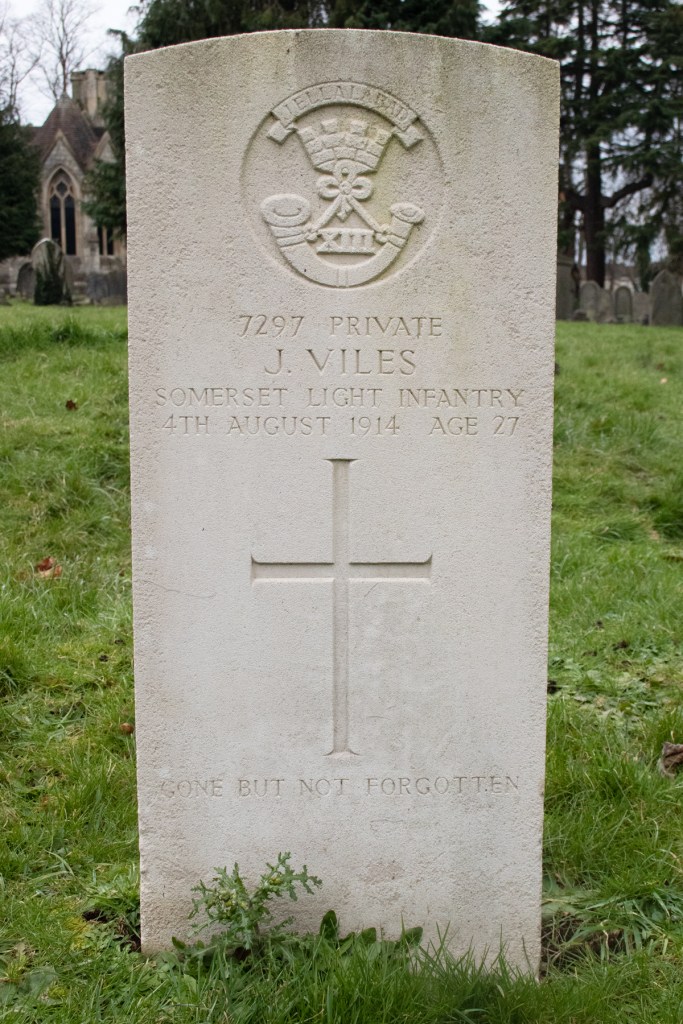
When he left school, Edward found work in the village as a basket maker, and this is a trade he continued in until war broke out. He enlisted early on, and was assigned to the Somerset Light Infantry as a Private.
His battalion was shipped to India in October 1914, but records are sparse, and it is not clear whether Private Foster also set sail. All that can be confirmed is that he was at home on 21st December 1914, as this is where he sadly passed away from heart failure. He was just 27 years of age.
Edward Foster was laid to rest in the graveyard of St Peter’s Church in his home village, North Newton.
John Thomas Holland was born in 1883 in Tunstall, Staffordshire, and was the son of Jane Holland. Sadly, neither name was uncommon in that area at that time, so it is a challenge to determine any further information about his early life.
John was 31 years old when war broke out and, while his service records no longer exist, he enlisted early on, joining the North Staffordshire Regiment as a Private. He was assigned to the 8th Battalion, and was soon billeted in Weston-super-Mare, Somerset.
Sadly, the next information available for Private Holland is a coroner’s report in a local newspaper.
Considerable mystery was associated with the evidence given before Mr Craddock, at the inquest… concerning the death of Private John Holland… now billeted in the town. Deceased was found killed on the railway line near Weston-super-Mare Station on Tuesday. The evidence revealed that Holland left his billet at 8:15am on that day, and announced that he was going to see a doctor. His body was found down the line at 12:30, the legs having been severed. From enquiries, it transpired that Holland had walked along a slip of garden fringing the line at a distance of about two miles from his billet. It was stated that deceased was of sober habits, and that he bore a good character. A verdict of Accidental Death was returned.
Shepton Mallet Journal: Friday 8th January 1915
Private John Thomas Holland died on 29th December 1914: he was 31 years of age. He was laid to rest in Weston-super-Mare’s Milton Road Cemetery.
Bert Mayled was born in the autumn of 1889, the fourth of four children – all boys – to Benjamin and Anna Mayled. Benjamin was a butcher from Somerset, who raised his young family in the seaside town of Weston-super-Mare.
The whole family followed in Benjamin’s trade, with all four siblings supporting in one way or another, either through farm work or, in Bert’s case, becoming a butcher as well.
On 6th July 1914, Bert married Catherine Swearse, a builder’s daughter from nearby Axbridge. They married in Catherine’s local church, but settled – albeit briefly – back on the coast.
Bert may even have enlisted by the time of the wedding. While he is noted as a butcher on the marriage banns, within weeks war had broken out across Europe, and he found himself in the North Somerset Yeomanry.
Private Mayled’s regiment was one of the first into the fray – he was soon on the Front Line at Ypres. He was wounded early on, and medically evacuated to England for treatment. Admitted to the 2nd Western General Hospital in Manchester, he succumbed to tetanus, contracted from his wounds. He died on 25th November 1914, at just 25 years of age.
Bert Mayled was brought back to Weston-super-Mare for burial. He lies at rest in the Milton Road Cemetery there.
Gilbert Metters was born in Linkinhorne, Cornwall in March 1885, one of four children to William and Emma Metters. William was a farmer and haulier who moved his family to Chudleigh in Devon not long after Gilbert was born.
When Gilbert left school, he found work as a domestic gardener. By the time of the 1911 census, he was living with his parents, younger sister and Emma’s sister in Old Way, not far from the village centre. On 17th April 1914, William passed away, leaving Emma widowed.
When war broke out, Gilbert was one of the first from the town to sign up. He enlisted in the 8th Battalion of the Devonshire Regiment, and was soon off to Hampshire for training. Tragically, within weeks of arriving, Private Metters contracted tuberculosis, and passed away in the camp hospital. He was 29 years of age, breathing his last on 4th November 1914.
Gilbert Metters’ body was brought back to Chudleigh for burial, and was laid to rest alongside his father in the family grave.
The local newspaper reported on Gilbert’s funeral. It suggested that when enlisting “although not one of the strongest, he managed to pass the medical test.” It went on to say that:
He always assisted in every good cause in the town, and was very highly respected. He endeared himself with the officers and men of C Company.
Clifford Day was born on 27th November 1897 in Weston-super-Mare, Somerset. He was one of eleven children to John and Sophia Day. John initially worked as a general labourer for a stonemason, but by the time of the 1911 census, he had begun working for a gas company. The family, at this point, were living in a five-room house a short distance from the town centre.
Living in a large household, a dream of escape may have fermented in young Clifford’s mind. To see some of the world, he joined the Royal Navy on 3rd September 1913. Given he was only fifteen, he was too young to formally enlist, but he was given the rank of Boy, and set to work.
Clifford’s service papers confirmed that he stood at 4ft 11ins (1.48m) tall, had brown hair, brown eyes and a fresh complexion. It was also noted that he had a scar on his forehead.
Boy Day’s service began on HMS Impregnable, where he spent nine months learning the ropes. He moved on to HMS Gibraltar in May 1914, before transferring to HMS Vivid – the shore-based establishment in Devonport – at the outbreak of the First World War.
On 3rd October 1914, Clifford was assigned to the battlecruiser HMS Tiger. He was on board for only three weeks, when he was taken back to HMS Vivid, and sent to the Naval Hospital there. He was admitted with a fractured skull, sadly passing the next day – the 26th October 1914 – at the age of just 16 years old. I’ve been unable to locate any further information about his injury, other than that an inquest found that it was accidental death.
Clifford Day was brought back to Weston-super-Mare for burial. He was laid to rest in the Milton Road Cemetery in the town.