Tag Archives: 1915

Petty Officer 1st Class Samuel Bailey

Petty Officer 1st Class Samuel Bailey

Samuel Inkerman Bailey was born in the summer of 1861 in Bath, Somerset. The youngest of five children, his parents were James and Mary Bailey. James was an ostler, or groom, but he died in August 1862, when his son was barely a year old.

Mary was left a widow, with a young family to raise and, as so many women in her position did in Victorian Britain, she remarried. She wed tailor Robert Lankesheer, a widower with four children of his own. The couple went on to have three further children – three half-siblings to Samuel.

While the 1871 census suggests that Robert welcomed Mary’s youngest into the family home, it seems that things were not so comfortable for Samuel. On 22nd May 1878, he enlisted in the Royal Navy, destined for a life at sea. He was only 16 years old at this point – although, interestingly, his service records give his date of birth as 27th March 1862. They also note that he was 5ft 2.5ins (1.59m) tall, with light brown hair, blue-grey eyes and a fair and fresh complexion.

As he was too young to formally enlist, Samuel was given the rank of Boy 2nd Class and sent to HMS Impregnable for training. Just over a year later, he was promoted to Boy 1st Class and, on 10th January 1880 he was given his first posting, on board the sloop HMS Dryad.

It was while Samuel was on board the Dryad that he came of age, and was officially inducted into the Royal Navy. He signed up for ten years service, and was given the rank of Ordinary Seaman 2nd Class. Samuel was certainly a dedicated young man: within three months he was again promoted, this time to Ordinary Seaman. He remained on Dryad until February 1884, by which time he had been promoted again, to Able Seaman.

Samuel ended up serving until 31st March 1900. During his time with the Royal Navy, he continued to distinguish himself, his character being noted as Very Good on each of his service reviews. He served on thirteen vessels, and was promoted through the ranks, to Leading Seaman (in August 1885), Petty Office 2nd Class (in January 1894) and Petty Officer 1st Class (in September 1897).

When he was stood down to the naval reserve, Samuel returned to Somerset. He found a job as a superintendent at the public baths in Bathwick and, on 15th April 1901, he married former housemaid and agricultural labourer’s daughter, Alice Clarke. As Samuel’s house came with his job, the couple set up home there, and went on to have five children: Samuel Jr, Emma, James, Alice and Joseph.

When war broke out, Samuel has been stood down from reserve status for more than two years. This did not stop him from stepping up to play his part again, however, and as Petty Officer 1st Class, he took up a training role at HMS Victory, the Royal Naval Dockyard in Portsmouth. He served for just over fourteen months, before he became ill, passing away from intestinal disease – which an inquest identified as ptomaine poisoning – at the city’s Royal Naval Hospital. He was 54 years of age.

Reporting on his death, the local newspaper recognised his fifteen years’ service at the public baths, as well as picking up on the fact that his unusual middle name was given to him in recognition of the death of his great uncle in the battle of that name during the Crimean War.

The same report outlined his dedicated naval career, although not always being correct with all of the details. It did note, however “two years or more on the Royal Yacht ‘Victoria & Albert,’ when used by Queen Victoria, a testament to the reliance placed in his trustworthiness.” [Bath Chronicle and Weekly Gazette: Saturday 16th October 1915] The then Able Seaman Bailey’s service records do note that he served aboard the Victoria & Albert, from 18th March to 11th May 1885, although whether the Queen sailed on her during this time is not known.

Samuel Inkerman Bailey was brought back to Somerset for burial. He was laid to rest in the Smallcombe Vale Cemetery in Bathwick, the community he had served for so long.


Petty Officer 1st Class Samuel Bailey
(from ancestry.co.uk)

Private William Fey

Private William Fey

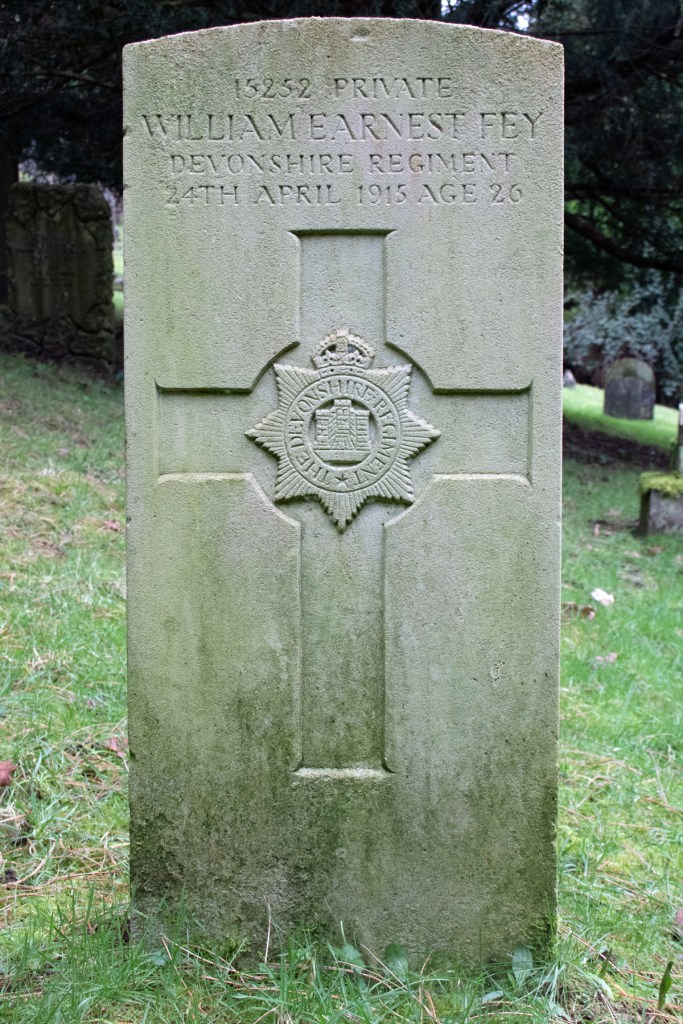
William Ernest Fey was born in Harburton, Devon, in the spring of 1889. The oldest of eight children, his parents were John and Margaret Fey. John was a farm labourer and, when he left school, William also took up work on the farm. By the time of the 1911 census he was listed as a horseman.

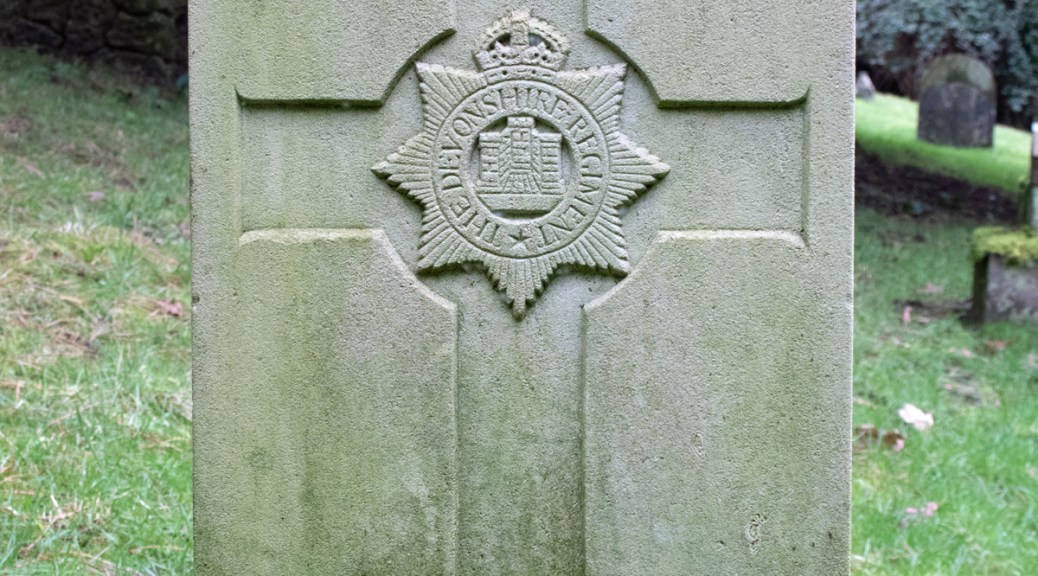
When was came to Europe, William was one of the first to step up and play his part. He enlisted in the Devonshire Regiment in the autumn of 1914, and was assigned as a Private in the 10th (Service) Battalion.

For part of his training, he was billeted in Bath, Somerset, and it was here, in April 1915, that he contracted meningitis. Private Fey was admitted to the city’s Red Cross Hospital, but the condition was to prove too much. He passed away on 24th April 1915, aged just 26 years of age.

Financial restraints may have limited John and Margaret’s ability to bring their boy back to Devon. Instead, William Ernest Fey was laid to rest in the quiet and picturesque Smallcombe Vale Cemetery on the outskirts of the city where he died.


Second Lieutenant Eric Guillebaud

Second Lieutenant Eric Guillebaud

The death occurred on Thursday of Mr Eric Cyril Guillebaud. Deceased was the youngest son of the late Rev. ED Guillebaud, Rector of Yatesbury, near Calne. On the outbreak of war he joined the Army, and was given a commission in the 11th (Service) Battalion of the Worcestershire Regiment. His physical strength not being equal to his patriotic zeal, he broke down under the strain of military duty. He came to rest at Combe Royal, Bathwick Hill, where his brother, Mr H Guillebaud, resides, but on medical advice entered a nursing home. Mr Guillebaud was 22 years of age. He was officially invalided from the Army six weeks ago. Deceased was a nephew of the late Mr Charles Marshall, of The Sycamores, Bathford, and the interment will take place in the churchyard there on Tuesday next.

Bath Chronicle and Weekly Gazette: Saturday 5th June 1915

Little further information is available on the life of Eric Guillebaud. The 1901 census confirms that he was living at The Rectory in Yatesbury, with an extended family: his parents, Reverend Erneste and Mabel Guillebaud; his maternal grandfather, William Marshall; his maternal uncle, Charles; and his cousin, William. The family also employed four servants: a nurse, cook and two housemaids.

There is no information relating to Eric’s military service, although it is clear from his headstone that he reached the rank of Second Lieutenant. His troop – the 11th Battalion of the Worcestershire Regiment – was based on Salisbury Plain and, from subsequent reports, uniforms and equipment were not provided until the spring of 1915: everything up to then was improvised.

The 11th Battalion did not leave for France until September 1915, three months after Eric’s passing: he would not, therefore, have seen any action overseas.

The only other document relating to Second Lieutenant Guillebaud is his probate record. This confirms that he died on 3rd June 1915 at 15 Somerset Place, Bath. His effects – totalling £5041 18s 10d – were left to his brother, Harold, who was listed as a gentleman.

Eric Cyril Guillebaud was 32 years old when he died. He was laid to rest in the graveyard of St Swithun’s Church, Bathford.


Major Francis Dickinson

Major Francis Dickinson

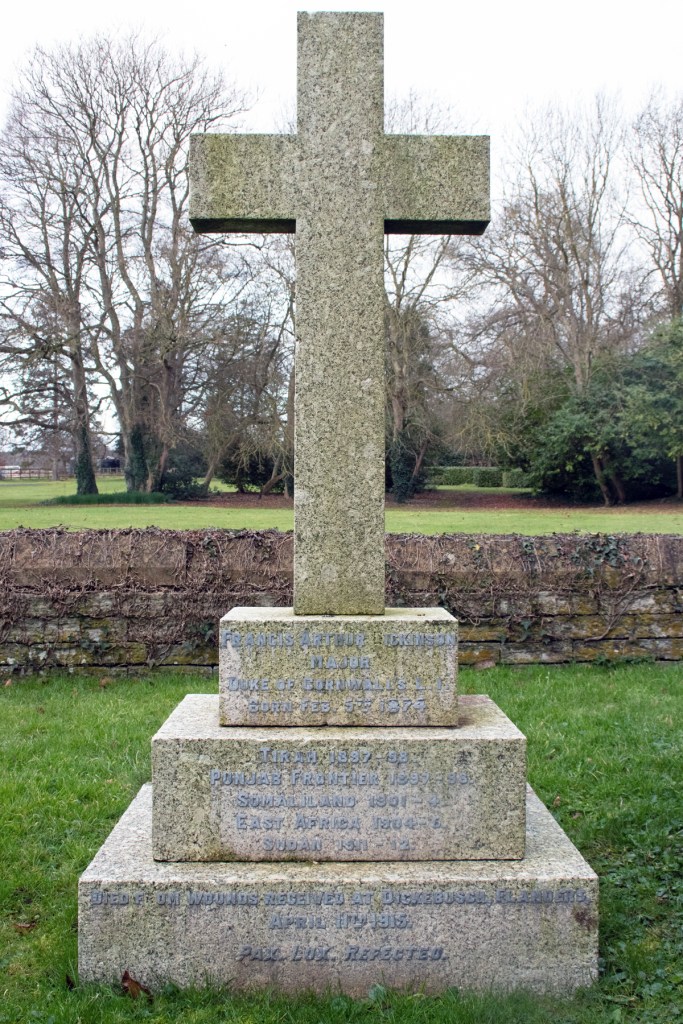
Francis Arthur Dickinson was born on 5th February 1874 in Lufton, near Yeovil, Somerset. The elder of two children, his parents were banker Arthur Dickinson, and his wife, Alice.

Francis was drawn to a military life. The 1891 census lists him as an army student at a boarding school in Cornwall, and by the end of the decade, he had enlisted in the Duke of Cornwall’s Light Infantry.

Over the next fifteen years, Francis served around the world, fighting in India, South and East Africa and in the Middle East. By the end of his term of service, he had risen to the rank of Major. During this time, he had been awarded a number of decorations, and had been mentioned in dispatches twice for his gallantry.

On 23rd July 1914, Francis married Clare Phipps, the daughter of a man of private means from Dilton Marsh, near Westbury, Wiltshire. The couple married in Clare’s home village, but set up residence in the Dickinson family home in Kingweston, Somerset.

When war was declared in 1914, the newlyweds were on their honeymoon. Francis returned to the army and was offered the rank of Colonel, but turned it down, in order to return to the Duke of Cornwall’s Light Infantry. He soon found himself in the thick of things again, and was caught up in the fighting at Mons, Marne, Aisne and Messines.

In April the following year, Major Dickinson was wounded. Evacuated to a camp hospital in Boulogne, he was not to survive his injuries this time round. He passed away at the hospital on 11th April 1915, at the age of 41 years old.

Due to the masses of servicemen being killed, a decision had been taken by the government of the time to not repatriate the dead to Britain, but to bury them in cemeteries close to where they fell. However, whether because of his family’s connections, or because he passed on the Channel coast, Major Dickinson’s body was, in fact, brought back to Somerset.

Francis Arthur Dickinson was laid to rest with full military honours in the graveyard of All Saints’ Church. He was buried alongside other family members, and in the shadow of the family manor.


Major Francis Dickinson
(from findagrave.com)

Farrier Ernest Rowsell

Farrier Ernest Rowsell

Ernest Rowsell was born in the spring of 1894, in the Somerset town of South Petherton. One of nine children, his parents were John and Bessie Rowsell. Builder and wheelwright John had been married before Bessie, and Ernest had five half-siblings as well.

When Ernest left school, he found work with a blacksmith – presumably, a connection made through his father. In his spare time, he joined the West Somerset Yeomanry, building on his skills and training.

War came to Europe in 1914, and it was a natural progression for Ernest to play his part, He formally joined the regiment he had previously trained with, enlisting on 24th September 1914. Given the rank of Farrier, Ernest was sent to a camp in Minehead for training.

His service records show that he was 5ft 3ins (1.6m) tall, had good vision and was of good physical development. Something came up during the medical examination, however, which was held on 1st February 1915. Farrier Rowsell was deemed medically unfit for army service and discharged.

Ernest returned home, but, whatever the condition was, it was to swiftly get the better of him. He passed away at home on 13th February 1915, at the age of just 21 years old.

Ernest Rowsell was laid to rest in South Petherton Cemetery, a short walk from where his parents lived.


Driver William Moore

Driver William Moore

William Hearn Moore – who became known as William Ernest Moore – was born in Churchstanton, Devon, in the summer of 1883. His mother, Mary, was only eighteen at the time but, when she married Henry Westcott in August 1891, he treated William as his own.

Henry found work as a coachman in Ilminster, Somerset, and, when he left school, William took on work as a gardener. In October 1903, he married carter’s daughter Charlotte Tucker: the couple set up home in the centre of the town, and went on to have three children – Gladys, Ethel and Henry.

William was working as a foreman for the Chard Lace Company when war broke out. While his full service records are lost to time, it is clear that he enlisted in the Royal Engineers, and was given the rank of Driver.

Driver Moore was in Aldershot, Hampshire, by the autumn of 1915, when he fell ill. He contracted cerebrospinal meningitis, a condition which took his life on 18th October 1915. He was just 32 years old.

William Ernest Moore was brought back to Somerset for burial. He was laid to rest in the cemetery in Ilminster, where Charlotte and the family were still living.


With three children to raise, Charlotte married again, to a William Dean, on 21st October 1916. They did not have children of their own and lived in Chard. Charlotte passed away in the winter of 1941, at the age of 57 years old.


Leading Stoker Ernest Brown

Leading Stoker Ernest Brown

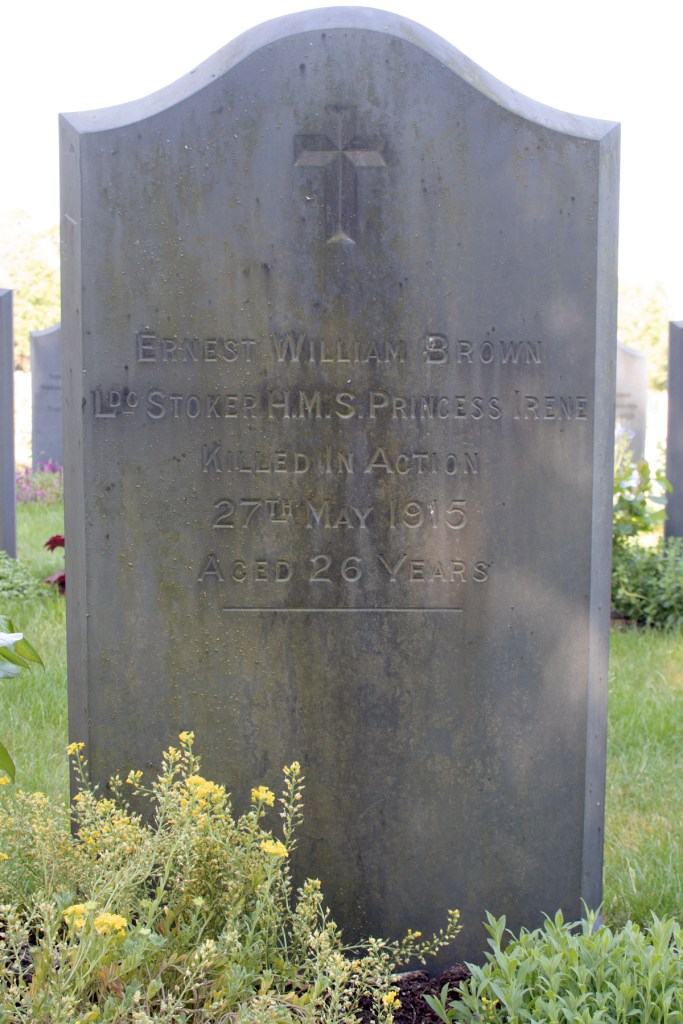
Ernest William Brown was born on 5th April 1889 in Halstead, Essex. One of twelve children, his parents were carpenter Edward and silk weaver Elizabeth Brown.

Ernest initially found work as an errand boy, then as a house painter. He wanted bigger and better things, however, and the Royal Navy offered him that opportunity. He enlisted as a Stoker 2nd Class on 12th March 1908 for a period of twelve years’ service.

Ernest’s early service records are lost to time, but he received a promotion to Stoker 1st Class on 12th March 1909, exactly a year after a joined up. At this point he was assigned to the dreadnought battleship HMS Russell, on board which he served until August 1912.

After a short period at HMS Pembroke, the Royal Naval Dockyard in Chatham, Kent, Stoker 1st Class Brown was transferred to the Apollo-class cruiser HMS Iphigenia. She was to be his home for the next two-and-a-half years, during which time he was promoted again, this time to Leading Stoker.

Returning to HMS Pembroke in March 1915, this was to be his shore base for the next couple of months. On 27th May, Leading Stoker Brown was helping out on the steamer Princess Irene. Tragically, while on board an explosion ripped through the ship, while moored off Sheerness, Kent and he was one of the 352 souls killed. He was just 26 years of age.

Ernest William Brown was laid to rest in the Woodlands Cemetery in Gillingham, Kent. His body having been identified, he was given his own grave, unlike those who were buried in a mass grave nearby.


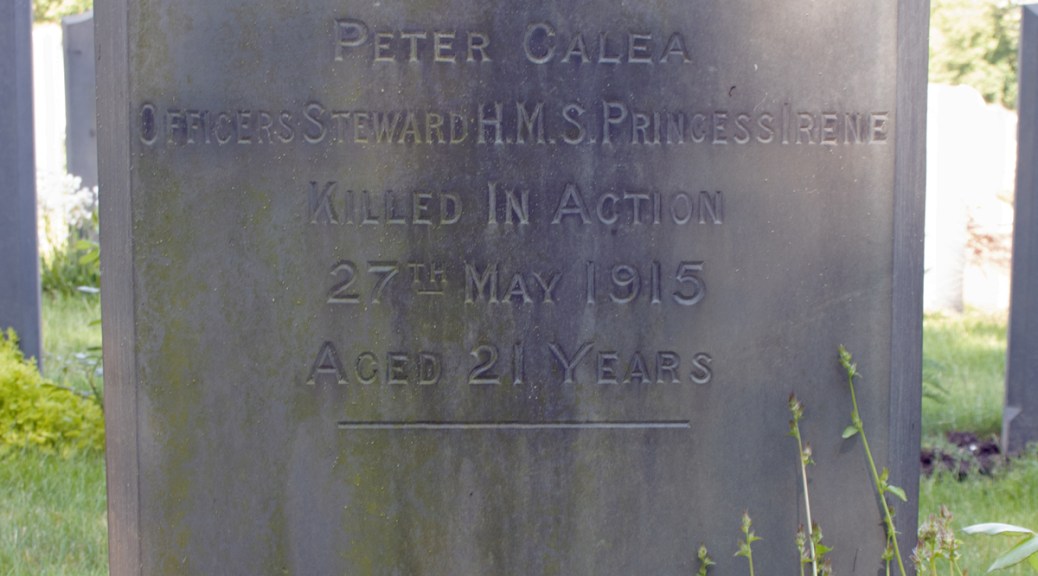
Officers’ Steward Peter Galea

Officers’ Steward Peter Galea

Peter Galea was born in the Maltese town of Senglea on 25th August 1893. His mother’s name was Carmela, but there is little further concrete information about his early life.

What is clear is that Peter found employment by enlisting in the Royal Navy. He joined up on 2nd January 1912 as an Officer’s Steward 3rd Class. His service records show that he was 5ft 9.5ins (1.66m) tall, had brown eyes, black hair and a dark complexion.

Officer’s Steward Galea’s first assignment was on board the dreadnought battleship HMS Orion. He was to spend more than three years on board, although his continuous service was interrupted by three days spent in the cells in May 1913: unfortunately his misdemeanour is not recorded.

In February 1914, Peter was transferred to the Apollo-class cruiser HMS Thetis. She was to be his home for the next year, during which time war was declared across Europe. In March 1915, Officer’s Steward Galea was assigned to another ship, the ocean liner Princess Irene.

Tragically, Peter was on board when, on 27th May 1915, an explosion ripped through the ship, while moored off Sheerness, Kent and he was one of the 352 souls killed. He was just 21 years of age.

Peter Galea was laid to rest in the Woodlands Cemetery in Gillingham, Kent. His body having been identified, he was given his own grave, unlike those who were buried in a mass grave nearby.


Fireman John Donoghue

Fireman John Donoghue

In the naval section of the Woodlands Cemetery in Gillingham, Kent, stands a headstone to a John Donoghue. The stone states that he was a Fireman on board HMS Princess Irene and that he was killed in action on 27th May 1915. He was 25 years of age.

Further research confirms that he was part of the Mercantile Marine Reserve, but there are no records to confirm his service at sea. While John was born in around 1890, with no confirmation of his place of birth, or the names of his parents, it is impossible to narrow down any further details for him.

Records of the Princess Irene’s crew do not include a John Donoghue, although this does not necessarily mean that he was not serving on board, only that records no longer exist. The fact that he was granted an individual headstone, rather than being commemorated in the mass grave that is also situated in the Woodlands Cemetery suggests that his body was able to be identified.

Sadly, however, Fireman John Donoghue’s life is destined to be lost to time, his legacy to be one of the 352 souls lost during the explosion and sinking of the ship on board which he served.


Private James Jones

Private James Jones

James Ward Jones was born on 17th August 1871 in the Denbighshire town of Llangollen. He was the oldest of eleven children to William and Anne Jones. William was a bricklayer’s labourer, and James followed suit when he finished school.

On 30th April 1898, James married fisherman’s daughter Mary Jones. The couple set up home in Llangollen and went on to have ten children.

When war came to Europe, James stepped up to play his part for King and Country. Sadly, little detail of his military service remains available. but it is clear that he enlisted in the Royal Welch Fusiliers and, as a Private, he was assigned to the 47th Provisional Battalion. The troop was based on home soil, and James found himself sent to Norfolk for his war work.

It is unlikely that Private Jones was in camp for long. On Christmas Day 1915 he collapsed having had a seizure, and passed away. He was 44 years of age.

James Ward Jones’ body was brought back to Wales for burial. He was laid to rest in the graveyard of St John’s Church in his home town of Llangollen.


Mary was left with ten children to bring up on her own. She married again, to a Jack Evans, in the autumn of 1916. The couple had two children of their own. Mary passed away in December 1935, aged just 58 years old.