John Henry Saunders was born at the end of 1899, in the West Sussex village of East Preston. One of five children, his parents were agricultural labourer John and his wife Louisa. John Sr sadly passed away in 1904, when his son was just 4 years old.
Louisa went on to marry again in 1909, to a man named Charman. While no marriage records remain, it seems that he might have been a widower. The 1911 census finds Louisa living in Worthing with her four surviving children (her eldest, Lilian, having passed away earlier in the year), a stepson of 16 and new babe-in-arms.
With the outbreak of war in 1914, John looked to do his part. Sadly, his military records are not available, but what is clear is that he joined the Cavalry Regiment at some point after September 1917. He was assigned to the 3rd Reserve Regiment, which trained men for the Dragoon Guards, and Northamptonshire, Surrey and Sussex Yeomanry units.
Sadly, Private Saunders’ time in the armed forces was limited. He was admitted to the Military Isolation Hospital in Aldershot and, while it is not clear what the admission was for, it seems likely that he was moved from the main hospital because of a contagious condition like tuberculosis or pneumonia.
John Henry Saunders’ time in hospital was brief. He passed away on 16th March 1918, aged just 18 years of age. His body was brought back to Worthing, and he was buried in the Broadwater Cemetery to the north of the town.
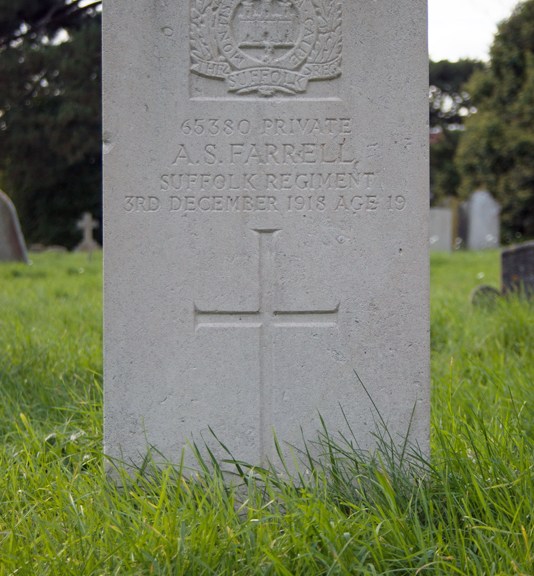
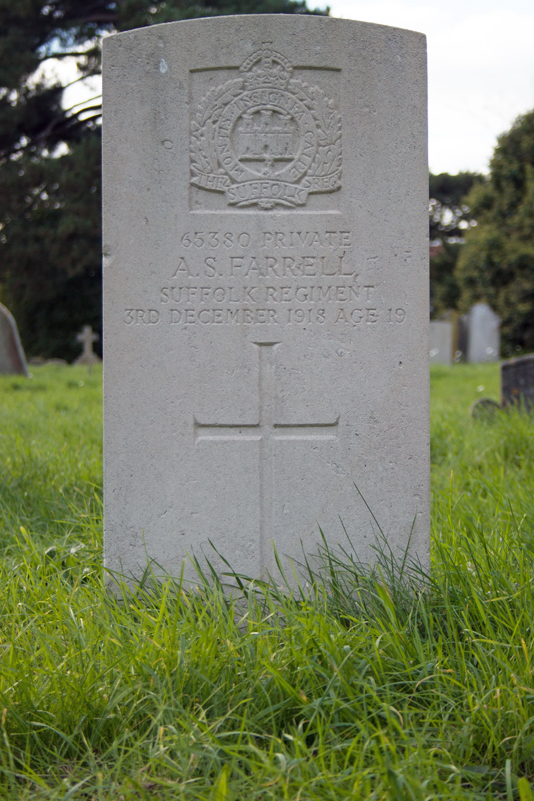
Albert Sydney Farrell was born in Mayfield, East Sussex, in the summer of 1899. One of four children his parents were gardener and coachman Arthur Farrell and his wife, Sarah Ann. Arthur had been born in Findon, a village to the north of Worthing, and is was to this town that he returned with his family. By the time of the 1911 census, when Albert was listed as a schoolboy, they were living in a small cottage within spitting distance of the sea.
Because of his youth, there is little further documentation on Albert’s early life. The war was coming, however, and he wanted to do his part. Dates cannot be confirmed, but he enlisted later in the conflict, at east before June 1918.
Private Farrell joined the Suffolk Regiment, and was assigned to the 1st (Reserve) Garrison Battalion. He would have carried out guard, escort and other similar duties from where he was based on the Isle of Grain in Kent.
Towards the end of the conflict, Albert fell ill; he was admitted to the Military Hospital in Sheerness, but sadly passed away on 3rd December 1918. He was just 19 years of age.
Albert Sydney Farrell was brought back to Worthing; he lies buried in the Broadwater Cemetery to the north of the town.
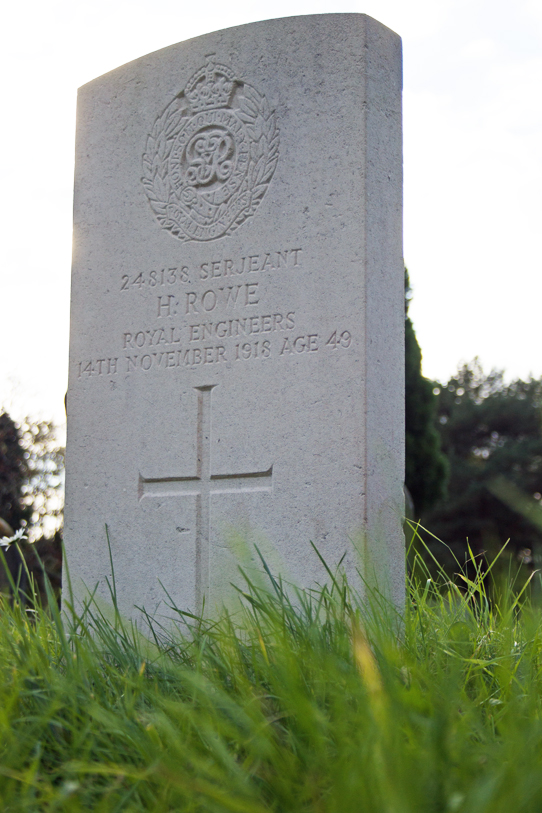
Henry Samuel Rowe was born in Shoreditch, London, on 18th August 1873. He was one of three children to Henry and Amelia Rowe. Henry Sr was a stonemason, who died in 1876, when Henry was only three years old.
Amelia moved her and her children to the Sussex Downs, and married again in 1883. Her new husband was John Herrington, and the couple went on to have three further children, Henry’s half-siblings. John was a farm labourer, and his stepson followed in his footsteps when he left school.
Henry soon sought other accomplishments, however, and, in October 1895, he joined the King’s Royal Rifles. During his twelve years’ service, he travelled the world, from Mauritius, to India, South Africa to Sri Lanka. He returned home in December 1903 serving on home soil until the end of his contract in 1907.
On 23rd April 1905, he married a widow, Amelia Routledge, in Brighton. There is no confirmation of the couple going on to have children.
Once demobbed, Henry found employment with the railways, and, by the time of the 1911 census, was working as a signalman. The document records him as boarding in a house in the village of Rudgwick, near Horsham; Amelia, meanwhile, was lodging with a family in South East London.
War was on the horizon, and, in August 1914, Henry volunteered. His time with the King’s Royal Rifles, stood him in good stead; after initially enlisting as a Private in the Royal Sussex Regiment, he was quickly promoted to Corporal and, by November 1914, had transferred to the Royal Engineers and attained the role of Sergeant.
Henry had spent just over a year in France, when he was shot in the right arm on 18th July 1916. Medically evacuated to England, he spent three months recuperating, before heading back into the fray in October the same year.
Henry served another eighteen months on the Front Line, before being admitted to hospital. His medical admission records show that he was suffering from “tremulous speech, confused… conversation, transitory admissions [sic?] of a grandiose type, outbursts of excitement, says he is a man of importance, childish, facile, simpleminded…” His condition was recorded as General Paralysis of the Insane (GPI), more commonly known these days as shellshock, and he was medically discharged from the Army on 4th September 1918.
Sadly, at this point Sergeant Rowe’s trail goes cold. He seems to have been hospitalised following his discharge, but the documents give conflicting suggestions about where he was admitted. Amelia was still living in South London, one record suggests Henry was in the Welsh Metropolitan Hospital in Whitchurch, near Cardiff. But, as he was buried in Worthing, West Sussex, it seems unlikely that he remained in Wales.
The cause of Henry’s passing is not evident either. There is no confirmation that GPI was to blame, but nothing to suggest it was not either. Whatever the cause, Sergeant Rowe died on 14th November 1918, three days after the conflict to which he had given so much had been brought to a close. He was 49 years old.
Henry Samuel Rowe lies at rest in the Broadwater Cemetery in Worthing, West Sussex.
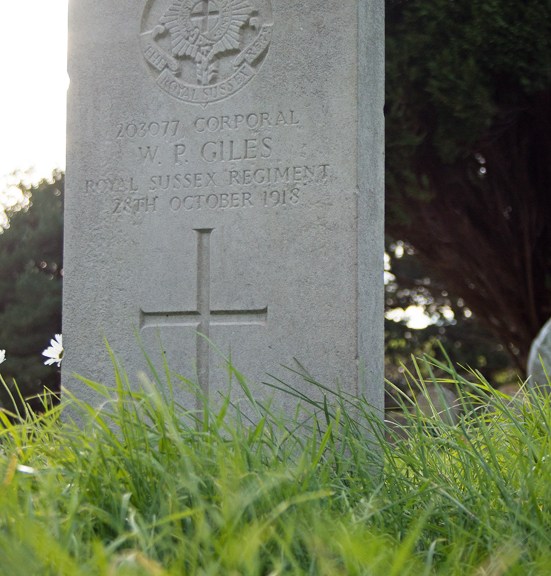
William Percy Giles was born in the autumn of 1879, in the West Sussex town of Storrington. His father was also called William, and his mother was Esther. William Sr was a carpenter, and this was to be a trade that his son followed him into.
In 1905, William married a woman called Ellen; the young couple moved to the seaside town of Worthing, and went on to have a son, Frederick, two years later. William, by this time, was working full time as a carpenter.
War was on the horizon and, while full service details are not available, it is clear that William joined the Royal Sussex Regiment at some point before March 1918. He was assigned to the 4th Battalion, though no further details of his time in the army remain, other than the fact that he reached the rank of Corporal during the conflict.
In the autumn of 1918, Corporal Giles was admitted to the 2nd East General Hospital in Brighton, suffering from nephritis. Sadly, he was to succumb to the condition, and he passed away on 28th October 1918. He was 40 years old.
William Percy Giles’ body was brought back to Worthing for burial. He lies at rest in the Broadwater Cemetery, not far from where his widow and son were living.
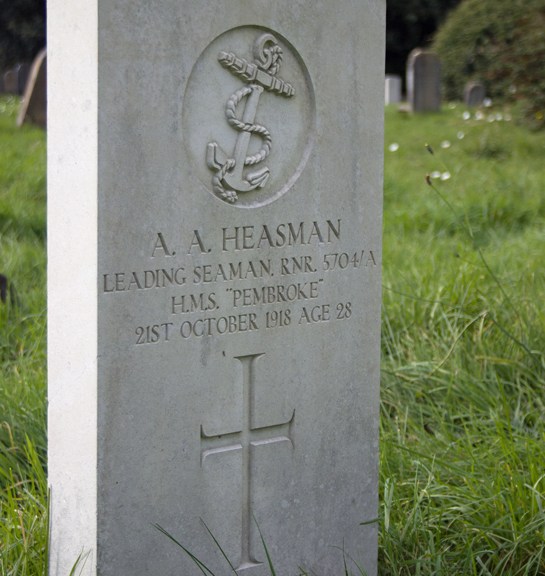
Albert Andrew Heasman was born in 1890 or 1891, and, like his date of birth, much of his life remains a mystery. He was one of five children to William and Kate Heasman, who brought their family up in the West Sussex town of Worthing.
Documentation on Albert is scarce. He does not appear on census records until 1911, by which time he is working as a mate on a fishing boat, based out of Ramsgate, Kent.
Naval records are also patchy; he certainly enlisted during the war, and, by 1918 had joined the Royal Naval Reserve. He was assigned to HMS President III, a training ship based at the Royal India Dock in London.
The only other concrete information available on Leading Seaman Heasman is that he passed away from pneumonia on 21st October 1918. He was just 28 years old. His pension record confirms that his sister, Ethel, was listed as a dependent.
Albert Andrew Heasman’s body was brought back to Worthing, where he lies buried in the Broadwater Cemetery, to the north of the town.
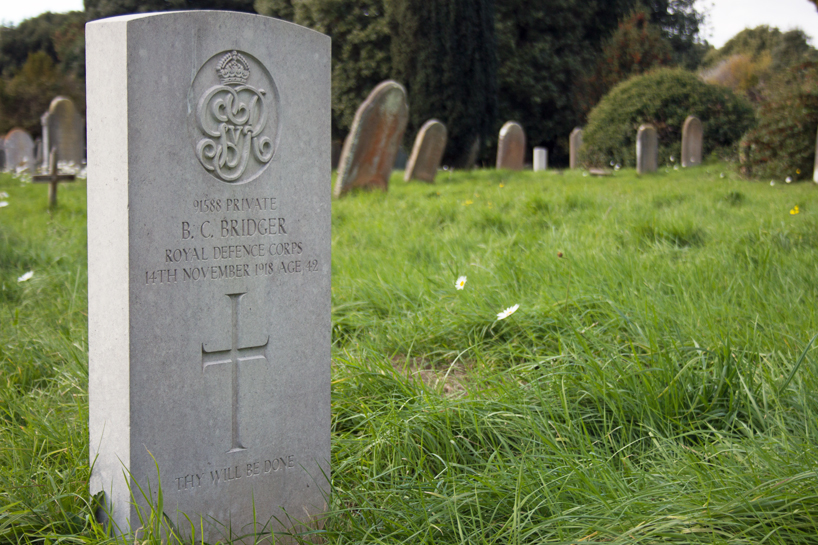
Bertie Charles Bridger was born in the summer of 1876, one of nine children to William and Anne. William was a carman for the railway, and the family lived close to the central station in Worthing.
When Bertie left school, he followed in his father’s trade and, by the time of the 1901 census, was working as a groom and carman alongside his father and older brother, Arthur.
Bertie came to the notice of the local court when, in February 1900 he was called up to the Petty Sessions. He was fined for ‘cruelly ill-treating a horse by working it into an unfit state’ [Sussex Agricultural Express: Friday 9th February 1900], and ordered to pay a total of 18 shillings.
In the spring of 1904, Bertie married Ethel Gray, a carpenter’s daughter from Essex, who had found employment as a parlour maid for a Worthing solicitor. The couple would go on to have two children, Bertie Jr, who as born in 1905, and Leonard, born seven years later.
By the time of the 1911 census, the young Bridger family were living near the main railway station in a two-up, two-down property, where Bertie Sr was still plying his trade as a carman at the station.
War was coming, however, and in the summer of 1915, Bertie enlisted in the Royal Defence Corps. He was assigned as a Private to the 452nd Protection Company and, while his exact duties remain unclear, it is likely that he would have been involved with horses at some level, given his experience.
Private Bridger’s service appears to have mainly been spent on home soil, although, towards the end of the conflict he was sent to Ireland. It was while he was there, that he came down with influenza, which then turned into pneumonia. He was admitted to the Military Hospital in Curragh, but he died of the conditions on 14th November 1918, three days after the Armistice was signed. He was 42 years old.
The body of Bertie Charles Bridger was brought back to Sussex, and he was laid to rest in the Broadwater Cemetery to the north of Worthing. The local newspaper commented that:
Previous to his enlistment the deceased soldier was an outside porter at the Railway Station for nearly thirty years, and the sympathy of a wide circle of friends will be extended to his widow and two children.
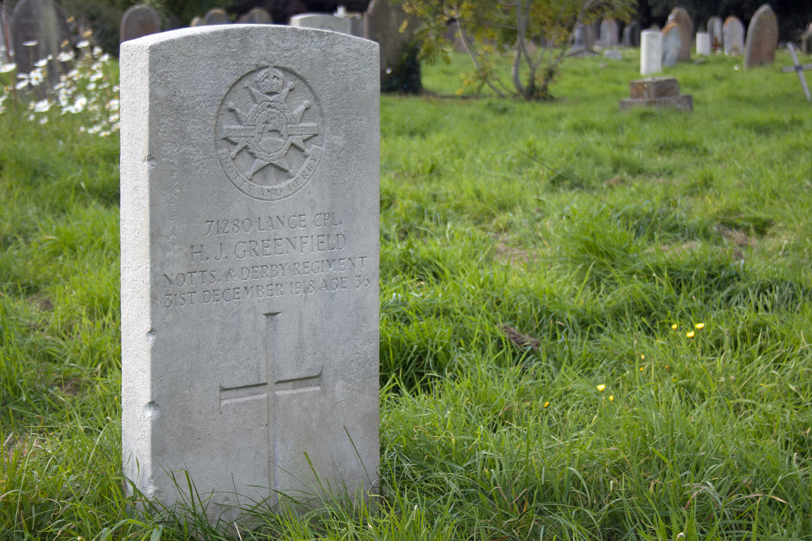
Henry James Greenfield was born in Brighton, Sussex, in July 1878, one of at least seven children to William and Anne Greenfield. Henry’s parents were from Worthing, who seem to have worked their way along the coast to Brighton by the mid-1870s, when his older brother George was born.
William was a bootmaker and, by the early 1880s, had brought his family back to Worthing, where they remained settled.
At this point, it is harder to pinpoint Henry’s life, as documentation becomes scarce and, with Greenfield being a common name in Sussex at the time, it is challenging to confirm that anything written relates to this specific Henry James Greenfield.
There is a 1901 census with a Henry James Greenfield from Brighton on it: this lists him as an Able Seaman aboard HMS Ramillies moored in Valetta, Malta. However, given that the Henry buried in Worthing served with the army, rather than the navy, it seems unlikely to be the same person (although not impossible).
The next document that can by specifically linked to the grave is Lance Corporal Greenfield’s entry on the Army Register of Soldier’s Effects. In addition to giving his rank, this expands on his service during the Great War.
He joined the Sherwood Foresters (Notts and Derby Regiment) at some point before July 1918, and was assigned to the 2nd Battalion. While there is no confirmation of where he fought, his battalion served on the Western Front for the duration of the conflict.
Henry survived the war, but was admitted to a hospital in Leith, near Edinburgh, where he passed away from ‘sickness’ on 31st December 1918. He was 36 years old.
The document stated that his effects were distributed to his six siblings; this suggests that William and Anne had both passed away by this point, and also indicates that Henry himself had not married.
Henry James Greenfield’s body was brought back to Worthing; he is buried at the Broadwater Cemetery to the north of the town.
Henry Charles Forrest was born in Bromley, Kent, in the summer of 1893. The youngest of eight children to William and Wilhelmina Forrest, Henry’s father was a police sergeant, who retired not long after his youngest son’s birth, moving his family to Worthing in West Sussex.
Henry was obviously a bright lad; the 1911 census records him as a student teacher. The only one of William and Wilhelmina’s children still living at home, he was, by this point, still just 17 years old. His career continued over the next few years, and he taught at the Ham Road Schools in Worthing.
In the spring of 1916, Henry married Constance Robertson. The young couple had a lot in common and seemed like a perfect match. Constance was the daughter of a retired police constable, and was also a student teacher.
War, by this time, had come to Europe. Full details of Henry’s military service are not available, but it seems that he initially joined the Oxfordshire and Buckinghamshire Light Infantry. Private Forrest was promoted to the rank of Corporal, and subsequently transferred to the Army Cycling Corps, serving in France.
As the war moved on, Corporal Forrest was released to resume his teaching back in Worthing but, in the autumn of 1918, he contracted influenza and pneumonia. The conditions got the better of him, and he passed away on 5th December 1918, at the age of just 25 years old.
Henry Charles Forrest was laid to rest in the Broadwater Cemetery in Worthing; sadly, it seems that Constance was unable to attend – she was represented at the ceremony by her mother.
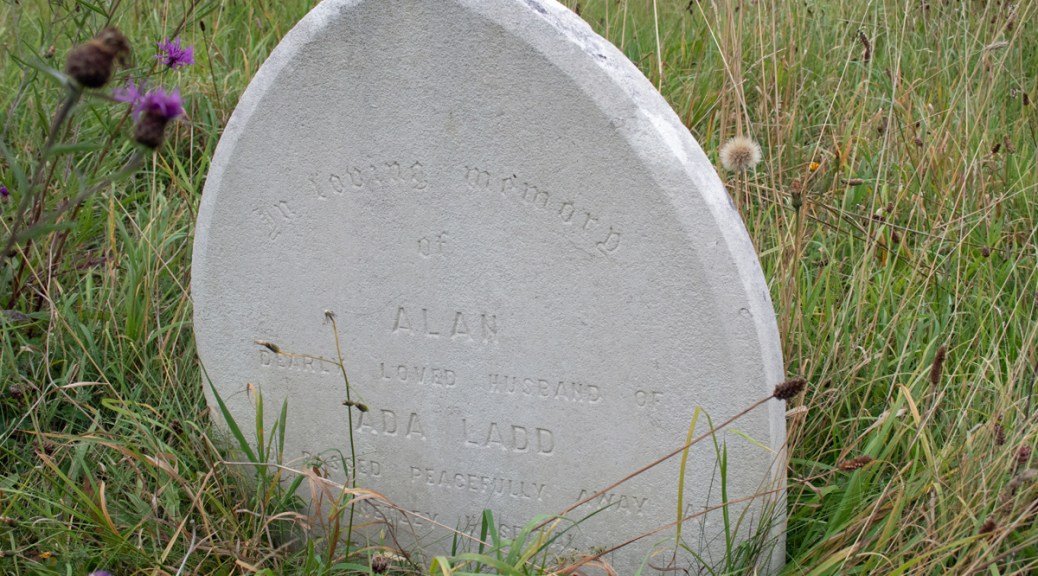
Alan Ladd was born in the summer of 1893, and was one of twins. His parents were plumber and gas fitter George Ladd and his wife Mary Ann, who was a midwife. The couple had eight children altogether, of whom Alan and his twin Arthur were the youngest.
George had been born in Exeter, Devon, and Mary Ann in Somerset, which is where they initially based their family. By 1887, however, they had moved to Berkshire, and were living in Knowl Hill, near Maidenhead, when their youngest four children were born.
The 1911 census found the family living in Dunster, Somerset, where everyone seemed to be bringing in a wage. George and Mary Ann had four of their children living with them, who were employed as an engine driver, grocer, baker’s apprentice and, in Alan’s case, a tailor’s apprentice.
War broke out in 1914, and, in November 1915, Alan enlisted. He joined the Royal Army Service Corps as a Private, and his enlistment papers showed he stood 5ft 5ins (1.65m) tall, and weighed in at 130lbs (59kg). He was stationed at the Corps’ Remount Department in Swaythling, Southampton and thus his military service was completed on the Home Front.
Shortly after enlisting, on 16th April 1916, Alan married Ada Westlake. She lived in the village of Long Sutton, near Langport in Somerset, and the couple married at the Wesleyan Methodist Chapel in Somerton. They do not appear to have gone on to have any children.
Further details of Private Ladd’s life are scant. What can be determined is that he was admitted to Netley Hospital in Southampton on 11th October 1918, having had symptoms of pneumonia for a few days. Sadly, his condition worsened, and Alan passed away just three days later, on 14th October 1918. He was just 25 years of age.
Alan Ladd was brought back to Long Sutton for burial. The war may have led him and Ada to adopt more of a Quaker way of life, as he lies at rest in the Friends Burial Ground on the outskirts of the town.
Ernest Charles Parsons was born in 1881, and was one of six children to bricklayer Robert Parsons and his wife Mary Ann. Robert was a labourer and bricklayer from Watford, while Mary Ann was born in Arundel, West Sussex. The couple moved to where his work was, having their first children in Hertfordshire and Sussex They finally settled in London, which was where Ernest was born.
Where he first left school, Ernest worked as a painter, but soon found a career as a postman., something he would continue to do through to the outbreak of war.
Ernest married Frances Olive Eynott on 28th February 1904; they went on to have a daughter, Doris, the following year. It seems, however, that their marriage was destined to be a short one; Frances passed away within a couple of years.
With a daughter to raise and a living to earn, Ernest married again. Elizabeth Kate Dew was born in Fulham in 1883, and the couple married in the spring of 1907. Again, however, their happiness was to be short; Elizabeth died eighteen months later.
Widowed twice, and with Doris now a toddler, Ernest moved back in with his parents in Chiswick. He continued his work as a postman, but alongside this had been an active volunteer in the London Regiment (Post Office Rifles) since early 1908.
Rifleman Parsons’ initial year’s service was extended and extended and, by the time of the outbreak of the First World War, had been serving for some six years.
By 1914, Ernest had found love for a third time, and married Lilian Frances Cromie on 25th March that year. With war imminent, his time was take up more with military duties; while part of the territorial force, Rifleman Parsons had been officially mobilised.
The sudden intermingling of men from different parts of the country in small, packed training camps made the perfect environment for illness and disease to circulate. Ernest had initially contracted bronchitis while on service in 1912; this had dogged him intermittently oved the next few years until, in March 1915, it was serious enough for the Medical Examination Board to declare him unfit for military service.
Ernest moved his family to Worthing, in West Sussex, presumably as the air was fresher there than in the bustling capital. He may also had had family in the area, as his mother had been born just up the road in Arundel. Sadly, though, it seems that his health was not to recover sufficiently, and he passed away on 4th October 1918, at the age of 37.
Ernest Charles Parsons was buried in the Broadwater Cemetery in the town, not far from where his widow and daughter were then living.
Coincidentally, when researching another soldier, Lance Corporal Edgar Godden, this turns out to be the address where he also died, just ten months earlier on 22nd December 1917. There is no apparent other link between the two men.