Tag Archives: brothers

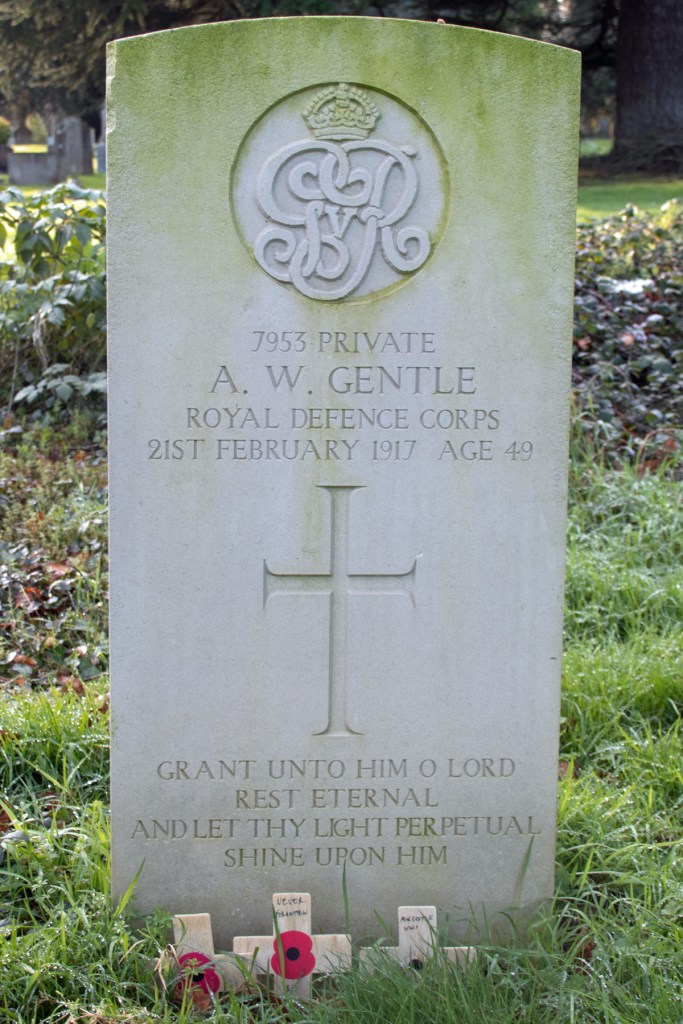
Private Arthur Gentle

Private Arthur Gentle

Arthur William Gentle was born in 1867 in Whitelackington, Somerset. The son of Maria Gillard, his father is not noted, although he was accepted as one of the family when Maria married Richard Gentle in 1873. The couple went on to have eleven children of their own, giving Arthur a large family of siblings.

Richard was an agricultural labourer, and this was a trade into which Arthur followed. On 23rd October 1897, Arthur married Mary Marsh, a labourer’s daughter from South Petherton. The couple tied the knot in her local church, the illiterate Arthur marking his intent with a cross.

The couple set up home just off Silver Street in South Petherton, and went on to have ten children of their own. The 1911 census recorded Arthur still employed as an agricultural labourer, his oldest son following suit, and Mary – who was also known as Polly – raising the family.

War came to Europe, and, despite his age, Arthur felt a need to play a part. While full service records are no longer available, what remains confirms that he had enlisted by the summer of 1916, and had joined the 300th Protection Company of the Royal Defence Corps.

Sadly, Private Gentle’s military career was to end in the same way as so many of his army colleagues. He contracted pneumonia during the winter of 1916, and passed away at home on 21st February 1917. He was 49 years of age.

Arthur William Gentle was laid to rest in the cemetery of his adopted home town, South Petherton.


Arthur’s brother Frank Gentle also fought in the Great War. Assigned to the 1st Battalion of the Somerset Light Infantry, he was caught up in the fighting in the Somme, and was killed on 14th July 1916. He was just 26 years of age.

Private Frank Gentle is commemorated on the Thiepval Memorial in Northern France.


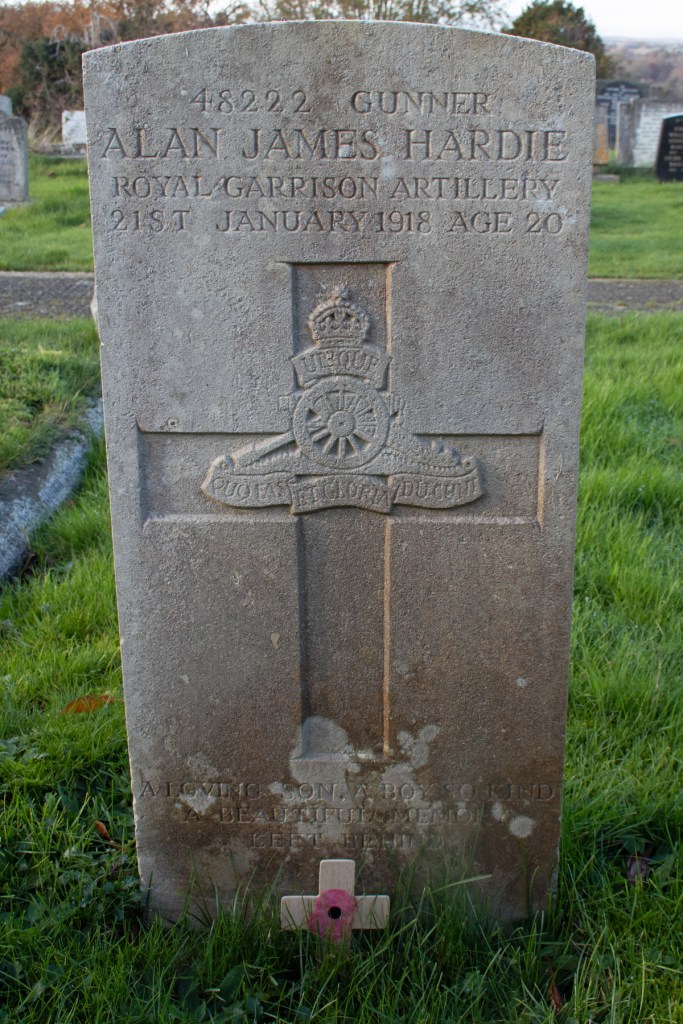
Gunner Alan Hardie

Gunner Alan Hardie

Alan James Howland was born in the spring of 1897 in Plymouth, Devon. One of nine children, his parents were pianist and musician Harman Howland and his Irish wife, Ellen.

The Howland family moved around as, presumably, Harman followed where his work was needed. The 1901 census records them living in Devonport: ten years later they had moved to Barnstaple. Alan, by this time, had left school and was working as an errand boy.

War came to Europe in 1914, and, at some point, Alan stepped up to play his part. Full details of his military service are no longer available, but from what remains it is clear that he enlisted in the Royal Garrison Artillery at some point before the summer of 1917.

Alan enlisted using his mother’s maiden name of Hardie, and was assigned to the 274th Siege Battery. His troop saw action at the Somme and Arras, and a later newspaper report confirmed that Gunner Hardie saw action overseas:

[He] had been previously wounded but was gassed and entered Leicester Hospital on November 2nd 1917.

Taunton Courier and Western Advertiser: Wednesday 30th January 1918

Gunner Hardie had been admitted to the 5th Northern General Hospital following his injury. He seemed to be improving, but developed pneumonia and the lung condition was to take his life. He passed away on 21st January 1918, at the age of just 20 years old.

Alan James Hardie/Howland was brought back to Somerset for burial. He was laid to rest in the cemetery of the town where his family now lived, Ilminster, Somerset.


Alan’s older brother, William Harman Howland, also fought in the First World War. He enlisted in the 1st Battalion of the Hertfordshire Regiment, also using his mother’s maiden name. Again, details of his service are sparse, and Private Hardie seems to have transferred to the Royal Army Service Corps at some point during his military career.

William passed away on 18th August 1918, while in Germany. The cause of his death is not clear, but he was 28 years old. He was laid to rest in the Ohlsdorfer Cemetery in Hamburg.


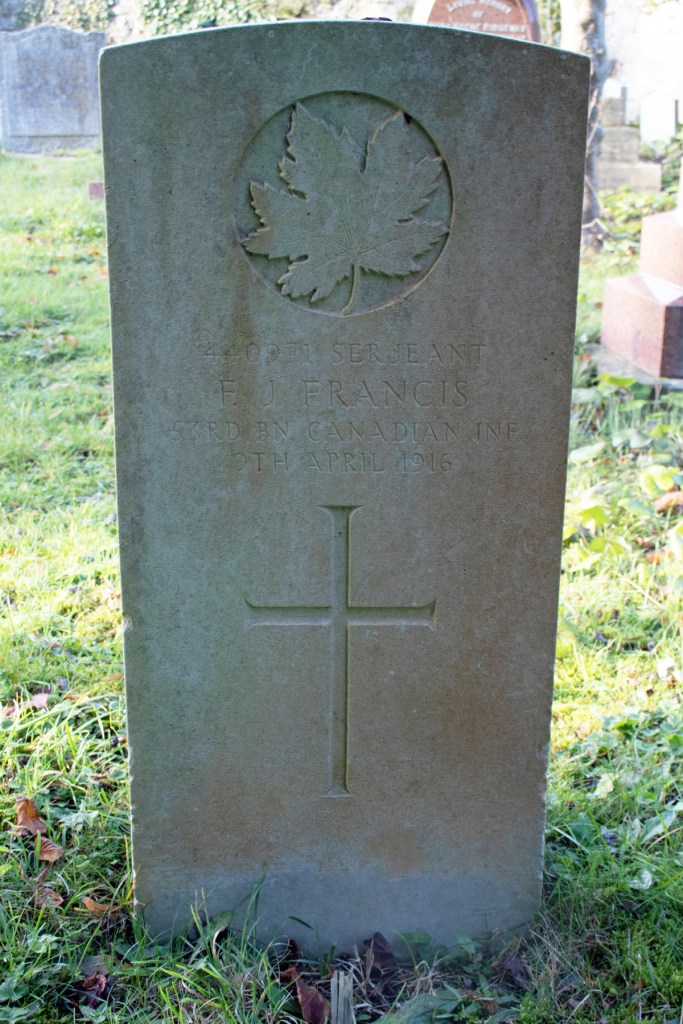
Serjeant Frederick Francis

Serjeant Frederick Francis

Frederick John Francis was born on 15th February 1893, to Henry and Mary Francis. One of nine children, the family lived in the Somerset village of Curry Rivel.

Henry was a labourer, but Frederick had his sights set on a new life and, at some point in his teens, he emigrated to Canada to work as a farmer. Details of his life in North America are scarce, but it is clear that he was in Manitoba when war broke out back in Europe.

Frederick stepped up to serve his King and Country, enlisting at Camp Sewell on 5th April 1915. His service records confirm that he was 5ft 5ins (1.65m) tall, and weighed 145lbs (65.8kg). He was assigned to the 53rd Battalion of the Canadian Infantry. His service papers also note that he was promoted to the rank of Sergeant on 30th April 1915, although whether the date is correct, or whether Frederick had previous military experience is unclear.

Sergeant Francis boarded the SS Empress of Britain to make the journey back to Europe, little knowing that he was not going to see his home again. On 9th April 1916, just one day from docking in Hampshire, he passed away from quinsy, or throat abscess. He was just 23 years of age.

The body of Frederick John Francis was brought back to Somerset for burial. He was laid to rest in the graveyard of St Andrew’s Church in the village of his birth, Curry Rivel.


Frederick’s younger brother, Charles, had also made a life in Canada. He enlisted at Camp Sewell just two months after his brother, joining the same battalion.

Charles, who had the rank of Private, arrived in Europe before Frederick and, and was sent to the front line in February 1916. In June, he was involved in the fighting at Mount Sorrel, on the Ypres Salient, and it was here, on 6th June 1916, that he lost his life. He was just 21 years of age.

Charles Arthur Francis is commemorated on the Menin Gate in Ypres. His parents had to mourn the loss of two sons within two months.


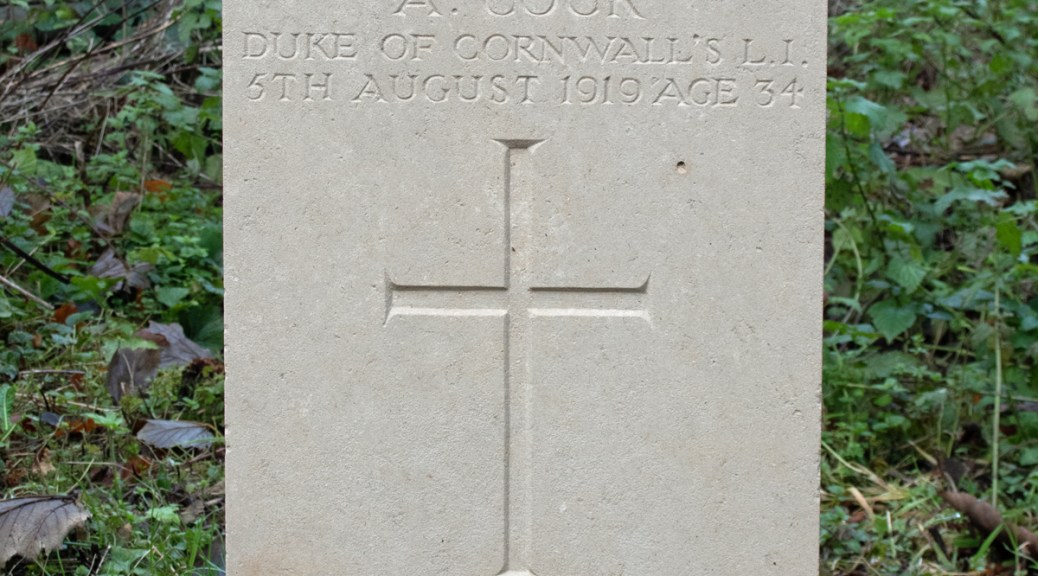
Private Arthur Cock

Private Arthur Cock

Arthur Cock was born in around 1885 in Wadebridge, Cornwall. One of eleven children, he was the son of mortar mason William Cock, and his wife, Louisa.

When he left school Arthur helper his father out in the business, but when war came to Europe’s shores, he stepped up to play his part. Sadly, his service records are lost to time, and it is a challenge to piece together his time during the conflict from a confusion of other documents.

It is clear that Arthur enlisted in the Duke of Cornwall’s Light Infantry, as this is what is engraved on his headstone. However, his Medal Roll suggests that he also served in the Gloucestershire Regiment and the Labour Corps. He seems not to have fought overseas, and was awarded the Victory and British Medals for doing his duty.

Private Cock’s entry in the Army Register of Soldier’s Effects confirms that he must have enlisted before February 1919, and that he passed away at Whitchurch Hospital.

An entry in the local newspaper, reporting on his death, reads as follows:

In loving memory of Pte. Arthur Cock, son of William, and the late Louisa Cock, of Wadebridge, who died August 5th, at Whitchurch War Hospital, Cardiff.

Cornish Guardian: Friday 8th August 1919

Interestingly, the facility Arthur had been admitted to was a psychiatric hospital, but with no other confirmation as to his passing, it is only possible to assume the cause of his death. He was 34 years old when he passed away.

Arthur Cock’s body was brought back to Cornwall for burial. He was laid to rest in the peaceful, wooded graveyard of St Breoke’s Church, next to the family grave in which Louisa had been buried three years previously.


The family grave, by this time, was tragically quite full. William was able to mourn his son, wife and six of Arthur’s siblings – Mary, William, John, Fred, Charles and Ernest – who had all passed in childhood and were laid to rest there.


Arthur’s younger brother – another William – also fought in the First World War. His service records reveal a lot about his life.

Private Cock enlisted in the Australian Imperial Force on 7th September 1914. At the time he was working as a railway porter in Morphettville, now a suburb of Adelaide, Australia. His records confirm that he was 5ft 8.5ins (1.74m) tall, and weighed 158lbs (72kg). He had brown hair, brown eyes an a fresh complexion.

William left Australia for the battlefield on 20th October 1914, and soon found himself in the Eastern Mediterranean. Sadly, this was to be the end of the line for him: he was killed on the battlefields of Gallipoli on 23rd March 1915, aged just 28 year of age.

William Cock was laid to rest in the Shrapnel Valley Cemetery in Gallipoli. He is commemorated on the headstone of the family grave back in St Breock.


Private Joseph Roe

Private Joseph Roe

Joseph Leonard Roe was born on 16th February 1892 in Totnes, Devon. The older of two children, his parents were Francis and Mary Roe. Mary died in 1898, when Joseph was only six years old, leaving Francis, who was a traveller for a wholesale grocer, to raise his sons. Tragically, he also passed away in 1902, and it seems that Joseph and his brother were left in the care of their paternal grandmother.

Hope was to come out of adversity – the 1911 census recorded Joseph as boarding in a school in Tiverton, while his brother, who was called Francis, found work as a clerk at a chartered accountant. He was living with his grandmother Mary and aunt Marian in Weston-super-Mare, Somerset.

Joseph followed in his father’s footsteps, finding work as a chemist’s merchant, and this took him travelling across the country. When war broke out, he was living in Wallasey, Merseyside, and it was from here that, on 28th August 1914, he was to enlist.

Joseph’s service records show that he was 5ft 11ins (1.80m) tall, was of good physical development and had good vision. He was accepted for enlistment into The King’s (Liverpool Regiment), and was assigned to the 10th (Scottish) Battalion.

After a coupe of months’ training, Private Roe set sail for France, arriving in Le Havre on 1st November 1914. His time overseas, however, was to be cut short, however, when he contracted a combination of myalgia, bronchitis and diarrhoea. He was medically evacuated back to Britain on 30th November, and given time to recover.

Private Roe remained on home soil for the remainder of his time in the army. However, he continued to suffer with his health. In the spring of 1916, he contracted tuberculosis and was at his grandmother’s home when he passed away on 4th April. He was just 24 years of age.

Joseph Leonard Roe was laid to rest in Totnes Cemetery, buried in the family grave, and reunited with his parents at last.


Francis, meanwhile, had also played an active part on the First World War. He joined the 2nd Battalion of the South Lancashire Regiment and fought on the Western Front.

While at Etaples, he was wounded, and succumbed to his injuries on 7th January 1916, aged just 21 years old. Second Lieutenant Francis Roe was buried at Etaples Military Cemetery in Northern France.

His sacrifice is also commemorated on the family monument in Totnes Cemetery.


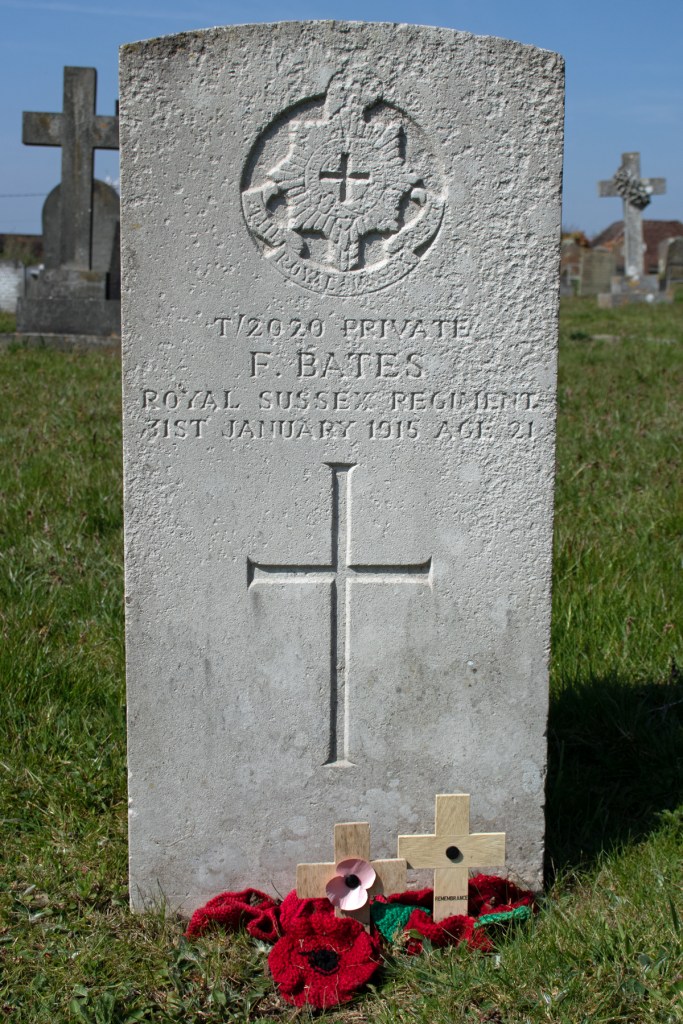
Private Frank Bates

Private Frank Bates

Frank Bates was born on 29th June 1893, in Cuckfield, West Sussex and was the fourth of five children. His parents were tailor William Bates and his wife, Sarah.

Tragedy was to be a constant companion to the Bates family. Frank’s older brother, William, died in November 1907 after a protracted illness, at the tender age of just 19 years old. Four years later, his younger sister, Maggie, also passed away after an illness. She was just 21 years of age.

When he left school, Frank went into the service of the Messel family, who owned the Nyman’s estate close to where Frank and his family lived. When war was declared, however, he was keen to play his part, enlisting soon after hostilities were announced in August 1914.

Private Bates joined the 4th (Home Service) Battalion of the Royal Sussex Regiment and was sent to Newhaven for training. It was while he was here that he fell ill, and, having caught a chill, he returned to Cuckfield to recuperate. Sadly, his condition worsened, and he passed away at his family home on 31st January 1915. He was just 21 years old.

Frank Bates was laid to rest in Cuckfield cemetery, resting not far from his siblings.


Tragedy was to strike one more time for William and Sarah. Frank’s older brother Jack served as a Private in the 2nd/4th Battalion of the London Regiment. In the spring of 1918, he was caught up in that year’s Battles of the Somme, including fighting at St Quentin and Avre.

In May 1918, Private Bates was officially reported as missing, but it was later confirmed that he had died of injuries sustained in the fighting. He passed away on 16th April 1918, at the age of 29 years old.

Jack was laid to rest at the Chauny Communal Cemetery in Picardie, France, and is also commemorated in Cuckfield Cemetery.


Second Lieutenant Francis Wakeford

Second Lieutenant Francis Wakeford

Francis Reginald Steele Wakeford was born in the summer of 1893 in Penarth, Glamorgan. The middle of five children, his parents were Herbert – who was a master printer – and Mary Wakeford. When he left school, Francis became a stockbroking clerk, but when war broke out, he was quick to ensure he played his part.

Initially enlisting in the Royal Engineers, he was attached to the Glamorgan Yeomanry. By the time he was sent to France, however, he had been assigned to the Lancashire Fusiliers.

After eighteen months of fighting, in the spring of 1918, Second Lieutenant Wakeford transferred to the Royal Air Force and gained his wings. “During six months’ flying he had many encounters with enemy airmen, many of whom he brought down, and was also in several bombing raids over Germany.” [Western Mail: Monday 30th December 1918]

When the Armistice was declared, Francis returned to Wales. He has been suffering from an ongoing illness, and this was to be to what he was to succumb. Second Lieutenant Wakeford passed away in Cardiff on Christmas Day, 25th December 1918. He was just 25 years of age.

Francis Reginald Steele Wakeford was laid to rest in the graveyard of St Augustine’s Church in his home town of Penarth.


Second Lieutenant Wakeford (from findagrave.com)

Francis’ grave also commemorates the passing of his only brother, Charles Herbert Stanley Wakeford.

Four years Francis’ senior, Charles had enlisted in the 24th (Pembroke and Glamorgan Yeomanry) Battalion of the Welch Regiment. As the war moved through its final year, Lieutenant Wakeford found himself caught up in the fierce fighting of the Second Battles of the Somme.

Charles was killed on 7th September 1918, aged 28 years old. He was laid to rest in Tincourt British Cemetery, in Picardie, France. He is also commemorated on the family grave in St Augustine’s Church, Penarth.


Lieutenant Alexander Spurway

Lieutenant Alexander Spurway

Alexander Popham Spurway was born on 8th April 1891 in Newbury, Berkshire. He was the second of six children to Edward and Gertrude Spurway. Edward was a clergyman, and the family moved to Heathfield in Somerset when Alexander was a small boy. Education was key to Edward and, the 1901 census records show Alexander as being a boarder at the Portmore School in Weymouth, Dorset.

Reverend Spurway set the family up well in Heathfield: by the time of the next census in 1911, the family were living in the village rectory, with five members of staff.

Alexander, meanwhile, had taken a different route, entering the Royal Naval College at Osborne on the Isle of Wight in January 1904. He was a keen sportsman and, while there, he represented the college at both cricket and football.

In September 1908, he passed out from the college as a Midshipman, and served on HMS Canopus in the Mediterranean. His career continued, and he was made Sub-Lieutenant in December 1911, and Lieutenant two years later.

Reverend Spurway died at home in February 1914 and, by the time war broke out, Lieutenant Spurway was assigned to HMS Achilles. He remained on board the cruiser for the next two years and it was during this time that he developed diabetes: something that was to prove an ongoing issue for him.

Returning home in the autumn of 1915, the condition was to prove too much, and he passed away on 29th November 1915, at the age of 24 years old.

Alexander Popham Spurway was laid to rest in the graveyard of his late father’s church, St John the Baptist in Heathfield.


Lieutenant Spurway (from findagrave.com)

Sadly, Alexander was not the only member of the Spurway family to lose their life as a result of the war.

Richard Popham Spurway, Alexander’s older brother, was a 2nd Lieutenant in the Somerset Light Infantry, and was attached to the Hampshire Regiment, when it was moved to Gallipoli in 1915. He was killed on 13th August 1915, and is commemorated on the Helles Memorial at Canakkale, Turkey.

Alexander’s younger brother, George Vyvyan Spurway, joined the Royal Fusiliers, before transferring to the Machine Gun Corps. He had arrived in France in September 1916, and was killed while fighting on the Western Front on 28th March 1918. He was laid to rest at Arras and is commemorated on the memorial there.


Flight Lieutenant Lewis Morgan

Flight Lieutenant Lewis Morgan

Lewis Morgan was born on 22nd May 1892 in Plymouth, Devon. He was one of six children to former army officer and rector Lewis Harold Gilbert Morgan and his wife, Mary.

Growing up in Plymouth, it seems inevitable that the sea life would take hold in Lewis Jr. He first took up a post in the Merchant Navy, rising to Second Mate in December 1911.

By this point, however, he had set his sights on something more formal and soon enlisted in the Royal Navy. He served on a number of vessels over the years, and was re-engaged when war broke out. By the summer of 1915, he transferred to the Royal Naval Air Service, earning his wings on 5th August that year.

The now Flight Lieutenant Morgan’s service grew as the war continued. The life of air crew at this point in the era of flight was notoriously dangerous, and Lewis was to meet his own fate. On 11th May 1917, he was flying with Probationer Flight Officer Randolph Seed around Edmonton, Middlesex, when an accident occurred. The local newspaper reported on the incident and the subsequent inquest:

Flight-Lieutenant Mitchell gave a graphic account of the accident. He said that about eight o’clock in the evening he was flying at a height of 1,000 feet, and the machine containing the deceased officers was just ahead, but 500 feet higher. The flying conditions were good, and at the time both machines were going steadily. Glancing upwards he notices that the other machine suddenly appeared to collapse, the front extension of the main plane crumpling up. The machine nose-dived, and a black object fell out of it. The machine continued its descent and fell into the Edmonton Sewage Farm… The machine was so entirely broken up that it was impossible to theorise upon the cause of the accident. Morgan was said to have fallen on a concrete path. The deaths were instantaneous.

Taunton Courier and Western Advertiser: Wednesday 23rd May 1917

Lewis Morgan was just 24 years old, and days away from his 25th birthday. His body was brought back to Somerset, and laid to rest in the graveyard of Holy Cross Church in Sampford Arundel. By this point, his parents were living in the nearby Woolcombe House, so their son was, in a way, brought home.


The newspaper article went on to report that Flight Lieutenant Morgan was the third and last son to Lewis and Mary.

Francis Morgan – five years Lewis’ senior – enlisted in the Royal Field Artillery when war broke out. He rose to the rank of Captain, and was mentioned in Despatches for his actions. He was killed in the Dardanelles – potentially at Gallipoli – on 2nd May 1915, at the age of 28 years old.

Walter Morgan was a year younger than Lewis. He also played his part in the First World War, joining the South Lancashire Regiment, and rising to the rank of Second Lieutenant. Walter was also sent to fight in Gallipoli, and this is where he also lost his life. He was killed just three months after Francis, on 9th August 1915. He was just 22 years of age.

The loss of three sons in two years was to take a further toll on the Morgan family. Mary had suffered from poor health for a while, and the deaths of Francis, Walter and Lewis was to prove too much. She passed away at home on 15th July 1917, aged just 56 years old.


Flight Lieutenant Lewis Morgan

Reverend George Sweet

Reverend George Sweet

George Charles Walrond Sweet was born on 4th December 1889, the oldest of three children to Reverend Charles Sweet and his wife Maud. A Church of England vicar, Charles moved around with his work, and, when George was born, he was based in Winterborne Kingston in Devon.

George was sent away to school, and, by the time of the 1901 census, Charles and the family had moved to Milton Lilbourne in Wiltshire, to tend the local flock.

After school, George studied at Oxford, then followed in his father’s footsteps by taking holy orders, and was soon appointed rector of Symondsbury, Dorset.

When war broke out, his calling was to serve in the Royal Army Chaplain’s Department. Details of his time during the conflict are unclear, although by the spring of 1919, he was attached to the headquarters of the Army of the Rhine.

It was here that he met Phyllis Squire Hickson, who was serving as a Nurse in the Queen Mary’s Auxiliary Army Corps. The couple fell in love and, in June 1919 they returned to England to marry. The wedding occurred on 6th August 1919, and the newlyweds set off on honeymoon the following day.

On his honeymoon tour, the Revd. George C Walrond Sweet… was drowned on Thursday evening in the Cherwell at Oxford, in the presence of his wife.

Mr and Mrs Sweet engaged a punt at Tims’s boathouse and went for a trip on the river. On returning about seven o’clock, when within 300 yards of the boathouse, the punt pole was embedded in the mud and, in attempting to dislodge it the pole broke.

Mr Sweet fell on the side of the boat and then over-balanced into the river. His wife tried to reach him, but without success, and then jumped into a second punt and from that into another boat, but failed to reach him, and he disappeared. The body was not recovered until a quarter of an hour had elapsed, and life was then extinct.

Mr Sweet, who was an MA of Keble College, was only married on Wednesday at St James’s Church, West Hampstead…

[Phyllis’ father] Mr William Hickson… said his daughter became engaged to Mr Sweet in France. He did not meet him until last Tuesday. They came to England to be married. Mr Sweet met with a bicycle accident some years ago and [he] understood from his daughter that her husband was unable to swim or take any active exercise, but while he had been in France his health had much improved.

It was stated [at the inquest] that Mr and Mrs Sweet had been married only one day when the accident occurred and Dr Brooks, a university coroner, said that the tragedy was one of the saddest that had ever come under his notice.

Taunton Courier and Western Advertiser: Wednesday 13th August 1919

The inquest confirmed that the punt pole had broken about 2.5ft (0.76m) from the top. When George was dragged from the river, artificial respiration was carried out for around 50 minutes, but proved unsuccessful. The inquest returned a verdict of accidental death. George was just 29 years of age.

Reverend George Charles Walrond Sweet’s body was brought to Somerset for burial. He was laid to rest in the graveyard of Holy Cross Church in Sampford Arundel, more than likely because he or his father had been vicars there.


This was the second tragedy to befall the Sweet family. George’s younger brother, Leonard, had been schooled in Sherborne, then at the Military College in Sandhurst. He joined the 1st Battalion of the Hampshire Regiment as Second Lieutenant on 5th February 1913, and was promoted to full Lieutenant in September 1914, and Captain in October 1915.

Captain Sweet was then attached to the 29th Squadron of the Royal Flying Corps, and gained his wings at the British Flying School in Le Crotoy, France, in August 1915. On 22nd June 1916, he was on patrol duty over the British lines, when he was involved in a skirmish, and his plane crashed, killing him instantly. He was just 23 years of age.

Captain Leonard Sweet was laid to rest at the Lijssenthoek Military Cemetery in Poperinge, near Ypres.

Captain Leonard Sweet
(from findagrave.com)

Phyllis Sweet never remarried. By the time of the 1939 England and Wales Register, she was living in Bridport, Dorset, and working as a political organiser and speaker. She passed away in August 1944 in Cannock, Staffordshire, at the age of 63 years old.