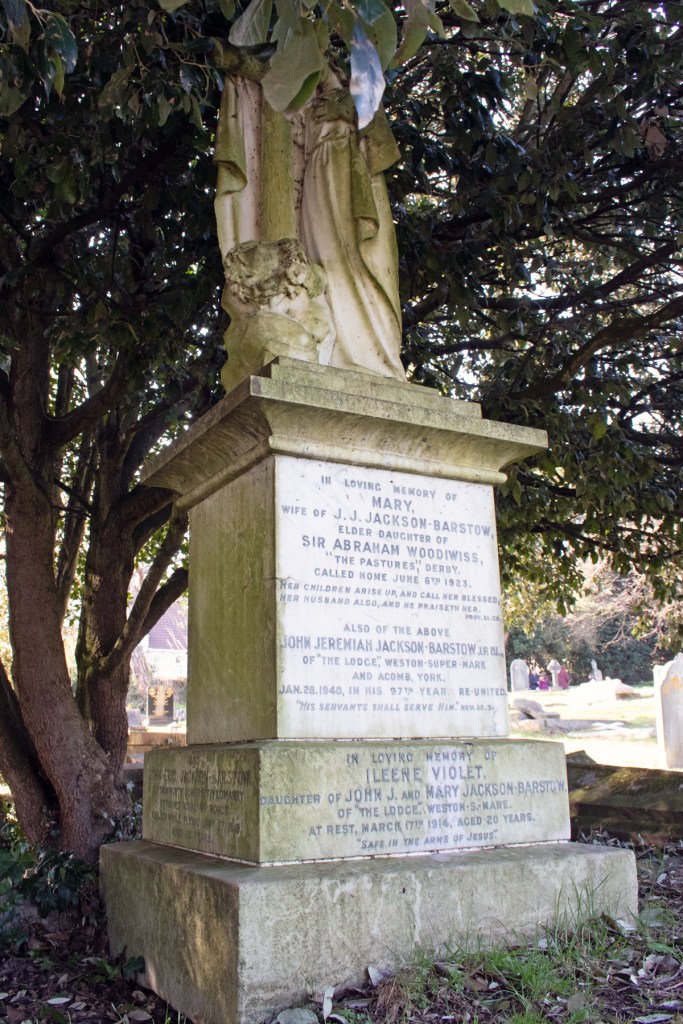
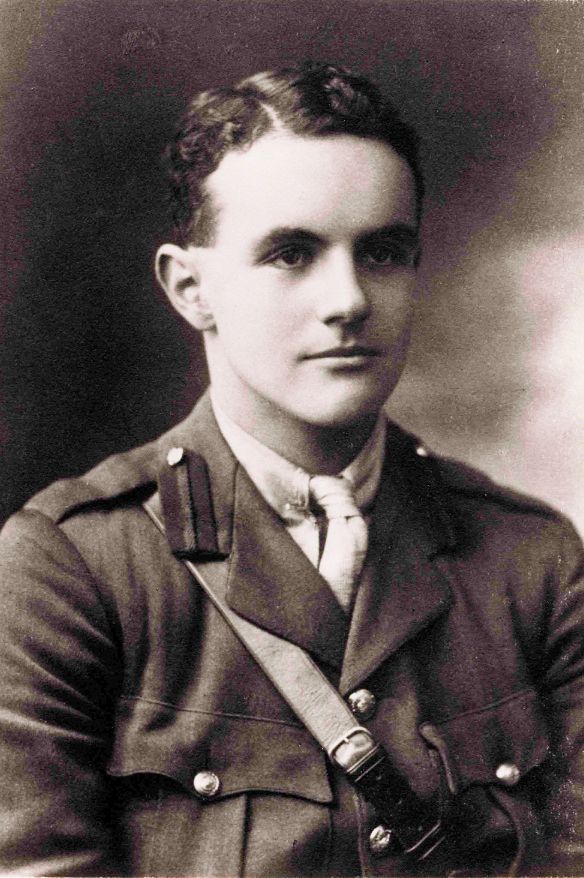
John Eric Jackson-Barstow was born on 10th August 1895, and was one of seven children – and the only boy – to John and Mary Jackson-Barstow. John Sr was a Justice of the Peace from Yorkshire, who had moved his family to Somerset in the early 1890s; this is where John Jr and his sisters were born.
When war broke out, John Jr enlisted as a Trooper in the North Somerset Yeomanry and, by the autumn of 1914, he was moved to France.
On the outskirts of Ypres, his regiment were involved in a prolonged attack by German forces and Trooper Jackson-Barstow was injured. Medically evacuated to England, he received a commission and was given the role of aide-de-camp to a general based on the East Coast.
In 1917, Captain Jackson-Barstow transferred to the Royal Flying Corps – later moving to the newly-formed Royal Air Force. Over the following months, he regularly flew sorties across France and did extensive piloting in English skies.
Captain Jackson-Barstow continued in his role when the Armistice was signed. On 27th January 1919, he was flying in Surrey; it was snowing heavily, which limited what he could see. Flying low, he crashed into a hill near Oxted, and was killed instantly. He was just 23 years of age.
John Eric Jackson-Barstow’s body was brought back to Somerset; he was laid to rest in the family grave in the Milton Road Cemetery in Weston-super-Mare.
Captain John Jackson-Barstow (from findagrave.com)
Stafford Edmund Douglas was born on 4th January 1863, the second of four children to Stephen and Mary Douglas. Stafford came from a military family, his father having been a Captain in the Royal Navy. This led to a lot of travelling and, having been born in Donaghadee, County Down, he then moved to South Wales.
By the 1880s, when Stephen and Mary had set up home in Portsmouth, Stafford had started to carve out a career for himself, and was a Lieutenant in the Argyll and Sutherland Highlanders, based at Edinburgh Castle.
Over the coming years, Lieutenant Douglas, who stood 5ft 8.5ins (1.74m) tall and also spoke French, travelled the world, serving in South Africa, Ceylon (Sri Lanka) and Hong Kong. By 1894 he had made Captain, and he finally retired in 1903, after nineteen years’ service.
On 29th April that year, at the age of 40, Stafford married Mary Louisa Harris. She was the daughter of an army colonel, and the couple wed in St George’s Church, Hanover Square, London. The couple set up home in Exeter, Devon, and went on to have two children – Violet and Stafford Jr.
At this point, Stafford’s trail goes cold. When war broke out in 1914, he was called back into duty, working as a Railway Transport Officer in Norwich. He continued in this role until 1919, before being stood down and returning home.
Stafford Edmund Douglas passed away on 15th February 1920, at the age of 57 years old, although no cause of death is immediately apparent. He was laid to rest in the Milton Road Cemetery in Weston-super-Mare, presumably where his family were, by this time, residing.
Hugh Cyril Arthur Brooking was born on 15th September 1870 and was one of six children (although he also had three further half-siblings through his father’s first marriage). His father, Arthur Brooking, was the vicar of the Hertfordshire village of Bovingdon, and it was in the vicarage that he and his wife Marian raised their family (with the help of seven servants).
Hugh led a life befitting of a reverend’s son; he was educated at St Mark’s School in Windsor, Lancing College and Down College, both in Sussex. He continued his studies at the Mining College in London (now part of Imperial College London), and went out to South Africa to further that work.
The local newspaper reporting on his funeral takes up the story:
When the Boer War broke out he joined the Imperial Light Horse, and was engaged in the battles of Elandslaagte, Wagon Hill and others, was in Ladysmith during the siege, and the relief of Mafeking. He was several times mentioned in despatches, and obtained the Queen’s medal and six clasps, and the King’s medal with two clasps. He then joined the South African Constabulary, under General Baden Powell.
He had previously held a commission in the North Somerset Yeomanry, and after leaving it for a short time he re-joined a soon as the [First World War] was declared, and was in France with his regiment when it made its famous stand against the Prussian Guards. All his superior officers were killed or wounded, and he was temporarily in command of the regiment.
He received the ribbon of the 1914 Star of Mons, but did not live to get the star. He served with the regiment 20 years. He was latterly attached to the Labour Corps at West Ham.
Captain Brooking came to Frome with his parents as a boy. In his youth he was a thorough sportsman, well known in the hunting field, genial and kindly, ready with a pleasant word, and courteous to all, he won friendly appreciation from all classes of townsfolk.
He had seen a great deal of fighting, though from exposure and other causes his health suffered, and he was employed on home service.
He was in command of the 371st Labour Company, and second in command of his battalion, when he met with the slight accident which led to his death. He grazed his knuckles, causing bleeding, but of so slight a character that no notice was taken of it. A few hours later he again struck his hand, and fresh paint appears to have affected the wound, and blood poisoning supervened.
Somerset Standard: Friday 7th June 1918
In his personal life, Hugh had met and married Florence Day, a farmer’s daughter seventeen years his junior from Somerset. The wedding was in the autumn of 1912, and they would go on to have two children, Granville and Hugh Jr. The boys would both go on to lead distinguished lives, Granville in the armed forces and Hugh as a ‘King’s Messenger’ in South America.
Following Captain Brooking’s injury, he was admitted to the Military Hospital in Purfleet but the treatment he received there was to do no good. Three months after the accident, on 31st May 1918, he passed away; he was 47 years of age.
Hugh Cyril Arthur Brooking’s body was taken back to Frome; he was laid to rest in the graveyard of St John the Baptist Church in the town.
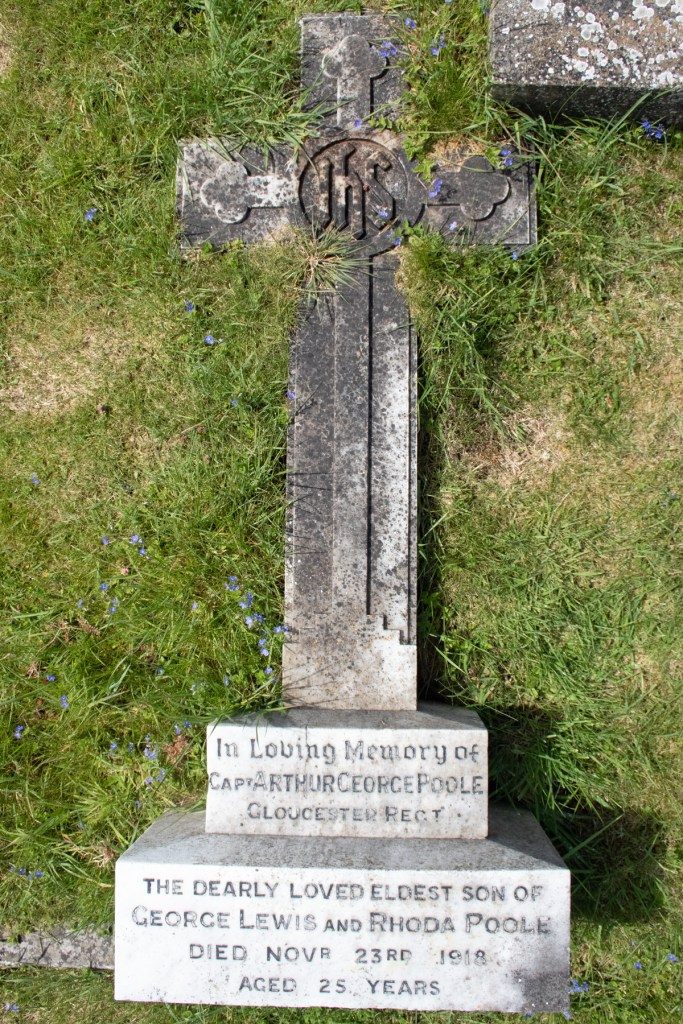
Arthur George Poole was born in Brislington, Somerset, in April 1893. His father, George, was a master builder, and with his mother, Rhoda, the family raise their five children in the Bristol suburb.
Arthur was obvious a bright lad; he attended the Bristol Grammar School, excelling at football, hockey and cricket. After finishing school, he joined a firm of Bristol solicitors and was also appointed secretary of the Bristol Law Society. He went on to continue his studies, when he was accepted to read law at Emmanuel College, Cambridge.
The war was on the horizon, however, and he was called upon to do his duty.
He joined Bristol’s Own (12th Gloucester Regiment) in 1914, and was musketry officer at Chiseldon for some months before going to France in 1915, where he was attached to the 6th Gloucester Regiment.
Within three months he had a severe attack of trench fever, and was home on sick leave for a few weeks. He was severely wounded in October 1917, and came back to England for good. Some months later he was mentioned in despatches. He spent a year in hospital, and although not discharged, was allowed to resume his law studies.
Gloucestershire Echo: Saturday 14th December 1918
While in hospital, Captain Poole contracted influenza, which then became pneumonia. Although recovering from his injuries, it was these conditions that were to get the better of him, and he passed away on 23rd November 1918, at the age of 25 years old.
Arthur George Poole was laid to rest in the pretty graveyard of St Andrew’s Church in Clevedon, Somerset, where his parents now lived.
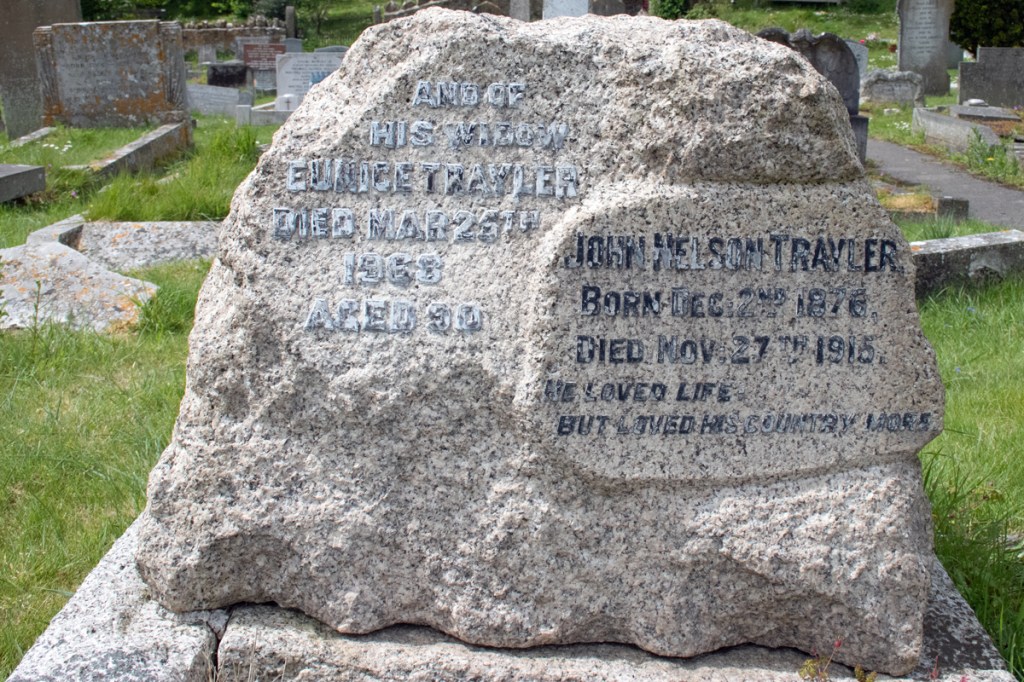
John Nelson Trayler was born on 2nd December 1876, the oldest of seven siblings. His father, Jonas Trayler, was born in London, but moved to South Wales to become a farmer. He married Elizabeth Green, who was from Haverfordwest, and John was their eldest child, born in Pembrokeshire.
In December 1895, having just turned 19, John joined the 1st Devonshire Volunteer Corps. He seemed eager for a life of action; given that the 1901 census lists his profession simply as ‘farmer’s son’, it’s easy to see why. By this time, the family had moved to a farm in Broadclyst, to the north east of Exeter in Devon.
There was a change of direction for the family, however. By 1908, both father and son were working as tanners; John had moved back to Wales, while Jonas had set up work in Bridgwater, Somerset.
John, by this time, had met Eunice Sully; she was the daughter of a gentleman, and her family lived in Wembdon, near Bridgwater. They married in July 1908, and lived in the village of Lamphey in Pembroke.
John was, by now, the managing director of a tannery and obviously had the business acumen to run a company. He joined the local freemason’s – the Lodge of Perpetual Friendship – but, in January 1914, it was reported in the local newspaper that the business was to be voluntarily wound up.
John’s father Jonas was also forging ahead with his ambitions, and was a councillor for the Bridgwater area.
When the Great War broke out, John’s time with the Devonshire Volunteer Corps was such that he had attained the rank of Captain. Assigned to the 11th (Reserve) Battalion, John was based out of Exeter and it is unlikely that he saw any active service in France.
In August 1915, the Exeter and Plymouth Gazette reported that Captain Trayler had relinquished his commission on account of poor health, and this seems to have been an ongoing issue. In fact, when he was staying with Eunice’s parents in Clevedon later that year, he fell seriously ill. While his medical condition is lost to time, sadly it was one he succumbed to. He died at his in-laws’ house on 27th November 1915, at the age of 39 years old.
John Nelson Trayler was laid to rest in the picturesque graveyard of St Mary’s Church in Clevedon, Somerset.
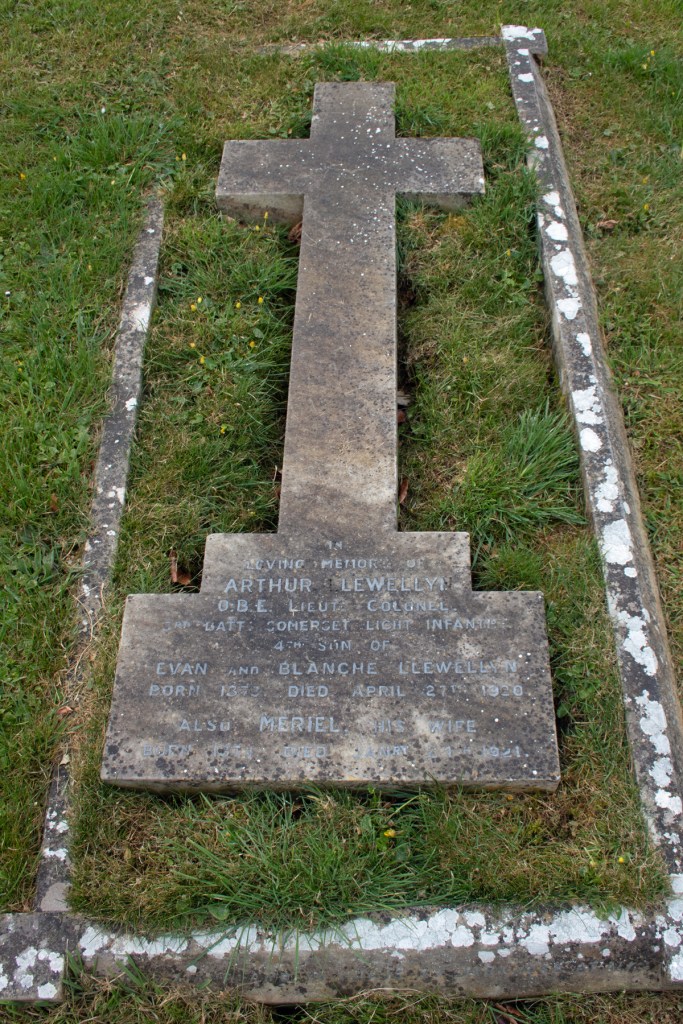
Arthur Llewellyn was born in the summer of 1873, one of four children to Evan and Mary Llewellyn. Originally from Wales, Evan was a Justice of the Peace in the Somerset village of Burrington, and the family lived in the comparative luxury of Langford Court, a mile or so from the village centre.
I use the term ‘comparative luxury’ with some sense of irony; according to the 1881 census, the family had a household staff of eight, including a governess, two nurses, housemaid, cook, kitchen maid, parlour maid and page.
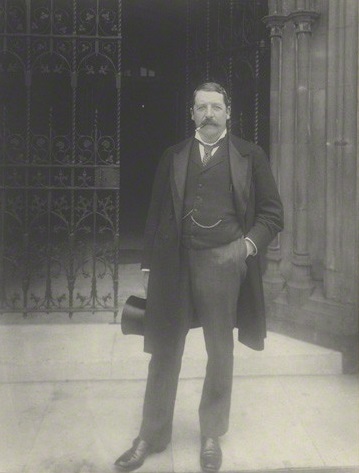
Ambition was obviously what drove Evan; he was an army office, who served in initially in the Somerset Light Infantry. In 1885, he was elected MP for North Somerset, a position he held on and off for nearly twenty years. His military service continued, however, and he led the 2nd (Central African) Battalion, King’s African Rifles in the Boer War.
Comfort ran in the Llewellyn family; according to the 1891 census, Arthur was staying with his maternal aunt, Rose Stewart. She also lived in Somerset, and, at the time the census was drawn up, she was recorded as a widow living on her own means, with her mother, mother-in-law, two nieces and Arthur, her nephew. She was not without help, however, as the house had a retinue of eight staff to support her.
Military life was an obvious draw for Arthur. He enlisted in the Somerset Light Infantry in October 1891 and, within a year, had been promoted to Second Lieutenant.
He had met and married Meriel Byrne, in 1895. The couple’s marriage certificate confirms that he had been promoted to Captain in the militia, and his residence was Buckingham Palace Road, in south west London. They were married in Holy Trinity Church, Brompton, with Meriel’s mother and Arthur’s father acting as witnesses.
The couple went on to have five children, all girls, and they settled into a comfortable life. By 1901, Meriel had set up home in Worcestershire; Arthur does not appear on that year’s census, which suggests that he may too have been fighting in South Africa.
Arthur’s mother Mary passed away in 1906, at the tender age of 39. By 1911, he had been promoted to Lieutenant Colonel in the 3rd Somerset Light Infantry, and was head of his household in Worcestershire. The family was, by this time, complete – Arthur and Meriel and their five children also had help running their home, with two nurses, a cook, parlour maid and housemaid to support them.
Evan passed away months before war was declared, at the age of 67. Lieutenant Colonel Llewellyn felt duty bound to re-enlist, and was given command of the 3rd Reserve Battalion, Somerset Light Infantry. He subsequently served as part of the Army Service Corps in France, before transferring to the Army Labour Corps in Nottingham.
According to the Evening Mail, on 27th April 1920, he “was suddenly seized with illness in the street, and died as he was being conveyed to Nottingham Hospital. He was 46 years of age.”
Arthur was brought back to Burrington in Somerset, where he was buried alongside his parents in Holy Trinity Churchyard.
Sadly, Meriel passed away nine months after her husband; she too is buried in Holy Trinity Churchyard.
Arthur’s estate passed to his brother, Owen, and totalled £12,023 15s 11d (approximately £530,000 in today’s money).
As an aside to Arthur’s illustrious story, another of his brothers is worthy of note. Hoel Llewellyn was two years older than Arthur.
Educated for the Royal Navy, he saw active service on the East Coast of Africa, 1888-90 with despatches. He also served as Artillery Officer and commanded artillery in the Matabele War, where he was recommended for the Victoria Cross. He was promoted Captain in the British South Africa Police, and Justice of the Peace in Matabeleland in1896.
Captain Llewellyn served throughout the South African War; commanding armoured trains north of Mafeking before transferring to the South African Constabulary in 1901. Hoel was eventually created a Companion of the Distinguished Service Order for his service in South Africa.
He was wounded while serving with the Mediterranean Expeditionary Force in the Great War. Hoel was subsequently promoted to the rank of Colonel and appointed Provost-Marshal of Egypt and the British Mediterranean Expeditionary Force.
In 1908, he had been made Chief Constable of Wiltshire, a role he was to hold for 37 years. He was key to pioneering the use of police dogs, and went on to become the oldest serving person to hold the Chief Constable role in the county.
Evan Henry Llewellyn
Another aspect of the Llewellyn family is that Evan was obviously a source of political drive for the family; his great-great-grandson is David Cameron, UK Prime Minister from 2010 to 2016.
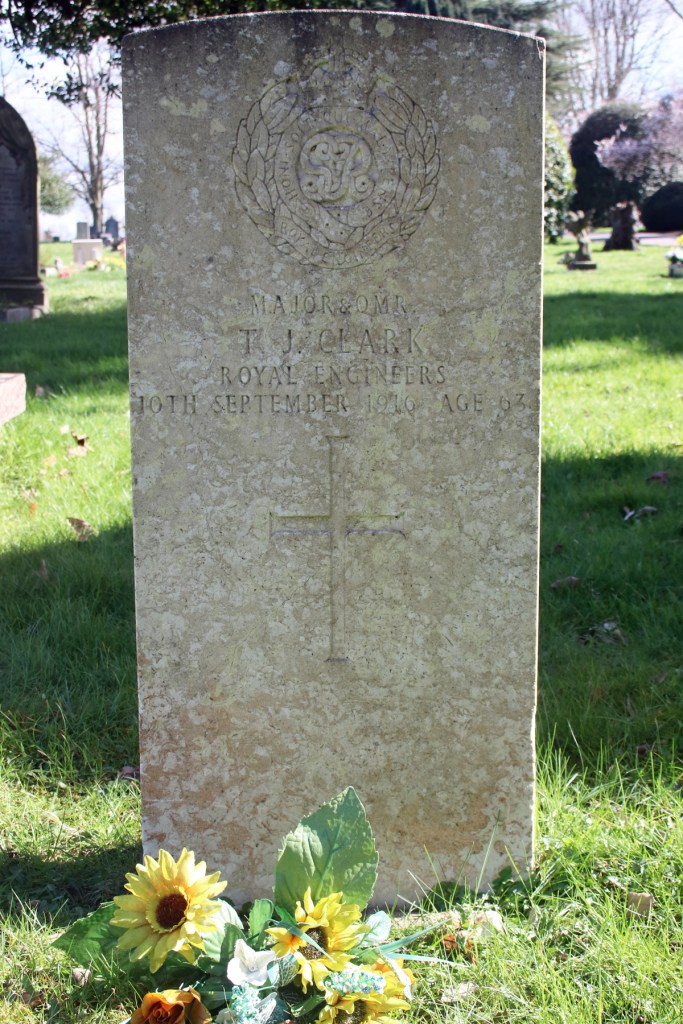
Thomas James Clark was born in Worcester at the beginning of 1853, the oldest of two children to James Clark and his wife Sarah. James was an engine smith and gas fitter, and moved the family with his work, initially to London, then on to the Kent coast.
Documentation relating to Thomas’ early life is difficult to track down; the 1871 census has him listed as a gas fitter like his father, but it is likely that he enlisted in the army fairly shortly after this date.
In 1875, he married a woman called Emily Ann. There life was to take on a grand new adventure as their first child, a boy named after his father, was born in Bombay, India, later that year.
It seems likely that it was Thomas’ military service that took the young family overseas. This was to be the case for at least a decade, as Emily gave birth to four further children in India. James, their fifth child, was born in Bombay in 1884. Their sixth, and last child, Ellen, was born in Gillingham, Kent, ten years later.
Given that the standard time for military service was twelve years, it is possible that Thomas served all of that time overseas, returning to England in around 1887.
Back home in Kent, Thomas is given the commission of Quartermaster in November 1897. By this point, he has been in the Royal Engineers for just under 21 years. He and his family are living in central Gillingham, within easy walking distance of the Royal Engineers Barracks and School of Engineering.
The 1901 census also lists Thomas as Quartermaster for the regiment, while three of his sons are by this time working in the Naval Dockyard as shipwrights and engine fitters.
Ten years later and the family are still living in the same house. By now, and aged 57, Thomas is recorded as a Retired Captain and Quartermaster for the Royal Engineers. He and Emily have been married 36 years, and their three youngest children (now aged 29, 26 and 17) are still living with them.
War was looming by now, although, age 61 when it broke out, it is unlikely that Retired Quartermaster Clark would have been involved in any front line activity. While no military records survive for Thomas, it seems possible that he may have been recalled for a training or administrative role at the barracks nearby.
Any re-commission would not have lasted for long, however, as Quartermaster Clark passed away at home on 10th September 1916. He was 63 years old.
Thomas James Clark lies at peace in the Woodlands Cemetery in Gillingham, Kent.
Thomas’ widow, Emily, passed away just two years after her husband. She was also laid to rest in the Woodlands Cemetery.
Thomas left his estate in the hands of his youngest son, James, who was still living at his parents’ home when they passed away.
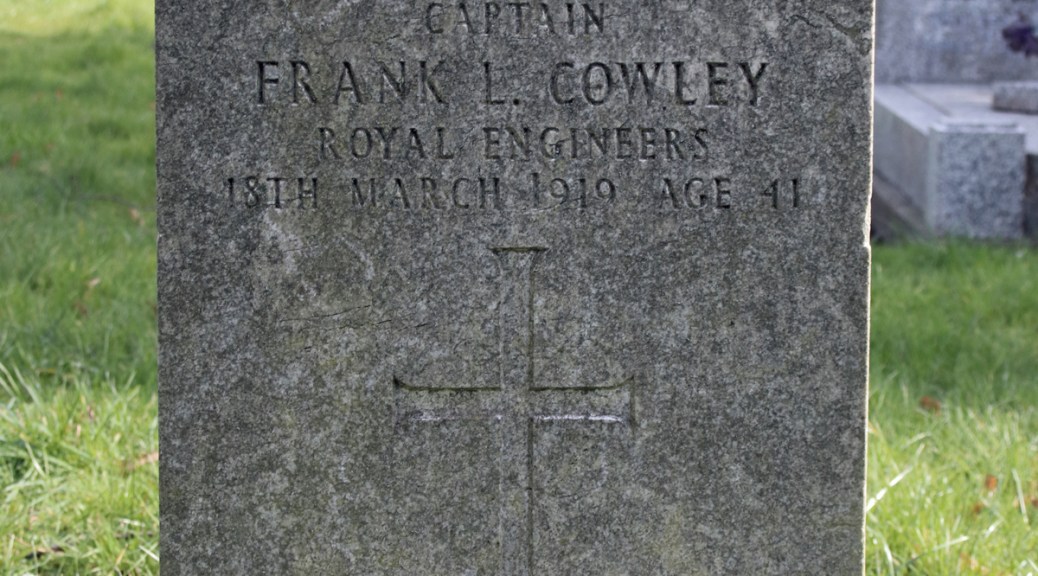
Francis Llewellyn Cowley – also known as ‘Frank’ was born in July 1877 on the Isle of Man. He was one of ten children to Thomas and Ann Cowley, farmers who owned 133 acres on the northern tip of the island.
Frank’s trail goes cold for a few years; he was still living on his father’s farm in 1891, but by 1913, had moved to to the mainland, settling in Kent.
It was here, in Gillingham, that Frank married Lily Matilda Carrington in the summer of 1913. Sadly there is little information about Lily, but the couple do not appear to have had any children.
Frank enlisted shortly after war broke out; he joined the Royal Engineers on 27th October 1914, and within a couple of years has reached the rank of 2nd Lieutenant.
Sadly again at this point Frank’s trail goes cold. He next appears in a newspaper article from 1st March 1919, when he is listed as having attended the funeral in Rainham, Kent, of Air Mechanic Herbert Holdstock. He is now listed as Captain F Cowley RE.
That was resolved to be a tantalising glimpse into Captain Cowley’s final few weeks. From this point, all the documents tell us is that he worked at the School of Military Engineering in Chatham.
Frank passed away on 18th March 1919, although no cause of death is recorded. He was 41 years old.
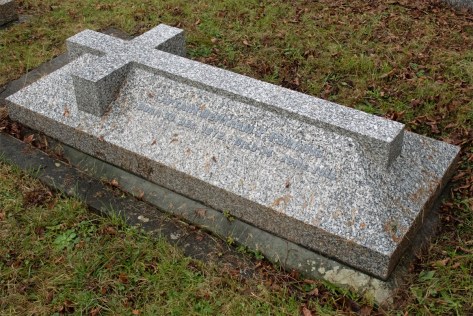
Francis Llewellyn Cowley lies at rest in the Woodlands Cemetery close to his home in Gillingham, Kent.
Bertram Falls Perkins was born in December 1872, the third of four children to Alfred and Mary Perkins. Alfred was a Colonel in the army and has met his wife while serving in Madras, India. He had retired by the time Alfred was born, and had brought his family back to England, where he set up as a Country Magistrate, living in the village of Wookey in Somerset.
Bertram was set for good things – by the time of the 1881 census, the family were living in Eastcott House, with a footman, cook, two ladies’ maids, two house maid and a governess to look after them.
Bertram’s military records are a little scant, but can be pieced together from his funeral notice.
The late Captain Bertram Perkins… joined the 1st Vol. Batt. of the Somerset Light Infantry as 2nd Lieutenant in February 1892, and, in November 1894, was transferred to his father’s regiment, the 3rd Batt. Welsh Regt. as Lieutenant… In October 1896 he went to South Africa and joined the Natal Mounted Police, in which he saw much active service… at the relief of Ladysmith and Dundee. Being stricken down with a very severe attack of enteric fever, he had to resign… and return home. As soon as he recovered his health he again retuned to South Africa as a Captain in the 3rd Battalion Welsh Regiment, where he saw much service…
Whilst at Vryburg, he was appointed Provost Marshal, and in recognition of his tact and energy in filling a very difficult position, was presented by the inhabitants of the district with a gold watch and an illuminated address. He was in possession of the Queen’s Medal with four clasps and the King’s Medal with two clasps. On his return home he took to farming… He retired from the Service in 1905, but on the outbreak of the present war was appointed as Captain to the 12th Battalion of the Sherwood Foresters. Unfortunately, his health, which had never been quite restored, broke down, and he was invalided out of the Regiment.
Wells Journal: Friday 16th June 1916
During the Great War, Captain Perkins’ regiment has been the 12th (Service) Battalion for the Nottinghamshire and Derbyshire Regiment. His unit been shipped out to France in August 1915, but it is likely that he saw little, if any, time on the Western Front. After being invalided out, he succumbed to his ongoing illness on 14th June 1916, aged 43.
Bertram Falls Perkins lies at rest in the graveyard of St Matthew’s Church, in his home village of Wookey, near Wells in Somerset.










 Death and Service