Theodore Slade was born early in 1885 in Buckfastleigh, Devon and was the second of two children to Frederick and Mary Slade. The 1891 census recorded the family four living with Frederick’s widowed mother and younger sister in Minehead, Somerset, where he had himself been born. Frederick was listed as a schoolmaster, while Mary was working as an organist.
Music definitely ran through the Slade family. The next census, in 1901, found Frederick now working as a gunsmith. Mary, meanwhile, was now noted as being a professor of music, while Theodore and his older brother, appropriately named Beethoven, were both employed as music teachers.
Ten years further on, and Beethoven had moved out of the family home, for a life with his wife and her widowed mother. Frederick was still working as a gunsmith, while Mary and Theodore were still teaching music. All three were self-employed, Theodore also working as an organist at St Andrew’s Church, Minehead, for more than a decade.
An interesting side note to the three document is how the census takers relied fully on the information they were given by residents. In 1891, Frederick gave his age as 41 and Mary 40; ten years later, Frederick was noted as being 56 and Mary 53; the 1911 census gave their ages as 71 and 63 respectively.
When war broke out, Theodore enlisted early on. He joined the Somerset Light Infantry, and was initially attached to the 4th (Reserve) Battalion. Private Slade was transferred across to the 1st Battalion, and soon found himself ensconced at Ypres.
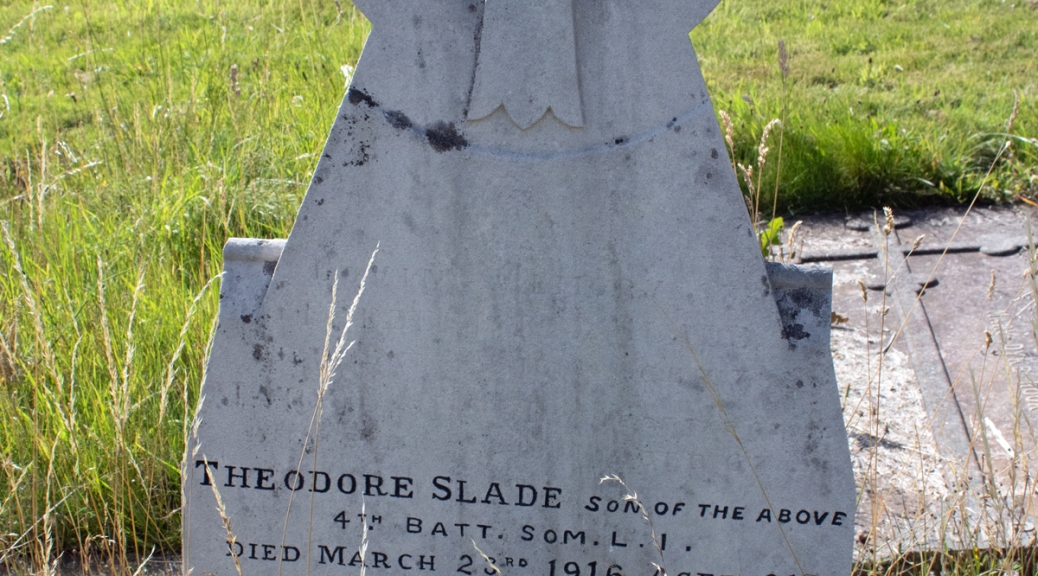
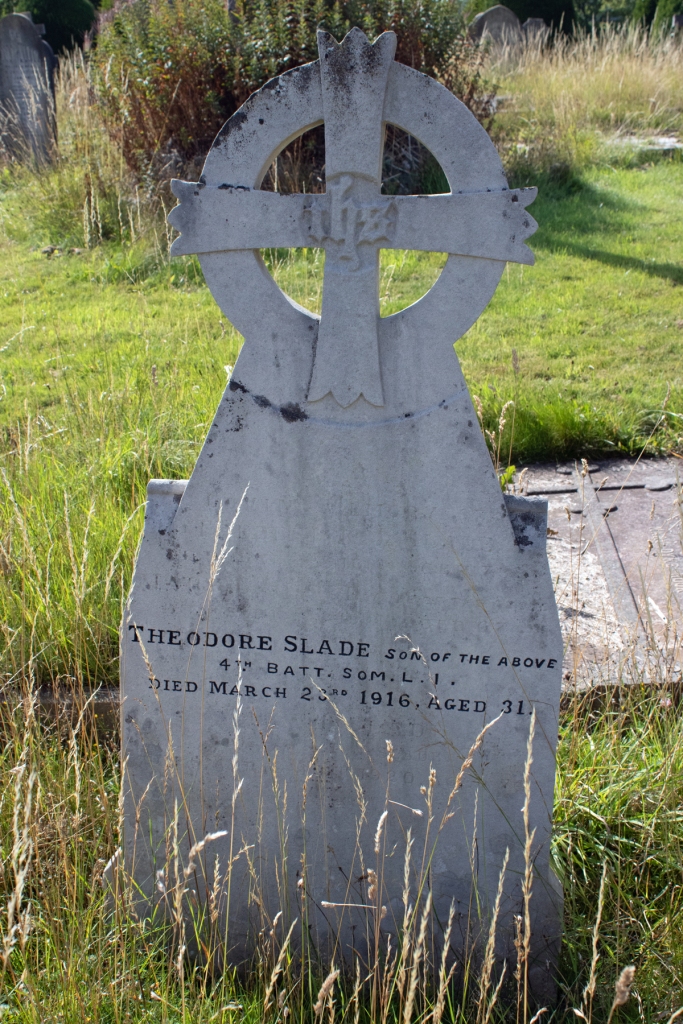
Towards the end of 1915 Theodore came down with tuberculosis, and was medically evacuated to Britain for treatment. He was admitted to St John’s Hospital in Penarth, Glamorganshire, and remained in hospital over the winter months. His lungs weakened, he contracted pneumonia, passing away from the condition on 23rd March 1916, at the age of 31 years old.
Theodore Slade’s body was brought back to Somerset for burial. He was laid to rest in the family plot in the sweeping vista of Minehead Cemetery.
Thomas Charles Slade was born in Bristol, Gloucestershire, on 13th March 1880. One of twins, he and his sibling Ernest were two of nine children to Charles and Elizabeth Slade. Not long after the twins were born, the family had moved to Minehead, Somerset, where both Charles, who was a mason and bricklayer, and Elizabeth had hailed from.
Whilst Ernest seemed content to remain in Somerset – going on to become a poultry farmer – Thomas sought a life of adventure. Foregoing his gardening job, he enlisted in the Royal Navy, setting his sights on a life at sea.
Thomas’ service records show that he joined up on 12th November 1895. He stood just 5ft 2ins (1.57cm) tall, with brown hair, blue eyes and a ruddy complexion. As he was to young to formally join up, he was give the rank of Boy 2nd Class, and sent to HMS Impregnable, the shore-based training establishment in Devonport, Devon.
Boy Slade seemed to create a good impression. He was promoted to Boy 1st Class in July 1896, and the follow February was given his first posting, on board the battleship HMS Benbow. This was the ship he was serving on when he turned 18 and, having come of age, he was officially inducted into the navy, and given the rank of Ordinary Seaman.
And so began a glittering career for young Thomas. Over the twelve years of his contract, he served on nine different ships, returning to HMS Vivid – the Royal Naval Dockyard in Devonport – between voyages.
Small in stature, Thomas appears to have been a dedicated young man. His annual reviews noted his character was ‘very good’ every year, and his ability was either ‘very good’, ‘superior’, or ‘excellent’. He was promoted to Able Seaman in September 1898, just eighteen months after becoming an Ordinary Seaman. By June 1906 he rose in rank again, ending his initial term of service as a Leading Seaman.
Thomas was not done with the navy yet, however. He immediately re-enlisted and, over the ensuing years served on a further four vessels. He spent more and more time on board HMS Defiance, the torpedo and mining school ship in Devonport. Whether this was because he was being taught, or was supporting incoming students is unclear, but by September 1912, he had been promoted again.
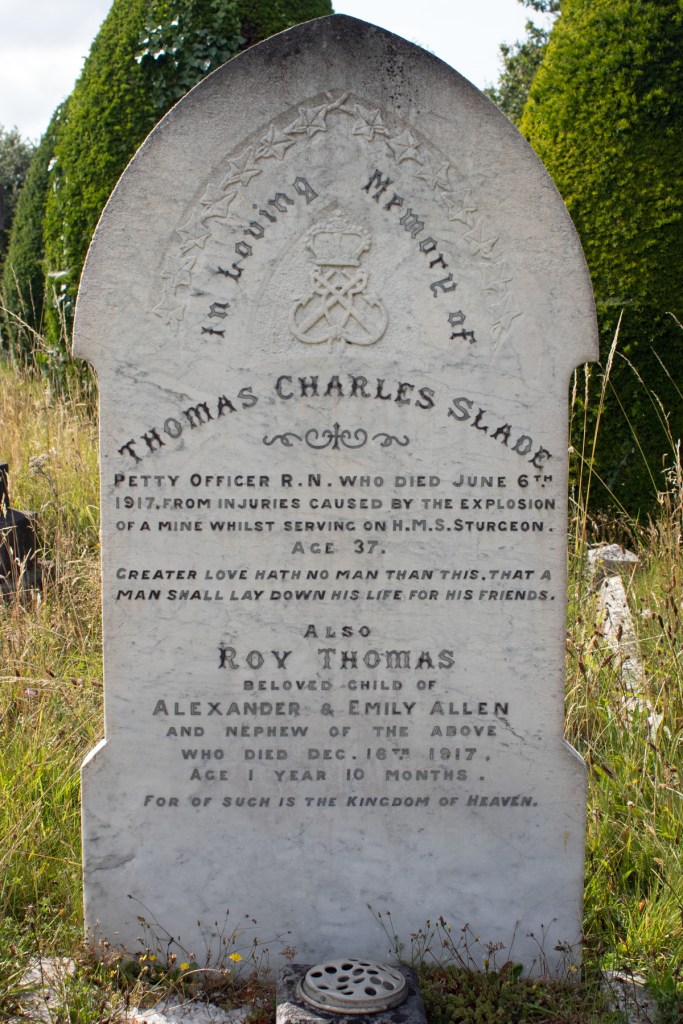
In November 1915, the now Petty Officer Slade had moved to the depot ship HMS Dido. His new posting supported the Tenth Destroyer Flotilla in the North Sea, patrolling the waters off the East Anglian coast. In February 1917 he moved to another of the support vessels, HMS Sturgeon.
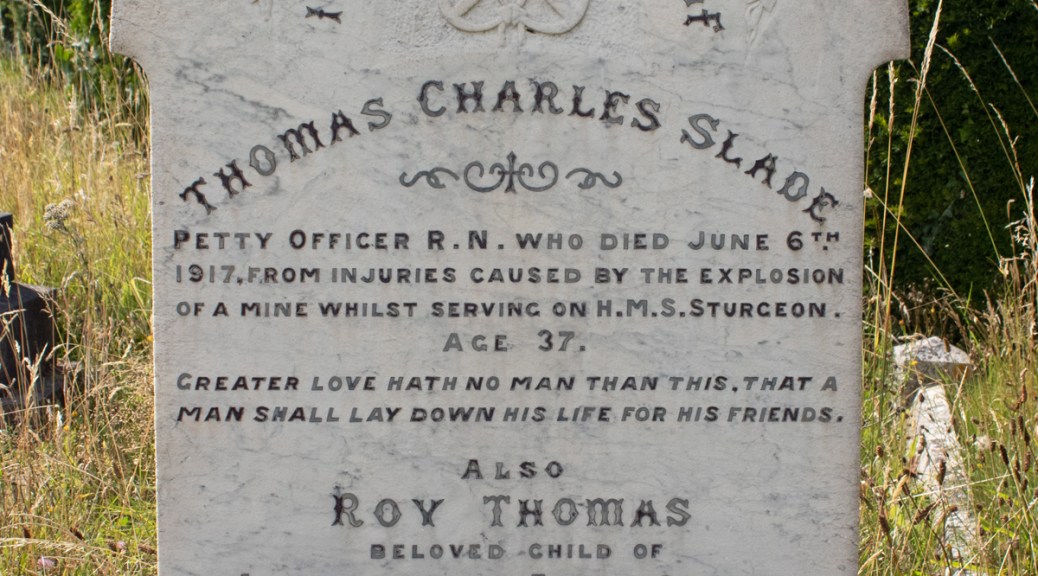
In June 1917, a mine exploded on board, injuring a number of the crew, including Petty Officer Slade. The wounded were transferred to a hospital near Ipswich, and it was here that Thomas was to pass away. The only one of those caught up in the incident to die, he was 37 years of age.
Thomas Charles Slade was brought back to Somerset for burial. He was laid to rest in the sweeping Minehead Cemetery, close to the grave of his mother, Elizabeth, who had passed away nine years before.
Thomas’ headstone also includes an inscription to Roy Thomas Allen, who died six months after him. Roy was the young son of Thomas’ younger sister Emily: an uncle and nephew reunited.
Amos William Cornish was born on 16th August 1887 in Dunster, Somerset. One of five children, his parents were George and Elizabeth Cornish. George, who was a brickmaker, died in 1893, and at this point the family relationships seemed to have broken down.
By the time of the 1901 census, Elizabeth had remarried, and was living with her new husband and Amos’ youngest sibling, sister Lily. Two of Amos’ brothers, Walter and George, were living with his maternal grandparents, while Amos himself was one of three hundred inmates at the Horton Kirby Home for Homeless Boys in the Dartford area of Kent.
Amos’ schooling would have finished by the time he was 14 years old, and he quickly sought work that allow him to support himself as a young man with no home to go to. A career in the Royal Navy seemed to provide that regular pay and, on 4th June 1902, he enlisted.
As he was under age, Amos was given the rank of Boy 2nd Class, and sent to the shore-based training ship HMS Impregnable in Devonport, Devon. His service records show that he stood just 5ft 4ins (1.63m) tall, had brown hair, brown eyes and a fresh complexion. He was noted as having a scar in the centre of his forehead, and a tattoo of clasped hands over a heart on his right forearm.
Boy Cornish transferred to another training vessel – HMS Lion – after a month or so, and it was here, in February 1904, that he was promoted to Boy 1st Class.
Over the next eighteen months, Boy Cornish served at two more training bases – HMS Boscawen and HMS Vivid. He was given his first sea-going posting in April 1905, aboard the cruiser HMS Blake. It was on his next assignment, however, that he came into his own.
In May 1905, Amos boarded HMS Carnarvon, an armoured cruiser that had been launched a couple of years before. He was to spend the next two years as part of her crew, gaining the rank of Ordinary Seaman when he came of age in August 1905, and Able Seaman a year later.
When his time on board Carnarvon came to an end, Amos returned to shore, to HMS Pembroke, the Royal Naval Dockyard in Chatham, Kent, which was to be his base on and off for the next eight years. During that time, he served on six more ships, and rose to the rank of Leading Seaman in December 1911. This new rank, however, seemed not to suit Amos, and he reverted back to his previous rank eight months later.
Able Seaman Cornish’s longest posting was on board the cruiser HMS Antrim. He joined her crew in September 1913 and, over the next three-and-a-half years he travelled far and wide. Initially patrolling the North Sea – particularly around the Scottish Isles – Amos was on board for a journey to Arkhangelsk in Russia. The ship then transferred to the Western Atlantic, patrolling around America and the West Indies.
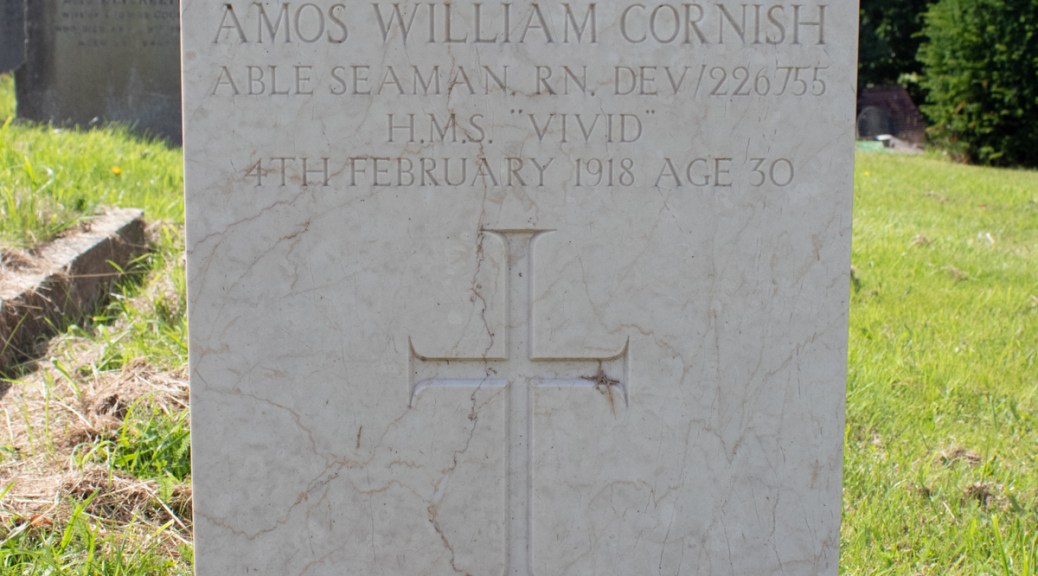
Able Seaman Cornish returned to British shores in April 1917, to be based at HMS Vivid, the Royal Naval Dockyard in Devonport, for the nest nine months. During this time, he became ill and was admitted to the Royal Naval Hospital in Truro with double pneumonia. Tragically, this was something he was not to recover from: Amos passed away on 4th February 1918, at the age of 30 years old.
While somewhat stretched, Amos’ family bond still remained. Elizabeth was living in Minehead by this point, with husband Alfred and their two children. It was to the Somerset town, therefore, that Amos William Cornish’s body was brought. He was laid to rest in the town’s sweeping cemetery.
George’s death in 1893, and Elizabeth’s remarriage a few years later split the family, and Amos’ siblings all followed separate paths.
The oldest of his siblings, Walter, also followed a military path. He joined the Royal Garrison Artillery as a Gunner and, by the time of the census, was based in Gibraltar. On completing his service, he returned to Somerset, marrying Florence Peddle in 1925. The 1939 Register found the couple living with his cousin, Amelia, while he worked as a gardener. Walter died in Weston-super-Mare in 1962, at the age of 74.
Amos’ next sibling, brother Harold, seems to have had a less fortunate time of things. Absent from the 1901 census, he appears in prison records four years later. He was incarcerated for six months’ hard labour in Brecon Prison, having been found guilty of “Gross Indecency with another male person”. Harold was 14 years and three months old at the time. A newspaper report from around this time suggests that the other party was a George Williams, but there is no further information about him. Harold seems to have come out the other side of his experience, however: the 1911 census recorded him as living and working with draper and grocer James Ridler and his family in Dunster, Somerset.
Amos’ third sibling, sister Lily, found work as a servant to bakers Joseph and Minnie Bagley in Minehead. She married painter and decorator William Whitting in 1916 and the couple went on to have a daughter, Kathleen, eight years later. The family settled in Weston-super-Mare, Lily passing away in 1968, at the age of 75.
The youngest of the Cornish siblings was George. He remained living with his maternal grandparents in Dunster, and found work as a printer. In the spring of 1921, he married Clara Govier and, by the time of the 1939 Register, they couple were living in Aylesbury, Buckinghamshire, where George was working as a printer and compositor. He died in 1957, at the age of 62 years old.
Harold Cane was born in Minehead, Somerset, on 10th August 1898. One of nine children, his parents were Henry and Mary Cane. Henry was a stone mason from Minehead, but he was working in Ireland when he met his future wife. The couple married in 1891, only moving back to Somerset the mid-1890s, by which time they had two children, Harold’s oldest siblings.
The 1911 census recorded Henry and Mary living with their children at 3 Church Steps in Minehead, a short row of houses leading to St Michael’s Church. Henry was a mason and his oldest son, also called Henry, has working with him.
Harold, meanwhile, dreamed of a bigger and better life. When he finished his schooling, he joined the Royal Navy, looking for a life of adventure on the high seas. He signed up on 22nd September 1914, just a month after the declaration of war, and was sent to the shore-based training ship, HMS Impregnable, based in Devonport, Devon.
As he was just 16 years of age, Harold was given the rank of Boy 2nd Class. However, his commitment to the role was evident and led to a promotion – to Boy 1st Class – after just three months. In September 1915, Harold as assigned to the dreadnaught battleship HMS Iron Duke, where he served as an Ordinary Seaman. He spent just under a year on board, during which time the Iron Duke was caught up in the Battle of Jutland. She was involved in the sinking of the German destroyer SMS S35, after which she and the rest of the fleet moved on.
Ordinary Seaman Cane remained on board HMS Iron Duke until the summer 1916. He had fallen ill by this point, having contracted tuberculosis. The condition was enough for Harold to be invalided out of the navy, and he was stood down on 9th August 1916.
At this point, Harold’s trail goes cold. It seems that he returned home to Somerset, as this is where he passed away. He died on 14th November 1917, at the age of just 19 years old.
Harold Cane was laid to rest in the peaceful landscape of Minehead Cemetery.
Francis William Prescott – better known as Frank – was born on 17th March 1894, and was one of four children to William and Mary. William was an agricultural labourer from Somerset, and, by the time of the 1901 census, the family had settled in the village of Luccombe, in the western outreaches of the county.
Frank went to school in Allerford, before spending a year at Luccombe’s Church of England school – from 13th May 1907 to 29th May 1908. Now aged 14 years old, he was considered old enough to be earning his keep. He found work as a farm boy on a farm on the outskirts of the village, but with storm clouds brewing across the Channel, he was keen to play his part.
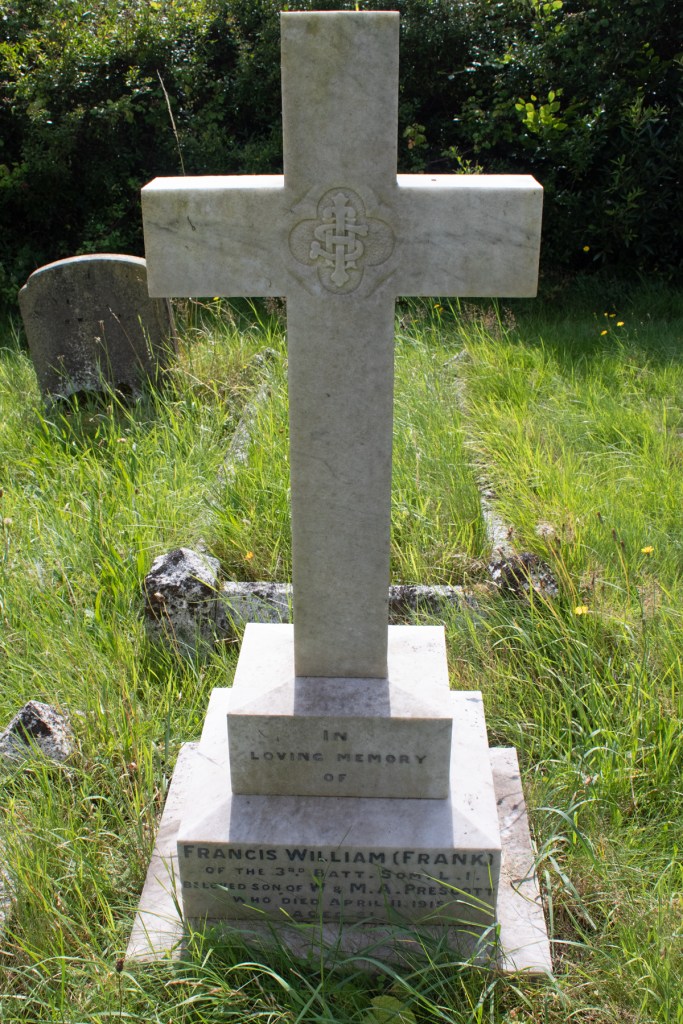
Little information is available about Frank’s military service, but it is clear that he enlisted in the first weeks of the war, as imperial fervour gripped the country. He enlisted in the Somerset Light Infantry and, as a Private, was assigned to the 3rd (Reserve) Battalion. Contemporary documents do not confirm either way, but as this particular troop was based at Devonport, Devon, for most of the war, it is unlikely that Private Prescott saw any action overseas.
Indeed, he was in barracks on 11th April 1915, when he passed away. Again, the cause is lost to time, but he was just 21 years of age when he died.
Francis ‘Frank’ William Prescott was taken back to Somerset for burial. He was laid to rest in Luccombe Church Cemetery, not far from where his family still lived.
Frank’s younger brother, Harold, also enlisted in the war. He joined the Royal Engineers as a Private and, unlike his brother, he did go to the Western Front.
Harold was caught up in the fighting, and received a gunshot wound to his arm. He recovered, but the injury dogged him. He was formally discharged on 14th May 1919, and found work as a lorry driver. Harold married Kathleen Peck in December 1929: the couple’s only child, Edward, was born just over a year later.
Harold spent his life in Somerset. He died in Exmoor in the spring of 1968, at the age of 71 years old.
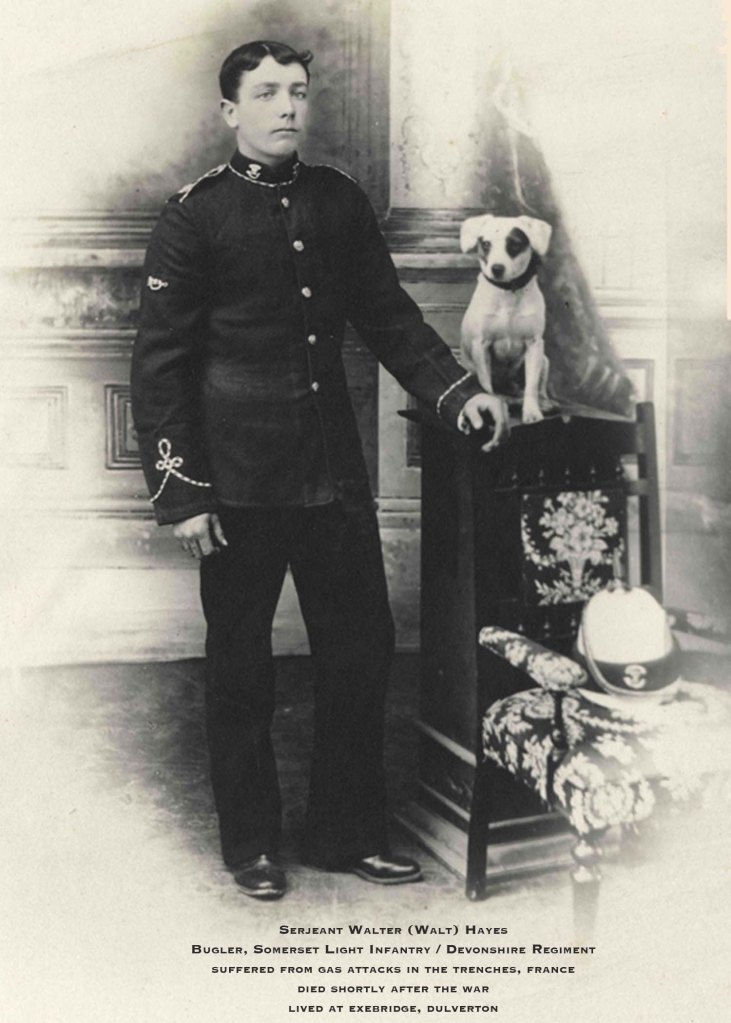
Walter Hayes was born in Somerset in 1883. The oldest of seven children, his parents were William and Mary Hayes. William was an agricultural labourer, and the family lived and worked at Houndhill, to the south east of Stogumber.
Walter also fell into farm work and, in the spring of 1914, he married Emily Mary Tarr. The wedding took place in Tiverton, Devon, but the couple did not stay there for long as, just weeks after their wedding day, Emily gave birth to a daughter, Edith, over the Somerset border in Dulverton.
Storm clouds were brewing over European shores, and Walter was called upon to play his part. His service records are also sparse, but they confirm that he initially joined the Somerset Light Infantry, before moving across to the Devonshire Regiment.
Walter had either been in the army earlier in his life, or he worked his way up during the war, and at some point he reached the rank of Serjeant. He saw fighting overseas and, according to later documentation, was caught up in a gas attack. This was to have an impact on his health and he was discharged from army service sooner than he might otherwise have done. Officially stood down in March 1919, he returned home to his wife and family.
Emily and Walter had a second child, William, later that year, and the family were finally able to settle into a routine. Walter’s health, however, was severely impacted and, on 12th January 1921, he passed away from bronchitis. The lung condition was found to be directly attributable to his war service, and that gas attack, Walter was 38 years of age.
Walter Hayes was laid to rest in the quiet graveyard of All Saints’ Church in Dulverton.
Emily was pregnant when her husband died: she gave birth to their third child, a son she named Walter, just a few months later. She did not re-marry, and, according to the 1939 Register, she was boarding in a house in Dulverton and carrying out unpaid domestic duties.
Emily lived on until the autumn of 1973, passing away in Taunton at the age of 85.
Serjeant Walter Hayes (courtesy of Trevor Hayes)
The early life of Walter Hayes was a challenge to piece together, as his was not an uncommon name in the area at the time. My thanks go to his great nephew, Trevor Hayes, for his help in pulling together the story and for the image of his great uncle.
Walter John Greedy was born in the spring of 1889, the eighth of nine children to Theophilus and Mary Greedy. Theophilus was an agricultural labourer from Wiveliscombe in Somerset, and it was here that the Greedy family were born and raised.
When he finished his schooling, Walter found work as a carter for a brewery. In 1906 his oldest sister, Charlotte, was widowed, and he moved in with her and her children to help provide some additional support. He soon found alternative employment, however, and within a couple of years was employed by Great Western Railways as a plate-layer.
On 26th December 1913, Walter married Irene Hobbs. She was a blacksmith’s daughter from nearby Fitzhead, who was working as a domestic servant when the couple wed. They went on to have three children: Frederick, Winifred and Dorothy.
When war was declared, Walter stepped up to play his part. Full details of his military service no longer remain, but he had certainly enlisted by the summer of 1918. Walter joined the Royal Engineers, and, based on his previous employment, was assigned to the 278th Railway Company.
Sapper Greedy served in Northern France, and was based in and around Boulogne. He survived the war, and was back on home soil by December 1918. This may have been because of illness: Walter was admitted to Exeter War Hospital in Devon, having contracted influenza and pneumonia. Sadly, the combination of conditions was to prove a fatal one: he passed away on 22nd December 1918, at the age of 29 years old.
Walter John Greedy was brought back to Somerset for burial: he was laid to rest in the peaceful graveyard extension of St Nicholas’ Church in Brushford, where Irene and their children were now living.
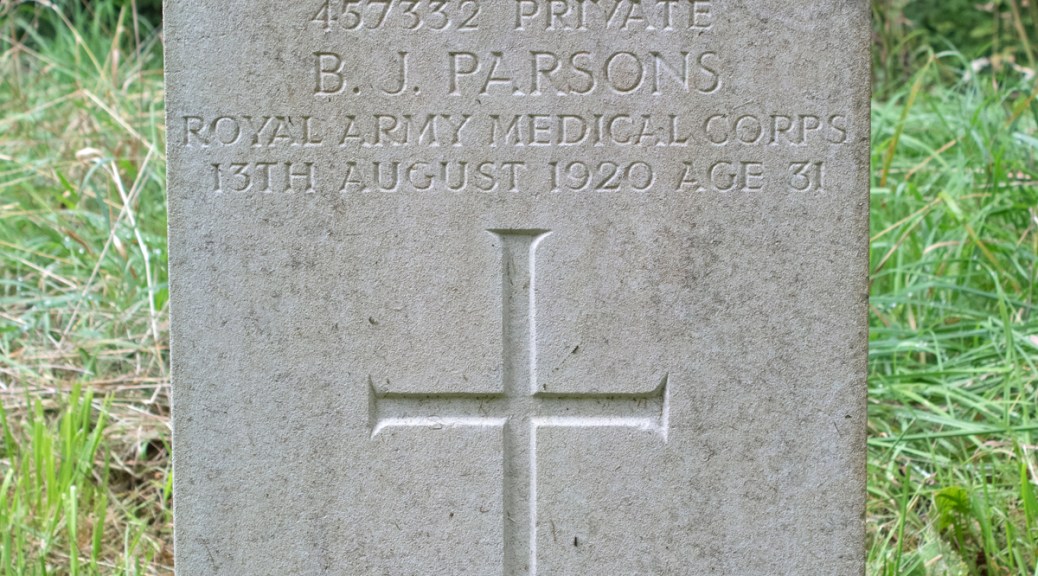
Bertie James Parsons was born in the summer of 1889, and was the fourth of six children to James and Elizabeth Parsons. James was a quarryman and slate-maker from Somerset, and he and Elizabeth raised their family in the parish of Ashbrittle.
While his older siblings found farm work in this peaceful part of the county, Bertie found employment as a baker’s assistant. This meant a move away from Somerset, and, by the time of the 1911 census, he was apprenticed to a bakery in the Crediton area of Devon.
The following year proved a tragic one for the Parsons family. Bertie’s younger brother, Richard, had found work as a hall boy for an estate in Wheathampstead, Hertfordshire. This was to prove a springboard for him, and he landed work for one of the new class of liners ploughing the waters of the Atlantic. Employed as a 2nd Class Steward, he was employed on the RMS Titanic and, like most of the ship’s 900 crew, he perished on that fateful night of 15th April 1912.
Among the large number of souls who perished with the Titanic recently we regret to report that among that number was a young man named Richard Parsons, aged 18, a native of Ashbrittle, and whose relatives still live in the neighbourhood, his father, James Parsons, being an invalid.
The deceased, who a couple of years ago embarked on a seafaring life, was on board the Olympic when it collided with the Hawke, and he left his home about a month ago, and journeyed to Belfast to assist in getting the Titanic ready for her maiden voyage.
He was particularly pleased at being appointed to a post on the largest ship in the world.
Deceased, who was a bright lad and much respected in the village, occupied the position of lift steward on his previous boat, and on the Titanic was a steward in a second-class dining saloon.
He was unable to swim.
Somerset County Gazette: Saturday 27th April 1912
Steward 2nd Class Richard Parsons
Back in Devon, Bertie was still working as a baker. When war came to Europe, however, he stepped up to play his part. While full service details are not available, it is clear that he enlisted in the Royal Army Service Corps as a Private. He was attached to the 2nd/1st Wessex Field Ambulance, who were sent to France in January 1916.
Private Parsons saw action – or helped treat the results of it – at some of the key battles on the Western Front: the Somme, Ypres, Cambrai, Givenchy and Festubert. In the autumn of 1917, Bertie returned home to marry Florence Riddaway, a milliner from Bow, Devon, who he had courted while working in nearby Crediton. The couple went on to have a son, Douglas, who was born on 26th May 1918.
It is unclear how long Bertie remained in the army after the Armistice was signed. By the summer of 1920, he was back on British shores, and had fallen ill. He was admitted to hospital in Bath with acute staphlococcic infection and a cerebral embolism. He died in hospital on 13th August 1920, at the age of 31 years old.
The body of Bertie James Parsons was taken back to Ashbrittle for burial. He was laid to rest in the village’s St John the Baptist Churchyard.
Tragedy was to remain close by for the Parson family. Florence was a couple of months pregnant when Bertie died. Bertie Jr was born on 26th March 1921, but both mother and son died during childbirth. They were laid to rest near her family in Devon.
Douglas, just two years old, was now an orphan. There is little information about his life in the aftermath of his parents’ passing, but by the time of the 1939 Register, he was working as a motor mechanic in Wellington, Somerset. He lived on until 1993, passing away in Taunton Deane, at the age of 74.
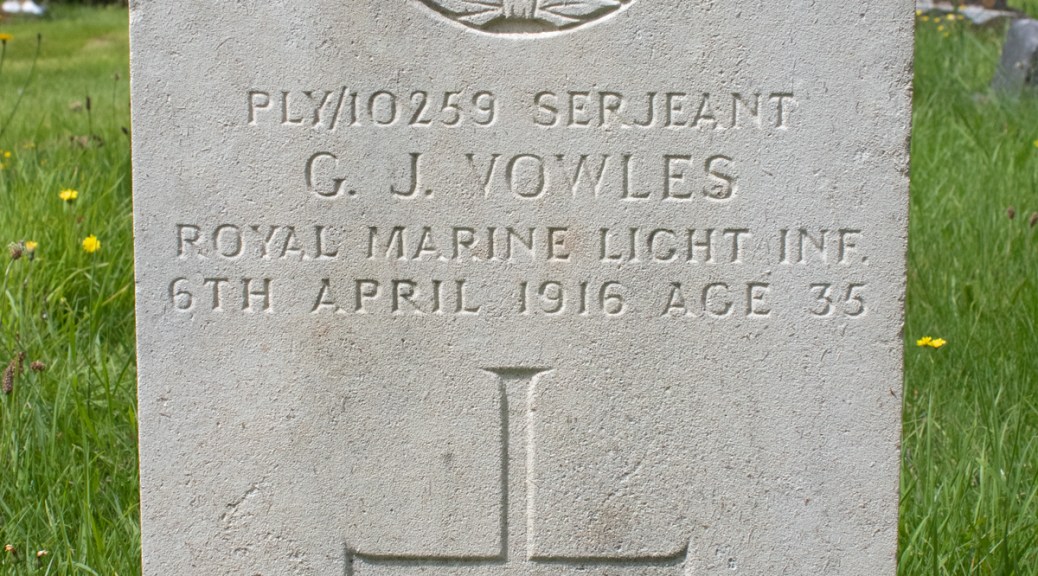
George Joseph Vowles was born in Winsley, Wiltshire, on 18th September 1881. The older of two children, his parents were Joseph and Sophia Vowles. Joseph was an agricultural labourer from Bedminster, who was 46 when his son was born, and twenty years older than his wife. By the time George’s sister was born, in 1890, the family had moved west, and had settled in Wraxall, near Nailsea in Somerset.
George found work as a gardener when he finished his schooling, but he had his sights set on bigger and better things. Sophia had died in 1894 and on 21st March 1900, he enlisted in the Royal Marine Light Infantry. His service records show that he was 5ft 6ins (1.68m) tall, with light brown hair, brown eyes and a fresh complexion. He was also noted as having a scar on the back of his neck.
For the next ten years, George seemed to flourish, serving on a number of ships, including HMS Niobe and HMS Andromeda. In between voyages, he was based at the RMLI depot in Plymouth. During this time he was promoted twice, to the rank of Corporal in September 1902 and Serjeant five years later.
Serjeant Vowles’ contract of service ended in 1911, but with his father now also having passed, he was re-engaged. He continued to make great strides, and, as war broke out, served on HMS Medea and HMS Theseus.
George’s service was cut short in the spring of 1916. Based back at the Plymouth Depot at the time, he fell ill with pulmonary tuberculosis. Sadly, the condition was to get the better of him, and he passed away on 6th April 1916, at the age of 35 years old.
George Joseph Vowles’ body was brought back to Somerset for burial. He was laid to rest in the graveyard of All Saints’ Church in Wraxall, alongside his parents, and not far from where his now-married sister, Dorothy now lived.
John Renouf was born in Bedminster, Bristol, on 26th June 1875. Hiss parents, Charles and Emily Renouf, had been born in St Helier, Jersey, and had moved to the mainland with their older children in around 1874. Charles was a blacksmith, initially working on naval vessels in Jersey, he continued his smithing when the family had settled in Bedminster.
John was one of seven children and became apprenticed to his father when he finished his schooling. Charles’ trade offered him an opportunity for a career, however, and, on 23rd September 1893, he enlisted in the Royal Navy as a Blacksmith’s Mate. His service records show that he was 5ft 7.5ins (1.71m) tall, with black hair, grey eyes and a fresh complexion.
John signed up for a 12-year contract, and was primarily based out of HMS Vivid, the Royal Naval Dockyard in Devonport. His records confirm that he was not shore-bound, however, and he spent time on eleven ships up to 1905. At this point, his contract came to an end, and he chose not to re-enlist.
At this point, John’s trail becomes a little hazy. He returned to Bristol, and seems to have continued working as a blacksmith. The 1911 census recorded him as being one of a number of residents at the city’s Salvation Army Hostel on Tower Hill. According to the same census, Charles, now 71 and a widower of three years, was living with his youngest son, Ernest, and family.
When war came to European shores, John’s skills as a blacksmith were to be called upon once again. His service records are no longer available, but it is clear that he chose not to re-join the navy, instead enlisting in the Royal Engineers as a Sapper.
Sapper Renouf’s trail goes cold again: he was assigned to one of the Waterways and Railway Troops, but it is unclear whether he spent his time on home soil or overseas. Either way, he survived the conflict, and was back in Britain soon after the Armistice.
The next record for John Renouf is that of his passing. He died in Bath, Somerset, on 30th December 1919, at the age of 44 years old. John was laid to rest in the sweeping grounds of the city’s Locksbrook Cemetery.












 Death and Service