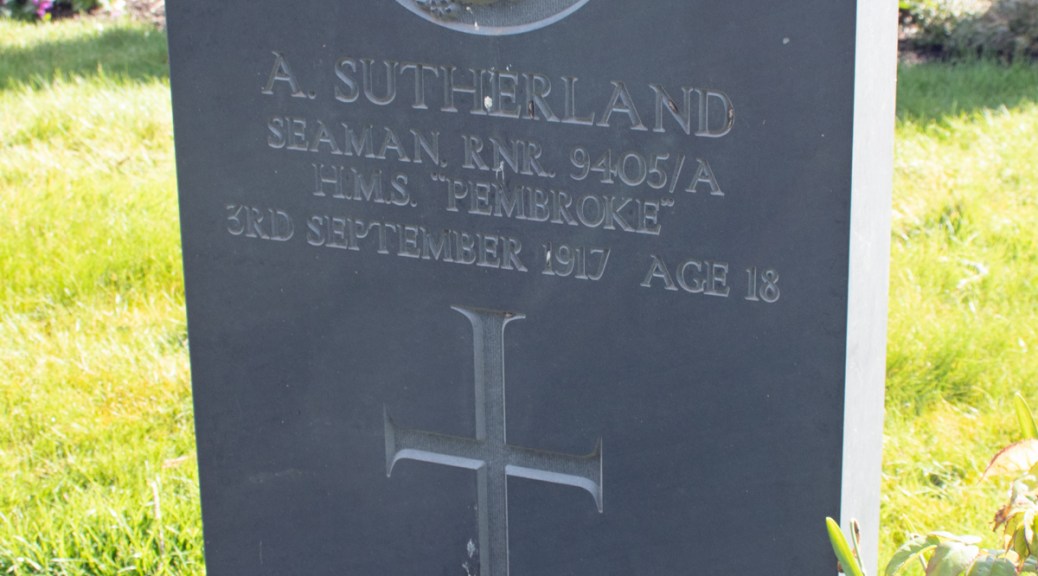
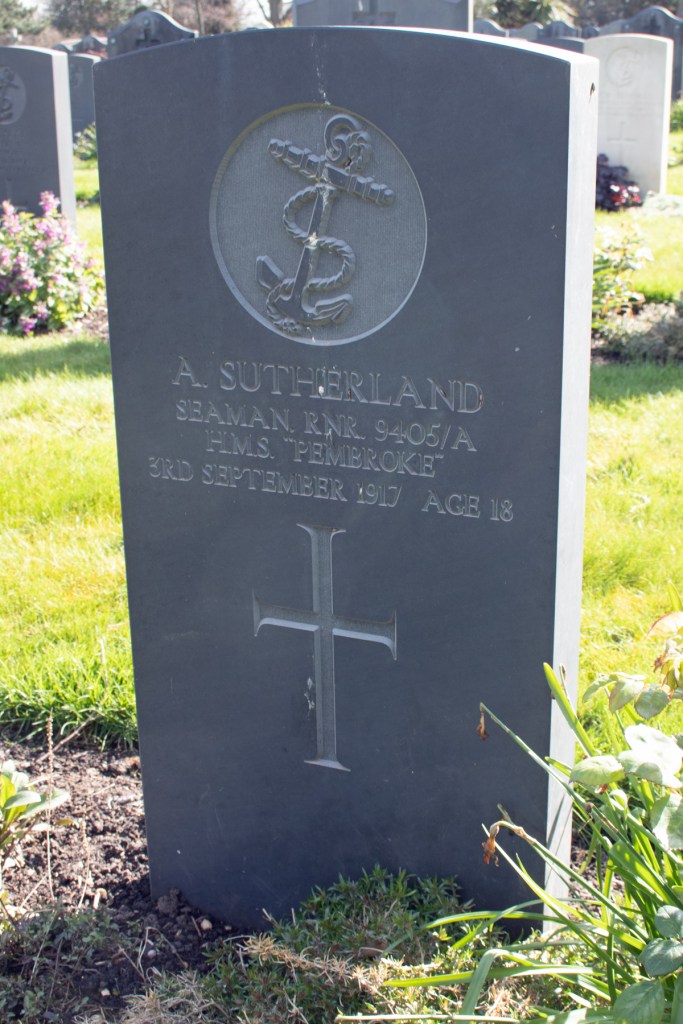
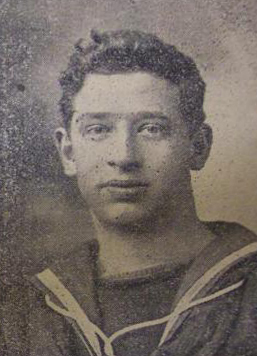
Alexander Sutherland was born on 20th May 1899 in the Scottish town of Brora. His parents were Peter and Jane Sutherland and he was one of four children, although, tragically, all three of his siblings died before they turned five.
There is little information documented about Alexander’s life: the 1901 census recorded him and his parents living with his paternal grandparents, but give little additional information. Peter died in March 1917, although, again, there is nothing to confirm a cause of death.
The document that provides the most detail about Alexander is his service record. He was too young to enlist when war broke out, but in August 1917, having turned 18, and possibly spurred on by the passing of his father, he joined the Royal Naval Reserve as a Seaman. The record shows that he was 5ft 11ins (1.8m) tall, had fair hair, blue eyes and a fresh complexion. He was also noted as having a scar on the left side of his neck.
Seaman Sutherland’s first posting was at HMS Pembroke, the Royal Naval Dockyard in Chatham, Kent and he arrived there on 23rd August 1917. The base was a particularly busy place that summer, and Alexander was billeted in some overflow accommodation in the barracks’ Drill Hall.
On the night of the 3rd September 1917, Chatham was bombarded by a German air raid, and the Drill Hall received a direct hit. Tragically, Seamen Sutherland was amongst those killed. He was just 18 years old and had been at the base for just ten days, and on active service for just over a fortnight.
Alexander Sutherland’s body was laid to rest in the Woodlands Cemetery in Gillingham, alongside the other victims of the Chatham Air Raid.
Alexander’s death was particularly tragic for his mother, Jane. She had lost three children early on, and both her husband and last child within six months. Her torment must have been unimaginable.
Mark Ford was born early in 1881 in Wellow, near Peasedown St John in Somerset. He was the youngest of eleven children, and the son of Thomas and Ellen Ford. Thomas was a coal miner, and this was a trade that his seven sons, including Mark, went into.
The 1901 census recorded Mark as boarding in a house in Abertillery, Monmouthshire, learning his trade. Within a few years, however, he was back in Peasedown St John. In the summer of 1910, he married local woman Emily Tucker and the couple set up home in Wellow, where they went on to have four children: George, Phyllis, Hubert and Ethel.
War was coming to Europe and, while records are scarce, it’s possible to build up a picture of the service Mark undertook. He initially enlisted as a Private in the Royal Berkshire Regiment, and was assigned to the 10th (Labour) Battalion. They were sent to France in June 1916, although it is not possible to confirm if Mark went at the same time.
His battalion became the 158th and 159th Labour Companies in April 1917, and it seems that Private Ford transferred to the former and, at this point, was definitely serving in France. That summer, he was wounded in the hip and head by an exploding shell and was medically evacuated to England for treatment.
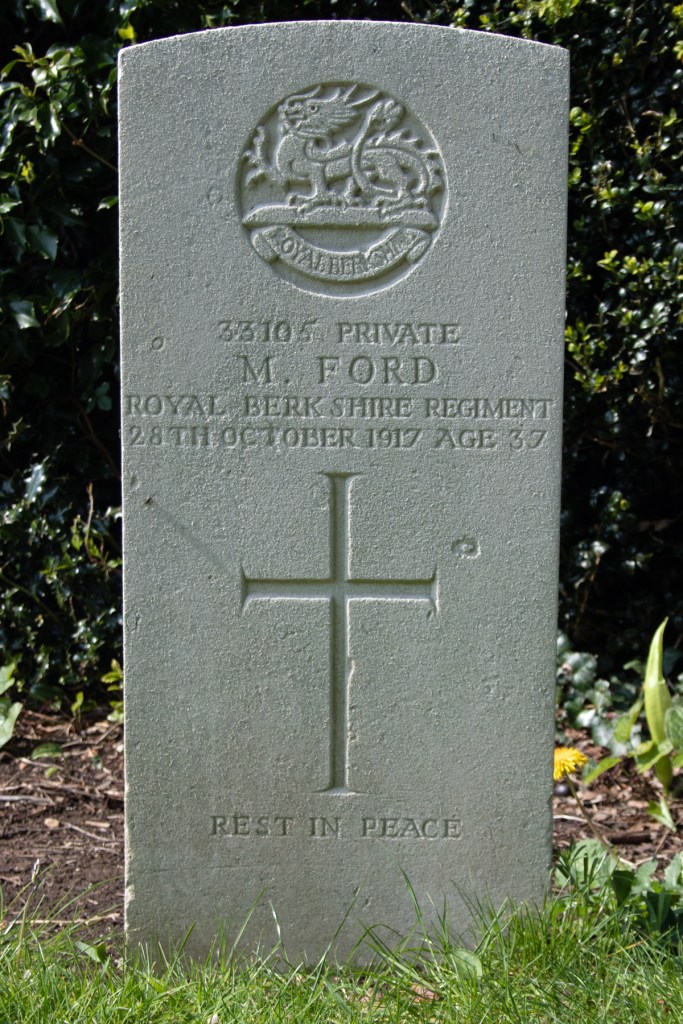
Private Ford was admitted to the Military Hospital in York, where he lay injured for some time; long enough, thankfully, for Emily to make the journey to be with him. Sadly, his wounds were to prove too much: he passed away at the hospital on 28th October 1917, at the age of 36 years old.
Mark Ford’s body was brought back to Somerset for burial He was laid to rest in the churchyard of St John the Baptist, in Peasedown St John.
William John Withers was born in the spring of 1883, in the Somerset town of Midsomer Norton. He was one of six children to William and Rose Withers. William Sr was a coal miner who went on to become a night bailiff, or caretaker, for the colliery. His son, however, sought different things, and, when he left school, he found work as a grocer’s assistant.
In the summer of 1909, William Jr married Florence Robbins, a miner’s daughter from Radstock. The couple went on to have a son, Allan, in June 1913 but tragically it appears than Florence either died in childbirth, or shortly afterwards.
In the summer of 1914, war came to Europe; by the end of the following year, William had enlisted, joining the Royal Garrison Artillery as a Gunner. His service records show that he stood 5ft 8.5ins (1.74m) tall, and weighted 147lbs (66.7kg). By this time he was working as a shop manager and, as a widower with a young son, it seems that, while he volunteered for service, he wasn’t formally mobilised for another year.
Gunner Withers was initially posted at the Citadel Fortress in Plymouth, but soon moved to Halton Park in Buckinghamshire. He spent time there training to be a Signaller, and in April 1918, he succeeded. That summer, he was posted overseas, serving as part of the 461st Siege Battery in France.
In March 1919, Signaller Withers returned to England. Details are a bit sketchy, but it seems that he was posted to Lincolnshire, and while there he fell ill. He was admitted to the Northern General Hospital in Lincoln with peritoneal adhesions; sadly these proved too much for his body to take; he passed away on 9th April 1919, at the age of 36 years old.
William John Withers’ body was brought back to Somerset for burial. He lies at rest in the graveyard of St Nicholas’ Church in Radstock.
The exact spot of William’s burial is unknown. The grave in the image is of his father, who passed away in 1921. It is likely that William Sr was buried with his son.
Bertie Ball was born in Westcott, Berkshire, in the spring of 1890, the oldest of ten children to John and Matilda Ball. John was from Berkshire, who raised his family in Wantage. He began life as a farm labourer, but, by the time of the 1901 census, he had found other employment, as a groom at a racing stable.
Details of Bertie’s life are scarce. When he left school, he found work as a garden labourer and, when war broke out, he enlisted in the Royal Army Service Corps. Private Ball was assigned to the Mechanical Transport Company, but whether he served overseas or on home soil is unknown.
Bertie died on 4th March 1915 from cerebrospinal meningitis. He was just 24 years old. He was laid to rest in the graveyard of St John the Baptist Church in Midsomer Norton – I can find no Somerset connection, so can only imagine that he passed away in or near the town.
Bertie’s younger brother Percival Ball also served in the First World War. He served with the 5th Battalion of the Wiltshire Regiment and fought in Mesopotamia. Sadly, he was killed there, dying on 5th April 1916. He was just 17 years of age. He is commemorated on the Basra Memorial in Iraq.
Edmund George Durnford was born in the spring of 1881 in the Somerset village of Pitcombe. The second oldest of twelve children, he was the oldest son to Edmund and Eliza Durnford. Edmund Sr was an agricultural labourer who travelled with the work – the 1891 census recorded the family living in Mells, near Frome.
When Edmund Jr left school, he found work at an ironmonger’s. He moved to Midsomer Norton and, in 1907, he married local carter’s daughter Bessie Welch. The young couple set up home in a terraced house on the road to nearby Radstock, and went on to have two children: Ian, who was born in 1908, and Ronald, born the following year.
War came to Europe, and Edmund was keen to play his part. He enlisted in the Royal Army Service Corps as a Driver, and was assigned to the 827th Company. Full details of his service are not available, but he remained a part of the territorial force and was promoted to Lance Corporal.
The local newspaper of the time reported on what became of Edmund:
Lance Corporal Edward [sic] G Durnford, Army Service Corps… son of Mr and Mrs EG Durnford… died suddenly on April 18 at Duston Hospital, Northampton, from shell shock and hemorrhage [sic] of the brain, was 38 years of age. The body was brought back from Northampton, and the deceased accorded a military funeral at Midsomer Norton last week.
Somerset Guardian and Radstock Observer: Friday 3rd May 1918
There are a couple of inconsistencies with the report. The newspaper has Edmund’s name wrong, while his pension record does not mention shell shock as the cause of death (it confirms the cerebral haemorrhage, but also cites a granular kidney). Given that Lance Corporal Durnford did not serve abroad, it seems unlikely that shell shock was a contributing factor.
The same article also places three of Edmund’s brothers in the war, and gives an insight into what had become of them before the conflict. Gunner Percy Durnford was with the Canadian Field Artillery, training in the South of England; Sergeant Major Arthur Durnford, of the Australian Light Horse, was based in Sydney; Bombardier Horace Durnford, of the Royal Garrison Artillery, had served in France, where he had been gassed, but was, at the time of his oldest brother’s death, based in Egypt.
Edmund George Durnford died in Northampton on 18th April 1918. He was 38 years of age. His body was brought back to Somerset, and he was laid to rest in the graveyard of St John the Baptist Church in Midsomer Norton.
Edmund’s younger son, Ronald, served in the Second World War. He joined the Royal Artillery, reaching the rank of Lance Bombardier. Ronald was serving in the Far East early in 1942, and for the next year, no news was heard of him.
However, contact was made in March 1943, confirming that Ronald had been captured by the Japanese, and was a prisoner of war in Borneo. Three months later, his wife, Kathleen, received a postcard from him, confirming he was a prisoner of war, well and unwounded.
Tragic news was quick to follow, however:
In last week’s issue it was stated that Mrs [Bessie] Durnford… had received through her daughter-in-law news that her son, Lance Bombardier Ronald Durnford, was a prisoner of war in Jap hands and was unwounded.
On Saturday she received the sorrowful news that he was dead in the following messages, which her daughter-in-law had sent on:
“I deeply regret to inform you a report has been received from the War Office, that [Ronald], who was reported a prisoner of war in Borneo Camp, had died from dysentery. The date of his death is not yet known, but you may rest assured as soon as any further information is received, I will immediately let you know.”
Somerset Guardian and Radstock Observer: Friday 30th July 1943
Lance Bombardier Durnford was laid to rest in the Labuan War Cemetery in Malaysia.
Further family tragedy, albeit with a life well-lived, was to follow as, on 6th September 1943, Bessie too died at the age of 86. She was laid to rest alongside Edmund in the family plot. Her obituary confirmed that “She leave a husband, seven daughters, and four sons to mourn her loss. One son and one daughter are in Canada, and one son in Australia, and one daughter and son in London.” [Somerset Guardian and Radstock Observer, Friday 17th September 1943]
Bessie had not, in fact, remarried: the husband was, in fact, the one who had died some 25 years before.
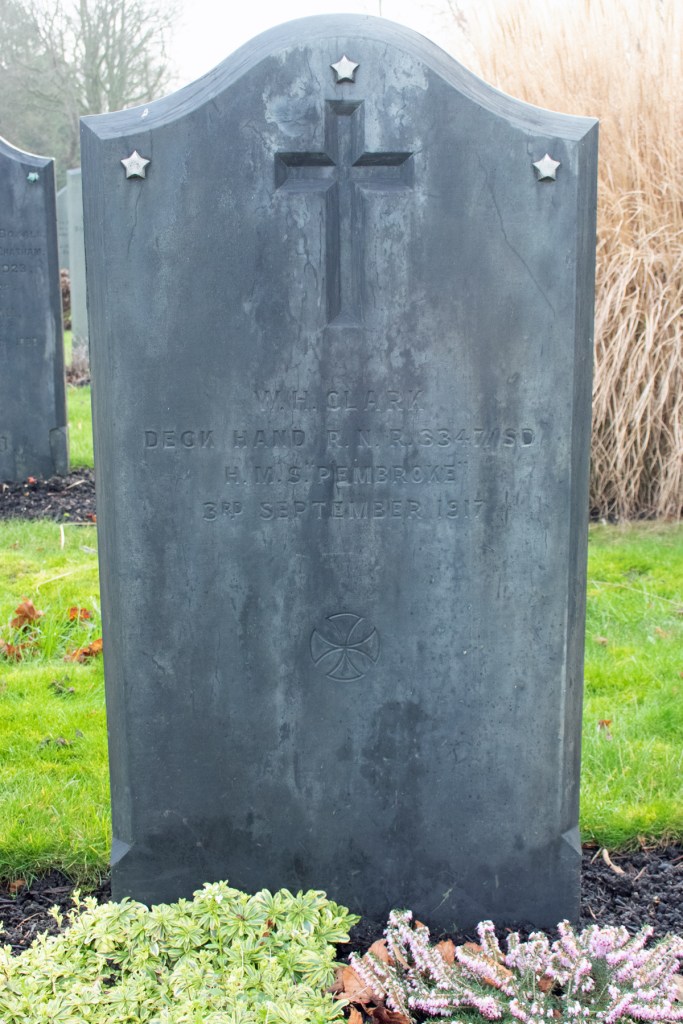
William Henry Clark was born in Whitby, North Yorkshire, on 15th March 1884 and was the younger of two children to James and Fanny Clark. Fisherman James drowned in September 1885, when the boat owned by his brothers-in-law – Robert and Mark Dryden – capsized.
Fanny and her children moved in with her Robert and her widowed mother, Martha, who was a lodging house keeper. In the spring of 1892, she married quarry labourer William Bennison. Her and James’ two children remained living with their grandmother; she went on to have three children with her new husband.
The 1901 census recorded young William working as a rivet heater in the local iron shipyard. He progressed in his work and, by the next census in 1911, remained living with his grandmother and uncle, but was working as a boilermaker in the shipyard.
When war broke out, William was called upon to play his part. While he had done engineering work, he also worked with his Uncle Robert on his fishing boat; this meant he was placed on reserve in the Royal Navy, and was not formally called upon as a Deck Hand until November 1915. Full details of his service are not available, but it is clear that he was based at HMS Pembroke – the Royal Naval Dockyard in Chatham, Kent – by the summer of 1917.
HMS Pembroke was a generally bustling place, but by the summer of 1917, it had exceeded capacity to the point where temporary accommodation was set up. William found himself billeted at The Drill Hall, away from the main barracks.
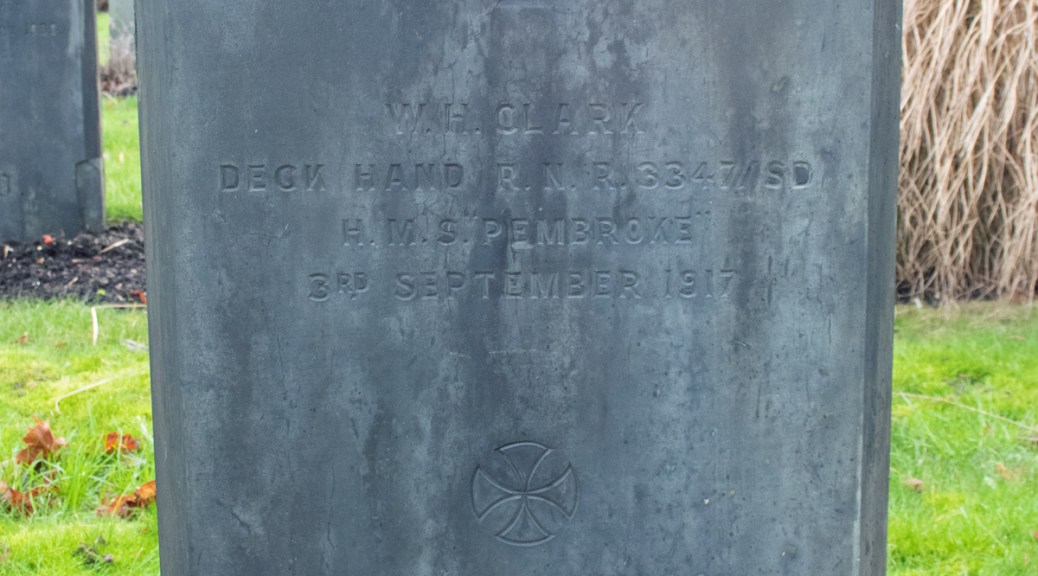
On the night of 3rd September 1917, Chatham suddenly found itself in the firing line, as the German Air Force launched a bombing raid. One of the bombs landed squarely on the Drill Hall, and Deck Hand Clark was killed. He was 33 years of age.
More than a hundred men perished during the Chatham Air Raid that night. They were buried in a mass funeral at the Woodlands Cemetery in nearby Gillingham. This is where William Henry Clark was also laid to rest.
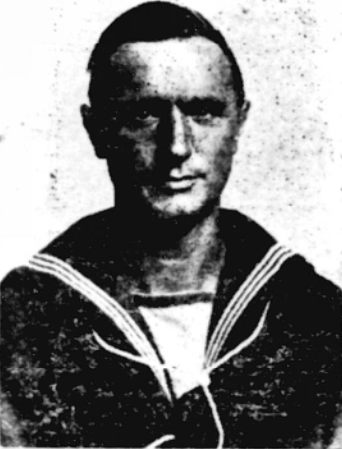
Deck Hand William Clark (from britishnewspaperarchive.co.uk)
A local newspaper had reported on William’s father’s death:
FATAL COBLE ACCIDENT: SURVIVOR’S NARRATIVE
We append the personal account of Robert Dryden, who was capsized along with his two comrades, James Clark and Mark Dryden, in the fishing coble Ann Maria… off Robin Hood’s Bay, on the morning of Saturday, the 19th inst. The tale tells of the marvellous escape of the narrator and of the sad drowning of his two mates, who each leave a widow and two children. The survivor, who is a stout and healthy fellow, had his left leg amputated some years ago, and a wooden support substituted. The following is his account:
“We were coming in from the fishing grounds on Saturday morning in our coble under a three-reefed sail, with two hundred herrings. There was a stiff breeze blowing form the south-east, with occasional squalls, and it was very dark. We should be, I reckon, about two miles from land… I had just gone into her head to see how she was coming for the land, leaving Mark at the helm, when a puff of wind took her on the starboard quarter and sent her over. We were floated out, and she sank directly, each of us catching hold of an oar.
“Just then a steamer passed us, and we shouted, but could not get their attention, and we all swam about, talking to each other, and I told them to keep their hearts up. We all had knee boots on, and, poor Jim, I think he must have been caught by the cold, for about twenty minutes after he sank. He was a fine fellow, as fine a fellow as you would meet in the streets.
“Shortly after he had gone, poor fellow, a tug boat passed us with a black and flesh-coloured funnel. I was too exhausted to shout much, and had to swim across her bows to keep clear. When she had passed, poor Mark had disappeared. I could then see the land, and with the sea beating on my left shoulder I set out for it…
“I was very disheartened after losing my mates, and all I had – for the coble belonged half to me and half to my brother – nets, money, and, all together, about £60 had gone…
“After a long swim, I neared the shore, and swam for the Blue Rock, because I could not swim further to a calm spot. I found myself on the rock after being, I think, knocked senseless by the seas. I climbed the cliff – it’s a bad coast about here – and walked for about two miles before I met anyone…
“I was several times almost in despair when in the water, and was much distressed at having to return with such a sad tale… It’s a great loss to me. Jim was my brother-in-law, and was 29 years of age, and Mark was my cousin, and 23 years old. It’s thirteen years since I had my other narrow escape, and I would sooner go to the poor-house than go through such another time of it.”
By this melancholy accident, two families have been plunged into deep grief and dire poverty, and deserve the sympathy and practical support of all kind and well-to-do-people.
Frederick Lutitt was born on 23rd May 1897, one of thirteen children – and one of twins – to Thomas and Mary Lutitt. Thomas was a sailor and so was away at sea a lot of the time. This left Mary raising the family alone, and the conditions seemed to have been against her.
The 1891 census recorded Mary as living at 11 Meard Street in St James, London. She was sharing the property with four other families at the time, although, with eight children by this point, hers was the largest. She was 40 years old and was earning some money working as a tailoress, as where here two oldest daughters.
Ten years later, and by now Mary was living in a new house; Thomas was away again, but four of her children – including Frederick – were still living at home, and there was also a boarder, 16-year-old printer’s boy Albert Poulter. Frederick and his twin, Charles, were working as errand boys at the local docks, while Mary was still tailoring.
Frederick was keen on bettering himself, however, and, on 25th January 1906, he enlisted in the Royal Navy. He signed up as a Stoker 2nd Class for an initial five year term of service, with another seven years in the reserve. His service records show that he has begun work as a labourer, and that he was 5ft 3.5ins (1.61m) tall, had brown hair, brown eyes and a fresh complexion.
Stoker Lutitt served on four ships during his term of service – HMS Acheron, Attentive, Endymion and Indomitable – and was promoted to Stoker 1st Class. Between each posting, however, he returned to his base port, the Royal Naval Dockyard in Chatham, Kent, which was also known as HMS Pembroke.
Frederick was stood down from active duty in January 1911 and that year’s census found him living back with his family in two rooms off Tottenham Court Road. Tailoress Mary was still very much the head of the household, with Frederick and Charles – who was employed as a trouser presser – still at home. Mary’s daughter, Ada, had moved back in with her two children in tow.
Storm clouds were gathering over Europe, and Frederick’s time on reserve was limited. He was recalled to HMS Pembroke in October 1912, and soon found himself at sea, on board the cruiser HMS St George. The following year, he was assigned to another cruiser – HMS Apollo – which had been converted to a minelayer.
Romance was in the air for Stoker Luttit, and on 11th April 1914, he married Edith Lambert. She was a plumber’s daughter from Kentish Town, and the couple wed at St Pancras Register Office, while he was on leave.
Two further postings awaited Frederick, the minesweeper HMS Bluebell and the coastguard gunboat, HMS Colleen. By July 1917, however, he found himself back at the dockyard in Chatham. It was a busy place that summer, and temporary accommodation was installed at Chatham Drill Hall. Frederick found himself billeted there.
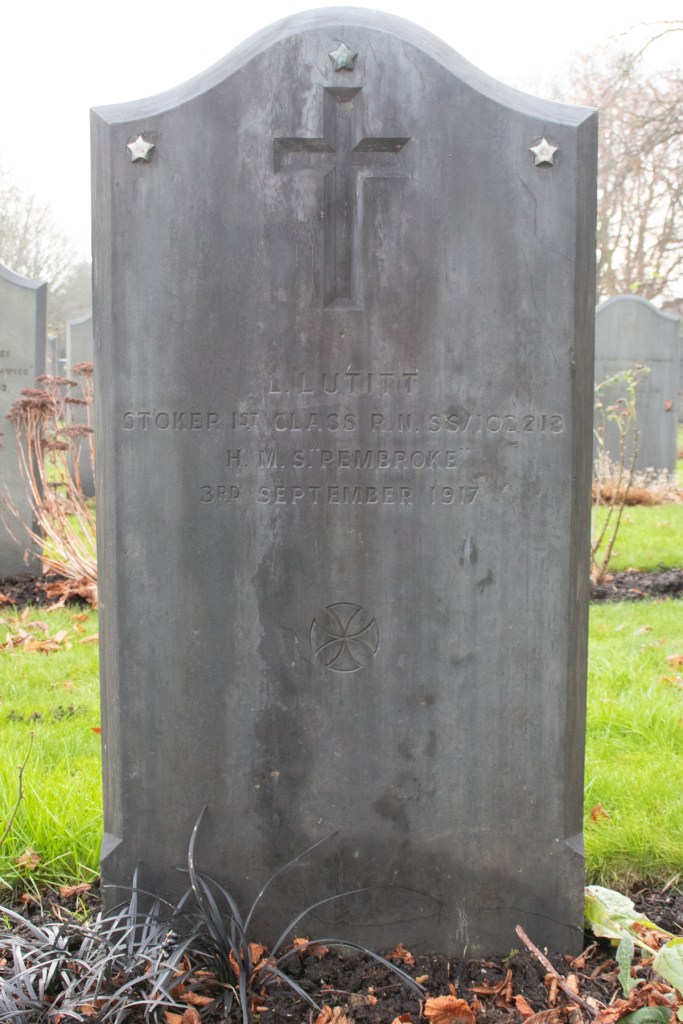
On the 3rd September 1917, the German Air Force carried out its first night air raid: Chatham was heavily bombed and the Drill Hall received a direct hit; Stoker 1st Class Lutitt was among those killed instantly. He was just 30 years of age.
Frederick Lutitt was laid to rest, alongside the other victims of the Chatham Air Raid, in the Woodlands Cemetery, Gillingham.
Frederick’s headstone gives the incorrect initial, but the details are correct.
Frederick’s older brother, Richard, served in the army. Initially enlisting in 1893, he served in Malta. He was called back into service in April 1915, joining the West Riding Regiment as a Private. Sent to France, he was killed on 12th December 1917, at the age of 42 years old; he left behind a widow and five daughters. He was buried at the Windmill British Cemetery in Monchy-le-Prieu.
Leonard Fish was born on 24th November 1893, one of eleven children to Arthur and Elizabeth. Arthur was a maltster (brewer) from Hertfordshire and it was in Ware that Leonard was born.
While Leonard’s older brothers followed in their father’s brewing footsteps, he worked as a farm labourer after leaving school. He wanted bigger things, however, and, on 25th February 1913, he enlisted in the Royal Navy.
Leonard’s service records show that he stood 5ft 9ins (1.75m) tall, had brown hair, blue eyes and a fresh complexion. He enlisted as a Stoker 2nd Class, and was sent to HMS Pembroke – the Royal Naval Dockyard in Chatham, Kent – for training.
Over the next four years, Stoker Fish travelled far and wide. His initial sea posting was on board the battleship HMS King Edward VII; he served on board for nearly two-and-a-half years, gaining a promotion to Stoker 1st Class in the process.
After a brief spell back in Chatham, Leonard was sent to HMS Vivid – a similar shore-based establishment in Devonport – and from there he was assigned to the newly fitted out battleship HMS Royal Oak. Within the month she was at the heart of the Battle of Jutland, and continued to protect the North Sea convoys.
Stoker Fish returned to HMS Pembroke in August 1917. The Dockyard was particularly busy that summer, and the large number of extra servicemen meant that Leonard was billeted in temporary accommodation in Chatham Drill Hall.
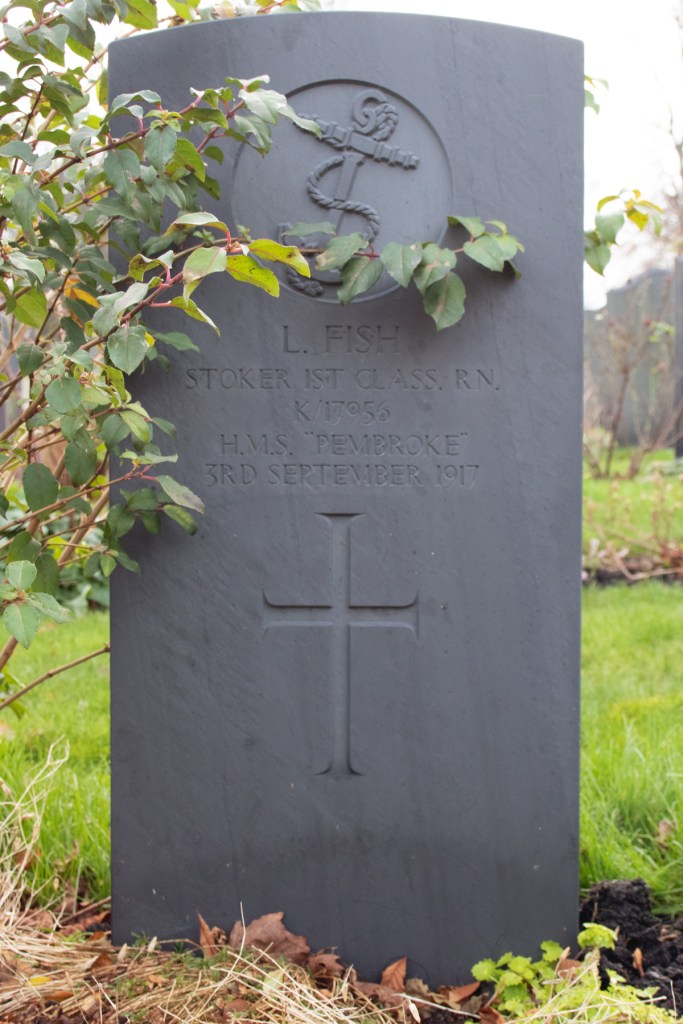
On the 3rd September 1917, the first night air raid carried out by the German Air Force bombarded the town, and scored a direct hit on the Drill Hall; Stoker Fish was among those killed. He was just 23 years of age.
Leonard Fish was laid to rest, along with the other victims of the Chatham Air Raid, in the Woodlands Cemetery, Gillingham.
Stoker Leonard Fish (from ancestry.co.uk)
Leonard’s older brother Frederick Fish also fought in the First World War.
Frederick was born three years before Leonard, and enlisted in the Royal West Kent Regiment in 1915. He was sent to France at the end of July, and gained the rank of Corporal.
He was killed in the fighting at the Somme on 13th July 1916. He was just 26 years of age, and left a widow, Ellen.
Corporal Frederick Fish was laid to rest in the Serre Road Cemetery No 2 in Beaumont-Hamel.
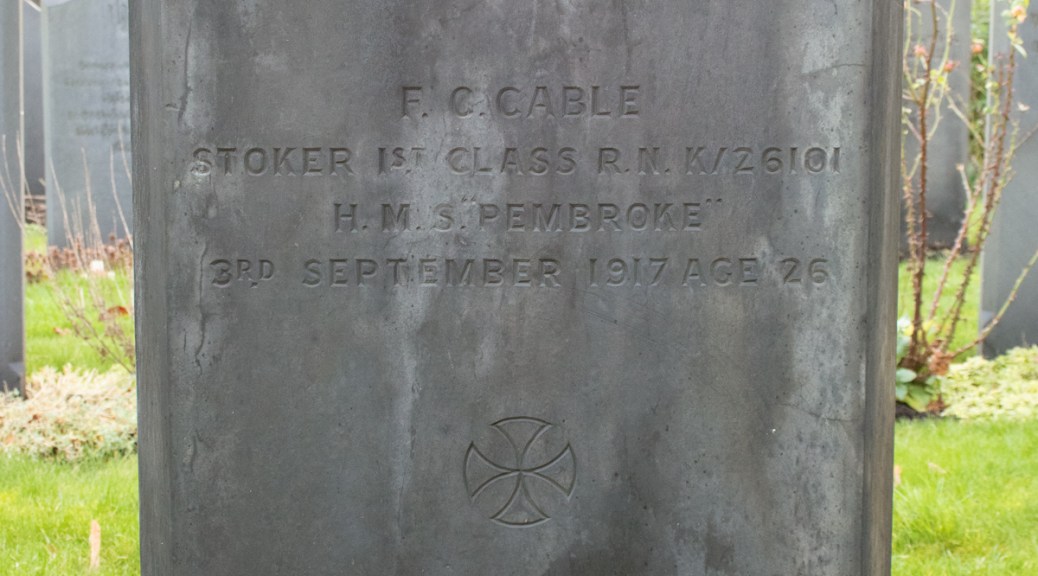
Frederick Charles Cable was born on 22nd November 1890 in Eastbourne, West Sussex. He was the younger of three children to John and Louisa Cable, and the family lived on one floor of a three-storey house in the middle of the town.
When Frederick was born, John was working as a billiard marker, but it seems that this was a poor way to scratch together a living for a young father. The 1901 census found the family in London, where John had been born, and where he was not employed as a hotel waiter.
Sadly, the new set-up was not to last long: John died in 1905, leaving Louisa to raise her boys on her own. The next census record, in 1911, records the two of them living a five-room terraced house in East Finchley. They were not alone, however, as they were sharing it with a widow – Elizbeth Hickinbottom – and her 34-year-old son, George.
A year later, George and Louisa married, and went on to have a daughter, also called Louisa. Frederick, meanwhile, was to find love of his own, and, in the spring of 1914, while working as a milkman, he married Dorothy Ada Laurence. They would go on to have a son, who they named after his father, a year later.
By this point, war was raging in Europe, and Frederick was called to do his duty in May 1915. His records show that he was 5ft 7ins (1.70m) tall, had dark brown hair, brown eyes and a dark complexion and was given the rank of Stoker 2nd Class.
Over the next couple of years, Frederick served on two ships – HMS Actaeon and HMS Weymouth – and it was on board the latter that he was promoted to Stoker 1st Class in April 1916. The majority of his time, however, was spent on shore-based establishments: HMS Victory in Hampshire and HMS Pembroke in Kent.
The Royal Naval Dockyard in Chatham (HMS Pembroke) was where he spent most of his time, and was where he returned to in the summer of 1917. It was a particularly busy place at that point in the war and temporary accommodation was set up. Frederick found himself billeted at The Drill Hall, away from the main barracks.
On the night of 3rd September 1917, Chatham suddenly found itself in the firing line, as the German Air Force launched a bombing raid. One of the bombs landed squarely on the Drill Hall, and Stoker Cable was killed instantly. He was just 26 years old.
Over a hundred servicemen perished during the Chatham Air Raid that night. They were buried in a mass funeral at the Woodlands Cemetery in nearby Gillingham. This, too, is where Frederick Charles Cable was laid to rest.
Frederick’s brother John Cable also fought in the First World War. He served as a Sergeant in the 21st Battalion Middlesex Regiment and was killed at the Battle of St Quentin on 25th March 1918. He was 28 years old and left a widow and three children.
Serjeant John Cable is commemorated on the Arras Memorial in Northern France.
Charles Cash was born on 8th August 1893 in Stepney, East London. He was one of seven children to Samuel and Clara Cash. The 1901 census gives Samuel’s trade as a fish porter, while his wife was recorded as a scrubber in a Sick Asylum.
Samuel died not long after the census was taken, and the family seems to have dissipated. Charles is recorded as having entered the local workhouse with his younger brother on 1st August 1906: the reason for admission being deserted by their mother.
The next census record – taken in 1911 – raises some hope for Charles as it found him living with his mother’s sister and brother-in-law in Bow, where he was working as a labourer in a chemical works.
Things continued to look up for young Charles. On 1st August 1915 – nine years after entering the workhouse, he married Florence Elizabeth Ribbons, a labourer’s daughter from Poplar. The couple went on to have one child, a daughter named after her mother, in October 1916.
War was, by this point, raging across Europe and, despite having a new baby, Charles had to play his part. On 12th December 1916, he joined the Royal Navy as a Stoker 2nd Class, and, given his age, it is likely that he was drafted, rather than volunteering.
Stoker Cash’s service records show that he was 5th 7.5ins (1.71m) tall, he had dark brown hair, brown eyes and a fresh complexion. He was posted to HMS Pembroke, the Royal Naval Dockyard in Chatham, and it was here that he served for nine months.
The summer of 1917 was particularly busy for the base, and temporary accommodation was set up in the Drill Hall; this is where Charles found himself billeted.
On the night of 3rd September 1917, Chatham suddenly found itself in the firing line as a wave of German aircraft bombed the town. The Drill Hall received a direct hit, and Stoker Cash was amongst those to be instantly killed. He was just 24 years old.
More than 100 servicemen perished during the Chatham Air Raid that night. They were buried in a mass funeral at the Woodlands Cemetery in nearby Gillingham. This, too, is where Charles Cash was laid to rest.