Lot Hayward was born in November 1897 in the Somerset village of West Coker. The seventh of eight children, his parents were Walter and Elizabeth Hayward. Walter was a twine maker at a local factory, but when Lot left school – and after Elizabeth died in 1908 – he found work as a farm labourer.
Lot was seeking bigger and better things in life, however, and on 18th August 1913, he enlisted in the Royal Marine Light Infantry. His service records confirm that he was 5ft 6ins (1.67m) tall, had light brown hair, brown eyes and a pale complexion. It also confirms that he lied about his age – giving his year of birth as 1895 in order to be accepted for service.
Private Hayward joined up at the recruitment depot in Deal, Kent, and, after training there, he was sent to Plymouth in Devon, arriving there in June 1914. Over the next couple of years, he moved between Devon and HMS Victory, the Royal Navy Dockyard in Portsmouth, Hampshire.
When war was declared, Lot also served overseas, fighting at Antwerp, Alexandria and in Turkey. While there in the summer of 1916, he fell ill, contracting pulmonary tuberculosis. He returned to Plymouth, and was admitted to the Royal Naval Hospital in the city.
His lung condition meant that Private Hayward could no longer perform his duties as a soldier. He was medically discharged from the navy on 10th June 1916.
Lot returned home, but his condition grew steadily worse. He eventually succumbed to it, passing away on 18th November 1917, at the tender age of just 20.
Lot Hayward was laid to rest in the graveyard of St Martin’s Church in his home village of West Coker. Reunited with his mother, Lot’s father, Walter, was also laid to rest in the family plot when he passed away in 1920.
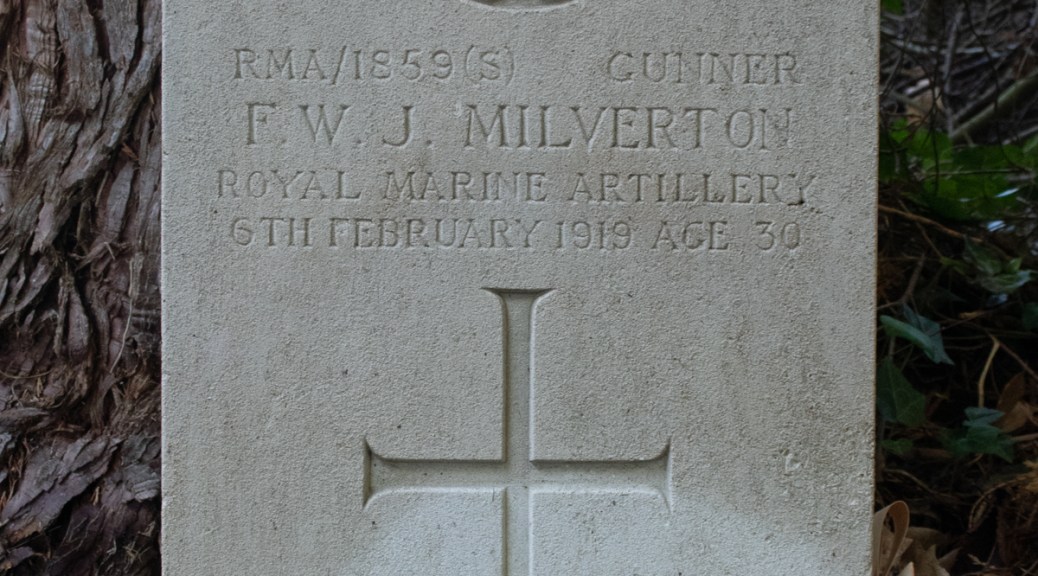
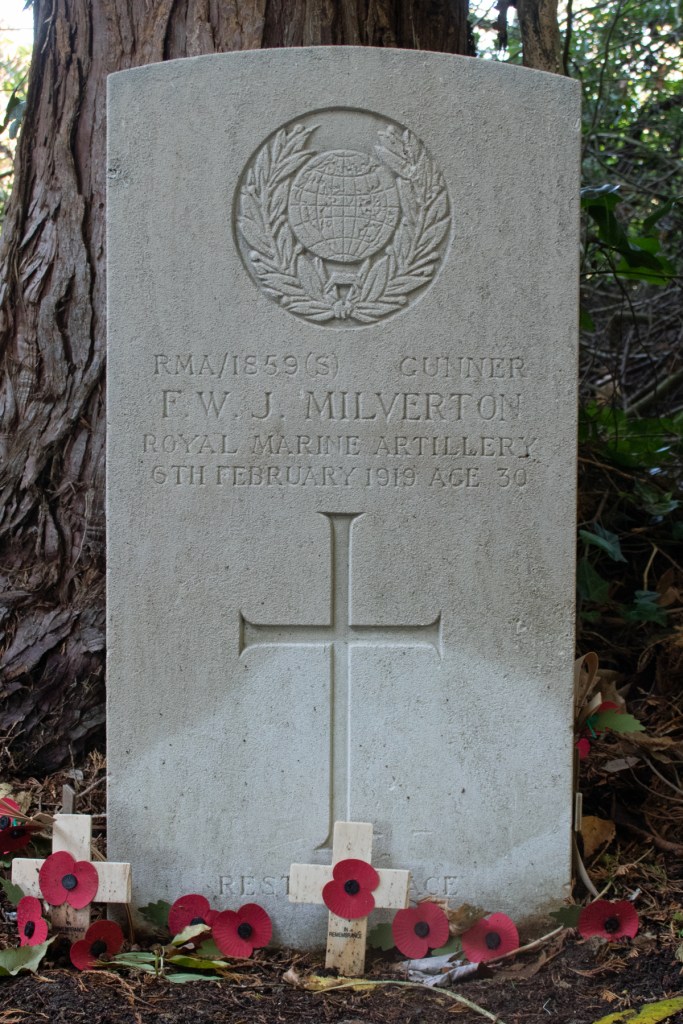
Frederick Walter John Milverton was born on 26th June 1888 in the Somerset village of Rimpton. One of seven children, his parents were farm workers George and Mary Milverton.
When he left school, it was natural for Frederick to follow in his father’s footsteps. The 1901 census recorded him as working as a farm lad in Leigh, Dorset, while in 1911 he was back at the family home, where he was formally employed as a rabbit trapper.
George passed away in 1913 and, with war fast approaching, Frederick remained at home, to help support his mother. But he eventually received his enlistment notice and, on 28th February 1916, he joined the Royal Marine Artillery.
Private Milverton’s service records show that he was 5ft 8ins (1.73m) tall, with dark brown hair, blue eyes and a fresh complexion. After five months’ initial training, Frederick was awarded the rank of Gunner 2nd Class, and assigned to the cruiser HMS Euryalus.
For the next couple of years Gunner Milverton remained on board Euryalus, serving in the Mediterranean, the Middle East, India and Hong Kong. He transferred to HMS Lavatera in March 1918, and saw out the remainder of the war on board.
In January 1919 Gunner Milverton returned to home soil, and was assigned to the Royal Marine Artillery Headquarters in Eastney, Hampshire. It was here, however, that he fell ill, and was admitted to the Royal Naval Haslar Hospital with bronchial pneumonia. Tragically the condition was to get the better of him: Frederick passed away on 6th February 1919, at the age of 30 years old.
Frederick Walter John Milverton’s body was brought back to Somerset for burial. He was laid to rest in the quiet graveyard of St Mary’s Church in his home village of Rimpton.
James Toop was born in the Somerset village of Galhampton on 13th January 1879. He was the fifth of eleven children to William and Elizabeth Toop. William was a farm labourer, and James followed his father’s line of work when he left school.
James disappears from documents for a while, only surfacing again in October 1914, when he enlisted for army service. At this point, he was working as a bricklayer, and notes that he had previously served in the Somerset Light Infantry. He is recorded as being 5ft 8ins (1.73m) tall, weighing 136lbs (61.7kg). He had brown hair, grey eyes, and gave his religion as Congregationalist. James also lied about his age, saying that he was 29 years and 9 months when, in fact, he would have been closer to 36 years old when he joined up.
Sapper Toop was assigned to the Royal Engineers, and spent nine months on home soil, during which time he was promoted to Lance Corporal. On 18th July 1915 he went to France, but returned just five days later.
Admitted to the Royal Victoria War Hospital in Netley, Hampshire, James was recorded as suffering the stress of campaign. He was moved to Napsbury War Hospital, near St Albans in Hertfordshire, after a couple of weeks. This institution – formerly the Middlesex County Asylum – was where servicemen suffering from shell shock were sent for rehabilitation, and Lance Corporal Toop joined the near 2,000 other residents.
James’ diagnosis was recorded as being neurasthenia with depression and, in October 1916, he was medically discharged from the army. The medical report noted that he had “had nervous breakdown, complained of vomiting of his food. Had defective memory. Had religious mania 5 years before enlistment.” While his condition was not the result of his war service, the medical board recorded that his mental debility has been aggravated by the strain.
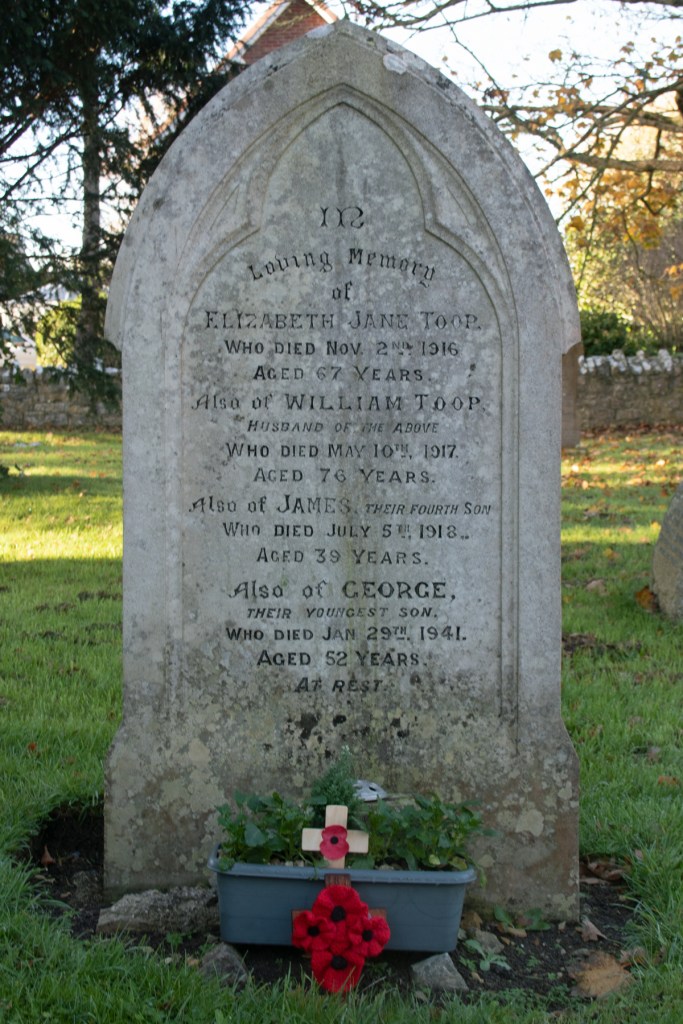
James falls off the radar again at this point. When he recovered, he returned to bricklaying for work. In 1916 his mother died, followed a year later by his father. Both were laid to rest in the family grave in St Mary Magdalene’s Church, Sparkford, Somerset.
James Toop died on 5th July 1918 at the age of 39 years old. He was also buried in the family plot, reunited with his parents far too soon.
Sidney William Biddiscombe was born in South Cadbury, Somerset, in the spring of 1895. The eighth of sixteen children, his parents were Thomas and Constance Biddiscombe. Thomas was an agricultural labourer, and this is work that Sidney went into when he finished school.
When war came to Europe, Sidney was quick to enlist. Whether this was out of a sense of duty, a keenness to get involved, a need to follow his older brothers, or as an escape from farm labouring is unclear, though. He joined the Somerset Light Infantry in August 1914, and was assigned to the 7th (Service) Battalion.
There is little information available about Private Biddiscombe’s time in the army. He received his training in Hampshire, and was based at Aldershot. The sudden influx of young men from across the country into small, cramped billets meant that illness ran rife, and Sidney, it seems, was not immune. He contracted measles, and was admitted to the camp’s Isolation Hospital.
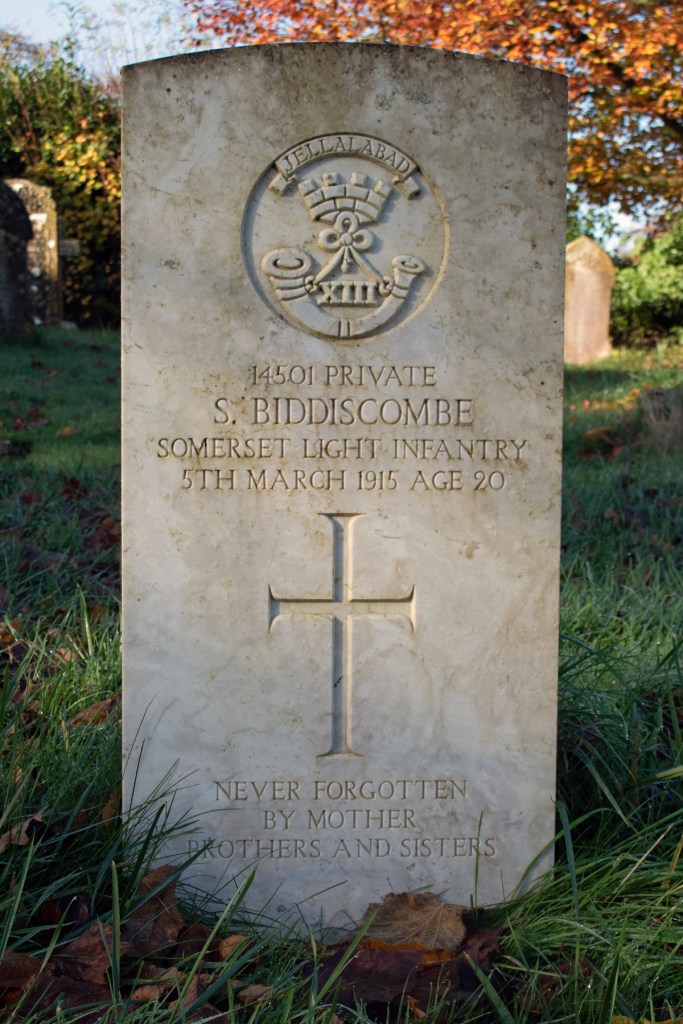
Sadly, the infection was to get the better of Private Biddiscombe, and he passed away at the hospital on 5th March 1915. He was just 20 years of age.
Sidney William Biddiscombe was brought back to Somerset for burial. He was laid to rest in the graveyard of St Thomas a Becket’s Church in his home village of South Cadbury.
Sidney’s epitaph notes he is “never forgotten by mother, brothers and sisters”. His father, Thomas, died in 1918, at the age of 62, and so was not commemorated on his son’s headstone, which was erected at a later date.
Frederick John Avards was born in Lamberhurst, Kent, in the summer of 1891. The oldest of three children, his parents were Frederick and Lucy Avards. Frederick Sr was a licenced publican and went on to run the Beckingford Arms in Tovil, near Maidstone.
Frederick Jr helped his father with the business, but when war came to Europe, he stepped up to play his part. He enlisted on 1st January 1915, joining the 7th (Service) Battalion of the King’s Royal Rifle Corps.
Rifleman Avards was sent to France on 19th May 1915 and very quickly found himself in the thick of things. Based on the Western Front, his regiment was involved in a number of skirmishes during the Battle of the Somme.
Last week [Rifleman Avards’] parents received a telegram stating that he was lying at the Royal Victoria Hospital, Netley, dangerously wounded. They at once proceeded to Netley but only to find that he had passed away.. Meanwhile his lieutenant, knowing he had been hit and thinking he had been killed on the battlefield, had written a feeling letter to the parents, saying his gallantly he had done his duty and that he had died a true rifleman’s death in the hour of victory, and worthily upheld the name of his regiment.
Kent Messenger & Gravesend Telegraph: Saturday 9th September 1916
Rifleman John Avards had passed away from his injuries on 3rd August 1916: he was just 24 years of age. His body was brought back to Kent for burial and he was laid to rest in the graveyard of St Peter & St Paul’s Church in Aylesford, Kent, not far from the Lower Bell public house, which his parents were then running.
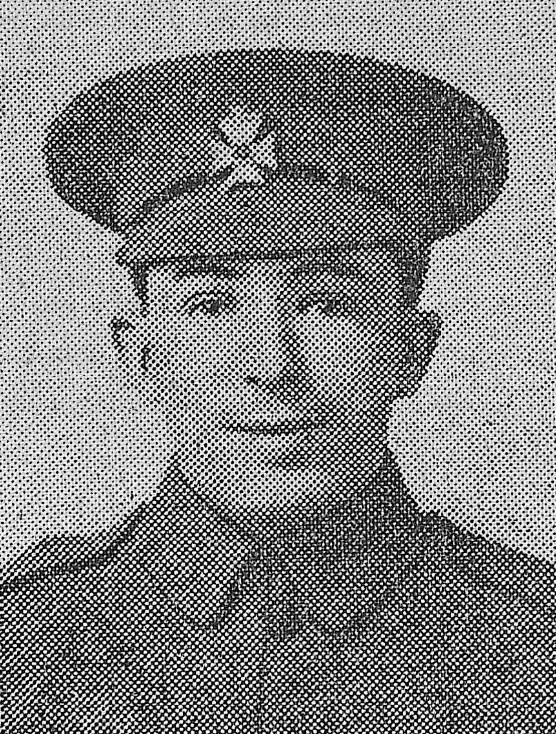
Rifleman Frederick Avards (from britishnewspaperarchive.co.uk)
While buried in the churchyard, the location of Frederick’s grave is not known. Instead, he is commemorated on a joint headstone in the First World War section of the graveyard.
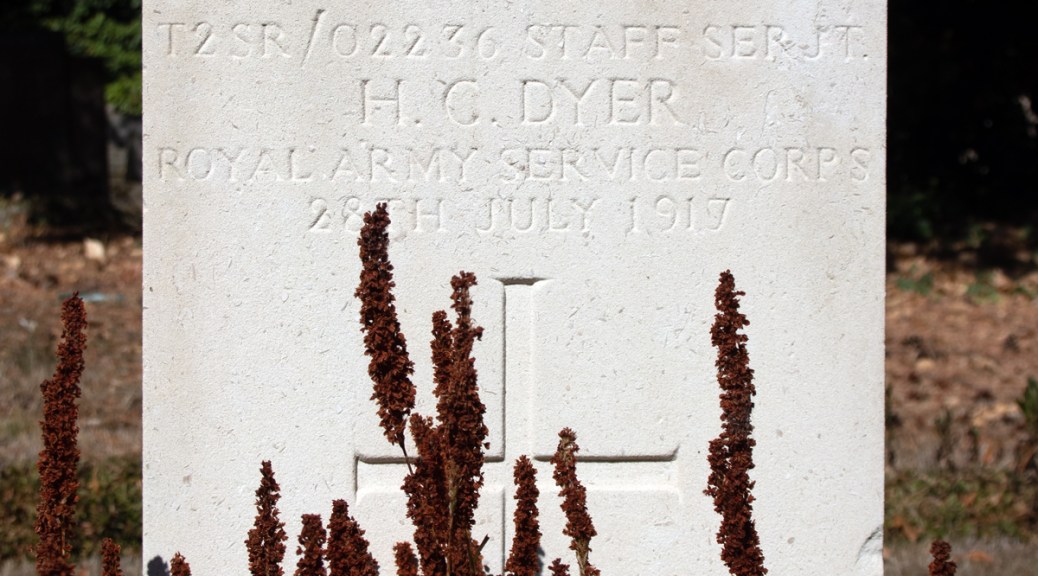
Henry Charles Dyer was born in January 1865 in the Devon town of Ivybridge. The oldest of five children, his parents were carpenter James and dressmaker Mary Dyer. When he left school, Henry found work as a cordwainer’s apprentice but, after James died in 1886, he sought out a career that would help support his mother.
Henry enlisted in the Army Service Corps on 10th July 1886 and, by the time of the next census was based at barracks in Woolwich, South London. His service records note that he was 5ft 4.5ins (1.64m) tall and weighed 124lbs (56.25kg). He had a dark hair, grey eyes and a dark complexion. He was also noted as having a tattoo of a cross on his left forearm.
Private Dyer served in the regiment on home soil for more than thirteen years, qualifying as a horse collar maker and saddler during this time and rising through the ranks. He was made a Driver in 1889, Corporal in 1895 and Staff Sergeant in October 1899.
Trouble was afoot on the other side of the world by this time and his promotion was linked to Henry being sent to South Africa. He was there for eighteen months, and was awarded the Queen’s South Africa Medal, as well as clasps for service at Tugela Heights, the Relief of Ladysmith, Laing’s Nek, Transvaal and Orange Free State.
Staff Sergeant Dyer went back to Britain in April 1901, where he remained for a further six years. On 4th July 1907, reached the end of his term of service and having completed 21 years with the Army Service Corps he returned to civilian life.
Henry moved back to Devon, moving back in with his mother and younger brother. Mary had remarried after James passed, but her second husband had also passed away, and so having two of her sons home would have been of comfort to her. The 1911 census records the family as living in three rooms of a house in Grenville Street, Plymouth. They shared the property with the Smith family, a husband, wife and two children. Henry was recorded as an army pensioner (saddler), while his brother Ernest was listed as being a watchmaker, while also in the army reserve.
War was on the horizon again, and, Henry was one of the first to step up when it was declared. He was 49 years old by this point, and so technically exempt from enlisting, but as an army life had served him well before, it must have seemed fit for him to serve King and Country once more.
Staff Sergeant Dyer’s new service records noted that he was formally employed as a saddler, and that he had put on 18lbs (8kg) since he initially signed up.
Henry was based firmly on home soil this time round, and while he was initially based in Aldershot, Hampshire, he seems to have been moved to barracks in Kent. He served for more than two and a half years, but his health seems to have been suffering by this point. At a medical on 24th July 1917, he was deemed to be no longer fit enough for war service and was discharged from the army.
It is likely that this discharge came while he was admitted to the Preston Hall Military Hospital in Aylesford. While Staff Sergeant Dyer’s earlier military service is fairly detailed, his later career is not. What is clear is that, four days after being discharged, he passed away. He was, by this time, 52 years of age.
A lack of funds may have prevented Mary from bringing her son home to Devon. Instead Henry Charles Dyer was laid to rest in the graveyard of St Peter and St Pauls Church in Aylesford, not far from the Kent hospital in which he passed.
David Coleman was born in the spring of 1880, one of nine children to Jeremiah and Mary Coleman. Jeremiah was a farmer from County Cork, Ireland, and it was in his home village of Killbrittain that the family were raised.
When David left school, he found work as a labourer and mechanic and, in the spring of 1896, he left Ireland for England in search of a bigger and better life for himself.
Things may not have gone quite to plan, however, and, on 17th March 1897, he enlisted in the Royal Navy. He was too young to enrol for full service at this point, however, and so he took on the rank of Boy 2nd Class. He was initially assigned to the training ship HMS Northampton and quickly made Boy 1st Class.
Over the next year, David served on two vessels – HMS Calliope and HMS Doris. When he turned eighteen, he was officially enrolled in the Royal Navy, and given the rank of Ordinary Seaman.
David remained on HMS Doris for nearly four years, and seemed to impress his superiors. By the end of his time on board, he had been promoted again, reaching the rank of Able Seaman.
Over the next nine years, Able Seaman Coleman served on ten different ships, each time returning to HMS Vivid, the Royal Naval Dockyard in Devonport. In March 1910, with his contract complete, he was stood down to reserve status.
The same year, he married Florence Tompkins, who had been born in Newton Abbot, Devon. The couple set up home in Totnes and went on to have three children. David found work as an electrician for the local electric light works.
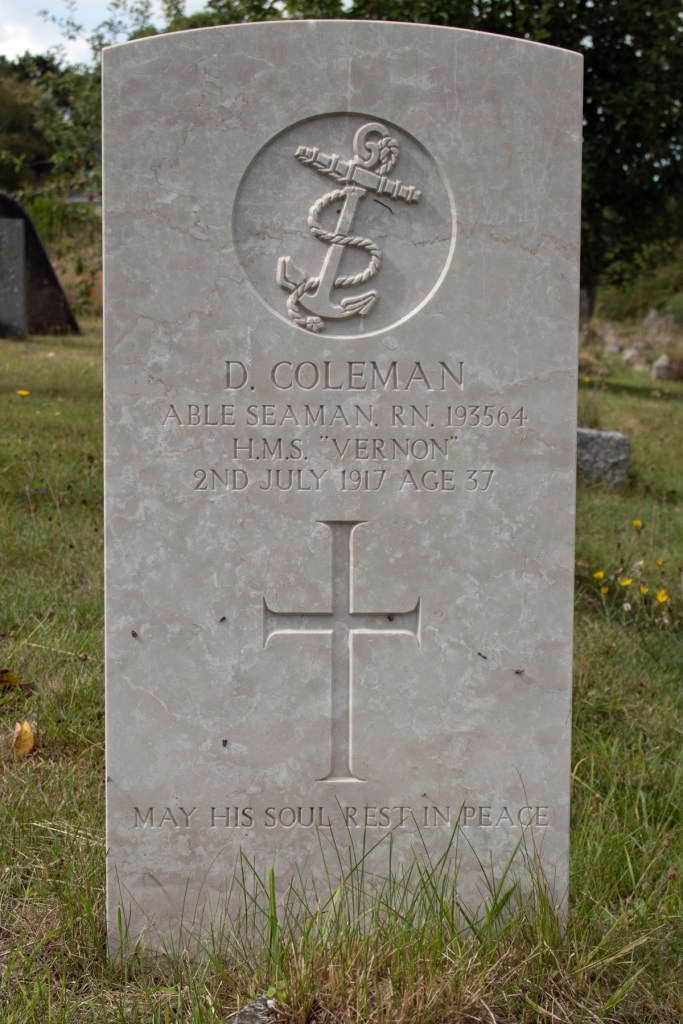
War was coming to Europe by this point and, in August 1914, Able Seaman Coleman was called back to duty. He served for two years on board the battleship HMS Caesar and, having previously been assigned to HMS Defiance, returned there again. In May 1916, he was assigned to HMS Vernon, one of the shore-based establishments in Portsmouth, Hampshire.
It was while he was in Portsmouth that he fell ill, and was admitted to the town’s Haslar Hospital. Details of his condition are unclear, but he was to succumb to it, passing away on 2nd July 1917, at the age of 37 years old.
David Coleman was brought back to Devon for burial: he was laid to rest in the town’s cemetery, not far from the family home.
Tragedy was to strike the Coleman family again when, early in 1918, both of David and Florence’s younger children – David, aged 5, and Mary, age 2 – passed away. Causes of death are again unclear, but it seems likely to have been one of the lung conditions that would ravage Europe as the war entered its final stage.
George Garrett was born in early 1895 in Abbotskerswell, Devon. He was the oldest of five children to George and Annie Garrett. George Sr was a labourer and the family seemed to travel with his work: his and Annie’s younger children were born in Aldershot, Plymouth and London.
When he left school, George Jr found work as an errand boy – the family were back in Devon by this point. War was on the horizon, however, and he would feel compelled to play his part. Full details of his service are not available, but it is known that he enlisted in the Devonshire Regiment, and was assigned to the 2nd Battalion.
Private Garrett arrived in France in December 1915, and was soon entrenched on the Western Front. Hi battalion was caught up in the Battle of the Somme and George was badly injured, having received a gunshot wound to his spine.
Medically evacuated to Britain, his wounds proved too severe for him to return to duty, and he was discharged from the army on 28th December 1916. It is not clear whether he returned home, but it seems likely that he remained in hospital in Exeter. He would never recover from his injuries. He passed away at the hospital on 18th April 1917, at the age of 22 years old.
George Garrett was laid to rest in the graveyard of St Andrew’s Church in Ipplepen, Devon, where his family were, at that point, living.
Philemon Witheridge Richards was born on 9th July 1891 in Porthleven, Cornwall. He was one of at least seven children to George and Ann Richards. George was a sailor, as were he two oldest sons and, by the late 1890s, the family had made the move to Penarth in Glamorganshire.
When he left school, Philemon followed his father and older brothers into sailing. By the time he turned eighteen, George had passed away and Philemon wanted bigger and better things. On 16th July 1909, he enlisted in the Royal Garrison Artillery. His service records show that he stood 5ft 9.5ins (1.76m) tall, had good vision and was of good fitness.
Gunner Richards was posted to No. 6 Company and remained part of the territorial force. On 1st July 1911, after twenty months’ service, he was, at his own request, discharged from the army.
The trail goes cold for a while, and Philemon seems to have returned to a life at sea. This changed, however, when war broke out and, in October 1915, he was drafted into the Royal Naval Reserve as a Deck Hand.
Philemon’s time in service seems to have been shore-based however. After an initial posting to HMS Vivid, the Royal Naval Dockyard in Devonport, he moved to HMS Victory, which was the name given to the dockyard in Portsmouth, Hampshire. He moved on again in the autumn of 1916, by which point he was based at HMS Pembroke, the Royal Navy’s shore-base in Chatham, Kent.
It was here that Deck Hand Richards fell ill. It is unclear what the condition was, but he was admitted to the Military Hospital in Chatham on 20th October 1916. His illness worsened, and he passed away there on 2nd November. He was just 25 years of age.
Philemon Witheridge Richards was brought back to Glamorganshire for burial. He lies at rest in the graveyard of St Augustine’s Church in Penarth.
Philemon’s gravestone is also dedicated to his brother, Thomas Witheridge Richards. Eighteen years Philemon’s senior, Thomas had been a sailor, and, while no records remain, it seems likely that he may also have been called into service during the First World War. He died at home on 4th July 1918, at the age of 45 years old. He was laid to rest in the same plot as his younger brother.
Walter Strickland was born in 1890 in Pitminster, Somerset, the youngest of eight children to William and Sarah Strickland. William was a farm labourer, but his son found employment in the local coal mines on leaving school.
In December 1910, Walter married local woman Eliza Burton. The couple moved with Eliza’s brother and sister-in-law to Monmouthshire, where mining was the primary industry. After a couple of years, the young couple moved back to Somerset and went on to have a son, Wilfred, who was born in 1913. Walter had found other work, by this time, and was employed as a groom.
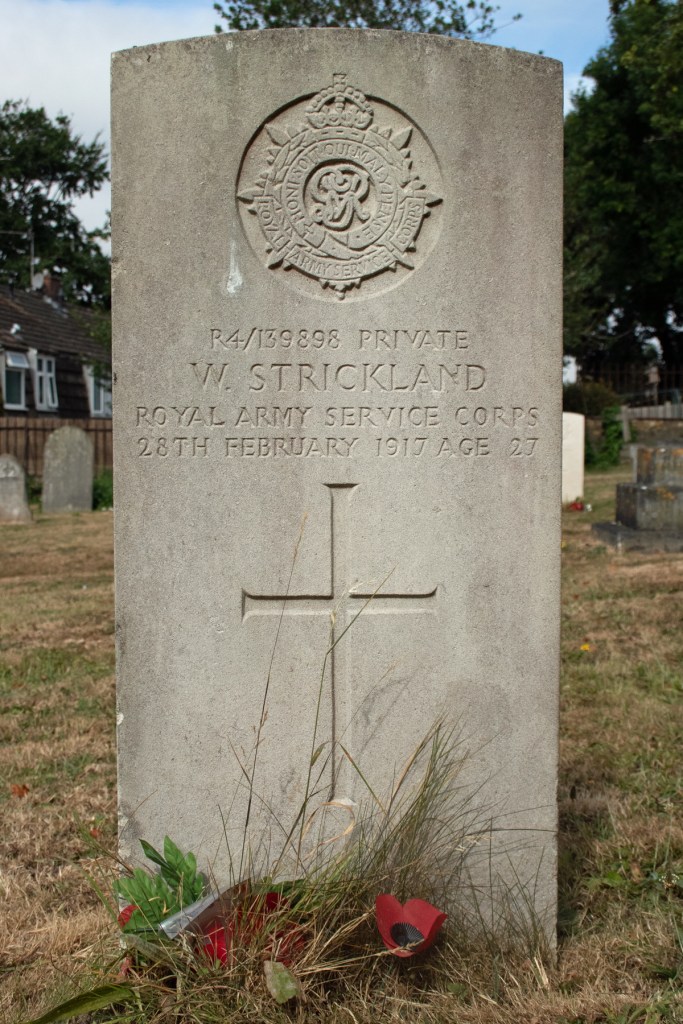
Storm clouds were brewing over Europe, and Walter enlisted in September 1915. He was assigned to the Royal Army Service Corps and given the rank of Private. His service records show that he was 5ft 6ins (1.67m) in height, and had a 35in (89cm) chest measurement.
Details of Private Strickland’s military service are limited. It seems likely that he was sent overseas, but that cannot be confirmed. By the start of 1917, however, he was back in England, and had been admitted to the Royal Victoria Hospital in Netley, near Southampton. He was suffering from an exophthalmic goitre – also known as Grave’s Disease – which results in heart palpitations, and an enlargement of the thyroid gland.
Sadly, this was an illness to which Private Strickland was to succumb: he passed away in the hospital on 28th February 1917, Eliza by his side. He was just 27 years of age.
Walter Strickland’s body was brought back to Somerset for burial. He was laid to rest in the graveyard of All Saints’ Church in his now home town of Norton Fitzwarren.










 Death and Service