Tag Archives: influenza

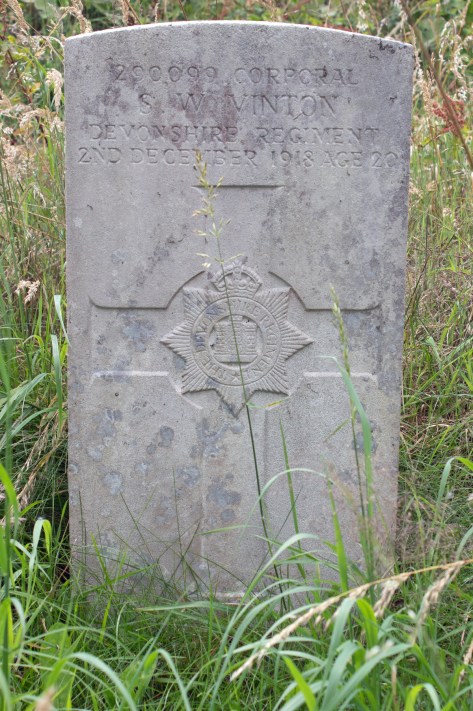
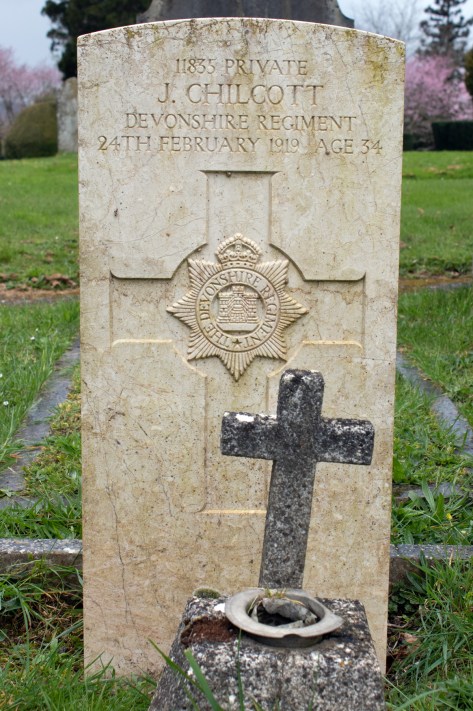
Private James Chilcott

Private James Chilcott

James Chilcott was born in Eccles, Lancashire, in the autumn of 1885. One of twelve children, his parents were William and Mary Chilcott. William seemed to be able to turn his hand to most things: the 1891 census recorded him as a hawker of fish, while ten years later he was employed as an insurance agent.

The Chilcotts had moved to Tiverton in Devon in around 1891, setting up home on St Andrew’s Street, to the south of the town centre. James initially found work as a bookseller’s assistant when he left school, but things were to change.

In the autumn of 1908, James married Mabel Candey. The couple moved to Nottinghamshire, settling in the village of Cresswell, where they lived in a small cottage at 6 John Street. James had found work as a coal miner in the area, which had taken the couple away from the comfort of Devon.

Over the next four years, James and Mabel would have four children, all of whom died before they celebrated their first birthday. The series of tragic events may have driven a need for Mabel to be with family, and by 1913, the couple had moved back to Tiverton. Daughter Dorothy was born in 1914.

When conflict his Europe the following year, James stepped up to play his part. Full details of his military service hare long since lost, but it is clear that he enlisted in the Devonshire Regiment, and had done so at the beginning of the war.

Attached to the 2nd Battalion, Private Chilcott was in France by 9th February 1915. Over the next few years, the unit saw fighting in most areas of the Western Front, including the Somme and Ypres. It is unclear how much of this James was involved in, but it is unlikely that he would have come away completely unscathed.

Pte. James Chilcott, of the 2nd Devons, who went through the dispersal camp at Fovant on February 20, died at Exeter on Monday from influenza. A son of Mr WH Chilcott, of St Andrew-street, Tiverton, he joined up at the beginning of the war, and had seen considerable service. He leaves a widow and one child.

[Western Times: Wednesday 26th February 1919]

James Chilcott died on 24th February 1919: he was 33 years of age. His body was taken back to Tiverton for burial, and he was laid to rest in the town’s cemetery.


“He leaves a widow and one child” does no justice to the pain that Mabel had to go through, having lost four children and her husband in a matter of six years. The 1921 census recorded her living on St Andrew Street with Dorothy, and showing she was undertaking home duties. She had two lodgers, who helped bring in a little more money.

Mabel Chilcott never remarried: she passed away in Tiverton in January 1946, at the age of 62.


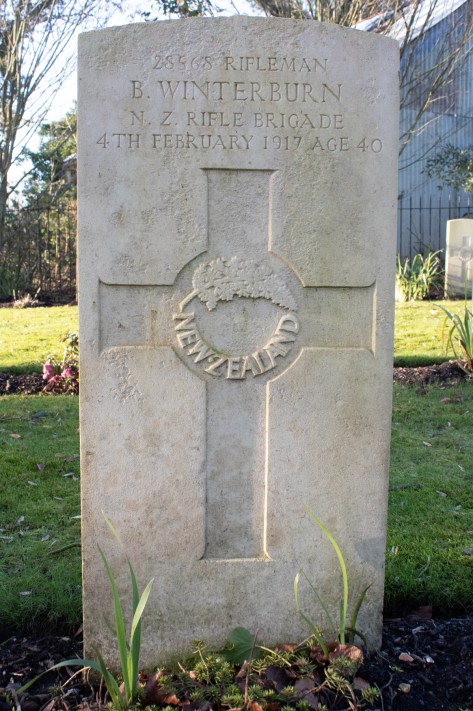
Rifleman Alexander Shaw

Rifleman Alexander Shaw

Alexander Richardson Shaw was born in Sandhurst, Victoria, Australia, on 10th February 1884. The second of seven children – although two of his younger siblings died when just babes-in-arms – his parents were Thomas and Elizabeth Shaw.

Little is known about Alexander’s early life. Thomas passed away in 1890, and Elizabeth was left to raise the family alone.

The next document for Alexander is his army service record, confirming that he enlisted on 27th June 1916. By this point he had moved to New Zealand and settled in Wellington. He was employed as a labourer and working for a GG Holmes.

It seems that Alexander had tried to enlist before: his records show that he had previously been turned down because of poor eyesight. At this point, however, with the war raging in Europe, and thousands of New Zealanders being called upon, he was taken on. His service records show that he was 5ft 8ins (1.72m) tall, and weighed 12st 6lbs (78.9kg). Alexander was also noted as having fair (reddish) hair, blue eyes and a fresh complexion.

Rifleman Shaw was sent to Trentham, outside Wellington, for his basic training. His time there was not without incident, however, and on 21st July he was confined to barracks for three days for failing to comply with an order.

On 16th October 1916, Rifleman Shaw’s unit – the New Zealand Rifle Brigade – set sail from Wellington on the SS Willochra for their ten-week voyage to Europe. Discipline remained tight on board and, as the ship was nearing the end of its journey, Alexander was again pulled up. His records simply state that his offence was ‘for clothing issued’, and he was stopped the sum of 3d 6d from his pay.

The Willochra arrived in Devonport, Devon, on 29th December 1916 and, while the rest of his unit was sent to their base at Sling Camp near Bulford, Wiltshire, Rifleman Shaw was admitted to the port’s military hospital. His condition is unclear, but by 10th January he was well enough to be moved to the No. 3 New Zealand General Hospital in Codford, Wiltshire.

Private Shaw was suffering from influenza, and this quickly developed into pneumonia. He passed away on 15th January 1917, just five days after being admitted. He was 32 years of age.

Thousands of miles from home, the body of Alexander Richardson Shaw was laid to rest in the peaceful graveyard extension to St Mary’s Church in Codford, not far from where he had died.


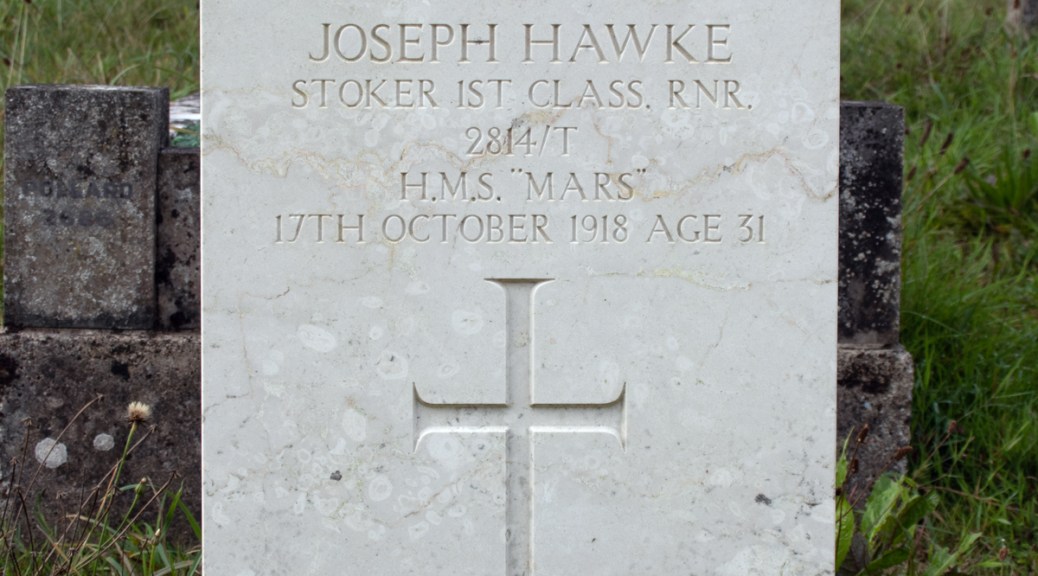
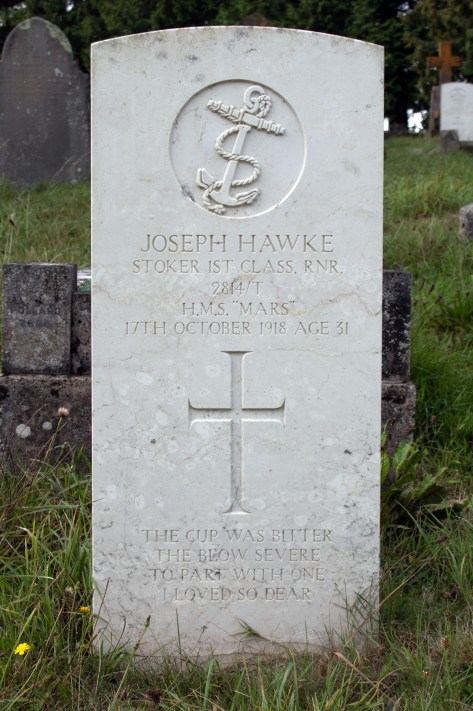
Stoker 1st Class Joseph Hawke

Stoker 1st Class Joseph Hawke

Joseph Hawke was born in Paignton, Devon, on 8th January 1887. Details of his early life are lost to time, although the 1891 census suggests that he was one of five children to Maria Hawke, who had been widowed by that point. The family had taken rooms at 104 Pembroke Street in Devonport.

When he finished his schooling, Joseph initially found work as a packer. However, possibly driven by his proximity to the Devon dockyards, he soon stepped up to take a job in the Royal Navy. Joining the training cruiser HMS Northampton, he was given the rank of Boy 2nd Class, as he was under the age to enlist.

Over the next few years, Joseph proved his mettle. In May 1904 he was promoted to Boy 1st Class and, when he came of age on 8th January 1895, he was formally inducted into the Royal Navy, taking the rank of Ordinary Seaman. His service papers show that he was 5ft 3ins (1.6m) tall, with fair hair, hazel eyes and a fresh complexion. It was also noted that he a mole on his right shoulder and abdomen, a scar on his chin, and tattoo marks on the back of his left hand and on his right forearm.

Ordinary Seaman Hawke would serve on three ships in total. On 26th February 1906 he became a Stoker 2nd Class, a role change that might be seen as a semotion, although his records suggest he was of very good character. By November 1906 Joseph had become Stoker 1st Class, but within twelve months, he gave up his life at see, buying himself out of the Royal Navy.

This change of heart may have been driven by love as, on Christmas Day 1908, he married Ellen Saunders, in Tower Hamlets, London. Their wedding certificate gives Joseph’s father’s name as cabinet maker George Hawke, but doesn’t suggest that he is deceased.

The document also gives Joseph’s job as a stoker, later confirmation suggesting that he was employed by the electrical works in Paignton, Devon. Joseph and Ellen would go on to have five children – Marie, Joseph, Albert, Harry and Ellen – between 1909 and 1917.

When war broke out, Joseph was called upon to play his part once more and, as part of the Royal Naval Reserve, he was assigned to HMS Gibraltar in November 1914. Over the next four years, he would serve as a Stoker 1st Class on four more ships, each time returning to HMS Vivid, the Royal Naval Dockyard in Devonport, in between voyages.

By the spring of 1918, Joseph’s health was struggling. He was medically dismissed from active service on 22nd May, and returned home to Paignton. His condition was to worsen, however, and on 17th October 1918 he passed away froma combination of dysentery and influenza. He was 31 year of age.

Joseph Hawke was laid to rest in Paignton’s sweeping cemetery, not far from his family home in Laura Terrace.


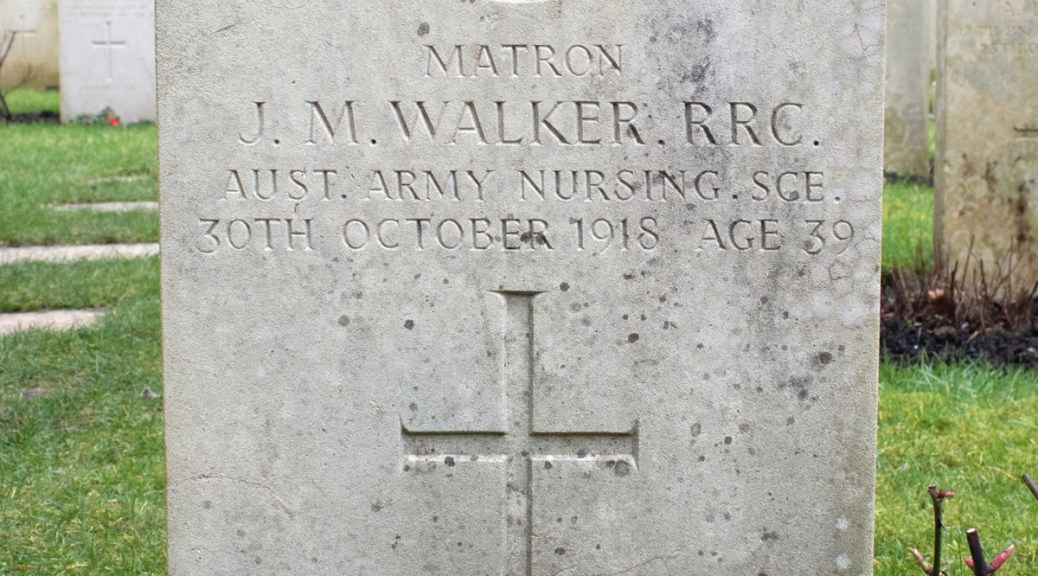
Matron Jean Walker

Matron Jean Miles-Walker

Jean Nellie Miles Walker was born in Hamilton, Tasmania, on 16th November 1878. Her parents were Arthur and Louisa Walker, and her surname moves from Walker to Miles-Walker, depending on the document. There is little information about Jean’s early life, but by 1906 she had taken up nursing.

When war broke out, Jean was quick to step up and help those who were fighting. Initially enlisting on 27th September 1914, she was assigned to a hospital ship a year later, arriving in Ismailia, Egypt, in January 1916.

Now a Sister in the Australian Army Nursing Service, Jean’s records shot the woman she had become. At 36 years of age, she was 5ft 10ins (1.78m) tall, and weighed 128lbs (58kg). She had dark brown hair, brown eyes and a dark complexion.

Over the next couple of years, Sister Walker moved to where she was needed. By September 1916 she was attached to the No. 15 General Hospital in Alexandria, by the end of the year saw her in the 3rd Australian Auxiliary Hospital in London. Jean’s service records note that she was mentioned in despatches on 1st October 1916, but there is no clarification about why she was recognised.

Jean was promoted to Matron in the summer of 1917, and over the next year, she spent time at hospitals in both Britain and France. By the autumn of 1918, she had moved to the No. 1 Australian General Hospital in Sutton Veny, Wiltshire. It was while based here that she fell ill, contracting a fatal combination of influenza and pneumonia.

Sister Walker passed away in the Sisters’ Quarters on 30th October 1918. She was just a couple of weeks short of her 40th birthday.

Jean Nellie Miles Walker was laid to rest in the grounds of St John’s Church, Sutton Veny, close to the hospital in which she had served.


Matron Jean Walker
(from findagrave.com)

Private Arthur Shute

Private Arthur Shute

Arthur Henry Shute was born on 13th February 1893 in Buckfastleigh, Devon. The younger of two children, he was the only son to Henry and Elizabeth Shute. Henry was a baker, and this trade soon took the family to Cirencester, Gloucestershire, where they had set up home by the time of the 1901 census.

Cirencester certainly suited the Shute family, and they remained at 107 Dyer Street for at least ten years. Arthur was set on learning the business, and the 1911 census found him as one of four apprentices to George Cox, a flour confectioner based in Hastings, Sussex.

New things were on the horizon, however, and Henry was evidently set on a better life for his family. On 10th May 1912, the family boarded the SS Victorian, destined for a fresh start in Canada. The Shutes eventually set up home at 118, 4 Avenue West in Calgary, Henry becoming a chef, and Arthur a baker.

Within a few years, the world was at war, and Arthur would step up to play his part. He enlisted on 13th September 1915, and wold be assigned to the Canadian Army Service Corps. His service records show that he was 6ft 0.5ins (1.84m) tall, with dark brown hair, brown eyes and a dark complexion. The document also highlighted three years’ voluntary service with the 5th Gloucestershire Regiment.

Private Shute’s unit arrived back in Britain on 6th November 1915. Sent to a base in Shorncliffe, Kent, Arthur was transferred to the 3rd Field Bakery, taking up a role suited to his skills. In March 1916, his unit was sent to France, and he remained there for the next five months.

Arthur’s time in the army seems to have been beset by illness. He was admitted to hospital on 12th August 1916, having come down with influenza, and he was medically evacuated to Britain to recuperate. Arthur would not be discharged for another six weeks, and only returned to the base in Shorncliffe on 3rd October.

From this point on, Private Shute remained on British soil, and he would remain in Shorncliffe for the remainder of the conflict and beyond the Armistice. In January 1919, he was admitted to the No. 14 Canadian General Hospital in Eastbourne, again suffering from influenza, but this time the condition would prove to be fatal. He passed away on 5th February 1919, a week short of his 26th birthday.

With his immediate family living thousands of miles away in Canada, Arthur Henry Shute’s body was taken back to the town of his birth for burial. He was laid to rest in the graveyard of Holy Trinity Church in Buckfastleigh.


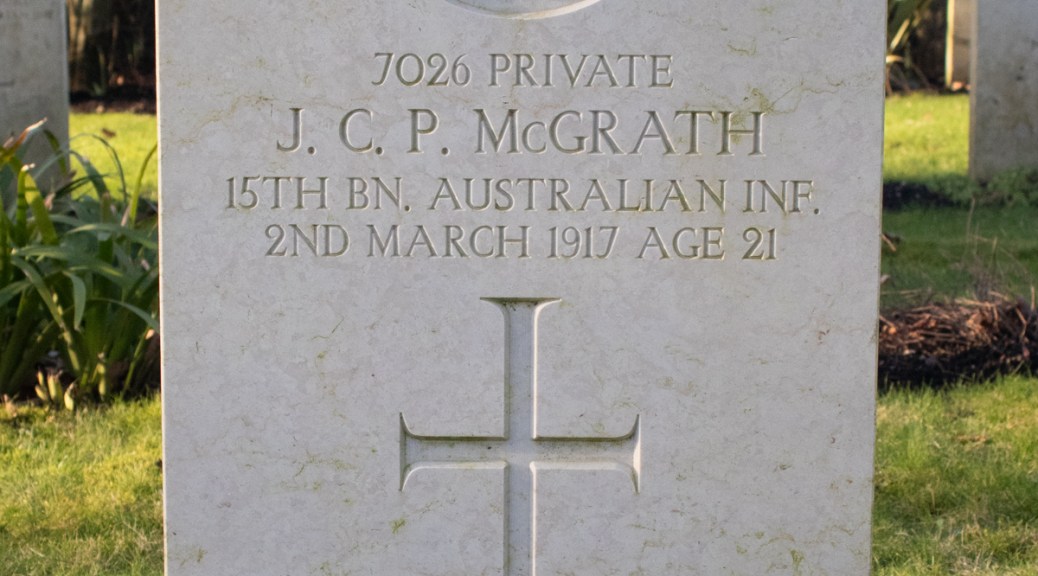
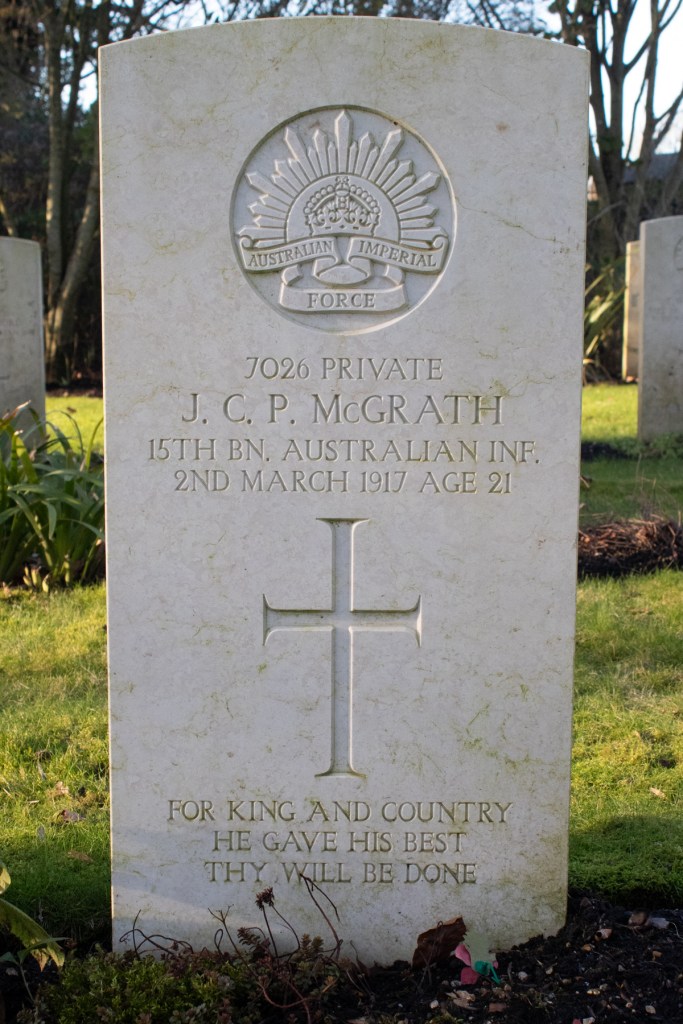
Private James McGrath

Private James McGrath

James Charles Patrick McGrath was born in June 1895 in the town of Marlborough, Queensland, Australia. He was the only child of Patrick and Margaret McGrath.

Little information is available about James’ early life. His father died in 1912, and he found work as a station hand when he completed his schooling.

When war broke out in Europe, James stepped up to play his part. Seeking adventure, and a reliable wage, he enlisted in the Australian Imperial Force in August 1916.

Private McGrath’s service records suggest he must have cut quite a figure, being 5ft 11.5ins (1.81m) tall, and weighing 172lbs (78kg). A Roman Catholic, he had hazel eyes, fair hair and a fair complexion.

James’ unit – the 15th Battalion of the Australian Infantry – departed Australia on 25th November 1916. Leaving from Sydney, his ship, the Beltana, took just under two months to reach its destination, Devonport, Devon. From here, Private McGrath’s battalion made the 130 mile (210km) journey to their base on the outskirts of the Wiltshire village of Codford.

James arrived in Codford on 30th January 1917, but soon fell ill. He was admitted to the camp hospital with influenza on 17th February, but his condition worsened. He passed away from pneumonia on 2nd March 1917: he was just 21 years of age.

Thousands of miles from home, James Charles Patrick McGrath was laid to rest in the cemetery extension to St Mary’s Church in Codford.

Private James McGrath
(from findagrave.com)

Private James Williams

Private James Williams

James Thomas Williams was born in Toodyay, Western Australia, in May 1888. The third of eight children, his parents were John and Mary Williams.

When he finished his schooling, James found work farming. Details of his early life are lost to time, but it seems likely that he had followed in his father’s footsteps.

When war engulfed the Empire, James stepped up to serve his King and enlisted in the Australian Imperial Force on 24th August 1916. His service records show that he was 5ft 6ins (1.68m) tall and that he weighed 134lbs (60.8kg). He was noted as having auburn hair, blue eyes and a fresh complexion.

Private Williams’ unit departed Australia from Freemantle on 9th November 1916. He would spend the next two months on board the Argyllshire, and eventually reached British shores on 10th January 1917. Assigned to the 16th Battalion of the Australian Infantry, his unit disembarked at Devonport, Devon, and made straight for base near Codford, Wiltshire.

The ANZAC troops had spent weeks cramped in the bowels of their ships, and space was once again at a premium in their army barracks. This congestion would prove fatal for numerous soldiers, as disease ran rife across the encampments.

Sadly, James would not be immune to poor health. Having contracted influenza, he was initially admitted to the camp infirmary, before being moved to the military hospital in nearby Sutton Veny. The condition was to get the better of him, and Private Williams passed away from a combination of flu and heart failure on 18th February 1917. He was 29 years of age.

The body of James Thomas Williams was laid to rest in the peaceful graveyard of St Mary’s Church in Codford, surrounded by others from his regiment.


Private James Williams
(from ancestry.co.uk)

Private Nicholas Paice

Private Nicholas Paice

Nicholas John Paice was born in the spring of 1867, the second of five children to John and Olive Paice. John was a railway policeman from Aldermaston in Berkshire, but his oldest son, Nicholas, was born in Poole, Dorset where Olive came from.

The Paice family seemed to move to wherever John’s work took him. The 1871 census found them living back in the Berkshire village of Shrivenham, while a decade later they were to be found in Longfleet, to the north of Poole. By this point, John was employed as a groom, and Olive a laundress.

When he completed his schooling, Nicholas found work as a butcher. He had also enlisted in the local militia, joining the 3rd Dorset Regiment. The army life seemed to suit him and, on 12th July 1886, he enlisted in the Rifle Brigade. His service records show that he was 5ft 7ins (1.7m) tall and weighed 148lbs (67.1kg). At 19 years and three months old, he was noted as having a fresh complexion, grey eyes and brown hair. The papers show that he had a scar on his left eyebrow, and tattoos on his forearms and the middle finger of his left hand.

Joining up for a period of twelve years, Private Paice would spend nearly seven of those in India and Burma. His time in the army was not without incident, however. Just three weeks after enlisting he deserted, and remained at loose for nearly a month. When he was captured, he was imprisoned for desertion for four weeks, his term of service extended to reflect the time he was AWOL.

In August 1896, having been back on home soil for just over two years, Nicholas was arrested again. Convicted of ‘begging’, he was confined for a week, before being released back to duty.

On 16th September 1898, Nicholas completed his contract, and was formally discharged from the army.

The next few years are a mystery for Nicholas. He had married Maria Andrews in 1896, and the couple would go on to have eight children, of which five would survive childhood. By the time of the 1911 census – the next document where we can pick him up – Nicholas and the family were living in two rooms at 2 New Corn Street, Bath, Somerset. Nicholas was working as a cattle drover, along with Maria, the household included her daughter Annie, and granddaughter Lily, and John and Maria’s son, Earnest.

When war came to Europe, Nicholas stepped up to play his part. He enlisted in the Somerset Light Infantry on 26th October 1915 but, with his age against him, he was transferred to the 263rd Coy. of the Royal Defence Corps the following April.

It seems that Private Paice’s health was also being impacted and he spend a month in the Red Cross Hospital in Portishead, having contracted influenza. Released to duty on 16th May 1916, just a month later he was re-admitted for three weeks, this time suffering from bronchial catarrh. On 10th September he was admitted to the hospital for a third time. This time it was identified that he had come down with pulmonary tuberculosis, and on 12th October 1916, he was formally discharged on medical grounds.

It is unclear what happened to Nicholas next. His service records suggest that he wasn’t immediately discharged from the Portishead hospital, and it seems likely that he would have returned home to Bath at some point. The next record for him is that of his passing, from tuberculosis, on 20th December 1919. He was 52 years of age.

Nicholas John Paice was laid to rest in the sweeping Locksbrook Cemetery in his adopted home town of Bath, Somerset.


Private Albert Neathey

Private Albert Neathey

Albert Ernest Neathey was born in Bath, Somerset, early in 1875. The third of six children, his parents were John and Rose Neathey. John was a baker and the family lived at 11 Trinity Square. When John died in 1890, Rose and the four youngest children remained there, and by the time of the following year’s census, three of the Neathey siblings were bringing in a wage.

The 1891 document recorded Rose as living on her own means, while Albert, then 16 years of age, was employed as a telegraph messenger. His older sister, Alice, was a dressmaker’s apprentice, while his younger brother, Sidney, was apprenticed to a hairdresser.

The family are missing from the 1901 census, but the following year Albert got married. His new bride, Mary Louisa Slip, was a mason’s daughter, and the couple exchanged vows in Christ Church, Bath, on 18th September. They would go on to have one child, Doris, born in the summer of 1903, but she would only live for a few months, before passing away on 1st November.

Albert was, by this time, working as a postman, and the 1911 census found him and Doris living at 18 Lansdown Road, to the north of the city. Mary was noted as assisting in the business, although her trade was recorded as being general grocery. The couple were sharing their home with Albert’s ten year old nephew, Norman.

When war broke out, it was inevitable that Albert would be called upon to play his part. Full service details are not available, but a later newspaper report sheds light onto not only his army career, but his personal life:

DEATH OF A WELL-KNOWN BATH POSTMAN

The death occurred at the Bath War Hospital… of Mr Albert Ernest Neathey, of 18 Lansdown Road. Mr Neathey, who was only 44 years old, was the second son of the late Mr John Neathey, of Walcot.

When quite young he entered the service of the Bath Post Office as telegraph boy, and rose to be a postman. Altogether he was a postal servant for nearly 30 years. While thus engages he was a member of the Post Office Band, in which he played cornet.

His military career began with the old 1st Volunteer Battalion of the [Somerset Light Infantry], which whom he served six years. After leaving the infantry he joined the North Somerset Yeomanry. At the outbreak of war he was mobilised with the Yeomanry, and from August 1914, to the November of the same year he was stationed with the regiment in different parts of this country. When the regiment was sent to France, he was sent, much against his will, to the Regimental Depot at the Drill Hall, Lower Bristol Road, and remained there as a member of the staff until his death. While there he was promoted to Corporal. His constant wish was to be with his regiment in France, but his state of health would not have allowed him to stand the rigours of a campaign.

On Tuesday last he was not feeling well, but would not give up his work, and it was not until Saturday that he did so. Then he was sent to the War Hospital, where he was detained, and he passed away at 8:30 on Monday morning. The cause of his death was congestion of the lungs following influenza. For twenty years he was a member of the Foresters (Queen of the West Lodge). He was greatly respected by all who knew him. He leaves a widow, but no children.

Bath Chronicle and Weekly Gazette: Saturday 22nd March 1919

As part of his retention on home soil, Albert was transferred across to the 6th Dragoons (Inniskilling) Reserve Regiment. Nothing on the available documents, however, suggest a promotion during his time in Bath. Albert Ernest Neathey died on 17th March 1919: he was laid to rest in the city’s sweeping Lockbrook Cemetery.


Private Arthur Harcourt

Private Arthur Harcourt

Arthur Wellesley Harcourt was born on 18th June 1895 in Brentford, Middlesex. He was the youngest of five children to Charles and Eliza Harcourt.

The son of a Baptist minister, Charles was a banker’s clerk, but “practically the whole of [his] leisure in a busy life [was] spent in mission work, mainly in Middlesex…” [Middlesex & Surrey Express – Saturday 13 October 1900] When he died in 1900, at the age of 57, Eliza was left to raise her younger children alone.

Arthur’s young life was to be one of travel. The 1901 census, taken just six months after his father’s death, found him living in Walton le Soken (now Walton-on-the-Naze), Essex. Eliza had taken rooms for the family in a lodging house at 9 New Pier Street, yards from the town’s stony beach.

The next record for Arthur is from 1908. Surprisingly, for the grandson of a Baptist minister and the son of a missionary, he seems not to have been baptised when he was born. The document shows that he was christened on 26th April, at St Mary’s Church in the village of Sporle with Palgrave in Norfolk. There is nothing to confirm why he was in Norfolk, or why he chose to be baptised there: the 1911 census found Eliza and his siblings living back in Middlesex.

By this point, Arthur was on the move again. Now fifteen years of age, the same census found him visiting George and Amelia Kerswill at their home in Exeter, Devon. George was a retired nurseryman and florist from Hendon, and it seems likely that the couple were friends of the family.

By the time war broke out, the Harcourts had moved once again, this time setting up home in Reculver, Kent. Arthur was working as a surveyor’s assistant, but felt drawn to play his part. On 8th March 1917, he enlisted, joining the Army Service Corps as a Private. His records show that he was 5ft 4.5ins (1.61m) tall, and weighed 96lbs (43.5kg). He was of fair physical development, but it was noted that he had an understandard chest, but was deemed fit for military service.

Private Harcourt was sent to Somerset for training. Tragically, however, his health was to take a dramatic downturn. Admitted to the Bath War Hospital on 1st April with influenza, this quickly developed into double pneumonia and pleurisy. The strain was to be too much for his young body to bear: Arthur passed away on 18th April 1917, at the age of just 21 years old.

Surprisingly, Eliza, whilst able to live on her own means, did not chose to lay her son to rest close to home. Instead, Arthur Wellesley Harcourt was buried in Locksbrook Cemetery, Bath, not far from the hospital in which he had breathed his last.