Tag Archives: Kent

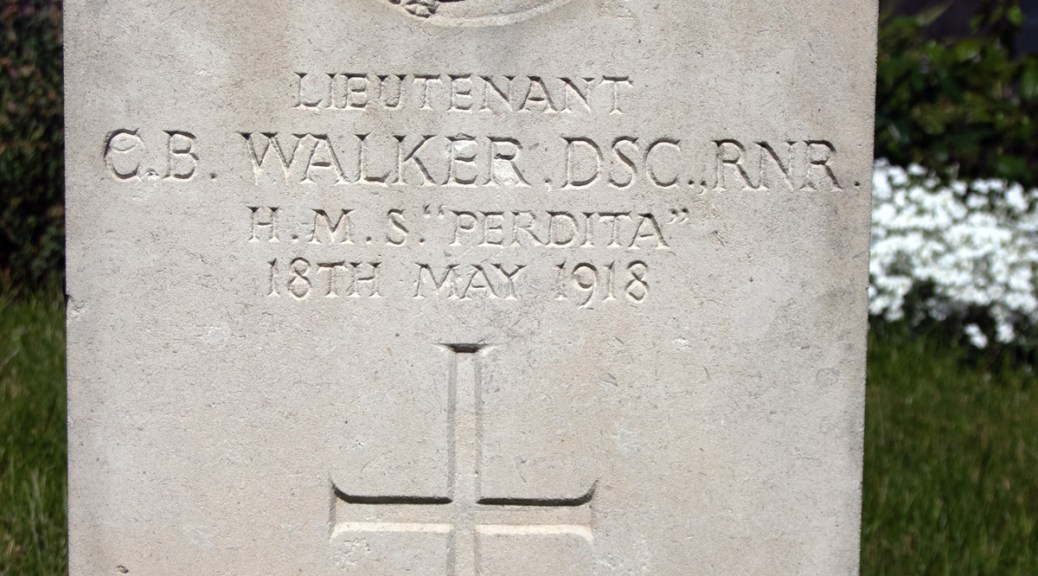
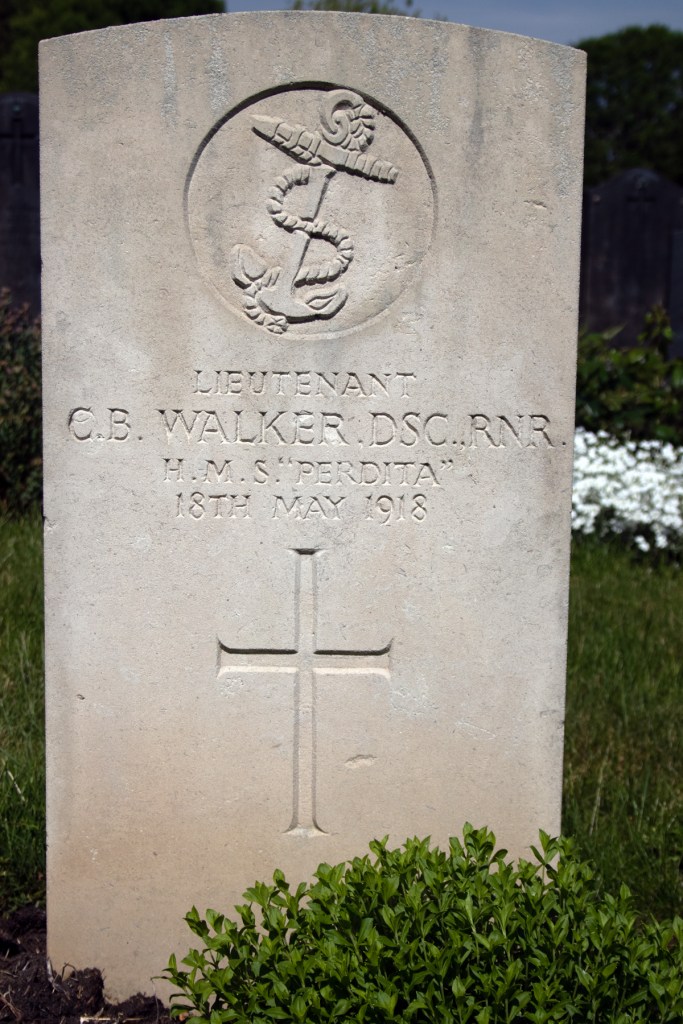
Lieutenant Claude Walker

Lieutenant Claude Walker

“The funeral took place on Wednesday with naval honours of Lieut. Claude Bennett Walker, RNR, whose home is a 23, Overcliffe, Gravesend, and who died at the Royal Naval Hospital, Chatham, on Saturday. His death was a naval casualty, and it was only on Friday, a day before his death, that he was taken to the Chatham Hospital.”

[Kent Messenger & Gravesend Telegraph: Saturday 25th May 1918]

Claude Bennett Walker was born on 6th July 1882 in Deal, Kent. The oldest of five children, his parents were George and Amelia Walker. George was a Trinity pilot, navigating ships off the Kent coast and beyond, and it was only natural that his first born followed in his stead.

Claude set to a life at sea when he completed his schooling. By August 1904, he was a registered Second Mate on board sea-going vessels, and within two years, he was deemed competent to become a First Mate. By 1909 he was certified as a Master of a foreign-going ship. At some point he joined the Royal Naval Reserve, and on 5th July 1912, was given the rank of Sub-Lieutenant.

That autumn, Claude married Gwen Case. The wedding took place in her home town of Melksham, Wiltshire, and the couple would go on to have two children – son Alec in 1913, and daughter Alison three years later.

When war broke out, Claude would be called upon to play his part, serving on the battleship HMS Majestic and the destroyer HMS Recruit early on in the conflict. By the spring of 1915, he was assigned to the minelayer HMS Biarritz, and that October, he was promoted to full Lieutenant.

On 9th March 1917, Claude was given command of the minelayer HMS Perdita. She served in the Mediterranean, and would be caught up in some skirmishes. In October 1917, Lieutenant Walker was awarded the Distinguished Service Cross, and the following April he was mentioned in dispatches.

The Perdita was back in Kent by the spring, by which point Claude had fallen ill. He was admitted to the Royal Naval Hospital in Chatham with cerebrospinal meningitis, and this would be the condition to which he would succumb. He passed away on 18th May 1918, at the age of 35 years of age.

Claude Bennett Walker was laid to rest in the naval section of Woodlands Cemetery, Gillingham, Kent.
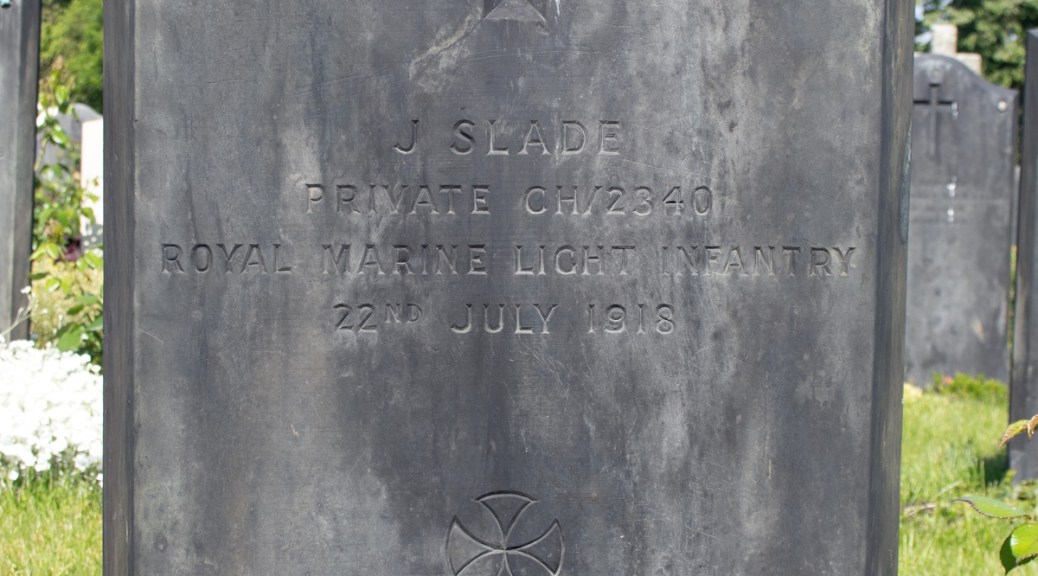

Private John Slade

Private John Slade

John Slade was born in Winchmore Hill, Buckinghamshire, in 1865. One of three children to Edward and Mary, he also had three half-siblings from his mother’s previous marriage. Edward was a hawker, but when he left school, his son sought bigger and better things. By the time of the 1891 census he was recorded as being a Private in the Royal Marine Light Infantry, and was based in Chatham, Kent.

Sadly, Private Slade’s service records have been lost to time, so it is not possible to identify where his role took him. The 1901 census, however, shed some light on his time in the navy. It found him living at 36 Cross Street in Gillingham, Kent, with his wife, Annie, and his adopted daughter, Lillie. They had also taken on three boarders – Frank Hall, Harry Monk and Charles Barwell – all of whom were in the navy as well.

Ten years later on, and thing had changed once more. Still living in Gillingham, it seems that John’s time in the Royal Marine Light Infantry had come to an end. Instead, he was living at 54 James Street and giving his trade as an unemployed labourer. Still noted as being married, there is no sign of either Annie or Lillie: instead John was living with widow Laura Greyson and her two teenage boys, Charles and George.

At this point, John’s trail goes cold. As he was formally granted a Commonwealth War Grave, he must have stepped up to serve his country once more when war broke out in 1914. He would, however, have been getting on in years at this point, so how for long that service continued is anyone’s guess. He passed away from ‘disease’ on 22nd July 1918, at the age of 53 years of age.

John Slade was laid to rest in the military section of Woodlands Cemetery, Gllingham, the town that had been his home for more than three decades.


Stoker 1st Class Thomas Ellis

Stoker 1st Class Thomas Ellis

Thomas Ellis was born in 1896 in St Leonard’s, Sussex. The third of twelve children, his parents were George and Ellen Ellis. George was a general labourer, but when he finished his schooling, Thomas found work as a golf caddy. The 1911 census recorded the Ellis family living in four rooms at 7 Caves Road to the east of the town centre.

There is little additional information about Thomas, sadly. He joined the Royal Navy when war broke out, and was working as a Stoker 1st Class by the closing months of the conflict. He passed away, through causes unknown, on 7th July 1918, at the age of just 23 years old.

Thomas Ellis was laid to rest in the naval section of the Woodlands Cemetery in Gillingham, Kent, not far from the Royal Naval Dockyard in Chatham – HMS Pembroke – at which he was based.


Acting Leading Seaman William Wood

Acting Leading Seaman William Wood

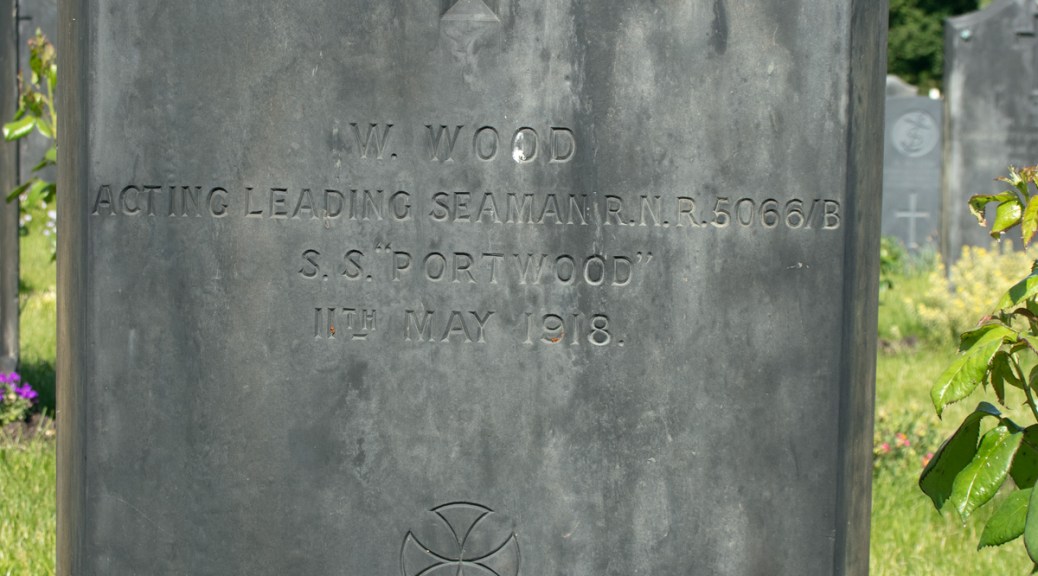
The life of William Wood, who is buried in Woodlands Cemetery in Gillingham, Kent, is a challenge to piece together. His headstone confirms that he held the rank of Acting Leading Seaman in the Royal Naval Reserve, and that he was assigned to SS Portwood at the time of his death.

Full service records for William have long since disappeared, but his pension ledger index card gives his widow as Catherine Rose Wood, of Greenfield Street in Govan, Scotland. It also suggests that the couple did not have any children under full age.

The Royal Navy and Royal Marine War Graves Roll provides William’s date of birth – 28th December 1887 – and goes on to suggest that he was born in London. Sadly, his name is far too common to narrow down census records, and there are no documents relating to his and Catherine’s marriage, so any additional family connections are also lost.

Acting Leading Seaman Wood’s entry on the pension ledger confirms his died of general paralysis of the insane, and his burial in the Gillingham cemetery would suggest that he had passed away in the Royal Naval Hospital in Chatham, Kent. He died on 11th May 1918, at the age of 29 years old.

William Wood was buried in the military section of Woodlands Cemetery, Gillingham, Kent.


Private Arthur Couchman

Private Arthur Couchman

Arthur John Couchman was born in the spring of 1887, the oldest of seven children to John and Emma. John was a farm labourer from the parish of Wilmington, Kent, and this is where he and Emma raised their family.

When he completed his schooling, Arthur found work as a house boy, but soon turned his hand to gardening. When the opportunity was presented to him, however, and in the autumn of 1908, he emigrated to Australia, presumably to find work as a farmer.

Little about Arthur’s time overseas is detailed. He settled in Freemantle, to the south of Perth, and, early in 1916, he married Sarah McAlinden. She had left London for the Antipodes to work as a domestic four years previously. Their marriage seems to have been spurred on by Arthur’s imminent departure for the home country, as, on 19th June 1916, he enlisted in the Australian Imperial Force.

Working as a general labourer by this point, Arthur’s service records show that he was 5ft 3.5ins (1.61m) tall, and weighed 146lbs (66.2kg). He was found to have fair hair, grey eyes and a ruddy complexion. He also had tattoos on both of his forearms.

Private Couchman’s unit departed Freemantle on 9th November 1916, on a journey to Devonport, Devon, that would take two months. On his arrival, he was assigned to the 51st Battalion of the Australian Infantry, and dispatched to a camp near Codford in Wiltshire.

Tragically, Arthur’s army career was to follow a not uncommon path for those arriving in Britain from overseas. Within a matter of weeks he had been sent to the New Zealand Hospital in Codford, as he was suffering from bronchial pneumonia. On 15th February 1917, just four days after his admission he passed away from the condition. He was 29 years of age.

Thousands of miles from his Australian life, Arthur John Couchman was laid to rest in the new extension to St Mary’s Churchyard in Codford, not far from the camp in which he had been briefly based.


Sapper Walter Woodward

Sapper Walter Woodward

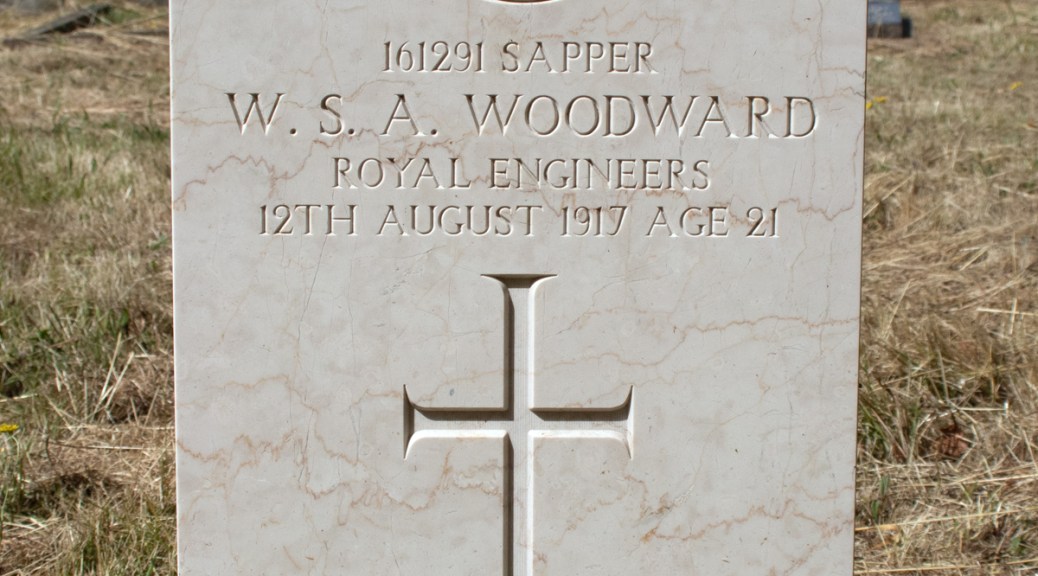
Walter Sargeant Abbott Woodward was born in Bath, Somerset, in the summer of 1896. The oldest of four children, his parents were Henry and Louisa. Henry Woodward was a painter and decorator, but when Walter completed his schooling, he found work as a telegraph messenger for the Genera Post Office.

The 1911 census recorded the family – Walter, his parents and his three siblings – living in a 3-roomed apartment at 5 Beauford Square, close to the city centre. Within a year, Walter had been promoted within the GPO, and was given the role of Assistant Postman.

War came to Europe and Walter was called upon to play his part. On 10th December 1915 he enlisted in the army, and was assigned to the Royal Engineers as a Sapper. His records show that he was still employed by the GPO at this point, and was working as a Lineman, so it seems that his skills were appropriate for the regiment to which he was assigned.

Sapper Woodward’s service documents confirm that he was 5ft 10ins (1.78m) in height, and that he was not formally mobilised until April 1916. After a couple of months’ training, he was sent to France and he remained on the Western Front for just over a year.

On 3rd July 1917, Sapper Woodward was posted back to England. It seems that he was en route for the Signal Depot in Fenny Stratford, Buckinghamshire, when he became ill. Admitted to the Queen’s Canadian Hospital in Shornecliffe, Kent, he was suffering from gastritis. This would ultimately take his young life: he passed away on 12th August, aged just 21 years old.

The body of Walter Sargeant Abbott Woodward was taken back to Somerset for burial. He was laid to rest in the city’s Locksbrook Cemetery.


Lance Bombardier George Higgins

Lance Bombardier George Higgins

George Henry Higgins was born in Bath, Somerset, in the spring of 1888. The fifth of fifteen children, his parents were Charles and Sarah Higgins. Charles was a carter-turned-labourer for the city’s corporation, and this is work into which George also went.

The 1911 census recorded the Higgins family living in a six-roomed house at 15 London Place, Bath. By this point, Charles and Sarah were sharing their home with ten of their children – including George – plus four of their grandchildren by their married third-oldest daughter, Sarah. Five of the household were bringing in a wage: George and his father were employed by the Corporation, daughter Rose was a factory hand, while two of George’s younger brothers were errand boys.

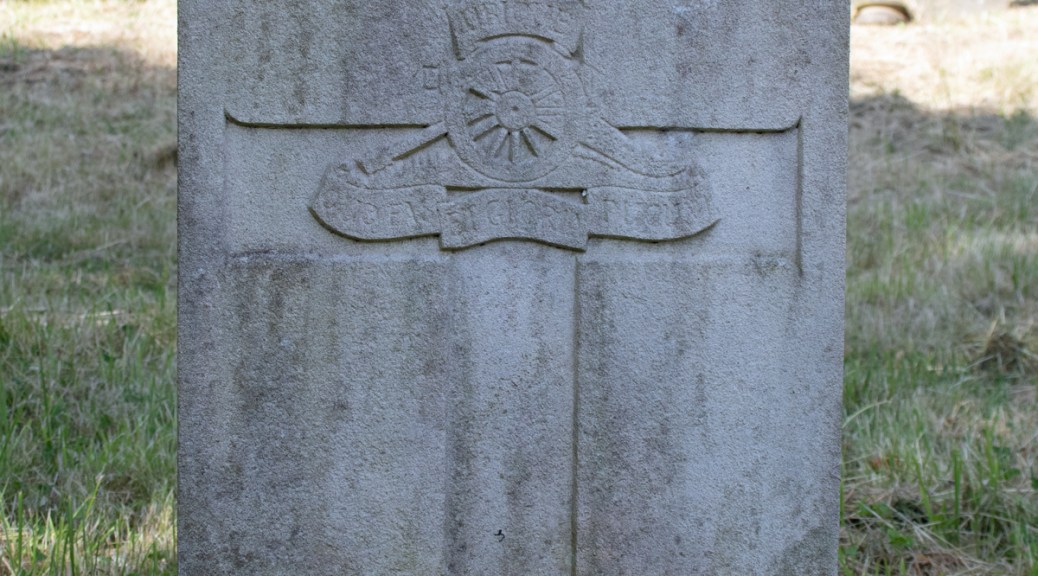
Charles died in the autumn of 1914, and George was suddenly the head of the household, with war raging across Europe. The following summer he enlisted in the Royal Field Artillery: this may have been out of duty to his King, but it is likely that, as the oldest man in the house, the army offered the prospect of a regular, decent wage.

Full service details for Gunner Higgins have been lost in the annals of time, but his unit – the 92nd (Howitzer) Brigade – served in some of the fiercest battles of the conflict. Arriving in France for training on 21st July 1915, it is likely that George saw fighting at the Somme in 1916 and 1918, and at Ypres in 1917. By the end of the war, he had been promoted to the rank of Lance Bombardier for his service.

George’s older brother, Charles, died in the fighting in Northern France, but by the start of 1919, George himself had returned to home soil, and was attached to the regiment’s Clearing Office in Woolwich, Kent.

His health was being impacted by this point, and he was admitted to the Royal Herbert Hospital in nearby Shooter’s Hill. His records simply record that he was suffering from ‘disease‘, and it was this that was to kill him. He died on 17th February 1919, at the age of 30 years old.

The body of George Henry Higgins was taken back to Somerset for burial. He was laid to rest in the sweeping grounds of Bath’s Locksbrook Cemetery, not far from where Sarah still lived.


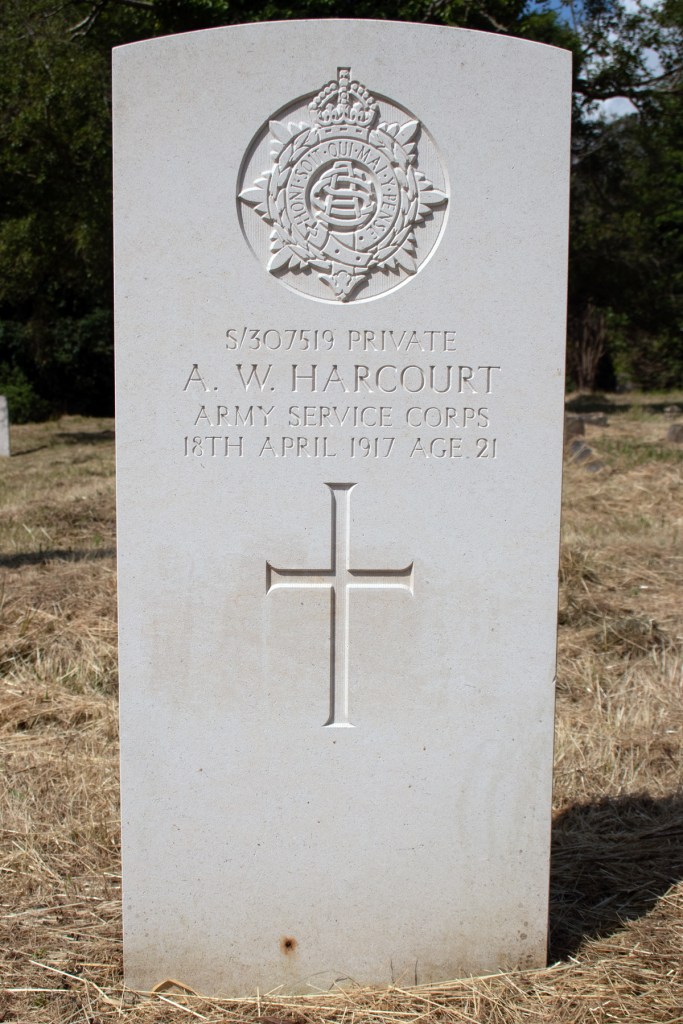
Private Arthur Harcourt

Private Arthur Harcourt

Arthur Wellesley Harcourt was born on 18th June 1895 in Brentford, Middlesex. He was the youngest of five children to Charles and Eliza Harcourt.

The son of a Baptist minister, Charles was a banker’s clerk, but “practically the whole of [his] leisure in a busy life [was] spent in mission work, mainly in Middlesex…” [Middlesex & Surrey Express – Saturday 13 October 1900] When he died in 1900, at the age of 57, Eliza was left to raise her younger children alone.

Arthur’s young life was to be one of travel. The 1901 census, taken just six months after his father’s death, found him living in Walton le Soken (now Walton-on-the-Naze), Essex. Eliza had taken rooms for the family in a lodging house at 9 New Pier Street, yards from the town’s stony beach.

The next record for Arthur is from 1908. Surprisingly, for the grandson of a Baptist minister and the son of a missionary, he seems not to have been baptised when he was born. The document shows that he was christened on 26th April, at St Mary’s Church in the village of Sporle with Palgrave in Norfolk. There is nothing to confirm why he was in Norfolk, or why he chose to be baptised there: the 1911 census found Eliza and his siblings living back in Middlesex.

By this point, Arthur was on the move again. Now fifteen years of age, the same census found him visiting George and Amelia Kerswill at their home in Exeter, Devon. George was a retired nurseryman and florist from Hendon, and it seems likely that the couple were friends of the family.

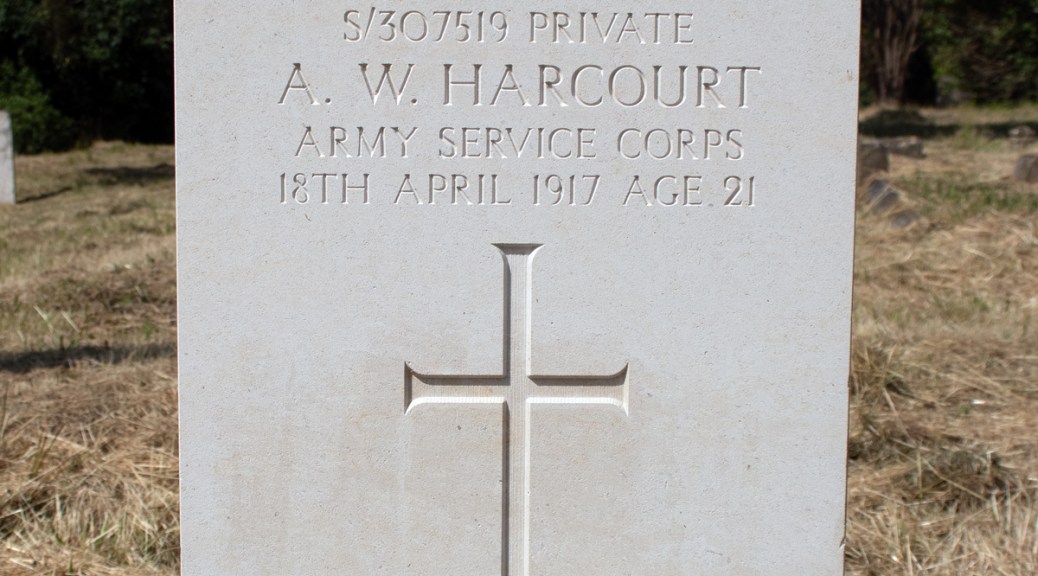
By the time war broke out, the Harcourts had moved once again, this time setting up home in Reculver, Kent. Arthur was working as a surveyor’s assistant, but felt drawn to play his part. On 8th March 1917, he enlisted, joining the Army Service Corps as a Private. His records show that he was 5ft 4.5ins (1.61m) tall, and weighed 96lbs (43.5kg). He was of fair physical development, but it was noted that he had an understandard chest, but was deemed fit for military service.

Private Harcourt was sent to Somerset for training. Tragically, however, his health was to take a dramatic downturn. Admitted to the Bath War Hospital on 1st April with influenza, this quickly developed into double pneumonia and pleurisy. The strain was to be too much for his young body to bear: Arthur passed away on 18th April 1917, at the age of just 21 years old.

Surprisingly, Eliza, whilst able to live on her own means, did not chose to lay her son to rest close to home. Instead, Arthur Wellesley Harcourt was buried in Locksbrook Cemetery, Bath, not far from the hospital in which he had breathed his last.


Captain William Mence

Captain William Mence

William Charles Mence was born in Blackheath, Kent in the spring of 1877. He was the oldest of five children to William Cookes Mence and his wife, Susanna.

William Sr was a chemist-turned-dentist, and by the time of the 1881 census, the family had moved to prestigious lodgings on the corner of Claremont and Victoria Roads in Kingston-upon-Thames, Surrey. William had set up practice in the building, and employed two servants to assist him with the practice, and two more to help Susanna with the family.

Dentistry would keep William Sr occupied for at least the next thirty years, a move to nearby Surbiton in the late 1890s being the only change tot he business.

William Jr, meanwhile, was making his own way in the medical world. The 1901 census recorded the 24-year-old Mr Mence visiting a possible mentor, physician and surgeon Charles Gallie, in Camberwell. William was also noted as being a physician and surgeon, and this was to become the career in which he forged his way.

On 9th August 1906, William married Dorothy Mytton in the Saint Aelhaiarn’s Church in Guilsfield, Powys, Wales. Dorothy was the daughter of a retired army captain, Devereaux Mytton. She had been born in Guilsfield and, at the time of the 1901 census, was living with her family and ten servants at Garth Hall, close to the village.

The young couple’s marriage certificate also sheds some light on William’s career. It confirms that he was working as a medical practitioner, and was living in the village of Perranzabuloe in Cornwall.

William and Dorothy went on to have five children, and named them to reflect their combined family histories. Daughter Evaline Dorothy Cookes Mytton Mence was born first, in 1907, followed by sons John Herbert Myttone Cookes Mence, Devereaux Mervyn Mytton Cookes Mence and Godfrey Powis Mytton Cookes Mence. Their fifth child, daughter Myfanwy Susan Mence, was born in 1914.

When war broke out in Europe, William was drawn to play his part. While full details about his service are not available, his public standing meant that he took a commission as Captain in the Royal Army Medical Corps. His Medal Roll Index Card confirms that he was awarded the 1914-1915 star, so he joined early in the conflict. It also outlines that he served in Mesopotamia from 4th February 1916, in France in 1917 and in Salonika from 1917 to 1919.

Ill health seemed to have dogged him in later years, and by the summer of 1919, Captain Mence had returned to British shores, and to Devon, where his practice had moved to shortly before the conflict.

Dr William Charles Mence, of Axminster, who died in Axminster Cottage Hospital on Friday night, recently returned from active service… He was a medical officer under Axminster Board of Guardians…

Western Morning News: Monday 28th July 1919

William Charles Mence died on 25th July 1919 as a result of an ongoing illness: he was 42 years of age. He was laid to rest in Axminster Cemetery, not far from the family home.


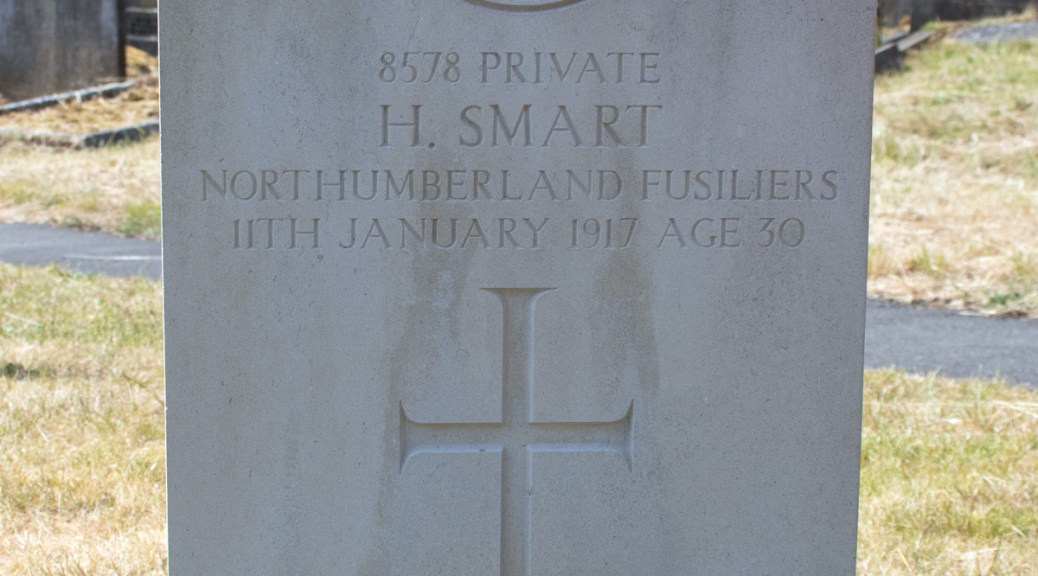
Private Herbert Smart

Private Herbert Smart

Herbert – or Bertie – Smart was born on 9th February 1885, and was the middle of five children to John and Lucy. John worked as a gardener and the family were raised in the Kent town of Sidcup.

By the early 1900s, Bertie had moved to London, and had settled in Islington, Middlesex. He was working as a fruiterer and, on 19th May 1907, he married Lucy Purton, a policeman’s daughter from the east of the capital.

The couple set up home in Kensington, and went on to have four children: Frank, Herbert, Kathleen and Frederick. The 1911 census found the family renting three rooms in a tenement at 36 Netherwood Road. They were sharing their home with Lucy’s younger brother, Frederick.

When war broke out across Europe, Bertie was called upon to play his part. Full service details have been lost to time, but it is clear that he enlisted in the second half of 1916, and was assigned to the Northumberland Fusiliers. Attached to the 2nd/4th Battalion, it seems that he may have been sent to the South West for training.

Private Smart’s time in the army was not to be a lengthy one. He came down with cerebrospinal meningitis, and was admitted to the War Hospital in Bath, Somerset. The condition was to get the better of him: he passed away was still admitted, on 11th January 1917. He was 31 years of age.

Herbert Smart was laid to rest in the sweeping grounds of Bath’s Locksbrook Cemetery.


These were tragic times for the Smart family. Lucy’s brother died just four months after her husband, and Lucy herself passed away in February 1918. In just over a year, the four children – Frank, Herbert, Kathleen and Frederick – had become orphans.