Tag Archives: Kent

Writer 1st Class Harry Goodger

Writer 1st Class Harry Goodger

Harry Goodger was born on 15th April 1885, the fourth of five children – and the only boy – to George and Emma Goodger. George was a canal labourer from Aylesbury in Buckinghamshire, but by the time of his son’s birth, the family had settled in Tipton, Staffordshire.

Harry was initially committed to education and, by the time of the 1901 census, he was working as a school teacher. His heart seemed set on a career with more prospects, however, and so, on 2nd November 1904, he enlisted in the Royal Navy.

Harry’s service records show that he was 5ft 2ins (1.57m) tall and that he had bark brown hair, dark brown eyes and a fresh complexion. He was also noted as having a mole on his wight upper arm and another on his left breast.

Harry’s rank was Writer 3rd Class, which was the naval equivalent of a clerk. After an initial training period, he was assigned to the cruiser HMS Terrible. Over the next decade, he served on ten further ships, and was based at HMS Victory, the Royal Naval Dockyard in Portsmouth, in between voyages.

Writer Goodger slowly progressed through the ranks during his naval service. On 1st November 1908 he was promoted to Writer 2nd Class, and on 31st October 1912 was raised to Writer 1st Class. Harry seems to have needed extra support, however, and he was knocked back to Writer 2nd Class on 25th April 1913, and sent back to Portsmouth for further training. By 23rd October 1914, however, while serving on HMS Bulwark, he again received a promotion to Writer 1st Class.

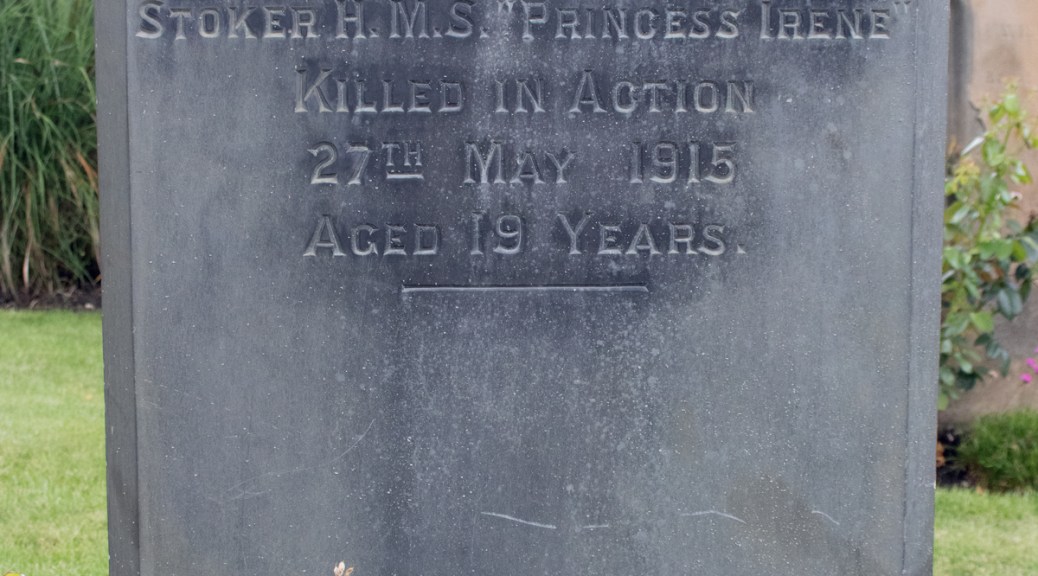
By the spring of 1915, Harry had been assigned to HMS Princess Irene. She an ocean liner that has been converted to a minelayer at the start of the war.

On 27th May 1915, while Irene was moored off Sheerness, Kent, a series of explosions ripped through the ship, killing more than 350 crew. Writer Goodger was among those who perished: he was 30 years of age.

The body of Harry Goodger was buried in Woodlands Cemetery, Gillingham, Kent alongside the other victims of the disaster.


Writer 1st Class Harry Goodger
(from findagrave.com)

Harry’s surname is variously spelt Goodger and Goodyer across the documents that trace his life. While his headstone has the latter spelling, I have used Goodger, as this is what is recorded on his naval service records.


Private William Preston

Private William Preston

William Robert Preston was born on 2nd January 1888, and was the oldest of six children to William and Alice Preston. William Sr was a blacksmith from Norwich, Norfolk, and this is where the family were initially raised.

The 1901 census saw a move to Northamptonshire, however, the document confirming that the family were living at Tanner Cottages in the village of Walton.

When he finished his schooling, William Jr found work as a painter’s labourer. However, he sought bigger and better things and, on 5th June 1905, he enlisted in the Royal Marine Light Infantry. His service records show that he was 5ft 6ins (1.67m) tall, with dark brown hair, blue eyes and a fresh complexion. He was also noted as having a number of tattoos on his arms.

Private Preston was sent to barracks in Deal, Kent, for his initial training. He spent the best part of a year there, before being transferred to the Royal Naval Dockyard in Portsmouth, Hampshire, in April 1906. He was given his first ocean-going posting in January 1907, when he joined the crew of the cruiser HMS Terrible.

Over the next eight years, Private Preston served on three further ships, returning to HMS Victory, Portsmouth, in between trips. In March 1915, he was assigned to HMS Princess Irene, an ocean liner converted to a minelayer at the start of the war.

On 27th May 1915, while Irene was moored off Sheerness, Kent, a series of explosions ripped through the ship, killing more than 350 crew. Private Preston was among those who perished, but whose body was identified: he was 27 years of age.

The body of William Robert Preston was buried in Woodlands Cemetery, Gillingham, Kent alongside the other victims of the disaster.


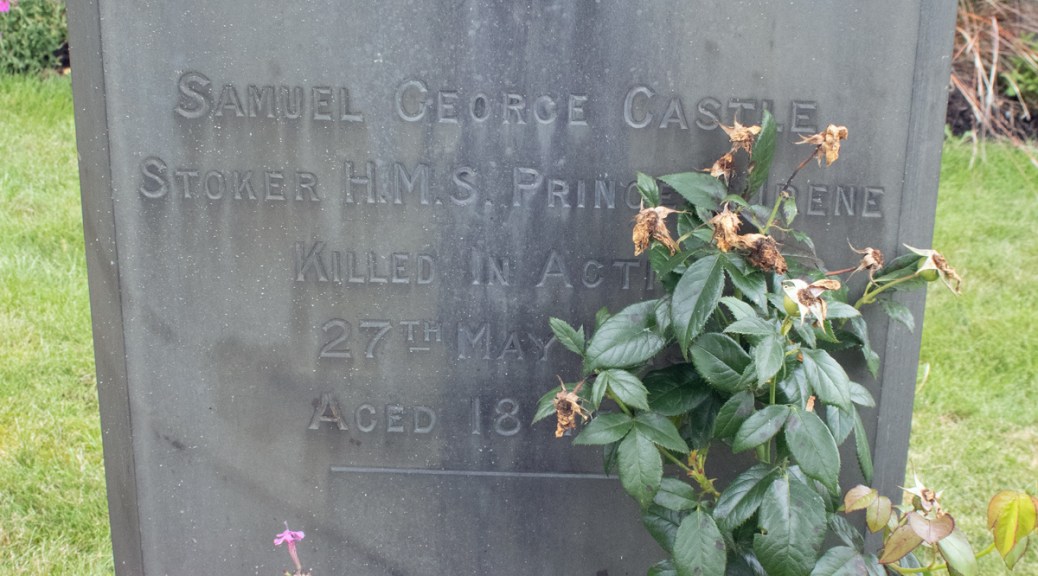
Stoker 2nd Class Samuel Castle

Stoker 2nd Class Samuel Castle

Samuel George Castle was born on 1st November 1896 in Battersea, Surrey. The third of ten children, his parents were Samuel and Louisa Castle. His father was a gas fitter turned blacksmith and, by the time of the 1911 census, Samuel Jr was working as an errand boy for Army & Navy Stores.

When war broke out, Samuel was quick to step up and serve his country. On 6th March 1915, he gave up his job – he was by then employed as an equipment maker – to enlist in the Royal Navy as a Stoker 2nd Class.

George was sent to HMS Pembroke, the dockyard in Chatham, Kent, for his training. His service records show that he was 5ft 4ins (1.62m) tall, with black hair, brown eyes and a fresh complexion.

Tragically, Stoker Castle’s time in the navy would not prove a lengthy one. By the end of May he was part of the crew of HMS Princess Irene, an ocean liner that had been put into service as a minelayer when war was declared. On 27th May 1915, a series of explosions ripped through the ship, killing more than 350 crew, Samuel included. He was just 18 years of age.

Samuel George Castle was laid to rest in Woodlands Cemetery, Gillingham, alongside the other victims of the disaster.


Stoker George Marshall

Stoker George Marshall

George Patrick Marshall was born in Dublin, Ireland, on 17th March 1896. One of ten children, his parents were plumber and gasfitter Robert Marshall and his wife, Rachel.

When he finished his schooling, George found work as a messenger. By the time war broke out, however, he was working as a builder’s mate. Keen to play his part and serve his country, he decided to enlist in the Royal Navy.

Stoker 2nd Class Marshall enlisted on 7th March 1915. His service records show a little of the man he had become. He was noted as being 5ft 4ins (1.62m) tall, with brown hair, grey eyes and a fresh complexion. His first trip overseas took him to HMS Pembroke, the Royal Naval Dockyard in Chatham, Kent, where he would receive his training.

Tragically, George’s time in the navy would not prove a lengthy one. By the end of May he was part of the crew of HMS Princess Irene, an ocean liner that had been put into service as a minelayer when war was declared.

On 27th May 1915, a series of explosions ripped through the ship, killing more than 350 crew, Stoker Marshall included. He was just 19 years of age.

George Patrick Marshall was laid to rest in Woodlands Cemetery, Gillingham, alongside the other victims of the disaster.


Fireman Robert McQueen

Fireman Robert McQueen

In amongst the rows of naval headstones in the Woodlands Cemetery, Gillingham, Kent, is one dedicated to Robert McQueen. The inscription notes that he was a Fireman on board HMS Princess Irene, a liner that was conscripted by the Royal Navy as a minelayer during the First World War.

The headstone records that he died during the catastrophic explosion on 27th May 1915 that destroyed the ship, killing more than 300 people in the process. It also confirms that Robert was 23 years old when he died.

Birth records identify at least six Robert McQueens born in 1891/92, and without a place of birth, or parental names, it is not possible to definitively confirm which of these was serving on the Princess Irene on that fateful day. He was in what would become the Merchant Navy: their records are sparser than the Royal Navy equivalents, and none match the man who lies buried in Gillingham.

The life of Robert McQueen, therefore, is destined to remain lost to time, although his sacrifice will never be forgotten.


Signalman Philip Files

Signalman Philip Files

Phillip William Turner Files was born on 13th April 1894 in Walmer, Kent. One of eight children, his parents were George and Annie Files. George was a carpenter at a local colliery, but living so close to the sea, his son was inevitably drawn there. On 25th January 1910, Phillip gave up his life as an errand boy and joined the Royal Navy.

Phillip’s service records show that he was 5ft 4ins (1.62m) tall, with dark brown hair, blue eyes and a fresh complexion. He was just 15 years old when he enlisted, and, as he wasn’t of full age, he was given the rank of Boy 2nd Class. He was initially sent to HMS Ganges, the shore-based establishment in Suffolk for his initial training.

Phillip remained at HMS Ganges for the next year, and was promoted to Boy 1st Class on 5th September 1910. The following January he was moved to the Royal Naval Dockyard in Portsmouth, Hampshire, also known as HMS Victory.

Over the next year, with Victory as his base, Boy Files was sent to serve on three ships – the dreadnought battleship HMS Albermarle, and the cruisers HMS Sappho and HMS Philomel. While on board Philomel, Phillip came of age and, because of his technical abilities, was given the rank of Ordinary Signaller – changing to Signalman when the ranks were updated later in 1912.

Phillip remained on Philomel until October 1913 and, after a brief spell back in Portsmouth, he was transferred to the armoured cruiser, the converted RMS Laconia. She was to be Signalman Files’ base for the next year, when, on 9th March 1915, he was transferred again, this time to HMS Princess Irene.

Princess Irene was a converted liner, requisitioned as a minelayer when war broke out. On 27th May 1915, an explosion ripped through the ship, while moored off Sheerness, Kent. Signalman Files was one of the 352 souls killed. He was just 21 years of age.

Phillip William Turner Files was laid to rest in the Woodlands Cemetery in Gillingham, Kent. His body having been identified, he was given his own grave, unlike those who were buried in a mass grave nearby.


Signalman Files’ headstone spells his first name with one L. However, all the other documents relating to Phillip spell it with two.


Private William White

Private William White

William White was born in the autumn of 1892 in Gravesend, Kent. He was the second of eleven children to Joseph and Eleanor – or Ellen – White. Joseph was a general labourer who, by the time of the 1911 census, was employed in the local docks.

The same census recorded the family of eleven people living in four rooms at 2 Robert Street, Gravesend. In addition to Joseph, both William and his older brother, Joseph Jr, were employed as assistants for a local butcher, while the next youngest of the siblings, Edward, was working as a bootmaker’s errand boy.

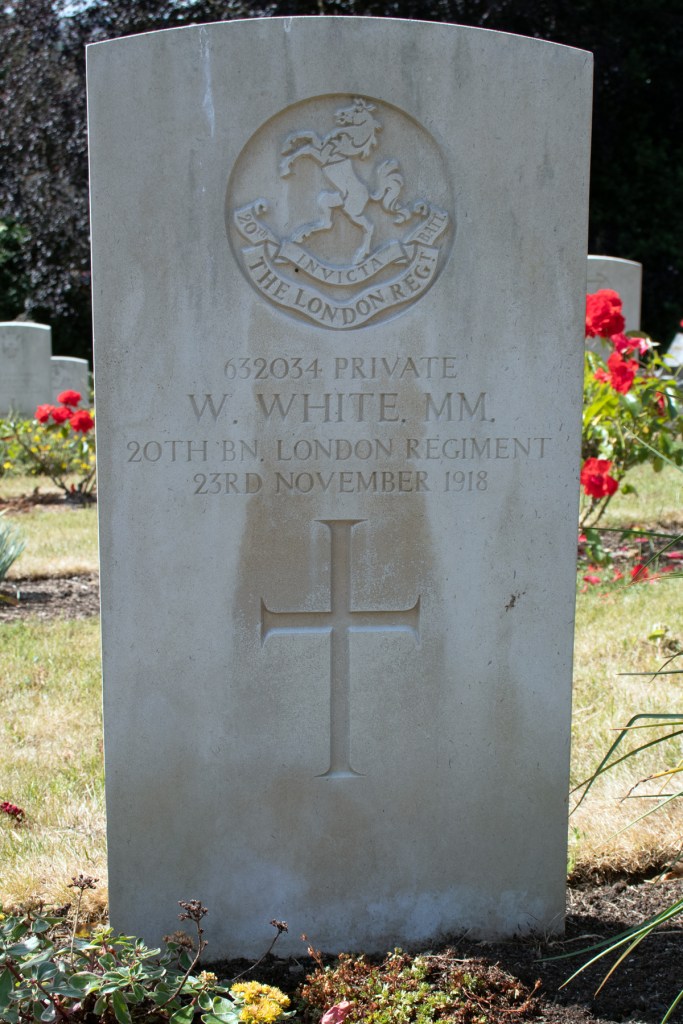
When war was declared, William stepped up to play his part. Full service details have been lost to time, but it seems that he had enlisted by the spring of 1918 at the latest. He joined the London Regiment, and was assigned to the 20th (City of London) Battalion. Private White’s unit spent the duration of the conflict on the Western Front, fighting at Loos, the Somme and Messines amongst other areas.

By the end of the war, William had been awarded the Military Medal for his bravery, although it is unclear when and for what he receive it.

The next confirmed record for Private White was his admission to hospital in Somerset, as he was suffering from pneumonia. He was sent to the Bath War Hospital, but it is unclear whether he had been on home soil when he fell ill, or if he had been medically transferred there from across the English Channel.

William White’s condition was to prove fatal. He passed away in hospital on 23rd November 1918, at the age of 26 years old. His body was laid to rest in the military section of Locksbrook Cemetery in Bath, not far from the hospital where he had breathed his last.


Sub-Lieutenant Denys Puttock

Sub-Lieutenant Denys Puttock

Denys Ernest Puttock was born on 14th September 1895 in the Devon village of Halwill. The middle of three children, his parents were Edward and Alice Puttock. Edward was a vicar of the village’s St Peter & St James’ Church, but died tragically early:

The Red. E Puttock, Rector of Hallwill died on Wednesday, after a brief illness… Mr Puttock had been in charge… for six and a half years. He was much beloved by those among whom he labourer and universally respected. His devotion to the due performance of all his sacred duties was unceasing and his visitations among the poor and afflicted were much appreciated by the whole parish. He was fond of all manly sports, and under his captaincy the Cricket Club at Halwill attained considerable success. Up to the day of his death he could hardly believe that he was ill, and up to the last it was hoped that his wonderful constitution might have carried him through the illness. About a fortnight since he contracted a chill. He would not be deterred from carrying out his duties, and against the advice of his friends, he persisted in taking every service at the church long after he was fit for it. On Sunday, the 24th January, although then in a high fever, he took both the morning and evening services at Halwill Church unassisted, and also the Sunday School in the afternoon. Pneumonia set in at the end of last week, and on Tuesday evening, the 2nd February, the action of the heart failed. He leaves a widow and three young children to mourn their loss.

[Exeter and Plymouth Gazette: Friday 5th February 1897]

After Edward’s death, Alice moved the children to Okehampton. The 1901 census found the family living at 4 Brondage Park, Alice by this time living off her own means. She felt that learning was important, and Denys was sent to Twyford School and St Edmund’s School in Canterbury, Kent. From here he took up a career in the Royal Navy, enlisting in September 1913.

He served in the Highflyer as a Cadet, and was Midshipman in HMS Conqueror, and later Sub-Lieutenant in the destroyers Patriot and Valorous. Long exposure to the rough weather in the North Sea during the winters of 1916 and 1917 brought on tuberculosis, which incapacitated him for further war service. He was invalided our of the Navy and spent many months in a Sanitorium.

[Exeter and Plymouth Gazette: Friday 4th April 1919]

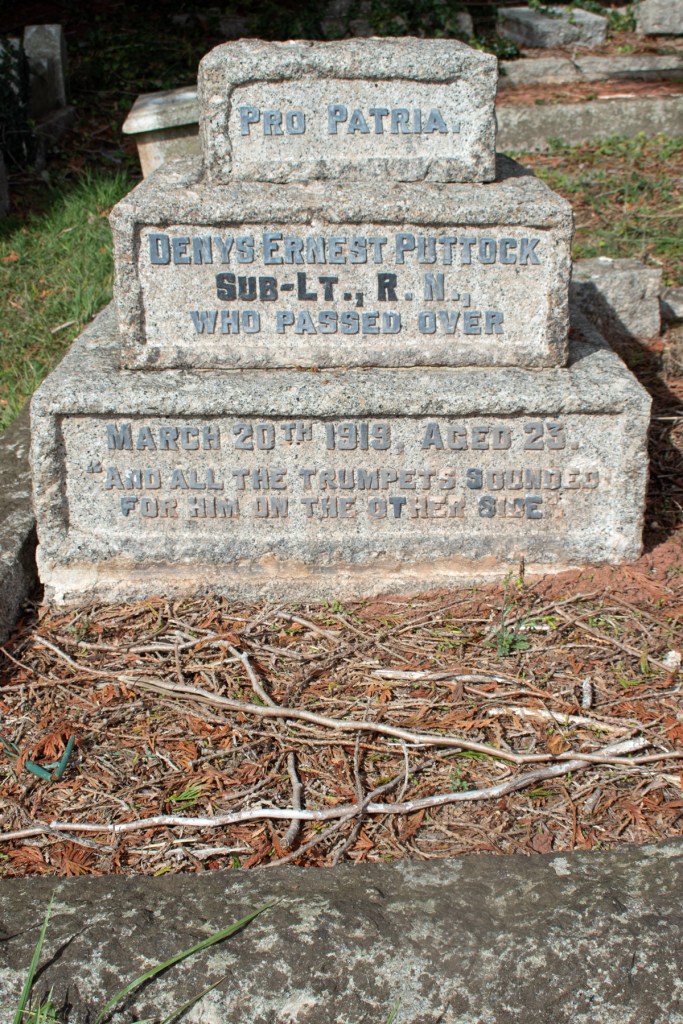
Denys Ernest Puttock’s health was failing him, and he passed away on 20th March 1919, while still admitted. He was 23 years of age. The report of his funeral included comments from those who knew him:

His Headmaster writes: “He has not lived in vain, for he has exercised the power of unconscious influence on all those around him. He knew the secret of happiness – purity of soul and unselfishness of heart.” His Commanding Officer has written: “He was a zealous and capable young officer. Possessed of great charm of manner, he was popular with both officers and men.”

[Exeter and Plymouth Gazette: Friday 4th April 1919]

Alice, having moved to Paignton by this point, laid her son to rest in the town’s cemetery. When she passed away in 1932, she was buried alongside him.


Serjeant Edward Davies

Serjeant Edward Davies

Edward Victor Davies was born in the Weston area of Bath, Somerset, in the summer of 1897. The second of four children, and the only boy, his parents were Walter and Emily Davies.

Walter was a park keeper who died when Edward was just 9 years old. By the time of the 1911 census, Emily was working as a caretaker for a solicitor’s office, while her sone was a boarding student at the Duke of York’s School in Guston, Kent. This army school had more than 500 students, with a staff of 100 to train them. It is unclear whether Edward went voluntarily, or whether he was sent there by his mother’s employers because he was fatherless.

War came to Europe in the summer of 1914, and Edward stepped up to play his part. Unfortunately, his service records have been lost to time, so it is unclear whether he went straight into the army after finishing his education. However, given that he held the rank of Serjeant by the end of the conflict, it seems likely that his military career began before the start of the First World War.

Edward – who was better known as Ted – joined the Wiltshire Regiment, and was assigned to the 2nd Battalion. His unit spent time on the Western Front, but there is no evidence whether or not he served overseas. He survived the war, but subsequently fell ill, as so many servicemen did:

DAVIES – March 28th, Sergeant Edward Victor (Ted) Davies, 2nd Wiltshire Regiment, at the Royal Military Hospital, of pneumonia, following influenza, aged 22 years.

[Bath Chronicle and Weekly Gazette – Saturday 03 April 1920]

Edward Victor Davies was laid to rest in the sweeping grounds of Bath’s Locksbrook Cemetery, not far from where he had grown up.


Gunner Arthur Green

Gunner Arthur Green

Arthur William Green was born on 27th August 1896, the middle of five children to William and Mary Green. William was a shoemaker, who was employed at the Clark’s factory in Street, Somerset, and this is where the family were born and raised.

Clark’s was the key employer in Street and, by the time of the 1911 census, five of the Green family were working for them. This included the 15 year old Arthur, whose job was a shoe cutter.

When war came to Europe, Arthur had already stepped up to play his part. He enlisted in the Royal Marine Artillery in March 1914. His service records confirm that he was 5ft 8ins (1.72m) tall, with brown hair, blue eyes and a fresh complexion. He was also noted as having a scar on the back of his neck.

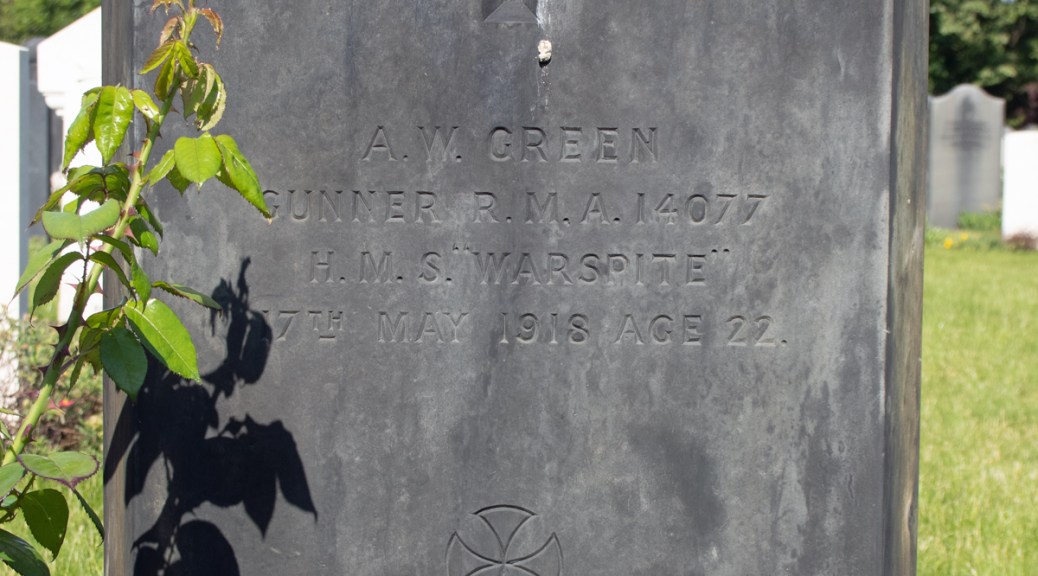
Private Green was initially under age for service in the regiment, only coming of age at the end of August 1914. He initially completed his training either in Chatham, Kent, or Plymouth, Devon, becoming a Gunner on 5th February 1915. That spring he was assigned to the battleship HMS Warspite, and would remain on board for the next four years.

In February 1918, Gunner Green was assigned to the 4th Battalion of the Royal Marines. Still serving on Warspite, on 23rd April he was involved in the Raid on Zeebrugge. A combined action by the Royal Navy and Royal Marines, the aim was to block the entrance to the port of Bruges-Zeebrugge by sinking obsolete ships. A total of 1700 men were involved, and, in the ensuing battle, some 200 were killed and 400 wounded.

Gunner Green was one of those who was injured in the battle. When the Warspite returned home, he was admitted to the Royal Naval Hospital in Chatham, Kent, but his injuries were to prove too severe for him to overcome. He passed away on 17th May 1918, at the age of just 21 years old.

Arthur William Green was laid to rest in Woodlands Cemetery, Gillingham, not far from the Chatham base he had briefly known as home.