The early life of Henry Watkin Lewis is a challenge to piece together, and a lot of the detail comes from his later service records.
The document confirms that Henry was born in Pontypool, Monmouthshire, in December 1885. It gives his next of kin as his aunt, Ann Dunning, and there are no details about his parents.
Henry joined up in the days after war was declared. He was working as a plumber by this point, and enlisted in Preston, Lancashire, although it is not clear whether he was living in the area at this point. His records showing that he was 5ft (1.52m) tall and weighed 116lbs (52.6kg). With brown hair, blue eyes and a fresh complexion, he had a scar across the bridge of his nose and another on his lower lip.
Henry’s military career is an intriguing one. Assigned to the Loyal North Lancashire Regiment, he was initially given the rank of Private. He was promoted to Lance Corporal on 5th September 1914, just two weeks after enlisting. Four days later his rank was increased to Corporal, and by 14th October he had been promoted again, this time to Lance Sergeant. There is no evidence of any previous military background for him, and the cause of this rapid rise is unclear.
With any rapid rise, a rapid fall is often likely to follow, and Henry’s case was to be no different. He service records note that he was discharged from the army on 16th January 1915, as he was ‘not likely to become an efficient soldier’. Again, there is no further record as to why, although his papers do not suggest the cause was anything medical.
Lance Sergeant Lewis’ unit was based in Tidworth, Wiltshire, by this point, but he must have moved to Warminster following his discharge. It was here that he died on 23rd April 1915, the cause of his passing unknown. He was 29 years of age.
Henry Watkin Lewis was laid to rest in the graveyard of St Denys’ Church, Warminster.
Richard Oscar Ford was born in Williamstown, Australia, in July 1891. The oldest of four children – and the only son – his parents were Anthony and Mary Ford. Anthony was a soldier, but Richard chose a different route and took work as a labourer when he completed his schooling.
There is little information available about Richard’s early life, but when war broke out, he stepped up to play his part. He enlisted in the Australian Imperial Force on 9th November 1914.
By this point he was working as a bushman, and his service papers reveal something of the man he had become. Standing 5ft 7ins (1.7m) tall, he weighed 140lbs (63.5kg), Private Ford had auburn hair, blue eyes and a fair complexion.
Assigned to the Light Horse Regiment, Richard left Australia for Europe on in March 1915. His unit arrived on the Gallipoli Peninsula on 15th July, and he would remain there for the next five months.
In December 1915, Richard came down with a bout of influenza, and was medically evacuated to the island of Mudros, then on to Alexandria, Egypt. In January 1916, he was admitted to hospital again, this time suffering from gonorrhoea and, after treatment, he re-joined his unit on 2nd February.
Private Ford’s unit spent that spring training in Egypt, but on 29th May, they set sail for the Western Front. Within a week they had disembarked in the French port of Marseilles and headed north to Etaples.
The next couple of years would prove a little disjointed. Richard switched units in August 1916, and given the rank of Gunner, but within two months his role had changed to Driver. His service records suggest that he managed to avoid injury during the fighting he was involved in, but that did not mean that he avoided hospital completely.
In January 1917 Driver Ford was admitted to the 51st General Hospital with a heart murmur, returning to his unit on 16th March. He had a second spell in hospital in February 1918, having come down with laryngitis.
In July 1918, having spent some time at the 4th Army Corporal School, Richard was reassigned to the 3rd Australian Field Artillery. This move seemed to have been the focus he needed. Initially promoted to Bombardier, within a month he rose to Lance Corporal, and by December 1918 he was a full Sergeant.
After the Armistice was signed, Richard was given three weeks’ leave, which he spent in Britain. By January 1919, however, his health was becoming an issue again, and he was admitted to the military hospital in Fovant, Wiltshire, suffering from influenza. The condition worsened, and Sergeant Ford passed away from bronchopneumonia on 4th February 1919. He was 27 years of age.
Richard Oscar Ford was laid to rest in Highgate Cemetery, Middlesex. While there seems to be no direct connection between the location and the man, his father, Anthony, had been born in Hackney, so it can be assumed that there was a family link to the area.
Ralph William Page was born in the autumn of 1889, and was the second of five children to William and Elizabeth. William was a brush maker from London, but the family were initially born and brought up in Ottery St Mary, Devon.
By the time of the 1901 census, the family had upped sticks and relocated to Kilmington, near Axminster. Three of the family – William, Elizabeth and Ralph’s older sister Ethel – were all working in bone brush making, William as a maker, and his wife and daughter as drawers.
Ralph initially followed in the family trade, but this was not to be enough for him. He was already volunteering for the Devonshire Regiment, and he took the opportunity to join full-time. He enlisted on 11th September 1907. His service records show that he was exactly 18 years of age, and that he had black hair, brown eyes and a fresh complexion. Ralph stood 5ft 4ins (1.62m) tall and weighed 10st 9lbs (67.6kg).
Private Page initially enlisted for five years on active service. During that time he remained on home soil and, by the autumn of 1911, he was promoted to Lance Corporal. The following spring, he extended his term of service, in advance of being placed on reserve status later in 1912.
Away from army life, romance had also blossomed. On 2nd September 1912, he married Beatrice White at St Mary’s Church in Axminster. She was the daughter of a carpenter, who had also follower her widowed mother into lacemaking. The couple would go on to have three children: Florence, Ralph and Frederick. A fourth child, Peggy, passed away when she was just a matter of weeks old.
When war was declared in the summer of 1914, Ralph was sent with his unit – the 1st Battalion – to France. He saw action at Mons, Messines and Armentières in the next few months alone. In October, Ralph was promoted to Acting Corporal, and just two months later he was made Acting Serjeant.
In March 1915, things seem to have changed for Ralph. He was transferred to a Depot unit on home soil, and reduced in rank to Private. Nothing in his service records suggests any misdemeanour leading to his transfer.
Private Page remined on home soil until the end of 1916. Attached to the 3rd (Reserve) Battalion, he made his way back up through the ranks again, and was a Corporal by the time he was reassigned to the 2nd Battalion and sent off to France once again that December.
Ralph was to be firmly entrenched on the Western Front over the next five months. It was during the German retreat back to the Hindenburg Line in the spring of 1917 that he received the injury that would remove him from the war. On 23rd April, the now Lance Serjeant Page was shot in the abdomen. He was medically evacuated to Britain for treatment, and did slowly recover. Ralph’s need for an abdominal belt meant that he was no longer fit to serve and he was ultimately discharged from the army on 29th November 1917.
Ralph returned home to Devon, but the war had taken its toll on his health. When pandemic spread around the world as the conflict drew to a close, he was to succumb. He passed away from a combination of the influenza and pneumonia on 5th November 1918, at the age of 29 years old.
Ralph William Page was laid to rest in Axminster Cemetery, Devon, not far from where his widow and children lived.
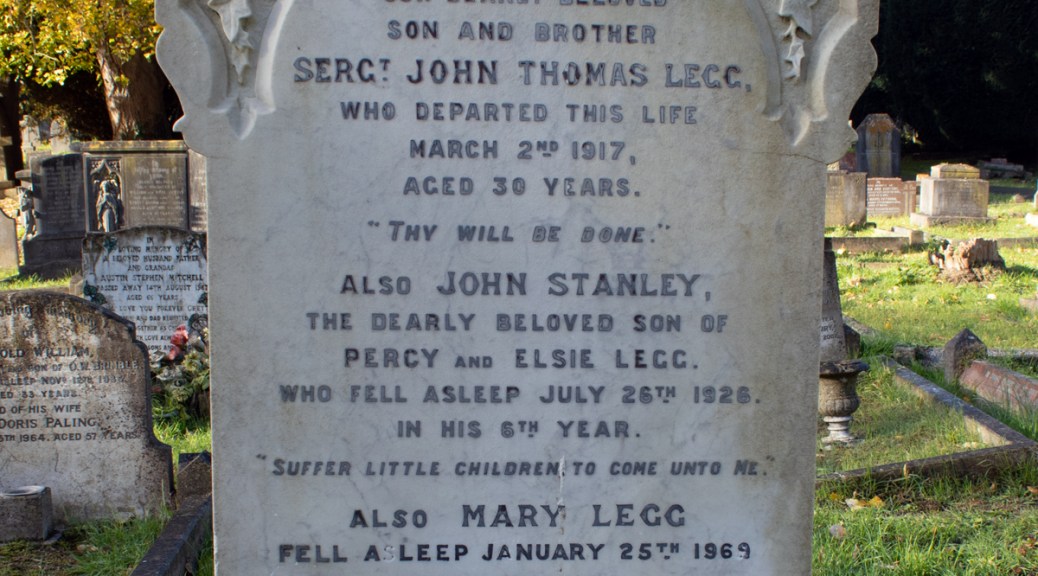
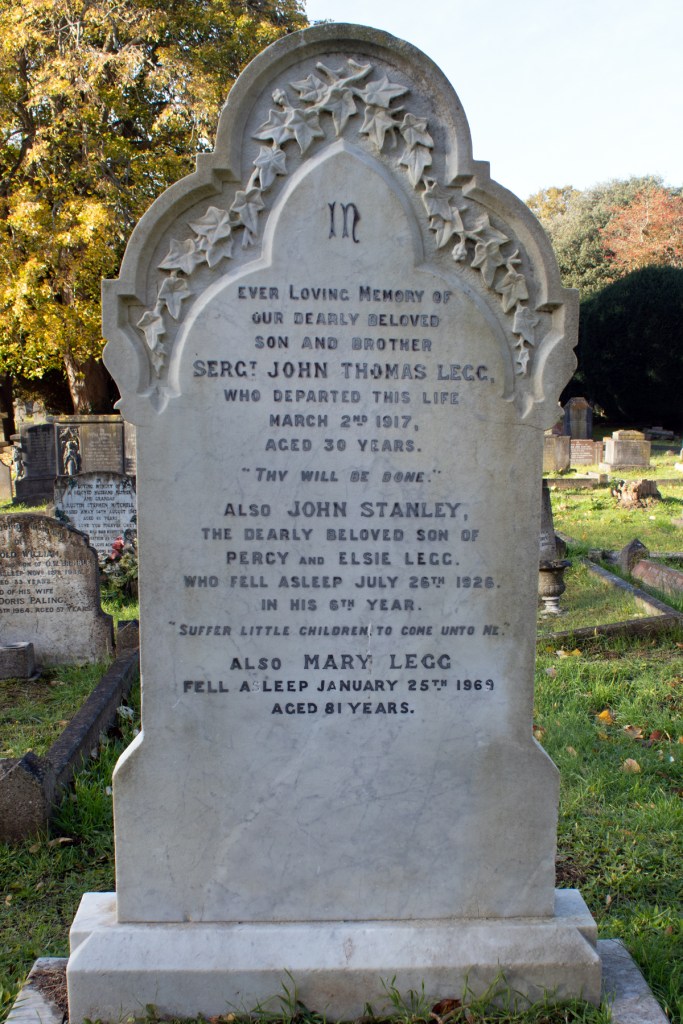
John Thomas Legg was born in the summer of 1885, the oldest of five children to Benjamin and Sarah Legg. Benjamin was a carpenter from Dorset, and it was in Bridport that John was born. Within a year or so, however, the young family moved north to Weston-super-Mare, Somerset, and this is where they settled.
When he completed his schooling, John found a job as a clerk. By the time of the 1911 census, he was working as a political assistant/clerk, and five of the six members of the Legg household were gainfully employed. Benjamin was still working as a carpenter, while John’s two sisters were dressmakers, and his younger brother Percy was a tailor’s assistant.
In the summer of 1914, war came to Europe, and John was one of the first to step up and serve his King and Country. He initially enlisted in the North Somerset Yeomanry, and was assigned to the 1st/1st Battalion. Private Legg’s unit was quickly sent to France, and fought at the Battle of Nonne Bosschen that November.
John’s service records are sparse, and so it is not possible to confirm exactly when and how he served. He moved from the North Somerset Yeomanry to the 6th Battalion of the Reserve Cavalry Regiment: his promotion to Corporal and then Lance Sergeant suggests that this move enabled him to share his skills with incoming recruits. It is unclear whether he was based in Somerset by this point, but it is certainly where he ended up by the start of 1917.
The remains of Sergeant JT Legg, North Somerset Yeomanry, were buried at Weston-super-Mare Cemetery on Wednesday. The first portion of the service was held at St Saviour’s Church, which the sergeant formerly attended, and the interior of which bears many evidences of his skill as an amateur wood-carver… Sergeant Legg was formerly chief clerk in the offices of the Well Division Conservative Association.
Bath Chronicle and Weekly Gazette: Saturday 10th March 1917
John Thomas Legg passed away on 2nd March 1917: he was 31 years of age. He was laid to rest in the sweeping grounds of Milton Road Cemetery, Weston-super-Mare, a short walk from where his family still lived.
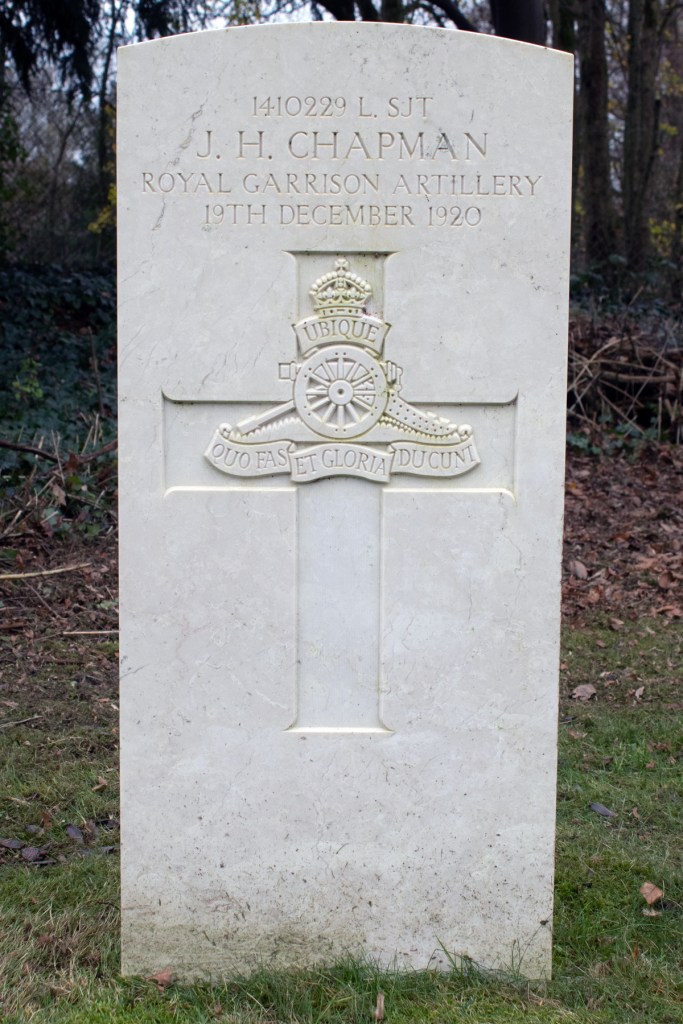
There is little concrete information available on the life of John Henry Chapman. His headstone, in Amesbury Cemetery, Wiltshire, confirms that he was a Lance Serjeant in the Royal Garrison Artillery, and that he died on 19th December 1920.
John’s pension ledger gives his widow’s name, Caroline, date of birth, 25th August 1900, and her address, High Street, New Romney, Kent. It also gives a cause of death for John, who passed away from pneumonia.
The record for Lance Serjeant Chapman’s headstone gives his next of kin as Mrs C Chapman, c/o Mrs Savage, which would suggest that that was Caroline’s maiden name. The Civil Registration Marriage Index records the union of a John H Chapman to someone with the surname of Savage in the summer of 1920: the wedding took place in Richmond, Yorkshire, although there does not appear to be any direct connection between the Lance Serjeant, Caroline and the town.
There are no further clear documents relating to John Henry Chapman. He lies at rest in the peaceful anonymity of Amesbury Cemetery.
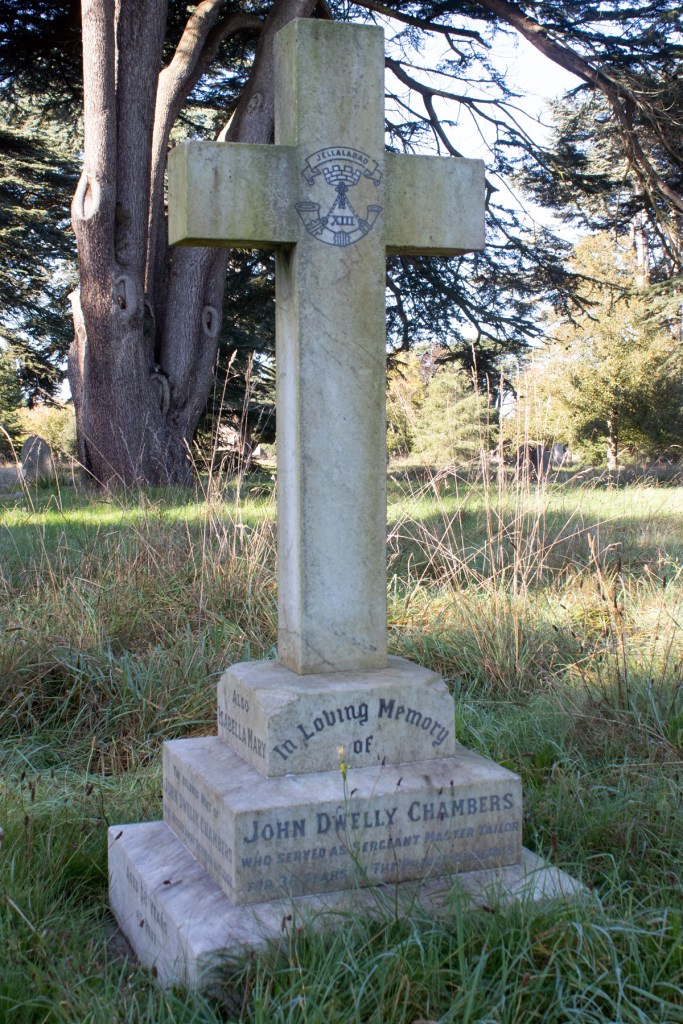
John Dwelly Chambers was born on 21st August 1846, in Holborn, Middlesex. The second of four children, his parents were John and Sarah Chambers. John Sr was a tailor, and this was a trade into which his oldest son followed.
Unusually, John Jr travelled widely with his work and, by the late 1860s, he was based in Devon. It was here that he met and, on 5th March 1870, married Isabella Smith. She was born in Exeter, and couple initially made a life for themselves there.
The 1881 census return shows just how far the family moved in the coming years. John and Isabella were to have nine children: their first, Louise, was born in Exeter a hear after their marriage. The second child, son John, was born in Armagh, Ireland, though; their third, Emily, was born in Glasgow; while their fourth, George, was born in Surrey. It was only by the time their fifth and sixth children, Thomas and Charles, were born that they family returned to Devon. Their youngest three children – Percy, Victoria and Ivor, were all born in Somerset, when the family had settled in Taunton.
The reason for these moves seem to have been because his tailoring work was for the army. The 1891 census found the family living in army barracks, where John was listed as being a soldier. Ten years on, and John was recorded as being a Lance Sergeant in the Somerset Light Infantry, the Chambers’ still being billeted in barrack accommodation in Taunton.
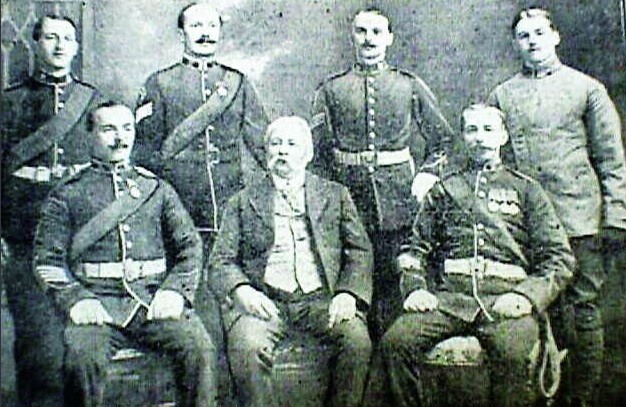
By this point, Percy, now 17 years of age, was employed as a gunsmith, and a later photo suggests that all six of John’s sons went into the army.
Isabella died in 1906, at the age of 58: the following year, John married Elizabeth Dunning, a widow with her own children to raise. The 1911 census found the extended family living in the barracks: John, Elizabeth, Ivor and Elizabeth’s two daughters, Kate and Beatrice. John, by now, was listed as being a master tailor (military), Ivor was now a gunsmith, and the two girls were employed as a book binder and dressmaker respectively.
John had officially been discharged from the army by this point, but it seems likely that the outbreak of war brought him back into service. His life over the next few years is largely undocumented, but it is fair to assume that Serjeant Chambers was called back to the army, possibly to train newer recruits in the trade he had been working in for decades.
John Dwelly Chambers died of a heart attack on 2nd August 1915: he was just short of his 69th birthday. John was laid to rest in the sprawling St Mary’s Cemetery in Taunton, not far from the barracks to which he had devoted his life.
Serjeant John Chambers (seated middle, with his sons) (from ancestry.co.uk)
Alfred Pollard was born in the spring of 1869 in Hinton Charterhouse, Somerset. His early life seems to have been a little disjointed. The son of Harriett Pollard, who had him out of wedlock, his baptism record gives no details of his father.
The 1871 census found him living with his mother and her widowed father, Thomas Pollard. Ten years later, Harriett is living with her husband, Walter Hayden, and four children, including Alfred – who has also taken the name of Hayden. Thomas is also recorded as living with the family.
Alfred is missing from the 1891 census return. Harriett, however, is now listed as married and the head of the household. She and Walter had a further three children – their youngest, Percy, being just three months old. Times must have been tough for her: the same census recorded Walter as being an inmate of the Somerset and Bath Asylum, where he is listed as being a lunatic.
Harriett died at the start of 1892, aged just 46 years old: Walter died three years later, at the age of 55. Both are buried in the graveyard of St John the Baptist Church, Hinton Charterhouse.
The passing of his mother and the diminishing health of his stepfather seems to have spurred Alfred into building a career to support his siblings. Having been working as an engine driver, on 7th December 1892, he enlisted in the Somerset Light Infantry.
Alfred’s service records give his height as 5ft 7ins (1.7m) and his weight as 137lbs (62kg). He was noted as having black hair, bark eyes and a coarse complexion. He also had a number of tattoos, including a cross on his right forearm; a circle of dots on his right wrist; crossed flags, an anchor and Jubilee 1887 VR and crown on his left forearm; and a bracelet on his left wrist. The records also noted the loss part of the middle finger on his right hand.
Private Pollard quickly became a career soldier. Over 21 years, he rose through the ranks to Lance Corporal (July 1902), Corporal (April 1906), Lance Sergeant (November 1907) and Serjeant (June 1911). He spent more than 14 years in India, and was involved in the Mohmand Campaign of 1897. He was formally discharged on 6th December 1913, having served as a signaller for eleven years, and a Provost Sergeant for three. His discharge papers confirmed his exemplary character, and that he was “thoroughly hardworking, sober and reliable.“
Back on civvy street, Alfred found work as a labourer in an iron foundry. This was not to last long, however, as he stepped up once more when war was declared in the summer of 1914. Joining the Somerset Light Infantry on 12th October, he retook his previous rank of Serjeant.
Alfred served on home soil during this second period in the army. Initially attached to the 3rd (Reserve) Battalion, his unit was based in Devonport, Devon. In September 1916, Sergeant Pollard was transferred to the 2nd Garrison Battalion of the Devonshire Regiment, which was based in nearby Plymouth. In January 1917, he moved again, to the Hampshire Regiment. He spent most of the year with 18th (Home Service) Battalion in Aldershot, Hampshire, and by December had moved to the 3rd (Reserve) Battalion, which was based in Gosport.
Sergeant Pollard remained on active service until the end of February 1919, when he was formally demobbed. At this point, his trail goes cold, although he seems to have settled in Bath, Somerset. He went on to marry, although details of his wife are limited to the name Mrs AE Pollard and her date of birth, 15th March 1879.
Alfred Pollard died of cardiac failure on 7th March 1921: he was 52 years of age. He was laid to rest in the army section of Bath’s Locksbrook Cemetery.
John Gordon Ashton was born at the start of 1885, and was one of at least two children to John and Elizabeth. Little information is available about his early life, although later records confirm that he was born in Newcastle-upon-Tyne, and that the family were living on Elswick Road, leading west out of the city, by 1900.
John found work as a musician, but sought a bigger and better career for himself. On 3rd October 1900, he enlisted in the army, joining the 21st (Empress of India’s) Lancers. His service records show that, at not yet sixteen years of age, he was just 5ft 1in (1.55m) tall, and weighed 101lbs (46kg). He had brown hair, grey eyes and a dark complexion, and two moles on the front of his left shoulder.
Private Ashton joined up for a period of 12 years’ service, and spent most of it on home soil. The army seemed to suit him, and he steadily rose through the ranks. By August 1901, John was promoted to Bandsman; five years later, he took the rank of Trumpeter; the start of 1908 brought with it a promotion to Lance Corporal.
In September 1910, John’s unit was sent to Egypt: the move brought him a further promotion. Corporal Ashton spent two years in Cairo, before returning to Britain in the autumn of 1912. He had completed his contract of service with the 21st Lancers, and was formally discharged from service on 4th October.
Back on civvy street, John once again found work as a musician. Life outside of the army seemed not to suit him, however, and he joined the reserve forces in March 1913. The now Lance Sergeant’s service records show the man he had become: he now stood 5ft 9ins (1.75m) tall, and bore a large oval scar on the underside of his right knee.
When war was declared the following summer, John was formally mobilised once more. He was attached to the 9th (Queen’s Royal) Lancers and, by 27th August 1914, was in France. Lance Sergeant Ashton’s time overseas was not to last long, however; he returned to Britain just before Christmas that year, and was based at Tidworth Camp in Wiltshire.
John’s military record was not without its hiccups. On 11th March 1910, while based in Canterbury, he was severely reprimanded for being in neglect of his duty whilst in charge of a barrack room. In 1915, however, he received a more severe punishment: on 23rd January, he was found guilty of using insubordinate language to his superior officer – in front of six ranking witnesses – and was demoted to Corporal.
It would seem that John’s health was beginning to suffer, and, after a career of nearly sixteen years, he was medically discharged from the army because of a heart condition.
At this point, his trail goes cold. He remained in the Wiltshire area, and seems to have been receiving ongoing medical treatment. At some point, he married a woman called Mary, although no other information is readily available for her.
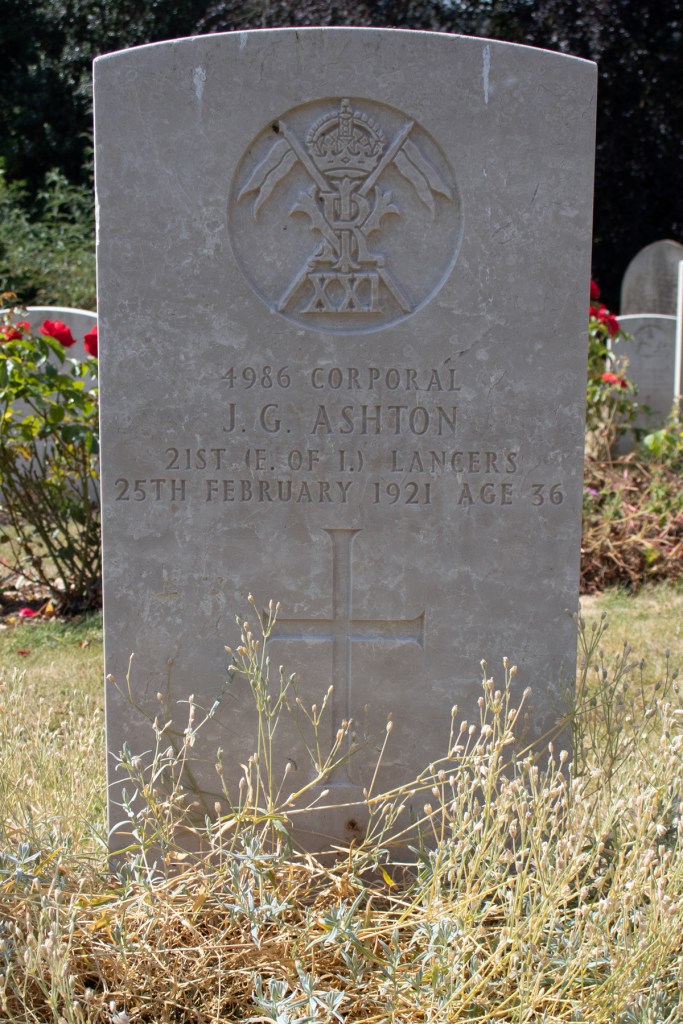
Early in 1921, John was admitted to the Pensions Hospital in Bath, Somerset, having contracted pneumonia. He passed away there on 25th February following an aneurysm of the heart. He was 36 years of age.
John Gordon Ashton was laid to rest in the sweeping Locksbrook Cemetery in Bath.
Andrew Michael Fox was born on 25th May 1871, the oldest of six children, to Michael and Eliza Fox. Michael was a Private in the 40th Regiment of Foot, and was based in Curragh Camp, Kildare, Ireland, when Andrew was born.
The family travelled where Michael’s work took him: Andrew’s oldest siblings were born in Uttar Pradesh, India, and the family were in England by the time of the 1881 census.
Given Michael’s military connections, it is no surprise that Andrew followed him into the army. He enlisted in August 1884, joining the South Lancashire Regiment. His service records give his age as 14 – he was, in fact, just 13 years old – and note his height as 4ft 9ins (1.44cm) and his weight as 73lbs (32.7kg). Andrew was recorded as having hazel eyes, brown hair and a fair complexion: his religion was also confirmed as Roman Catholic.
Andrew’s service records have become damaged over time, and a lot of his details are illegible. Because of his age when he enlisted, he was initially given the rank of Boy. In July 1887, he was formally mobilised, with the rank of Private. He remained on home soil for the next ten years, with the 1891 census listing him as being barracked in Fort Regent, Jersey.
It was in the Channel Islands that Andrew met Kathleen Dooling. The couple married on 7th January 1892, and went on to have ten children. Over the next couple of years, Andrew progressed through the ranks, achieving Lance Corporal in September 1892, Corporal in June 1894 and Lance Serjeant in August 1897.
In 1899, the Second Boer War led to the newly-promoted Serjeant Fox being posted overseas. He remained in South Africa for six months, while the conflict raged on. Andrew returned to Britain in April 1900, and was officially stood down from the army on 31st December that year, as he was deemed no longer fit for military service.
The 1901 census found Andrew and Kathleen still living in family barracks in Aldershot with their three eldest children, Andrew Margaret and Edith. Andrew was recorded as being an officer’s valet, likely now in a civilian role. The family remained in Aldershot until 1910, with five more of their children being born there.
Another change came at that point, however, as the following year’s census found the family living in Brighton Street, Warrington, Lancashire. Andrew was, by this point, working as a salesman for the Singer Sewing Machine Company, and the family were cramped into a four-roomed end-of-terrace house.
War came to Europe in the summer of 1914, and Andrew stepped up to play his part once more. Again, full details have been lost to time, but he took up the rank of Serjeant once more, and was attached to the Somerset Light Infantry. This necessitated another relocation for the family, and they moved to Cannington, near Taunton, Somerset.
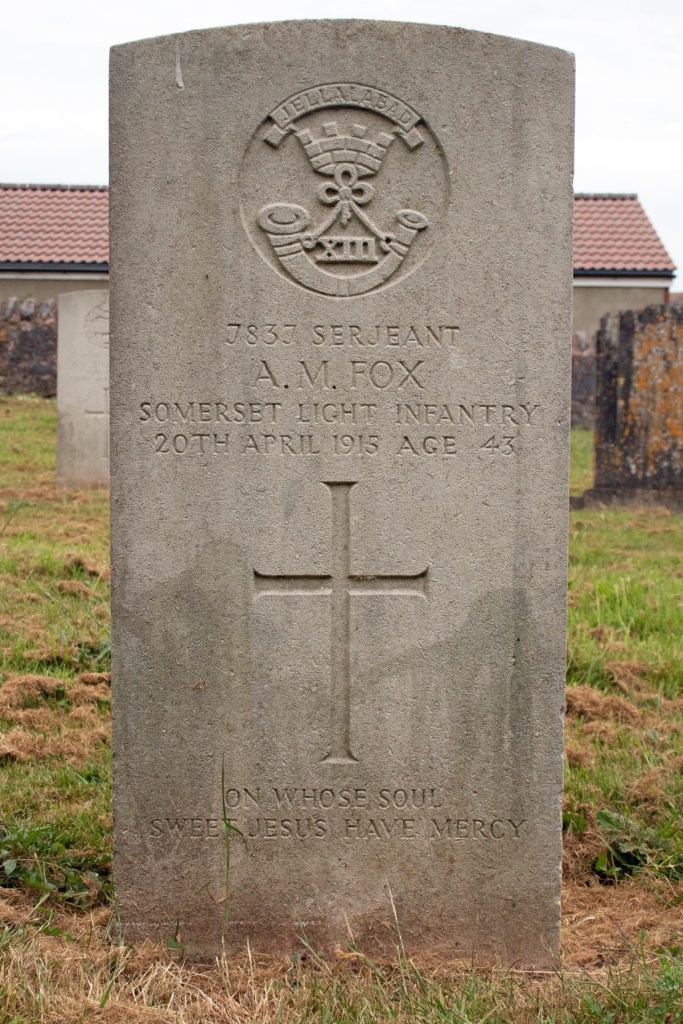
Serjeant Fox was assigned to the 7th (Service) Battalion, but was not to remain in his role for long. He contracted phthisis, or tuberculosis, and passed away from the condition on 20th April 1915, just weeks before his regiment departed for the Western Front. He was 43 years of age.
Andrew Michael Fox was laid to rest in the peaceful Cannington Cemetery, not far from the family home.
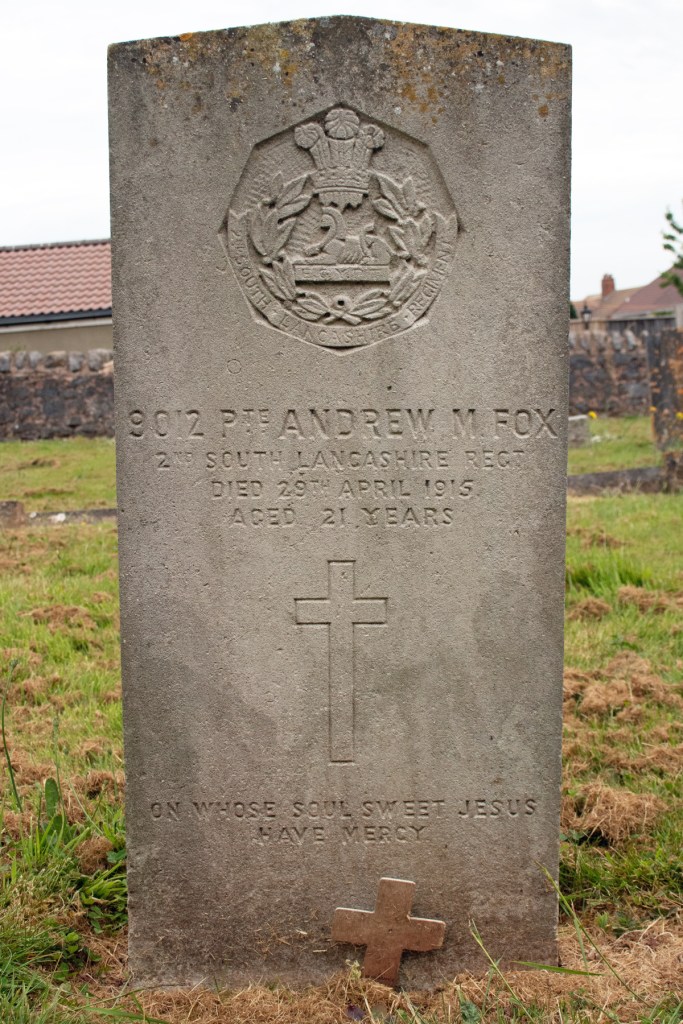
Private Andrew M Fox
In the plot next to Serjeant Andrew Fox is another, similar headstone. Not quite having the same form as the Commonwealth War Grave Commission headstone that Serjeant Fox has, this is dedicated to a Private Andrew M Fox, of the 2nd South Lancashire Regiment.
Andrew Moyse Fox was the eldest son of Andrew and Kathleen. Born on 31st March 1894 in Ireland, he wanted to follow his father and grandfather into the army.
Andrew Jr enlisted in the South Lancashire Regiment in August 1908. His service records confirmed that he was just 14 years of age, standing 5ft (1.52m) tall, and weighing 5st 2lbs (32.7kg). He was noted as having dark brown hair, hazel eyes and a fresh complexion, and that he has a scar on his right buttock.
As is the case with his father, there is limited information about Andrew Jr’s army career. He spent just under six years serving with the regiment, and was formally mobilised when he came of age in 1912. On 27th March 1914, however, Private Fox was discharged from the army on medical grounds, for reasons unclear. The next record available for him is that of his passing, just nine days after his father. He was 21 years of age.
Andrew Fox Jr was laid to rest next to his father in Cannington Cemetery. The heartbreak for Kathleen, to have lost husband and oldest boy within two weeks, must have been indescribable. While her son’s headstone is similar in design to her husband’s, he was not subsequently entitled to an official Commonwealth War Grave, as he had left the army before the outbreak of war: the Commission’s qualification dates (4th August 1914 to 31st August 1921).
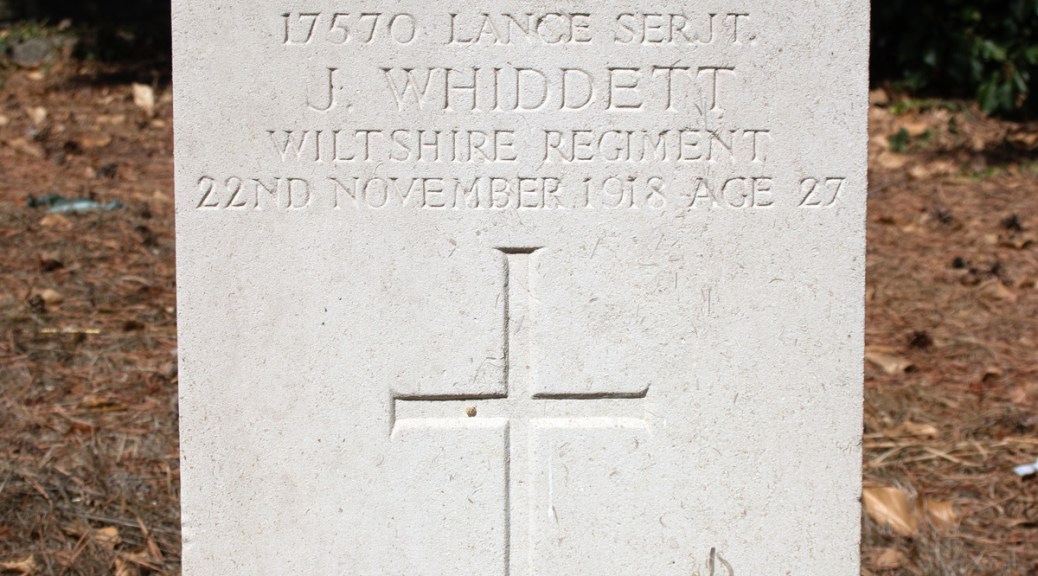
John Whiddett was born in Hammersmith, Middlesex, in 1892, and was one of thirteen children to Alfred and Mary Ann Whiddett. Alfred was a house painter while Mary Ann worked as a charwoman to bring in some additional money for the growing family.
John worked as a porter when he left school, but when war came to Europe, he stepped up to play his part. He enlisted in the Wiltshire Regiment in the summer of 1915, and was assigned to the 3rd (Reserve) Battalion.
While Private Whiddett served in France, he returned to Britain, and promoted to Corporal and then Lance Serjeant. His battalion eventually formed part of the Thames & Medway Garrison. Frederick found himself in Kent by the autumn of 1917 and served out the remainder of the war there.
At some point during the autumn of 1918, Lance Serjeant Whiddett fell ill. He was admitted to the Preston Hall Military Hospital in Aylesford, suffering from a combination of influenza and pneumonia. Sadly he was not to survive these lung conditions, and he succumbed to them on 22nd November 1918. He was just 26 years of age.
Finances may have restricted John’s family’s ability to bring his body back to Middlesex. Instead, he was laid to rest in the graveyard of St Peter and St Paul’s Church in Aylesford, Kent.








 Death and Service