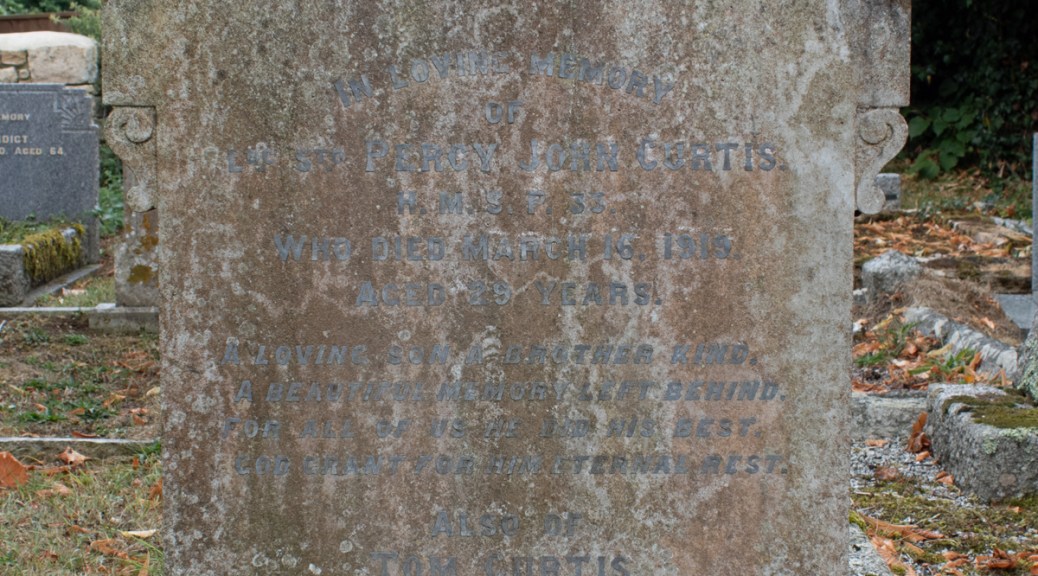
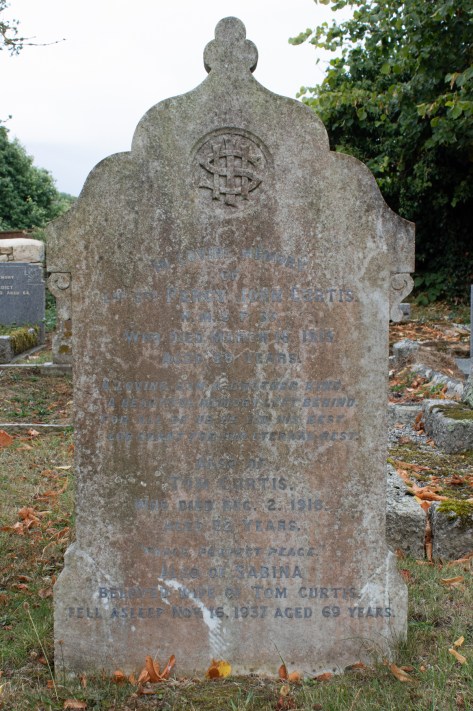
Percy John Curtis was born on 2nd January 1889, the second of twelve children to Tom and Sabina Curtis. Tom was a general labourer from Todber, Dorset, and this is where the family were born and raised.
Much of Percy’s life is a mystery. He found work at sea when he finished his schooling, and in October 1911 he enlisted in the Royal Navy as a Stoker 1st Class. His service papers show that he was 5ft 3ins (1.6m) tall, with brown hair, hazel eyes and a fresh complexion.
Stoker Curtis was initially assigned to the cruiser HMS Pathfinder, and remained on board until the summer of 1912. After a short sting at HMS Victory – the Royal Naval Dockyard in Portsmouth, Hampshire – he was given another posting, aboard the battleship HMS King George V. She would become his home for the next four years, during which time Percy was promoted.
In September 1916, the now Leading Stoker Curtis returned to shore and to HMS Victory. He would remain at the base for the rest of his time in the navy.
On 5th November 1918, Percy married Kathleen Francis. She was the daughter of a Co-operative store manager from Dovercourt, Essex. She seems to have stayed with her family while her new husband was working, and a later census records confirms that she had returned (or remained) there after his death.
Percy’s service record gives a intriguing hint as to what happened, to him. By the end of the war he had been assigned to HMS Victory’s accounting branch. His papers simply state that he “Found dead on board 17 March 1919”. No cause of death is confirmed, although another naval document does confirm that it was due to illness, rather than any foul play. He was 30 years of age.
The body of Percy John Curtis was taken back to Dorset for burial. He was laid to rest in the family plot in Todber Churchyard, alongside his father, who had passed away the year before.
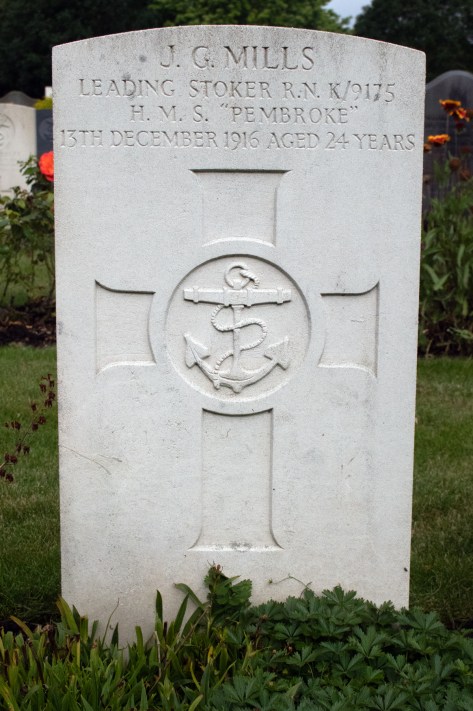
James George Mills was born on 5th August 1891 in Poplar, Middlesex. One of nine children, his parents were Robert and Emily Mills. Robert was a bricklayer, and by the time of the 1901 census, they had settled in Lochnager Street.
Robert had died by 1911, and Emily was left to raise their children alone. That year’s census return found them living in rooms at 1 Cobden Street, with three of the children – including James – old enough to be earning a wage.
James had enlisted in the Royal Navy the year before, and was employed as a Stoker 2nd Class. His service papers show that he was 5ft 5ins (1.65m) tall, with light brown hair, blue eyes and a fair complexion. He was also noted as having a small scar on his right cheek.
Stoker Mills would come to be based at HMS Pembroke, the Royal Naval Dockyard in Chatham, Kent, during his career. He served on a number of ships and, by the time he was promoted to Stoker 1st Class in October 1911, he had spent time on board the cruisers HMS Vindictive and HMS Foresight.
With his promotion came a move, and James was assigned to HMS Acteon, the navy’s new torpedo school based in Sheerness, Kent. From here on in, much of his time seems to have been spent on land, and in January 1914, he moved to HMS Dido, also in Sheerness.
This move to the navy’s land bases seems to have coincided with James’ life away from his career. On 26th December 1912, he married Classina Steenbergen, a Dutch national, whose parents had moved to Barking, Essex in the late 1890s. The couple would go on to have two children: daughters Clasina and Iris.
James’ dedication to the Royal Navy began to pay off, with his annual reviews noting a very good character and a superior ability. In May 1915 he was promoted to Acting Leading Stoker, with the position being formalised that November.
By this point, however, James’ health was becoming impacted. He was admitted to the naval hospital in Chatham in December 1916, suffering from a malignant growth on his pancreas. The condition would prove fatal: he died on 13th December, at the age of just 25 years old.
The body of James George Mills was laid to rest in Woodlands Cemetery, Gillingham, Kent, not far from the naval base he had known so well.
Classina now had two young children to support on her own. She married again in the spring of 1920, her new husband being cabinet maker William Walter Hermann. The couple went on to have three children: Walter, Pearl and James.
Edward Thomas Stewart was born on 7th September 1880 in the Kent village of Sturry. The middle of three children, his parents were farm labourer James Stewart and his wife, Frances.
When he finished his schooling, Edward found work as a coachman, but he sought a life of adventure and, on 24th July 1899, he enlisted in the Royal Navy as a Stoker 2nd Class. His service records show that he was 5ft 7.5ins (1.71m) tall, with light brown hair, grey eyes and a fresh complexion.
Stoker Stewart was sent to HMS Pembroke, the Royal Naval Dockyard in Chatham, Kent, for his training, and remained there for the next eight months. He was then given his first assignment, on board the battleship HMS Sans Pareil. She became his home for the next year, during which time he was promoted to full Stoker.
Edward’s initial term of contract was for twelve years, and over that time he would serve on nine different vessels. Between voyages his shore home remained Pembroke, and he spent more than two years based there. By the summer of 1911, Edward had been promoted three times – to Stoker 1st Class in July 1906, Leading Stoker in March 1908, and Stoker Petty Officer in March 1910.
When his contract came to an end, Edward immediately re-enlisted. By this point, his records show that he had grown to 5ft 10.5ins (1.79m) tall, and had a scar on his nose.
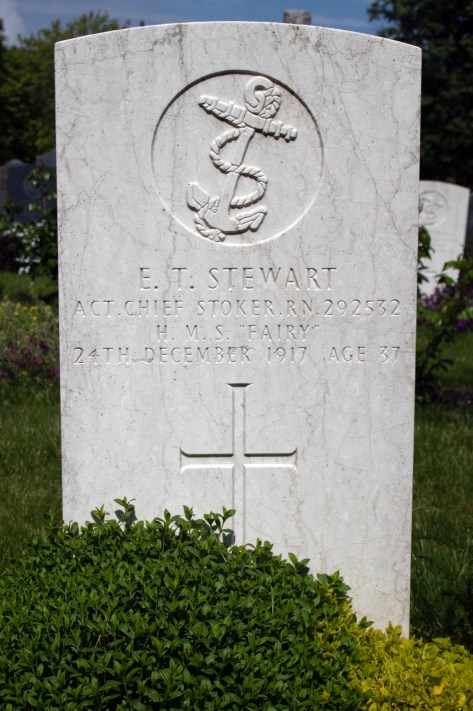
In the autumn of 1912, Stoker Petty Officer Stewart was assigned to the troop ship HMS Tyne. She would become the ship on board which he would spend the longest part of his career, not disembarking until 31st May 1917. He transferred to HMS Fairy, a destroyer, and with the move came a promotion to Acting Chief Stoker.
Attached to the Grand Fleet, Fairy was engaged in convoy work off the east coast. Edward’s time on board would not be a lengthy one, however. On 24th December 1917, he fell overboard, and was killed. He was 37 years of age. There is little additional information about the incident, although his service papers note that “no blame was attributable to anyone.”
Edward Thomas Stewart’s body was recovered, and brought back to Kent for burial. He was laid to rest in the naval section of Woodlands Cemetery, Gillingham, not far from the base he had called home for so long.
Henry Weller was born on 13th January 1877 in the village of Ashurst Wood, Sussex. The second of four children, his parents were John and Mary Weller. John was a farm labourer, and the 1881 census found the family living in a cottage on Brooklands Farm in East Grinstead.
Times look to have been tough for the Weller family. By the time of the next census, John, Mary and three of their children were lodging with Hartfield family. Henry, meanwhile, was living in Deptford, Kent, with James and Susannah Weller. He was noted as being a ‘cousin’, although his exact relationship is unclear. James’ nephew Joseph Weller, was also living with them. Just fourteen years of age, Henry was working as a general labourer, and the family were living at 21 Adolphus Street.
Labouring was an irregular way to being in money, and so Henry sought out a more regular career. On 18th November 1896 he signed up to the Royal Navy as a Stoker 2nd Class. His service records show that he was 5ft 4.5ins (1.64m) tall, with brown hair, brown eyes and a fresh complexion. He was also noted as having the letters HW tattooed on his left forearm, and shaking hands on his upper left arm.
Stoker Weller was sent to HMS Pembroke, the Royal Naval Dockyard in Chatham, Kent, for his training. He spent the next nine months split between there and HMS Wildfire – Sheerness Dockyard – learning his trade.
On 8th June 1897, Henry was assigned to the battleship HMS Victorious. Promoted to Stoker 1st Class three months after boarding, she would remain his home for the next three years. After a month aboard another battleship – HMS Revenge – he returned to Chatham.
Love blossomed and, on 8th July 1900, Henry married Alice Beldham, a dock worker’s daughter. The couple exchanged vows at All Saints’ Church, Rotherhithe, Kent, and moved in with Alice’s widowed father, George, at 12 Osprey Street. They went on to have three children: Henry, Harold and Ivy.
Newly settled, Henry seems to have voiced a preference to remain closer to home and, for the next couple of years he would remain based at HMS Pembroke. Alice relocated, and the family set up home at 51 King Edward Road, Gillingham, Kent. Close to the River Medway, the Wellers’ neighbours were all based at the docks, and, during her husband’s future absences, it is likely that Alice felt a sense of community.
After leaving HMS Pembroke, Henry was attached to the cruiser HMS Bacchante. Promoted to Leading Stoker 2nd Class, over the next six years, he would serve on three more ships, spending six-month stints back in Chatham in between assignments. In July 1903 he was promoted to Leading Stoker 1st Class, although he reverted to 2nd Class nine months later. Promoted again in June 1905, he took the rank of Stoker Petty Officer a year later.
Henry’s initial term of service came to an end in November 1908. He immediately re-enlisted, and remained in service until the spring of 1918.
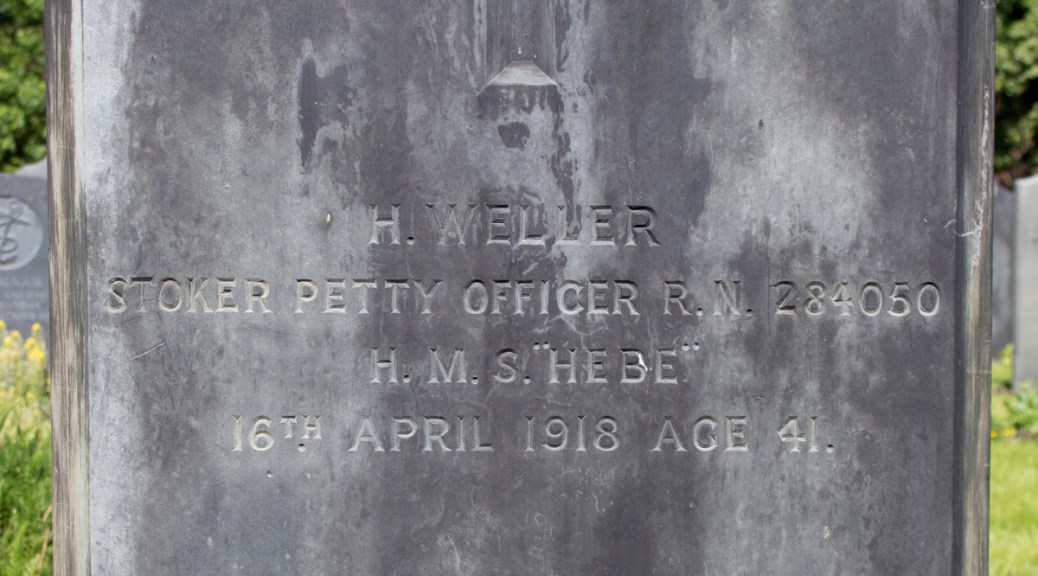
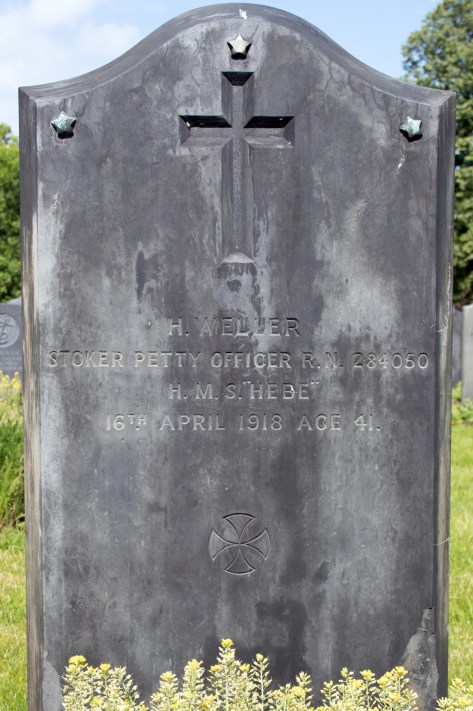
By this point Stoker Petty Officer Weller had been assigned to the torpedo gunboat HMS Hebe for more than thirty months. Patrolling the North Sea coast, on 12th April, she moored at the Alexandra Dock in Hull, Yorkshire. A later inquest outlined what happened next:
Joseph Taylor, a chief petty officer, said that about 11:55pm… [Henry] and he were going from the town to their ship… Witness struck a match to light his pipe. [Henry] walked on for about two yards, and then disappeared. Witness raised the alarm, and went tot he bottom of the dry dock, into which he found [Henry] had fallen, a distance of about 50 feet. They did not know the docks, has they had only come in that morning… If he (witness) had not struck the match they would both have gone over.
[Hull Daily Mail: Wednesday 17th April 1918]
Alive, but severely concussed, Stoker Petty Officer Weller was quickly taken to a local hospital. He was operated on, but his injuries were too severe. Henry passed away on 16th April 1918: he was 41 years of age.
The body of Henry Weller was taken back to Kent for burial. He was laid to rest in Woodlands Cemetery, Gillingham, a short walk from where Alice and their children were still living.
Andrew Dryden Blakey was born on 14th October 1873 in Jarrow, County Durham. One of twelve children, his parents were John and Jane Blakey. John was a joiner by trade, and the family were brought up at 71 Hedley Street, South Shields.
When he completed his schooling, Andrew was set on broadening his horizons. On 21st January 1899 he enlisted in the Royal Navy as a Stoker. Full details of his time in the navy have been lost to time, but by the time he reached the end of his contract, he had spent thirteen years at sea, and had risen to the rank of Leading Stoker.
On 4th February 1902, Andrew married Eleanor Slater, a labourer’s daughter from South Shields. The have five children, and, while her husband was at sea, she would take rooms with her uncle.
Leading Stoker Blakey was stood down to reserve status on 30th July 1913. His service records at that point show that he was 5ft 3.5ins (1.61m) tall, with blue eyes and a fair complexion. He was also noted as having a number of tattoos: clasped hands and a star on his right forearm, and his initials on the left.
When war broke out, Leading Stoker Blakey was called into action once more. After an initial assignment on board the battleship HMS Duncan, his time was split between HMS Pembroke and HMS Wildfire, the Kent shore bases at Chatham and Sheerness respectively.
Andrew’s health was becoming impacted by this point, however, and, in the spring of 1917, he was admitted to the Royal Naval Hospital in Chatham with carcinoma of the colon. The condition would ultimately take his life: he died on 4th May 1917, at the age of 43 years old.
The body of Andrew Dryden Blakey was laid to rest in the naval section of Woodlands Cemetery, Gillingham, Kent, not far from the Chatham Dockyard, he had for so long called home.
Walter William Pankhurst was born on 21st March 1867, and was the third of four children – and the only son – to Thomas and Harriet Pankhurst. Thomas was a farm labourer from Staplehurst, Kent, but he and Harriet raised their family in Murston, to the east of Sittingbourne.
Walter initially followed his father into farm work, but he sought a bigger and better life and, on 3rd December 1888, he enlisted in the Royal Navy. His service records show that, at 21 years of age, he was 5ft 7ins (1.7m) tall, with dark hair, hazel eyes and a ruddy complexion.
Given the rank of Stoker 2nd Class, Walter was sent to HMS Pembroke, the Royal Naval Dockyard in Chatham, Kent, for his training. In the summer of 1889 he was given his first posting, on board the gunboat HMS Pigmy, and she would remain his home for the next three-and-a-half years.
When he joined up, Walter had committed to twelve years’ service, and this time was not wasted. By the time his contracted came up for renewal, he had served on three further ships, returning to Chatham in between voyages. He had also progressed through the tanks, to Stoker 1st Class in January 1890, Leading Stoker 2nd Class in March 1897 and, with the renewal of his service, to Leading Stoker 1st Class in February 1901.
On 15th June 1904, Walter married Ellen Goddard. A gardener’s daughter from Eastling, Kent, by the time of their wedding, she was working as a domestic servant for a chemist in Hampstead, Middlesex. The couple exchanged their vows in St Stephen the Martyr’s Church, Hampstead, Ellen’s sister Susan acting as one of the witnesses.
Back in the Navy, Walter’s career continued its progression. Regularly noted as being of very good character, within three months of his wedding he was promoted to Acting Chief Stoker. By October 1905 the role was formalised, and he would end his naval career in December 1910 as Chief Stoker.
Stood down to reserve status, Walter made the move to civilian life. The 1911 census found him and Ellen living at 95 Glencoe Road, Chatham, a small terraced house with just four rooms. The couple had had three children by this point, and Susan was also living with them. A naval pensioner, Walter was still employed by the navy, and was working as a bootmaker’s labourer in the dockyard.
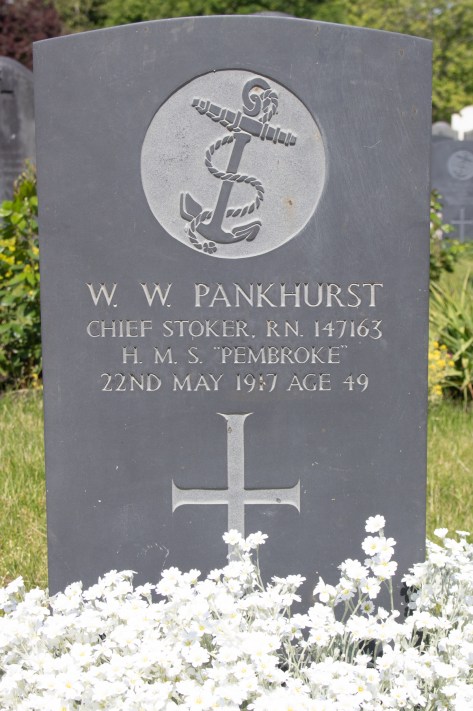
When war was declared in the summer of 1914, Chief Stoker Pankhurst was called into service once more. For the next couple of years he would be based at HMS Pembroke, either working in the dockyard’s boiler rooms or training new recruits.
In the spring of 1917, Walter was taken ill. He was suffering from haematemesis, and the condition was to prove his undoing. He passed away on 22nd May 1917, at the age of 50 years old.
The body of Walter William Pankhurst was laid to rest in the naval section of Woodlands Cemetery, Gillingham, a few miles from where Ellen was now living on Luton Road, Chatham.
By the time Walter passed, he and Ellen had had four children. His widow never remarried, but when she died, on 7th April 1961, she was buried alongside her husband. She was 90 years of age.
The couple’s eldest daughter, Nancy, remained a spinster throughout her life, initially supporting her mother after Walter died. Nancy was buried with her parents, when she died in 1995: she was also 90 years old.
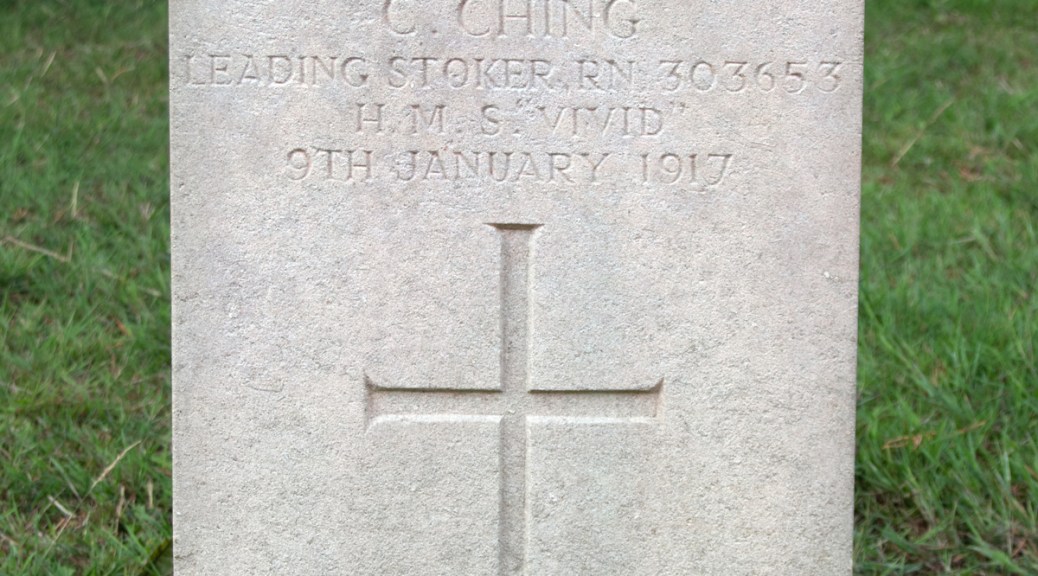
Charles Ching was born in Torquay, Devon, on 22nd March 1885. The oldest of three children, his parent were Joseph and Sarah Ching. Joseph died by the time Charles was just four years old. The 1891 census found Sarah living with their three sons – plus her other son from a previous marriage – on Pannier Street in Paignton. There is no evidence of work for any of the family, but it is likely that Charles’ half-brother, George, would have been bringing some money in, as he was 14.
Moving forward ten years, and Sarah was employed as a charwoman. Her three boys with Joseph were still at home, and Charles and his younger brother Henry were both working as errand boys.
Charles had his sights on bigger and better things, however, and on 21st March 1903, he enlisted in the Royal Navy. His service records show that he had given up a job as a gardener, and he would continue with manual labour, taking on the rank of Stoker 2nd Class. The document also confirms that he was 5ft 8ins (1.73m) tall, with brown hair, hazel eyes and a fresh complexion.
Throughout his naval career, Stoker Ching would be based out of HMS Vivid, the Royal Naval Dockyard in Devonport. Over the twelve years of his service, he was assigned to six ships, and rose through the ranks. In June 1904, he was given the rank of Stoker, and two years later was promoted to Stoker 1st Class.
On 1st July 1907, Charles was given a posting on board the cruiser HMS Forth. She would remain his home for five-and-a-half years, during which time, a number of things changed. A previously unblemished record was tainted by seven days in cells in November that year, although his misdemeanour is not noted.
In December 1908, Charles married Florence Tucker. The daughter of a carter from Totnes, her mother’s maiden name was Ching, although whether there was any connection to Charles’ late father is unknown.
On 1st September 1911, Charles was promoted again, taking on the rank of Leading Stoker. When his initial term of service came to an end in March 1915, war was raging around the world. He re-enlisted, and his records not that he had grown an inch (2.5cm) over the previous decade, but had also gained a number of tattoos. These included a woman’s head, a rose pierced by a sword and a Japanese woman on his right arm; there was also a peacock, clasped hand, heart and butterfly on his left.
Leading Stoker Ching’s health was beginning to suffer at this point, and by September 1915, he had returned to his short base, HMS Vivid. Suffering from pulmonary tuberculosis, he was invalided out the Royal Navy just a month later.
At this point, Charles’ trail goes cold. He seems to have settled in Totnes with Florence, her father having passed away there in 1915. His health was to get the better of him, however. He passed away on 9th January 1917 at the age of 31 years old.
Charles Ching was taken to Paignton for burial. He was laid to rest in the town’s cemetery.
Florence remained in Totnes after her husband’s passing. Her life there would not be a lengthy one: she passed away in March 1919, aged 29.
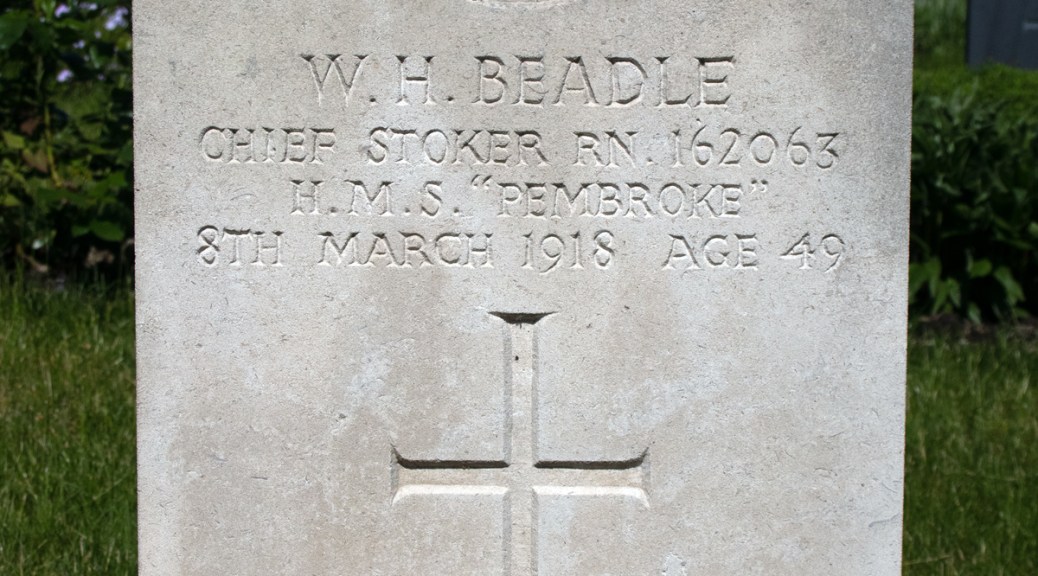
William Henry Beadle was born in Heybridge, Essex, on 23rd April 1870. The youngest of three children his parents were William and Sophia Beadle. William Sr was a waterman-turned-labourer, and the young family lived with Sophia’s parents.
When Sophia died in 1875, her widow and their children remained with his in-laws. William Sr died in 1887, and by the time of the 1891 census, his son was living with his now widowed grandmother. The document notes that she was a pauper, but he was a moulder in the local iron works.
William sought bigger and better things and, on 13th August 1891, he enlisted in the Royal Navy as a Stoker 2nd Class. His service records show that, as 21 years of age, he was 5ft 8ins (1.72m) tall, with brown hair, grey eyes and a fresh complexion.
Stoker Beadle was initially sent to HMS Pembroke, the Royal Naval Dockyard in Chatham, Kent, for his training. He would spend the next six months split between there and HMS Wildfire, a shore establishment downriver at Sheerness.
In 1892, William spent six months on board the troop ship HMS Tyne. He returned to Chatham in July of that year, and was promoted to Stoker 1st Class. Over the course of the next eleven years, he would go on to serve on four ships, each time returning to his base port, HMS Pembroke.
William’s service record is pretty much mark free. He was confined to cells for seven days in October 1895, although his offence s unclear. In April 1896 he was promoted to Leading Stoker 2nd Class, and made Leading Stoker 1st Class three years later. In December 1902, while on board the cruiser HMS Diana, William was promoted again, to Acting Chief Stoker, and the following August, his initial contract of service came to an end.
By this point William was a married man. He married Clara Walford in Rochford, Essex, and, while the couple did not go on to have children, there is little additional information about her.
William re-enlisted as soon as his initial twelve-year contract came to an end. In December 1903 he was promoted to Chief Stoker, and he remained at this rank until he war formally retired on 16th August 1913. He had spent more than two decades in the Royal Navy ,and travelled the world: the 1911 census recorded him as one of the crew of HMS Lancaster, moored in Malta.
Chief Stoker Beadle’s time away from the Royal Navy was not to be lengthy and, when war broke out less than a year later, he was called upon once more. He spent nine months back at HMS Pembroke, before being assigned to the new cruiser HMS Calliope. She would be William’s home for the nearly three years, and it was not until March 1918 that he came back to shore.
William’s return to Chatham seemed to coincide with a downturn in his health. He was admitted to the town’s Royal Naval Hospital with nephritis, and this is what would take his life. He died on 8th March 1918: he was 47 years of age.
William Henry Beadle was laid to rest in the military section of Woodlands Cemetery, Gillingham, not far from the naval base he had called home for so long.
Albert Willingham was born in Upchurch, Kent, on 4th January 1888. One of eleven children, his parents were George and Annie Willingham. George was a brickmaker and labourer, who moved his family to where the work was. By the time of the 1891 census, they had relocated to the nearby town of Gillingham, and were living on the waterfront at 5 Danes Hill.
As the family grew, so they kept moving. The census of 1901 found the ten Willinghams – George, Annie and eight children including 13-year-old Albert and his youngest sibling, 11-day-old Ada – residing at 5 Court Lodge Road. The small terraced house would still be crowded, however, and this may have been one of the factors pushing Albert to bigger and better things.
Having followed his older brothers into labouring work, Albert decided enough was enough. On 13th July 1908, he enlisted in the Royal Navy, joining up as a Stoker 2nd Class. His service records show that he had brown eyes, dark brown hair and a ruddy complexion. He was 5ft 8.5ins (1.73m) tall.
Stoker Willingham was first sent to HMS Acheron, the training frigate, for his induction. He remained on board for six months, before moving to the cruiser HMS Dido in January 1909. Over the next six years, Albert served on seven further ships, returning to what became his home base, HMS Pembroke in Kent, in between voyages.
Albert quickly became well-travelled, and he served in the Somaliland Expedition, and in the operations in the Persian Gulf between 1909 and 1914. The 1911 census recorded him as being a stoker on board HMS Hyacinth, which was then moored in Bombay (now Mumbai), India.
While on board Hyacinth, Albert was promoted to Stoker 1st Class, and in April 1915, with the war raging around him, he was promoted again, to Acting Leading Stoker. At the end of that month, he was transferred to what would be his final ship, HMS Princess Irene.
She was an ocean liner that had been requisitioned at the outbreak of war, and converted to a minelayer. On 27th May 1915, while moored off Sheerness, Kent, a series of explosions ripped through the ship, killing more than 350 crew. Acting Leading Stoker Willingham was among those who perished: he was 27 years of age.
The body of Albert Willingham was buried in Woodlands Cemetery, Gillingham, Kent, just a short walk from his family’s home.
Albert’s headstone records the permanent rank he held at the time of his passing, rather than acting one he had been temporarily given. He is therefore noted as Stoker 1st Class, instead of Acting Leading Stoker.
Albert Symes was born in Dorset on 6th March 1887. Details of his early life are a challenge to piece together, as his was not an uncommon name in the county – the 1891 census has at least two potential matches, and the 1901 record at least three.
The first concrete information for Albert is that of his military service. Having been working as a general labourer, he enlisted on the 22nd September 1906, joining the Royal Navy as a Stoker 2nd Class. His service records show that he was 5ft 5ins (1.65m) tall, with brown hair, blue eyes and a fresh complexion. He was also noted as having the letters BS (presumably for Bert Symes) tattooed on his right forearm.
The service document gives his place of birth as Yeovil, Dorset, although the town is actually in Somerset. The next census, taken in 1911, suggests he was born in the village of Bradford Abbas, three miles south east and over the Dorset border.
Stoker 2nd Class Symes was first sent to the training ship HMS Nelson. Based in Portsmouth, Hampshire, this is where Albert spent three months, before being assigned to the cruiser HMS Eclipse. Over the next nine years, Albert served on eight ships, returning to a land base – HMS Victory in Portsmouth – in between voyages.
Albert’s commitment to the job is evident – his character was continually noted as being Very Good, while his ability was Superior as each of his annual reviews. In May 1907 he was promoted to Stoker 1st Class; five years later he made Acting Leading Stoker, with a full promotion to the rank in June 1913; on 1st June 1915, while serving on board HMS Hampshire, Albert was promoted again, to Stoker Petty Officer.
Things would change rapidly for Albert, however. Within a matter of weeks, he had contracted pneumonia. He was transferred to the hospital ship Garth Castle, but the condition was to prove too severe. Stoker Petty Officer Symes passed away from the condition on 3rd October 1915: he was 28 years of age.
Albert Symes’ body was brought back to Dorset for burial. He was laid to rest in the peaceful graveyard of St Mary’s Church in the village of Bradford Abbas.








 Death and Service