Tag Archives: Private

Private William Garrett

Private William Garrett

William Garrett was born in Warminster, Wiltshire, on 18th October 1880. The fourth of seven children, he was the fourth son to Henry and Mary Garrett. Henry was a groom, and the family lived at 80 Portway, a Victorian villa to the north of the town centre.

The 1901 census records the family having moved from No. 80. The document notes their address as 14 Portway and with this move, there appears to have been a change of circumstances. At some point in the previous ten years, Henry had given up working with horses, and had gone into baking instead. This too had taken a back seat, however, as the census confirms his employment as former baker. William, now 21 years of age, was still living with his parents, and was working as a printer for a local newspaper.

On 5th August 1905, William married Kate Macey. A labourer’s daughter from Bishopstrow, Wiltshire, the couple exchanged vows in her parish church. They settled in a house on Deverill Road, Warminster, and went on to have five children,

When war broke out, William would eventually be called upon to play his part. “He was previously employed at the ‘Warminster Journal’ office as monotype caster and operator, and served his apprenticeship at the office. It was very largely through his services that the ‘Journal’ was forced to suspend publication and though he might have obtained further exemption from military service, he preferred to leave civil employment and enter into the service of his country” [Wiltshire Times and Trowbridge Advertiser: Saturday 25th May 1918]

William enlisted in the Army Service Corps on 1st May 1918. As a Private, was attached to the Mechanical Transport Depot in Sydenham, Kent. His service records show that he was 5ft 3ins (1.59m) tall and weighed 126lbs (57.2kg). His medical records note that he was of good physical development.

The newspaper report continued:

[Private Garrett] left Warminster only a week or two ago and was billeted at Sydenham, being apparently in the best of health and spirits. On Tuesday his wife… received the following telegram from an officer: “I regret to have to inform you your husband died suddenly in his billet around 1:30pm today. All ranks convey deepest sympathy.”

The distressing news was confirmed by a letter from a comrade, Pte. Manley, who is a native of Taunton. He wrote “It is with extreme sorrow I write this letter to you. Your husband and I arrived here the same day and he slept in my room with two others – very nice fellows. We all send you our heartfelt sympathy in your sorrow. He spoke to me today about 1.10pm and then fell forward. I and others did everything possible for him but he was beyond human aid from the start. He only lived about two minutes and suffered no pain. We all liked him very much in our bedroom and indeed in the billet. I am sure he would have proved a credit to the ASC.”

[William] was a member of the Oddfellows Society and filled all the local lodge offices, and was also a member of the committee of the Co-operative Society. He belonged to the Warminster Volunteer Training Corps, and jus as he left to join the regular army he was about to be promoted.

[Wiltshire Times and Trowbridge Advertiser: Saturday 25th May 1918]

The inquest into Private Garrett’s death found he had died of natural causes. He was 37 years of age when he passed away on 21st May 1918. He had been in the army for just 20 days.

The body of William Garrett was taken back to Wiltshire for burial. He was laid to rest in the graveyard of Christ Church, Warminster.


Private John Adlam

Private John Adlam

John Adlam was born in the spring of 1883 in Warminster, Wiltshire. The youngest of seven children, his parents were William and Emily Adlam. William was a maltster’s labourer, and the family lived in a small cottage at 66 Pound Street, to the south west of the town centre.

When John finished school, he found work as a garden labourer. By this point the Adlam family had moved, and home was 29 Chapel Street. William himself wasn’t recorded there, however. Work had taken him away and he was living at Holcombe Malthouse, on the outskirts of Kilmersden, Somerset.

On Christmas Day 1906, John married Ethel Brown, a plasterer’s daughter from Westbury, Wiltshire. The couple would go on to have three children, and 1911 census shows them living at 24 Chapel Street, Warminster with John’s recently widowed mother.

When war broke out, John stepped up, or was called upon, to play his part. His service records no longer exist, although it is clear that he served as a Private in the Dorsetshire Regiment as a Private. He was based at on of the regimental depots, and served through to the end of the war.

The only other record for John are those relating to his passing. He died on 29th November 1918 and, as his death was registered in Warminster, it seems likely that he died at or close to home. He was 35 years of age.

The body of John Adlam was laid to rest in the graveyard of Christ Church in his home town of Warminster.


Interestingly, while an initial grant was paid to Ethel, John’s entry on the Pension Ledger stated that they had been “instructed to cease [temporary] payment as widow not eligible for pension in respect of her late husband.” There is no indication as to whether this was later overturned.


Sergeant Herbert Marriott

Sergeant Herbert Marriott

Herbert Ernest Marriott was born on 15th November 1881 in the Hampshire village of Alverstoke (now part of Gosport). The younger of two children, his parents were George and Sarah Marriott. George was a navy pensioner, who died a matter of months after his youngest son was born, leaving Sarah to raise their two children alone.

The 1891 census found Sarah living at Prince Alfred Cottage in Alverstoke, with her two sons – Herbert, aged 9, and Joseph, aged 22 – and grandson, one-year-old Charles. She was employed as a launderess, while Joseph was employed as a bricklayer’s labourer.

Herbert was keen to build a career for himself and, on 20th July 1897, he enlisted in the Royal Marine Light Infantry. His service record shows that he was 5ft 7.5ins (1.71m) tall, with dark brown hair, brown eyes and a fresh complexion. He was also recorded as having a small scar on his left shoulder.

Private Marriott was sent just along the coast to Portsmouth for his training: this would become his land base in between voyages. He evidently showed some musical talent as, just two months after enlisting, he was given the rank of Bugler. Over the years the career he had sought grew, and his abilities grew with it.

Between 1897 and 1914, Herbert would serve on nine vessels in total. In February 1900 he became a Private once more, but by the end of the following year he had been promoted to Corporal. He continued to rise through the ranks, becoming Lance Sergeant in January 1905 and full Sergeant in the summer of 1907.

In the spring of 1901, Herbert married navy pensioner’s daughter Annie Hill. The newlyweds would set up home at 140 Queen’s Road, Gosport, and have six children between 1904 and 1914.

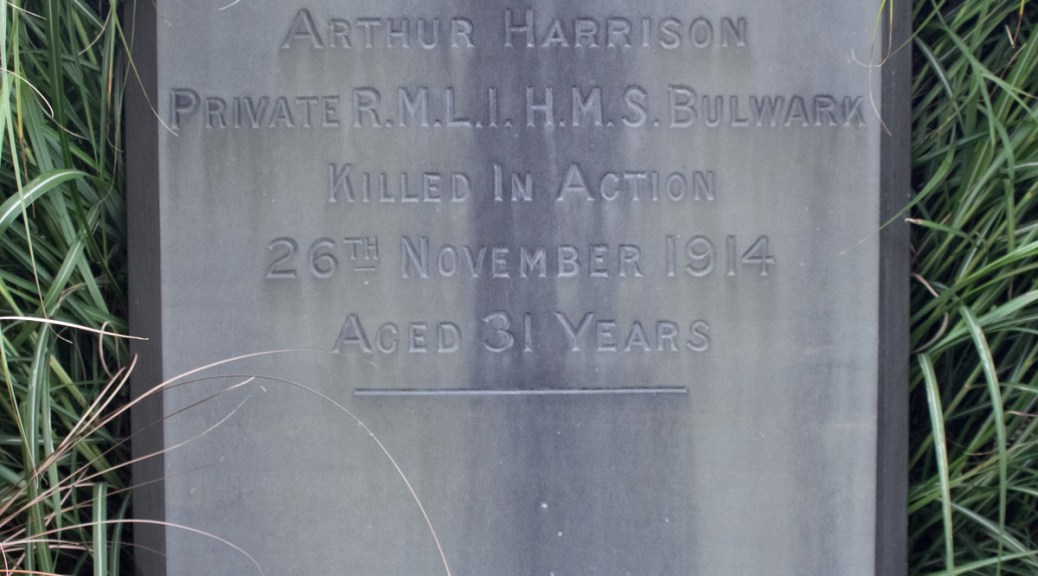
Back at sea and, by the time war was declared, Sergeant Marriott had been assigned to the battleship HMS Bulwark for two years. Part of the Channel Fleet, she was charged with patrolling and protecting the water off the south coast of England.

On 16th November, Bulwark was moored in the River Medway, near Sheerness, Kent, and being restocked with ammunition. A number of cordite charges had been stored incorrectly and overheated. These detonated the nearby shells and the resulting chain reaction of explosions ripped apart the battleship, sinking it and killing more than 740 crewmen, including Sergeant Marriott. He had turned 33 years of age just the day before.

The bodies recovered were laid to rest in the naval section of Woodlands Cemetery, Gillingham, Kent. As his had been identified, Herbert Ernest Marriott was buried in a marked grave.


Private Thomas Neale

Private Thomas Neale

Thomas Neale was born in the Botley, Oxfordshire, on 3rd June 1876. One of eight children, his parents were George and Mary Neale. George was an agricultural labourer and the family would settle in Cumnor, just over the Berkshire border.

Thomas was keen to make a life for himself and, on 29th December 1898, he enlisted as a Private in the Royal Marine Light Infantry. HIs service papers show that he had been employed as a general labour and the point he signed up, and give an indication into the man he was becoming. He was noted as being 5ft 7ins (1.7m) tall, with grey eyes, brown hair and a fresh complexion. He was also recorded as having a small scar on his right knee.

Private Neale was initially sent to the Royal Marines barracks in Deal, Kent, for his training. Over the next sixteen years, he would serve on eight ships, each time returning to what would become his home base, the Royal Naval Dockyard in Portsmouth, Hampshire, in between voyages. While never outstanding, his annual reviews reported his good or very good character, and very good ability.

When war broke out in the summer of 1914, Private Neale was serving on board the battleship HMS Bulwark. Part of the Channel Fleet, her role was to patrol and protect the English Channel and south coast.

On 26th November she was moored up in the lower reaches of the River Medway, not far from Sheerness, being re-stocked with ammunition. That morning, a number of cordite charges overheated, detonating the shells stored nearby. The resulting explosion ripped through the battleship, and more than 740 crew were killed. Thomas was amongst those whose bodies were recovered and identified: he was 38 years of age.

The bodies that were recovered from the tragedy were taken to the Woodlands Cemetery in nearby Gillingham and laid to rest. Thomas Neale was buried alongside his colleagues in a marked grave, while those whose remains had not been identified were laid to rest in a mass grave nearby.


Private Thomas Neale
(from findagrave.com)

Private John Bellamy

Private John Bellamy

John Henry Bellamy was born in Leicester, Leicestershire, on 14th August 1890. The oldest of four children, his parents were Joseph and Alice Bellamy. Joseph worked as an iron moulder, and the couple lived at 70 Friars’ Causeway when their first child was born.

By the time of the next census, taken in 1901, the Bellamy family had moved, and were living at 19 Pingle Street. Close to the river, this was presumably also close to the foundry where Joseph was employed. John sought a more regular income, however, and, on 22nd November 1907, he gave up his work as a shoe dresser, and enlisted in the Royal Marine Light Infantry.

John’s service records show that he was just over 5ft 5ins (1.65m) tall, with light brown hair, grey eyes and a fair complexion. He had a number of scars, including one by his left elbow and another on the right side of his chin.

Private Bellamy was sent to Deal, Kent, for his training. He spent a year at the Royal Marines base there, and this is where his ability to swim was tested. Over the next seven years, he would go on to serve aboard five ships, more often than not being based in Portsmouth, Hampshire, between assignments.

In July 1914, John was assigned to HMS Bulwark, and would remain with her for the next few months. Indeed, he was on board Bulwark on the 26th November 1914, when she was moored close to Sheerness, Kent. That morning, an explosion ripped through the ship, sinking it and killing more than 740 people. Private Bellamy was amongst them: he was just 24 years of age.

The body of John Henry Bellamy was laid to rest in a marked grave in the naval section of Woodlands Cemetery, Gillingham, Kent.


Second Lieutenant Wesley Archibald

Second Lieutenant Wesley Archibald

Wesley Alexander Archibald was born in Flatlands, New Brunswick, Canada, on 19th October 1894. The oldest of ten children, his parents were Scottish-born couple James and Jane Archibald. It is unclear what employment James was in, but when he completed his schooling, Wesley found work as a telegraph operator.

When not working, Wesley was an active member of the Irish Fusiliers of Canada, and, by the time was broke out, he had been with the 11th Regiment for a year.

Wesley enlisted in the Canadian Expeditionary Force on 29th November 1915. His service records show that he was 5ft 6.5ins (1.69m) tall, with black hair, brown eyes and a fresh complexion. He was also noted as having a large scar on the outer side of his right thigh.

Private Archibald’s initial training was completed on home soil. His unit – the 121st Battalion – left Halifax on 14th August 1916, and arrived in Liverpool, Lancashire, ten days later. His dedication to the role was clear: his unit moved to Bramshott, Surrey, and he had been promoted to Corporal by the time he arrived there, and Sergeant just two months later.

In January 1917, Wesley was assigned to the 7th Battalion of the Canadian Expeditionary Force and sent to the Front Line. Over the next few months, his unit saw some fierce fighting at Arras, Vimy and Hill 70. On 9th July Sergeant Archibald was awarded the Military Medal for his actions.

By the end of 1917, Wesley was seeking more adventure, and, on 10th December, he transferred to the Royal Flying Corps. Attached to the 29th Training Depot Station, he was based near Beaulieu in Hampshire when the Royal Air Force was created. Over the next year he learnt his new trade and, on 7th November 1918, he was appointed Second Lieutenant.

The following day, Wesley was preparing for a flight in his Sopwith Dolphin. The aircraft took off, but the engine stalled, and the plane crashed. Second Lieutenant Archibald was killed instantly. He was 24 years of age.

The body of William Alexander Archibald was laid to rest in the graveyard of St Paul’s Church in East Boldre, not far for the airfield he had called home.


Private Victor Creed

Private Victor Creed

Herbert Victor Creed was born in Warminster, Wiltshire, towards the end of 1898. One of eight children, his parents were David and Mary Creed. Davis was a railway porter, and, at the time of the 1911 census, the family were living at 41 Vicarage Street, to the west of the town centre.

When he finished his schooling, Herbert – who had begun to be known by his middle name – found employment working alongside his father. When war broke out, however, he stepped up to play his part. His service papers have been lost to time, but it is clear that he enlisted by the spring of 1918, and he was attached to the Machine Gun Corps.

Private Creed was sent to the Western Front. Where and when he served is not known, but he would definitely have been in the thick of it.

Victor Hubert Creed [sic] (21), third son of Mr and Mrs DJ Creed… who was attached to the Machine Gun Corps, was seriously wounded in action on October 21st. He was taken t a hospital in Manchester, where he passed away on Friday.

[Wiltshire Times and Trowbridge Advertiser: Saturday 9th November 1918]

Herbert Victor Creed – plain Victor to his friends – was 21 years of age when he died on 1st November 1918. His body was taken back to Wiltshire for burial and he was laid to rest in the graveyard of St Denys’ Church.


Private Harry Carr

Private Harry Carr

Harry James Carr was born on 17th October 1893 in Warminster, Wiltshire. The youngest of four children, his parents were Joseph and Annie Carr. Joseph was a plasterer and tiles, and also a sexton for the local church: the 1901 and 1911 census returns found the family living at 22 Church Street, towards the west of the town centre.

When Harry completed his schooling, he found work as a plasterer alongside his father. War was coming, and he stepped up to play his part. Full service records have been lost to time, but he would have enlisted no later than the summer of 1916, joining the 1st Battalion of the Wiltshire Regiment. Private Carr’s unit became entrenched on the Western Front, fighting at the Somme during that year.

Harry was wounded during the Battle of Ancre Heights. The details of his injuries are unclear, but they were bad enough for him to be medically evacuated for treatment. Admitted to the Graylingwell Hospital in Chichester, West Sussex, he would remain there for the next four months. Ultimately, his wounds were too severe: Private Carr passed away on 17th February 1917, aged just 23 years old.

The funeral took place at the Minster on Thursday of Pte. Harry James… The deceased was the youngest son of Mr and Mrs J Carr, the respected sexton and sextoness for many years at the Minster Church.

[Wiltshire Times and Trowbridge Advertiser: Saturday 24th February 1917]

Harry James Carr was laid to rest in the graveyard of St Denys’ Church, in his home town of Warminster.


Private Sydney Devenish

Private Sydney Devenish

Sydney Milton Devenish was born in Perth, Western Australia, on 27th October 1884. One of eight children, he was the oldest son to Ralph and Ann Devenish. There is little information about his early life, but when he completed his schooling, he found work as a carter.

On 28th December 1912, Sydney married Matilda Durnin. They set up home in Fremantle, and had four children: Olive Harold, Sydney and Flora.

When war was declared, Sydney was keen to play his part. He tried to enlist at the start of 1916, but was turned down because of a heart issue. He tried again a year later, and was taken on as a Private in the Australian Imperial Force. His service records show that he was 5ft 3ins (1.6m) tall, and weighed 139lbs (63kg). He was noted as having light brown hair, brown eyes and a fresh complexion.

Private Devenish set sail from Perth on 29th June 1917. The voyage to Britain would take two months and, after arriving in Plymouth, Devon, he was marched into base at Durrington, on Salisbury Plain, Wiltshire. The journey took a lot out of the soldiers, and many fell ill because of it. Sydney was soon admitted to the Fargo Military Hospital with influenza, and spent a week there.

Sydney was discharged from hospital on 15th September, and would continue with his training as part of the 51st Battalion. His health was still causing a problem, however, and he was admitted to a military hospital again, this time in Sutton Veny, Wiltshire.

This man paraded in sick at 1.30pm on 8.2.18.. He had a diffuse swelling on the right side of the jaw. This did not extend down to the next, nor were there any other signs of Oedema found. There was a history of these sudden swellings …three day’s medicince [sic] given [to] this man; he complained of no pain.

I was awakened at 3.25am this morning [9th February] and told by two men that a man was choking… On my arrival there I found that life was extinct but did artificial respiration for a few minutes proving that there was a block in the lower respiratory passages somewhere, as air was difficult to force out of the chest. This man was cyanosed and there was a diffuse swelling of the face and neck…

Private Devenish died of an acute angioneurotic odema: he was 33 years of age.

The body of Sydney Milton Devenish was taken to nearby Warminster for burial. He was laid to rest in the graveyard of St Denys’ Church.


Sydney’s personal effects were forwarded to Matilda. The extensive list included ‘5 prs sox, 1 pr knee pads, 3 khaki collars, 3 balaclavas, water-proof cap cover, 1 money belt, 2 hair brushes in case, 1 safety raxor & blades in tin, 1 tin cigarette cards, 1 coo-ee wallet with letters, 2 note books, 2 religious books, 1 Cpl’s chevrons, 1 holdall (containing 2 razors, 1 comb, 1 clasp knife, 1 razor strop, cotton, buttons, cord, badges, metal ring and ribbon), 1 pr mittens, 1 parcel addressed Bailey Devenish, Guildford (containing 5 pieces music, 1 housewife, 2 handkerchiefs, 1 religious book, 1 letter, 1 French book, 1 book of views, 3 pipes, 2 masonic books), 1 tin (containing letters, postcards, signalling and playing cards), 2 novels, 1 prayer book, 1 motor manual, 1 purse, 1 damaged watch, 1 leather watch case, 1 watch protector on strap, 1 pr pliers, 2 kit bag handles & 1 lock, 1 tin opener, 1 pipe, 1 scarf’.


Private Sydney Devenish
(from ancestry.co.uk)

Lance Corporal Herbert Sims

Lance Corporal Herbert Sims

Herbert Rowland Sims was born in Warminster, Wiltshire, on 27th May 1895. One of nine children, he was the youngest son to Edward and Mary Sims. Edward was a railway signalman, and the family lived on Imber Road, to the north east of the town centre.

When Herbert finished his schooling, he found employment as a tailor’s apprentice. When war broke out, however, he was keen to play his part. His service records no longer exist, but a later newspaper report fills in some of the details.

The death took place on Wednesday in last week at the Tewkesbury Red Cross hospital of Lance-Cpl. Herbert Rowland Sims… [He] went to India on the outbreak of war with the Wilts Regiment, and subsequently volunteered for service in Mesopotamia, being transferred to the Dorsets. He contracted typhoid, and after being in hospital in Egypt he was invalided home. He was about to receive his discharge, but was again laid low by an attack of pneumonia which, after the illness contracted in Mesopotamia, proved fatal.

A memorial service was held in Tewkesbury Abbey on Saturday, the body being escorted by wounded comrades from the hospital. From the Abbey the coffin was taken to the railway station to be sent to Warminster, and on Monday the internment took place in the Minster churchyard with military honours.

[Wiltshire Times and Trowbridge Advertiser: Saturday 26th October 1918]

Herbert Rowland Sims was just 23 years of age when he died on 16th October 1918. He was laid to rest in St Denys’ Churchyard in his home town of Warminster.


Lance Corporal Herbert Sims
(from ancestry.co.uk)