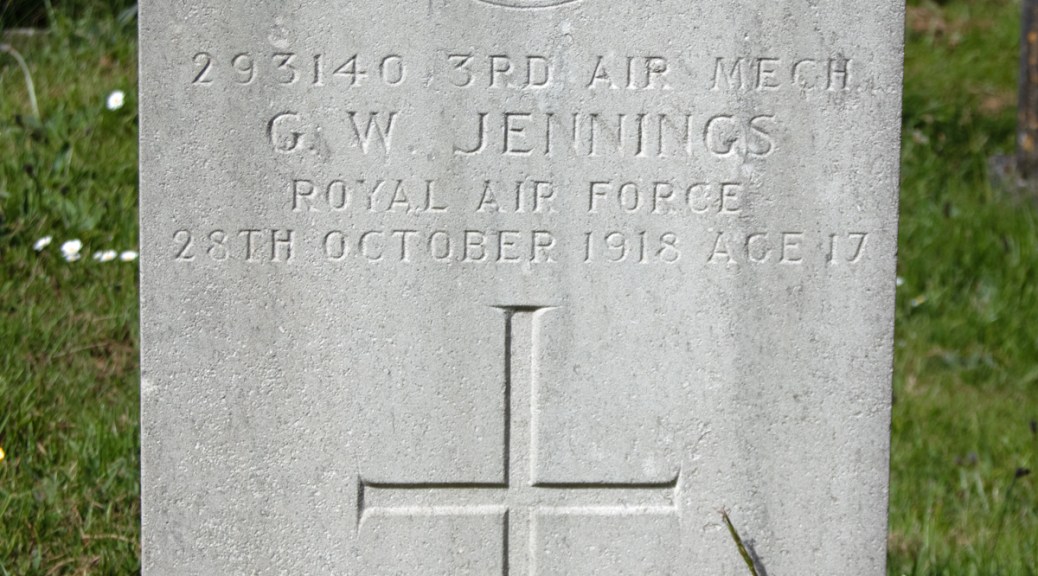
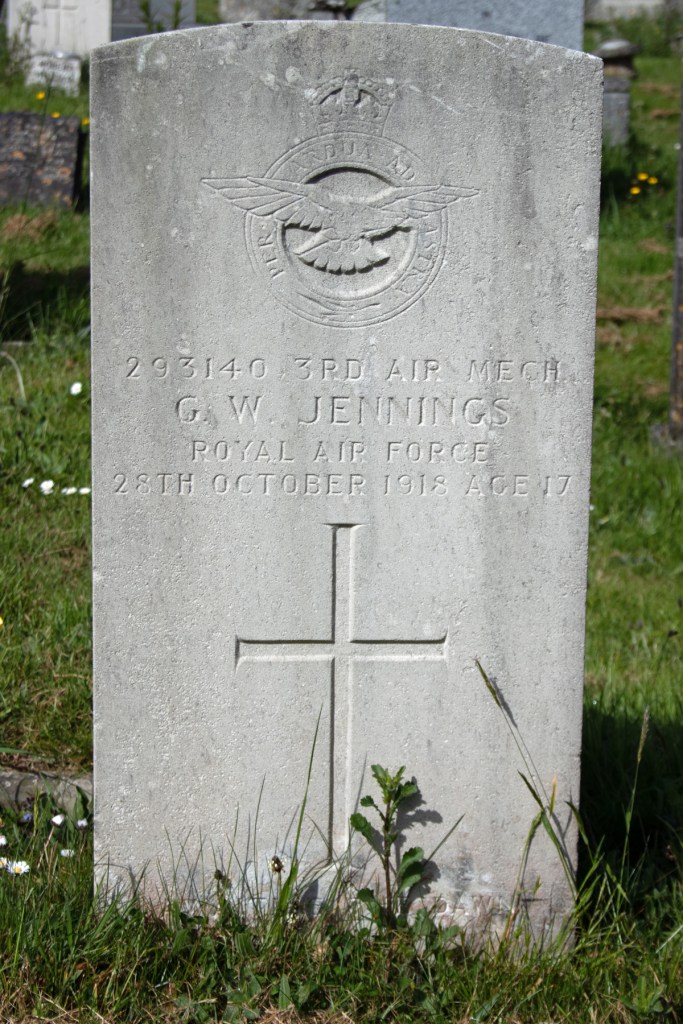
Gilbert William Jennings was born on 4th January 1901, and was the third of four children to William and Lily Jennings. Both were born in Chard, Somerset, and this is where they raised their young family. William was a foreman in one of the town’s lace factories and when he finished school Gilbert followed his father into the industry.
War broke out across Europe in 1914 and, while Gilbert was too young to enlist at the start of the conflict, it is evident that he wanted to play his part as soon as he was able to.
On 6th September 1918 he enlisted in the Royal Air Force: his experience with factory machinery led him to the role of Air Mechanic 3rd Class. His service records confirmed that he was 5ft 7ins (1.70m) tall, had brown hair, hazel eyes and a fresh complexion.
Air Mechanic Jennings was sent to Buckinghamshire for training, but his time there was to be tragically short. Within a matter of weeks he was admitted to the Central Military Hospital in Aylesbury with pneumonia. The condition was to prove too much for his body: he passed away on 28th October 1918. He had been in the Royal Air Force for just 52 days and was a victim of his desire to get involved in the war before it was too late to do so. He was 17 years of age.
Gilbert William Jennings’ body was brought back to Somerset for burial: he was laid to rest in the cemetery of his home town, Chard.
William Cecil Rowell was born on 29th November 1892 in Wolborough, Newton Abbot, Devon. He was the youngest of three children to architectural surveyor Spencer Rowell and his wife, Annie.
The 1911 census recorded that William had left the family home to study to be a civil servant, and was boarding with a family in Fulham, London. His studies complete, he was driven by a need to serve his country and, on 22nd January 1913, aged just 20 years old, he enlisted in the Loyal North Lancashire Regiment.
Full details of his service are not available, but it is clear that he was committed to his purpose. He was promoted to Second Lieutenant soon after enlisting, rose to full Lieutenant in November 1914, and Captain a year later. It’s not possible to pinpoint where he served, he was wounded twice and, after his second recovery, he made a transfer to the Royal Flying Corps (later moving to the new Royal Air Force when it was founded in 1918).
Captain Rowell was based at Bekesbourne Airfield in Kent. He qualified as a pilot with 50 Squadron in October 1918, but was injured when, on the 12th November, his Sopwith Camel collided with the hanger. William was admitted to the Military Hospital in nearby Canterbury, but the injuries to his leg proved too severe for it to be saved, and he underwent an amputation in January 1919.
Tragically, while the initial prognosis was good, within a few weeks sepsis set in; Captain Rowell passed away on 22nd May 1919, aged just 26 years old.
William Cecil Rowell’s body was brought back to Devon for burial. He was laid to rest in the family plot in the graveyard of St Mary’s Church in Wolborough.
Frederick Charles Evelyn Liardet was born in Brighton, now a suburb of Melbourne, Australia, in 1888, and the eldest son of Wilbraham and Eleanor Liardet.
There is little further information about Frederick’s early life, but, when war broke out, he wanted to play his part for King and Country, and enlisted in the Devonshire Regiment.
He had an adventurous career… Having been twice wounded while on active service in France, he was appointed an instructor in the Balloon Section of the Royal Flying Corps.
Exeter and Plymouth Gazette: Tuesday 18th December 1917
On 23rd October 1915, Frederick married Kathleen Norah Liardet in Highweek, Newton Abbot, Devon. She was the daughter of a retired Lieutenant Colonel in the Royal Marine Light Infantry, and may have been a cousin (while their surname is unusual enough for there to be a connection, I have been unable to identify a specific connection). The couple went on to have a daughter, Barbara, who was born in 1917.
In 1916, while on a night flight with the Royal Flying Corps, the now Lieutenant Liardet was involved in an accident and badly injured. He returned to England to recover, he and Kathleen living with her family. While his health initially improved, he relapsed and passed away on 13th December 1917, aged just 29 years old.
Frederick Charles Evelyn Liardet was laid to rest in the graveyard of All Saints Church in his adopted home of Highweek, Devon.
Alan Edward Lloyd was born in around 1899, the second of five children – all boys – to William and Edith Lloyd. Both of his parents were Welsh, and his older brother was born in Cardiff. Railway clerk William moved around the country with work, however, and Alan was born in Lydney, Gloucestershire, his younger brother in Paddington, London, and his two youngest siblings were born in Windsor, Berkshire.
There is little information about Alan’s early life; what is clear is that, by the autumn of 1918, he had been in the army, reaching the rank of Lieutenant. He transferred across to the newly formed Royal Air Force and, in December that year was training as a Flight Cadet at Shotwick Airfield near Chester.
On the 4th December, Alan was flying his Sopwith Camel, when he got into a flat spin; the aircraft crashed and Alan was killed. He was just 19 years old.
Alan Edward Lloyd was brought to Devon – where his family were now living – for burial. He was laid to rest in the graveyard of All Saints Church in Highweek, near Newton Abbot.
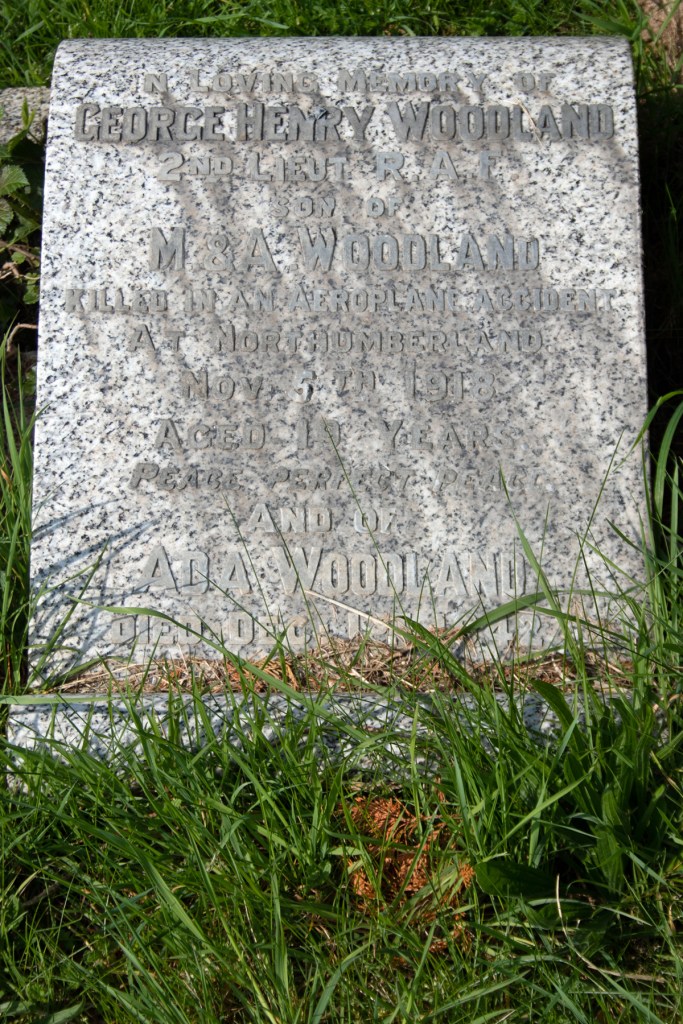
George Henry Woodland was born on 9th June 1899, and was one of six children – three boys and three girls – to Mark and Ada Woodland. Mark was a hewer in a coalmine in Radstock, Somerset, and this is where the family were raised.
George – who was better known as Harry – was still at school when war broke out. He had been taught at the Church of England School in his home town, before winning a scholarship to Shepton Mallet Grammar School. Having passed his exams there, he was taken on as a member of staff at his former school, before joining the army in June 1917 when he turned eighteen.
Initially joining the Infantry Training Reserve, Harry was subsequently transferred to the Royal Air Force. After training in Yorkshire for five months, he was transferred to the 52nd Training Depot Station at Cramlington Airfield in Northumberland.
Second Lieutenant Woodland returned home on leave in October 1918. This was the first time that he and his two brothers had been together since war had been declared – one had been serving in France, the other had been injured and was recuperating at a hospital in Bristol. Harry returned to Northumberland on 14th October.
On 5th November 1918, Harry was flying at the Cramlington base; shortly after take off, while carrying out a flat turn at a height of about 100ft, his aircraft stalled and nosedived, catching fire on impact. Tragically, Second Lieutenant Woodland and his passenger – Air Mechanic Ryder – were burnt to death. Harry was just 19 years of age.
George Henry “Harry” Woodland was brought back to Somerset for burial. He was laid to rest in the family plot in the graveyard of St Nicholas’ Church in his home town of Radstock.
Second Lieutenant George Woodland (from britishnewspaperarchive.co.uk)
Walter Matthias Naish was born in the autumn of 1896, and was one of of five children to agricultural labourer Matthias Naish and his wife, Sarah Ann. Born in Lovington, near Castle Cary, Somerset, this is where the family is recorded as living for the 1901 and 1911 censuses.
When he left school, Walter found work as a cabinet maker; war was on the horizon, however, and he enlisted on 28th February 1916. He was immediately put on reserve, however, and was only mobilised in January 1917, when he was assigned to the Royal Flying Corps as an Air Mechanic.
Tragically, Walter’s military career was not to be a long one. He was admitted to the Connaught Hospital in Aldershot with conditions unknown, and passed away on 3rd March 1917, just 51 days after leaving home. He was just 20 years old.
Walter Matthias Naish’s body was brought back to Somerset for burial. He lies at rest in the Castle Cary Cemetery, not far from his home.
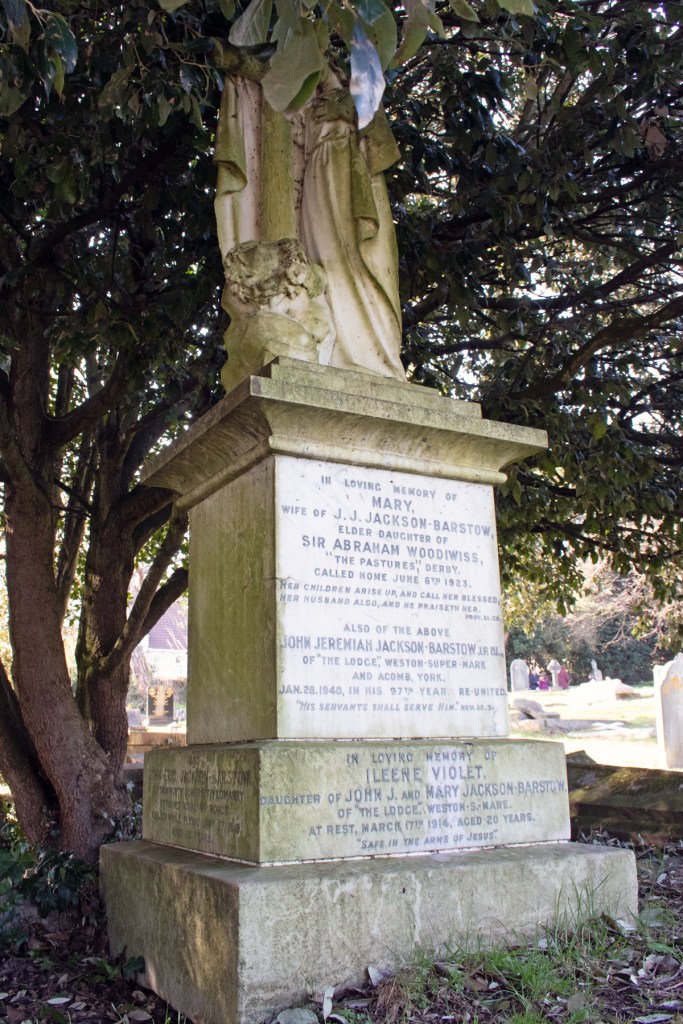
John Eric Jackson-Barstow was born on 10th August 1895, and was one of seven children – and the only boy – to John and Mary Jackson-Barstow. John Sr was a Justice of the Peace from Yorkshire, who had moved his family to Somerset in the early 1890s; this is where John Jr and his sisters were born.
When war broke out, John Jr enlisted as a Trooper in the North Somerset Yeomanry and, by the autumn of 1914, he was moved to France.
On the outskirts of Ypres, his regiment were involved in a prolonged attack by German forces and Trooper Jackson-Barstow was injured. Medically evacuated to England, he received a commission and was given the role of aide-de-camp to a general based on the East Coast.
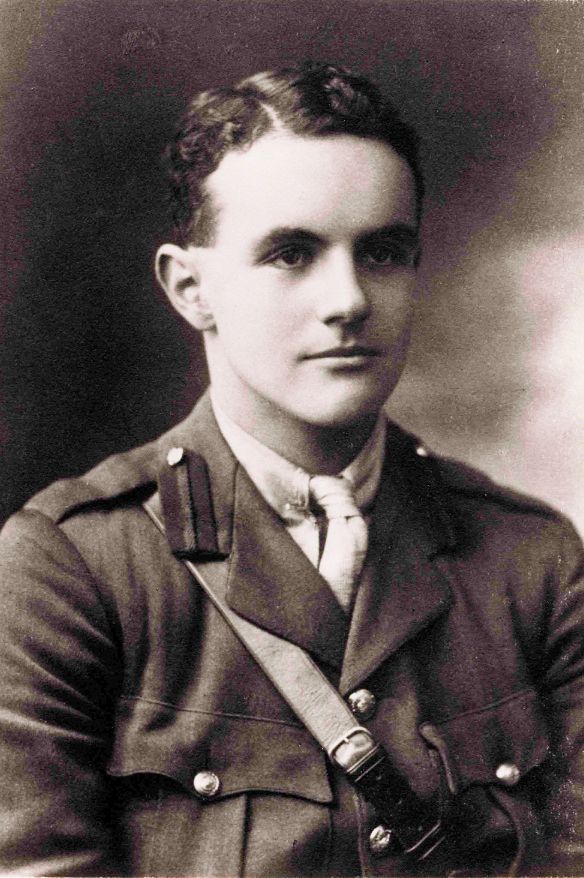
In 1917, Captain Jackson-Barstow transferred to the Royal Flying Corps – later moving to the newly-formed Royal Air Force. Over the following months, he regularly flew sorties across France and did extensive piloting in English skies.
Captain Jackson-Barstow continued in his role when the Armistice was signed. On 27th January 1919, he was flying in Surrey; it was snowing heavily, which limited what he could see. Flying low, he crashed into a hill near Oxted, and was killed instantly. He was just 23 years of age.
John Eric Jackson-Barstow’s body was brought back to Somerset; he was laid to rest in the family grave in the Milton Road Cemetery in Weston-super-Mare.
Captain John Jackson-Barstow (from findagrave.com)
Leslie Harry Perkins was born on 15th June 1901, the only child to Harry and Rosalie. Harry was a solicitor’s clerk from Taunton in Somerset, and Leslie was born and raised in nearby Weston-super-Mare.
Given Leslie’s young age, there is very little documentation about his early life. When he left school, he found work as a motor fitter but, with war raging across Europe by this point, he was keen to put his skills to use.
On 9th October 1917, he enlisted in the Royal Flying Corps (RFC). His service records show that he stood 5ft 10ins (1.77m) tall and noted that he had three scars on his left hand. Because of his age, he was given the rather diminutive rank of Boy.
He worked in the Engine Repair Section just outside Sheffield, Yorkshire, and, transferred across to the RFC’s successor – the Royal Air Force – when it was formed on 1st April 1918.
It was here, in the autumn of 1918, that Boy Perkins contracted influenza. Sadly, like so many others of his generation, he was to succumb to the disease, and passed away in the camp’s hospital on 1st December 1918. He was just 17 years old.
Leslie Harry Perkins’ body was brought back to Somerset for burial. He was laid to rest in the family grave in Milton Cemetery, in his home town of Weston-super-Mare.
Bertie Richard Moody was born in Warminster, Wiltshire in April 1885, one of ten children to Joshua and Mary Moody. Joshua was a navy pensioner, who was twenty years older than his wife, and they raised their family in a small house to the west of the town centre.
When he left school, Bertie found work labouring for a man with a traction engine, but, after his parents died – Mary in 1901 and Joshua two years later – he had more need of a trade. The army offered him a life of adventure, and so he enlisted in the 1st Battalion of the Wiltshire Regiment. Full details of his military career are lost to time, but by the 1911 census, Private Moody was based in Pietermaritzburg, South Africa.
War in Europe was looming, and Bertie’s regiment was called back home. By December 1914, however, he was on the front line in France, and, over the next couple of years, earned the Victory and British Medals, the 1915 Star and a promotion to Serjeant for his service.
As time wore on, it was evident that illness was playing a bigger part in Serjeant Moody’s life. He was suffering from diabetes, and the condition led to him being medically discharged from the army in October 1916. Bertie moved to Frome, Somerset, and found work as a labourer.
He still wanted to play his part, and after making something of a recovery, he tried to enlist again, this time in the Royal Air Force. They rejected Bertie because of his condition too, however, so his time in active service came to an end.
At this point, Bertie’s trail goes cold. He died in Frome on 13th December 1918, at the age of 33, and was laid to rest in the graveyard of Holy Trinity Church in the town.
Fergusson Barclay was born in Cheltenham, Gloucestershire, towards the end of 1877 and was the oldest of six children. His father, Henry, was a retired army captain, and so it is of little surprise that Fergusson and his siblings had something of a privileged upbringing.
The 1881 census recorded Henry and his wife, Agnes, bringing up the family in Tenby, South Wales. With three children under four, the Barclays employed two live-in nursemaids to support them.
Ten years later, the family had moved to Weston-super-Mare, Somerset, living in a large house to the north of the town centre. With five children now living at home, Henry and Agnes found additional help was needed: they were now employing a governess, manservant, cook and a housemaid. The family were not alone in this support: the 1891 census shows that all of the Barclays’ neighbours had at least one domestic servant.
The new century turned, and a new census followed. Captain Barclay and his family were still living in their three-storey Victorian villa in Weston-super-Mare. By this point, however, only three of the children were still living at home. Fergusson, now 23, was working as an architect, his brother Herbert was a legal professional, and his sister, Hermione, also still lived there. The house was not empty, however, as the Barclays’ retinue of staff remained. By this point, they were employing a gardener, groom, coachman, parlour maid, cook, kitchen maid and house maid. Agnes, who was around 20 years younger than her husband, also had a live-in companion, spinster Helen Empson.
Little had changed for the family when the next census was recorded in 1911. Henry was by now 84 years old, and he and Agnes had been married 34 years. Fergusson and Herbert were still living at home, fully immersed in their jobs. Helen was still providing companionship for Agnes, and the family still employed four members of staff: butler Daniel O’Brien and his wife, Jesse, who was the cook; parlour maid Rosie Davies and house maid Edith Booden.
In March 1912, Henry passed away, and it was inevitable that things would change for the Barclay household. Fergusson had been a volunteer for the Royal Engineers since the late 1890s and had steadily worked his way up through the ranks. With the outbreak of war, he found himself called into a more formal role.
Full details of his military career are not evident, but it is clear that, by the spring of 1918, Fergusson had gained the rank of Captain. He joined the Royal Air Force and was assigned to 75th Squadron.
On the afternoon of 7th December 1918, Captain Barclay took off from Elmswell Aerodrome in Suffolk, when the engine of his Avro 504K aircraft cut out. He attempted to turn the plane to land, but it nosedived into the ground and Fergusson was seriously wounded. He was taken to hospital, and died of his injuries later that day. He was 40 years old.
Captain Fergusson Barclay’s body was taken back to Somerset – he lies at rest in the Milton Road Cemetery in Weston-super-Mare, walking distance from his family home.









 Death and Service