Tag Archives: Royal Army Service Corps

Private Herbert Stevens

Private Herbert Stevens

Herbert Stevens was born in Lincolnshire in 1873. Little record of his early life remains, but his mother, Rachel, was born in Cambridgeshire.

Herbert had at least two siblings; Arthur was ten years older than him, and had been born in Liverpool. Alice, who was six years Herbert’s junior, was also born in Lincolnshire.

By the time of the 1891 census, Rachel had been widowed. She was living with her three children in Chatham, Kent, and working as a laundress. Arthur was a labourer in the Naval Dockyard, which may be what brought the family so far south. Herbert, aged 18 by this point, was a stable hand, while Alice was still at school. To help make ends meet, the family had also taken in two lodgers, Joan Kitteridge, who was a tailoress, and her daughter, two-year-old Florence.

On Christmas Day 1898, Herbert married Sarah Beed. Her father was a ship’s carpenter, based in the Dockyard, and the couple set up home in neighbouring Gillingham. The young couple went on to have seven children.

Herbert went on to become a labourer in the Dockyard, but then found employment for the local council, working as a carman, or carter (presumably his work in the stables and his affinity with horses stood him in good stead).

War was on the horizon, however. He enlisted in May 1915, enrolling in the Royal Army Service Corps, and gave his trade as a groom. Private Stevens was assigned to the Remount Depot in Romsey, Hampshire, where he would have been partly responsible for the provisioning of horses and mules to army units both in England and abroad.

Split across ten squadrons, at times there were as many as 4,000 horses and mules stables at the Romsey Remount Depot, so Herbert’s life would have been a busy one. It seems, however, to have been a strenuous life too an, on 23rd March 1918, after nearly three years’ service, Private Stevens died of heart failure. He was 45 years old.

Herbert Stevens lies at rest in the Woodlands Cemetery in his adopted home of Gillingham, Kent.


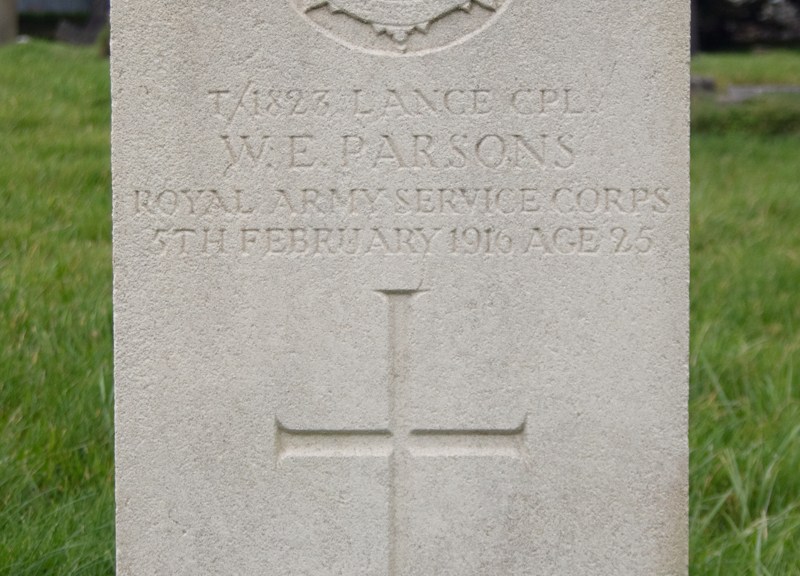
Lance Corporal William Parsons

Bridgwater (St John’s)

William Edward Parsons was born in 1890, one of six children to John and Prudence Parsons. John found work in a number of fields, working as a blacksmith, porter, dock labourer and a hobbler (towing boats along the River Parrett) in his time. Throughout this, he lived with his family in the Somerset town of Bridgwater.

William found work as a collar cutter in a local shirt factory, and went on to marry Matilda Mary Temblett on Christmas Day 1913. The young couple went on to have a son – Leslie William – who was born in February 1915. William was teetotal, and played full back for the local rugby football club, Bridgwater Albion.

Sadly, Lance Corporal Parsons’ military records are sparse; he had enlisted in the Royal Army Service Corps and was based in Fovant, to the west of Salisbury.

It was while he was on leave that William met his sad fate. On the evening of 5th February 1916, he had seen his parents and had set out to organise a football match in the town. He was walking over the town bridge, when a passer-by heard a splash. He saw a man in the water, who was crying for help, and then disappeared.

William’s body was found in the river a fortnight later close to a local brickyard. He was just 25 years old.

William Edward Parsons lies at rest in St John’s Cemetery in his home town of Bridgwater.


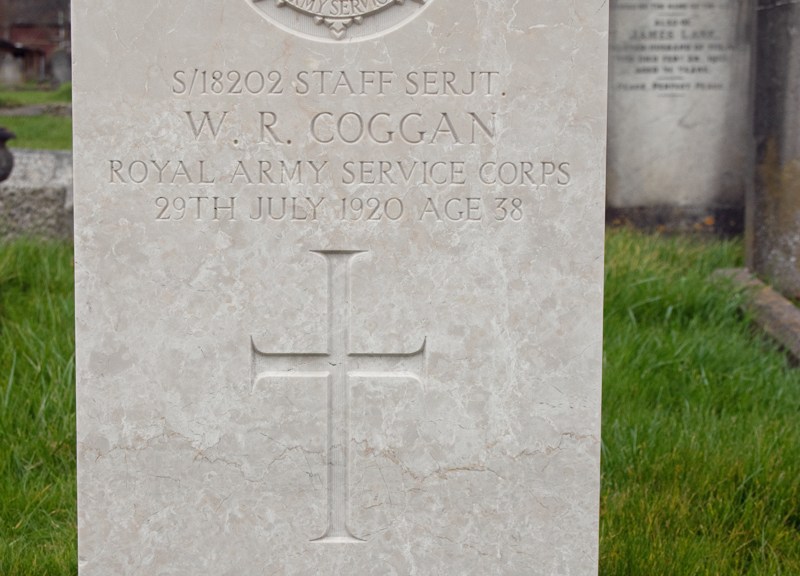
Staff Serjeant William Coggan

Staff Serjeant William Coggan

William Reginald Coggan was born in Twerton, near Bath, at the end of 1882. His father, also called William, was a railway guard, and with his mother, Annie, he would go on to raise nine children, six of them girls.

William Jr became known as Reginald, presumably to avoid confusion with his father. He didn’t follow his father onto the railways, but found a way to serve his country. In the 1901 census, he was working as a baker for the Army Service Corps, and was based at the Stanhope Lines Barracks in Aldershot (along with more than 1800 others).

Ten years later – by the time of the 1911 census – William had left the army but continued his trade. He was listed as a baker of confections in Glastonbury, was living above the bakery with his wife of four years. I have been able to find little information about his wife, Kate, other than that she came from Dublin.


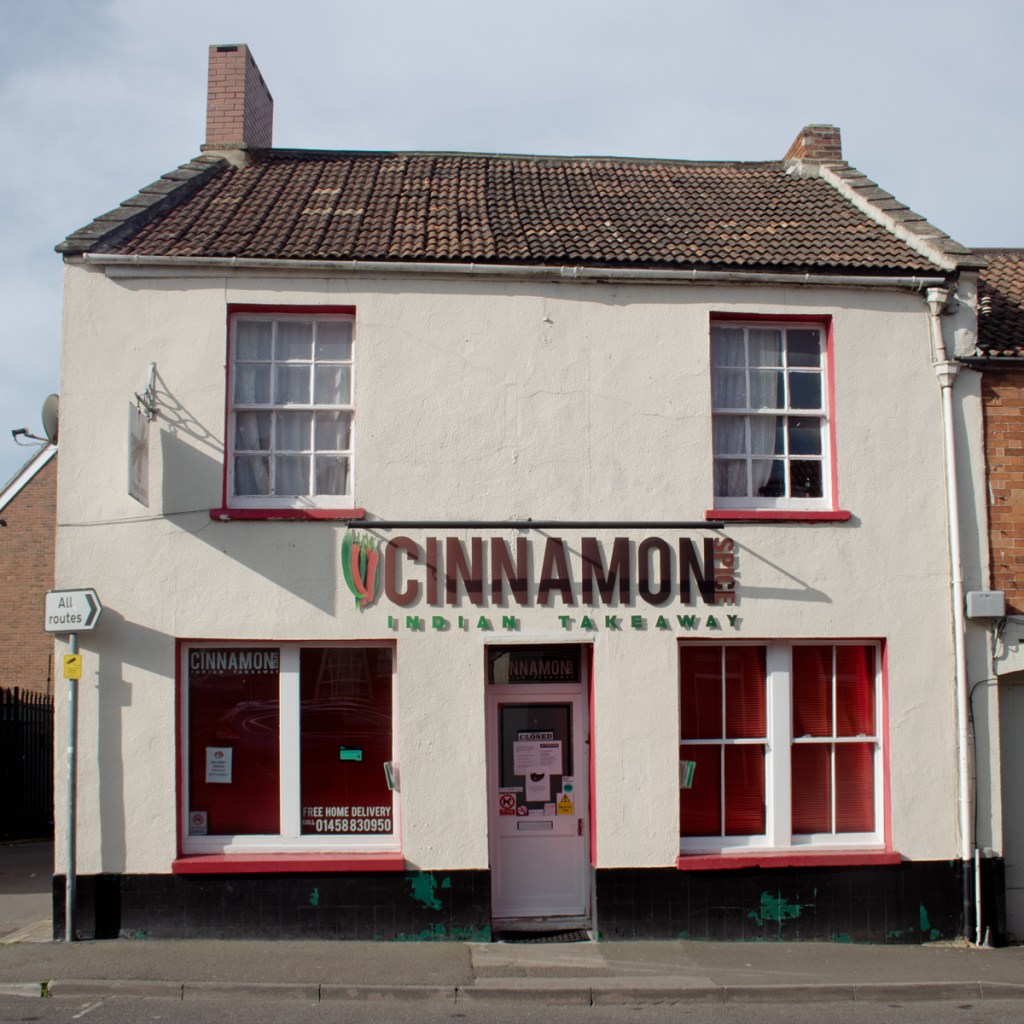
William Coggan’s former bakery in Glastonbury, Somerset.

William’s life becomes a little vague after the census. A newspaper report confirms that he had served in the South Africa war (1899-1902), and that he had seen five years’ service in France. The report – and William’s pension records – confirm that he had continued in the Army Service Corps, gaining the rank of Staff Sergeant.

William had died in Ireland, and his death registered in Fermoy, thirty miles to the north of Cork. The report confirmed that:

Nothing is yet known of how he came by his death, although a request was made for a post-mortem examination.

Taunton Courier and Western Advertiser: Wednesday 11th August 1920.

I can find no further information about his death and, unusually, his Pension Record gives the date, but not the cause. Staff Sergeant Coggan died on 29th July 1920, aged 38 years old.

William Reginald Coggan’s body was brought back to England for burial. He lies at rest in St John’s Cemetery in Bridgwater, Somerset.


Driver Ernest Wood

Driver Ernest Wood

Ernest James Wood was born in 1891, one of ten children to Alfred and Charlotte Wood. Alfred was a carpenter and machinist for a timber merchant, and, by the time of Ernest’s birth the family lived in Bridgwater, Somerset.

When hostilities broke out, Ernest was quick to enlist. He joined the Royal Army Service Corps in September 1914. Driver Wood was assigned to the Horse Transport Depot Company at Park Royal in London, and there is a note of him being injured on 29th July 1916. Sadly, little else of his military service remains.

In January 1916, Ernest married Hilda Williams. She was the same age as her new husband, and was the daughter of Thomas and Elizabeth, who were also from Bridgwater.

The trail of Driver Wood goes a little cold after that. He was demobbed om 6th January 1919 and on the release form declared that he was not medically unfit as a result of his military service.

Frustratingly, the trail goes totally cold at that point. All we know for certain is that Ernest died on 2nd March 1919, two months after leaving the army. There a no records confirming a cause of death but, as he does not appear in any contemporary newspapers, it is likely that the cause was not unusual; perhaps one of the respiratory conditions going around at the time, such as influenza or pneumonia. Whatever the cause, Ernest was just 28 years old when he died (his headstone is based on an incorrect date of birth).

Ernest James Wood lies at peace in the St John’s Cemetery in his home town of Bridgwater, in Somerset.


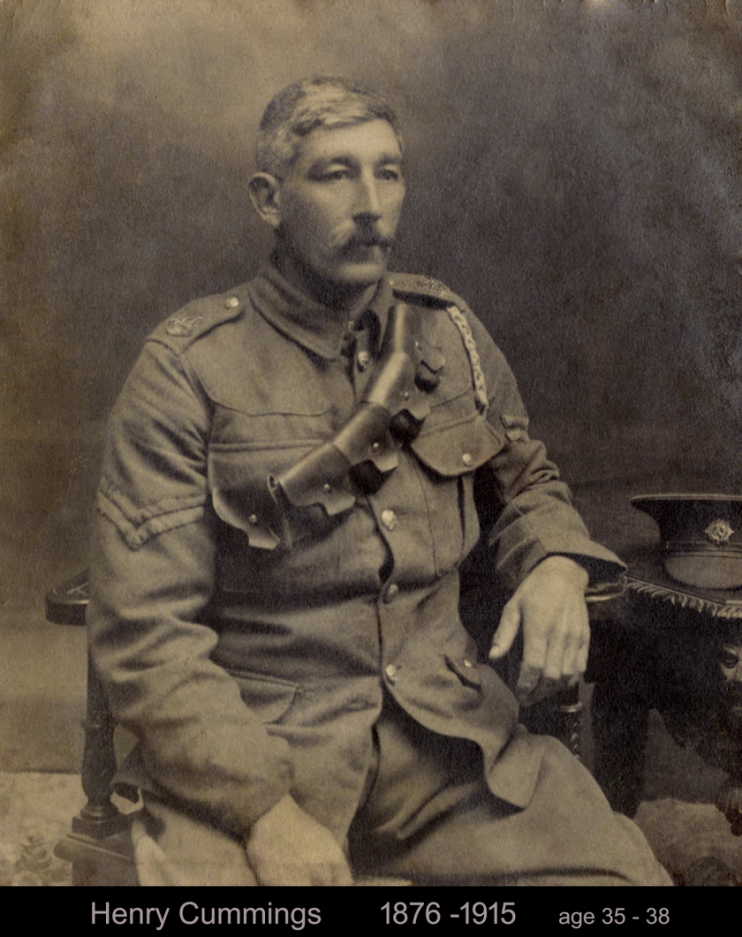
Serjeant Henry Cummings

Sergeant Henry Cummings

Henry Cummings was born in the village of Wembdon, near Bridgwater in Somerset in 1876. The son of agricultural labourer John and his wife Jane, Henry was one of six children.

When he left school, Henry followed his father into agricultural labouring, as his older siblings had done before him. Jane had died when Henry had just reached his teens, so he continued to live with his widowed father, and was recorded there as late as the 1911 census.

On 4th August 1912, he married Sarah Palmer in Wembdon Parish Church; Henry was 36 by this point, and his new wife was 30. They couple may not have thought they could have children, as they went on to adopt a girl, Edith, who was six years old when they had married.

From a military perspective, it appears that Henry had initially tried to enlist in 1908. Based on his service records, it seems that he was not accepted at that point, but when war broke out, things were a different matter. He joined the Army Service Corps on 6th January 1915, attaining the rank of Sergeant.

Henry’s service was to be cruelly short, at just 85 days. Hospitalised in Rugby, Sergeant Cummings passed away from cerebrospinal meningitis on 6th April 1915. He was 38 years old.

Henry Cummings was brought back to Bridgwater for burial, and lies at rest in the Wembdon Road Cemetery there.


In September 1915, Sarah gave birth to a baby girl, Irene. Henry was never to see his little girl, and, tragically, may not even have known he was to be a father.


Photo courtesy of ancestry.co.uk

Driver Stanley Pearce

Driver Stanley Pearce

Stanley Arthur Robert Pearce was born in September 1895, the fourth of five children to Edwin and Rosetta Pearce from Bridgwater, Somerset. Edwin was a painter and sign-writer, and it was in the creative trades that his children followed.

Stanley’s eldest brother Clifford became a gardener; his next oldest Edwin Jr was a mason’s labourer; while his older sister Dorothy became a cardboard box maker. By the time of the 1911 census, when Stanley was 16, he was listed as a painter’s errand boy, presumably helping out his father.

War was on the horizon, and Stanley was keen to do his bit. In October 1914, he enlisted, becoming a Driver in the Royal Army Service Corps. Assigned to the 662nd Heavy Transport Company, he was based in London. There was still time for visits home, however, and the local Bridgwater newspaper reported on an ASC football match in which Driver Pearce was involved in October 1915.

By this time, Stanley had met Flossie Vickery, from nearby North Petherton. The couple married the following year, and had two children, Ada and Geoffrey.

In 1916, Driver Pearce’s battalion was shipped off to Salonica in Greece, as part of the British Expeditionary Force in the Balkans. While there, he contracted malaria and dysentery, and was evacuated back to England for treatment in September 1918.

Driver Pearce recovered well enough to enjoy a month’s recuperation, but fell ill again, with a recurrence of malaria, combined with influenza and pneumonia. He was admitted to the Brook War Hospital in South East London, but sadly not recover, and passed away on 10th November 1918, a day before the Armistice was signed. He was just 23 years old.

Stanley Arthur Robert Pearce lies at rest in the Wembdon Road Cemetery in his home town of Bridgwater.


Stanley’s older sister Dorothy – the cardboard box maker – contracted influenza around the same time as her brother and, tragically, died just five days after him. The siblings were buried in a joint funeral at the cemetery.


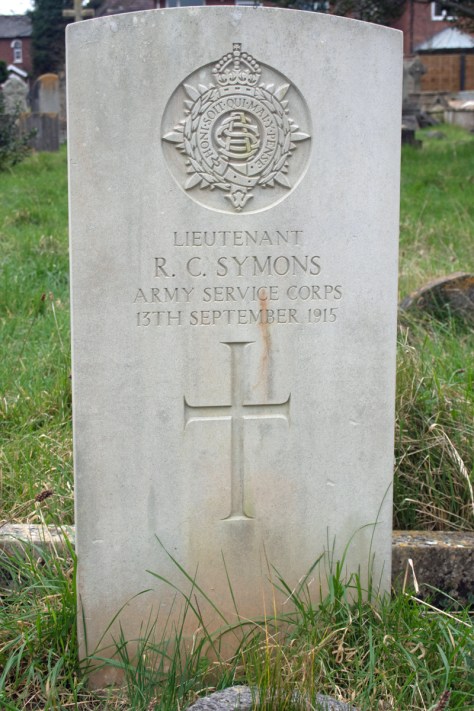
Lieutenant Rudolph Symons

Lieutenant Rudolph Symons

Rudolph Clifford Symons was born in the autumn of 1887, one of ten children to Clifford and Clara Symons. Clifford ran a brick and tile manufacturer’s and later became a town councillor in the family’s home of Bridgwater in Somerset.

By the time of the 1911 census, Rudolph had become the works manager for his father, but war soon beckoned.

Sadly, Rudolph’s full military record has been lost to time, but he enlisted in the Royal Army Service Corps early on in the conflict and was promoted to Lieutenant at the end of September 1914. He was involved in recruiting new soldiers, and it was following one of these meetings that he was involved in an accident.

The local media picked up the story:

On Friday night, while riding through St Jon Street on his motorcycle, to which a side-car was attached, he collided with a horse and light waggon… Lieutenant Symons appears to have been struck by one of the shafts in the region of the heart, and was rendered unconscious. He was at once conveyed to his home, where he was medically attended and was subsequently removed to the nursing home on Friarn Street. On the following day a specialist was called in, and an operation performed, but the injuries were of so severe a character that death ensured on Monday.

Taunton Courier and Western Advertiser: Wednesday 22nd September 1915

The coroner reported that Rudolph had died from an internal haemorrhage and the inquest recorded a verdict of accidental death, and exonerated the waggon driver – a dealer caller Wyatt – from all blame.

Lieutenant Symons was a popular man, a vocalist in the Bridgwater Amateur Operatic Society, and was also heavily involved in the local annual Guy Fawkes celebrations.

He died on 13th September 1915, aged 27 years old, and lies at rest in the Wembdon Road Cemetery in his home town.


Private Clarence Fry

Private Clarence Fry

Clarence Vivian Clements Fry was born in November 1898 to William and Rosa Fry. William was a ‘provisions merchant clerk’, who went on to become a ‘cheese and provision dealer’, or grocer. Sadly, Rosa passed away in 1904, at the tender age of 31, leaving Clarence without a mother at just six years old.

William remarried in 1908, and he and new wife Amy had a daughter, also called Amy, a year later. By the 1911 census, the family of four were living in a three storey Victorian Terraced house to the south of Bridgwater town centre.

Sadly, little of Clarence’s military career remains documented. Initially joining the Royal Army Service Corps, Private Fry soon transferred over to the Duke of Edinburgh’s Wiltshire Regiment.

The 1st Battalion found in some of the key battles on the Western Front, including Mons, Ypres, Messines and Vimy Ridge. As his enlistment date isn’t known, it’s impossible to say whether Private Fry was involved in these conflicts or not.

What is likely is that Private Fry was involved in the Battle of the Selle, which took place near the towns of Cambrai and Valenciennes in northern France in October 1918. Clarence was certainly injured at this point, and was evacuated to England for treatment.

Admitted to the Cambridge Military Hospital in Aldershot, it seems that his injuries were too severe and he succumbed to them on 5th November 1918, just a week before the Armistice was signed. Private Fry was just 19 years old.

Clarence Vivian Clements Fry lies at rest in the Wembdon Road Cemetery in his home town of Bridgwater in Somerset.


Second Lieutenant Walter Treliving

Second Lieutenant Walter Treliving

Walter Ricks Treliving was born in Bridgwater, Somerset, in 1876, the middle of three children to James and Elizabeth Treliving. James was a commercial traveller in the drapery trade, and this is something his son followed him into.

According to the 1891 census, Walter was a pupil at the Commercial Traveller’s School in Pinner, Middlesex, which was, in effect, a boarding school-cum-children’s home for the children of commercial travellers and orphans.

Commerce was obviously engrained into Walter by this point and, after leaving school, he followed his father into the trade of trading. He travelled with his work, frequently boarding with others; in 1901, the census recorded him as living lodging with his maternal aunt Annie Ricks.

Love beckoned, however, and in 1904, Walter married Mabel Broadrick, the daughter of a Unitarian Minister from Worcestershire. The couple set up home in Weston-super-Mare and had a daughter, Beryl, two years later.

Things were not to go smoothly, however, as an article in the Western Daily Press were to show:

In the Divorce Court yesterday, a case was heard in which Mr Walter Treliving, a commercial traveller of Weston-super-Mare, petitioned for a divorce from Mabel Annie Treliving, on the ground of her misconduct with Mr Charles E Rust, an engineer. The case was undefended.

Mr Treliving said he was married on the 13th August 1904 at Bridgwater, and afterwards lived at Weston-super-Mare. There was one child of the marriage. The married life was happy until May 1913, when his wife told him that she cared for someone else.

In July 1913, his wife went away to Manchester on a visit, and when she came back she told him she had stayed with Mr Rust at the Grand Hotel… He forgave her for that, and took her away for a holiday to Lynton. He then discovered that she was still corresponding with the co-respondent, and afterwards that she was meeting him again.

On the 13th September his wife left him, and he heard that she had gone to Khartoum with the co-respondent. He received a letter from her, in which she said:

“Dear Walter. The divorce papers have come. Of course I cannot defend the case, nor he. So you have it all in your power. I hope you will be happy now you are free. If eve I came back to England, may I see Betty [sic]? I cannot marry Mr R. She will not divorce him. I do not know what I shall do now. I hope you will be happy if you marry again, as I hear you will. Oh! if you had only held out one hand to save me, how different it might have been. I am a broken woman. Yesterday, when the petition came, I realised it. You are fully paid back for all your sufferings. Enjoy your victory. Your wife.”

Petitioner said it was not his intention to marry again, as his wife suggested. He had done everything in his power to induce her to remain with him.

Western Daily Press: Thursday 1st April 1915

A decree nisi was granted to Walter and he was awarded costs.

Sadly, it has not been possible to track Walter’s military history. That he enlisted is evident; he joined the Royal Army Service Corps, and rose through the ranks to become Second Lieutenant Treliving. The divorce proceedings did not identify him as serving in the army, so it seems likely that he joined up at some point after April 1915 – his age and his status as a single father seem further proof of this assumption.

Walter returned to Bridgwater in October 1918 to attend his mother’s funeral. Elizabeth had contracted influenza and, sadly, after returning home Walter also caught and succumbed to it. He died on 11th October 1918, at the age of 42.

His probate confirms two beneficiaries; his sister Hilda Treliving, and another woman, Kate Symons, presumably as guardians and trustees for Beryl.

Walter Ricks Treliving lies at rest in the Wembdon Road Cemetery in his home town of Bridgwater, Somerset. He had been buried on the same day as Elizabeth, the mother whose funeral he had returned to attend.


Lieutenant Stanley Russ

Lieutenant Stanley Russ

Stanley Hugh Russ was born in 1888, the youngest of five children to Alfred and Elizabeth. The family lived in Wells, Somerset, where Alfred worked as Clerk to the Guardians of the local workhouse. They were doing well for themselves, as they had two domestic servants at the time of the 1891 census.

Stanley seems to have been a studious young man, and by 1911 was boarding in London, where he was a dental student.

Details of Stanley’s military service are scant, but he obviously did well at his job, and rose to the rank of Lieutenant. The local newspaper gave a good overview of his life when reporting on his funeral:

The deceased gentleman was a dentist by profession, and served his apprenticeship with Mr Goddard of Wells. He afterwards went to London, where for some years he had been following his profession at Guy’s Hospital.

At the outbreak of was he joined the Middlesex Yeomanry as a trooper. He was later given a commission in the same regiment… After much service in France, he was, by reason of a physical disability incurred whilst on service, transferred to the Royal Army Service Corps (Mechanical Transport).

He again went to France and was attached to the North Somerset Yeomanry. He was invalided home, but went out a third time, being attached to a Canadian Siege Battery. He took part in the great push around Arras and Vimy Ridge.

He returned to England in October 1918, suffering from heart trouble, severe shell shock, and slight gassing. He was discharged from hospital in January 1919 and demobilised in the following March.

His health gave way, and he was subsequently operated on by a Harley Street specialist. He derived little benefit, and was afterwards removed to a nursing home, where he died.

The deceased gentleman, who was unmarried, was of a very bright and happy disposition, and enjoyed a wide circle of friends.

Wells Journal: Friday 5th November 1920

Stanley Hugh Russ died on 28th October 1920. He was 32 years old. He lies at rest in the cemetery of his home city of Wells.