Tag Archives: story

Gunner William Foxworthy

Gunner William Foxworthy

William George Foxworthy was born in Dartmouth, Devon early in 1880. The middle of five children, his parents were William and Mary Foxworthy. William Sr (whose full name was William George Foxworthy, and who was known by his middle name) was a house painter, but when he finished his schooling, William Jr found work as a boat builder.

The 1901 census found the family living in a small house on Crowther’s Hill, to the Dartmouth town centre. The cottage would have been cramped, but there were five wages coming in from George, William and William’s siblings.

William does not appear on the 1911 census, and it seems that he took the step from building boats to sailing on them. When war broke out, he was quick to step up and play his part, enlisting in Exeter on the 22nd October 1914. While he had previously been a volunteer in the Devonshire Regiment, William was assigned to the Royal Garrison Artillery.

Gunner Foxworthy’s service records show that he was 5ft 4.5ins (1.64m) tall, and weighed 121lbs (54.9kg). He was noted as having brown hair, hazel eyes and a fresh complexion. Deemed fit for military service, he was packed off to a base in Sheerness, Kent.

William spent the next year on the north Kent coast, before being reassigned. By 1st November 1915 he was on the Front Line, and remained in France until the following June.

In the spring of 1916, Gunner Foxworthy fell ill. He contracted tuberculosis, and this was to dog him for the rest of his life. The contagious nature of the condition meant that he was no longer fit for military service, and he was medically discharged on 11th July 1916.

The death occurred on Tuesday of last week at Roseville Street, of Mr William George Foxworthy, second son of Mr and Mrs Foxworthy, after a long and painful illness. In 1914 deceased joined the [Royal Garrison Artillery] as a gunner, and saw much fighting around Ypres in the winter of 1915-16, during which time he contracted the disease which has now terminated fatally. This is the second son Mr and Mrs Foxworthy have lost in the war, their youngest boy having been killed some two months ago. Great sympathy has been shown the parents in their second bereavement.

[Dartmouth & South Hams Chronicle:  Friday 20th December 1918]

William George Foxworthy was 38 years of age when he died on 10th December 1918. He was laid to rest in the graveyard of St Clement’s Church in his home town, Dartmouth.


William’s younger brother, Louis Henry Foxworthy, was a Corporal in the 9th (Service) Battalion of the Devonshire Regiment. He served on the Western Front as well and, in September 1918, he was caught up in the fighting in St Riquier, near Abbeville. Corporal Foxworthy was killed in action on 8th October 1918: he was 31 years of age.

Louis’ body was not recovered, and he is commemorated on the Vis-en-Artois British Memorial in Harcourt, France.


Deck Hand James Lineham

Deck Hand James Lineham

A verdict of drowned was returned at the inquest at Dartmouth on Saturday evening on James Lineham (18), a seaman, whose body was recovered from the sea. Lineham was bathing in Dartmouth harbour nine days ago. He called for help, and a comrade with him caught him by the hair, but could not retain his hold. The skipper found the body drifting towards the ship on Saturday.

[Western Times: Tuesday 13th August 1918]

Beyond the newspaper report on James Lineham’s death, there is tantalisingly little information about him or his life. The Commonwealth War Graves Commission confirm he was a Deck Hand in the Mercantile Marine Reserve, and that he was assigned to the HM Drifter Niedra.

James’ pension record add a little more light and a little more confusion to the matter. This names Miss Beatrice Lineham as his dependant, and confirms she was in the care of Mrs Buchly of 22 Vera Road Fulham.

The document has another name on it, written in red, that of a Acting Corporal Thomas Lineham of the Army Service Corps, who died from disease on 7th February 1917. The word daughter is also written in red, so it would seem that Beatrice was Thomas’ child, and potentially James’ niece.

Frustratingly, Thomas’ service number is the same as Deck Hand Lineham’s so it is not possible to trace any more information about his army service.

A more general search of census records draws a blank too: there is no combination of James and Thomas Lineham, with or without Beatrice, in the Fulham area in the 1901 or 1911 records.

It would seem, therefore, that the life of Deck Hand James Lineham , who drowned in the River Dart on 2nd August 1918, is destined to remain lost to time. His secrets were buried with him in St Clements’ Churchyard, Dartmouth, Devon.


Trimmer Cook Douglas Ferguson

Trimmer Cook Douglas Ferguson

At Dartmouth on Saturday, Mr AM Dawson held an inquest on Douglass [sic] Davidson Mitchell Ferguson, cook, aged 30, of a Government trawler, whose body was recovered from the boat float the previous afternoon.

TG Elliott, of the Britannia Inn, said deceased had one drop of whiskey at his house on Thursday.

W Bursey, seaman, said he saw deceased at the King’s Arms Hotel, the same evening. He was very quiet and chatted with others.

Frank Lavers, coal lumper, said he thought he saw Ferguson at 9.50 on his way to the Embankment. Deceased asked the time and spoke quite rationally.

After evidence as to the recovery of the body, and Dr GM Soper’s evidence that the death was due to drowning, an open verdict was returned.

Lieut. PN Taylor [Royal Naval Reserve], commander of the vessel to which deceased had belonged, said Dartmouth was the most dangerous place for the embarkation at night that he had visited, owing to the restricted lighting. He thought rails should eb placed not only around the Boat Float, but along the whole of the Embankment.

Members of the jury agreed that lights in the vicinity of the Boat Float were inadequate, and the jury added a rider to their verdict urging the authorities to provide adequate lighting as advised by the Town Council, for the benefit of persons embarking in the vicinity of the Boat Float, and with a view to preventing further tragedies.

[Western Times: Tuesday 29th February 1916]

Douglas Davidson Ferguson was born in Stirling, Scotland, on 28th August 1896. One of four children, his parents were Andrew and Mary Ferguson. There is little information available about his early life, unfortunately, but it is clear that he enlisted in the Royal Naval Reserve on the 6th September 1915.

Assigned the role of Trimmer Cook, Douglas’s records show that he was 5ft 3ins (1.6m) tall, with brown eyes and a pale complexion. He was also noted as having a tattoo of a dancing girl on his left arm.

Douglas was initially assigned to the cruiser HMS Pactolus, and travelled from Scotland to Devon, where the Royal Naval Dockyard in Devonport would become his base. He remained stationed there for the next few months, working on ships’ galleys as they patrolled out the Channel coastline. It was during one of these voyages that he fell into the River Dart and drowned.

It would seem that Douglas Davidson Ferguson’s family were unable to cover the cost of taking his body back to Scotland for burial. Instead, he was laid to rest in the graveyard of Dartmouth’s St Clement’s Church.


Leading Seaman Frederick Tillier

Leading Seaman Frederick Tillier

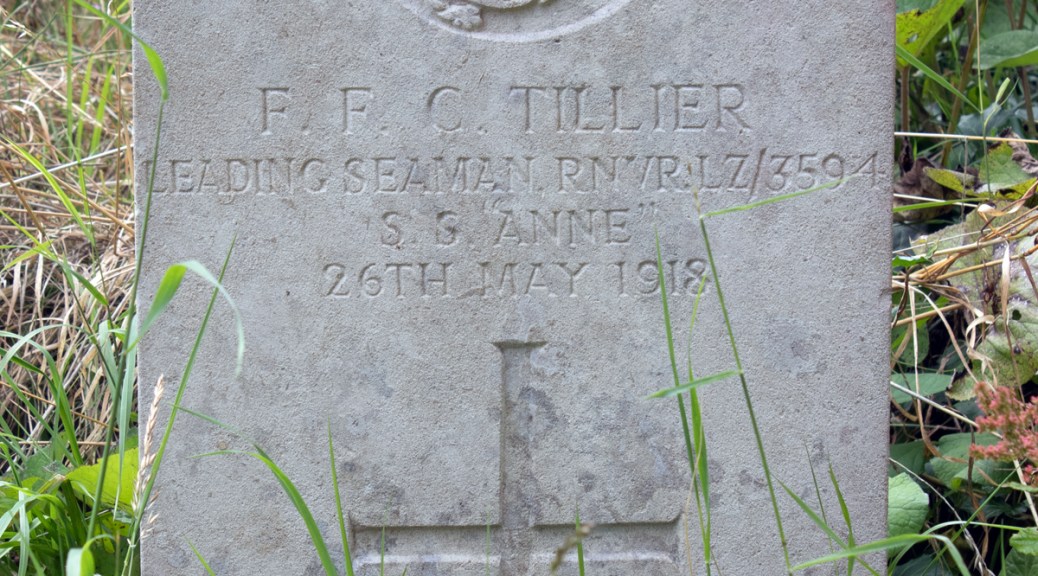
Frederick Francis Charles Vizzard was born on 12th December 1894 in Ottershaw, Surrey. The younger of two children, his parents were nurseryman Frederick Vizzard and his wife, Frances.

Details of Frederick Jr’s life are a challenge to unpick. Frederick Sr had died in 1909, and is seems that from this point on, he used his mother’s maiden name, Tillier, as his own. He found work as a labourer, and this is what he was doing when war broke out.

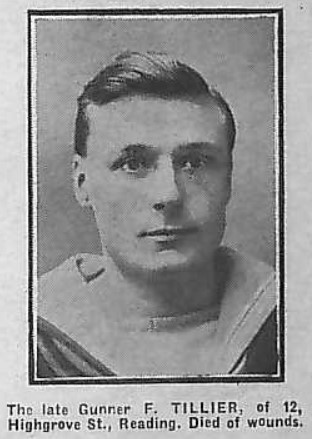
By this point Frederick had moved to Reading, Berkshire, and he was living in a small terraced house at 12 Highgrove Street. He enlisted in the Royal Naval Division on 18th October 1915, and was mobilised six months later.

Frederick’s records show that he was 5ft 7.5ins (1.71m) tall, with brown hair and grey eyes. He joined as an Able Seaman, which would suggest some previous experience, although there are no records to confirm this.

Able Seaman Tillier’s time in the navy seems to have been spent on shore. He was initially sent to Portsmouth, Hampshire, where he served on HMS Victory and HMS Excellent. On 19th December 1916, Frederick was reassigned to the Royal Naval Volunteer Reserve as a Leading Seaman, and sent to HMS President, the unit’s shore base near Tower Bridge in London.

Frederick would remain attached to HMS President for the next couple of years. The next entry on his service papers states that he was admitted to the Cottage Hospital in Dartmouth, Devon, as he was very seriously injured. What those injuries were, and how he received them is unclear, but Leading Seaman Tillier would succumb to them on 26th May 1918. He was 23 years of age.

Frederick Frances Charles Tillier was laid to rest in the graveyard of St Clement’s Church in Dartmouth.


Leading Seaman Tillier
(from ancestery.co.uk)

Air Mechanic 2nd Class Jack Gauntlett

Air Mechanic 2nd Class Jack Gauntlett

Jack Wallis Gauntlett was born in Burbage, Wiltshire, in the spring of 1898. The oldest of four children, his parents were George and Florence Gauntlett. On Jack’s baptism record, George gives his trade as a yeoman, while later census records confirm he was a farmer.

Jack was baptised in St Mary’s Church in Stapleford, near Salisbury, some distance south of Burbage, and, given that his parents had no connection to that area, it seems that his father’s work took the family around the county. The 1901 census record found them Gauntletts back in Burbage, but by the time of the 1911 return, they had moved to Middleton Farm in Norton Bavant.

When war broke out, Jack stepped up to serve his country. He enlisted in the Royal Flying Corps in January 1917 and, as an Air Mechanic 2nd Class, was sent to Farnborough, Hampshire, for training.

Much sympathy is felt with Mr and Mrs FG Gauntlett, of Middleton Farm, in the loss they have sustained by the death of their eldest son, JW Gauntlett… He came home three weeks ago on leave before proceeding to France, and was then sickening for measles and had bronchitis. He was taken to Sutton Veny military hospital and died there on Friday from an attack of pneumonia.

[Wiltshire Times and Trowbridge Advertiser: Saturday 19th May 1917]

Jack Wallis Gauntlett was just 19 years of age when he died on 11th May 1917. He was buried in the family plot in All Saints’ Churchyard, Norton Bavant.


Private George Francis

Private George Francis

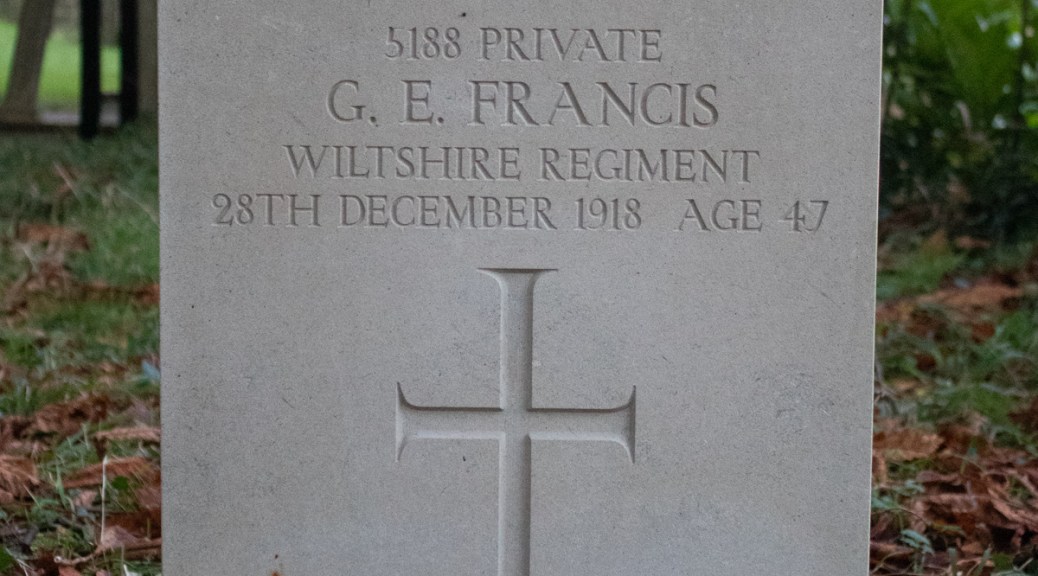
George Edward Francis was born at the end of 1871 in the Wiltshire village of Alvediston. The youngest of six children, his parents were Eli and Mary Francis. Eli was an agricultural labourer, and this was the line of work that George would also follow.

Eli died in 1885, and Mary moved in her daughter Elizabeth’s family, and the 1891 census noted that George and his older brother Samuel were also living there. George, now 19 years of age, was employed as a farm labourer.

On 11th July 1906, George married Alice Shirley. A year older than her new husband their wedding certificate notes that she was also born in Alvediston, but that her father wasn’t known. The couple settled in a house in Tollard Royal, a few miles south of their home village.

George stepped up to serve his country when war was declared. Full details of his time in the army are unclear, but he had definitely enlisted by the summer of 1918. He was initially assigned to the Wiltshire Regiment, but was later transferred to the 651st Agricultural Company of the Labour Corps.

The only other record for Private Francis’ time in the army, is a document relating to his passing. This confirms that he died on 28th December 1918 in camp at Norton Bavant, to the east of Warminster, Wiltshire: he was 47 years of age.

It seems likely that Alice was unable to cover the cost of bringing her husband’s body back to Tollard Royal for burial. Instead, George Edward Francis was laid to rest in the graveyard of All Saints’ Church in Norton Bavant.


Private Joseph Tyler

Private Joseph Tyler

Joseph Tyler was born in the spring of 1882, and was the youngest of three children to Joseph and Sarah. Joseph Sr was a carter from Staffordshire, and the family were born and raised in Wordsley.

The 1901 census found the Tylers living in Brierley Hill, with Joseph Jr having found employment as a glass worker. His father passed away in 1907, and so he remained at home to support his now widowed mother.

By the 1911 census, Sarah and Joseph had moved to Birmingham, and were living at 32 Wiggin Street, a terraced house in the Ladywood area. Joseph listed his employment as a glassblower, while his mother gave no employment, presumably looking after the home.

When war came to Europe, Joseph stepped up to play his part. Full details of his service have been lost, but it is clear that he enlisted early on in the conflict. He joined the Hampshire Regiment, and was sent to Wiltshire for training.

Tragically, Private Tyler’s time in the army was not to be a lengthy one. Barracked near the village of Boyton, he was quickly admitted to the local military hospital. Suffering from heart failure, this would take his life: Joseph died on 13th October 1914, at the age of 32.

The body of Joseph Tyler was laid to rest in Boyton Cemetery, not far from the camp that had, so briefly, been his home.


Private George MacFarlane

Private George MacFarlane

George McFarlane was born in Alexandria, Dumbartonshire, in 1879, and was the third of four children to George and Jane.

There is little concrete information about George Jr’s life, and most of that information comes from his army service records. These confirm that he was working as a printfield worker, employed by the local dye works to produce printed cloth.

The service papers also confirm that George had married Christina Kerr on 19th April 1905, and that they had four children: Irene, William, Christina and George. Christina had also had a son, Richard, from a previous relationship.

George had readily answered the call to serve his country when war broke out. He enlisted on 18th September 1914, and was assigned to the Argyll and Sutherland Highlanders. He is recorded as being 5ft 7ins (1.69m) tall and 135lbs (61.2kg), with auburn hair, grey eyes and a fresh complexion.

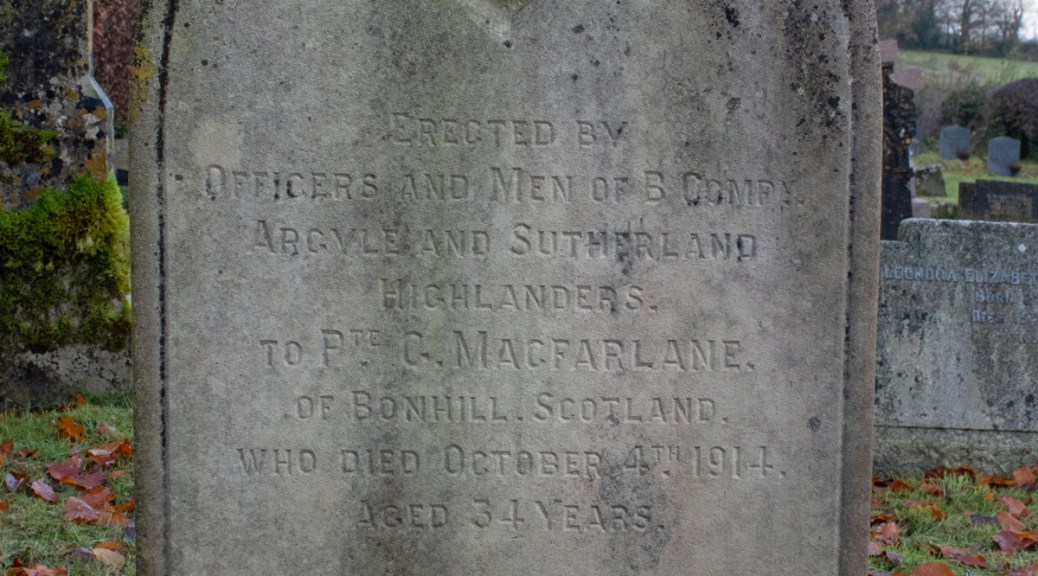
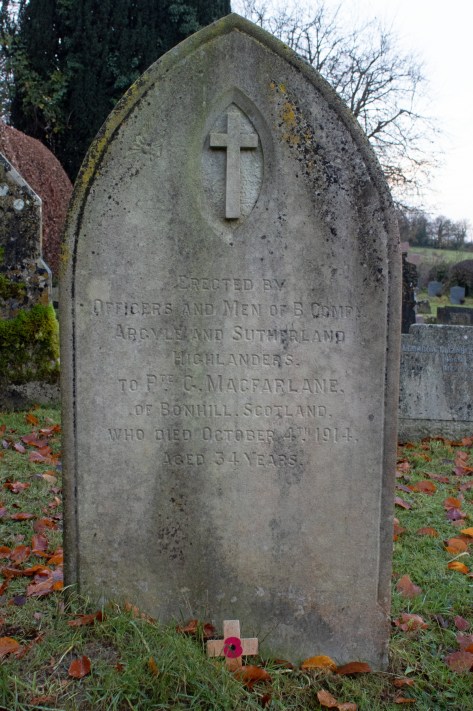
Private McFarlane was sent to Wiltshire for his training, and was barracked near the village of Boyton. His time there was to prove tragically short. Within a matter of weeks he contracted pneumonia, and succumbed to the condition on 4th October 1914. He was just 34 years of age, and had been in the army for 16 days.

Christina was unable to cover the cost of bringing her husband back to Scotland. Instead, George McFarlane was laid to rest in Boyton Cemetery, his headstone paid for by the men of his regiment.


Corporal George Collins

Corporal George Collins

The funeral of Corporal GH Collins, of the Royal Engineers, who died at Devonport at the age of 46, took place at Tiverton, where his mother and stepfather and sister reside. Corporal Collins’s wife and two children are at present in India. He had been in the army since 1899, and served in the South African War, for which he received the Queen’s and King’s medals with four clasps. He went to India in 1902, where he remained until the outbreak of the present war, when he came to France with his regiment. Corporal Collins was wounded, losing two fingers. He afterwards contracted fever, from which he died. The funeral was accorded military honours.

[Exeter and Plymouth Gazette – Monday 29 October 1917]

George Henry Collins was born in West Anstey, Devon, and was the son of George and Harriett Collins. There is little additional information about his early life available, and his was not an uncommon name in the area at the time.

George married Stella Euphrasia Constance O’Leary on 11th October 1911. At the time he was stationed in Myanmar, and the couple exchanged vows in the town of Maymyo, to the west of Mandalay. They would go on to have two children: Mary was born in August 1912, with Gertrude arriving the following November.

When the First World War broke out, it seems that Corporal Collins initially joined the Devonshire Regiment, but soon transferred to the Royal Engineers. Documentation suggests that he was assigned to the Special Brigade Depot at Saltash, Cornwall. However, this may have been the unit he was nominally allocated to when arrived in Britain for treatment to his injuries.

Frustratingly, there is little additional information available about George’s life. He died on 21st October 1917 was laid to rest in Tiverton Cemetery.


Stoker 1st Class Frederick Webber

Stoker 1st Class Frederick Webber

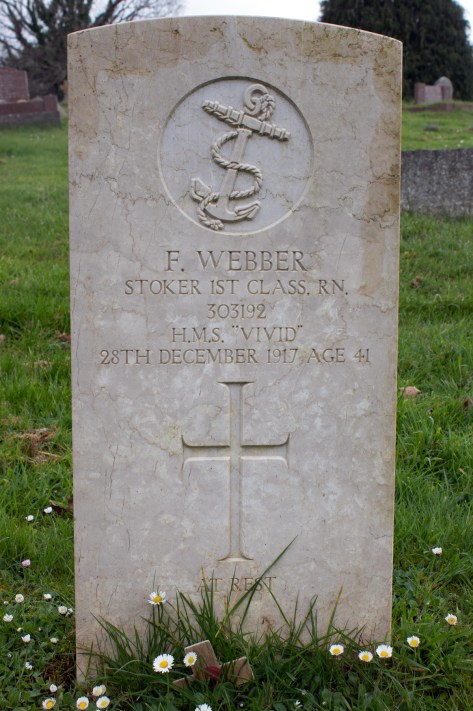
Frederick Webber, of Westexe-south, Tiverton, stoker in the Royal Navy, has died at the age of 40. He had been in the Navy 15 years, and was on board HMS Dartmouth when she was torpedoed, and on HMS Sylvia when she sank a submarine. While home on leave in November he was taken ill. He partially recovered, but had a relapse and died on December 28th.

[Tiverton Gazette (Mid-Devon Gazette): Tuesday 1st January 1918]

The early life of Frederick Webber is a challenge to piece together, as his is not an uncommon name for the area and period.

His widow is recorded as Elizabeth Webber, and marriage record from August 1907 suggests his father’s name was also Frederick. Stoker Webber’s entry on the military pension ledger confirms two children – Frederick and Frank.

When he enlisted on 10th February 1903, he gave his date of birth as 26th December 1880 and his place of birth as Exeter, Devon.

This combination of details doesn’t give any definite results from the 1891 or 1901 census, so it’s not possible to confirm the early stages of his life.

Based on Frederick’s naval records, he was working as an engine driver when he joined up. He was 5ft 4ins (1.63m) tall, with dark brown hair, hazel eyes and a fresh complexion. He was also noted as having a tattoo on his right forearm

Stoker 2nd Class Webber was sent to HMS Vivid – the Royal Naval Dockyard in Devonport. Enlisting for an initial period of 12 years, he would spend that time serving on a total of ten ships, returning to his Devon base in between voyages.

Frederick’s career seems to be one of doing just enough to satisfy his superiors. His annual reports noted his character and ability as being good or satisfactory, and he spent three periods of time in the brig – for three days in 1904, 14 days in 1906 and five days in 1910.

Frederick’s was promoted to Stoker 1st Class in July 1906 and, unusually, he remained at that rank for the rest of his career. It may be that promotion didn’t come his way, or simply didn’t appeal to him, and he was happy doing what he was doing.

Stoker Webber came down with bronchitis while he was on leave in November 1917. Based on his service records, he had just turned 47 years of age when he passed.

Frederick Webber was laid to rest in Tiverton Cemetery, not far from his grieving family’s home.