Tag Archives: Sussex

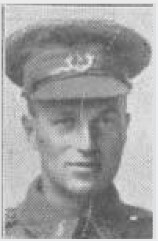
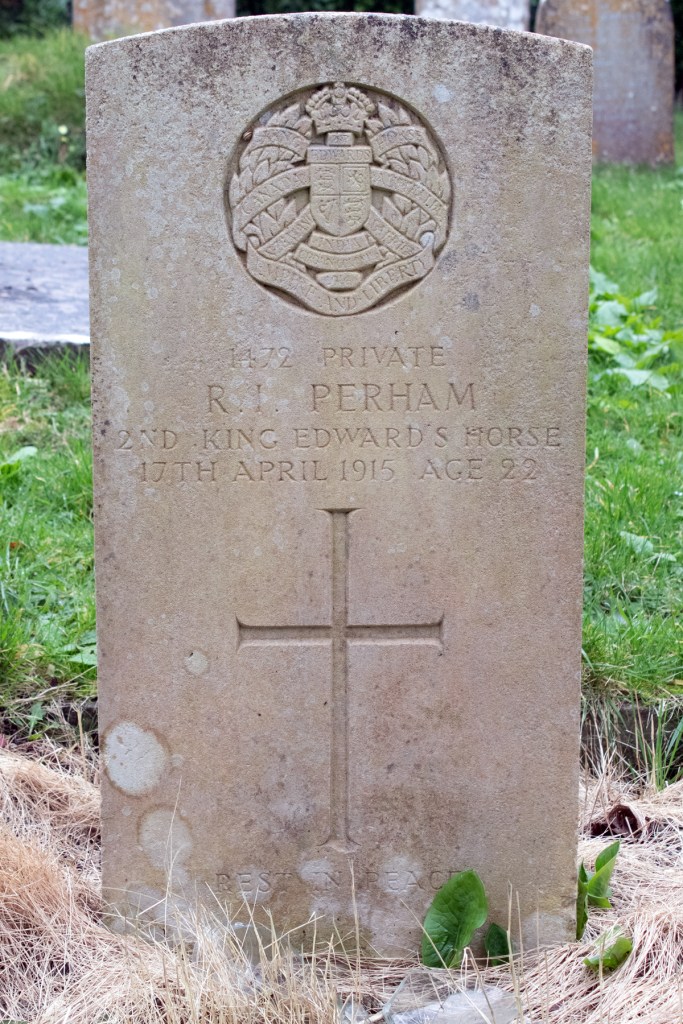
Private Robert Perham

Private Robert Perham

Robert Ivor Perham was born in the Dorset village of Purse Caundle in the autumn of 1892. The oldest of eight children – and thirteen years older than his youngest sibling – his parents were farmers Thomas and Annie Perham.

Thomas took the family where the work was: the 1901 census found them living at Manor Farm in West Chelborough, Dorset. Ten years later, they had moved north in the county, to Ryme Intrinseca. Robert was helping his father on the farm by now, his seven siblings all still being at school.

Robert saw an opportunity for farming to give him an adventure and, on 27th March 1913, he set off for Australia to work as a ranch hand. His time in the Antipodes was to be cut short, however, when, in the summer of 1914, war broke out in Europe. He made the lengthy journey back to Britain to serve his King, and was assigned to the 2nd King Edward’s Horse regiment.

Private Perham’s time in the army seemed not to have been a lengthy one. Full details of his service are lost to time, but it is likely that he arrived back in Blighty in the early weeks of 1915. He quickly fell ill – from ‘spotted fever’, or meningitis – and was admitted to the 2nd Eastern General Hospital in Brighton, Sussex. Sadly, it was a condition to which he would succumb: Robert passed away on 17th April 1915, at the age of 22 years old.

The body of Robert Ivor Perham was taken back to Dorset for burial. He was laid to rest in the peaceful graveyard of St Hippolyte’s Church in Ryme Intrinseca.


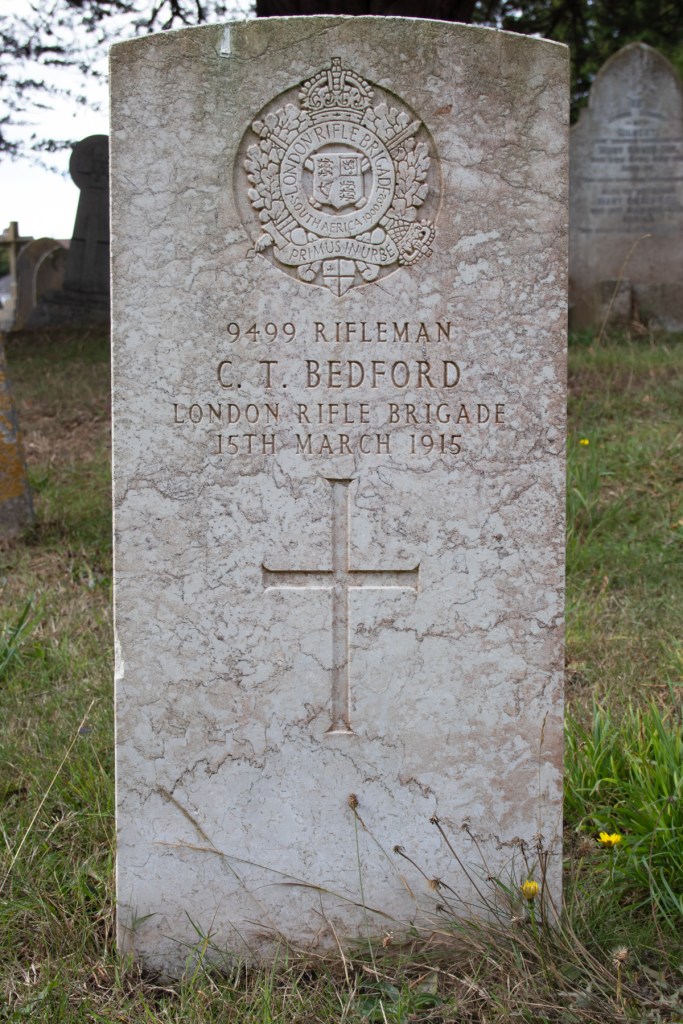
Rifleman Conrad Bedford

Rifleman Conrad Bedford

Conrad Thomas Bedford was born on 8th August 1891 in Bowes Park, Middlesex. The younger of two children, his parents were Thomas and Clara Bedford. Thomas was a bank clerk, who had a strong focus on education and, after his untimely death in 1899, aged just 40, Clara was keen to ensure that her only son received the best.

Conrad was educated at Seaford College in Sussex, and was boarding there at the time of the 1901 census. Whilst there, he served in the College Cadet Corps, which was attached to the Royal Sussex Engineers, and by the time he left, in 1909, he had taken the rank of Corporal.

When he completed his schooling, Conrad found work as a clerk in the London Joint Stock Bank, and soon volunteered for the London Rifle Brigade. When war broke out, he willingly stepped up to serve his country, and became attached to the regiment’s 5th Battalion.

The 1/5th (City of London) Battalion (London Rifle Brigade), to give the London Regiment’s unit it’s full title, fought on the Western Front, and Rifleman Bedford arrived in the Wallonia region of Belgium on 4th November 1914.

Early in 1915, Conrad was based near Ploegsteert, when, at around 2am on 27th February, he was shot in the right shoulder. He was medically evacuated to Britain, and admitted to the American Women’s War Hospital, in Paignton, Devon. While his injury was treated, sepsis set in, and Rifleman Bedford succumbed to it: he passed away on 15th March 1915, at the age of 23 years old.

Surprisingly, Clara did not bring her son back to London, where she was living. Instead, Conrad Thomas Bedford was laid to rest in Paignton Cemetery, not far from where he had breathed his last.


Riflemen Conrad Bedford
(from ancestry.co.uk)

Shipwright 2nd Class Laurence Durell

Shipwright Laurence Durell

Laurence Edward Horsnell la Vavasour dit Durell was born on 24th December 1894, one of seven children to Edward and Julia. Edward was born in Jersey, in the Channel Islands, but he and Julia were living in Camberwell, Surrey, when Laurence was born.

The census records from the time show a family who came to be divided. In 1901, Edward was working as an artificial limb maker, while Julia looked after their son and the house the family shared at 14 Kerfield Crescent.

By 1911, things had changed significantly. Edward was now employed as a grocer’s storeman, and he and Laurence – apprenticed to a carpenter – were living with his parents, Edward and Sarah, at their home in St Clement, Jersey. Julia, meanwhile, was still on the mainland, where she was employed as a housekeeper for Frederick Manford, a 31-year-old cinema attendant in Hastings. Laurence’s younger sister, Phyllis, was also living there.

Laurence seemed keen to carve out a career for himself and, on 3rd January 1913, he enlisted in the Royal Navy as a Ship’s Carpenter. His service records show that he was 5ft 8ins (1.72m) tall, with dark hair, blue eyes and a fresh complexion. He was first sent to HMS Victory, the Royal Naval Dockyard in Portsmouth, Hampshire, for his training.

Over the next five years, Ship’s Carpenter Durell served on six ships, and as war broke out in the summer of 1914, his role became more and more vital. In May 1917, while serving on board the cruiser HMS Castor, he was promoted to the rank of Shipwright 2nd Class.

During the summer of 1918, Laurence contracted pneumonia. He was transferred to the hospital ship Soudan, but the condition was to prove too severe. He passed away on 15th July 1918, at the age of 23 years of age.

Laurence Edward Horsnell la Vavasour dit Durell was taken back to Jersey for burial. He was laid to rest a family plot in St Clement Churchyard, not far from where his relatives still lived.


Shipwright Laurence Durell
(from ancestry.co.uk)

Private Frederick China

Private Frederick China

Frederick George China was born in Bath, Somerset, in the summer of 1885. He was the second of children to tailor George China and his wife, Gloucestershire-born Frances.

Frederick was working as a grocer’s assistant when his father died in 1906, at the age of 52. Determined to earn money for Frances and his three sisters, he left Somerset for work. The 1911 census recorded him as living in Worthing, West Sussex, boarding with the Vitler family. Percy was a baker’s assistant, and lived at 4, Tarring Road with his wife and two daughters. The census noted two visitors to the property, railway contractor Robert Puttock and his wife, Annie.

On 26th December 1912, Frederick married Lucy Hellier. Born in Midhurst, West Sussex, she was working as a confectioner’s shop assistant in Worthing’s Montague Street, boarding with the manager, Catherine Castle, her mother and her niece. The couple wed in Stanmer Parish Church, to the north of Brighton, which is where Lucy’s family were then living.

The newlyweds moved back to Bath, and Frederick took up a job as manager of the Widcombe branch of the Twerton Co-operative Society. Their only child, son Douglas, was born in February 1915.

By this point, war was raging across Europe, and Frederick stepped up to play his part. His full service details are no longer available, but he joined the Somerset Light Infantry in June 1916, and was assigned to the 7th Battalion.

He was in a battalion of the Somersets, who were heavily engaged at Langemarck, but he and his chum came safely through the severe fighting at that place. While returning, some time after, to the front trenches, he was knocked out by a shell, and received severe injuries. The spine was so badly hurt that, if he had survived, he would never have walked again.

[Bath Chronicle and Weekly Gazette – Saturday 29 September 1917]

Private China was medically evacuated to Britain for treatment, and he was admitted to King George’s Military Hospital in South London. Lucy and Frances travelled to Surrey to see him, and were with him when he passed, his wounds being too severe for him to survive. He passed away on 21st September 1917, at the age of 32 years of age.

The body of Frederick George China was aid to rest in Bath’s sweeping Locksbrook Cemetery, not far from where his father, George, was buried.


Private Frederick China
(from britishnewspaperarchive.co.uk)

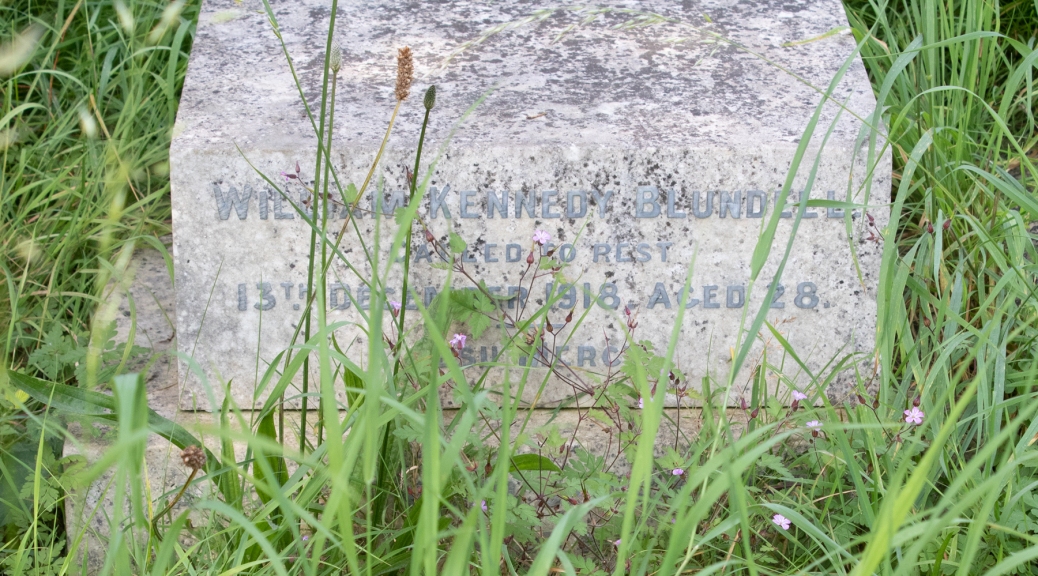
Captain William Blundell

Captain William Blundell

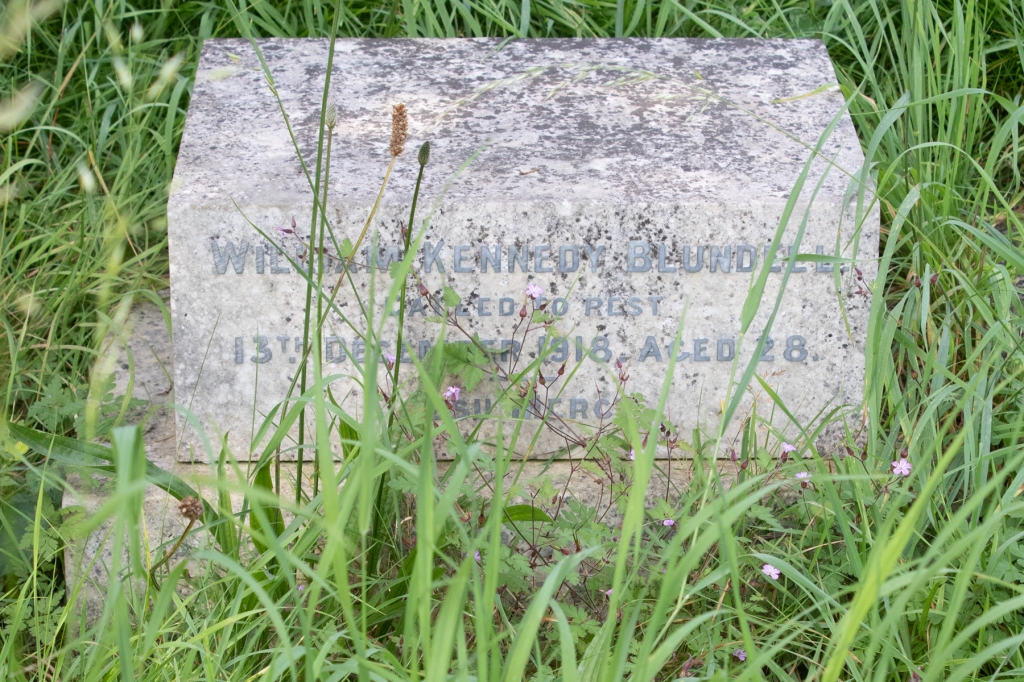
William Kennedy Blundell early life seems anything but ordinary. Born in Cardiff, Glamorgan, in the summer of 1890, he was the only child to bank clerk Edmund Blundell and his wife, Annie. Edmund was born in Staplegrove, Somerset, while Annie had grown up in Lahore, India.

The 1891 census found William living with his maternal grandparents James and Edith Kennedy in the Walcot area of Bath, while his parents were firmly based in Cardiff. Edmund died the following year, so it is possible that he was placed out of the way while Annie tended to her husband (along with her sister-in-law and a domestic servant).

By the time of the next census return, Annie and William were reunited, and were living in Avenue Road, Wimborne Minster, Dorset. Anne was living off her own means, and had a servant, Emily Chaffey, to hep look after the home.

Both Annie and her son disappear from the 1911 census. It is likely that William had embarked on a military career by this point, and may have been serving overseas. Sadly, his trail goes cold, but scraps of later information help identify some of what became of him.

By the outbreak of the First World War, he was serving in the Bedfordshire Regiment. He was based in Egypt from January 1916, and rose to the rank of Captain by the end of the conflict. By 1918, he was attached to the 12th (Transport Workers) Battalion, and was back in Britain.

Captain Blundell was in Sussex by the time of the armistice, and it was here that he fell ill, contracting pneumonia. He was admitted to the General Eastern Hospital in Brighton, but the condition was to prove too severe. He passed away on 13th December 1918, at the age of 28 years old.

William Kennedy Blundell’s body was taken back to Somerset for burial. He was laid to rest in the sweeping grounds of Locksbrook Cemetery in Bath.


Sapper Arthur Naile

Sapper Arthur Naile

Arthur Edward Naile was born in the summer of 1888, the youngest of ten children to James and Mary Naile. Both of his parents were born in Bath, Somerset, and this is where they raised their growing family.

The Nailes lived in the Camden area of the city, consecutive census returns showing different addresses, as the children grew and then left home. In 1891, they lived at 11 Malvern Buildings, a small terraced house on a steep hill. Ten years later, they had moved to 3 George’s Road, to another terraced cottage close to their old home. By 1911, only Arthur was still living at home, which was now the four-roomed terrace at 51 Brooklyn Road, in the more built up Larkhall area no the northern outskirts of the city.

During all of this time, James had worked as a printer’s compositor. By 1911 he was 64 years of age, and was employed by a newspaper in the area. Arthur, meanwhile, was working as a grocer’s assistant.

On 9th August 1914, he married soldier’s daughter Bessie Brine. She was working as a dressmaker, and lodging with Charles and Eleanor Richman, in a small cottage in Dover Place. Their marriage certificate shows that Arthur was living three doors down, so it is likely she caught his eye not long after he moved in. They went on to have a son, Leslie, in November 1916.

War was raging across Europe by this point, and Arthur had stepped up to serve his country. He joined the Royal Engineers as a Sapper, but there is little concrete information about his time in the army. He was awarded the Silver War Badge, which was given to men medically discharged from military service during the conflict, which would suggest that he was badly wounded at some point. He died in a hospital in Hastings, East Sussex, an annexe of which was dedicated to personnel who had been blinded during the war.

Sapper Arthur Edward Naile passed away from a combination of influenza and diabetes on 31st October 1918: he was 30 years of age. His body was taken back to Somerset for burial, and he lies at rest in a peaceful corner of Bath’s sweeping Locksbrook Cemetery.


After Arthur’s death, Bessie was left to bring up their young son. In the autumn of 1923, she married again, to John Forman, and not long afterwards the three of them emigrated to Australia, in search of a better life. They settled in Bunbury, Western Australia, and went on to have two children, Ron and Nan.

When war broke out again, Leslie was old enough to step up, and joined the Royal Australian Air Force. By 1943, he found himself as a Flight Sergeant in Waltham, Lincolnshire. He had joined 100 Squadron of Bomber Command and, on the night of 25th June 1943, was piloting a Lancaster over the Netherlands. His plane was hit and destroyed, killing all those on board. Father and son both lost to war, Flight Sergeant Naile was just 26 years of age when he passed. He was buried in Westbeemster, and commemorated on memorials in Runnymede, Surrey, and Canberra, Australia.

Bessie lived on until her early 70s. She died on 8th December 1960, and is buried in the family plot in Bunbury Cemetery.


Private Philip le Cornu

Private Philip le Cornu

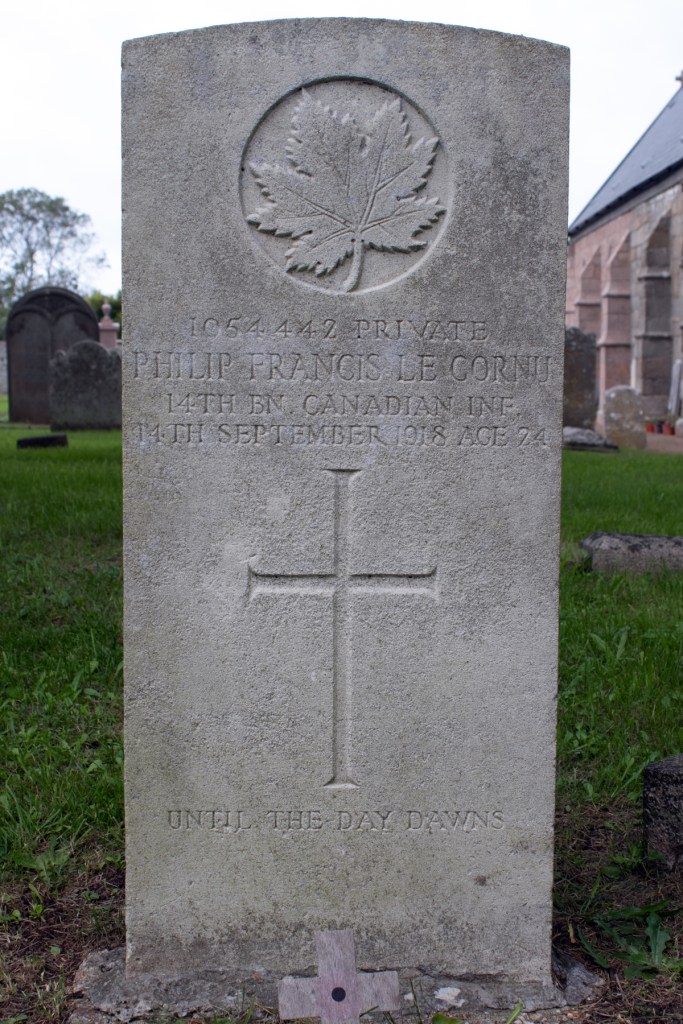
Philip Francis le Cornu was born on 29th July 1894 in St Peter’s, Jersey. The youngest of five children, his parents were Philip and Mary le Cornu. Philip Sr was a farmer, but it seems that both he and Mary passed away not long after his youngest son’s birth. By the time of the 1901 census the children had been split between family members, and Philip Jr was living with his maternal grandparents.

Philip finished his schooling, and seems to have sought a purpose in life. He emigrated to Canada and, by the time war broke out, was living in Grande-Mère, Quebec. He found employment as a clerk, but with conflict raging on the other side of the Atlantic, he responded to the call to arms.

Philip enlisted in the Canadian Expeditionary Force on 12th September 1916. His service records show that he was 22 years and 2 months old and stood 5ft 6ins (1.68m) tall. He had black hair, blue eyes and a dark complexion. Private le Cornu sailed to Britain, and arrived there on 7th April 1917.

Billeted in Shoreham, West Sussex, Philip was attached to the 14th Battalion of the Canadian Infantry. Within weeks he was sent to France, and, on 15th August 1917, was caught up in the Battle of Hill 70 near Lens.

During the skirmish, Private le Cornu was badly wounded in the thigh and sent to the 58th Casualty Clearing Station. Within days he was moved to the 4th General Hospital in Camiens, but his condition necessitated medical evacuation to Britain.

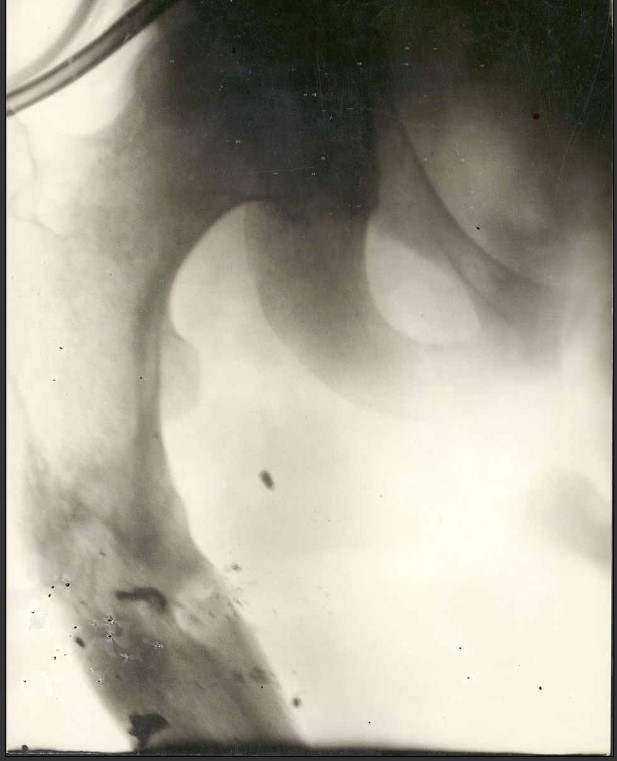
Over the next year, Philip had three operations on his leg, and spent time at the 3rd Southern General Hospital in Oxford, the Manor War Hospital in Epsom, Surrey, and the 16th Canadian General Hospital in Orpington, Kent. Tragically, all of the medical treatment was to prove to no avail. Private le Cornu passed away from his injuries on 14th September 1918, more than a year after Hill 70. He was 24 years of age.

Philip Francis le Cornu’s body was taken back to the Channel Islands for burial. He was laid to rest in the quiet graveyard of St Mary’s Church on Jersey.


X-ray of Private Philip le Cornu’s left femur
(from uk.forceswarrecords.com)

Gunner Valentine Wilkinson

Gunner Valentine Wilkinson

Valentine Burnett Wilkinson was born early in 1889 in Combe Down, Somerset. One of eight children, his parents were Harry and Eliza Wilkinson, Harry was from nearby Bath and worked as a gardener, and this is the trade into which Valentine also went when he finished school.

In the spring of 1913, Valentine married Florence Moody. She was the daughter of a stone mason and, at the time of the 1911 census, she was employed as a live-in sewing maid at Monkton Combe Junior School.

Gardening seems to have been a footstep to something bigger for Valentine, and he soon found other employment, as a police constable. He and Florence moved to Street, near Glastonbury, and this is where they were living when war broke out.

Keen to play his part, Valentine enlisted in the Royal Garrison Artillery on 11th December 1915. He was placed on reserve, possibly because of his occupation, and was not formally mobilised until the end of June 1917, just six weeks after Florence had given birth to their first and only child, Joan.

Gunner Wilkinson’s service records note that he was 5ft 11ins (1.8m) tall, and had a scar on his right wrist. He spent five months training, split between No. 3 Depot in Plymouth, Devon, 473 Siege Battery and No. 1 Reinforcing Depot in Bexhill-on-Sea, Sussex. On 3rd November 1917, however, he was sent to France, and was attached to the 234th Siege Battery.

Gunner Wilkinson’s time overseas was to be brief, however. He was caught up in a gas attack in December, and evacuated back to Britain for treatment. His health was now impacted and, during the summer of 1918, he was admitted to hospital having contracted pleurisy. After two months in hospital, Valentine was sent to the Military Convalescent Hospital in Ashton-in-Makerfield, near Wigan.

The war was in its closing stages by this point, and in November 1918 Gunner Wilkinson resumed some of his duties, albeit on home soil. His health was still suffering, and he contracted tuberculosis on the lung and throat. He was formally discharged from the army on 27th February 1919, no longer physically fit to serve.

Valentine returned home to Somerset, and it was here, on 1st April 1919, that his body finally succumbed to the lung conditions that had dogged him for nearly eighteen months. He was just 30 years of age.

Valentine Burnett Wilkinson was laid to rest in the quiet graveyard of St Michael’s Church in the parish of his childhood home, Monkton Combe.


Private Walter Lane

Private Walter Lane

Walter Frederick Lane was born in Sidcup, Kent, in the early part of 1893. The younger of two children, his parents were Frederick and Caroline Lane. Frederick was a carman and the transient nature of his work meant that the family moved on a regular basis.

The 1901 census found them in Eltham, Kent, while ten years later the family of three – Walter’s older sister having moved on – were boarding in Harton Street, Deptford. By this point, Walter was 17 years of age, and he was also working as a carman. (It is interesting to note that the earlier census recorded Walter’s parents by their first names, while the 1911 document used their middle names – Walter and Kate: transient work allowing for reinvention, perhaps?)

Walter sought a more permanent career, and, on 17th March 1913, he enlisted in the army. Full details of his military career have been lost to time and, in fact, most of his service details come from his discharge papers.

Walter enlisted in the Queen’s Own (Royal West Kent Regiment), although, as Private Lane, he was not formally mobilised until March 1914. When war broke out, his battalion, the 1st/5th, was sent to India, and he remained there for the duration of the war.

Private Lane’s time in the army was not without incident. He contracted malaria in 1915, and while he initially recovered, the condition was to continue to dog him over the following years.

By 1917 Walter’s troop was based in Jabalpur, Madhya Pradesh, but in December that year, the battalion set sail from Bombay for Basra, Mesopotamia.

While in Iraq, he had a couple of run-ins with his superiors. On 22nd December 1917 he was stopped a week’s pay for ‘disobeying an order: putting his equipment on a transport waggon’ and ‘losing by neglect his equipment.’ On 18th February 1918, a further 28 days’ pay was deducted for ‘making away with regimental necessaries (1 towel)’ and ‘neglecting to obey an order.’

During this time, though, Walter’s health was regularly impacted when malaria caught up with him. His discharge documents recorded that he had an attack about once a month, which lasted four or five days each time. In the end, he was released from active service, and left the army on 19th February 1919.

Walter had been discharged while admitted to the Dispersal Hospital in Brighton. His health did not improve, however, and he was soon moved to Somerset for respite care. It was here that he passed away on 7th August 1919. He was 26 years of age.

Walter Frederick Lane was laid to rest in the Holy Trinity Churchyard, Newton St Loe, Somerset.


My thanks go to Liz at the local parish office for her help in unpicking the details of Walter’s passing.

Thanks also go to Tim Hill, who has been researching the graves in the Newton St Loe churchyard.


Gunner Alfred Taylor

Gunner Alfred Taylor

Alfred Taylor was born in the summer of 1888 in Crewkerne, Somerset. The second of twelve children, his parents were Henry and Selina Taylor. Henry, who was also known as Harry, was a stone mason, but when Alfred and his siblings left school, they went into the weaving industry, a key employer in the area.

War came to European shores in the summer of 1914, and Alfred was keen to play his part. He had already been a part of the 3rd (Special Reserve) Dorset Regiment, but formally enlisted on 9th December 1915, joining the Royal Garrison Artillery. His service records note that he was 5ft 9ins (1.77m) tall and weighed 149lbs (67.6kg). The document also confirms his next of kin as his father, who, at 48 years old, had also joined up, and was serving in the Royal Engineers in Canterbury, Kent.

Gunner Taylor was not mobilised until September 1916, and served the next eighteen month on home soil. He did his initial training in Hilsea, Portsmouth, before moving around the country. He finally made it to France in February 1918.

During his time in France, Alfred was caught up in a couple of gas attacks, and was evacuated to Britain at the end of August because of the impact on his lungs. Admitted to the 2nd Eastern General Hospital in Brighton, Sussex, his body finally succumbed to pneumonia. He passed away on 25th January 1919, at the age of 30 years old.

The body of Alfred Taylor was brought back to Somerset for burial. He was laid to rest in the Townsend Cemetery of his home town, Crewkerne. “…All the members of Gunner Taylor’s family were present, except his father and his brother George, who [were] with the Army of Occupation in Germany.” [Western Chronicle: Friday 7th February 1919]