William James Stevens was born in the autumn of 1891, and was the fourth of eight children to William and Emily Stevens. William Sr was a carter on a farm in Stogumber, Somerset, and this is where the family would come to be raised.
William Jr followed his father’s trade when he finished his schooling, but stepped up to serve his King and Country when war was declared. Little information remains about his time in the army, but it is clear that he had enlisted in the Royal Field Artillery by the spring of 1916.
The only other records relating to William are those connected to his passing. He was discharged from the army on medical grounds in November 1916, and was suffering from tuberculosis. He appears to have been admitted to a hospital that winter, and died from the lung condition on 16th February 1917. He was 25 years of age.
William James Stevens was laid to rest in the tranquil surroundings of St Mary’s Churchyard in Stogumber.
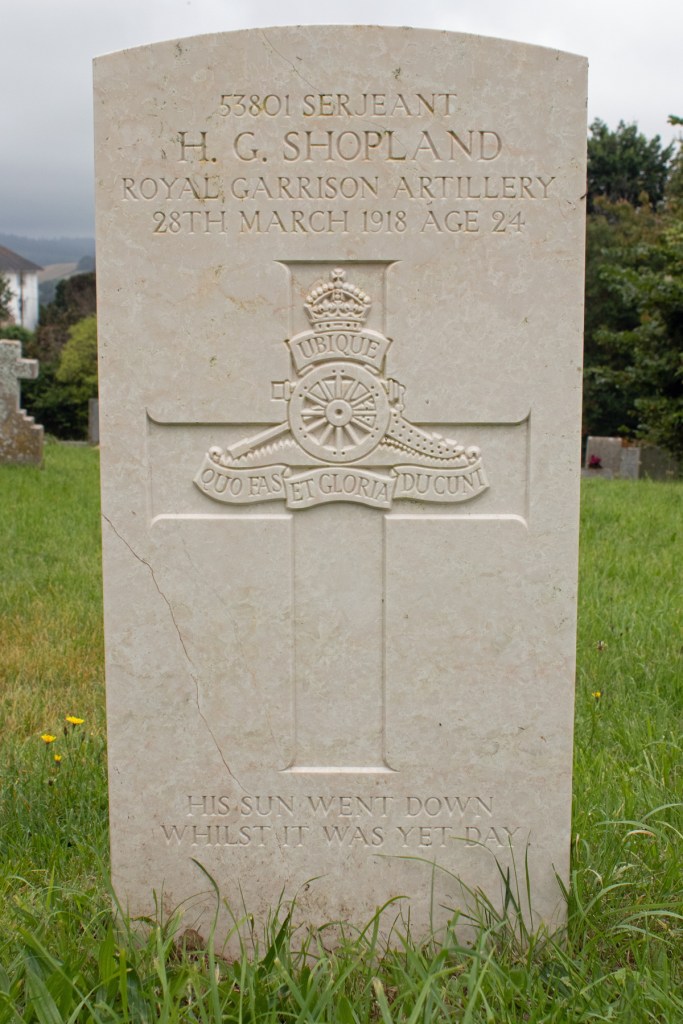
Harold George Shopland was born in the spring of 1893, the youngest of nine children to George and Mary Shopland. George was a joiner and platelayer for Great Western Railways: he died when Harold was just seven years old, which left Mary to raise the family alone. She did this with the support of the community and Harold’s older siblings.
By the time of the 1911 census, Harold, who was now 17 years of age, was the only one of her children to still be living at home: he was a stone mason’s carter, while Mary was getting by as the housekeeper for the local Wesleyan chapel.
When war broke out, Harold stepped up to play his part. Possibly keen to follow in his oldest brother’s footsteps – Private Walter Shopland had died at Bloemfontein in 1901 – he enlisted on 23rd November 1914. Harold joined the Royal Garrison Artillery as a Private, his service records confirming that he was 5ft 10ins (1.77m) tall, and weighed 165lbs (74.8kg).
Harold spent more than two years on home soil, before being sent to France in July 1917, with a promotion to Serjeant. He remained overseas, but fell ill with tuberculosis that winter, and was medically repatriated the following January. He was admitted to the Queen Mary’s Military Hospital in Whalley, Lancashire, and remained there for the next couple of months.
Harold’s condition meant that he was no longer fit for military duty, and was dismissed from service on 8th March 1918. He remained in hospital, however and his condition worsened. He passed away on 28th March 1918, at the age of 24 years old.
Mary brought Harold George Shopland’s body back to Somerset for burial. He was laid to rest in the peaceful setting of St Andrew’s Churchyard in Old Cleeve, not far from his father’s grave.
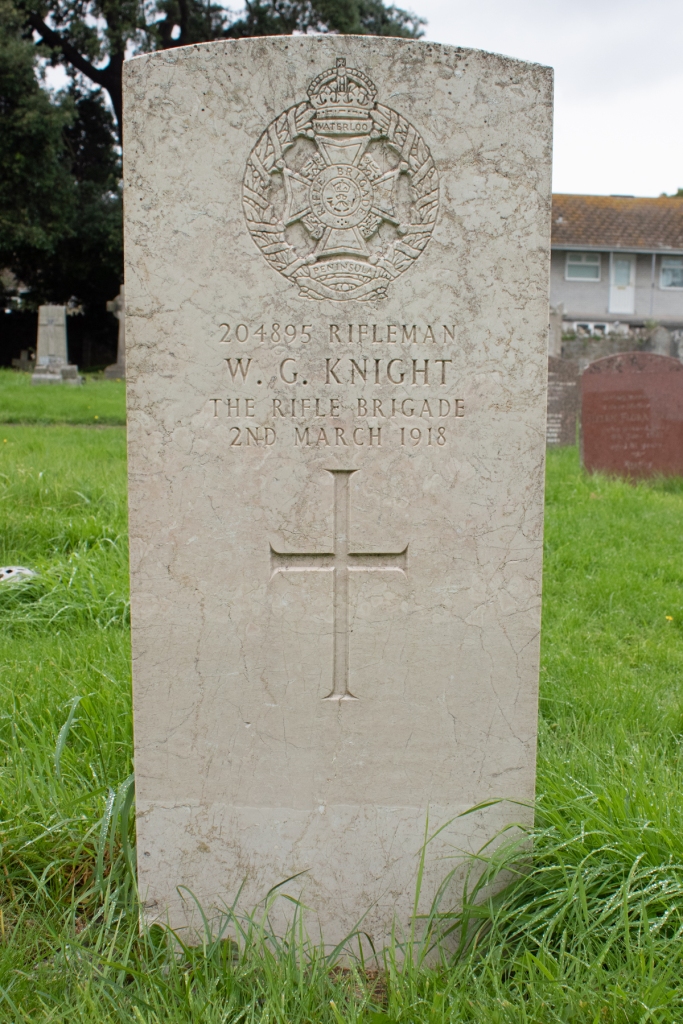
Walter George Knight was born on 27th December 1887 and was the older of two children to George and Mary. George was a gardener from London, Mary had been born in Devon, but it was in Weston-super-Mare, Somerset that they settled down to raise their family.
On 11th October 1910, Walter married Rosa Burford at St Saviour’s Church. While listed as a spinster, Rosa had two children by this point – Phyllis and Lionel. A later document records Walter as their stepfather, but their full parentage is unclear.
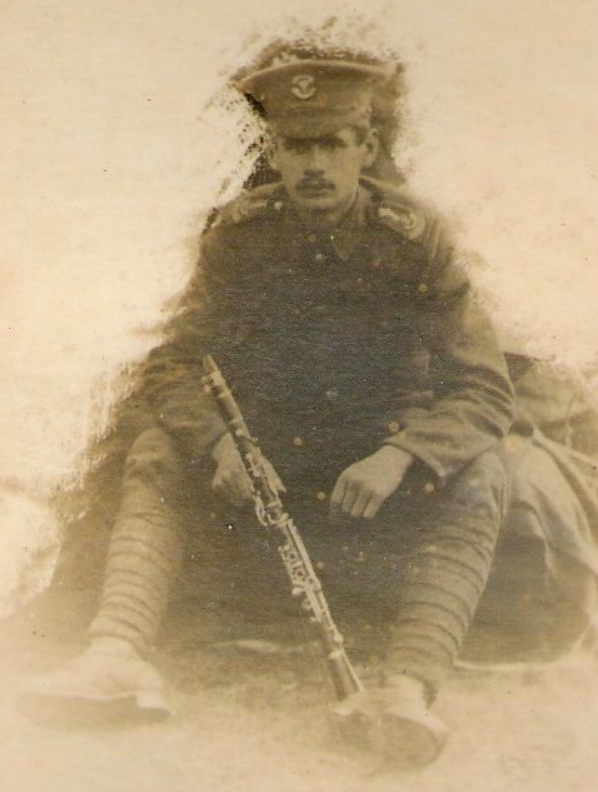
The marriage certificate notes Walter’s trade as a musician, but the following year’s census shows a more reputable trade, as he had taken to working as an insurance agent. He and Rosa had set up home in Cranleigh Road, Bridgwater, by this point, in a small terraced house they shared with the two children and Rosa’s widowed father, William.
By the summer of 1914, war was brewing over European shores, and Walter was quick to step up and support his country. He enlisted in the army on 14th October, joining the Somerset Light Infantry. He spent a year with the regiment, before transferring to the 22nd Wessex & Welsh Battalion of the Rifle Brigade.
By January 1916, Rifleman Knight found himself sailing for the Eastern Mediterranean, spending the next year in Egypt and Salonika. It was while he was overseas, in the spring of 1917, that he became ill and, having contracted tuberculosis, he returned to the UK.
Walter’s condition meant he was no longer fit for the army: he was formally discharged from the Rifle Brigade on 16th April 1917, having served for two-and-a-half years. He was admitted to the Cheddon Road Sanatorium in Taunton, the aim being to help manage his condition.
Rosa and the children had moved from Bridgwater by this point, settling in a small house in Ravensworth Terrace, Burnham-on-Sea. It is likely that Walter came here to visit the family during good spells in his health. The lung condition was to get the better of him eventually, however, and he passed away on 2nd March 1918, at the age of 30 years old.
Walter George Knight was laid to rest in the peaceful Burnham Cemetery, a short walk from where his grieving family lived.
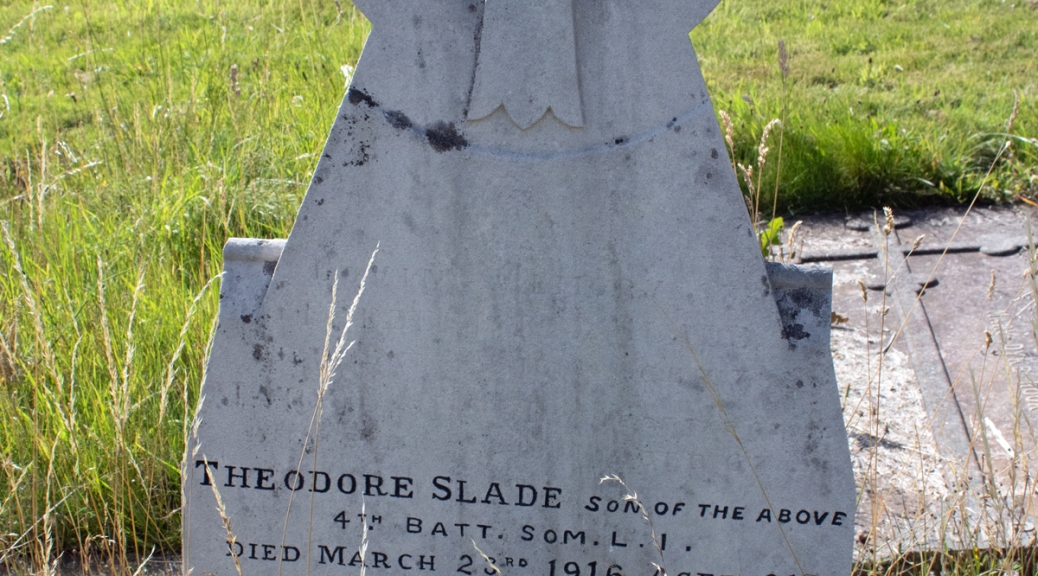
Theodore Slade was born early in 1885 in Buckfastleigh, Devon and was the second of two children to Frederick and Mary Slade. The 1891 census recorded the family four living with Frederick’s widowed mother and younger sister in Minehead, Somerset, where he had himself been born. Frederick was listed as a schoolmaster, while Mary was working as an organist.
Music definitely ran through the Slade family. The next census, in 1901, found Frederick now working as a gunsmith. Mary, meanwhile, was now noted as being a professor of music, while Theodore and his older brother, appropriately named Beethoven, were both employed as music teachers.
Ten years further on, and Beethoven had moved out of the family home, for a life with his wife and her widowed mother. Frederick was still working as a gunsmith, while Mary and Theodore were still teaching music. All three were self-employed, Theodore also working as an organist at St Andrew’s Church, Minehead, for more than a decade.
An interesting side note to the three document is how the census takers relied fully on the information they were given by residents. In 1891, Frederick gave his age as 41 and Mary 40; ten years later, Frederick was noted as being 56 and Mary 53; the 1911 census gave their ages as 71 and 63 respectively.
When war broke out, Theodore enlisted early on. He joined the Somerset Light Infantry, and was initially attached to the 4th (Reserve) Battalion. Private Slade was transferred across to the 1st Battalion, and soon found himself ensconced at Ypres.
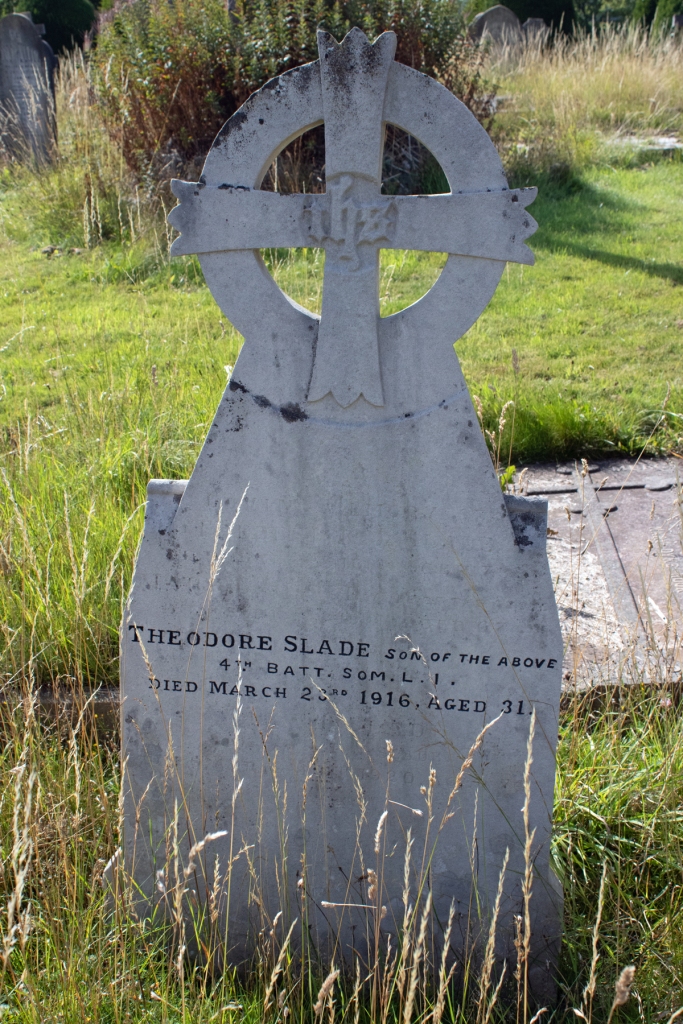
Towards the end of 1915 Theodore came down with tuberculosis, and was medically evacuated to Britain for treatment. He was admitted to St John’s Hospital in Penarth, Glamorganshire, and remained in hospital over the winter months. His lungs weakened, he contracted pneumonia, passing away from the condition on 23rd March 1916, at the age of 31 years old.
Theodore Slade’s body was brought back to Somerset for burial. He was laid to rest in the family plot in the sweeping vista of Minehead Cemetery.
Harold Cane was born in Minehead, Somerset, on 10th August 1898. One of nine children, his parents were Henry and Mary Cane. Henry was a stone mason from Minehead, but he was working in Ireland when he met his future wife. The couple married in 1891, only moving back to Somerset the mid-1890s, by which time they had two children, Harold’s oldest siblings.
The 1911 census recorded Henry and Mary living with their children at 3 Church Steps in Minehead, a short row of houses leading to St Michael’s Church. Henry was a mason and his oldest son, also called Henry, has working with him.
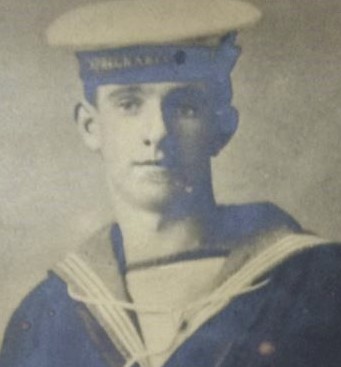
Harold, meanwhile, dreamed of a bigger and better life. When he finished his schooling, he joined the Royal Navy, looking for a life of adventure on the high seas. He signed up on 22nd September 1914, just a month after the declaration of war, and was sent to the shore-based training ship, HMS Impregnable, based in Devonport, Devon.
As he was just 16 years of age, Harold was given the rank of Boy 2nd Class. However, his commitment to the role was evident and led to a promotion – to Boy 1st Class – after just three months. In September 1915, Harold as assigned to the dreadnaught battleship HMS Iron Duke, where he served as an Ordinary Seaman. He spent just under a year on board, during which time the Iron Duke was caught up in the Battle of Jutland. She was involved in the sinking of the German destroyer SMS S35, after which she and the rest of the fleet moved on.
Ordinary Seaman Cane remained on board HMS Iron Duke until the summer 1916. He had fallen ill by this point, having contracted tuberculosis. The condition was enough for Harold to be invalided out of the navy, and he was stood down on 9th August 1916.
At this point, Harold’s trail goes cold. It seems that he returned home to Somerset, as this is where he passed away. He died on 14th November 1917, at the age of just 19 years old.
Harold Cane was laid to rest in the peaceful landscape of Minehead Cemetery.
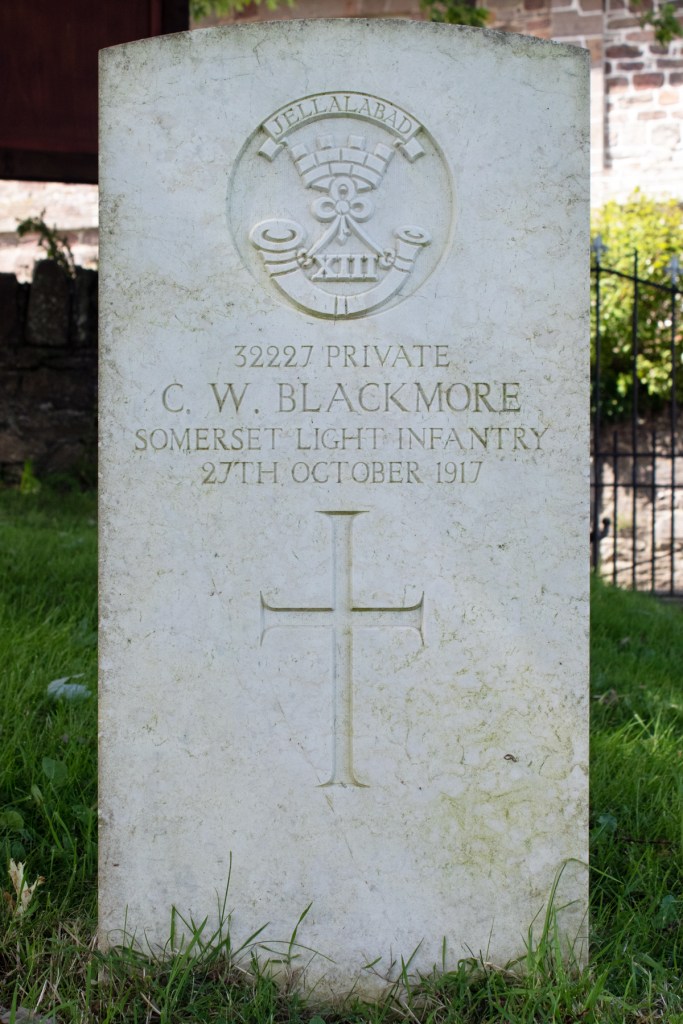
Charles William Blackmore was born in Brompton Regis (or Kingsbrompton), Somerset, on 19th August 1896. He was the twelfth of thirteen children to journeyman carpenter Joshua Blackmore and his wife, Margaret. Charles attended the nearby Upton Primary School until Christmas 1909 at which point he started working with his father.
When war erupted across Europe, however, he stepped up to play his part. He enlisted as a Private in the Somerset Light Infantry on 14th January 1916. Little remains of his service documents, but his medical report confirms that he was 5ft 9ins (1.75m) tall, with light brown hair and grey eyes. Interestingly, the document also gives his date of birth as 14th February 1897, six months later than his school intake record.
The documents that remain for Private Blackmore’s time in the army, do not specify exactly where he served, but his battalion – the 1st – were heavily involved in the Battle of the Somme in 1916, and at Arras the following year.
It was during that summer that Charles fell ill, contracting tuberculosis. He was medically evacuated to Britain for treatment, and admitted to the Toxteth Park Auxiliary Military Hospital in Liverpool. The former workhouse was to be where Charles breathed his last: he died on 27th October 1917, at the age of 21 years old.
The body of Charles William Blackmore was brought back to Somerset for burial. He was laid to rest in the peaceful and picturesque graveyard of the Church of the Blessed Virgin Mary in his home village, Brompton Regis.
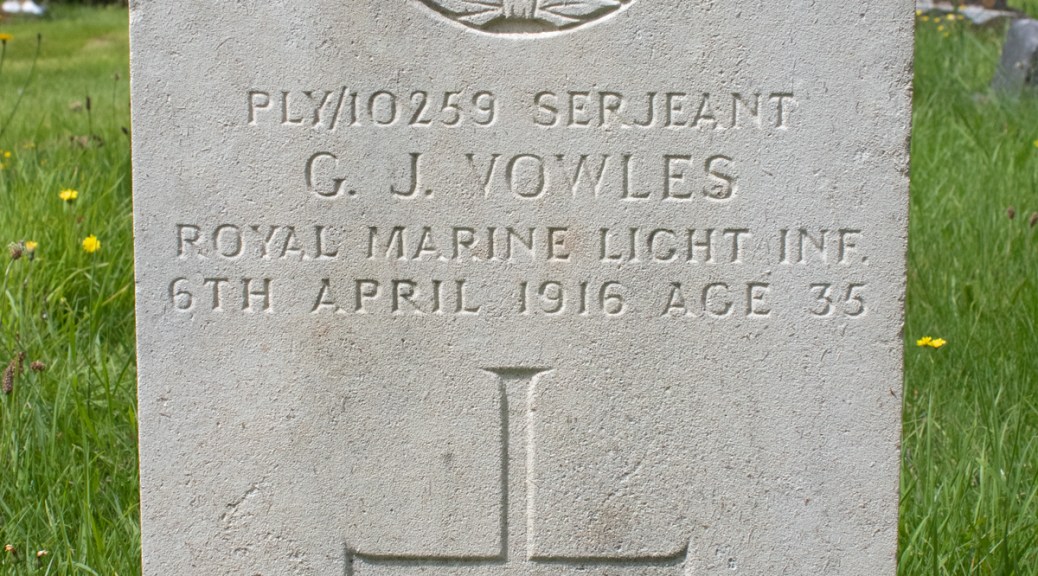
George Joseph Vowles was born in Winsley, Wiltshire, on 18th September 1881. The older of two children, his parents were Joseph and Sophia Vowles. Joseph was an agricultural labourer from Bedminster, who was 46 when his son was born, and twenty years older than his wife. By the time George’s sister was born, in 1890, the family had moved west, and had settled in Wraxall, near Nailsea in Somerset.
George found work as a gardener when he finished his schooling, but he had his sights set on bigger and better things. Sophia had died in 1894 and on 21st March 1900, he enlisted in the Royal Marine Light Infantry. His service records show that he was 5ft 6ins (1.68m) tall, with light brown hair, brown eyes and a fresh complexion. He was also noted as having a scar on the back of his neck.
For the next ten years, George seemed to flourish, serving on a number of ships, including HMS Niobe and HMS Andromeda. In between voyages, he was based at the RMLI depot in Plymouth. During this time he was promoted twice, to the rank of Corporal in September 1902 and Serjeant five years later.
Serjeant Vowles’ contract of service ended in 1911, but with his father now also having passed, he was re-engaged. He continued to make great strides, and, as war broke out, served on HMS Medea and HMS Theseus.
George’s service was cut short in the spring of 1916. Based back at the Plymouth Depot at the time, he fell ill with pulmonary tuberculosis. Sadly, the condition was to get the better of him, and he passed away on 6th April 1916, at the age of 35 years old.
George Joseph Vowles’ body was brought back to Somerset for burial. He was laid to rest in the graveyard of All Saints’ Church in Wraxall, alongside his parents, and not far from where his now-married sister, Dorothy now lived.
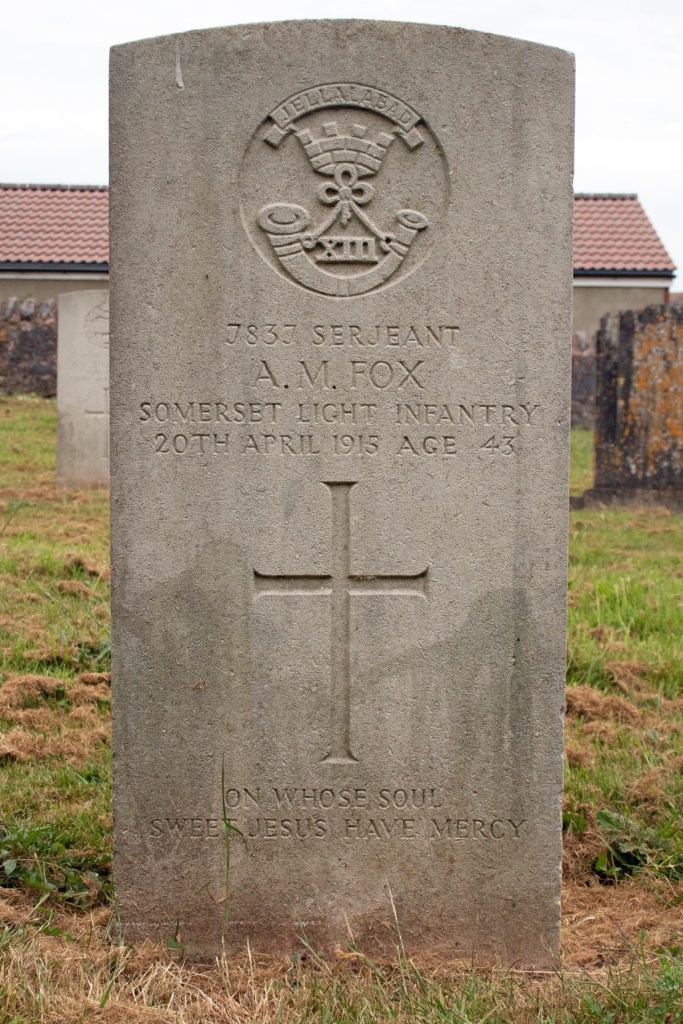
Andrew Michael Fox was born on 25th May 1871, the oldest of six children, to Michael and Eliza Fox. Michael was a Private in the 40th Regiment of Foot, and was based in Curragh Camp, Kildare, Ireland, when Andrew was born.
The family travelled where Michael’s work took him: Andrew’s oldest siblings were born in Uttar Pradesh, India, and the family were in England by the time of the 1881 census.
Given Michael’s military connections, it is no surprise that Andrew followed him into the army. He enlisted in August 1884, joining the South Lancashire Regiment. His service records give his age as 14 – he was, in fact, just 13 years old – and note his height as 4ft 9ins (1.44cm) and his weight as 73lbs (32.7kg). Andrew was recorded as having hazel eyes, brown hair and a fair complexion: his religion was also confirmed as Roman Catholic.
Andrew’s service records have become damaged over time, and a lot of his details are illegible. Because of his age when he enlisted, he was initially given the rank of Boy. In July 1887, he was formally mobilised, with the rank of Private. He remained on home soil for the next ten years, with the 1891 census listing him as being barracked in Fort Regent, Jersey.
It was in the Channel Islands that Andrew met Kathleen Dooling. The couple married on 7th January 1892, and went on to have ten children. Over the next couple of years, Andrew progressed through the ranks, achieving Lance Corporal in September 1892, Corporal in June 1894 and Lance Serjeant in August 1897.
In 1899, the Second Boer War led to the newly-promoted Serjeant Fox being posted overseas. He remained in South Africa for six months, while the conflict raged on. Andrew returned to Britain in April 1900, and was officially stood down from the army on 31st December that year, as he was deemed no longer fit for military service.
The 1901 census found Andrew and Kathleen still living in family barracks in Aldershot with their three eldest children, Andrew Margaret and Edith. Andrew was recorded as being an officer’s valet, likely now in a civilian role. The family remained in Aldershot until 1910, with five more of their children being born there.
Another change came at that point, however, as the following year’s census found the family living in Brighton Street, Warrington, Lancashire. Andrew was, by this point, working as a salesman for the Singer Sewing Machine Company, and the family were cramped into a four-roomed end-of-terrace house.
War came to Europe in the summer of 1914, and Andrew stepped up to play his part once more. Again, full details have been lost to time, but he took up the rank of Serjeant once more, and was attached to the Somerset Light Infantry. This necessitated another relocation for the family, and they moved to Cannington, near Taunton, Somerset.
Serjeant Fox was assigned to the 7th (Service) Battalion, but was not to remain in his role for long. He contracted phthisis, or tuberculosis, and passed away from the condition on 20th April 1915, just weeks before his regiment departed for the Western Front. He was 43 years of age.
Andrew Michael Fox was laid to rest in the peaceful Cannington Cemetery, not far from the family home.
Private Andrew M Fox
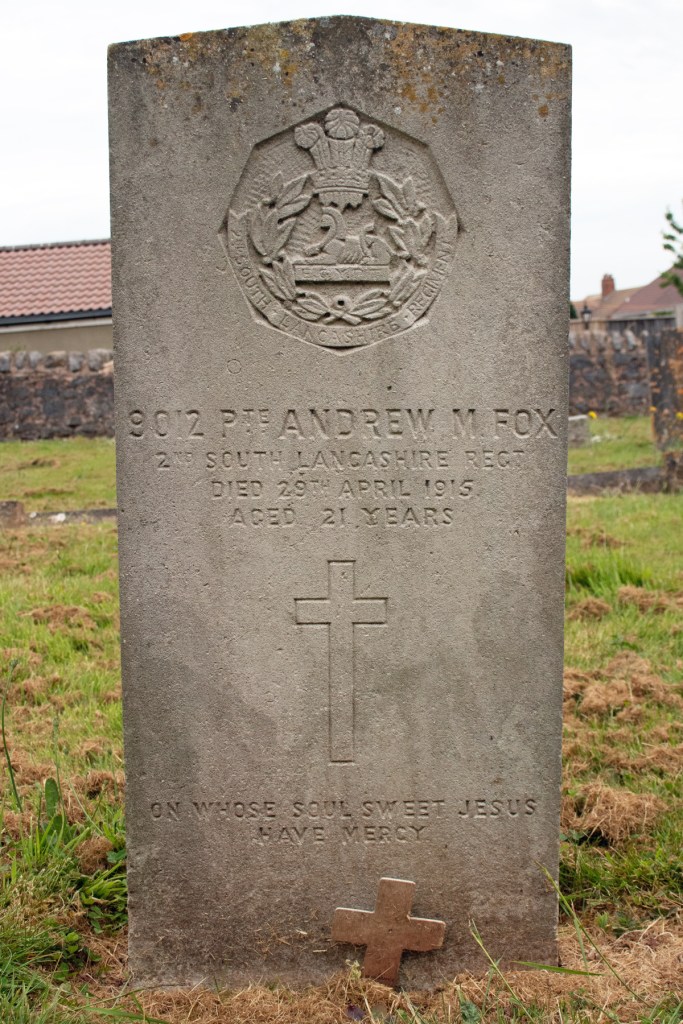
In the plot next to Serjeant Andrew Fox is another, similar headstone. Not quite having the same form as the Commonwealth War Grave Commission headstone that Serjeant Fox has, this is dedicated to a Private Andrew M Fox, of the 2nd South Lancashire Regiment.
Andrew Moyse Fox was the eldest son of Andrew and Kathleen. Born on 31st March 1894 in Ireland, he wanted to follow his father and grandfather into the army.
Andrew Jr enlisted in the South Lancashire Regiment in August 1908. His service records confirmed that he was just 14 years of age, standing 5ft (1.52m) tall, and weighing 5st 2lbs (32.7kg). He was noted as having dark brown hair, hazel eyes and a fresh complexion, and that he has a scar on his right buttock.
As is the case with his father, there is limited information about Andrew Jr’s army career. He spent just under six years serving with the regiment, and was formally mobilised when he came of age in 1912. On 27th March 1914, however, Private Fox was discharged from the army on medical grounds, for reasons unclear. The next record available for him is that of his passing, just nine days after his father. He was 21 years of age.
Andrew Fox Jr was laid to rest next to his father in Cannington Cemetery. The heartbreak for Kathleen, to have lost husband and oldest boy within two weeks, must have been indescribable. While her son’s headstone is similar in design to her husband’s, he was not subsequently entitled to an official Commonwealth War Grave, as he had left the army before the outbreak of war: the Commission’s qualification dates (4th August 1914 to 31st August 1921).
Much of the life of William Charles Taylor is destined to remain lost to time. His Commonwealth War Grave Commission and military records give his father as Henry Taylor, while another document suggests his mother’s initial was E, but no birth, baptism or census records match the three names given.
The document that can be directly attributed to William is his military service records. They confirm that he enlisted in Bath, Somerset, on 18th February 1916, joining the Somerset Light Infantry. The document notes that he was 21 years and 7 months old when he enlisted, and stood 5ft 7ins (1.7m) tall.
Initially assigned to the 10th Battalion of the Somerset Light Infantry, within a couple of months, Private Taylor was transferred across to the Durham Light Infantry in July 1917. He remained on home soil for the duration of his time in service, and was moved across to the Labour Corps in March 1918.
By May that year, William had become unwell. He was based in Essex at this point, and was admitted to the Warley Military Hospital in Brentwood, suffering from tuberculosis. He spent six weeks in hospital, before finally being discharged from the army as he was no fit for military service.
At this point, William’s trail goes cold once more. He seems to have returned home to Bath, finally succumbing to tuberculosis on 15th September 1918. He was just 24 years of age.
William Charles Taylor was laid to rest in Bath’s Twerton Cemetery.
Thomas Alfred Parsons was born in the summer of 1885 in Twerton, Somerset. One of six children, his parents were railway engine driver William Parsons and his wife, Mary. When Thomas finished his schooling, he found work at a labourer at a mineral water supplier, something he continued doing through to the outbreak of war.
On 27th May 1912, Thomas married Lily Howell, a labourer’s daughter, the couple tying the knot in Twerton parish church. They were living in Charlton Buildings, next to the river and now student accommodation for Bath’s universities. Lily had had a son, in November 1905: young Ronald was either Thomas’, or he was accepted as his own.
When war came to Europe, Thomas stepped up to play his part. He enlisted on 11th December 1915, although he was not formally mobilised until six months later. Private Parsons initially joined the Devonshire Regiment, but by early 1917, he became attached to the 169th Labour Corps.
Sent to France in February that year, Private Parsons only remained overseas for a matter of six months. By early September Thomas had fallen ill, contracting a combination of bronchitis and phthisis (or tuberculosis). Medically evacuated back to Britain, he was admitted to a hospital in Plymouth, Devon, but grew weaker until, on 2nd October 1917, he passed away. He was 32 years of age.
The body of Thomas Alfred Parsons was taken back to Somerset for burial. He was laid to rest in Twerton Cemetery, not far from his widow’s home.










 Death and Service