Tag Archives: war

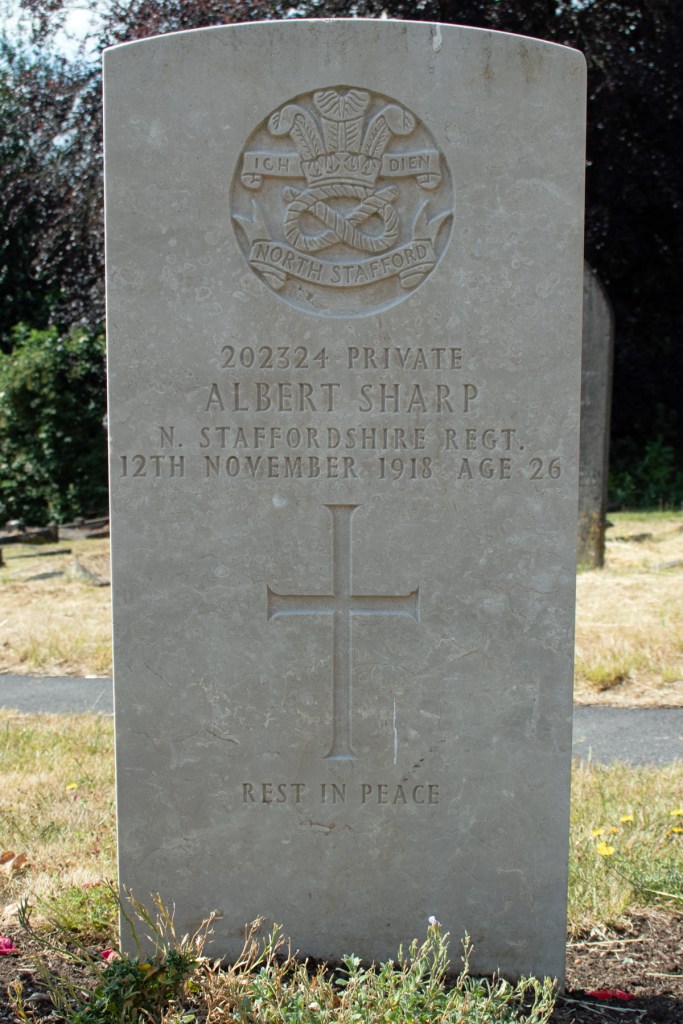
Private Albert Sharp

Private Albert Sharp

Albert Sharp was born in Rugeley, Staffordshire, in the summer of 1894. One of six children, his parents were George, who was a house painter, and Janet Sharp. When he left school, Albert found work as a bricklayer’s labourer, but, when war was declared, he sought a new adventure.

Albert enlisted in the army on 21st February 1916. Assigned to the North Staffordshire Regiment, he was initially attached to the 5th Battalion. His medical records show that Private Sharp was 5ft 6ins (1.6m) tall, and weighed 122lbs (553kg).

By November 1916, Albert found himself in France. Unusually, his life over the next couple of years is pretty well documented. His battalion saw action at the Hindenburg Line, the Third Battles of Ypres, Cambrai and the Third Battles of the Somme, but Private Sharp’s service records shed more light onto his life than simply where he fought.

Albert seems to have been a bit of a character, and this got him into trouble on more than one occasion. On 9th November 1916, he was confined to barracks for two days, for having untidy bedding and no towel on his bed. The following day, he was punished with another two days’ confinement for not attending his battalion’s role call.

On 18th December 1916, Private Sharp found himself in trouble again. This time, he was confined to barracks for five days for appearing dirty on parade, and committing a nuisance. Four days later, Albert was admitted to the camp hospital for reasons that are unclear. He returned to his unit just under a week later.

At the end of February 1917, Private Sharp transferred to the 31st Light Railway Operating Company of the Royal Engineers. He remained with the battalion for just under a year, although again his time there was not without incident. On 31st August 1917, Albert was confined to barracks for seven days for being absent from parade. The same punishment was meted out for the same offence on 8th January 1918.

Later that month, Private Sharp re-joined the North Staffordshire Regiment, and was this time attached to the 9th Battalion. He remained on the Western Front and was caught up in some of the fiercest fighting of the closing months of the conflict.

On 12th May 1918, Albert was caught up in a gas attack. Seriously injured, he was medically evacuated to Britain for treatment and admitted to the Bath War Hospital on 29th May. The next six months saw a slow and steady decline in his health. He passed away at 5:45am on 12th November 1918, the day after the Armistice was signed, from a combination of pneumonia and emphysema that was directly attributable to his injuries in France. Albert was 24 years of age.

It seems likely that Albert’s family were unable to pay for his body to be taken back to Staffordshire for burial. His service records give only his mother, Janet, as a next of kin, so it would seem that George had passed away by the time Albert enlisted. For some reason, however, while the British Register of Army Effects note that Private Sharp has effects to the value of £39 10s (£2250 in today’s money), this amount does not appear to have been paid. Janet passed away in the early 1920s, and Albert’s brother continued to try and obtain this gratuity on her behalf, but seems to have been unsuccessful.

Albert’s family did get his belongings when he died, however, which came to a postal order for 2s (around £3 today), 50 French centimes, a leather purse, two combs, two jack knives, a razor, a shaving brush, a toothbrush, two briar pipes and a pouch of tobacco, a nickel cigarette case, a text book, a wallet containing his pay book, his cap badge and six letters.

Unable to afford to bring Albert Sharp’s body back to his home town, he was, instead, laid to rest in the sweeping vista of Bath’s Locksbrook Cemetery, not far from the hospital in which he had breathed his last.

Bombardier William Johnson

Bombardier William Johnson

William Wilbur Johnson was born in Wingham, Ontario, Canada, on 25th August 1889, and was the son of John and Barbara Johnson. Little information is available about his early life, but he found work as a saddler when he finished his schooling.

In his free time, William volunteered in the 20th Border Horse Regiment. When war broke out in Europe, he was called upon to play his part, and joined the Canadian Expeditionary Force. His service records confirm he was 5ft 8ins (1.73m) tall, with brown hair, blue eyes and a dark complexion. He was also noted as having two scars both on his inner left forearm.

Private Johnson arrived in England in May 1916, and was initially billeted in Shorncliffe, Kent. He did not remain in Britain for long, however, and, assigned to the 2nd Brigade of the Canadian Field Artillery, he arrived in France on 1st June 1916. William would have been in the thick of things, caught up in the bloody stalemate of the Somme for most of the rest of the year.

In November 1916, William was promoted to Acting Bombardier. After a miserable winter on the Front Line, he became ill, and was admitted to a field hospital for a week with bronchitis and influenza. He recovered and remained on the Western Front during 1917, fighting at both Vimy Ridge and Passchendaele.

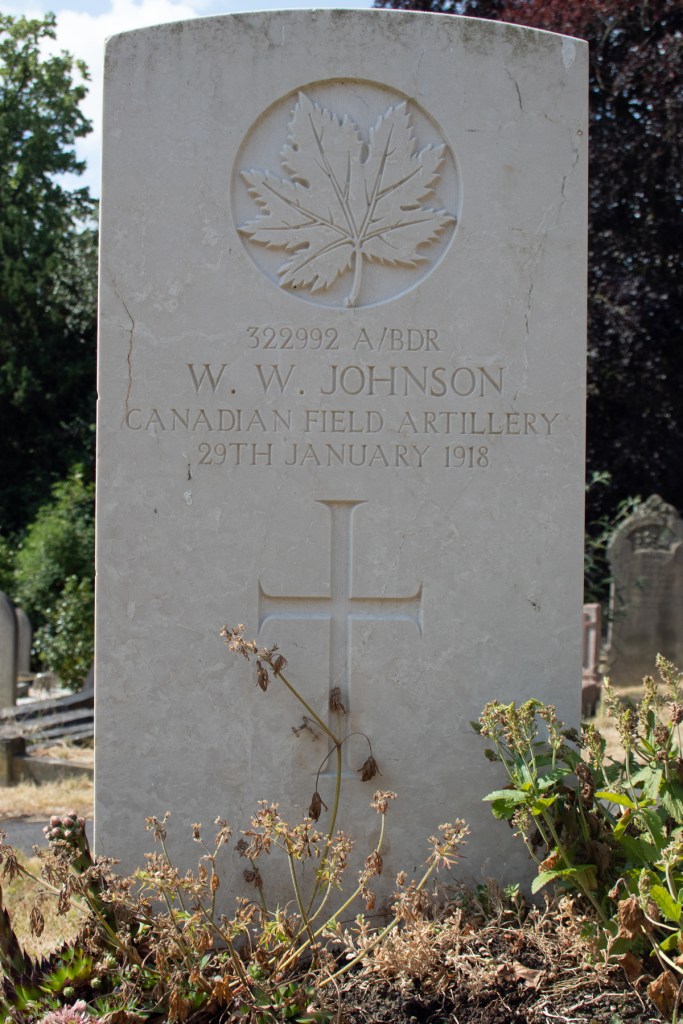
By the end of November 1917, Acting Bombardier Johnson’s health was suffering once more. He became jaundiced and, after some time spent in a field hospital, he was medically evacuated to Britain for further treatment. He was admitted to the Bath War Hospital in Somerset, with what turned out to be cirrhosis of the liver. This was something his body was unable to overcome: William passed away on 29th January 1918, at the age of 28 years old.

With all of his family overseas, it was not practical for the body of William Wilbur Johnson to be returned to Canada. Instead, he was laid to rest in the sweeping grounds of the Locksbrook Cemetery, not far from the hospital in which he had breathed his last.


Bombardier William Johnson
(from findagrave.com)

Private Henry Wiggs

Private Henry Wiggs

Henry Wiggs was born in Camberwell, Surrey, in the autumn of 1880. One of eleven children, his parents were dock labourer Thomas Wiggs and his wife, Sarah.

When he finished his schooling, Henry also took up labouring work and, by the time of the 1911 census, was working as a partition block maker in the building trade. The census shows him a living with his brother William and his family.

On 3rd August 1913, Henry married Blanche Hill. She was eight years older than Henry, and the daughter of a Sergeant in the Royal Horse Artillery. Blanche had been widowed ten years earlier, and had four children, who Henry took on as his own.

At this point, Henry’s trail goes cold. When war broke out, he stepped up to play his part, initially joining the Worcestershire Regiment. At some point he was transferred to the Royal Berkshire Regiment, subsequently becoming attached to the Labour Corps.

Details of Private Wiggs’ military service are lost to time, and it is unclear whether he served on the Home Front or overseas. He survived the war, and was discharged from the army on 13th March 1919. He was suffering from heart disease, directly attributable to his military service.

Again, Henry falls off the radar at this point. He and Blanche made the move to Somerset, setting up home in Weston-super-Mare. His heart problem seems to have dogged him, however, and likely caused his admission to a hospital in Bath towards the end of 1920. It was in the city that he passed away, on 28th December 1920, at the age of 40 years old.

Henry Wiggs’ body was not brought back to Weston-super-Mare for burial – the cost of doing so may have been too much for the now twice-widowed Blanche to afford. Instead, he was laid to rest in the sweeping Locksbrook Cemetery in Bath.


Private William MacPherson

Private William MacPherson

William George MacPherson was born in the township of Greenway, Huron County, Ontario, on 24th September 1893. The eighth of nine children, his parents were farmer Edmund Macpherson and his wife, Sarah, who was better known by her middle name, Keren (short for Kerenhappuch).

Edmund was the fourth generation of the family to be born in Canada, his maternal great grandfather having emigrated from Scotland to Nova Scotia in the late 1770s. Sarah was the first generation of her family to be born in North America, her parents having moved there in the 1850s.

After he finished his schooling, William followed his father into farming. When war broke out in Europe, the Empire was called upon to serve their King. On 7th January 1916, William enlisted in the Canadian Expeditionary Force. His service records show that he was 5ft 6.5ins (1.69m) tall and weighed 150lbs (68kg). He was noted a having dark hair, brown eyes and a dark complexion.

Private MacPherson set sail from Halifax on 22nd August 1916, and arrived in Liverpool eight days later. His troop was based in Witley, Surrey, and it was here, while attached to the 125 Battalion of the Canadian Infantry, that William spent the winter.

On 23rd May 1917, Private MacPherson was transferred to the 4th Battalion, and set sail for France. He was to spend the summer at Ypres, where he encountered some of the bloodiest fighting of the conflict. William was not to be unscathed, and was wounded in his shoulder and neck on 6th November 1917.

William was initially treated at the No. 2 State Hospital at Abbeville. Dangerously ill, though, he was medically evacuated to Britain, on board the Hospital Ship Essequibo, from Le Havre to Shornescliffe. Private MacPherson was quickly moved to Somerset, and was admitted to the Bath War Hospital. Tetanus set in, and he died of his wounds on 21st December 1917. He was 24 years of age.

With his family thousands of miles away, William George MacPherson was laid to rest in the Locksbrook Cemetery in Bath, not far from the hospital in which he had breathed his last.


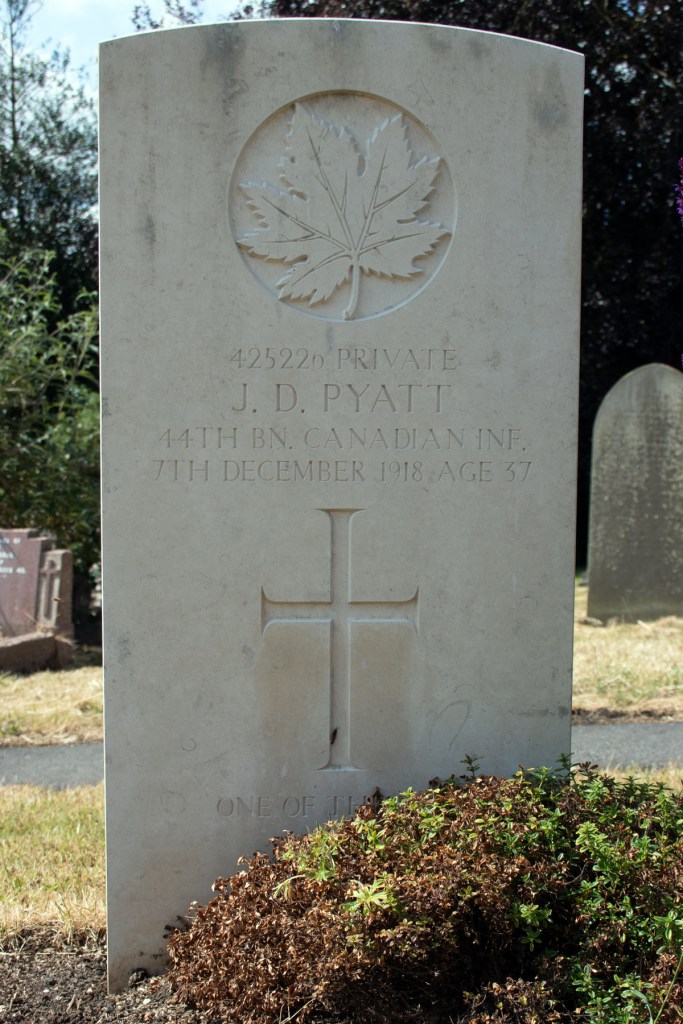
Private James Pyatt

Private James Pyatt

James Douglas John Pyatt was born in the spring of 1881 in Tranmere, Cheshire. The older of two children, his parents were Somerset-born John and Clara Pyatt. John was a coal merchant, and, by the time of the 1901 census, the family had moved back south, settling in the Clifton area of Bristol.

According to that census record, the family were living at 33 Pembroke Road, which Clara ran as a boarding house. James, by this point, was employed as a butcher, while his younger brother, Hubert, was a grocer. At the time the census was taken, the family had two boarders: Emmeline Blake, who was a music teacher, and Archibald Archer, a dentist.

Happiness is Bristol was destined to be short-lived. John died in 1902, aged just 49 years old. The same year, Hubert emigrated to Canada, settling in Brandon, Manitoba. Clara and James both followed the following year, setting up home in the same town.

Clara died in December 1908, but not before seeing both of her sons marry, James to Edith Gillam in June 1907, and Hubert to Lilian Pearce twelve months later.

James was working as a shipping clerk for a brewery by this point, and he and Edith were living on Park Street, to the east of the city. This was an ideal spot for their young family – John, born in 1908, Sidney, born in 1912, and Dennis, born in 1914 – as it overlooked a park and had space around it. Hubert lived down the road with his own family, so the brothers still had each other close by.

When war came to Europe, James felt compelled to play his part for King and Empire. He enlisted in the Canadian Expeditionary Force on 7th July 1915. Private Pyatt’s service records confirm that he was 33 years of age, and stood 5ft 10ins tall. He was noted as having brown hair, brown eyes and an average complexion.

James arrived back in England on 25th March 1916. Once there, he was attached to the 44th Battalion of the Canadian Infantry and by August that year, he was stationed on the Western Front. That autumn, however, he was dogged by illness and was admitted to field hospitals four times, suffering from diarrhoea, myalgia twice, and laryngitis.

By the start of 1917, however, Private Pyatt was back to full fitness. Details of his service over the next couple of years are unclear, although he remained on the Front Line. In December 1918, James was back in England on leave, and had returned to Somerset, possibly to see friends or relatives.

While here, James contracted influenza, and was admitted to the Bath War Hospital. The condition was to get the better of him, however, and he died on 7th December 1918, days after going in. He was 37 years of age.

With his surviving immediate family all in Canada, James Douglas John Pyatt was laid to rest in Locksbrook Cemetery, Bath, not far from the hospital in which he had passed away.


Private Joseph Curtis

Private Joseph Curtis

In the war grave section of Locksbrook Cemetery in Bath, Somerset, is a headstone dedicated to a Private J Curtis, of the King’s Liverpool Regiment, who passed away on 3rd January 1921. The Commonwealth War Graves Commission confirms that Joseph Curtis had transferred to the 430th Company of the Labour Corps at some point.

Little additional information is available for Joseph Curtis. Only one service document remains, his Medal Roll Index Card. This gives the dates of his service – 22nd February 1915 to 17th October 1918 – but no other identifying details.

Without a year or place of birth, it is not possible to track down any census records. As Bath was the location of both a War Hospital and one for army pensioners, his burial in a cemetery nearby is no guarantee that the city was ever his home. There is also no report of Private Curtis’ passing or funeral in any available contemporary newspapers.

The life of James Curtis is destined to remain a mystery, therefore, taken with him when he was laid to rest.


Private William Parsons

Private William Parsons

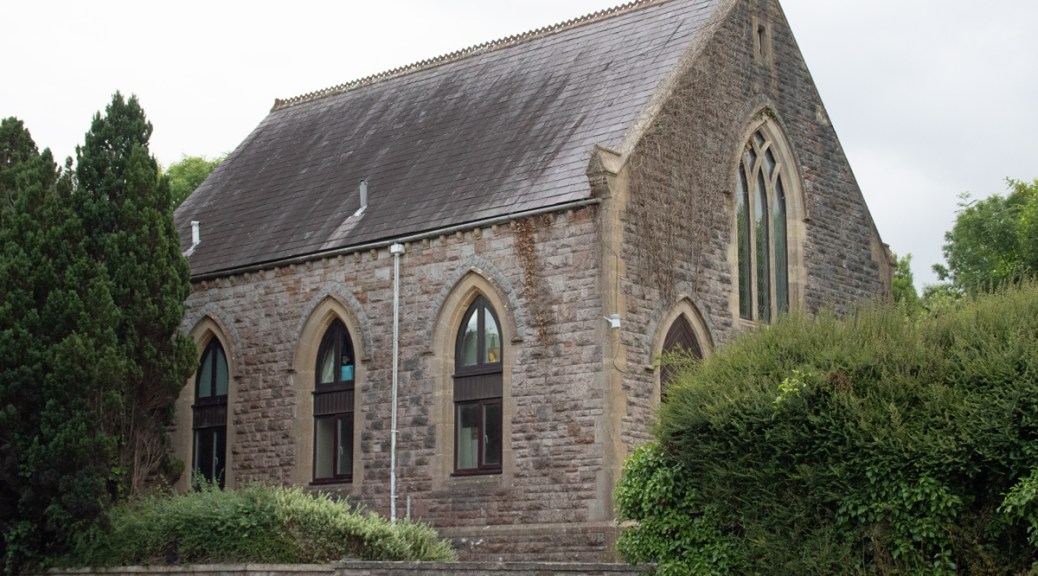
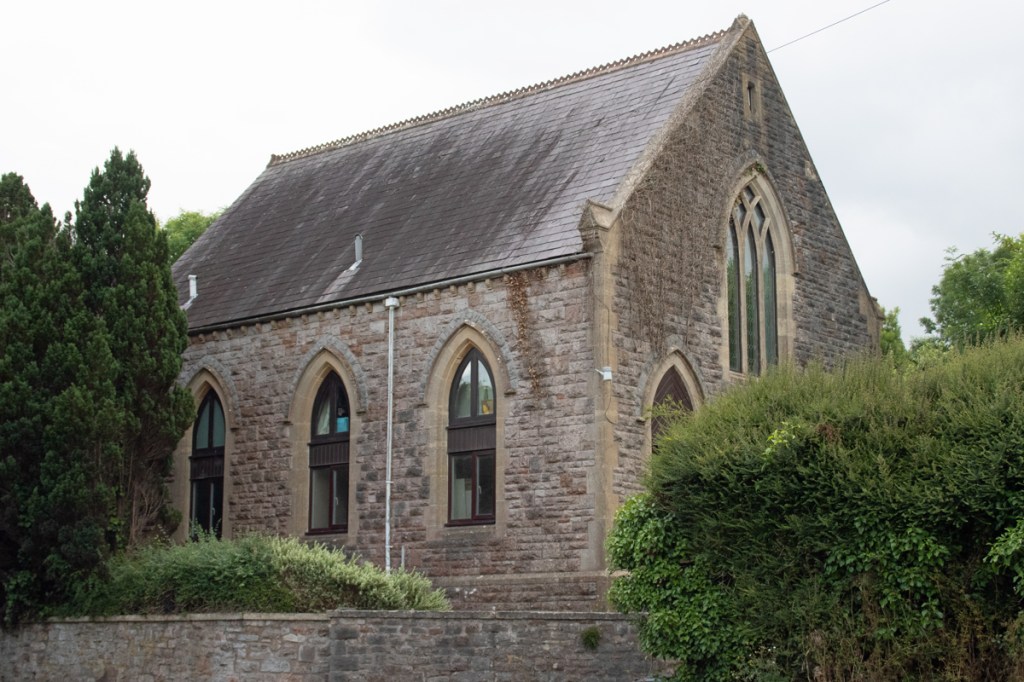
On the main road between Glastonbury and Wells, on the outskirts of the village of Coxley is the old Wesleyan Methodist Chapel. Now converted to a house, its back garden contains the remains of Private WR Parsons, who died in January 1919.

William Reginald Parsons was born on 22nd February 1895 in the hamlet of Chilton Burtle, near Bridgwater. The second of eight children, his parents were Wallace and Harriet Parsons. By the time of the 1901 census, the family had moved to Wells, where William was employed as a platelayer by Great Western Railways.

When he left school, William found employment as a paper maker, and was employed by the St Cuthbert’s Paper Mill to the west of the city. He wanted bigger and better things, however, and, on 11th April 1912, he enlisted in the Royal Marine Light Infantry.

Private Parsons’ service records show that he was 5ft 6.5ins (1.68m) tall, with brown hair, hazel eyes and a fresh complexion. It was also noted that he had a small scar on the right side of his back. Initially sent to the regiment’s depot in Deal, Kent, this is where he was tested for his swimming ability: he passed on 24th June 1912.

William remained in Deal until the end of the year. After seven months in Portsmouth, Hampshire, he embarked on a number of postings that lasted for the next six years. Initially assigned to the battleship HMS Bulwark, Private Parsons’ main posting was on board another battleship, HMS Zealandia.

Primarily based guarding the North Sea Coast, Zealandia also served in the Mediterranean, sailing as far as the Dardanelles towards the end of 1915. In all, Private Parsons spent more than three years on board the battleship.

William’s next posting was on board the cruiser HMS Royalist, on which he served until the end of the First World War. While he was on board, it appears that he became unwell, and he was admitted to the Royal Naval Hospital in Granton, near Edinburgh. Details of his condition are not readily available, but they were serious enough for him to succumb to them: he passed away on 30th January 1919, at the age of just 23 years old.

The body of William Reginald Parsons was brought back to Somerset for burial. He was laid to rest in the quiet churchyard of the Wesleyan Methodist Chapel in Coxley.


(c) Sharky Ward 2025

As the chapel is now a family home, its garden is not readily accessible. The photo of Private Parsons’ grave was taken by Commonwealth War Graves Commission volunteer Sharky Ward, to whom I am indebted for its use.


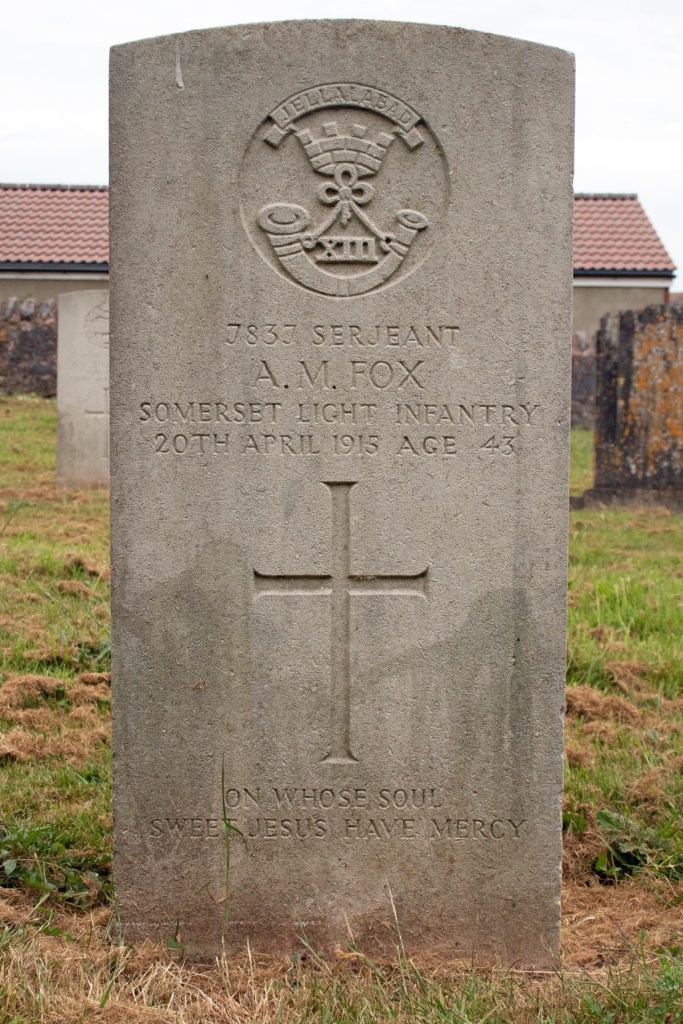
Serjeant Andrew Fox

Serjeant Andrew Fox

Andrew Michael Fox was born on 25th May 1871, the oldest of six children, to Michael and Eliza Fox. Michael was a Private in the 40th Regiment of Foot, and was based in Curragh Camp, Kildare, Ireland, when Andrew was born.

The family travelled where Michael’s work took him: Andrew’s oldest siblings were born in Uttar Pradesh, India, and the family were in England by the time of the 1881 census.

Given Michael’s military connections, it is no surprise that Andrew followed him into the army. He enlisted in August 1884, joining the South Lancashire Regiment. His service records give his age as 14 – he was, in fact, just 13 years old – and note his height as 4ft 9ins (1.44cm) and his weight as 73lbs (32.7kg). Andrew was recorded as having hazel eyes, brown hair and a fair complexion: his religion was also confirmed as Roman Catholic.

Andrew’s service records have become damaged over time, and a lot of his details are illegible. Because of his age when he enlisted, he was initially given the rank of Boy. In July 1887, he was formally mobilised, with the rank of Private. He remained on home soil for the next ten years, with the 1891 census listing him as being barracked in Fort Regent, Jersey.

It was in the Channel Islands that Andrew met Kathleen Dooling. The couple married on 7th January 1892, and went on to have ten children. Over the next couple of years, Andrew progressed through the ranks, achieving Lance Corporal in September 1892, Corporal in June 1894 and Lance Serjeant in August 1897.

In 1899, the Second Boer War led to the newly-promoted Serjeant Fox being posted overseas. He remained in South Africa for six months, while the conflict raged on. Andrew returned to Britain in April 1900, and was officially stood down from the army on 31st December that year, as he was deemed no longer fit for military service.

The 1901 census found Andrew and Kathleen still living in family barracks in Aldershot with their three eldest children, Andrew Margaret and Edith. Andrew was recorded as being an officer’s valet, likely now in a civilian role. The family remained in Aldershot until 1910, with five more of their children being born there.

Another change came at that point, however, as the following year’s census found the family living in Brighton Street, Warrington, Lancashire. Andrew was, by this point, working as a salesman for the Singer Sewing Machine Company, and the family were cramped into a four-roomed end-of-terrace house.

War came to Europe in the summer of 1914, and Andrew stepped up to play his part once more. Again, full details have been lost to time, but he took up the rank of Serjeant once more, and was attached to the Somerset Light Infantry. This necessitated another relocation for the family, and they moved to Cannington, near Taunton, Somerset.

Serjeant Fox was assigned to the 7th (Service) Battalion, but was not to remain in his role for long. He contracted phthisis, or tuberculosis, and passed away from the condition on 20th April 1915, just weeks before his regiment departed for the Western Front. He was 43 years of age.

Andrew Michael Fox was laid to rest in the peaceful Cannington Cemetery, not far from the family home.


Private Andrew M Fox

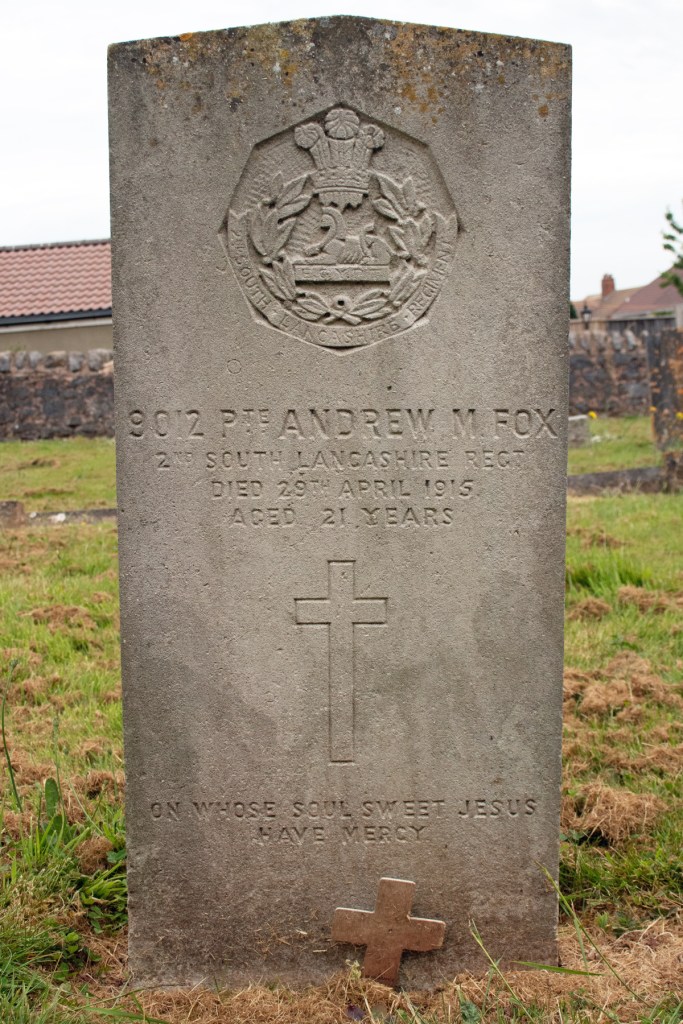
In the plot next to Serjeant Andrew Fox is another, similar headstone. Not quite having the same form as the Commonwealth War Grave Commission headstone that Serjeant Fox has, this is dedicated to a Private Andrew M Fox, of the 2nd South Lancashire Regiment.

Andrew Moyse Fox was the eldest son of Andrew and Kathleen. Born on 31st March 1894 in Ireland, he wanted to follow his father and grandfather into the army.

Andrew Jr enlisted in the South Lancashire Regiment in August 1908. His service records confirmed that he was just 14 years of age, standing 5ft (1.52m) tall, and weighing 5st 2lbs (32.7kg). He was noted as having dark brown hair, hazel eyes and a fresh complexion, and that he has a scar on his right buttock.

As is the case with his father, there is limited information about Andrew Jr’s army career. He spent just under six years serving with the regiment, and was formally mobilised when he came of age in 1912. On 27th March 1914, however, Private Fox was discharged from the army on medical grounds, for reasons unclear. The next record available for him is that of his passing, just nine days after his father. He was 21 years of age.

Andrew Fox Jr was laid to rest next to his father in Cannington Cemetery. The heartbreak for Kathleen, to have lost husband and oldest boy within two weeks, must have been indescribable. While her son’s headstone is similar in design to her husband’s, he was not subsequently entitled to an official Commonwealth War Grave, as he had left the army before the outbreak of war: the Commission’s qualification dates (4th August 1914 to 31st August 1921).


Private Anthony Gardner

Private Anthony Gardner

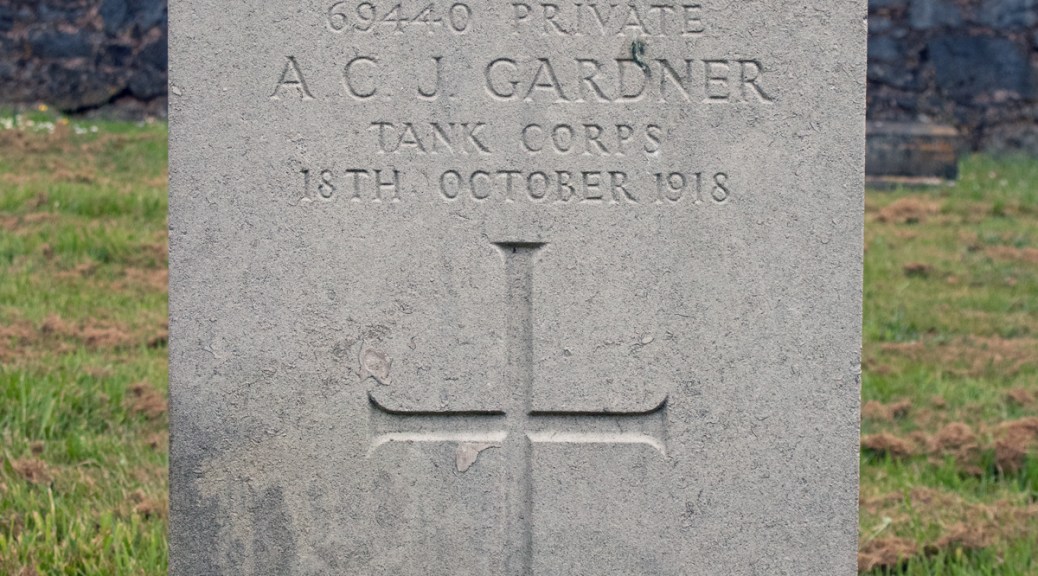
In a quiet spot in Cannington Cemetery, Somerset, is the burial plot for Anthony Charles James Gardner. His headstone confirms that he was a Private in the Tank Corps, and that he died on 18th October 1918.

Private Gardner’s service number provides only one army document: the British Army Register of Soldiers’ Effects. Sadly, this sheds little more light onto his life, confirming only that he died in the Military Hospital in Wool, the village connected to Bovington Camp in Dorset. No next of kin is evident.

Another record suggests that he may have served in the Somerset Light Infantry before transferring to the Tank Corps, but no records remain to confirm this stage of his military career.

There are no census birth or baptism records for an Anthony Gardner. While there are numerous Somerset documents connected to Charles and James Gardners, without any confirmation of his age, or whether he actually came from the county, it is impossible to identify ones relating to the soldier buried in Cannington.

Parish details confirm that Anthony worked at the Blue Anchor Inn in Cannington. The 1911 census recorded him as working there under Charles and Ann West. It confirms that Anthony was 24 years of age, and was born in Gloucester. Tantalising though this fact is, there are no earlier documents to confirm his upbringing in Gloucestershire.

There are no reports in contemporary newspapers about Anthony’s passing or his funeral, so no light can be shed down that route either.

The life of Alfred Charles James Gardner, therefore, is destined to remain lost in the mists of time. His story hidden in the cemetery in Cannington, Somerset.


My thanks to Tina at Cannington Parish Council for her help in uncovering a little of Anthony’s life.


Shoeing Smith Samuel Treeby

Shoeing Smith Samuel Treeby

Samuel Treeby was born in December 1865 in Taunton, Somerset. The third of seven children, his parents were cordwainer Thomas Treeby and his wife, Anna (or Hannah).

When he finished his schooling, Samuel found work as a blacksmith at a collar factory in Taunton. His trade stood him in good stead away from the forge: he volunteered for the Royal Horse Artillery, becoming adept at shoeing the animals.

In 1906, Samuel married Sarah Parker. She was from Enmore, between Bridgwater and Taunton, although the couple married in Cardiff, Glamorgan. The couple settled back in Enmore, where Samuel continued his smithing trade.

War came to Europe in 1914 and, although he was 49 years old, Samuel stepped up to play his part. He was attached to the Royal Army Service Corps and given a rank that echoed his civilian profession, that of Shoeing Smith. His service records show that he was of average height – 5ft 6ins (1.68m) tall – but that he was illiterate: he signed his declaration with a cross.

Samuel spent several months on home soil, before being sent out to France in March 1916. He spent six months overseas, before being shipped back to Britain, suffering from rheumatism. Shoeing Smith Treeby was admitted to the East Leeds War Hospital before being discharged to the regiment’s Remount Depot in Woolwich, Kent.

Samuel returned home to Somerset, but his poor health still dogged him during the winter of 1916/17. He contracted bronchitis, and died of the condition on 27th February 1917, while still based in London. He was 51 years of age.

Samuel’s body was taken back to Somerset for burial. He was laid to rest in the peaceful graveyard of St Michael’s Church in Enmore, not far from where his widow still lived.