In the naval section of the Woodlands Cemetery in Gillingham, Kent, stands a headstone to a John Donoghue. The stone states that he was a Fireman on board HMS Princess Irene and that he was killed in action on 27th May 1915. He was 25 years of age.
Further research confirms that he was part of the Mercantile Marine Reserve, but there are no records to confirm his service at sea. While John was born in around 1890, with no confirmation of his place of birth, or the names of his parents, it is impossible to narrow down any further details for him.
Records of the Princess Irene’s crew do not include a John Donoghue, although this does not necessarily mean that he was not serving on board, only that records no longer exist. The fact that he was granted an individual headstone, rather than being commemorated in the mass grave that is also situated in the Woodlands Cemetery suggests that his body was able to be identified.
Sadly, however, Fireman John Donoghue’s life is destined to be lost to time, his legacy to be one of the 352 souls lost during the explosion and sinking of the ship on board which he served.
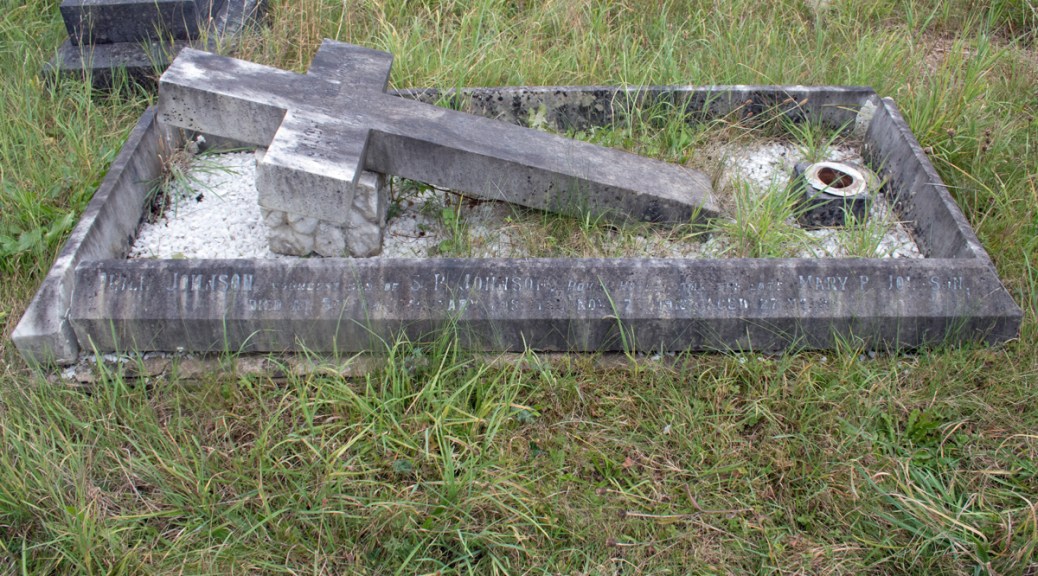
Philip Johnson was born in the summer of 1891 in Wrexham, Denbighshire. One of eight children his parents were Samuel and Mary Johnson. Samuel was a wine merchant from Scotland, while Mary had been born in Cheshire. When Philip was born the family were living and running the town’s Lion House inn on the High Street.
Mary died in 1897 and, in 1909 Samuel moved his family on. He bought the Royal Hotel in Llangollen, which occupied a large plot on the riverside, and which included a large garden.
The Royal Hotel was a busy business: to look after the guests, there were eleven members of staff living in. This was to be a Johnson family business, however, with Philip’s older sibling Elizabeth managing the hotel with her father, his brother Samuel Jr assisting, his sister Ethel acting as bookkeeper and Philip himself managing the bar.
In the spring of 1914, Philip married Elizabeth Kelsall, whose family ran the Eivion Hotel, down the road from The Royal. The couple set up home in the town – possibly even still living at Samuel’s hotel – and had two children.
When war came to Europe, Philip stepped up to play his part. Sadly, full details of his military service are lost to time, although it is clear from other documents that he had enlisted in the Royal Army Service Corps.
For The Royal Hotel, this was a challenging time. By December 1916, two of Samuel’s sons – including Philip – were away on service, as were nine of the hotel’s seventeen staff. Samuel applied for Samuel Jr’s exemption from war service on the basis that he was the hotel’s manager, but this was refused. A year later, he applied for another of the hotel’s servant’s, an Evan Edwards, exemption, but again this was refused.
Philip, meanwhile, was attached to the 728th Coy of the Motor Transport section of the Royal Army Service Corps. His troop served the RE Signal Service Training Centre, but it is unclear whether he saw any action overseas. By the end of the war, however, he was based in Hitchin, Hertfordshire.
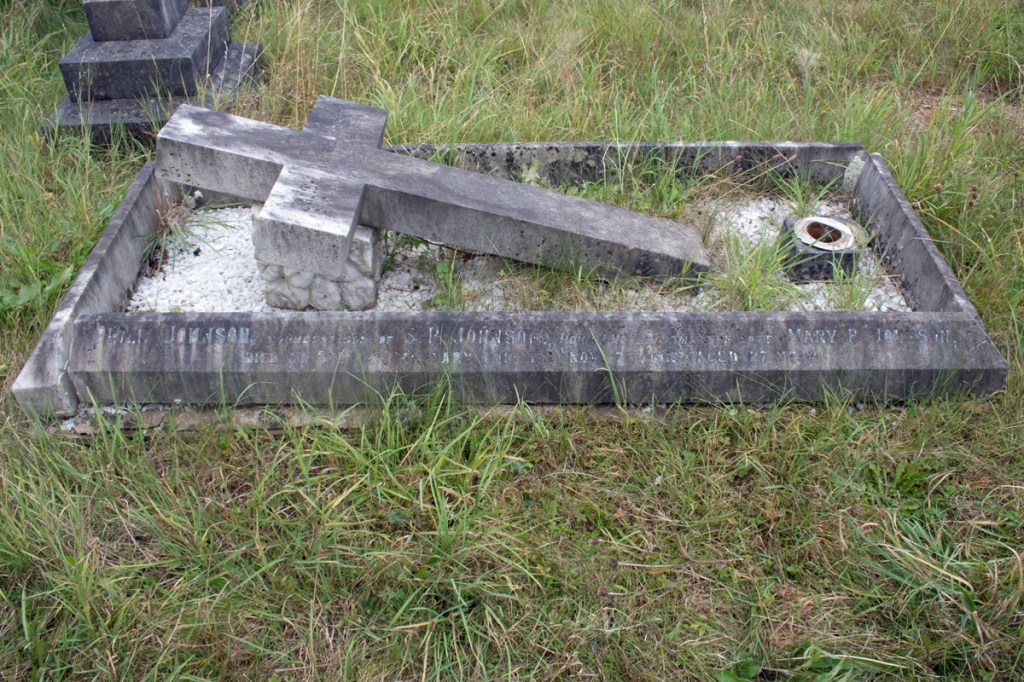
With winter closing in, illness became rife in the cramped condition of army barracks. Private Johnson contracted pneumonia, and was admitted to the Bedford Military Hospital, not far from where he was based. Sadly, the lung condition was to get the better of him, and he succumbed to it, passing away on 7th November 1918, aged just 27 years old.
Philip Johnson’s body was brought back to Wales for burial. He was laid to rest in a family plot in the graveyard of St John’s Church in his adopted home town of Llangollen.
William Thomas Hughes was born on 4th August 1898 in Llangollen, Denbighshire. One of twins, he was also one of seven children to William and Margaret Hughes. William Sr was a bricklayer and the family lived on Fron Bache, a land to the south of the town, leading into the hills. The Hughes’ baptised their first five children on the same day – 5th October 1904 – in the parish church.
Little further information on young William’s life remains. When war broke out, he stepped up to play his part: details of when have been lost to time, but, according to later records, he had enlisted by December 1917.
Private Hughes joined the Royal Welch Fusiliers, and was assigned to one of their depots, possibly on the North Wales coast. Certainly this is where he was based by the spring of 1918 as, in May of that year, he was admitted to the Red Cross Hospital in Colwyn Bay, having contracted malaria.
Tragically, this condition was to get the better of him: Private Hughes passed away on 7th May 1918, at the tender age of just 20 years old.
William Thomas Hughes was brought back to Llangollen for burial He was laid to rest in the graveyard of the town’s St John’s Church.
George Williams was born in 1887 in Ruthin, Denbighshire. One of thirteen children – of whom sadly only seven survived – his parents were John and Martha Williams. John was a carpenter and joiner and, when the children had grown a little, he and Martha took on the Registered Tramp Lodging House in Church Street, Llangollen.
The 1911 census recorded George living with his parents and working as a carter. His younger brother John was employed as a labourer, while the rest of his siblings were at school. The boarding house was full as Martha’s brother was staying there, along with four lodgers.
George married Catherine Edwards on 27th May 1911. She was an engineer’s daughter, also from Llangollen, and the couple tied the knot in St Collen’s Church, which was on the same street as the Williams’ boarding house. The newlyweds moved to Ruabon, six miles (10km) to the east of Llangollen, and had a daughter, Martha, who was born in 1912.
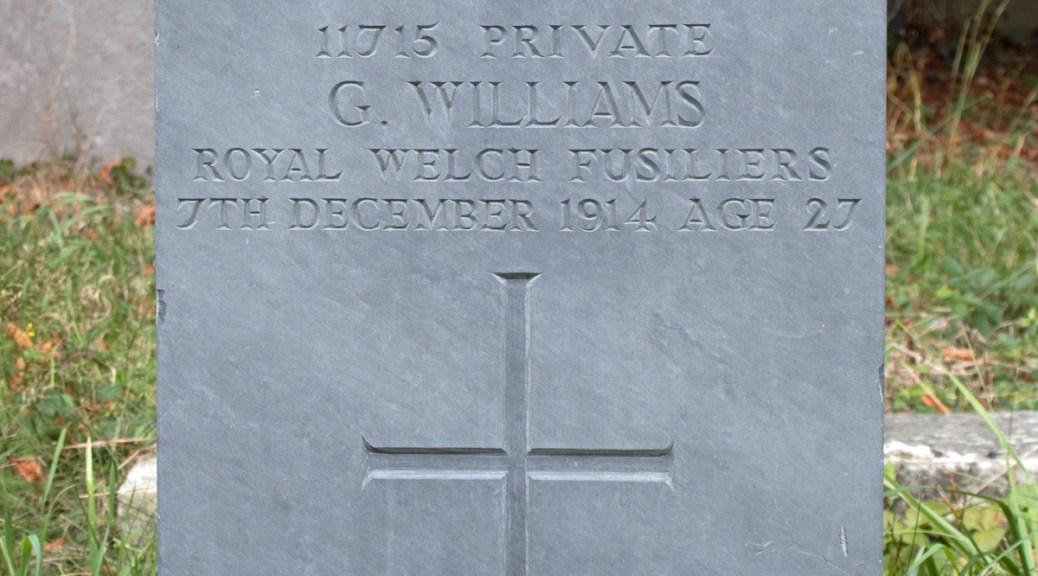
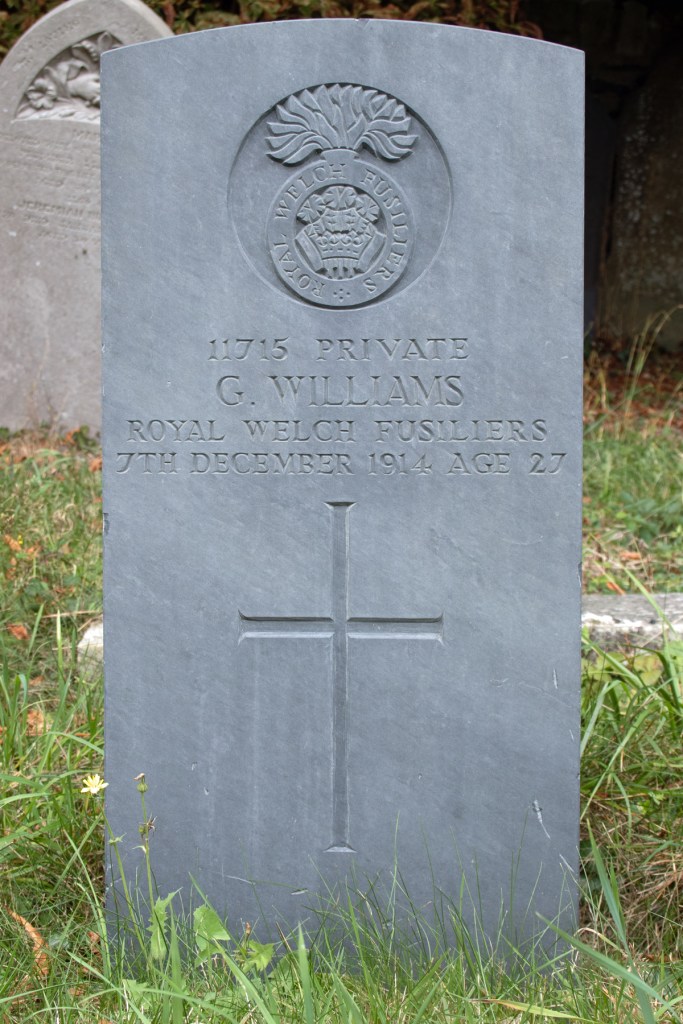
When war was declared, George was quick to enlist. He joined the 8th (Service) Battalion of the Royal Welch Fusiliers, and was sent to Salisbury Plain for his training. While here, however, Private Williams passed away. The cause of his passing is not readily available, but it seems likely that he succumbed to illness, possibly brought on by the sudden influx of men from across the country suddenly billeted together in the confines of an army camp. He died on 7th December 1914, aged just 27 years of age.
George Williams’ body was brought back to Wales for burial. He was laid to rest in the graveyard of St John’s Church in Llangollen.
Tragically, just six days after George’s death, Catherine gave birth to their second child. George Jr would never know his father.
James Ward Jones was born on 17th August 1871 in the Denbighshire town of Llangollen. He was the oldest of eleven children to William and Anne Jones. William was a bricklayer’s labourer, and James followed suit when he finished school.
On 30th April 1898, James married fisherman’s daughter Mary Jones. The couple set up home in Llangollen and went on to have ten children.
When war came to Europe, James stepped up to play his part for King and Country. Sadly, little detail of his military service remains available. but it is clear that he enlisted in the Royal Welch Fusiliers and, as a Private, he was assigned to the 47th Provisional Battalion. The troop was based on home soil, and James found himself sent to Norfolk for his war work.
It is unlikely that Private Jones was in camp for long. On Christmas Day 1915 he collapsed having had a seizure, and passed away. He was 44 years of age.
James Ward Jones’ body was brought back to Wales for burial. He was laid to rest in the graveyard of St John’s Church in his home town of Llangollen.
Mary was left with ten children to bring up on her own. She married again, to a Jack Evans, in the autumn of 1916. The couple had two children of their own. Mary passed away in December 1935, aged just 58 years old.
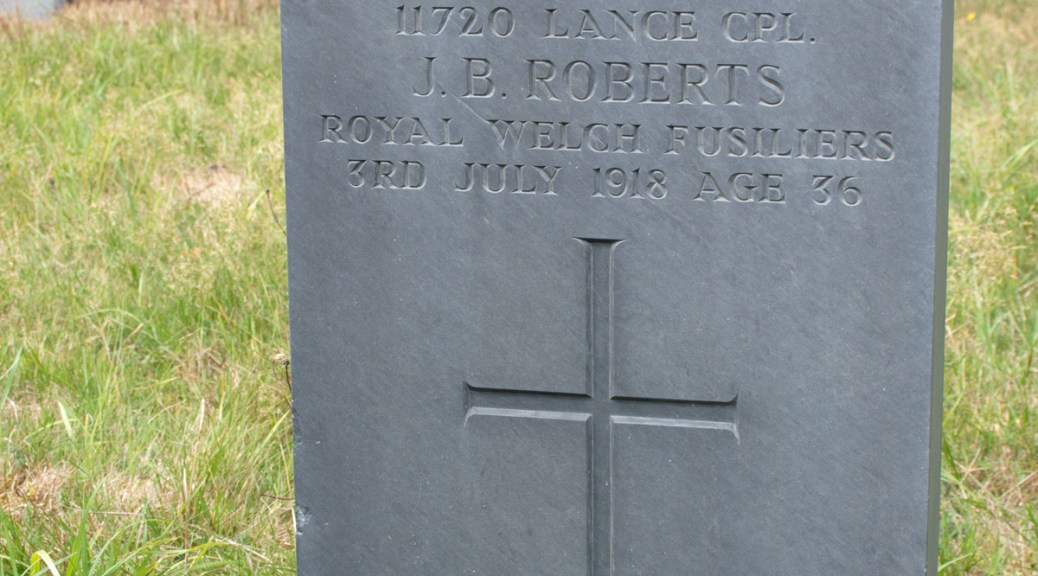
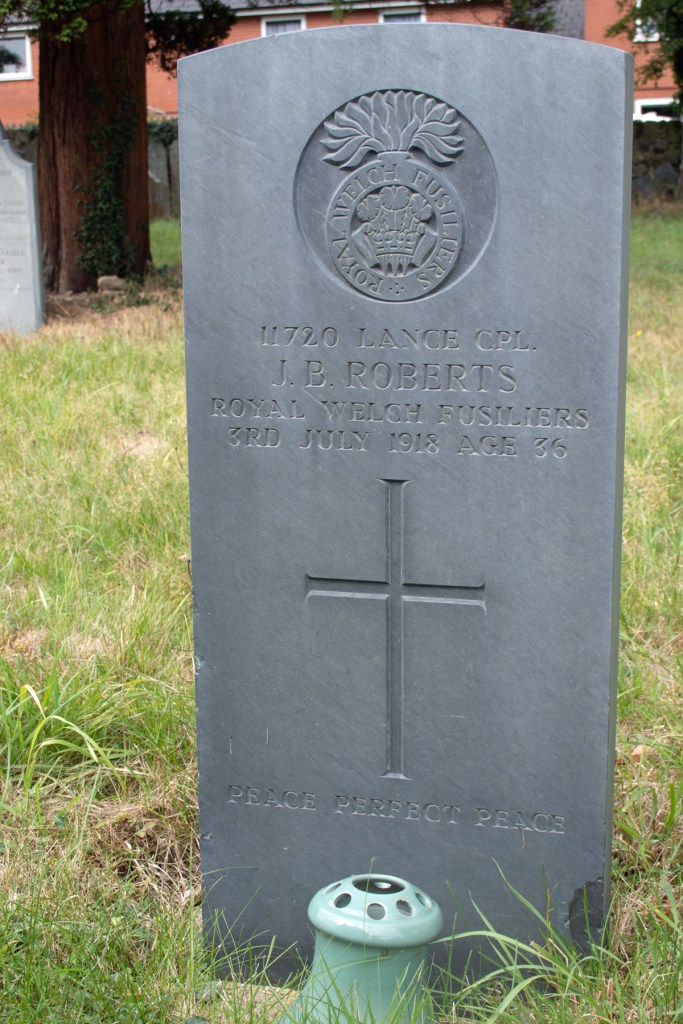
John Briscoe Roberts was born in 1882 in the Welsh village of Llanaelhaiarn. He was the oldest of ten children to the village’s sub-postmaster Samuel Roberts and his wife Elizabeth.
When he left school, John found employment with a local estate agent and, by the time of war was declared, he was working as a clerk for a timber mill in Llangollen, Denbighshire.
John was quick to enlist – he joined up on 15th August 1914 and, as a Private, was assigned to the Royal Welch Fusiliers. His service records show he was 5ft 7ins (1.70m) tall, and weighed 142lbs (64.4kg). They also note that he had black hair, brown eyes and a dark complexion.
Private Roberts’ initial service was carried out on home soil. He worked diligently and was rewarded for it, being promoted to Lance Corporal in December 1914. By the following June, his troop, the 8th Battalion, was sent overseas, first to Mudros in Greece, and then on to Gallipoli. In September 1915, Lance Corporal Roberts contracted dysentery and tuberculosis. He was medically evacuated back to Britain and admitted to the 1st Scottish General Hospital in Aberdeen to recover.
On 26th January 1917, John married Gladys Emily Edwards in Wrexham Parish Church. The couple settled down in Llangollen, where Gladys was from, and where John had been working before the war. His lung condition continued to dog him, however and, after another couple of months, he was deemed no longer fit for active service, and medically discharged from the army.
John took up his role in the timber yard again, remaining there for the next year or so. Tuberculosis was ultimately to get the better of him, however, and he passed away on 3rd July 1918, at the age of 36 years old.
John Briscoe Roberts was laid to rest in the graveyard of St John’s Church in Llangollen, Denbighshire.
William Henry Dove was born in the autumn of 1871 in Stafford, Staffordshire and was one of seven children to William and Louisa Dove. William Sr was a gardener by trade, but his son wanted bigger and better things.
On leaving school, he initially took up a post as a junior teacher, but military service was calling him and, on 21st February 1891 he enlisted in the Royal Lancaster Regiment. Private Dove’s service records show that he was 5ft 7ins (1.70cm) tall and 136lbs (61.8kg) in weight. He had sandy hair, grey eyes and a fair complexion. He also gave his age as 18 years and 3 months, although he was actually a year older.
Private Dove signed up for seven years’ service and completed this on home soil. In October 1891 he was promoted to Lance Corporal, and a year later he was promoted again, this time to Corporal.
In November 1894, William was found guilty of ‘conduct to the prejudice of good order and drunkenness‘ and was sentenced to be reduced in rank, so became a Private again. He learnt the error of his ways, though, and was reinstated to Lance Corporal in March 1897.
William’s service was completed in February 1898, and he was transferred across to the Army Reserve. This was intended to be for a further five years, but on 15th February 1900, he was discharged from future active service, having been found to be medically unfit. During his time in the army, William had been treated for a two bouts of gonorrhoea, as well as four further infections. The cause of his final medical discharge, however, is unclear.
While on reserve, William had found employment as a railway porter. His work took him to Llangollen, Denbighshire and, this is where he set up home. On 18th April 1899, he married Ellenor Roberts, a labourer’s daughter from the town: the young couple set up home in Ashfield House, Regent Street – now the busy A5.
The 1911 census records William as a porter: the couple had no children of their own, but had adopted a girl, Cissie, who was then eight years old. A live-in domestic servant – Esther Williams – was also recorded on the census.
War was coming to Europe by this point and, while details of his service are unclear, William stepped up to play his part once more. He enlisted in the Royal Engineers as a Sapper, at some point during the conflict, although exact details are lost to time.
Sapper Dove survived the war and returned to Llangollen. The 1921 census records him Ellenor and Cissie living at Bronhaul, and that William was working as a parcel’s porter for Great Western Railways. On 18th August 1921, he collapsed and died with a brain aneurysm. He was 39 years of age.
William Henry Dove was buried in the graveyard of St John’s Church in Llangollen, a short distance from the station at which he portered for so long.
Ellenor lived on until her late 70s. When she passed away, she was laid to rest in the family plot, reunited with her husband after 35 years.
Lot Hayward was born in November 1897 in the Somerset village of West Coker. The seventh of eight children, his parents were Walter and Elizabeth Hayward. Walter was a twine maker at a local factory, but when Lot left school – and after Elizabeth died in 1908 – he found work as a farm labourer.
Lot was seeking bigger and better things in life, however, and on 18th August 1913, he enlisted in the Royal Marine Light Infantry. His service records confirm that he was 5ft 6ins (1.67m) tall, had light brown hair, brown eyes and a pale complexion. It also confirms that he lied about his age – giving his year of birth as 1895 in order to be accepted for service.
Private Hayward joined up at the recruitment depot in Deal, Kent, and, after training there, he was sent to Plymouth in Devon, arriving there in June 1914. Over the next couple of years, he moved between Devon and HMS Victory, the Royal Navy Dockyard in Portsmouth, Hampshire.
When war was declared, Lot also served overseas, fighting at Antwerp, Alexandria and in Turkey. While there in the summer of 1916, he fell ill, contracting pulmonary tuberculosis. He returned to Plymouth, and was admitted to the Royal Naval Hospital in the city.
His lung condition meant that Private Hayward could no longer perform his duties as a soldier. He was medically discharged from the navy on 10th June 1916.
Lot returned home, but his condition grew steadily worse. He eventually succumbed to it, passing away on 18th November 1917, at the tender age of just 20.
Lot Hayward was laid to rest in the graveyard of St Martin’s Church in his home village of West Coker. Reunited with his mother, Lot’s father, Walter, was also laid to rest in the family plot when he passed away in 1920.
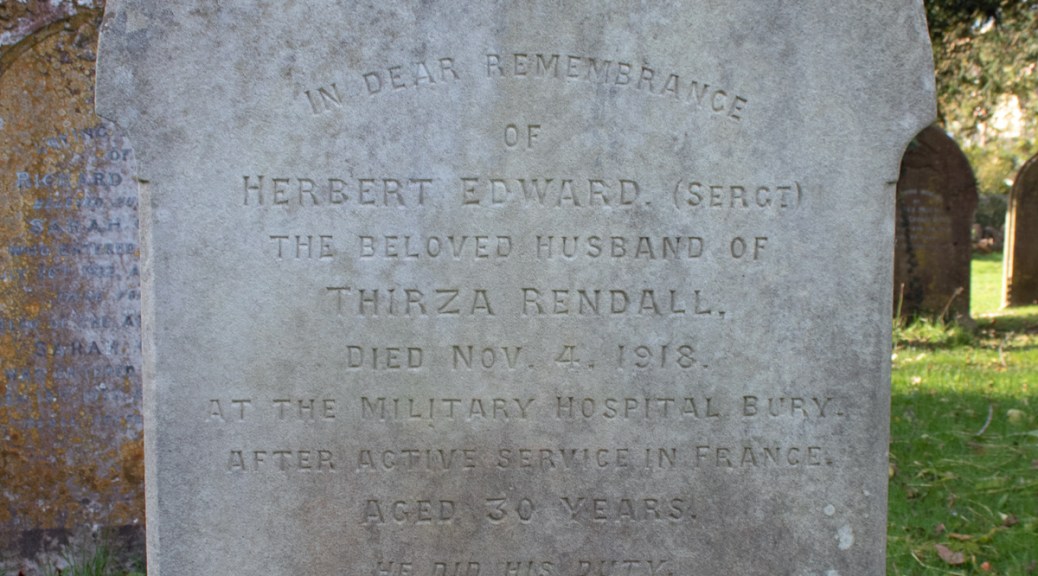
Herbert Edward Rendall was born in West Coker, Somerset, in the autumn of 1889. He was one of eight children to William and Mary Rendall. William was a foreman at a local twine factory, although by the time of the 1911 census, he had also taken on ownership of a local grocer’s shop. Herbert and his younger brother, Clifford, managed the shop for their father.
In the spring of 1913, Herbert married Thirza Shire. She was the daughter of an agricultural labourer from Yeovil and, by the time of their marriage, she had taken on work as a servant for the vicar of St Leonard’s Church in Misterton, near Crewkerne.
When war was declared, Herbert joined the Somerset Light Infantry. Sadly, little detail of his military service remains. It is clear that he was hard working and well thought of, as he progressed through the ranks to Sergeant, and transferred to the 1st Battalion of the Wiltshire Regiment.
Herbert served on the Western Front, and, as the war entered its final months, he would certainly have been involved in the Battles of the Lys, on the Hindenburg Line and in the closing Battles of the Somme.
By the autumn of 1918, Sergeant Rendall was back on home soil, either for home support, or for medical reasons. He was based in Bury, Manchester, and had fallen ill. While the full details are unclear, whatever condition he had contracted got the better of him, and he passed away on 4th November 1918. He was 29 years of age.
Herbert Edward Rendall was brought back to Somerset for burial. He was laid to rest in the quiet graveyard of St Martin’s Church in West Coker.
Records vary over the date of Herbert’s passing. While his headstone confirms 4th November, military records – and the Commonwealth War Graves Commission website – suggest the following day. Similarly, some documents suggest he was 30 when he died, while his birth and death records confirm he was in his thirtieth year.
Thirza went on to have a full life. She married again in 1923, to a Henry Tregale, and the couple went on to have a daughter. She lived to a ripe age, passing away in the autumn of 1981, at the age of 93.
Edgar George Bowditch was born in the spring of 1887, in the Dorset village of Melbury Osmond. One of seven children, his parents were William and Sarah Bowditch. William was an agricultural labourer turned gamekeeper, and Edgar helped his father out when he left school.
William passed away in 1911, and Edgar fell off the radar until March 1914, when he married local mason’s daughter Rosetta Morris. The couple settled down in her home village of West Coker, Somerset.
When war was declared, Edgar stepped up to serve his King and Country, and enlisted in the Machine Gun Corps as a Private. He was assigned to the 37th Battalion, and certainly saw action overseas. He “came through without a scratch and in good health until demobilised in France.” [Western Chronicle: Friday 21st February 1919]
Private Bowditch was unwell when he arrived back in West Coker on 4th February 1919. While his condition is unclear, it worsened, and he passed away at home ten days later. He was 32 years of age.
Edgar George Bowditch was laid to rest in the graveyard of St Martin’s Church in his adopted home of West Coker.
Rosetta married again in 1921, to a John Axe. The couple remained in the same part of Somerset, John dying in 1947. Rosetta lived on, passing away in Yeovil in 1963, at the age of 77 years old.











 Death and Service