Category Archives: story

Lieutenant Alfred Betty

Lieutenant Alfred Betty

Alfred William Betty was born early in 1869, one of ten children to John Betty and his wife Hannah. John was a blacksmith, and the family lived in the Somerset town of Taunton.

After leaving school, Alfred found work as a silk throwster, twisting silk into thread or yarn. Thus was not the long term career that he sought, however, and in 1887 he enlisted in the Rifle Brigade. During a period of service that lasted 21 years, he fought in India and South Africa, rising to the rank of Quartermaster-Sergeant by the end of his tenure in 1908.

In 1896, Alfred had married Elizabeth Johnson, also from Taunton, who was herself the daughter of a soldier. The couple went on to have three children, two of whom survived – daughters Ella and Hazel.

By the time of the 1911 census, the family had set up home in Taunton. Alfred, now back on civvy street, was working as a clerk and had become involved in the town’s Holy Trinity Men’s Club.

War was on the horizon, however, and when hostilities broke out, Alfred quickly re-enlisted. Within a month of re-joining the Rifle Brigade, he was given a commission in the 13th Battalion. After initially being based in Winchester, by the summer of 1915 Lieutenant Betty found himself on the Front Line. He was involved in some of the fiercest fighting, and was caught up in the Battle of the Somme.

It was here that Alfred fell ill. While full details of his condition are not readily available, he contracted a prolonged illness, as a result of “hardship and exposure” [Western Daily Press, Saturday 24th March 1917].

Whatever the condition, it was serious enough for Lieutenant Betty to be invalided back to England and out of the army, and he returned to his family home in Taunton.

Sadly, Alfred’s condition was to take its toll on him, and he finally succumbed to it on 23rd March 1917. He was 48 years old.

Alfred William Betty lies at peace in St Mary’s Churchyard in his home town of Taunton in Somerset.


Second Lieutenant Arthur Bentley

Second Lieutenant Arthur Bentley

Arthur Webb Butler Bentley was born on 1st January 1884 to Dr Arthur Bentley and his wife Letitia. The oldest of five children, they were a well-travelled family. Dr Bentley had been born in Devon, but his and Letitia’s first two children were born in Singapore, while their second two were born in Ireland, where Letitia herself had been born.

By the time of the 1891 census, the family were living in Paddington, London, where Arthur’s father was a medical practitioner.

Arthur Jr looked set to follow in his father’s footsteps; becoming a student of medicine in Edinburgh, although it seems his life was destined to take a different route.

By 1905, his father was working at a practice in Egypt. It was around this time that his mother made the newspaper headlines.

VICTIM OF CHROLODYNE

A painful story was told at the Clerkenwell Sessions when Letitia Bentley, the wife of a doctor holding an official position in Cairo, pleaded guilty to the theft of a diamond and ruby ring from the shop of Messrs. Attenborough, Oxford Street [London]. It was stated that Mrs Bentley was addicted to the drinking of spirits and chlorodyne, and that 240 empty bottles which had contained the latter drug had been found in her rooms in Bloomsbury.

Dr Bentley said he would keep his wife under strict supervision in the future, and she was bound over.

Shetland Times: Saturday 3rd June 1905.

The ring concerned was valued at five guineas (around £700 in today’s money), and another report confirmed that her husband “supplied her with ample means” [financially].

In the 19th century, chlorodyne was readily used as a treatment for a number of medical conditions. Its principal ingredients were a mixture of laudanum (an alcoholic solution of opium), tincture of cannabis, and chloroform, it readily lived up to its claims of relieving pain and a sedative.

Letitia does not appear in any other contemporary media; sadly, however, she passed away “at sea” in June 1907, presumably on the way to or from Cairo, where Arthur Sr was still working. She was just 47 years old.

Arthur seems to have taken the decision to move away, and he emigrated to Canada, settling in Winnipeg. Leaving England behind, he left the idea of medicine with it, finding work as a lineman instead, constructing and maintaining telegraph and power lines.

Arthur’s father is the next member of the family to appear in the local newspapers. Working in Cairo during the winter and Llandrindod Wells in the summer, he travelled to Wales in April 1911. One evening he collapsed and died while in the smoking room of his hotel. The media reported that he was “formerly Colonial Surgeon to the Straits Civil Service, Singapore” and that “he was going to deliver a lecture at Owen’s College [now the Victoria College of Manchester] on tropical diseases, upon which he was an expert.

Arthur Jr was now 27, and had lost both of his parents. War was on the horizon, though, and he seemed keen to become involved. He enlisted in December 1915, joining the Canadian Expeditionary Force. His sign-up papers gave him as just short of 32 years old, standing at 5ft 8ins (1.72m) tall, with a fair complexion, blue eyes and brown hair. The document also recorded his next of kin as his brother, William, who was living near Cairo.

Arthur arrived in England on 25th September 1916; during his time in the army he remained on English soil, primarily at a signal base in Seaford. Transferred to a reserve battalion in January 1917, he was eventually discharged seven months later.

His records suggest that his services were no longer required, but t is likely that Arthur’s discharge was his transfer to the Yorkshire Regiment, complete with a commission.

The now Second Lieutenant Bentley was assigned to the 3rd Special Reserve Battalion but never saw action in Europe. The troop’s main duties were to train men for service overseas and to provide coastal defences. While there is no confirmation of exactly where Arthur was based, there were units in and around Hartlepool, County Durham.

Sadly, there is little further information about Arthur. By the end of the war, he was living in Taunton, Somerset, where his younger sister Eileen had settled. Second Lieutenant Bentley survived the war, but passed away not long afterwards, on 2nd December 1918. There is no cause given for his death. He was just 35 years old.

Arthur Webb Butler Bentley lies at rest in St Mary’s Cemetery in Taunton, Somerset.


Serjeant Sydney Peters

Serjeant Sydney Peters

Sydney Edward Peters was born at the end of 1891, the only child to farmers Edward and Annie Peters. The family lived in Bishop’s Hull, near Taunton, where Edward also employed two members of staff to help with the household and his dairy herd.

Sydney went on to manage the neighbouring farm to his father, and looked to be making a living with this. Keen on sport, he went on to captain the village cricket team, and took an interest in physical fitness.

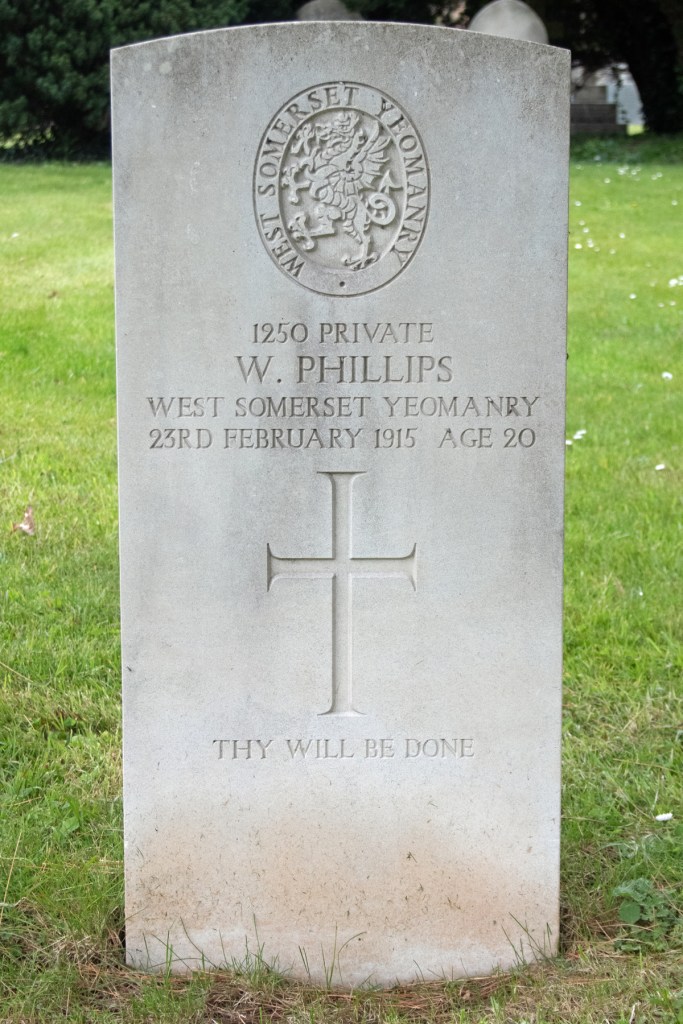
War broke out and Sydney was quick to enlist. Joining the West Somerset Yeomanry, he was assigned to the 1st Battalion. Initially the regiment were based on home turf, and he spent a lot of that time in East Anglia. He must have made a positive commitment to the troop, and was soon promoted to Serjeant.

In the early summer of 1915, he returned to Taunton, to help drill recruits at the Territorial Depot there. A short while after returning to his Essex he fell ill, and before the battalion were due to be shipped overseas, Serjeant Peters went back to Somerset on leave.

By the time he reached home, however, he was severely ill, and very quickly died from what turned out to be blood poisoning. Serjeant Peters was just 23 years old.

Sydney Edward Peters was buried in St Mary’s Cemetery in his home town of Taunton.


Serjeant Sydney Peters

Second Lieutenant Archibald Walsh

Second Lieutenant Archibald Walsh

Archibald Charles Mark Walsh was born on 3rd February 1892, the youngest of three children to Henry Alfred Walsh and his wife Ann. Henry had a distinguished military career, and his sons – Archibald and his older brother Theobald – seemed destined to do the same.

Henry’s service took him around the world, and, by the time Archibald was born, the family had settled in Devon. In tracing the family’s life, however, an unusual quirk arises around the turn of the century.

In 1901, the majority of the Walsh family disappear from census records. For someone like Henry, this would not be unusual; his career took him overseas, and it is likely that records were lost or destroyed.

However, Archibald and his sister Gwladys do appear in the records. They are set up in a seafront villa in the Kent town of Hythe, Gwladys is listed as both a school pupil and the head of the household – at the age of 14 – and the two siblings are living there with a governess, Mary Porter.

By the time of the next census, Cadet Walsh had followed his father into the military. He was a student at the Military Academy in Woolwich, and the following year achieved his commission, becoming a Second Lieutenant in the Royal Horse Artillery.

When war broke out, Archibald’s regiment were shipped off to the Western Front. In March 1915, he was caught up in the Battle of Neuve Chapelle, and was badly wounded.

Shipped back to England for treatment, he was admitted to the Hall-Walker Hospital for Officers in Regents Park, London. Sadly, Second Lieutenant Walsh’s injuries were too severe, and he passed away on 18th March 1915. He was just 23 years old.

Brought back to Taunton, near his family home, Archibald Charles Mark Walsh lies at rest in St Mary’s Cemetery.


Second Lieutenant Archibald Walsh

Colonel Henry Walsh

Colonel Henry Walsh

Henry Alfred Walsh was born near Taunton, Somerset, in September 1853, the eldest of five children to Theobald and Isabel Walsh. Theobald was a magistrate with some military connections, and it was military service that Henry went into.

While full details aren’t readily available, the 1881 census finds him living in Devon, with his employment simply as “military”. Presumably, he had enrolled in the Somerset Light Infantry, the regiment he had a lifelong commitment to.

By the early 1880s, Henry had married Ann Sparrow. The couple went on to have three children – Theobald, Gwladys and Archibald.

The 1891 finds Henry and his family in the Somerset Light Infantry Barracks at Farnborough. Henry was a Sergeant Major by this time, and was assigned to the 1st Battalion. Also living in the same accommodation – and presumably helping Ann with the running of the household – were a governess and cook.

The census also highlights the transient nature of army life. Henry, as mentioned before, was born in Taunton, while Ann came from Plymouth in Devon. Theobald was born in Taunton, while Gwladys and her younger brother were both born in Devon. Military service brought a sense of stability, but not necessarily geographically.

Henry eventually took a step back from the army; by the time of the 1911 census, he was living back in Bishop’s Hull, the village of his birth in Somerset, and listed as a retired colonel. When war broke out, however, he volunteered his services again, and was appointed the officer commanding the No. 8 District in Exeter.


While Henry came out of retirement to serve his country again, his two sons had also forged their own military careers. Theobald also joined the Somerset Light Infantry, also achieving the rank of Colonel. Archibald joined the Royal Horse Artillery; his story can be found by clicking here.


When Henry passed away in 1918, local newspapers were unanimous in their praise of the long-serving officer, outlining both his military service and his charitable work.

Colonel Walsh had had a distinguished military career, dating from 1870, when he joined the old Somerset Militia at Taunton. [He] was created a CB in 1905, and held the medal and clasp for Zululand, and the medal and two clasps and the Khedive’s Bronze Star for his services in Egypt.

He was a JP for Somerset and a member of the Army and Navy Club. [He] threw himself wholeheartedly into the work of the Boy Scout organisation.

The greatest work in which Colonel Walsh had been identified during the war, however, was undoubtedly that of feeding the Somerset prisoners of war in Germany, and his name will ever be linked in grateful memory with that of his honoured wife for having raised and maintained a fund capable of bearing the strain of over £3,000 expenditure per month to save the Somerset men in Germany from starvation.

Well Journal: Friday 29th November 1918

Ironically, for all this exultation, there is no immediate record of the cause of Henry’s death; given his age – he was 65 when he passed – it seems likely that he died following an illness.

Colonel Henry Alfred Walsh lies at rest in St Mary’s Cemetery in Taunton, Somerset. He is buried next to his son, Archibald.


Colonel Henry Walsh

Private Frank Stone

Private Frank Stone

Francis Jesse Stone – known as Frank – was born in 1899, one of five children to William and Sarah Stone. William was a general handyman – his census records record him variously as a labourer, carpenter and carman (or carter) – and the family lived in the village of Bishop’s Hull, on the outskirts of Taunton, Somerset.

Given when he was born, documentation for Frank’s early life is limited to the 1901 and 1911 censuses. We are restricted, therefore, to the information provided by the medal rolls.

Frank was under age when he joined up. He enlisted in the Somerset Light Infantry on 27th December 1914, when he could only have been 15 years old. He was assigned to the Depot Battalion, and was shipped to France the following year.

Sadly, there is little other information about Private Stone. He survived the war and returned to England, but passed away on 8th February 1919. No cause of death is evident, but it seems likely to have been one of the lung conditions running rampant across the country at the time, probably influenza, tuberculosis or pneumonia. When he died, Frank was just 20 years old.

Frank Jesse Stone lies at rest in St Mary’s Cemetery in his home town of Taunton, Somerset.


Private Robert Mayers

Private Robert Mayers

Robert William Mayers – also known as Bob – was born in 1888, one of nine children to Charles and Louisa Mayers from Taunton in Somerset. Charles was a solicitor’s clerk, whose work changed direction in the 1890s, and who became a general labourer.

When Robert left school, he became a carpenter, while his older brother became a motor mechanic, and other siblings became messengers, collar machinists and housemaids.

With war on the horizon, Robert enlisted. His full service records no longer exist, but he enrolled in the Bedfordshire Regiment and joined the 3rd Garrison Battalion. While there is no evidence of Private Mayers’ time in the army, it is likely that he saw some service in India and Burma during and after the Great War.

Robert returned to England after being demobbed, but, having survived the war, was suffering from tuberculosis. Sadly, the condition was to get the better of him, and he passed away at his parents’ home on 2nd May 1921. He was 34 years old.

Robert William Mayers lies at rest in St Mary’s Cemetery in Taunton, Somerset.


Private Ernest Baker

Private Ernest Baker

Ernest Baker’s early life is a bit of a muddle; Born in 1878 in Somerset, it’s a challenge to unpick specific details, as there are two Ernest Bakers, both of whom have parents of the same name – Henry and Sarah – and have siblings with similar names too. Was Ernest’s father, therefore, a thatcher from Meare near Glastonbury or a travelling draper from Taunton.

In fact, it was a newspaper article from April 1915 that helped unlock the confusion.

The Taunton Courier and Western Advertiser confirmed that Ernest’s full name was Ernest Bond Baker, and that his father – who had passed away by the time of Ernest’s death – was from Bishop’s Hull, a village near Taunton.

This would seem to confirm, therefore, that his father was a travelling draper.


Ernest was one of ten children. His father died when he was only fifteen years old, by which time Ernest had left school and found employment as a basket weaver, a trade which was prevalent on the Somerset Moors.

Sarah, a widow at only forty, took in laundry to make ends meet. Of Ernest’s two older brother, one had passed away as a teenager, while the other had gone on to have a wife and family of his own. It was left to Ernest, therefore, to remain at home and support his mother and younger siblings.

Ernest met and married local butcher’s daughter Bessie Glover in 1900, and the couple went on to have seven children. After a spell living in Wiltshire, the young family moved back to Somerset, settling in Bridgwater, where Ernest continued to ply his trade.

Ernest’s military service records are lost to time; he enlisted in the Somerset Light Infantry, joining the 5th Battalion at some point early in the war (certainly before October 1914). Private Baker’s battalion seems to have been part of a territorial/reserve force, and he was based in his home town of Taunton.

In early April 1915, Ernest fell ill, and was admitted to the Voluntary Aid Detachment Red Cross Hospital in Yeovil, suffering from bronchitis and pneumonia. Sadly, the lung conditions were such that he was succumb to them, and he passed away on 16th April 1915. He was just 36 years old.

Ernest Bond Baker lies at rest in St Mary’s Cemetery in his home town of Taunton, Somerset, the same cemetery where his father and brother were buried.


Private Ernest Baker

Serjeant Ernest Stelling

Serjeant Ernest Stelling

Ernest Leonard Stelling was born in the summer of 1881, the oldest of six children to Charles and Bertha Stelling. Charles was a tailor from London, and while Ernest was born in Suffolk, by the time of the 1891 census, the family had settled in Reading, Berkshire.

Ernest followed in his father’s footsteps, becoming a tailor and cutter in his own right. He met a woman from Reading called Lettie Eliza Mazey, and the couple married in 1904. The couple set up home with Lettie’s brother and his family in Tilehurst, but didn’t go on to have any children themselves.

Details of Ernest’s military service are a bit scarce. He initially enlisted in the Royal Berkshire Regiment, but quickly moved to the Somerset Light Infantry in the early stages of the First World War.

Sadly, no formal documents of Ernest’s time in the army are available, but a local newspaper gave a good insight into his Somerset service.

Death of a Master Tailor

After an illness of only seven days, the death took place at the military hospital on Monday afternoon of Sergeant EL Stelling, who has been master tailor of the Depot for the past two years. The cause of death was pneumonia, and the loss of so popular a member of the Depot staff is deeply regretted by all ranks.

Sergeant Stelling, who was 37 years of age, came to the Somersets from the Royal Berkshire Regiment, and succeeded the late Sergeant-Master-Tailor Chambers. He was a native of Reading, and one of four brothers serving their King and country. His father, Mr Charles Stelling, for many years carried on business as a master tailor in Reading.

Since he had been at Taunton barracks, Sergeant Stelling had made many friends, and actively identified himself with the social life of the sergeants’ mess, taking a prominent part in the arrangement of concerts, etc.

He was of a bright, generous disposition, and before his illness he was making a collection at the Depot on behalf of the Buffaloes’ Christmas treat to poor children of the town. He was a valued member of the local Lodge of the Royal Order of Buffaloes, and his death is greatly regretted by all the brethren.

He leaves a widow but no family. Much sympathy is felt for Mrs Stelling, who has for some years been a confirmed invalid.

The funeral took place with full military honours at St Mary’s Cemetery on Friday afternoon.

Taunton Courier and Western Advertiser: Wednesday 27th December 1916

This gives a real insight into Ernest’s personal life. He was obviously very active socially, and committed to the community. Whether Lettie’s infirmity contributed to the couple’s lack of family will never be known, but, from his support of the poor children of Taunton, it seems evident that he would have been a good family man.

The next document relating to Serjeant Stelling is his pension record; this confirms the news article’s report that he contracted pneumonia and influenza, and he succumbed to the conditions on 18th December 1916. He had, in fact, just turned 38 years old.

Ernest Leonard Stelling lies at rest in St Mary’s Cemetery in his wartime adopted home town of Taunton, Somerset.


Serjeant Ernest Stelling (from Ancestry.co.uk)

Private William Gulliford

Private William Gulliford

William Gulliford was born on 8th November 1877 in the village of Thurloxton, just to the north of Taunton, Somerset. William’s father – also called William – was an agricultural labourer who, with his wife Charlotte, had nine children in total.

William Jr found work as a labourer for a brewery and, by 1899, had moved to Staffordshire, met and married a local woman called Elsie Sutton. The couple settled down in Burton-on-Trent, and went on to have a daughter, also called Elsie.

War was coming, however, and, in August 1916, William enlisted. Initially assigned as a Private in the 14th Devonshire Regiment, he was soon moved to the Labour Corps, and within a couple of months was on the Western Front as part of the British Expeditionary Force.

In November 1917, Private Gulliford was shipped back to England, suffering from ill health. He was admitted to the Military Hospital in Taunton with heart failure, and sadly passed away from this a month later. He had just turned 40 years old.

William Gulliford lies at rest in St Mary’s Cemetery in Taunton, Somerset.