Category Archives: injury

Lieutenant Basil Scott-Holmes

Lieutenant Basil Scott-Holmes

Basil Scott-Holmes was born on 2nd February 1884 in the Somerset village of Wookey. The oldest of two children, his father was Liverpool-born Thomas Scott-Holmes and his wife, Katherine. When Basil was born, Thomas was the vicar of St Matthew’s Church, Wookey, but by 1901, he had risen to the role of clergyman – and subsequently Chancellor – at Wells Cathedral.

Basil’s pedigree stood him in good stead. Initially educated in Llandaff, South Wales, he subsequently attended Sherborne School in Dorset. Sent up to Cambridge, he studied history at Sidney Sussex College.

After leaving university, Basil spent time in Europe learning German and French. He was then assigned the role of Assistant Commissioner in North Nigeria but, after a year there he was invalided home taking up a teaching role at the Bristol Grammar School in 1912.

In July 1913, Basil married Barbara Willey, a surgeon’s daughter from Reigate, Surrey. The marriage record shows that Basil was registrar for an architectural association by this point; the couple went on to have two children, daughters Annette and Prudence.

When the war broke out, he was obviously keen to do his bit. In September 1914 he enlisted in the Royal Army Service Corps, before gaining a commission in the King’s Royal Rifle Corps a couple of months later. In the spring of 1916, Lieutenant Scott-Holmes had been seconded to the Machine Gun Corps, although it is unclear whether he served abroad during any of his time in the army.

On the evening of 24th October 1916, Lieutenant Scott-Holmes was riding in a motorcycle sidecar through central London, on the way back to camp. A local newspaper picked up the story:

…they stopped when going through Wandsworth to re-light the near light, and in the dark a motor omnibus ran into them, and Lieutenant [Scott-Holmes], who was strapped in the side-car, was, with the car, flung across the road. He died as he was being taken to Wandsworth Hospital. At the subsequent inquest, a verdict of “accidental death” was returned.

Central Somerset Gazette: Friday 3rd November 1916

Basil Scott-Holmes was just 32 years old. His body was brought back to Somerset; he was laid to rest in the cemetery at Wells Cathedral.


Larger memorial image loading...
Basil Scott-Holmes
(from ancestry.co.uk)

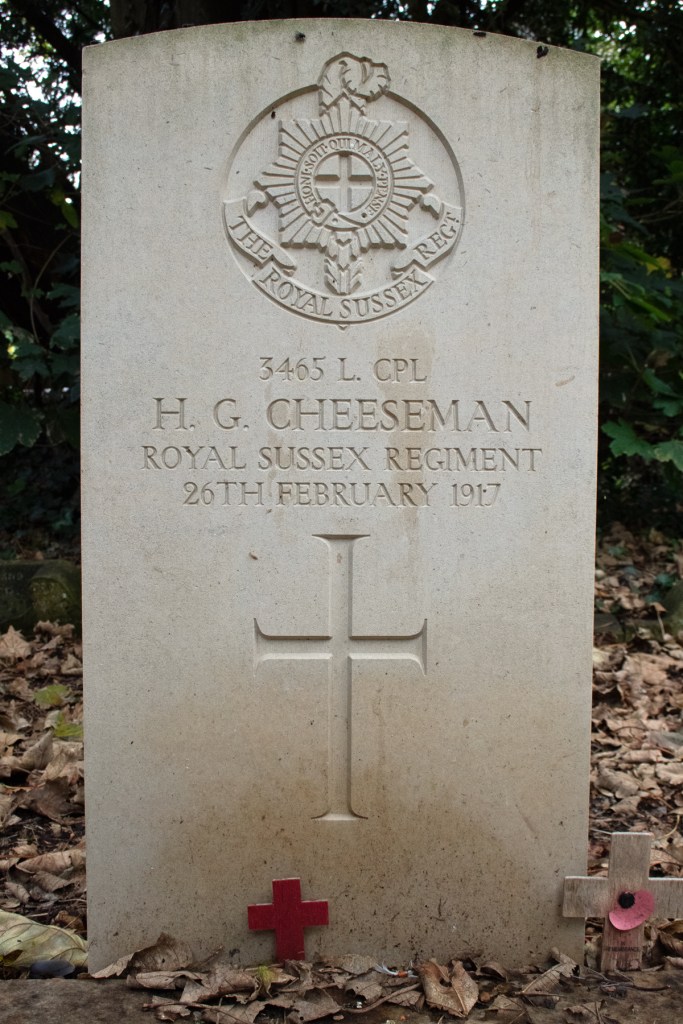
Lance Corporal Harry Cheeseman

Lance Corporal Harry Cheeseman

Harry George Cheeseman was born in the summer of 1893, one of eleven children to Charles and Sarah Cheeseman. Charles was an innkeeper, and ran the now-closed Red Lion Inn in Angmering, West Sussex for more than twenty years.

Harry did not follow in his father’s footsteps when he left school. Instead, he moved in with his older sister and her family in Horsham, where he worked as a roundsman on his brother-in-law’s dairy farm.

When war broke out, Harry was eager to enlist. He joined the Royal Sussex Regiment on 16th September 1914, and was assigned as a Private to the 9th (Service) Battalion.

Initially formed in Chichester, Private Cheeseman found himself moved to Portslade, then Shoreham, then Woking in Surrey, before eventually being sent to France at the beginning of September 1915. By this point, he had proved his worth and had been promoted to Lance Corporal.

Harry’s bravery shone through; in November 1915, while battle was raging, he brought an injured colleague into a field hospital and was about to rescue another when he himself was injured. His wound – a gun shot wound to the spine – was initially treated on site, but he was soon evacuated back to England.

Lance Corporal Cheeseman’s injuries proved to be life-changing. A later newspaper report stated that he had been “physically helpless” [Worthing Gazette: Wednesday 5th March 1917], so paralysis seems likely. Awarded the British and Victory Medals and the 1914 Star, he was medically discharged from the army in May 1916.

Harry returned home, but never really recovered from his injuries. He died on 26th February 1917, at the tender age of 23 years old. His funeral “which was of a most impressive character, was witnessed by five hundred people” [Worthing Gazette: Wednesday 5th March 1917], and he was laid to rest in the graveyard of St Margaret’s Church in his home town.


Private Edward Rendell

Private Edward Rendell

Edward Rendell was born in the Dorset town of Corfe Castle in 1894. His parents were Edward and Sophie Rendell, and he had two siblings, William and Agnes.

Sadly, little information on Edward Jr’s early life is available. His father was a farmer – or at least an agricultural labourer – and this is the line of work his son went into.

When war broke out, Edward Jr was quick to play a part, enlisting within a fortnight of hostilities being declared. He joined the 1st Battalion of the Dorsetshire Regiment as a Private and, after initial training, was sent out to the Western Front by March 1915.

Private Rendell’s battalion was involved in the fighting at Ypres and, on 19th April 1915, he was injured, receiving a gun shot wound to his left arm. Initially treated in the field, he was later transferred to a hospital in Boulogne, before being evacuated back to England to recover.

Reunited with his regiment, Edward was then shipped out to Gallipoli, arriving there in September 1915. While he is likely to have been involved in the fighting in Turkey, he did end up in hospital, but was suffering from influenza.

A couple of weeks later, he is recorded as being admitted to a hospital in Malta, although whether this was also because of the lung condition is not clear. Either way, Private Rendell was back in England by mid-December 1915, remaining in the country for six months.

In March 1916, he again returned to the fray and was posted back to the Western Front. Private Rendell spent a couple of months in battle until, on 21st June 1916, he received a gunshot and shrapnel wound to his thigh. The injury was serious enough for him to be medically evacuated back to England, and he was admitted to the Voluntary Aid Detachment Hospital at Norton-sub-Hamdon in Somerset.

Sadly, while his treatment may have bought Private Rendell some time, it seems that his wounds were too severe; he passed away on 30th July 1916 at the age of just 22 years old.

By this time both of Edward’s parents were dead; his next of kin was his sister, Agnes. While she was still living in Dorset, Edward was laid to rest in St Mary’s Churchyard in Norton-sub-Hamdon.


Private William Ridley

Private William Ridley

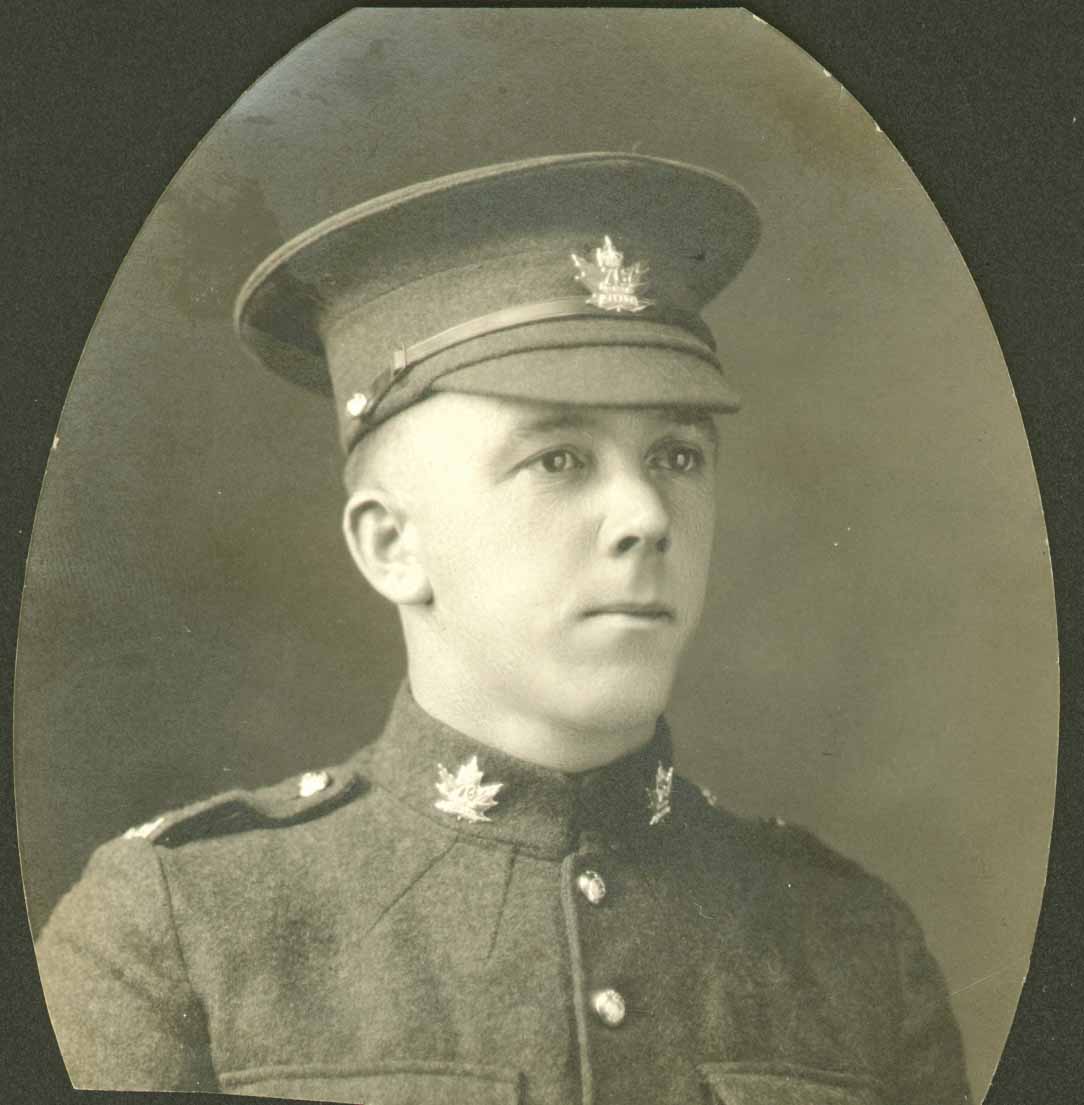
William Frederick Ridley was born on 7th April 1887 in the New Brompton area of Chatham/Gillingham, Kent, one of eight children to John and Elizabeth Ridley. John was an engine fitter in the nearby naval dockyard and, as the key employer in the area, William followed in his father’s footsteps.

Sadly, John died in 1904, and this seems to have been what spurred his son on to a better life. In 1907 William emigrated to Canada, settling in the town of Wentworth, on the banks of Lake Ontario.

It was in Ontario that William met his future wife. Edith Wass was the daughter of a local labourer; the young couple married on 5th June 1909, and went on to have two children, John, born in 1910, and Wilfred, who was born five years later.

During this time, William was putting his engineering skills to the test; his marriage banns confirm he was a machinist. While there is nothing to confirm any specific trade, given his proximity to the coast, dockyard employment seems probable.

On the other side of the Atlantic, war was breaking out; keen to do his part for King and Country, William enlisted in the Canadian Expeditionary Force on 28th July 1915. Initially enlisting in the 76th Overseas Battalion of the Canadian Infantry, he was shipped to England a year later and transferred across to the 4th Battalion.

Once on the Western Front, Private Ridley was thrown right into the thick of things. His battalion fought at the Battle of Flers-Courcelette – part of the Battle of the Somme – and it was here, on 18th September 1916, that he was wounded.

William received shrapnel wounds to his head, hand and right leg. Initially treated on site, he was quickly evacuated back to England, and admitted to the 2nd London General Hospital in Chelsea. Sadly, however, his wounds appeared to have been too severe; Private Ridley passed away from them on 30th November 1916, aged just 29 years old.

With his widow and children still in Canada, William’s body was taken back to Kent. He lies at rest in the Woodlands Cemetery in Gillingham, close to where his mother was still living.


Larger memorial image loading...
Private William Ridley
(from findagrave.com)

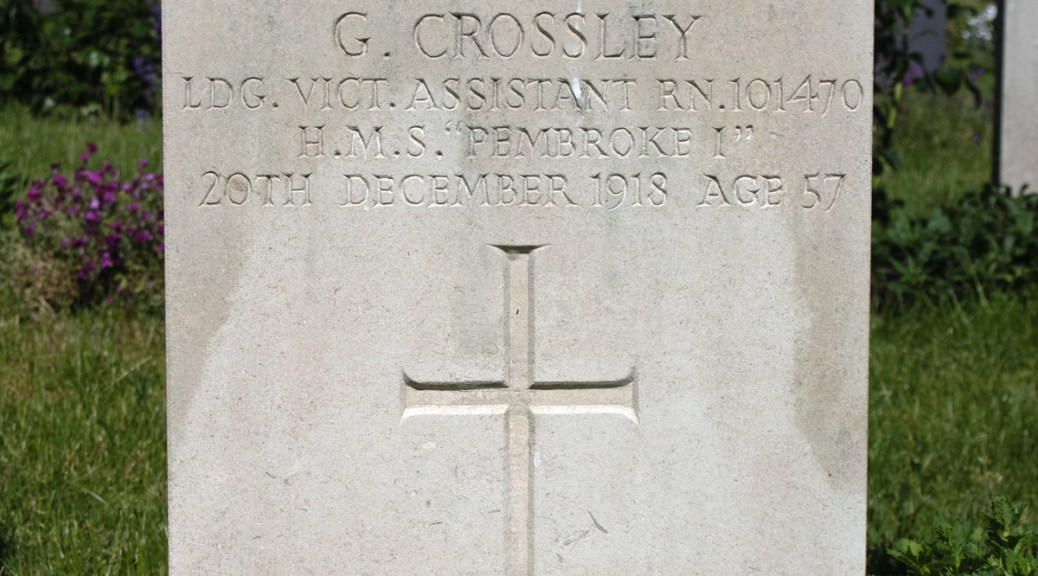
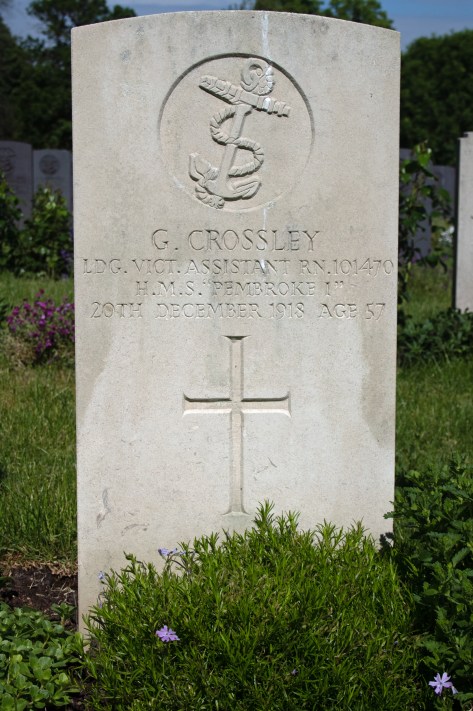
Leading Victualling Assistant George Crossley

Leading Victualling Assistant George Crossley

George Crossley was born on 30th December 1861 in the Stonehouse area of Plymouth, Devon. The oldest of five children, his parents were John and Charlotte. John died when George was only ten years old, leaving his widow to raise the family alone.

Left as the technical head of the family, George sought a reliable career and, in August 1877, aged just 15 years old he joined the merchant navy. After two years at the rank of Boy, he formally joined the crew, working as a Ship’s Steward’s Assistant.

Over the initial ten years of his service, George served on four ships, primarily the Royal Adelaide. In 1889, having seen the world, he signed up for a further decade. This new period of service saw him move up to Ship’s Steward, before working back in the assistant role.

In December 1899, George’s twenty years’ service came to an end. Charlotte, by this time, was in her mid-60s, and perhaps he felt it better to spend time ashore with her, rather than leaving her alone.

His experience did not count for nothing, however, and he found employment as a labourer in the Naval Dockyard in Chatham, Kent. And so another fourteen years passed, before war rose its ugly head.

George was called back into service at the start of the conflict, and resumed his role as a Ship’s Steward’s Assistant. Over the next few years, he served on a couple of ships, but the majority of his time was spent at the shore establishments in Portsmouth, Dover and Chatham. In 1917, George gained the rank of Leading Victualling Assistant, giving him some of the responsibility for the food stores at Chatham Dockyard.

Towards the end of 1918, George seems to have been in the east of the county, when he fractured and dislocated his left ankle. Little specific information is available, but it seems that he was admitted to the Royal Infirmary in Deal, but died of his wounds on 20th December. He was ten days short of his 57th birthday. An inquest later that month reached a verdict of accidental death.

Brought back to Gillingham, George Crossley was laid to rest in the Woodlands Cemetery in the town.


Private Arthur Westby

Private Arthur Westby

Arthur William George Westby was born in the spring of 1895, the only child to Arthur Henry Westby and his wife, Emma. Arthur Sr was a Corporal in the Scots Guards, but, beyond the fact that his son was born in Clapham, South London, there is little further information about Arthur Jr’s early life.

His father’s military career must have taken him across the country – the 1901 census lists Emma and Arthur Jr living in Bolton, Lancashire, even though there seem to be no connections with the county for them.

The records for Arthur Jr go quiet until 1920. At this point, documents hint at his military service during the Great War.

The death notices in the Sussex newspapers confirm his passing:

On November 19th 1920, at The Cedars, 13 Browning Road, Worthing, Arthur WG Westby (late MT, RASC), beloved husband of Ethel Westby, and only son of Ex-RQM Sergeant and Mrs Westby, 34 Wenban Road, Worthing. Patiently suffered to the end, result of Active Service.

Worthing Gazette: Wednesday 24th November 1920

There is no further information available about Ethel, and no marriage records to confirm a date for their wedding.

From a military perspective, Arthur enlisted in the Royal Army Service Corps, and was attached to the Motor Transport division. Again, there is nothing to evidence when he enlisted or for how long he served. It seems that Private Westby was injured in the line of duty, and was medically discharged in April 1918. The injury appears to have been life-changing, and it affected him until the end of his life.

Arthur William George Westby passed away in Worthing on 19th November 1920, aged just 25 years old. The specific cause of his death is unknown. He was laid to rest in the Broadwater Cemetery in the town, close to his parents and widow.


Private John Blake

Private John Blake

John George Blake was born early in 1878, and was the oldest of seven children. His father, Job, was a general labourer, and, with Eliza, John’s mother, brought the young family up in the West Sussex town of Worthing.

Job died in 1898, ages just 36 years old; Eliza found work as a housekeeper, while John was employed as a carter for the railway. By the 1901 census, the family were living in a terraced house near the centre of town, Eliza living there with her three sons, two daughters, son-in-law and granddaughter.

In October 1904, John married Alice Attwater, a labourer’s daughter from mid-Sussex. The couple moved into a house close to the station and went on to have four children; John Jr, Ernest, Bertha and Dorothy. John was by now working as a porter for the railway, a role he continued through to the outbreak of war.

John enlisted in November 1914; he joined the Royal Sussex Regiment, working as a member of the depot staff. Private Blake was shipped overseas, arriving in France in March 1916.

Almost exactly a year after landing in France, John was injured in the line of duty. The medical report confirmed that a “scald on the left arm and neck [had] occurred while on duty on March 1st 1917, in France. He was preparing hot soup for his company in the front line at midnight. He was not to blame. Injury caused by enemy shelling the company kitchen“.

Private Blake was shipped back to England for treatment, and admitted to Netley Hospital near Southampton. While there, he contracted phthisis (tuberculosis), which left his totally incapacitated. He was medically discharged from military service in August 1917.

Further details of John’s life are scarce. He returned home to his family, although whether he took up his job again is unknown. He passed away on 22nd June 1919 at the age of 41. The cause of his death is unknown, although it seems likely to have been related to the tuberculosis.

John George Blake lies at rest in the Broadwater Cemetery of his home town, Worthing.


Private Arthur Rousell

Private Arthur Rousell

Arthur Edward Rousell was born in the summer of 1898, one of five children to Henry and Lucy Rousell. Henry was a police constable in Worle, near Weston-super-Mare, and this is where he initially raised his family. By the time of the 1911 census – when Arthur was a schoolboy of 12 years old – the family had moved to the village of Huish Episcopi, on the outskirts of Langport.

Details of Arthur’s military career are sketchy. Initially enlisting with the Royal Lancashire Regiment, he was soon transferred over to the 1st Battalion of the Lincolnshire Regiment. He certainly saw action abroad, and was caught up on the Western Front.

Private Rousell was injured on 27th May 1918, this the first day of the Battle of Aisne. His battalion was certainly involved in the battle, but whether this was where he was injured, and what his injuries actually were, cannot be confirmed.

Evacuated back to England for treatment, Private Rousell was admitted to the South African Hospital in Richmond. Whether he was there for a long time, is not recorded, but he was certainly there in nine months after he was wounded.

It seems that his injuries left him susceptible; his pension record confirms that he died of sickness, and it seems likely that this was one of the lung conditions – pneumonia, influenza – that was prevalent following the cessation of hostilities.

Private Arthur Edward Rousell died on 22nd February 1919, at the age of 20 years old. His body was brought back to Huish Episcopi, and he lies at rest in the family grave in the graveyard of St Mary’s Church.


UPDATE : 19th April 2022

An article on Arthur’s passing sheds more light onto his life:

We regret to record the death of Pte. AE Rousell, of the 1st Lancs. Regt., eldest son of PC and Mrs HJ Rousell of Newtown, which occurred at Richmond Hospital on Saturday morning. Deceased, who was 20 years of age, had been seriously ill a week with influenza, death being due to septic pneumonia, which followed.

The late Pte. Rousell, was a member of the staff of “The Langport and Somerton Herald” where he served his apprenticeship, when war broke out, and joined up early in 1917, his regiment being the King’s Own Yorkshire Light Infantry. After a period of training he proceeded to the front and took part in several engagements. He was gassed, and in the winter of that year was invalided home with trench feet. On recovery he was transferred to the Lancs. Regt., and again proceeded to the front.

On May 27th last he was severely wounded in the right leg by shrapnel, the bones being badly splintered. He was sent to a military hospital in this country and had been in hospital ever since. He had made a fairly good recovery and his parents were expecting him home shortly, when on Thursday last week a wire was received, informing them of his serious illness. Mrs Rousell at once proceeded to Richmond and was able to see her son before he passed away.

Deep sympathy is extended to the relations in their sad bereavement.

Langport & Somerton Herald: Saturday 1st March 1919

Lance Corporal Edgar Godden

Lance Corporal Edgar Godden

Edgar Godden was born in the summer of 1892, one of eight children to John and Alice Godden. John came from Littlehampton, and Alice from Worthing, and this is where they raised their family.

John was a bricklayer, and it was this trade that Edgar went into when he left school. War was coming to Europe, however, and, within weeks of the conflict breaking out, he had volunteered his services.

Edgar joined the Royal Sussex Regiment, and was assigned to the 7th (Service) Battalion. Details of his military service are a little sketchy, but a newspaper article, written after his death, gives a hint about what happened to him.

Mr Edgar Godden… who was twenty-five years of age and leave a widow and a little child, enlisted on the 1st September 1914, and was wounded in the arm in September of the following year. In October 1916 he was blown up and buried by an enemy mine. Last February he was taken out of the trenches and sent to a hospital in France, and last April he came home to England and had an arm amputated. Since his discharge from the Seventh Royal Sussex Regiment, he had been a member of the staff of the Post Office, and was known as “The One-armed Postman”.

Worthing Gazette: Wednesday 10th January 1918.

In the autumn of 1916, and recovering from his injuries Lance Corporal Godden married Emily Owers. They lived with John and Alice, but I have been unable to find details of the child mentioned in the newspaper report.

It seems that his injuries had left Edgar in a weakened state, and, after a ‘short and painful illness’ [Worthing Gazette: 2nd January 1918], he passed away on 22nd December 1917. He was just 25 years of age.

Edgar Godden was laid to rest, finally at peace, in the Broadwater Cemetery in his home town of Worthing, West Sussex.


The newspaper report above gave a little more information about a couple of Edgar’s siblings.

Mr & Mrs [John] Godden had one son killed in action in November 1916; and still another – the eldest – is now in France, as a member of the Royal Engineers.

Worthing Gazette: Wednesday 10th January 1918

Edgar’s oldest brother – also called John – survived the war, but it was his younger brother, Charles, who was killed in action.

A Corporal in the 11th Battalion of the Royal Sussex Regiment, Charles was caught up in the Battle of the Somme. It was while fighting in the Battle of the Ancre on 13th November 1916, that he was killed. He is remembered at the Thiepval Memorial in Northern France, and is also commemorated on Edgar’s own headstone.


One last aside to Edgar’s story is his address in the last few years of his life. John and Alice were living in Worthing, specifically at a house called “Chiswick” in Tarring Road, to the west of the town.

Coincidentally, when researching another soldier, Private Ernest Parsons, this turns out to be the address where he also died, just ten months later on 4th October 1918. There is no apparent other link between the two men.


Lance Corporal Thomas Marston

Lance Corporal Thomas Marston

Thomas Henry Robert Marston was born on 12th February 1876, the son of Frederick and Elizabeth Marston. Frederick was a police constable who raised his family in the Paddington area of London.

Sadly, details of Thomas’ early life are tantalisingly scarce. He was not baptised until October 1881, on the same day as his brother, Frederick, who was four years younger.

Thomas seems to have had a sense of adventure; his Commonwealth War Graves Commission records confirm that he served in the South African Campaign – this would put him out of the country during the 1890s, and reinforce why documentation for that time is missing.

The next confirmed information for Thomas is his marriage record. He wed Bessie Ponder by banns in August 1909. The ceremony was at Christ Church in Marylebone, and the couple went on to have two children, Doris, born in 1911, and Hettie, born in 1912.

By the time of the 1911 census, with his military service by now complete, Thomas and Bessie were living on the Caledonian Road in Islington. Still childless at this point (although Bessie was undoubtedly pregnant), Thomas was working as a butcher.

The census gives their address as 54 Wallace Buildings, a Victorian tenement block, and the couple lived in two rooms. Their neighbours at No. 53 were fellow butcher Ralph Bonest, his wife Isabel and their three children, who also all lived in two rooms. On the other side newlywed cab driver William Barnes, lived with his wife Florence and her sister. The Barnes’ had the luxury of No. 55 being a three-roomed flat.

When the Great War broke out, it seems evident that the 38 year old Thomas was either re-mobilised or voluntarily re-enlisted. While the dates are not certain, he had joined the Army Service Corps by March 1917 and was assigned to the Remount Depot at Romsey in Hampshire. This section of the regiment was involved in the provision of horses and mules to other parts of the army.

No further details of Lance Corporal Marston’s military career remain. Sadly, the next record of his life confirm his death. He was admitted to the Hursley Camp Hospital with rupture of viscera (possibly an aneurysm), but died from his injury on 31st October 1917. He was 41 years old.

At some point after the 1911 census, the family had moved to Worthing in West Sussex. The body of Thomas Henry Robert Marston was brought back home, and he was laid to rest in the Broadwater Cemetery in the town.