Category Archives: unknown

Private Willie Howells

Private Willie Howells

In the peaceful Congregational Chapelyard of Berea, St Davids, Pembrokeshire, is a headstone dedicated to Willie Howells, grandson of Benjamin and Mary. The inscription – in Welsh – confirms that he died on 26th November 1918, at the age of 23.

The 1901 census records the couple living at Rhos y Gorse with four of their eleven children and two of their grandchildren, including William. There is no documentation to confirm which of their children was his parent.

Tragically, Willie’s military records are also lost to time. The Commonwealth War Graves Commission give his name as Private BW Howells. They suggest that his first regiment was the South Wales Borderers, and that he transferred to the Northern Command Labour Centre of the Labour Corps. His service numbers for both units draw a blank, however.

The life of Willie Howells is destined to remain a mystery, one of the many whose stories were buried with them.


Captain Robert Graves

Captain Robert Graves

Robert Kennedy Grogan Graves was born on 1st January 1878. An announcement in the local newspaper confirmed that “at Baronne Court, County Tipperary, the wife of Lieutenant-Colonel W. Grogan Graves, 82nd Regiment, of a son (prematurely).” Robert was the older of two children, while his parents were William Graves, a Justice of the Peace in Ireland, and his wife, Georgianna Graves.

William died in 1890, and Georgianna moved the family to London. The 1891 census found her residing at the Golden Hotel in St Martin in the Fields, while her two boys, Robert and his younger brother, Geoffrey, were boarding students at Francis Napier’s classics school on Shooter’s Hill Road in Kidbrooke, Kent.

Robert found his calling through education. He studied medicine, and by January 1896 he was a student at St George’s Hospital in Tooting, Surrey.

By 1906 Robert had set himself up in an infirmary on Southgate Street in Gloucester, Gloucestershire. That same year, he married Kathleen Schofield: the couple went on to have two children, Robert Jr in 1912, and Bernard the following year.

Graves, Robt. Kennedy Grogan, Scison Lodge, Clevedon, Somerset (Tel. 11 Y Clevedon) – MRCS, LRCP London 1904; (St Geo.); Hon, Med, Off. Clevedon Cott. Hosp.; Med. Off Mutual Insur. N.Y. & Clevedon Hydro. Estab.; late Sen. Ho. Surg. & Asst. Ho. Surg., & Surg. Gloucester Co. Infirm., & Asst. Med. Regist. & Obst. Clerk St Geo. Hosp.

[The Medical Directory, 1910]

Robert had set himself up well during his life. The 1911 census found him and Kathleen – who was better known by her middle name, Gladys – living in their 17-room house on Linden Road in Clevedon. They afforded themselves three servants, including a housemaid, a cook and a motor driver. By the outbreak of war, Robert has an entry in the town’s Kelly’s Directory, and seemed to be a focal member of the community, joining the local Grand Lodge in September 1908.

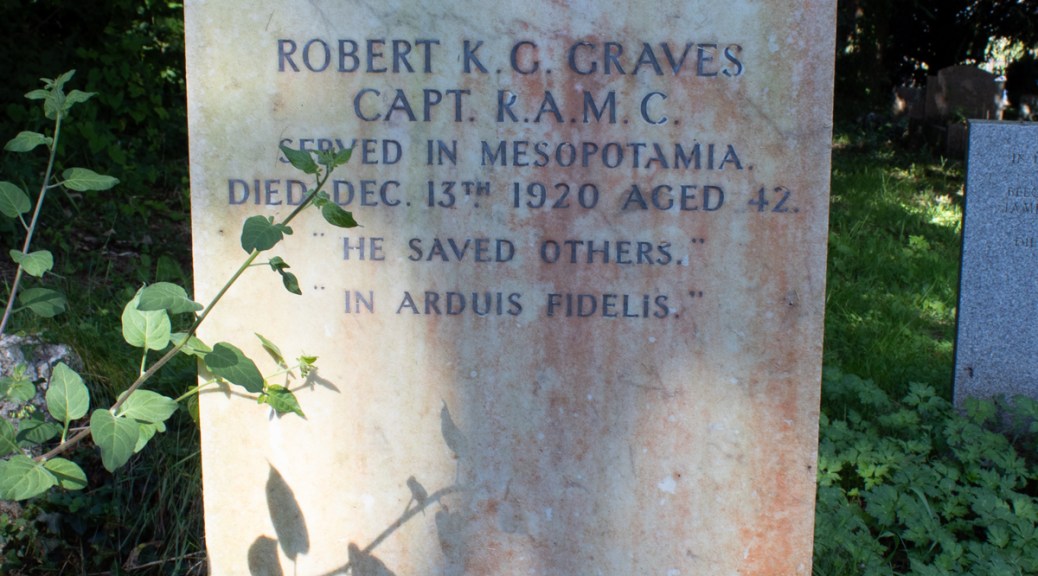
Robert’s time in the army, is hard to piece together. He joined the Royal Army Medical Corps as a Captain, and appears to have been connected to the air force. His headstone suggests that he served in Mesopotamia, but when and exactly where, however, is lost to time.

After the war, Robert returned to Britain. Leaving the Somerset coast, however, he and Kathleen appear to have set themselves up in Dorset. He died, through causes not detailed, on 12th December 1920, at 42 years of age. His entry on the probate register states:

GRAVES Robert Kennedy Grogan of 1 Charnwood Chambers Seabourne-road West Southbourne Hampshire died 12 December 1920 at The Grange Buckfastleigh Devonshire…

It is unclear whether Charnwood Chambers was his working address, with The Grange being the family’s official home, or if Buckfastleigh served as a place of convalescence.

Robert Kennedy Grogan Graves left an estate totalling £370 14s 7d (approximately £21,100 today) to Kathleen. He was buried in the graveyard of Holy Trinity church, Buckfastleigh.


Corporal Walter Marsh

Corporal Walter Marsh

Walter Marsh was born on 17th April 1891 in Beckenham, Kent. The fifth of thirteen children, his parents were Harry and Louisa Marsh. Harry was a bricklayer from Doncaster, Yorkshire, while his wife was from Enfield, Middlesex. By the time their first child was born, however, they had moved to Kent, and the 1901 census found the family living in a small terrace at 77 Birkbeck Road.

In such a large family, it would have been a challenge to find your place. It seems that Walter wasn’t able to make his mark on the world within the constrains of his siblings and so, on 11th August 1910, he enlisted in the Royal Marine Light Infantry. His service records confirm that he was 5ft 6ins (1.68m) tall, with brown hair, blue eyes and a dark complexion. He was also noted as having a scar on his back, and passed his swimming exam when he was tested on 4th November.

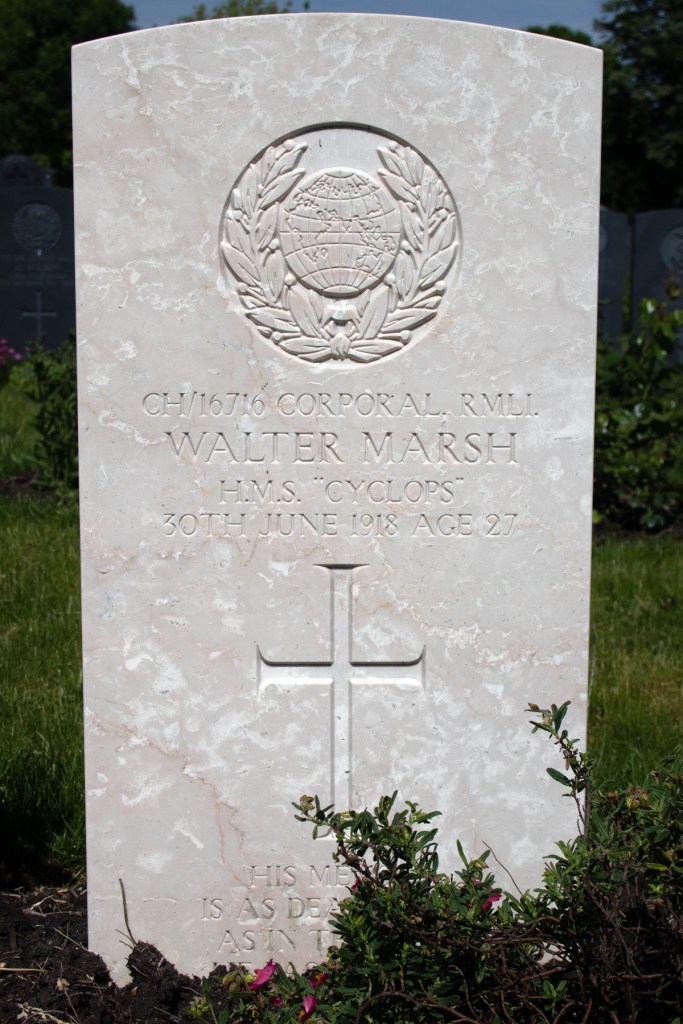
Private Marsh’s initial training was undertaken in Deal, Kent, but over the following eight years, his main base was to be the Royal Naval Dockyard in Chatham. In six separate postings, he would spend more than three-and-a-half years at sea, including a year on the battleship HMS Russell and the submarine depot ship HMS Cyclops.

In January 1915 Walter was promoted to the rank of Corporal, and it was around this time that he got married. In the summer of that year, he tied the knot with Gertrude Crozier, a domestic servant, and daughter of a Chatham flour mill labourer.

Corporal Marsh would continue in the Royal Marine Light Infantry until January 1918. Medically discharged, he was seen to no longer be fit for military service, although it is unclear what condition or injury led to the end of his eight year career.

As this point, Walter’s trail goes cold, and the next record relates to his passing. He died in Chatham on 30th June 1918, at the age of 27 years old. Gertrude had given birth to their first child, a daughter named after her mother, just six months before.

The body of Walter Marsh was laid to rest in the naval section of Woodlands Cemetery, Gillingham, Kent, not far from the base that had become a home from home.


After the loss of her husband, Gertrude would go on to marry again, wedding Royal Navy Petty Officer Frederick Harris on 1st January 1920. The couple went on to have a child of their own, daughter Florence, towards the end of that year.


Gunner Arthur Putt

Gunner Arthur Putt

Arthur Sidney Putt was born on 22nd October 1895 in Paignton, Devon. The youngest of five children, his parents were James and Elizabeth. James died when his son was jest five years old, leaving Elizabeth to raise the family in her own. By the time of the 1901 census, they Putts were living at 22 Roundham Cottages (four doors down from the fellow future soldier Charles Baker and his family), where Elizabeth was working as a charwoman to bring in the rent money.

When he finished his schooling, Arthur found employment as a wood chipper. At 15 years of age, he and his older brother, Frederick, were both bringing a wage into the household, and were the only two of Elizabeth’s children to still be living at home.

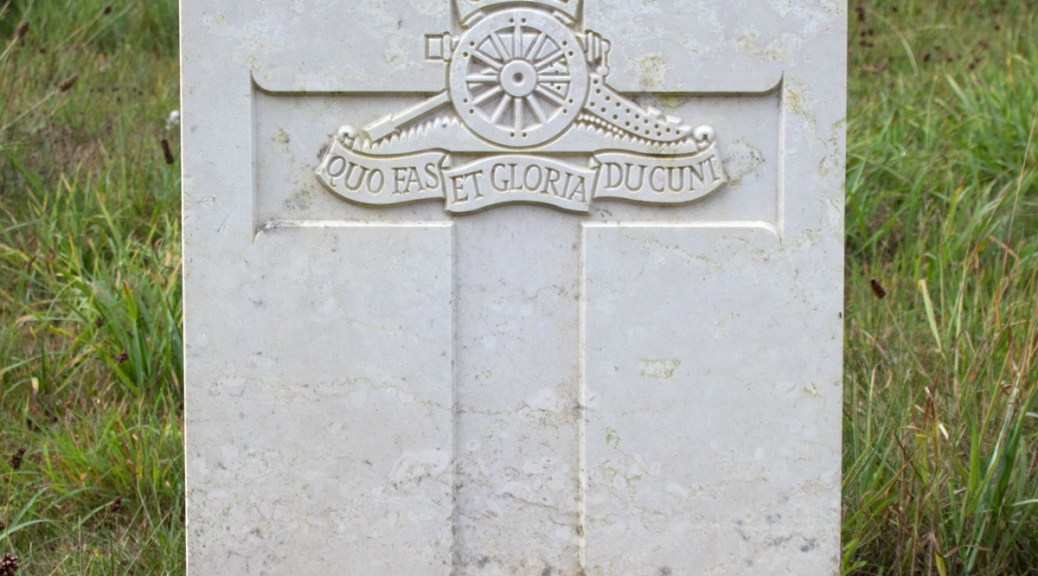
War broke out in the summer of 1914, and Arthur was one of the first to step up and play his part. He enlisted on 16th August, giving up his new job as a hairdresser, with the view of better prospects in the army. He joined the Royal Field Artillery, and was assigned to the 2nd Devon Depot Battery.

Gunner Putt’s initial medical report showed that he was 5ft 7ins (1.7m) tall, with good vision and normal physical development. He was sent for training, but a later, fuller, medical found that he was, in fact, not physically fit for army service. The report of the medical board of 27th April 1915 found that he had both rheumatism and valvular heart disease. He was dismissed from military service on 10th May 1915, after 267 days’ duty.

At this point, Arthur’s trail goes cold. It seems likely that he returned to Paignton, and to the life he had before the war, and the next record for him is that of his passing. He died on 14th May 1919, at the age of 23 years old.

Arthur Sydney Putt was buried in Paignton Cemetery, overlooking the town in which he had been born and raised.


Private Alfred Hurrell

Private Alfred Hurrell

Alfred Hurrell was born in the Devon village of Ugborough, in the autumn of 1885. He was the second of eleven children – of which five did not survive childhood – to Agricultural labourer Frank Hurrell and his wife, Hannah.

Soon after Alfred was born, the family moved to the village of Modbury, four miles to the south-west. Frank has found work on Hockenbridge Farm, on the edge of the village and, when he finished his schooling, Alfred also started working there, initially living in.

By the time of the 1911 census, Alfred was back living with his parents, on Galpin Street, Modbury. They shared their home with three of Alfred’s siblings, and his sister Jane’s two children.

When war broke out, Alfred was among the first to enlist. Full details of his military service have been lost, but it is clear from what remains that he had joined up by September 1914. Private Hurrell was attached to the 11th (Reserve) Battalion of the Devonshire Regiment, and seems to have remained in the county for his training.

The only other document relating to Alfred is his entry on the Army Register of Soldiers’ Effects. This confirms that he passed away on 16th February 1915 in Paignton, Devon. He was 29 years of age.

The body of Alfred Hurrell was laid to rest in Paignton Cemetery, not far from where he had breathed his last. It is unclear why he was buried there, rather than being brought back to Modbury.


Stoker 1st Class Thomas Ellis

Stoker 1st Class Thomas Ellis

Thomas Ellis was born in 1896 in St Leonard’s, Sussex. The third of twelve children, his parents were George and Ellen Ellis. George was a general labourer, but when he finished his schooling, Thomas found work as a golf caddy. The 1911 census recorded the Ellis family living in four rooms at 7 Caves Road to the east of the town centre.

There is little additional information about Thomas, sadly. He joined the Royal Navy when war broke out, and was working as a Stoker 1st Class by the closing months of the conflict. He passed away, through causes unknown, on 7th July 1918, at the age of just 23 years old.

Thomas Ellis was laid to rest in the naval section of the Woodlands Cemetery in Gillingham, Kent, not far from the Royal Naval Dockyard in Chatham – HMS Pembroke – at which he was based.


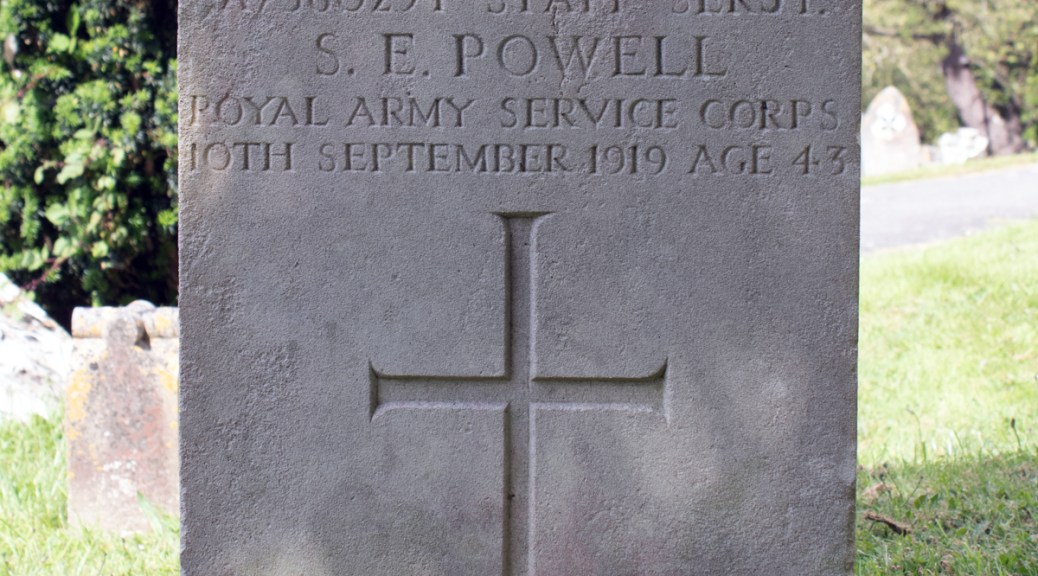
Staff Serjeant Samuel Powell

Staff Serjeant Samuel Powell

Samuel Edwin Powell was born at the start of 1876, the third of eight children to Samuel and Catherine Powell. Samuel Sr was a baker from Gloucestershire, and it was in the village of Leonard Stanley that the family were born and raised.

Much of Samuel Jr’s earlier life is undocumented, and he does not appear on either the 1891 or 1901 census returns. By the time of the next census, taken in 1911, he is recorded as living in Lewisham, Surrey.

The census noted that Samuel was employed as a commercial traveller in the chocolate industry. He was married to Stroud-born Ellen Hobbs, and had been since 1906. The couple had a son, Denis, who was a year old, and were living at 20 Hazelbank Road in Catford, with a domestic servant, Edith Price, helping Ellen while her husband was away working.

When war broke out, Samuel was called upon to play his part. He was enlisted in the Royal Army Service Corps, with the rank of Staff Serjeant, which would suggest that his absence from earlier documents was because of earlier military service.

There is little information about Samuel’s time in the army, other than that he was attached to the Clearing Office when the Armistice was declared.

The cause of Staff Serjeant Powell’s passing is not known, but the Army Register of Soldier’s Effects confirm that he died in Dorset on 10th September 1919. The connection to Dorset is unclear: he may have been serving in the area, or recuperating from an illness. He was 43 years of age.

Samuel Edwin Powell was laid to rest in Lyme Regis Cemetery, overlooking the seaside town.


Guardsman Francis Marchant

Guardsman Francis Marchant

Francis George Marchant was born in the autumn of 1894, the fourth of five children to William and Emma Marchant. William – who went by his middle name, Walter – was a gamekeeper from the village of Uplyme in Devon, and this is where the family were born and raised.

Sadly, there is little specific information about Francis’ life. When war was declared, he stepped up to play his part, joining the Coldstream Guards as a Guardsman. Attached to the Machine Gun Corps, he would have spent time overseas, but details about his time in the military are long since lost.

By the end of the conflict, Guardsman Marchant was based in Hampshire, billeted in Witley Camp. While here, for reasons unknown, he was admitted to the Connaught Military Hospital. It was here, on 4th April 1919, that he passed away: he was 24 years of age.

Francis George Marchant was taken back to Devon for burial. He was laid to rest in Uplyme’s Ss. Peter & Paul’s Church.


Private Ernest Richards

Private Ernest Richards

Ernest Richards was born in Bath, Somerset, 1886, and was the youngest of four children to Emma Richards. Emma was widowed when Ernest was an infant, and no baptism records remain to confirm who he was.

The fate of the Richards family is outlined through the consecutive census records. The 1891 document shows Emma and her children living at 4 Camden Row, to the north of the city centre. Emma was employed as a needlewoman, while Ernest’s oldest brother, Herbert, was working as an errand boy. The family shared their home with widowed laundress Emily Clarke, helping with the bills.

By the time of the 1901 census, the family had moved to 1 Claremont Row. A bit further out of the centre of the city, this offered more space for the growing children. Emma was still working as a needlewoman, but three of the children were gainfully employed: Ernest as a printer’s errand boy, Herbert as a grocer’s carter, and their brother William as a book shop porter.

The 1911 census found Emma still living at 1 Claremont Row. She was 53 by this point, and no longer working, but three of her children were still living there, and bringing in an income. William was a milkman, Ernest a porter, and her youngest child, daughter Gladys, was a machinist.

War was closing in on Europe by this point, but from here on in, Ernest’s trail gets a bit sketchy. Later records confirm that he had enlisted by the summer of 1916, and they he had joined the Coldstream Guards. Attached to the 5th (Reserve) Battalion, Private Richards appears to have been based on home soil.

Ernest seems to have been hospitalised in February 1917. Sadly, there is little additional information about his condition. While his regiment was based in Windsor, Berkshire, there is no evidence to confirm whether his barracks where also there, so it isn’t clear to which hospital he was admitted.

Private Richard would succumb to his ailment. He passed away, while in hospital, on 10th February 1917: he was 30 years of age.

Ernest Richards’ body was taken back to Somerset for burial. He was laid to rest in Bath’s majestic Locksbrook Cemetery, not far from his family home.


Private Reginald Loader

Private Reginald Loader

Reginald Alfred Loader was born in the autumn of 1898, and was the eighth of nine children. His parents – Robert and Amelia – both came from the Dorset village of Lillington, and this is where they raised their family.

Sadly, there is little specific information on Reginald’s life. When war broke out, he stepped up to play his part, and enlisted in the Training Reserve Battalion at some point after October 1916. His unit, the 35th Battalion, was based in Wool, Dorset, but there is no further information about his time there.

The only other concrete information about Private Loader confirms his passing. He died in hospital – through causes unknown – on 7th April 1913. He was just 18 years of age.

Reginald Alfred Loader’s body was taken back to Lillington for burial. He was laid to rest in the graveyard of St Martin’s Church in the village.