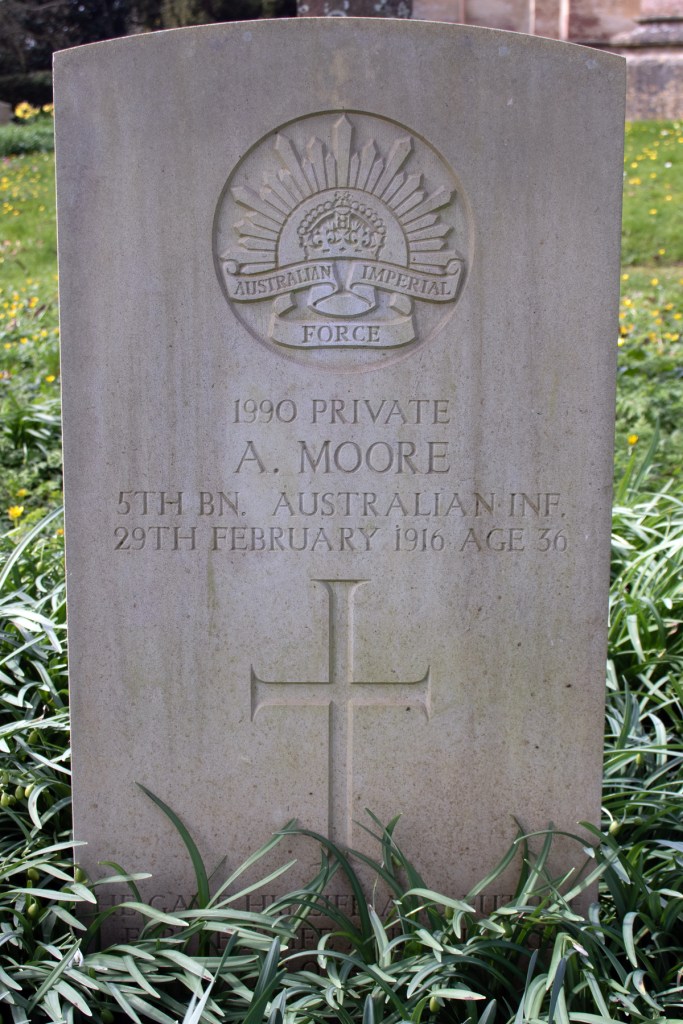
Category Archives: Australia

Private Arthur Cock

Private Arthur Cock

Arthur Cock was born in around 1885 in Wadebridge, Cornwall. One of eleven children, he was the son of mortar mason William Cock, and his wife, Louisa.

When he left school Arthur helper his father out in the business, but when war came to Europe’s shores, he stepped up to play his part. Sadly, his service records are lost to time, and it is a challenge to piece together his time during the conflict from a confusion of other documents.

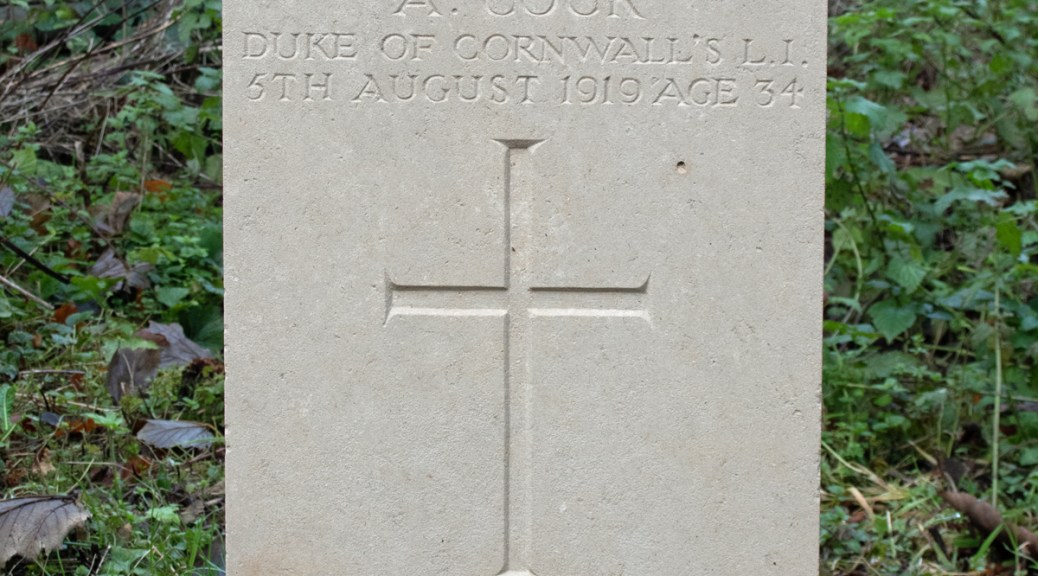
It is clear that Arthur enlisted in the Duke of Cornwall’s Light Infantry, as this is what is engraved on his headstone. However, his Medal Roll suggests that he also served in the Gloucestershire Regiment and the Labour Corps. He seems not to have fought overseas, and was awarded the Victory and British Medals for doing his duty.

Private Cock’s entry in the Army Register of Soldier’s Effects confirms that he must have enlisted before February 1919, and that he passed away at Whitchurch Hospital.

An entry in the local newspaper, reporting on his death, reads as follows:

In loving memory of Pte. Arthur Cock, son of William, and the late Louisa Cock, of Wadebridge, who died August 5th, at Whitchurch War Hospital, Cardiff.

Cornish Guardian: Friday 8th August 1919

Interestingly, the facility Arthur had been admitted to was a psychiatric hospital, but with no other confirmation as to his passing, it is only possible to assume the cause of his death. He was 34 years old when he passed away.

Arthur Cock’s body was brought back to Cornwall for burial. He was laid to rest in the peaceful, wooded graveyard of St Breoke’s Church, next to the family grave in which Louisa had been buried three years previously.


The family grave, by this time, was tragically quite full. William was able to mourn his son, wife and six of Arthur’s siblings – Mary, William, John, Fred, Charles and Ernest – who had all passed in childhood and were laid to rest there.


Arthur’s younger brother – another William – also fought in the First World War. His service records reveal a lot about his life.

Private Cock enlisted in the Australian Imperial Force on 7th September 1914. At the time he was working as a railway porter in Morphettville, now a suburb of Adelaide, Australia. His records confirm that he was 5ft 8.5ins (1.74m) tall, and weighed 158lbs (72kg). He had brown hair, brown eyes an a fresh complexion.

William left Australia for the battlefield on 20th October 1914, and soon found himself in the Eastern Mediterranean. Sadly, this was to be the end of the line for him: he was killed on the battlefields of Gallipoli on 23rd March 1915, aged just 28 year of age.

William Cock was laid to rest in the Shrapnel Valley Cemetery in Gallipoli. He is commemorated on the headstone of the family grave back in St Breock.


Private Hugh Jones

Private Hugh Jones

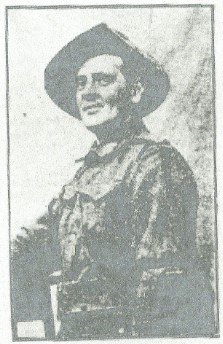
Hugh Henry Jones was born in around 1876 in the Welsh village of Llanberis, Gwynedd. He was one of seven children to quarryman John Jones and his wife Mary.

Slate was the big industry in Snowdonia, and Hugh and his brothers all followed his father into the quarries. Labour was plentiful and wages would not have been high, so when the opportunity arose for employment overseas, he seems to have taken it.

Exact details are sketchy, but Hugh emigrated to Australia at some point in the early 1900s. He settled in the city of Goulburn, New South Wales and the experience he had built up back home stood him good stead, as he continued working as a quarryman.

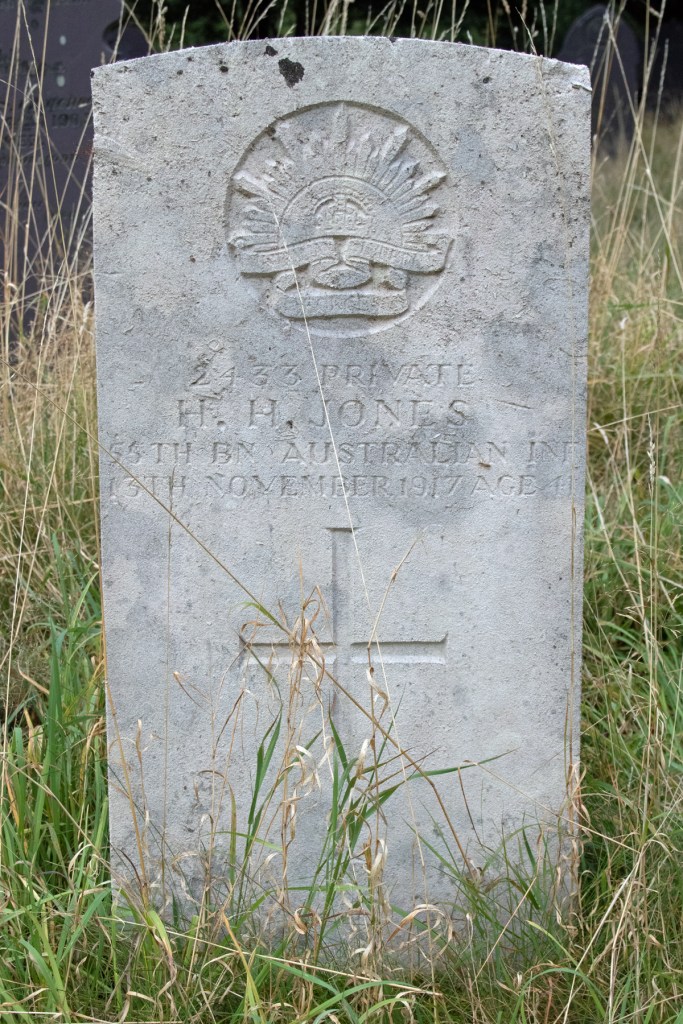
When war broke out in Europe, those in the British colonies were called upon to play their part, and Hugh was among those to serve King and Country. He enlisted on 29th December 1915, joining the 55th Battalion of the Australian Infantry.

Private Jones’ service records show that he was 40 years and six months old, stood 5ft 4ins (1.63m) tall and weighed 130lbs (59kg). He had a dark complexion, blue eyes and black hair. He also appears to have had a denture in his lower jaw.

After initial training, Private Jones set off for Europe at the end of September 1916, arriving in Plymouth six weeks later. Within a matter of weeks he was on the move again, sailing for France, and arriving at Etaples at the start of 1917.

Private Jones was ensconced on the Western Front for the next few months but, as spring came, he was starting to have some health issues. In April he was admitted to a field hospital suffering from dyspepsia (indigestion), which was subsequently diagnosed as gastritis.

Medically evacuated to Britain for treatment, Hugh spent the next few months being treated in hospitals in Kent, and Dorset, before being admitted to the Royal Infirmary in Liverpool. Sadly, by this point, his condition had been identified as stomach cancer and, while in Liverpool, he passed away. Private Jones breathed his last on 13th November 1917, at the age of 41 years old.

Hugh Henry Jones was brought back to Wales for burial. He was laid to rest in the graveyard of St Peris Church in his home village of Llanberis.


Private Hugh Jones
(from findagrave.com)

Private Sidney Budd

Private Sidney Budd

Sidney John Budd was born in the spring of 1888, the middle of three children to Abel and Mary Budd. Abel was a gardener from Tiverton, Devon, and this is where the family were born and raised. In the late 1890s, the family moved to West Monkton, near Taunton in Somerset.

When he finished school, Sidney found work as a house painter, and, by the time of the 1911 census, was boarding in a house near Minehead. Within a few years, he had moved again, this time to Chard, and had met Florence Moulding, the daughter of a shepherd from the town. The couple married on 1st August 1914, just days before the outbreak of war.

There is little information available relating to Sidney’s military service. He enlisted before the end of 1917, joining the 3rd (Reserve) Battalion of the Somerset Light Infantry as a Private. This was a wholly territorial troop, and Private Budd would have served in Somerset and Devon.

One of the downsides to being in close proximity to servicemen from other parts of the country in tightly-packed barracks was the ease with which disease could spread. Sadly, Private Budd was not immune from this and, in the spring of 1917, he contracted pulmonary tuberculosis. He was admitted to the Ford House Hospital in Plymouth, but his condition deteriorated and he passed away on 31st May 1917. He was just 29 years of age.

Sidney John Budd’s body was brought back to Chard for burial: he lies at rest in the town’s cemetery.


Florence went on to marry again, wedding Harry Golesworthy in the spring of 1918. Sadly, her happiness was to be short-lived: she passed away just two years later, at the age of 28 years old.


Sidney’s older brother, named Abel after his father, was an interesting character. When he left school, he found work as an apprentice to a photographer.

In July 1909, though, he was brought to court for stealing a bicycle. It seems that he had rented one from a dealer in West Monkton in order to visit friends in Cullompton, but not returned it at the end of the day, as expected.

The dealer contacted Abel’s parents, and he was found to have stayed over in Cullompton. It seems that while there, he had run low on funds, and had sold the bicycle to a dealer in the town. A week later, he returned to the Cullompton dealer, asking to buy the bike back, but hadn’t brought any money with him.

Eventually, Abel’s father went to Cullompton, bought the bicycle, then took it to the original dealer in West Monkton. By this point, however, Abel had been charged with theft, and pled guilty. His father stood witness, and, according to the Taunton Courier and Western Advertiser [Wednesday 14th July 1909], admitted that Abel “was rather weak of mind” and had not intended to steal the bicycle.

Abel was bound over for twelve months, with his father standing surety of five pounds.

The later parts of Abel’s life seem a mystery. There is a record of him travelling to Brisbane, Australia, in the spring of 1914, where he was to work as a farm labourer. He must have returned home, possibly as part of the war effort, and five years later he married Annie Talbot in Taunton, Somerset.

At this point, however, he falls off the radar, and there is no further information about him.


Lieutenant Frederick Liardet

Lieutenant Frederick Liardet

Frederick Charles Evelyn Liardet was born in Brighton, now a suburb of Melbourne, Australia, in 1888, and the eldest son of Wilbraham and Eleanor Liardet.

There is little further information about Frederick’s early life, but, when war broke out, he wanted to play his part for King and Country, and enlisted in the Devonshire Regiment.

He had an adventurous career… Having been twice wounded while on active service in France, he was appointed an instructor in the Balloon Section of the Royal Flying Corps.

Exeter and Plymouth Gazette: Tuesday 18th December 1917

On 23rd October 1915, Frederick married Kathleen Norah Liardet in Highweek, Newton Abbot, Devon. She was the daughter of a retired Lieutenant Colonel in the Royal Marine Light Infantry, and may have been a cousin (while their surname is unusual enough for there to be a connection, I have been unable to identify a specific connection). The couple went on to have a daughter, Barbara, who was born in 1917.

In 1916, while on a night flight with the Royal Flying Corps, the now Lieutenant Liardet was involved in an accident and badly injured. He returned to England to recover, he and Kathleen living with her family. While his health initially improved, he relapsed and passed away on 13th December 1917, aged just 29 years old.

Frederick Charles Evelyn Liardet was laid to rest in the graveyard of All Saints Church in his adopted home of Highweek, Devon.


Private Herbert Spiller

Private Herbert Spiller

Herbert George Spiller was born in 1881, the second of four children to George and Emily Spiller. George was a timber merchant and ironmonger, born in Taunton, Somerset, who raised his family in his home town.

When Herbert left school, he found work as a clerk in a solicitor’s office, and this was the trade he followed, eventually becoming a solicitor in his own right.

In March 1907, he married Winifred Lewis, an outfitter’s daughter, and the couple soon emigrated, arriving in Perth, Australia, later that year. They had two children in Australia; a son, who sadly passed as a babe in arms, and a daughter. Within three years, however, the Spillers were back living in England again and went on to have four further children, three of whom survived infancy.

War had arrived, and Herbert enlisted on 11th December 1915, but was initially placed as a reserve. He was finally called to do his duty for King and country on 6th September 1917 and joined the 28th Battalion of the London Regiment. After initial training, Private Spiller was sent out to the Front, arriving in France in April 1918.

Herbert was back on home soil after three months, suffering from albuminaria (a disease of the kidneys) and served in territorial depots until he was demobbed in December 1918.

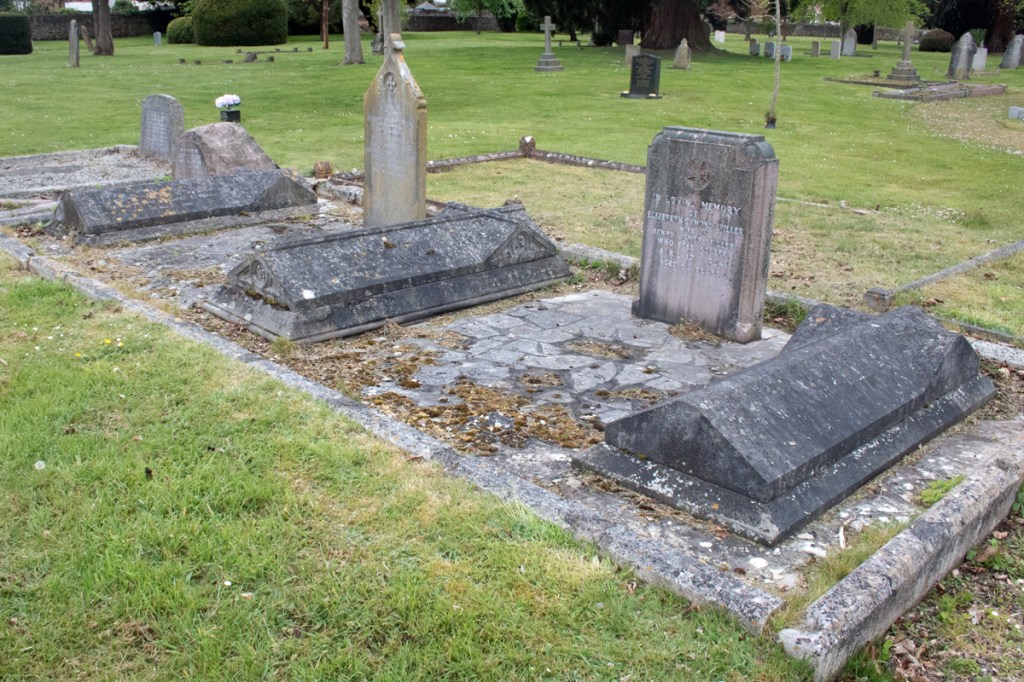
At this point, Herbert disappears from the records. It seems likely that his illness was the cause of his passing, but this cannot be confirmed. Either way, Herbert George Spiller died on 7th May 1920, at the age of 39 years old. He lies at rest in the St James Cemetery in his home town of Taunton, Somerset.


Please note: While Private Spiller was afforded a Commonwealth War Grave, his exact burial location is not identifiable. The image at the top of this post, therefore, is of the other family graves in the cemetery.


Herbert Spiller (from findagrave.com)

Deck Hand Leonard Tucker

Deck Hand Leonard Tucker

Leonard Francis Tucker was born in 1898, the middle of three children to Arthur and Frances Tucker. Arthur was a tailor from Taunton, Somerset, and this is where he brought his young family up.

Sadly, little documentation remains of Leonard’s life. His grave confirms that, when war came, he served in the Royal Navy, and, at the time of his death, he was a Deck Hand on HMS Vivid.

His Commonwealth War Graves Records confirm that his parents were living in Melbourne – his pension ledger confirms Arthur as his next of kin, with an Australian address. There is nothing to confirm their emigration, or whether Leonard emigrated as well.

Leonard’s young life is summed up in a short notice in the local newspaper, which has the simple comment “Tucker – Sept. 28th, at 10 Westgate-street, Taunton, Leonard Francis Tucker, aged 20.” [Taunton Courier and Western Advertiser: Wednesday 9th October 1918]

Slightly more confusing is the next name on that list: “Tucker – Sept. 29, at 10 Westgate-street, Taunton, Frances Ellen Tucker, aged 44.” It would seem that Leonard’s mother was in England, not Australia, at the time of his death, and that she passed away a day after him.

Combined with when Leonard died, it would suggest both he and his mother died from one of the respiratory conditions running rampant through England at the time, possibly influenza or pneumonia. There is nothing to confirm this outright, but it seems the likeliest outcome for the poor mother and son.

Leonard Francis Tucker lies at rest in St Mary’s Cemetery in his home town of Taunton.


As an aside to this, there is no record of where Frances was buried, but it is likely that she too was laid to rest in St Mary’s Cemetery.


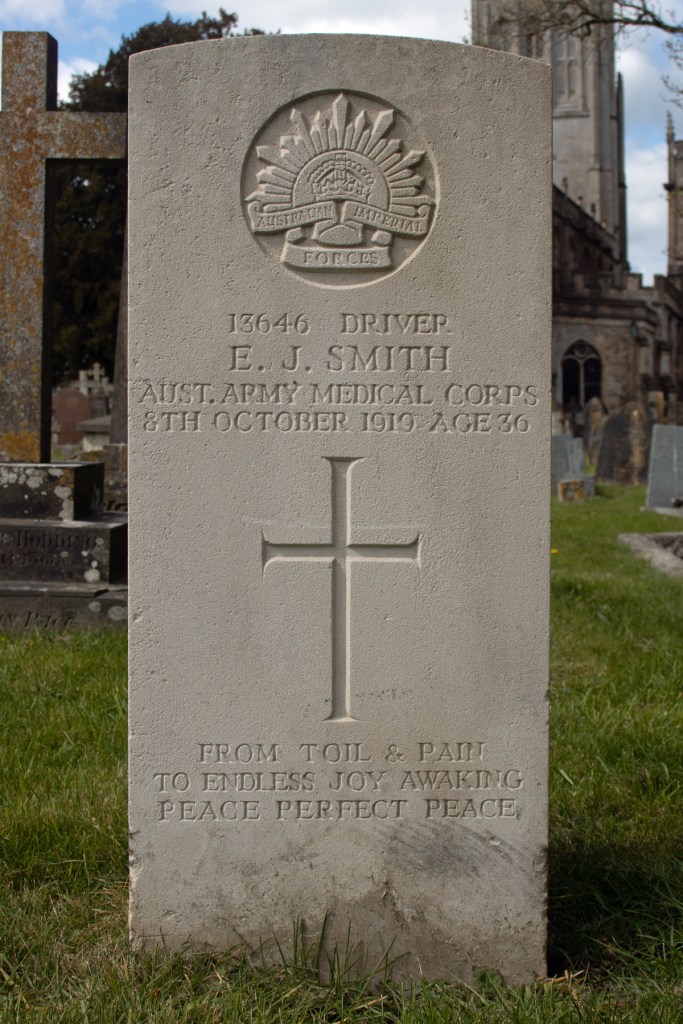
Driver Ernest Smith

Driver Ernest Smith

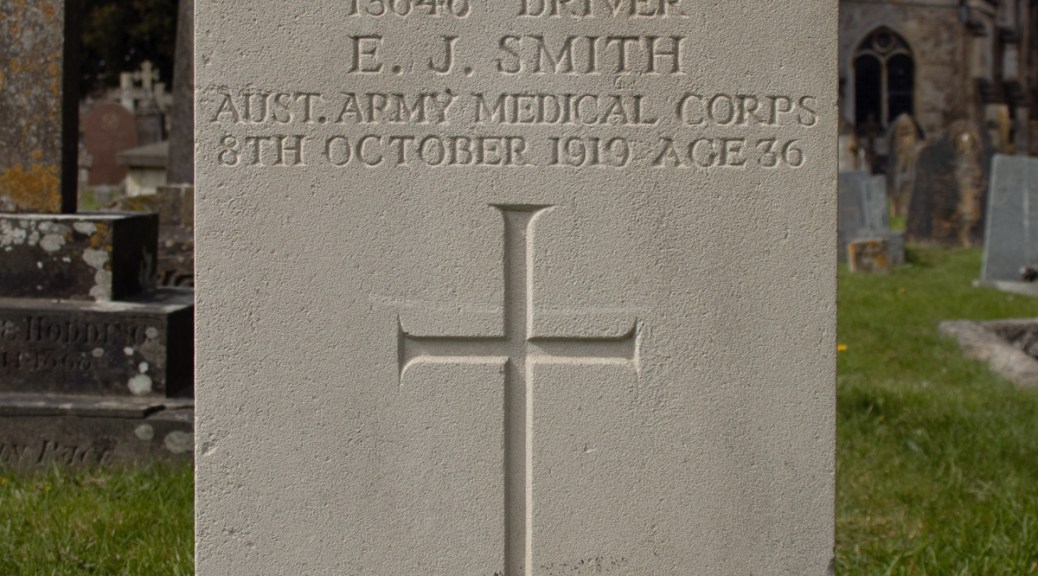
Ernest John Smith was born in 1883, one of seven children to John Smith and his wife Sarah Jane. John was a coal merchant, and the family lived in the Somerset town of Bruton. When Ernest initially left school, he worked as a farm labourer, but at some point, a sense of adventure caught him, and he emigrated to Australia. Sadly, details of his travels are not available, but he left England at some point before 1915.

When war broke out, however, he was still keen to do his bit. He was living in Queensland when he enlisted on 26th October 1915, and was assigned to the Australian Army Medical Corps.

Driver Smith’s battalion left Australia for Europe in March 1916, and served in France for the duration. He was dogged by ill health, catching pleurisy a couple of times, and had a number of fibromas operated on.

In October 1918, he was appointed Lance Corporal, but was shipped back to England later that year with ongoing fibroma issues. He was admitted to Torquay Hospital as dangerously ill in December of that year, and spent most of the next nine months in hospital, initially in Torquay, but then when he was able to be moved, he was transferred to the 1st Australian General Hospital near Warminster.

Sadly, the cysts Driver Smith has developing were malignant, and he passed away on 8th October 1919. He was just 36 years old.

Ernest John Smith was brought back to his home town for burial, and lies at rest in the graveyard of St Mary’s Church in Bruton.


Private Henry Morgan

Private Henry Morgan

Henry Morgan was born in 1892 in Bridgwater, Somerset. He was the oldest of two children, both boys, to Charles Morgan and his wife Ellen. Charles managed the local collar works, making collars for shirts.

While Henry’s younger brother, Herbert, followed his dad’s business, according to the 1911 census, Henry was learning the farming trade. This was to stand him in good stead, and in 1912, he emigrated to Australia, to become a farmer.

Henry settled in Gunnedah, New South Wales, but was called up when war broke out. He enlisted in May 1916 and joined the Australian Machine Gun Corps. His troop left Australia on the ship Borda in November 1916, arriving in Plymouth two months later, and he finally reached France in March 1917.

Initially part of the 9th Machine Gun Battalion, Private Morgan transferred to the 3rd Machine Gun Corps in April 1918. Involved in the Allied defence of the German Spring Offensive, he was caught up in a gas attack and injured.

Wounded on 17th April 1918, Henry was evacuated back to England and admitted to the Voluntary Aid Detachment Hospital in Cheltenham. Sadly, Private Morgan was not to recover, and he died from his injuries on 8th May 1918. He was just 25 years old.

Henry Morgan lies at rest in the Wembdon Road Cemetery in his former home town of Bridgwater, Somerset.