Category Archives: Devon

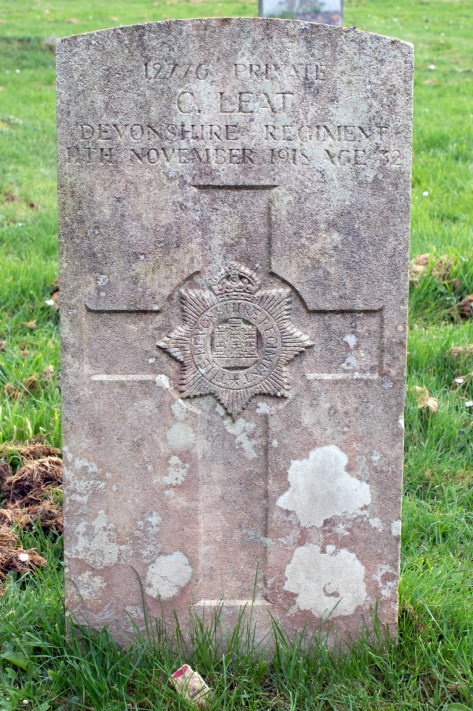
Private Charles Leat

Private Charles Leat

Charles Leat was born at the start of 1888 in Tiverton, Devon. One of thirteen children, his parents were Sidney and Ann Leat. Sidney worked as a lace maker, and the family lived in a crowded cottage on St Andrew Street to the south of the town centre.

When Charles left school, he found work as a grocer’s errand boy. Sidney died in 1897, Ann had to take on lace work herself. The house was too small for the growing family, and so the 1901 census found Charles and his brother Arthur living with his maternal aunt, Mary.

Things had moved on as the new century progressed. By 1911, Charles had moved to South Wales, and was living with his older brother, James, and his family in Glamorgan. James was a house painter, but his sibling had taken on work as a railway porter, and the family lived in terraced house at 57 Tydfil Street, Barry.

When war hit Europe, Charles seemed keen to play his part. Sadly, full details of his military service have been lost to time, but it is clear that he initially enlisted in the opening weeks of the conflict. Joining the Devonshire Regiment, he was assigned to the 11th Battalion.

A later newspaper report suggests that he “had been through most of the fighting on the Western Front… [and] was seriously wounded in 1915.” [Western Times – Friday 15 November 1918] It was after he had recuperated that Private Leat was reassigned to the regiment’s Labour Corps.

By the summer of 1918, Private Leat was serving on Salisbury Plain, Wiltshire. While here, he fell ill, and was eventually admitted to the Amesbury Military Hospital. His condition, pneumonia, was to prove too severe for his body to take, however, and he passed away from the condition on 11th November 1918, Armistice Day. He was 30 years of age.

Charles Leat’s body was taken back to Devon for burial. He was laid to rest in Tiverton Cemetery, not far from where his family still lived.


Petty Officer William Clark

Petty Officer William Clark

William George Clark was born on 23rd November 1884, and was the oldest child to John and Harriet. John was an agricultural labourer from Exminster, Devon, and this is where the family were born and raised.

When he completed his schooling, William found work as a gardener. However, he wanted bigger and better things for himself, and sought out a career at sea. On 12th March 1900 he enlisted in the Royal Navy: being under the formal age to enlist, he was given the rank of Boy 2nd Class.

William was sent to HMS Impregnable, the training establishment in Devonport, for his induction. Over the next two years – until he turned 18 in November 1902 – Boy Clark started to learn his trade. He was promoted to Boy 1st Class in October 1900, and spent time on the frigate HMS Agincourt and the cruiser HMS Melampus.

When William came of age, he was formally inducted into the Royal Navy as an Ordinary Seaman. His service records show that he was just under 5ft 1in (1.55m) tall, with black hair, blue eyes and a fair complexion. He was also noted as having a tattoo of an anchor in his left arm.

Over the next five years, William served on three further ships, returning to HMS Vivid – the Royal Naval Dockyard in Devonport – in between voyages. He travelled the world and, in May 1904, was promoted to the rank of Able Seaman.

Away from the navy, love blossomed. In May 1907, William married Louisa Cosway in Tiverton, Devon. She was a few months older than her husband, and the couple would go on to have one child, William, who was born the following spring.

Back at sea, and Able Seaman Clark’s career continued. In November 1911 he was promoted to Leading Seaman, reaching the rank of Petty Office in January 1917. During his eighteen year career, he would serve on a total of eleven ships, but in the closing months of the war, William’s health was beginning to suffer. On 9th May 1918, he was medically discharged from service, suffering from heart disease.

William returned home to Tiverton. His time with his family was to prove tragically brief: he passed away from mitral disease and pneumatic fever on 13th May 1918, at the age of 33 years old.

William George Clark was laid to rest in Tiverton Cemetery. His grave was just a 15min walk from where his widow and son lived on Fore Street, in the town centre.


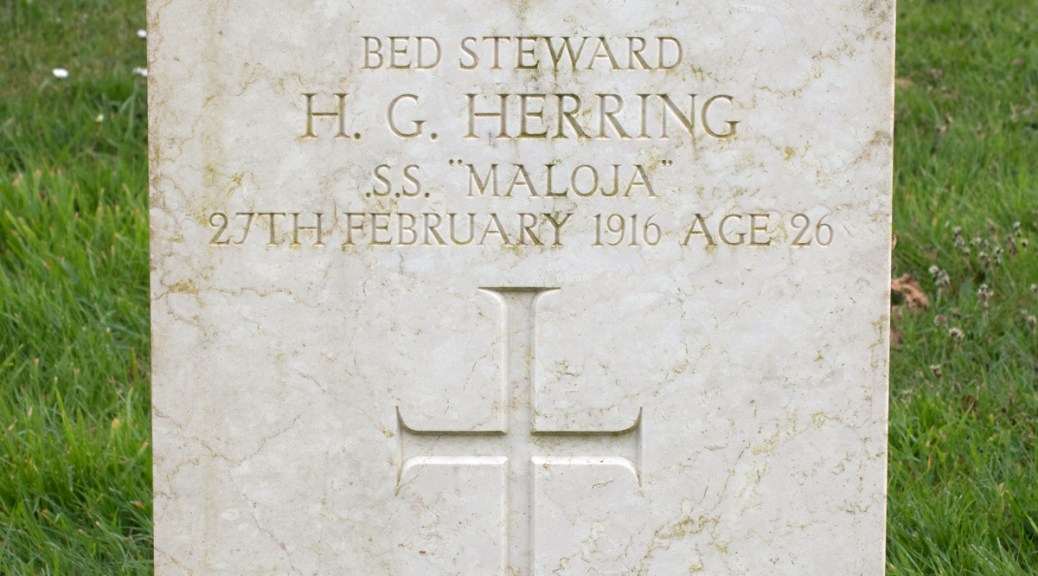
Bed Steward Henry Herring

Bed Steward Henry Herring

Henry George Herring – also known as Harry – was born on 10th November 1889. The second of six children, his parents were Thomas and Mary Herring. Thomas was a tailor from Tiverton, Devon, and the family lived at 131 West Exe South in the town.

Henry sought a life of adventure, and joined the Merchant Navy. Sadly, details of his service have been lost to time, so it is not possible to get a clear picture of his time at sea. Certainly he had moved out of the family home by the time of the 1911 census, though it is unclear whether he had enlisted by this point.

By the start of 1916, Henry was serving as a Bed Steward on board the SS Maloja, a passenger steamship that travelled between Britain and India. On 26th February she left Tilbury, Essex, bound for Bombay, with a crew of 301 and 122 passengers on board.

The following morning, Maloja was sailing through the Strait of Dover when she hit a mine. There was a large explosion and she faltered. The Canadian ship Empress of Fort William was only a short distance behind, and she steamed forward to assist, but she also struck a mine just 1km (0.6miles) away.

The Maloja’s lifeboats were readied to launch and passengers started to board, but the ships engine room had flooded, and she began to list. Three of the four lifeboats were unable to launch, and, as she was unable to stop, no rescue ships could come alongside.

The Maloja sank 24 minutes after hitting the mine. Many of the crew and passengers ended up in the water: most were rescued, but 44 bodies – including that of Bed Steward Herring – were recovered and around 100 people were unaccounted for.

Henry George Herring’s body was taken to shore: he was just 26 years old when he died. He was taken back to Devon for burial and laid to rest in Tiverton Cemetery, not far from where his grieving family still lived.


Driver Thomas Dicker

Driver Thomas Dicker

Thomas Lockyer Dicker was born at the start of 1890 in Tiverton, Devon. One of six children, his parents were Thomas and Mary Dicker. Thomas Sr was a cab driver, and the family lived at 4 Back Lane in the town.

Thomas Jr’s later life is a challenge to pin down. He doesn’t appear on the 1911 census, and his service records have been lost to time. It is clear that he had enlisted before October 1919 – and, in all likelihood, while the war was being fought. Assigned to the Royal Field Artillery, he worked as a driver, and again it is possible that he served overseas at some point.

Thomas Lockyer Dicker died at the Queen Alexandra Hospital in Cosham, Hampshire, on 12th April 1920, although the cause of his passing is unclear. He was 30 years of age. His body was taken back to Devon for burial, and he was laid to rest in Tiverton Cemetery, not far from the family home.


Boy George Hunt

Boy George Hunt

The funeral took place at the Tiverton Cemetery, on Tuesday afternoon, of George Hunt, 17… a member of the Devon band, who died in Ireland as a result of an illness brought on by exposure. Pte. Hunt visited Tiverton for the last time at Christmas. On the return journey to Ireland he, with several others, were drafted to camp to await the arrival of a steamer. Whilst in camp he contracted a severe chill which he was unable to throw off and his parents recently received a message stating that his condition was giving rise to some anxiety. Mr and Mrs Hunt journeyed to Ireland and satisfied themselves that everything possible was being done to save their son. In spite of all efforts he died on Thursday, June 16th.

[Tiverton Gazette (Mid-Devon Gazette): Tuesday 28th June 1921]

George Cockram Hunt was born on 15th January 1904, and was the youngest of five children to William and Emily Hunt. William was a carpenter and joiner from Tiverton in Devon, and this is where the family were born and raised.

There is little additional available about young George’s life. He had enlisted in the army by the middle of 1920, and, as a Band Boy, was attached to the 1st Battalion of the Devonshire Regiment. Given his age, it is unlikely that he spent any time overseas before the Armistice but, as the report of his funeral suggests, he was stationed in Ireland at the time of his death.

Boy Hunt died in barracks in Queenstown – now Cobh – in the south of Ireland. His body was brought back to Devon for burial.

George Cockram Hunt was laid to rest in Tiverton Cemetery, on the outskirts of the town he had called his home for less that two decades.


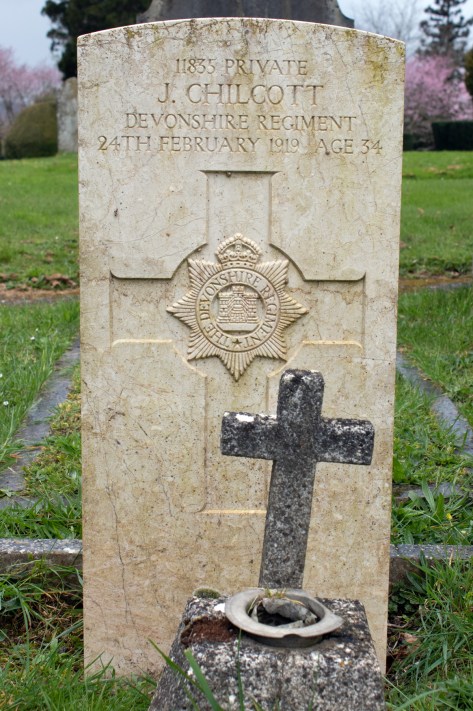
Private James Chilcott

Private James Chilcott

James Chilcott was born in Eccles, Lancashire, in the autumn of 1885. One of twelve children, his parents were William and Mary Chilcott. William seemed to be able to turn his hand to most things: the 1891 census recorded him as a hawker of fish, while ten years later he was employed as an insurance agent.

The Chilcotts had moved to Tiverton in Devon in around 1891, setting up home on St Andrew’s Street, to the south of the town centre. James initially found work as a bookseller’s assistant when he left school, but things were to change.

In the autumn of 1908, James married Mabel Candey. The couple moved to Nottinghamshire, settling in the village of Cresswell, where they lived in a small cottage at 6 John Street. James had found work as a coal miner in the area, which had taken the couple away from the comfort of Devon.

Over the next four years, James and Mabel would have four children, all of whom died before they celebrated their first birthday. The series of tragic events may have driven a need for Mabel to be with family, and by 1913, the couple had moved back to Tiverton. Daughter Dorothy was born in 1914.

When conflict his Europe the following year, James stepped up to play his part. Full details of his military service hare long since lost, but it is clear that he enlisted in the Devonshire Regiment, and had done so at the beginning of the war.

Attached to the 2nd Battalion, Private Chilcott was in France by 9th February 1915. Over the next few years, the unit saw fighting in most areas of the Western Front, including the Somme and Ypres. It is unclear how much of this James was involved in, but it is unlikely that he would have come away completely unscathed.

Pte. James Chilcott, of the 2nd Devons, who went through the dispersal camp at Fovant on February 20, died at Exeter on Monday from influenza. A son of Mr WH Chilcott, of St Andrew-street, Tiverton, he joined up at the beginning of the war, and had seen considerable service. He leaves a widow and one child.

[Western Times: Wednesday 26th February 1919]

James Chilcott died on 24th February 1919: he was 33 years of age. His body was taken back to Tiverton for burial, and he was laid to rest in the town’s cemetery.


“He leaves a widow and one child” does no justice to the pain that Mabel had to go through, having lost four children and her husband in a matter of six years. The 1921 census recorded her living on St Andrew Street with Dorothy, and showing she was undertaking home duties. She had two lodgers, who helped bring in a little more money.

Mabel Chilcott never remarried: she passed away in Tiverton in January 1946, at the age of 62.


Able Seaman Arthur Norris

Able Seaman Arthur Norris

Arthur Norris was born on 24th February 1897 in the Wiltshire town of Mere. The seventh of nine children, he was one of four sons to Fred and Mary Norris. Fred was a domestic groom, and the family lived on Castle Street on the western edge of the town.

By the time of the 1911 census, Arthur had left school, and had found work as an errand boy. He had moved out of the family home, and was living with his older sister, Beatrice, and her husband. Piecemeal work wasn’t something Arthur was keen on, however, and in September 1913, he found himself a career.

That autumn, Arthur enlisted in the Royal Navy. Just 16 years of age, he was too young to formally join up, and so he was given the rank of Boy 2nd Class. He was sent to HMS Impregnable, the training ship based in Devonport, Devon, for his induction, and seemed to make an impression.

On 14th May 1914 Arthur was promoted to Boy 1st Class, and was assigned to the depot ship HMS Gibraltar. On 24th February he came of age, and officially joined the Royal Navy. His service records show that he was 5ft 5ins (1.65m) tall, with dark brown hair, brown eyes and a fresh complexion. He was noted as having a mole on his left shoulder blade.

The now Ordinary Seaman Norris remained on Gibraltar for most of the year. After a couple of weeks back in Devonport, he was assigned to the Armed Merchant Cruiser Oropesa, and remained on board for the next twelve months. During his time there, Arthur was promoted again, gaining the rank of Able Seaman.

Over the next three years, Arthur served on three further vessels: HMS Excellent from March 1916; HMS Woolwich from April 1916 to June 1918; and HMS Columbine from July 1918.

While attached to the Columbine, Arthur fell ill. He contracted pneumonia, and passed away on 16th October 1918. He was 21 years of age.

The body of Arthur Norris was taken back to Wiltshire for burial. He was laid to rest in Mere Cemetery, not far from where his grieving family were still living.


Private Havelock Webber

Private Havelock Webber

It was with painful regret that the inhabitants of Bratton Fleming heard of the death of Private Havelock Webber… who passed away at Hursley, near Winchester, on Tuesday in last week. On being called to the Colours a few weeks ago, he was attached to the 3/6th Devons. Previous to joining up he followed the occupation of a tailor, and was also a part-time postman. Deceased was well-known and highly respected. He was closely connected with every movement at the Village Hall, and was a member of the Committee of Management.

[North Devon Journal: Thursday 11th May 1916]

Havelock Webber was born in Bratton Fleming early in 1878. There is no information available for his parents, but the 1891 census recorded him as living with his paternal grandparents, George and Grace Webber. At 13 years old, Havelock was already learning the tailoring trade.

Havelock doesn’t appear in the 1901 census, and the 1911 return gives little information away either. At this point he is boarding in a house with either the Bale or Musworthy family (his is a separate record, with those two families adjoining his).

Beyond this, there is little information available about Private Webber’s life or military service. He died from peritonitis on 2nd May 1916 in the Hampshire Camp. He was 38 years of age.

Havelock Webber’s body was brought back to Devon for burial. He was laid to rest in the graveyard of St Peter’s Church in his home village of Bratton Fleming, Devon.


Private Gilbert Smyth

Private Gilbert Smyth

Gilbert Rowland Locke Smyth was born in the summer of 1897, and was the oldest of three children to Charles and Elizabeth. Charles was a postman and bootmaker and both he and his wife came from North Molton in Devon. The 1901 found the young family taking rooms in Dobbs Cottage on East Street, midway between two pubs: the Poltimore Arms and the Miner’s Arms.

Gilbert – who was better known as Roy – found work as a clerk she he finished his schooling. By the time war broke out, he was had moved to East Sheen, Surrey, and was employed by the civil service. He was keen to play his part, and enlisted in the army on 10th December 1915.

Initially assigned to the Suffolk Regiment, Private Smyth’s service records give an insight into the young man he had become. At eighteen years of age, he was 5ft 8.5ins (1.74m) tall, and weighed 112lbs (50.8kg). While he had worn spectacles for a couple of years, he was noted as being of fair physical development. The document confirms that he had a mole on the top of his right arm.

Roy was not formally mobilised until October 1916. After four months’ training on home soil, his unit, the 14th Battalion, was sent to France. Private Smyth remained overseas for nearly a year, during which time he transferred to the 12th Battalion of the York & Lancashire Regiment.

At the end of July 1918 Roy was caught up in a German gas attack, and this would have a long-term effect on his health, particularly his eyesight. He returned to Britain on 30th November 1918, and, after a couple more months spent in France, he was formally discharged from the army on medical grounds on 5th April 1919.

The deepest sympathy is extended to Mr and Mrs C Smyth in the loss of their eldest son, Roy… Deceased, who was employed in London in the Civil Service, was taken ill with pneumonia, and died before his father could arrive.

[Exeter and Plymouth Gazette: Friday 6th August 1920]

Gilbert Rowland Locke Smyth died on 3rd August 1920: he was 22 years of age. He was brought back to Devon for burial, and was laid to rest in All Saints’ Churchyard in his home village of North Molton.


Private John Lethaby

Private John Lethaby

The news of the death of ex-Gunner JC Lethaby, who passed away early on Monday morning last. was received… with deep regret. On the outbreak of war he was only 16 years old, but when the call came for volunteers, he put his age to 19 and enlisted. He proved his worth on the battlefields of Flanders and after being wounded, was gassed, his work as a first class machine gunner calling him into much danger. He recovered from his injuries to some extent, but after demobilisation, his health broke down and he gradually sank. His pain and suffering during the past months were borne with much patience. Last week he earnestly begged to be removed to his home… and he was brought by motor car.. on Sunday afternoon, but he passed away the next morning. He leaves a wife and child to mourn their loss, and sympathy is expressed with them as also with his mother, father, brothers and sisters… Always of a cheerful disposition deceased had a host of friends, especially among the young men of the parish. He was awarded the Meritorious Service Medal and was entitled to the 1915-1915 Bronze Star.

[Tiverton Gazette (Mid-Devon Gazette): Tuesday 15th June 1920]

Despite the John Charles Lethaby’s obituary, there is little additional information about his early life. He does not appear on the 1901 or 1911 census returns, and there is no obvious sign of a birth or marriage certificate.

The Commonwealth War Graves Commission gives his wife’s name as Clara, and a later military record suggests that she moved to Hitchin, Hertfordshire, after her husband’s death. The 1921 census noted that she was living with her parents, Arthur and Eliza King, and had her daughter, Ada, with her.

The newspaper report suggests that John was born in 1898, which would have made him 22 when he died on 7th June 1920. His headstone gives his age as 25, which would fit in with the obituary commenting that he had added three years to his age in order to enlist. He appears to have joined the 3rd Battalion of the Devonshire Regiment, before transferring across to the Machine Gun Corps.

John Charles Lethaby was discharged from army on medical grounds on 19th April 1919. He died of pulmonary tuberculosis just over a year later, and was laid to rest in All Saints’ Churchyard, North Molton, Devon.