Category Archives: Lancashire

Private John Maguire

Private John Maguire

John Maguire was born in Dublin, Ireland, in 1874. There is scant information about his life, and his name is too common to be able to narrow down details of his family.

The only documentation that links to his life is that of his army service. He was working as a labourer when he enlisted in the Royal Army Medical Corps on 27th April 1918. His service records confirm he was 5ft 7ins (1.7m) tall, with blue eyes, grey hair and a sallow complexion. Interestingly, he reported that he did not have any next-of-kin.

Private Maguire seemed to serve on home soil, and was primarily based in Lancashire. It was while here in the January of 1919 that he fell ill with nephritis – kidney disease – and was admitted to the hospital on Adelaide Street, Blackpool.

His condition was such that it led to John’s discharge from military service on medical grounds. On 23rd February he was moved to the 2nd Southern General Hospital in Bristol, and two days later he left army life. John was transferred to the War Hospital in Bath a couple of weeks later, and it was here that he passed away on 16th April 1919. He was 45 years of age.

An addition to John’s initial service records noted that a next-of-kin had been confirmed, and so Mary Prestige, who was living in Bedminster, to the south of Bristol, was informer of her friend’s death.

Respecting the Irishman’s religion, John Maguire was laid to rest in the Roman Catholic Cemetery in Bath, the city in which he died.


John’s friend, Mary Prestige, is also destined to remain a mystery. There are no records of her at the address John’s service records provide – Pipe Cottage, North Street, Bedminster.

There are two census records for Somerset for a Mary Prestige: 1901 records a Durham-born 18 year old Mary working as one of a number of laundry maids at the Marlborough Hill House of Refuge in Bristol.

The 1911 census records the same Mary Prestige visiting a William and Amelia Hockerday in Yatton, Somerset. It is impossible to confirm, however, whether this is the woman John notified the army as his next of kin.

Sergeant Herbert Rendall

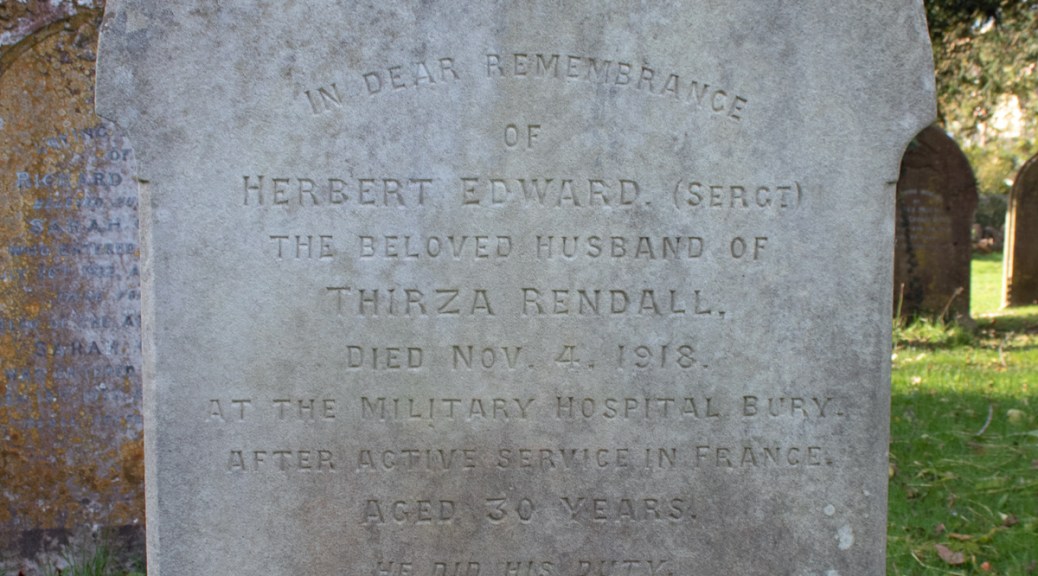
Sergeant Herbert Rendall

Herbert Edward Rendall was born in West Coker, Somerset, in the autumn of 1889. He was one of eight children to William and Mary Rendall. William was a foreman at a local twine factory, although by the time of the 1911 census, he had also taken on ownership of a local grocer’s shop. Herbert and his younger brother, Clifford, managed the shop for their father.

In the spring of 1913, Herbert married Thirza Shire. She was the daughter of an agricultural labourer from Yeovil and, by the time of their marriage, she had taken on work as a servant for the vicar of St Leonard’s Church in Misterton, near Crewkerne.

When war was declared, Herbert joined the Somerset Light Infantry. Sadly, little detail of his military service remains. It is clear that he was hard working and well thought of, as he progressed through the ranks to Sergeant, and transferred to the 1st Battalion of the Wiltshire Regiment.

Herbert served on the Western Front, and, as the war entered its final months, he would certainly have been involved in the Battles of the Lys, on the Hindenburg Line and in the closing Battles of the Somme.

By the autumn of 1918, Sergeant Rendall was back on home soil, either for home support, or for medical reasons. He was based in Bury, Manchester, and had fallen ill. While the full details are unclear, whatever condition he had contracted got the better of him, and he passed away on 4th November 1918. He was 29 years of age.

Herbert Edward Rendall was brought back to Somerset for burial. He was laid to rest in the quiet graveyard of St Martin’s Church in West Coker.


Records vary over the date of Herbert’s passing. While his headstone confirms 4th November, military records – and the Commonwealth War Graves Commission website – suggest the following day. Similarly, some documents suggest he was 30 when he died, while his birth and death records confirm he was in his thirtieth year.


Thirza went on to have a full life. She married again in 1923, to a Henry Tregale, and the couple went on to have a daughter. She lived to a ripe age, passing away in the autumn of 1981, at the age of 93.


Stoker John Campbell, AKA John Connolly

Stoker John Campbell, AKA John Connolly

John Connolly was born on 7th April 1887 in Liverpool, Lancashire. There is little information available about his early life, although his parents were Thomas and Marianne Connolly. A Roman Catholic, he was baptised at St James Church and went on to marry a woman called Bridget, although details for the wedding are lost to time.

John must have had a level of proficiency when it came to ships and sea-faring as, when war had broke out, he was call up for service with the Royal Naval Reserve (RNR). He enlisted as a Stoker on 1st October 1915, using the surname Campbell. His records show that he was 5ft 6ins (1.68m) tall, had blue eyes and a fair complexion.

Stoker Campbell was based at HMS Pembroke, the Royal Naval Dockyard in Chatham, Kent. His time in service, however, does not seem to have been a happy one. In fact, within a few months of being conscripted, John had absconded and made his way back to Liverpool.

John was caught and was being brought back to Kent under escort, when the unimaginable happened.

John Connolly, a stoker of the RNR, attached to the Royal Naval Barracks, Chatham, was found dead on the railway near Warren House Crossing, between Sole Street and Cuxton, on Wednesday, with terrible injuries to his head.

Connolly, who is known also as Campbell, had been arrested as a deserter at Liverpool, and was returning to Chatham under escort on Tuesday… The train was very full, and deceased, with his escort, stood in the corridor, where several soldiers were also standing.

Some time after the train had left Herne Hill the escort, Leading Stoker John Edward Craig, left his prisoner to proceed to the lavatory, and when he returned one of the soldiers shouted “Jack, your prisoner had gone out the window.” The train was stopped, but the guard suggested that Craig had better proceed to Rochester instead of searching for the deceased, as the night was very dark. At Rochester Bridge the matter was reported to the military authorities, and a search along the line, then ordered, resulted in the discovery of the body of deceased…

A Lance Corporal of the 2/5th King’s Liverpool Regiment, one of the soldiers in the corridor, gave evidence at the inquest… He said he was standing close by deceased, but did not see him go out of the window, which was open at the time.

It was stated that is was usual in the Navy for one man only to act as escort, as all expenses connected with desertions had to be paid by the prisoners.

The jury found the death resulted from injuries received by deceased in a fall from the train, but that there was not sufficient evidence to prove whether the fall was intentional or otherwise.

South Eastern Gazette: Tuesday 8th February 1916

Whether John had intended to throw himself from the train will never be known. All that can be confirmed is that he died of his injuries on 1st February 1916, aged just 28 years old.

John Connolly was laid to rest in Woodlands Cemetery, Gillingham, not far from the dockyard at which he had been based. His epitaph mentioned both of the names he chose to go by, and the inscription: “Beloved husband of Brigid, her one and only love. Re-united RIP. Jesus mercy Mary help.


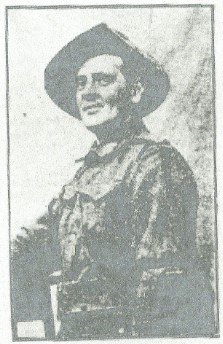
Private Hugh Jones

Private Hugh Jones

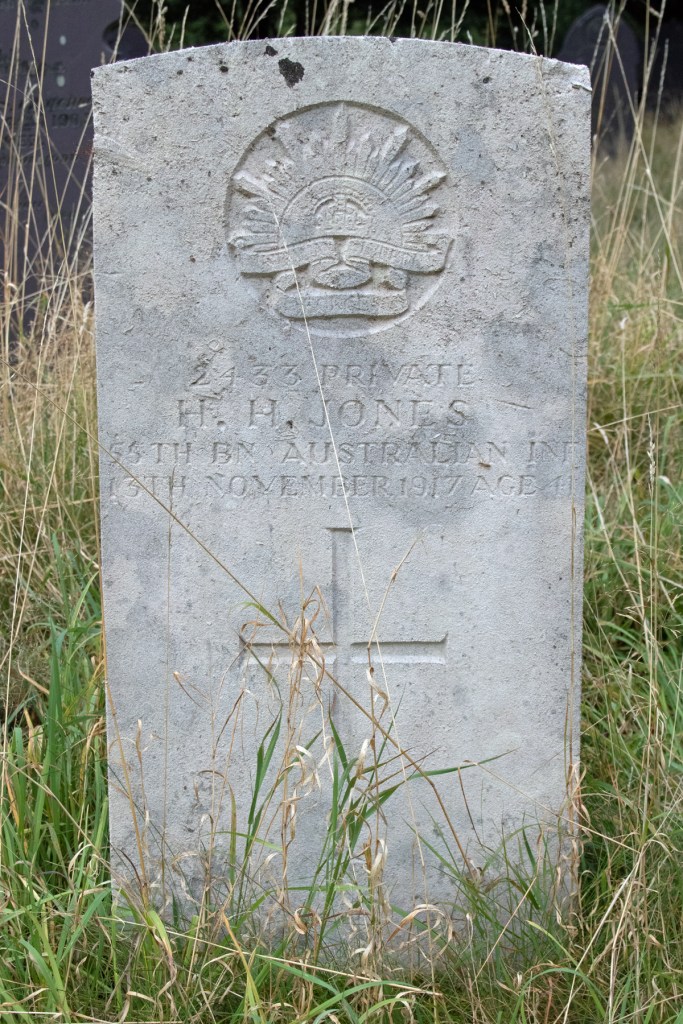
Hugh Henry Jones was born in around 1876 in the Welsh village of Llanberis, Gwynedd. He was one of seven children to quarryman John Jones and his wife Mary.

Slate was the big industry in Snowdonia, and Hugh and his brothers all followed his father into the quarries. Labour was plentiful and wages would not have been high, so when the opportunity arose for employment overseas, he seems to have taken it.

Exact details are sketchy, but Hugh emigrated to Australia at some point in the early 1900s. He settled in the city of Goulburn, New South Wales and the experience he had built up back home stood him good stead, as he continued working as a quarryman.

When war broke out in Europe, those in the British colonies were called upon to play their part, and Hugh was among those to serve King and Country. He enlisted on 29th December 1915, joining the 55th Battalion of the Australian Infantry.

Private Jones’ service records show that he was 40 years and six months old, stood 5ft 4ins (1.63m) tall and weighed 130lbs (59kg). He had a dark complexion, blue eyes and black hair. He also appears to have had a denture in his lower jaw.

After initial training, Private Jones set off for Europe at the end of September 1916, arriving in Plymouth six weeks later. Within a matter of weeks he was on the move again, sailing for France, and arriving at Etaples at the start of 1917.

Private Jones was ensconced on the Western Front for the next few months but, as spring came, he was starting to have some health issues. In April he was admitted to a field hospital suffering from dyspepsia (indigestion), which was subsequently diagnosed as gastritis.

Medically evacuated to Britain for treatment, Hugh spent the next few months being treated in hospitals in Kent, and Dorset, before being admitted to the Royal Infirmary in Liverpool. Sadly, by this point, his condition had been identified as stomach cancer and, while in Liverpool, he passed away. Private Jones breathed his last on 13th November 1917, at the age of 41 years old.

Hugh Henry Jones was brought back to Wales for burial. He was laid to rest in the graveyard of St Peris Church in his home village of Llanberis.


Private Hugh Jones
(from findagrave.com)

Private Griffith Hughes

Private Griffith Hughes

Griffith Hughes was born in Llanberis, in modern day Gwynedd, in 1893. Sadly, there is little information about his early life, and records mention his mother – Margaret – but no father. The 1901 census records Griffith as living with his grandmother, Ann Hughes.

Ten year later, the two are living in a two-up, two-down cottage – 19 Snowdon Street, Llanberis – with Griffith’s aunt, Ann’s daughter Jane, and her husband, Thomas. Griffith is earning money by now, working as a slate dresser at one of the local quarries.

War was coming to Europe by this point, and Griffith was called upon to play his part. He initially enlisted in the Welch Regiment as a Private, although he seems to have transferred across to the South Wales Borderers during his service.

Private Hughes’ time in the army was spent on home soil, although he earned the Victory and British Medals for his service. He remained in the army through to the end of the war and beyond until, on 15th August 1919, he was medically discharged. He had developed tachycardia, and this was having an impact on his life.

When Griffith left the army, he was based in Lancashire, and was living in the village of Bryn, to the south of Wigan. He remained in the area for the next year, his health sadly deteriorating. Admitted to the cottage hospital in nearby Pemberton, he passed away from his heart condition on 18th September 1920. He was just 27 years old.

Griffith Hughes was brought back to Wales for burial. He was laid to rest in the quiet graveyard of St Peris Church, in his home village of Llanberis.


Private Edward Savage

Private Edward Savage

In the graveyard of St Augustine of Hippo Church in Penarth, Glamorgan, lies the Commonwealth War Grave for Private Edward Savage. The headstone confirms that he had died on 25th December 1915 and that he was in the Loyal North Lancashire Regiment.

The Commonwealth War Grave Commission website suggests that he was the son of Edward and Rachel Savage and that he was born in Beccles, Suffolk. Sadly, there are no available census documents to shed any further light on that early life.

The same website suggests that he served in Burma, and in the South African campaign, which would have placed him there in the late 1890s and early 1900s.

It is also noted that Edward was the husband of Emily Savage and that they were living in Fleetwood, Lancashire. Edward’s later pension ledger suggests this was an Emily Shannon, who is, in fact, noted as the guardian of his illegitimate child. Further information, however, is not available.

From a military perspective, it is likely that Private Savage was either still service at the point that the First World War broke out, or that he was called into service – or volunteered his services – shortly after its declaration. He was assigned to No. 5 Supply Company of the 3rd/4th Loyal North Lancashire Regiment and, by the autumn of 1915, he found himself based at Penarth Head Fort near Cardiff.

Edward’s death seems to have been a less than auspicious one, as a local newspaper reported at the time.

The district coroner held an inquest at Penarth on Tuesday touching the death of Private Edward Savage, who was found dead at the billets of the A Company of the Loyal North Lancashire Regiment on Sunday morning. Surgeon-Major Charles Parsons, the local medical officer, stated that the deceased had apparently fallen down some stone steps, causing a fracture of the base of the skull. The jury returned a verdict of “Accidental Death.”

Western Mail: Wednesday 29th December 1915

Private Edward Savage had died on Christmas Day, 25th December 1915. He was 54 years of age. He was laid to rest in the graveyard of St Augustine of Hippo Church in Penarth.


Edwards shares his grave with another member of the Loyal North Lancashire Regiment, Serjeant Frank Carter. Read his story here.

Private William Bullock

Private William Bullock

Frederick William Bullock, who was known by his middle name, was born in the spring of 1894 in the small Somerset village of Hillfarrance. His parents were Frederick and Mary, and he was one of eleven children.

Frederick Sr was an agricultural labourer, but William wanted a life of adventure, and, by 1910, he had joined the army. It seems likely that he lied about his age when he enlisted, as he would only have been 16 years of age. Assigned as a Private to the 6th Dragoon Guards (The Carabiniers), he was based in Aldershot, Hampshire. His service records show that he was 5ft 6ins (1.68m) tall, had black hair and grey eyes.

Private Bullock’s early years of service were seemingly free of incident but this was to change. On 22md January 1914, his troop were preparing to board ship to sail to Egypt, but William went AWOL. He was apprehended a week later, tried and convicted of desertion. He was imprisoned for 56 days and his previous service with the army was forfeited.

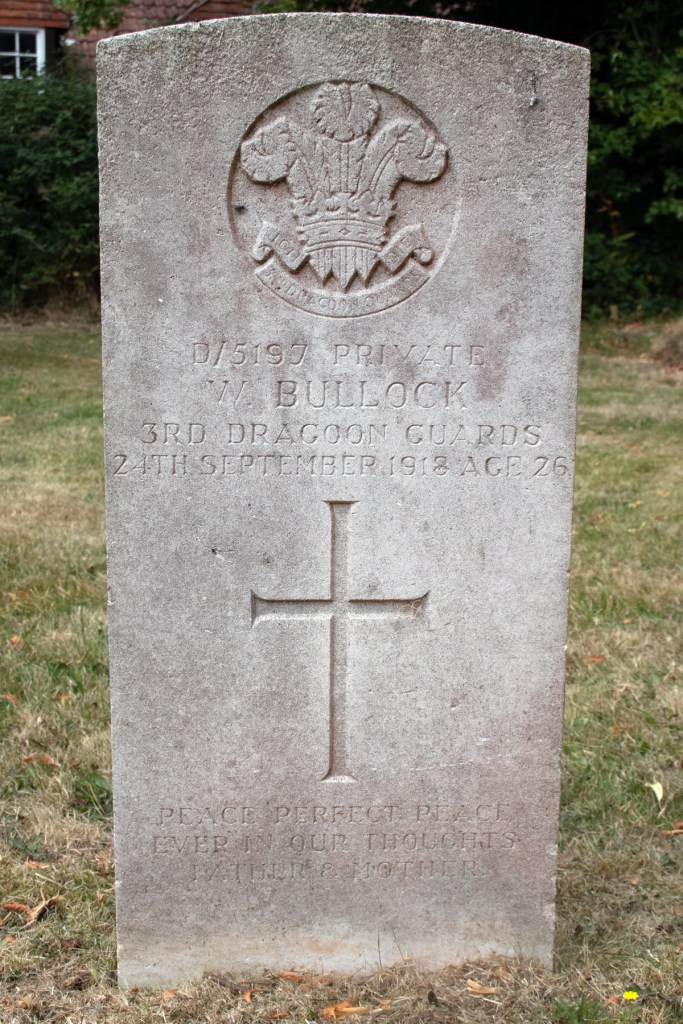
On 16th August, just a fortnight after war was declared, Private Bullock was sent to France. He spent three months on the Western Front before returning to England. In June 1915, he had transferred to the 3rd (Prince of Wales) Dragoon Guards, and was again sent to France.

William remained in France until the end of July 1916, when he fell ill and was medically evacuated to England for treatment. He was initially admitted to the 2nd Southern General Hospital in Bristol with a crumbling spine, but then transferred to the 2nd Western General Hospital in Manchester for more specialist treatment.

The condition, while not aggravated by his military service, was enough to have him medically discharged because of it. Private Bullock left the army on 28th July 1917.

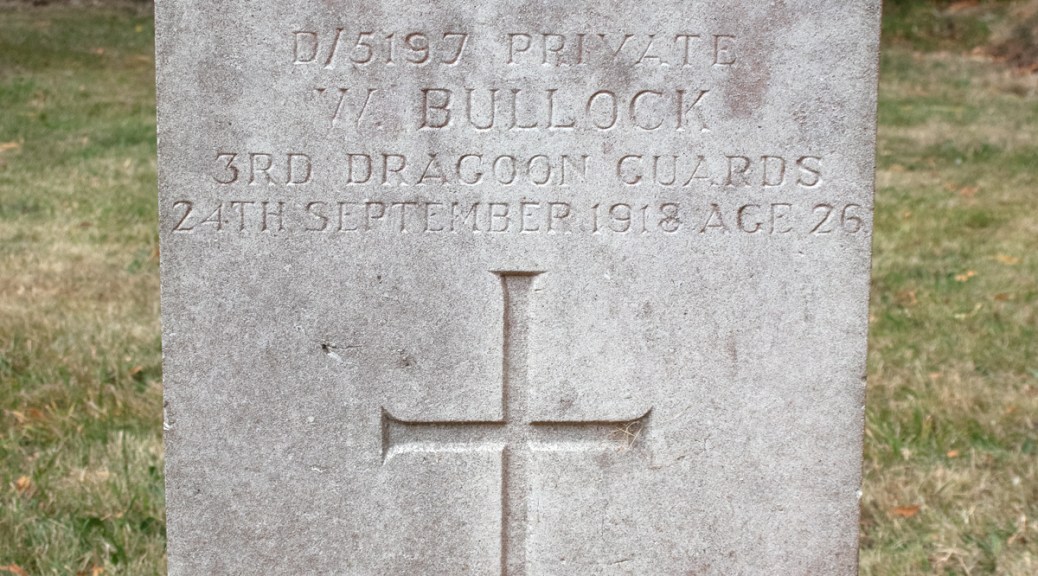
At this point, William’s trail goes cold. What can be confirmed is that he passed away on 24th September 1918, at the age of 24 years old. He was laid to rest in the graveyard of St Giles’ Church in Bradford-on-Tone, a village not far from his birthplace, where his family now lived.


Private William Catlow, AKA William Adams

Private William Catlow

William Adams was born in Skelmersdale, near Liverpool, in around 1868. He was the son of George and Harriet Adams, although as his name was quite common in the area at the time, it is not possible to narrow down details of his early life any further.

At some point after leaving school, William joined the army, using the surname of Catlow. The 1891 census records him as a soldier in the Private Infantry, based at the Habergham Eaves Barracks near Burnley, Lancashire.

On leaving the army, William found work as a labourer and, by the 1890s, he had moved to Kent. He met and married a woman called Kate in 1895, and they went on to have a son, Archibald, the same year. The 1911 census records the family living in Cheriton, near Folkestone, William doing labouring work, and Kate employed as a laundress.

With the outcome of the First World War, William stepped forward to play his part again. By this point, he was 46 years old and, while he was assigned to the 4th Battalion of The Buffs (East Kent Regiment), was given more of a territorial role.

Private Catlow was serving at the site shared by the Cotton Powder Company and Explosives Loading Company to the north of Faversham in the spring of 1916. On the afternoon of 2nd April 1916, a fire caused a series of massive explosions at the factories, and William was one of around 110 people to be killed. He was 48 years of age.

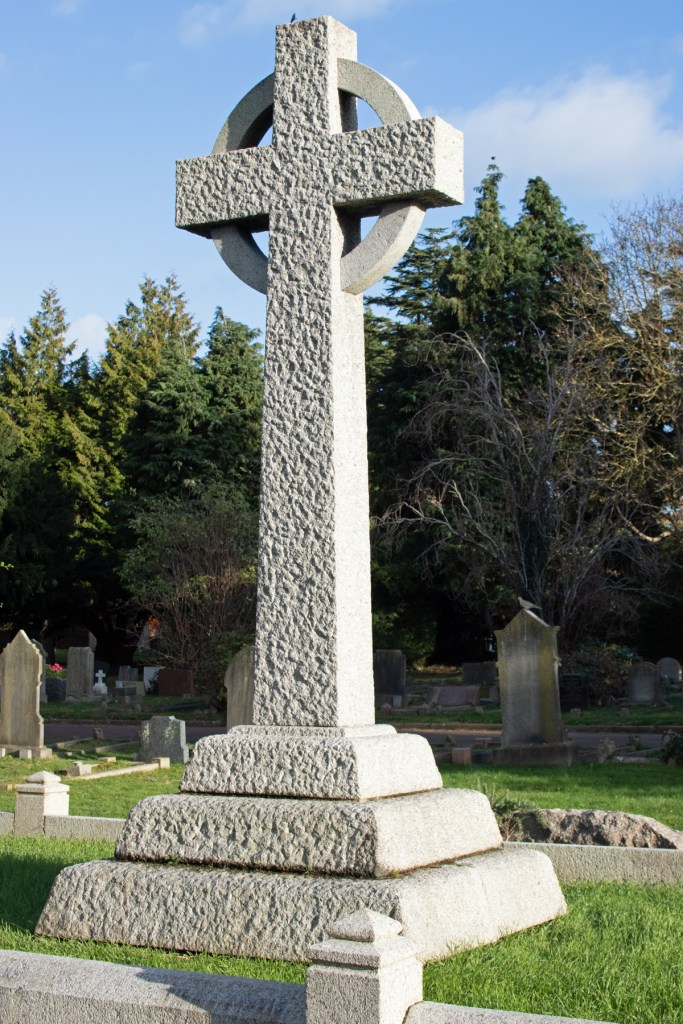
William Adams, known militarily as Private William Catlow, was laid to rest, along with the other victims of the Faversham Explosion, in the town’s Borough Cemetery.


Memorial to the Faversham Explosion, Borough Cemetery

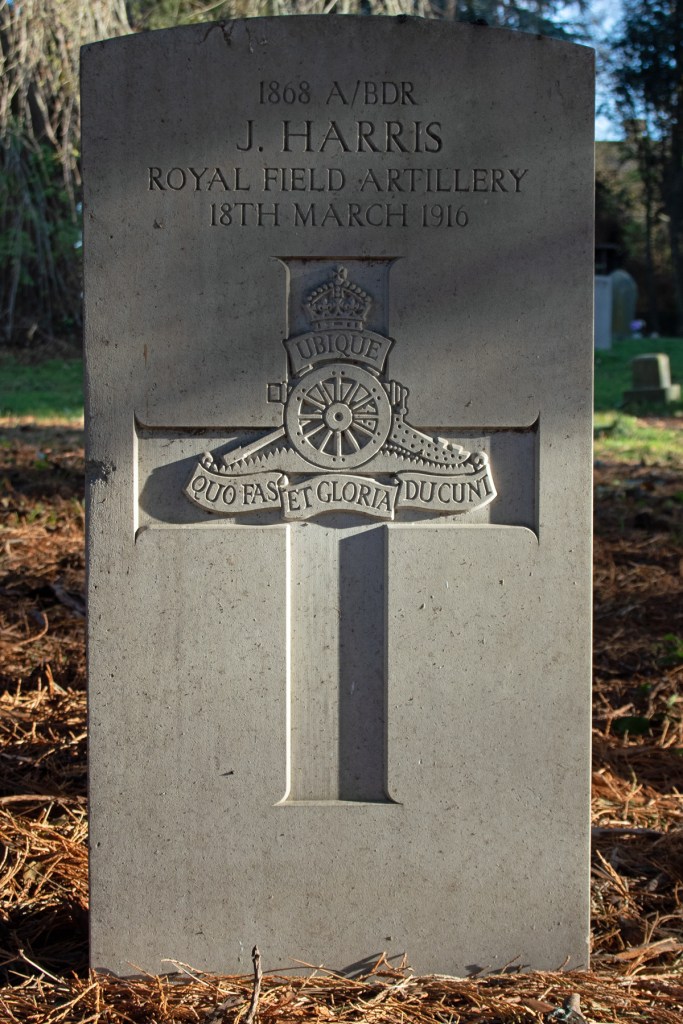
Bombardier John Harris

Bombardier John Harris

Sadly, much of John Harris’ life is lost to time. Born in Liverpool in around 1896, he was one of at least eight children, but, with a name as common as his, there is little to identify who his parents were.

What information remains available, comes from contemporary newspaper reports of his funeral:

Acting Bombardier Harris, of the 13th Battery, 2/3rd West Lancashire, died from double pneumonia at The Mount Hospital [in Faversham, Kent] last Saturday. He was 20 years of age, belonged to Liverpool, and had been in the Brigade about ten months. Deceased had been ill for about a fortnight. Several of the men at The Mount attended the funeral, and one of the nurses there accompanied the deceased’s sister.

Faversham News: Saturday 25th March 1916

From this it is possible to determine that John enlisted in the 2nd/3rd West Lancashire Artillery of the Royal Field Artillery in May 1915. His was a territorial force that was, by the spring of 1916, based in Kent.

It would seem that Acting Bombardier Harris’ parents had passed on by the time that he died at The Mount. His siblings – brothers Alfred and Edward, sisters Edith, Clara, Louise, Alice, Kate and Elizabeth – were all based in Lancashire.

John Harris, therefore, was buried in the town where he passed away, and was laid to rest in Faversham Borough Cemetery.


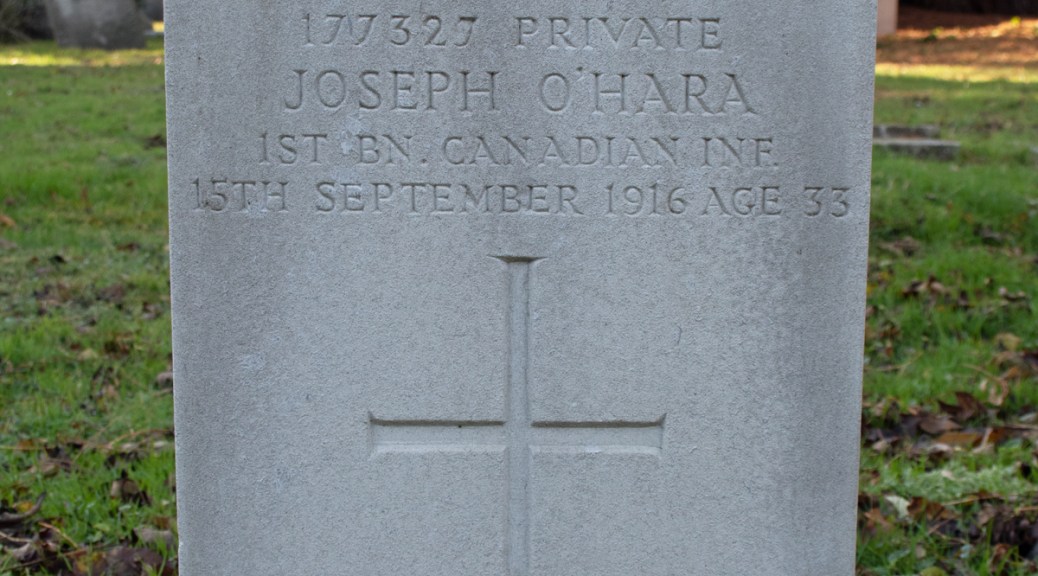
Private Joseph O’Hara

Private Joseph O’Hara

Joseph O’Hara was born in Manchester on 30th May 1882, the son of John and Kate O’Hara. There is little information available about his early life, although it is clear that at some point the family emigrated to Canada, settling in Toronto.

When war broke out, Joseph enlisted, joining the 1st Battalion of the Canadian Infantry. By 1916 Private O’Hara was not only back in Europe, but fighting on the Western Front. Details are scarce, but a contemporary newspaper sheds a little light on what happened to him next.

A contingent of 132 wounded men was detrained at Faversham last Friday morning. Forty-four of the number were taken to The Mount, seventy-one to Lees Court, and seventeen to Glovers (Sittingbourne).

With one exception the cases were all “sitting up” cases and were in a separate train by themselves. This train, however, was preceded by a train of “cot” cases which was going through to Chatham, but owing to the serious condition of one of the men – Joseph O’Hara, of the Canadian Expeditionary Force – the train was stopped at Faversham for his removal to the Mount Hospital. O’Hara had been badly wounded in both legs and he died at the Mount a few hours after his arrival there.

Faversham News: Saturday 23rd September 1916

Private Joseph O’Hara was 34 years of age when he passed away. He was laid to rest in the Faversham Borough Cemetery.


Private Joseph O’Hara
(from findagrave.com)