Category Archives: Lancashire

Stoker 1st Class Benjamin Corker

Stoker 1st Class Benjamin Corker

Benjamin Corker was born in Liverpool on 23rd June 1893, one of four children to James and Mary Corker. James was a railway foreman and porter from Helsby in Cheshire, who had moved to the city to get work.

Mary passed away in 1906, and this may have been the spur that got Benjamin moving. On 14th March 1910, he enlisted in the Royal Navy as a Stoker 2nd Class, for the set term of twelve years’ employment.

Benjamin’s service records shed a little more light into his life. He was noted as being 5ft 10ins (1.78m) tall, with brown hair, blue eyes and a fresh complexion. At the time that he enlisted, he was working as a capstan man for the railway, moving trucks in the goods yard using a rope device similar to that found on ships at the time.

The section on wounds, scars and marks notes that he had “tattooed tombstone, wreath and ‘in memory of my mother’, 3 crossed fishes, heart anchor and cross” on his right forearm; on his left were “heart flag, wreath flag, ‘mizpah’, KJ and two dots and indistinct letter C”. He also had a mole under his chin. The Hebrew word mizpah (remembrance, or emotional bond) is intriguing, and suggests that, while Benjamin was baptized at St Cleopas Church in Toxteth, there may have been Jewish heritage in his family line.

The last noteworthy entry on Stoker Corker’s naval records is that he had given his date of birth as 23rd June 1890, three years older than he actually was. He would have been 17 – and therefore underage – at the point he enlisted, which shows either a drive to follow his dream, or to escape some other reality.

Whatever his circumstances, Benjamin boarded HMS Acheron in Liverpool, and sailed from there to the Royal Naval Dockyard in Chatham, Kent, for formal training at HMS Pembroke there. After three months he was given his first formal posting on board the battlecruiser HMS Indomitable. He spent eighteen months on board, and received a promotion to Stoker 1st Class in the process.

After a further spell of training in Chatham, Stoker Corker was then assigned to HMS Hibernia, another of the Royal Navy’s battleships. He spent more than five years on board, through to the summer of 1917.

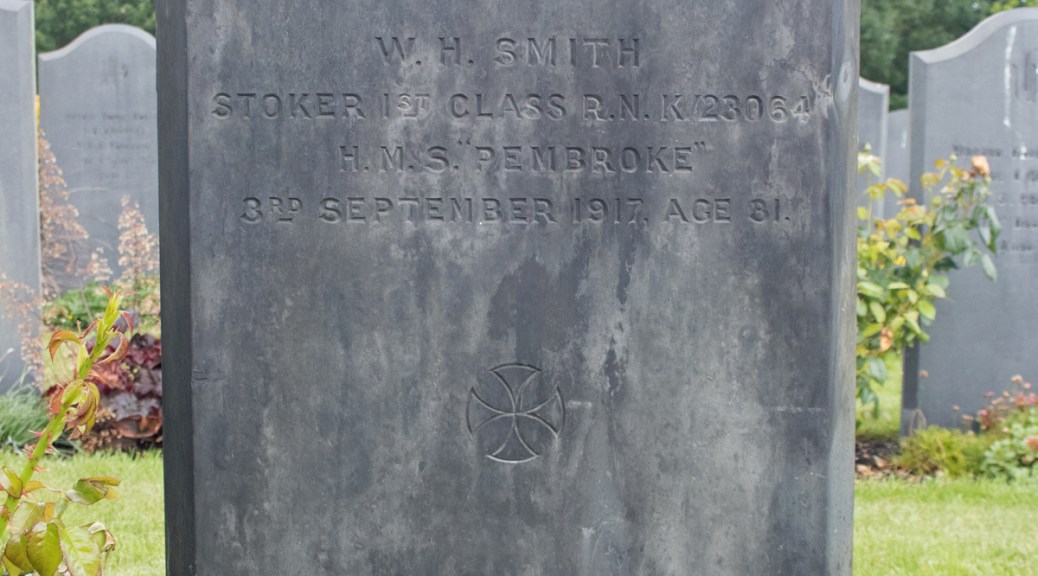
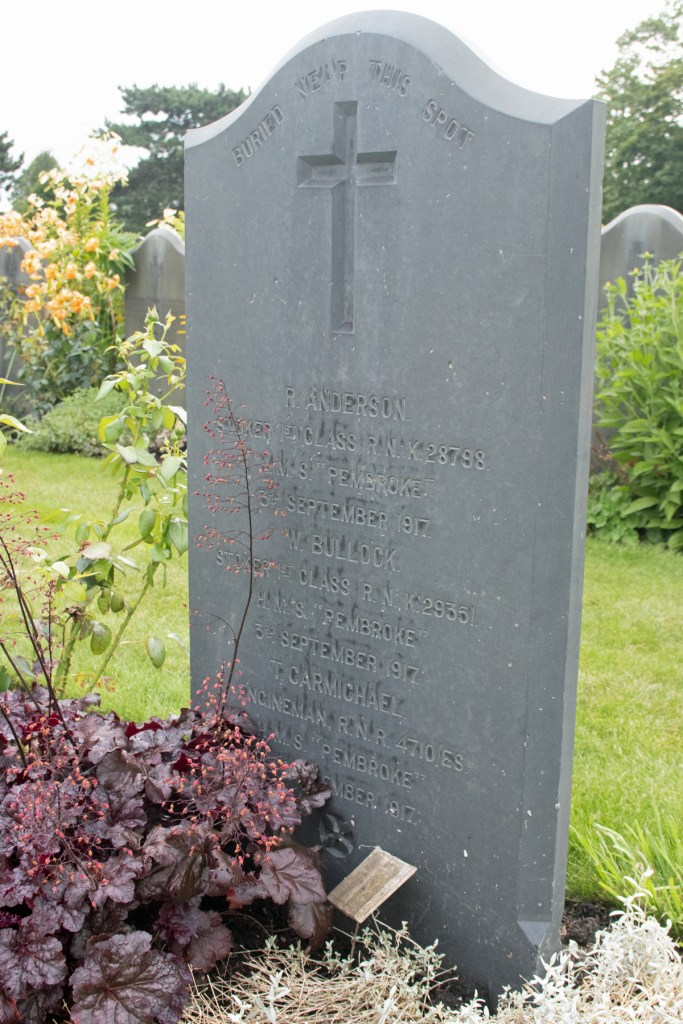
Benjamin then returned to Chatham to await his next posting. HMS Pembroke was a busy place that summer, and, with its barracks having reached capacity, the glass-roofed Chatham Drill Hall was used as temporary accommodation. This is where Stoker Corker found himself billeted.

By this point in the war, the German Air Force was trying to minimise the losses it had suffered during daytime raids. Instead, it trialled night flights and, on 3rd September 1917, Chatham was bombed. The Drill Hall received a direct hit, and Stoker Corker was killed along with close to 100 others. He was just 24 years old.

The victims of the Chatham Air Raid were buried in Woodlands Cemetery, Gillingham. Benjamin Corker was also laid to rest there, and lies within walking distance of the naval dockyard in which he had served.


Leading Stoker Joseph Craven

Leading Stoker Joseph Craven

Joseph Craven was born in Liverpool on 6th January 1870. There is little information available about his early life, but by the time of the 1891 census, he was boarding with a blacksmith and his family in Bootle, Lancashire. By this point he was working as a fireman – probably a stoker-type role, rather than for the fire service.

The following year, Joseph found an opportunity to broaden his horizons and, on 21st October 1892, he enlisted in the Royal Navy as a Stoker 2nd Class. His papers show that, at the time of joining up, he was 5ft 4ins (1.62m) in height, had dark brown hair, blue eyes and a fresh complexion. No distinguishing marks were noted.

Joseph’s previous employment seemed to have stood him in good stead. After initial assessments at HMS Pembroke – the shore-based establishment at the Royal Naval Dockyard in Chatham, Kent – he was quickly moved on to HMS Wildfire, based in Sheerness. His first sea posting was aboard the battlecruiser HMS Howe, and, within a couple of months, he had been promoted to Stoker 1st Class.

By the time Joseph’s initial twelve-year contract came to an end, he had served on board nine ships and travelled the world. When the time came, he voluntarily renewed his contract and continued his life at sea.

When back in port, he developed a private life. He met a young widow called Sarah Baker in Portsmouth, and the couple married in 1908. The census three years later found Joseph as the head of the household, living in a seven-room house with Sarah, her 13-year-old daughter, 80-year-old widowed mother and two boarders.

Stoker Craven’s naval service was, by this point, continuing apace. By the time hostilities were declared in August 1914, he had served on twelve further ships, and been promoted again, this time to the role of Leading Stoker. In between his voyages, he was based primarily at HMS Victory, Portsmouth Dockyard’s shore-base.

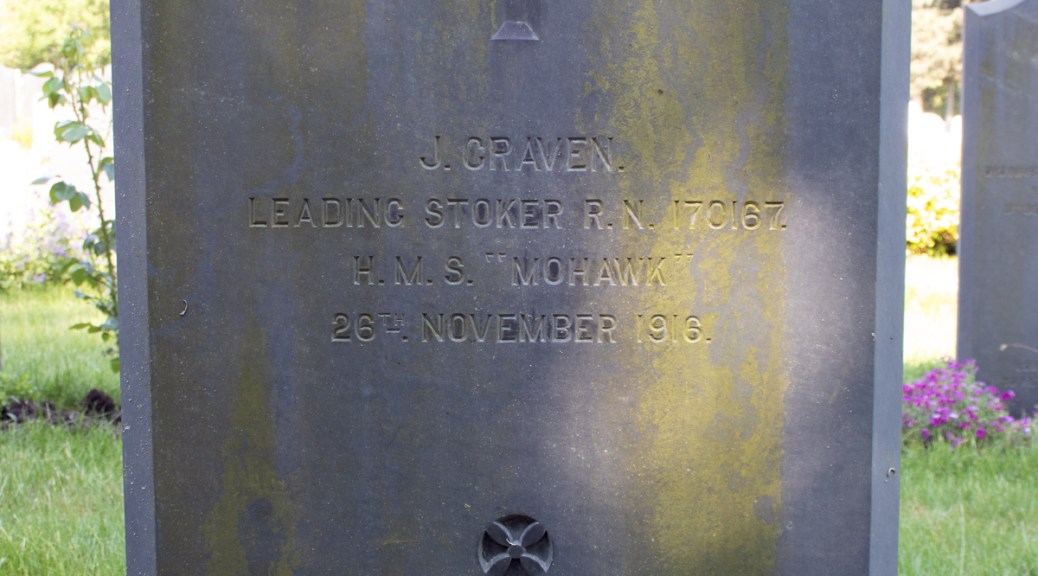
By the end of the following year, Joseph was almost entirely shore-based, moving from HMS Victory in Portsmouth to HMS Pembroke in Chatham and HMS Attentive in Dover. On 26th November 1916, he was serving in Chatham. A local newspaper picks up on what happened to him next:

Joseph Craven… belonging to Portsmouth, met his death under shocking circumstances at Chatham Dockyard on Sunday. When walking by the side of his ship, which was in dry dock, he tripped over some hose and fell headlong into the dock, turning two or three somersaults in his descent, and falling upon his head at the bottom, 80ft [24.3m] below. He was killed instantly.

Kent Messenger and Gravesend Telegraph: 2nd December 1916

An inquest on the 46-year-old’s death was held, and a result of accidental death was returned.

Joseph Craven was laid to rest in the Woodlands Cemetery, Gillingham, walking distance from the dockyard in which he lost his life.


Petty Officer Tom Jones

Petty Office Tom Jones

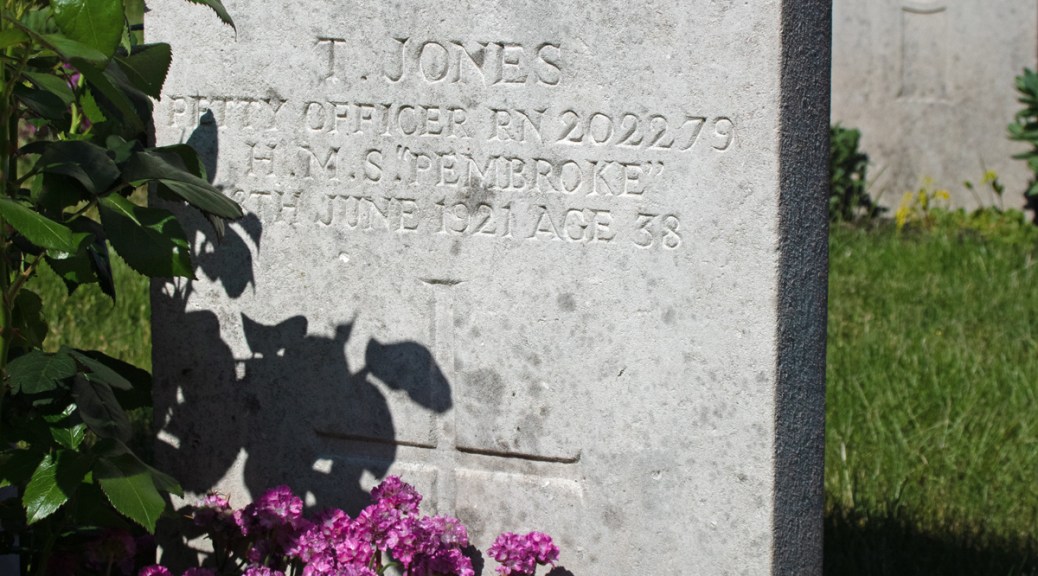
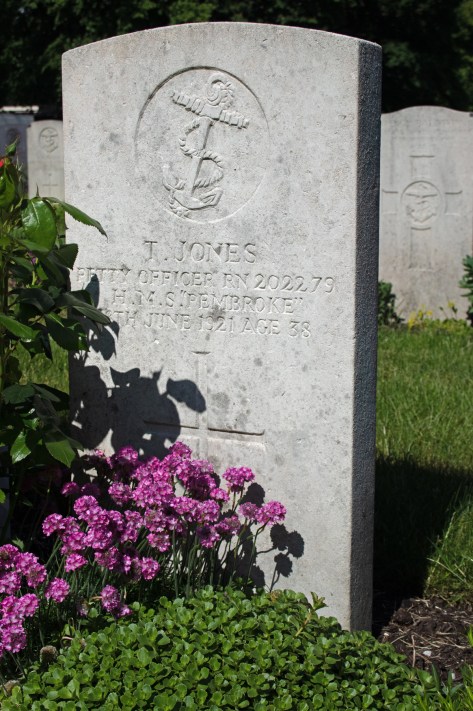
Thomas Jones (known as Tom) was born in Wednesbury on 7th September 1882 and was the middle of seven children. His father, also called Thomas, was a grocer and, with his mother Mary, they raised their family first in the Staffordshire town and then in Blackpool, Lancashire.

When he left school Tom helped his dad in the shop, primarily dealing with meat. His mind was on greater adventures, however, and in November 1898, he enlisted in the Royal Navy. Due to his age, he was initially given the rank of Boy, but was officially signed up as an Ordinary Seaman on the day after his 18th birthday.

Over the time of his initial twelve years’ service, Tom rose through the ranks, from Able Seaman to Leading Seaman and Petty Officer. In May 1912, however, he was ‘disrated’ back to Able Seaman, but there is no evidence to confirm why this was done. By this time, he had served on nine ships, as well as having time in shore-based establishments, and had completed his twelve years as a mariner.

Meanwhile, in the autumn of 1904, Tom had married Hannah Kennedy, a dockyard labourer’s daughter from Gillingham, Kent. The couple went on to have four children and set up home in the centre of the town, not far from the Naval Dockyard where Tom was sometimes based.

With war in Europe on the horizon, Tom immediately volunteered to continue his duty when he term of service came to an end. Working hard, he soon regained the rank of Leading Seaman and, by April 1915, was back up to Petty Officer once more.

During the remainder of his time in the Royal Navy, Petty Officer Jones served on a further seven vessels. In October 1920, after more than two decades’ service, he was invalided out, having contracted tuberculosis, rendering him unfit to continue.

At this point Tom’s trail goes cold. It seems likely that his lung condition got the better of him; he passed away on 20th June 1921, at the age of 38 years old.

Petty Officer Tom Jones was laid to rest in the Woodlands Cemetery in Gillingham, Kent.


Tom Jones II
Petty Officer Tom Jones
(courtesy of ancestry.co.uk)

Private Arthur Westby

Private Arthur Westby

Arthur William George Westby was born in the spring of 1895, the only child to Arthur Henry Westby and his wife, Emma. Arthur Sr was a Corporal in the Scots Guards, but, beyond the fact that his son was born in Clapham, South London, there is little further information about Arthur Jr’s early life.

His father’s military career must have taken him across the country – the 1901 census lists Emma and Arthur Jr living in Bolton, Lancashire, even though there seem to be no connections with the county for them.

The records for Arthur Jr go quiet until 1920. At this point, documents hint at his military service during the Great War.

The death notices in the Sussex newspapers confirm his passing:

On November 19th 1920, at The Cedars, 13 Browning Road, Worthing, Arthur WG Westby (late MT, RASC), beloved husband of Ethel Westby, and only son of Ex-RQM Sergeant and Mrs Westby, 34 Wenban Road, Worthing. Patiently suffered to the end, result of Active Service.

Worthing Gazette: Wednesday 24th November 1920

There is no further information available about Ethel, and no marriage records to confirm a date for their wedding.

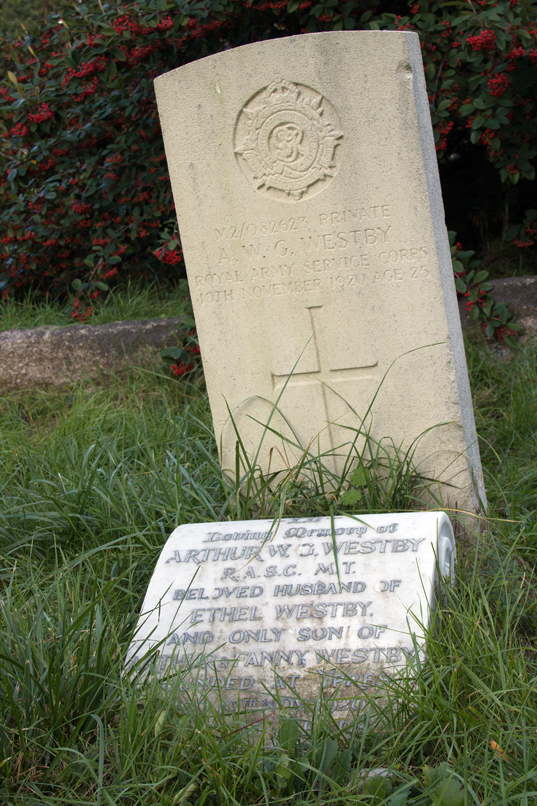
From a military perspective, Arthur enlisted in the Royal Army Service Corps, and was attached to the Motor Transport division. Again, there is nothing to evidence when he enlisted or for how long he served. It seems that Private Westby was injured in the line of duty, and was medically discharged in April 1918. The injury appears to have been life-changing, and it affected him until the end of his life.

Arthur William George Westby passed away in Worthing on 19th November 1920, aged just 25 years old. The specific cause of his death is unknown. He was laid to rest in the Broadwater Cemetery in the town, close to his parents and widow.


Lance Corporal William Neads

Lance Corporal William Neads

William John Neads was born on 16th December 1892, the middle of three children to cab driver and groom William Neads and his wife Ellen. Both William Sr and Ellen were from Somerset, although William Jr and his brother Charles – who was eleven months older – were both born in the Monmouthshire village of Cwmcarn.

William’s parents soon moved the family back to Clevedon in Somerset, and, when he left school, he found work as a farm labourer. He was eager to see more of the world, however and, in April 1913, he emigrated to Canada.

After working as a labourer there for a year or so, back in Europe war was declared. Keen to do his bit for King and Country, William enlisted in the 1st Battalion of the Canadian Infantry in January 1915. He soon found himself caught up on the Front Line.

In October 1916, he was involved in the Battle of the Somme – either at Le Transloy or The Battle of the Ancre Heights – and received a shrapnel wound to his left shoulder. Initially admitted to the Canadian General Hospital in Etaples, he was subsequently evacuated to England and the Northern General Hospital in Leeds. He spent three months recovering from his injuries, and was back on the Western Front in January 1917.

Later that year, William – now a Lance Corporal – was involved in the fighting at the Second Battle of Passchendaele (part of the Third Battle of Ypres). He was wounded again, this time receiving a rather unceremonious gunshot wound to the right buttock. Treated at the scene, he was evacuated back to England and admitted to the Fusehill War Hospital in Carlisle on 17th November.

Sadly, despite treatment, Lance Corporal Neads’ health deteriorated, and he passed away from his injuries on 16th December 1917, his 25th birthday.

William John Neads was brought back to his family’s home of Clevedon, and buried in the clifftop churchyard of St Andrew’s, overlooking the sea.


Tragically, William’s father had died in May 1917, at the age of 51. While no details of his passing are recorded, it meant that Ellen had, in just over a year, seen her son wounded, her husband die and her son wounded again and die as a result.


Sapper Herbert Ridge

Sapper Herbert Ridge

Herbert Gladstone Ridge was born in December 1886, the youngest of three children to Alfred and Sarah. Alfred was from Lancashire and had met and married his wife in Ireland, which is where Herbert’s older siblings had been born.

Sarah had died when Herbert was only eleven years old. Alfred’s skills were as a machine engineer, and, after his wife had passed away, he brought his family down to Somerset. Initially living with his father in Taunton, Herbert had found work as a piano tuner, and moved to a boarding house in Bristol to further his trade.

War was close, however, and, in July 1915, Herbert enlisted. Joining the Welsh Field Company of the Royal Engineers as a Sapper, he was quickly posted as part of the Mediterranean Expeditionary Force. He served nearly a year in Egypt, before being sent back to England in September 1916.

By this point, Sapper Ridge was suffering from a bout of tuberculosis, and had been sent back to England for treatment. The condition refused to clear up, however, and he was eventually discharged from the army on medical grounds three months after returning home.

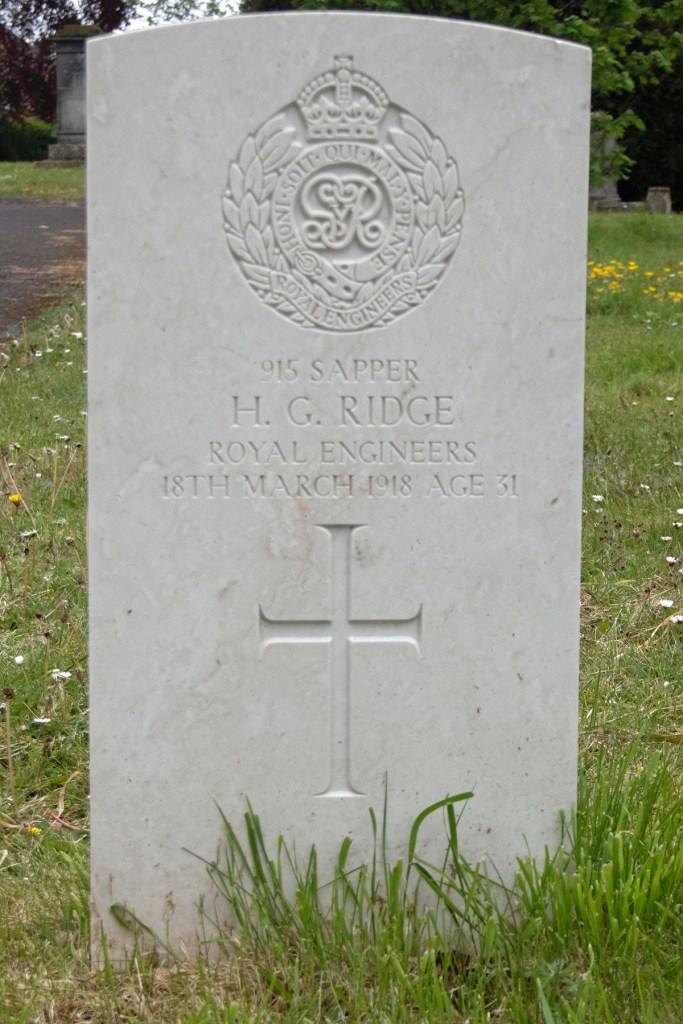
Details of Herbert’s life after the army are sparse. It can be assumed, however, that he remained dogged by tuberculosis, and this is what eventually killed him. He passed away on 18th March 1918, aged just 31 years old.

Herbert Gladstone Ridge lies at rest in St Mary’s Cemetery in his adopted home town of Taunton in Somerset.


Private Jack Alston

Private Jack Alston

John Thomas Alston, also known as Jack, was born in Chorley, Lancashire, in 1865 and was one of thirteen children to Richard and Elizabeth Alston. Before he died in 1878, Richard was a stripper and a grinder in a cotton mill, and it was millwork that the majority of his and Elizabeth’s children went into.

When he left school, Jack and his siblings worked as cotton piecers in the mills, tying together any threads that broke on the machines. This was a job aimed at children, whose hands were often the only ones small enough to reach into the equipment.

By 1895, Elizabeth too had passed away. Jack, who was 30 by this point, had moved from Chorley to nearby Oswaldtwistle, and met Mary Ellen Wilcock. She was a widow with two children, and the couple married on 14th February 1897. Their marriage certificate shows that she was the daughter of a weaver, while Jack was working as a furnace man in the mill. The couple went on to have a child together, Amy, who was born in 1900.

The couple settled into if not a comfortable life, then a continued existence. While Mary and her two older children were working in the cotton mill, Jack began labouring at the local chemical works. The family lived in a small, two up, two down cottage right next to Mary and the children’s place of work, and life continued apace.

War was coming however, and Jack volunteered to do his bit. His service records no longer exist, but it can only be assumed that he joined of his own accord; he would have been 50 when hostilities commenced, and so exempt from the initial call-up.

Private Alston was assigned to the Somerset Light Infantry, and was based at their Depot in Taunton. Little information about his time there is available, and sadly, the next accessible document is his pension record. This confirms that he died on 7th April 1916, from “shock caused by a fall while on duty”. There is no other reference to what or how this happened, so the circumstances will remain a mystery. He was 51 years old when he passed away.

It seems that his widow may not have had the funds to bring Jack back home; instead he lies at rest in St Mary’s Cemetery in Taunton, Somerset, close to the depot where he was based.


Company Quartermaster Sergeant Robert Roberts

Company Quartermaster Sergeant Robert Roberts

Robert Roberts was born in Liverpool in November 1887 the youngest of two children to Robert and Alice Roberts.

The New World beckoned for the Roberts family, and they set sail for Canada when Robert Jr was just 4 years old. The family settled in the city of Regina, Saskatchewan.

Little is recorded about Robert Jr until October 1911, when he married a Quebecois woman called Edna Webber. The young couple went on to have two children, a daughter, One, and a son, George.

In April 1916, he enlisted in the Canadian Expeditionary Force. His trade was noted as a Lumberman, and his record notes that Robert had already served as part of the 95th Saskatchewan Rifles.

Joining the 224th Battalion, Robert was shipped to England in May 1916. He transferred to the Canadian Forestry Corps in November, reaching the rank of Staff Sergeant, and was assigned to the company’s Base Depot in Sunningdale, near Windsor.

When the war ended, demobilisation was still a way off for a lot of soldiers, particularly those from the Commonwealth. Robert was transferred to Stirling, and was appointed Quartermaster Sergeant (responsible for supplies and stores) for 121st Company.

On 28th January 1919, Robert was admitted to the Royal Infirmary in Stirling with influenza and double pneumonia. Sadly, he passed away just over a week later, breathing his last on 6th February 1919. He was 33 years old.

Robert Roberts lies at peace in the Wembdon Road Cemetery in Bridgwater, Somerset.


There is no evident connection between Robert and Bridgwater, so why this was chosen as his place of rest is a mystery. It is likely that there was some sort of family connection, but that cannot be definitely established.


Private Walter Roman

Private Walter Roman

Walter James ‘Rattler’ Roman was born in July 1880, one of six children to George and Betsy Roman. George was a labourer in a brickyard, and the family lived in Bridgwater in Somerset.

Walter’s passion was rugby football, and he made the Bridgwater & Albion first team at the age of 15. Two years later had reached county level, and was playing for Somerset.

Walter enlisted in the army in around 1897, joining the Somerset Light Infantry. He spent several years abroad, serving as a Private in India and South Africa and fighting at Cawnpore and in the Second Boer War.

When Walter’s service ended, he returned to England, and continued his rugby career. He was a regular for the Bridgwater and Somerset teams, gaining the nickname ‘Rattler’, before being signed up by Rochdale Hornets in 1910.

Walter married Henriette Washer in Bridgwater in April 1911, and the couple had two children, Edna – born in 1912 – and Leonard – who was born a year later.

Continuing with rugby union, Walter was called to county level, where he joined Lancashire for a number of games. Walter also played for England, receiving a cap in the international match against Wales in February 1914, and he toured Australia and New Zealand the same year.

War broke out, and Private Roman was re-enlisted, one of twenty-five Hornets players to enlist. He served on the Western Front with the 1st Battalion of the Somerset Light Infantry and was caught up in the engagements at Ypres and Armentieres. Fighting at in the Battle of the Somme, he went over the top at Beaumont-Hamel at the start or fighting, on 1st July 1916 – his 36th birthday.

In that initial charge, he was shot several times, in both arms, a leg and the torso. Initially treated at a local field hospital, he was evacuated to England and admitted to the Voluntary Aid Hospital in Cheltenham. His condition initially improved, and he wrote letters to Henrietta, who was living back in Rochdale.

Sadly, Walter’s contracted sepsis and his health deteriorated; Henrietta was called to the hospital in Cheltenham on 27th July 1916. It is likely that she didn’t make it in time, as Walter passed away at 1pm the following day. He was just 36 years old.

Walter James Roman lies at rest in the Wembdon Road Cemetery in his home town of Bridgwater, Somerset, one of may sporting heroes to perish in the First World War.


Walter Roman (courtesy of findagrave.com)

Walter was one of 25 Rochdale Hornets players to enlist when war broke out. Of those men, five did not return: Private Walter Roman; Sergeant John Twigg; Private Archie Field; Private Tom West and Private CJ Burton.


Second Lieutenant Victor Bracey

Second Lieutenant Victor Bracey

Victor Charles Edelsten Bracey was born in October 1897, the only child of William and Florence Bracey. William was a physician and surgeon, practicing in Lancashire when Victor was born. The young family soon moved south, however, and by the time of the 1901 census, they were living in Wedmore, Somerset, where William had taken up as the village’s general practitioner.

Military records for Victor are not available, but his life can readily be pieced together from newspaper reports of his death and the de Ruvigny’s Roll of Honour, published after the war.


TWO PILOTS KILLED IN THE NEW FOREST

Two air fatalities have occurred within twenty-four hours of each other in the New Forest. On Saturday [22nd September 1917] Second Lieutenant Ernest Hargrave’s machine nose-dived from the height of 200ft, and crashed to earth.

Second Lieutenant Victor Bracey was flying on Sunday morning at a height of 300ft, when his machine turned and came down in a spinning nose-dive.

At the inquests verdicts of “Death by misadventure” were returned.

Western Gazette: Friday 28th September 1917

BRACEY, VICTOR CHARLES EDELSTEN, 2nd Lieut., RFC, only child of William Edelsten Bracey, LRCP [Licentiate of the Royal College of Physicians], Lieut. (Hon.) RAMC (retired), by his wife, Florence Marion, dau. of the late James Canning Gould.

[Victor was] educated St Peter’s School, Weston-super-Mare, and Blundell’s School, Tiverton, where he was a member of the OTC [Officers’ Training Corps]; passed into the Royal Military Academy in April 1915; joined the Inns of Court OTC in December 1916; was gazetted 2nd Lieut. RFC [Royal Flying Corps] 27 April 1917, obtaining his wings in July, and was killed in an aerial accident at the Beaulieu Aerodrome, Hampshire, 23 September, while testing a new machine.

A brother officer wrote that he was a gallant gentleman and a most skilful pilot.” He was a keen cricketer and footballer, and while at Blundell’s played in the First Cricket XI and the Second Football XV, and was also captain of the First Hockey XI; later played for the Royal Military Academy, Woolwich, and the RFC Rugby Football XV at Oxford.

de Ruvigny’s Roll of Honour, 1914-1919

A note on Second Lieutenant Bracey’s Roll of Honour states that he was ineligible for medals as he saw no overseas service; this seems to have been challenged by Victor’s father in 1921, but nothing confirms whether this anything was subsequently awarded.

Victor Charles Edelsten Bracey lies at rest in the churchyard of St Mary’s in Wedmore, where his father continued to practice. He died, aged just 19 years of age.


William’s prominence in the village played a big part in Victor’s legacy. A Memorial Fund was set up; this helped fund “necessitous cases for medical requirements and for conveying patients to hospitals“. The Victor Bracey Cup was also awarded into the 1940s for sporting achievement in the schools he had attended.