Thomas Salter – better known as Tom – was born on 5th June 1877, in the Devon village of Uffculme. He was the only child to John and Selina Salter. John was seventeen years older than his wife and, by the time his son was born, was 57 years old. Selina had been married before and widowed, and had had five children of her own.
When he left school, Tom found work as a butcher’s assistant at the Uffculme’s Commercial Hotel (now the Ostler Inn on Commercial Road). Food was not destined to be his career, however. By the time of the 1901 census, he had moved from Devon to Gloucestershire, and found employment as a labourer in the engine works at Knowle, Bristol.
His landlady was an Elizabeth Bobbett, who had been born in Trull, near Taunton, and this connection may have pre-destined what was to come. In the spring of 1908, Tom married Florence Taylor, a labourer’s daughter from Wellington, Somerset, five miles (8km) from his landlady’s home village.
Tom and Florence settled in Wellington, close to the centre of the town. They had four children – Harold (born in 1909), Evelyn (1912), Irene (1914) and Edna (1916). Tom found work as a packer at the Fox Bros. woollen mill in nearby Tonedale.
War was coming to Europe by this point and, in January 1917, Tom enlisted. Private Salter joined the 11th Battalion of the Somerset Light Infantry: this was a territorial troop, and Tom found himself based in Yeovil.
There is little concrete information about Private Salter’s military life. All that can be confirmed is that within a couple of months of joining up, he had been admitted to hospital, suffering from bronchial pneumonia. Sadly, he was not to recover from the lung condition: he passed away on 10th May 1917, at the age of 37 years old.
Tom Salter was brought back to Wellington for burial. He was laid to rest in the town’s cemetery.
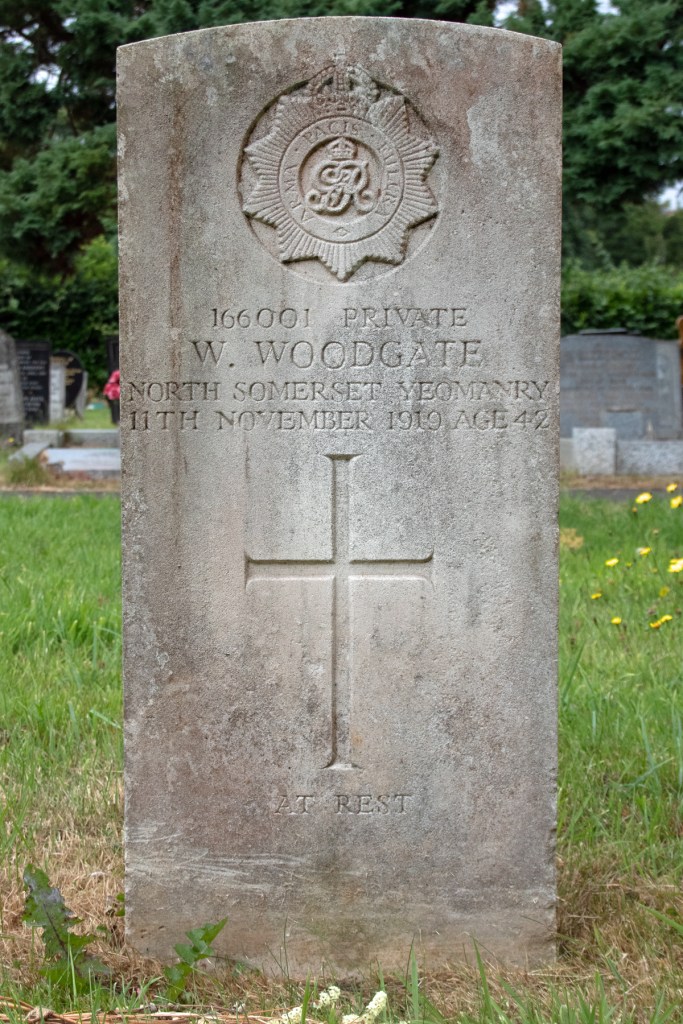
Much of William Woodgate’s life seems destined to remain a mystery. He was born in Dunsford, Devon, in around 1877, and was the son of Lewis Woodgate.
By the age of 14, he was living on a farm on Bovey Tracey, working as an agricultural labourer for the farm owners, Thomas and Betsy Dayment. Ten years later, William had made the move to Wellington in Somerset, where he was lodging with the Denner family, and working as a carter.
On 20th June 1903, William married Mary Jane Grinter, a signalman’s daughter from Wellington; the couple went on to have three children, Lewis, Leonard and Francis. The young family set up home in North Street, near the centre of the town. By the 1911 census, William had changed profession, and was working as a fish salesman.
War was about to descend on Europe, and, in May 1916, William signed up to play his part. He was enlisted as a Private in the North Somerset Yeomanry, and was assigned to the 2nd/1st Battalion. His service record shows that he was 5ft 2.5ins (1.59m) tall, and weighed 117lbs (53kg), and had a fair physical development.
Private Woodgate did not see any service abroad: his battalion became part of the 6th Cyclist Brigade, and he was based in East Anglia and, for a short while, in Northumberland.
There is little further detail about Private Woodgate’s life. He survived the war, and was transferred to the Army Reserve on 9th February 1919, having served for just under three years.
At this point, William’s trail goes cold. He returned home to Somerset, and passed away nine months later, on 11th November 1919. He was 42 years of age.
William Woodgate was laid to rest in Wellington Cemetery, not far from where Mary and their children lived.
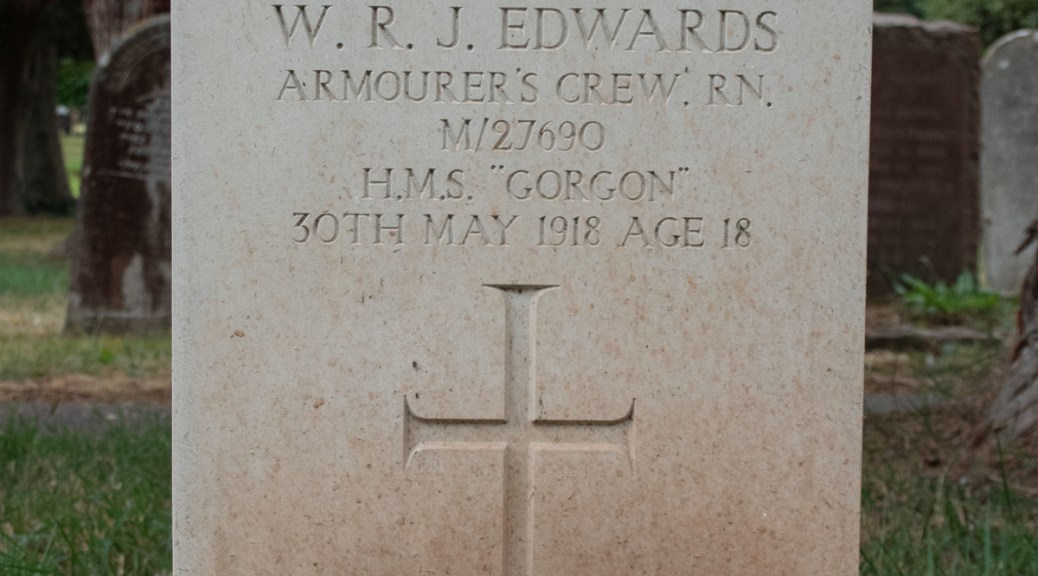
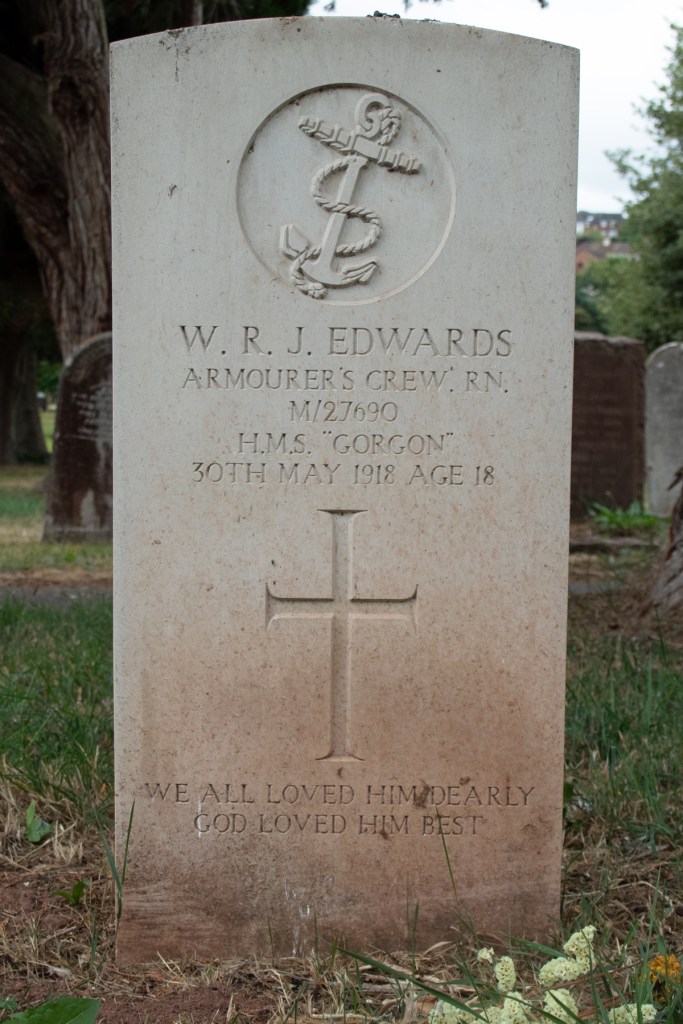
William Robert John Edwards was born on 10th July 1899, one of fourteen children to engine fitter William Edwards and his wife Bertha. Both of William Jr’s parents had been born in Devon, but, by the time of his birth, they had moved to the Somerset town of Wellington.
William followed in his father’s footsteps when he left school, but with war raging across Europe, he was keen to play his part as soon as he was able to do so. He enlisted in the Royal Navy on 7th September 1917, his engineering background making him perfect for a member of the Armourer’s Crew.
William’s service record show that he was 5ft 5ins (1.65m) tall, had brown hair, hazel eyes and a fresh complexion. He was initially sent to HMS Vivid – the Royal Naval Dockyard at Devonport – for training, and was given a posting on board HMS Gorgon, a coastal defence ship on 1st May 1918.
Tragically, this first assignment was to be Armourer’s Crew Edwards’ last. Within a matter of weeks, he was taken back to HMS Vivid, suffering from tubercular meningitis. Back at base, the condition proved too much for the young man: he passed away on 30th May 1918, days shy of his 19th birthday.
Brought back to Somerset for burial, William Robert John Edwards was laid to rest in the cemetery of his home town, Wellington.
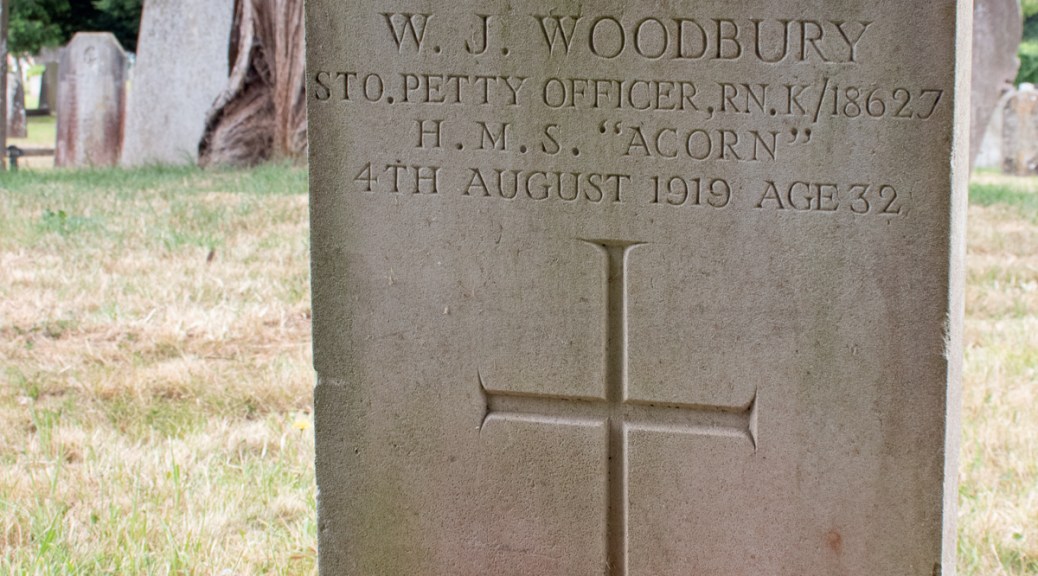
Wilson John Woodbury was born on 8th December 1888, and was the third of seven children to Daniel and Elizabeth Woodbury. Daniel was a chair maker from Wellington, Somerset, and this is where the family – including six boys and one girl – were raised.
By the time of the 1901 census, Daniel had had a change of career – he was now working as an oil presser. His and Elizabeth’s oldest three boys, Wilson included, had also found work, and were employed as wool spinners.
Elizabeth passed away in 1906, when Wilson was just seventeen years old. This may have pushed him to bigger and better things, and a career. On 13th August 1908, at the age of 19, he enlisted in the Royal Navy as a Stoker 2nd Class. His service record shows that he was 5ft 7.5ins (1.71m) tall, had light brown hair, blue eyes and a fresh complexion. It also noted that he had a tattoo of a cross on his right forearm.
Stoker Woodbury was initially trained at HMS Vivid – the naval dockyard at Devonport. On 9th February 1909, however, he was given his first posting, on board HMS Defence. He spent two years on board the armoured cruiser, and, gained a promotion to Stoker 1st Class.
During the remainder of his initial service, Wilson served on two further ships – HMS Sentinel and HMS Bellona – returning to Devonport between each posting. When he completed his five-year contract, Wilson voluntarily signed up for a further seven years with the Royal Navy.
As war came to Europe, Stoker Woodbury was given a number of assignments, on the battleships HMS Caesar and Lord Nelson, the cruisers HMS Blake and Apollo, and the depot ship HMS Blenheim. Further promotions followed – Leading Stoker in 1915 and Stoker Petty Officer two years later.
Wilson’s oldest brother, James, was serving in the Labour Corps during the conflict. Based in Northern France, he was assigned to the 720th Company, although further details are unclear. He almost survived the war unscathed, but contracted an illness of some description and died on 3rd November 1918, aged 34 years old. He was laid to rest in the Terlincthun British Cemetery in Wimille, France.
Stoker Petty Officer Woodbury returned home on leave in July 1919. The plan was to meet up with his fiancée who lived in Rockwell Green, near Wellington, but he instead turned up unexpectedly at his brother Fred’s home instead. Wilson said he had returned to Somerset because his girlfriend had broken off the engagement the previous week: the couple had been due to marry when he next came home on leave.
Fred told Wilson that she was not worth it, and they had gone drinking with a friend. Fred later said that on his previous leaves his brother had taken to drinking more than was good for him, but on that evening – Saturday 2nd August 1919 – he did not get drunk.
The following Monday, Stoker Petty Office Woodbury had taken himself down to the railway at Wellington, and been hit by a train. The action was deliberate, as, about his person were three letters. The first was to Daniel.
To My Dear Father,
Sorry to cause you any inconvenience or trouble, and please don’t worry about me, as I’m not fit to worry about. I have had this in mind for about a week. I can’t sleep and can’t eat, as I am broken-hearted, but not insane. This is through love. Now I must exit myself, and I am in great pain. Written at 4:15pm Sunday afternoon…
This is all I have to say in this world. Hoping you and my dear sister will soon forget their broken-hearted
Wilson John Woodbury.
Wilson’s second letter was to his only sister, Ivy. This included details of a parcel left on board his ship, in which was the ring he had given to his fiancée, which he asked that Ivy wear as a memory of him.
Knowing the implications of what he was doing, the third letter was addressed to the jury of the inquest.
My leave expires at 1pm, and my life expires just before by my own hand. I wait to get the chance to put a stop to my life. This would not have happened to bring disgrace on my relations. I am quite sane. Written at 2pm.
On the afternoon of Monday 4th August 1919, Wilson made his way to the Woodford crossing, a short distance from Wellington Railway Station.
…he waited by the side of the line at the crossing for a train, and as the Northern express approached he laid down with his head on the metals, being practically decapitated.
Taunton Courier and Western Advertiser: Wednesday 13th August 1919
The fiancée in question did attend Wilson’s inquest, although the Coroner did not think it was necessary to call her. The newspaper report referred to her, but not by name. She will remain a mystery.
Despite the evidence of his own hand, the inquest found that Stoker Petty Officer Woodbury had committed suicide while temporarily insane. He was just 30 years of age.
Wilson John Woodbury was laid to rest in the cemetery of his home town, Wellington.
Walter Stanley Chapman was born in the summer of 1897, the younger of two boys to William and Sarah (known as Annie) Chapman. William was a carter on a farm in North Cadbury, near Yeovil, Somerset, and this is where the young family grew up.
When he left school, Walter became apprenticed to a local carpenter, but war was on the horizon. His older brother Frederick was quick to enlist, joining the Royal Marine Light Infantry as a Private. He served on HMS Hood during the Battle of Jutland in the spring of 1916, and was killed during the fighting. He was buried at sea, and was just 23 years old when he died.
The loss of his brother may have spurred Walter into action. He enlisted as well, joining the 1/4th Battalion of the Somerset Light Infantry as a Private. Details of his service are limited, but his battalion served in Mesopotamia during the conflict, and it is likely that he spent some time in the region.
Private Chapman survived the war, and returned to Somerset on furlough, waiting to be demobbed. Sadly, he passed away during this time, breathing his last on 19th April 1919, at the age of just 21 years old. William and Annie had lost both of their sons because of the conflict.
Walter Stanley Chapman was laid to rest in the graveyard of St Michael’s Church in his home village of North Cadbury. His gravestone also commemorates the passing of his older brother.
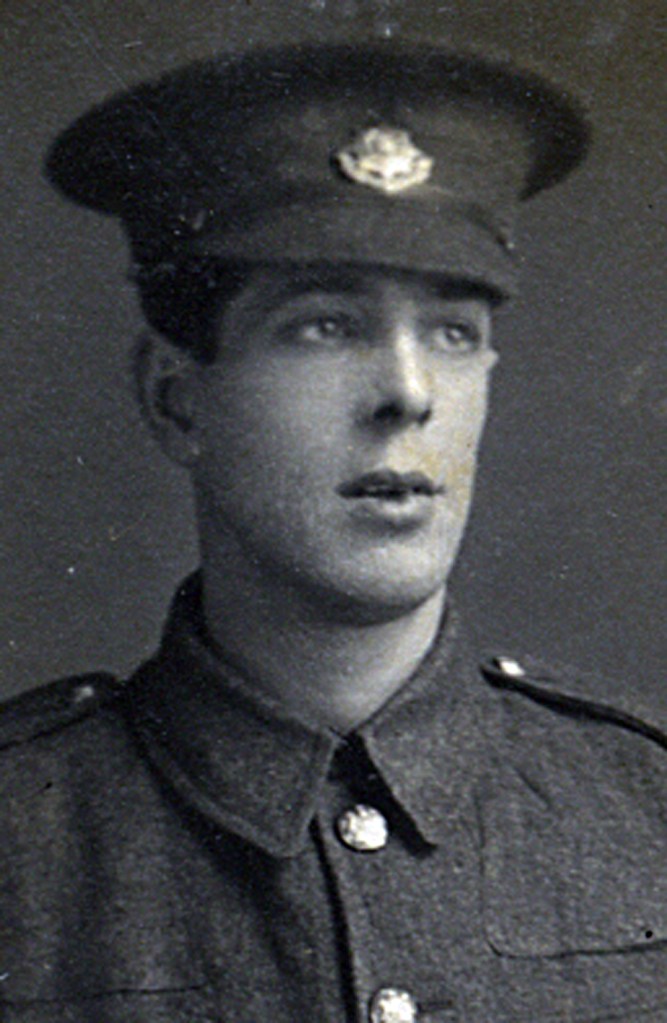
Alonsa Dixon was born in Kingston-upon-Hull, Yorkshire, in 1887, the oldest of seven children to Alonsa and Caroline Dixon. Alonsa Sr was a billiard marker, who raised his family in a small house near the city centre.
Alonsa Jr found work as an errand boy for a grocer when he left school, but went on to find work as a jobbing gardener. By the time of the 1911 census, he had moved out of home, and was boarding with cab driver George Gill and his family.
In April 1912, he married Edith Alice Gill. Trixie, as she was also known, was George’s daughter, and it seems likely that romance blossomed after Alonsa moved in. The couple went on to have a son, also called Alonsa, who was born the following year.
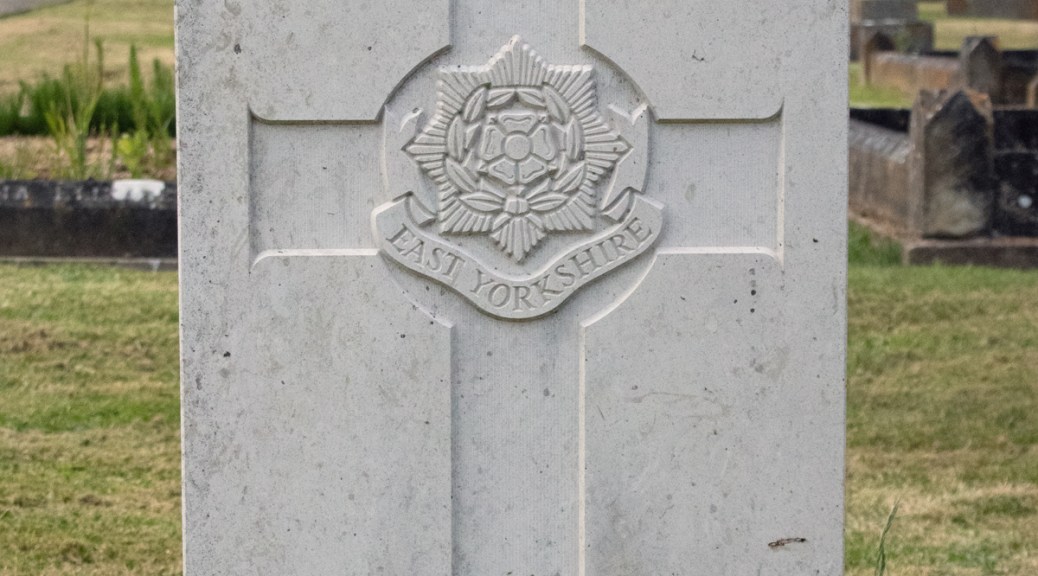
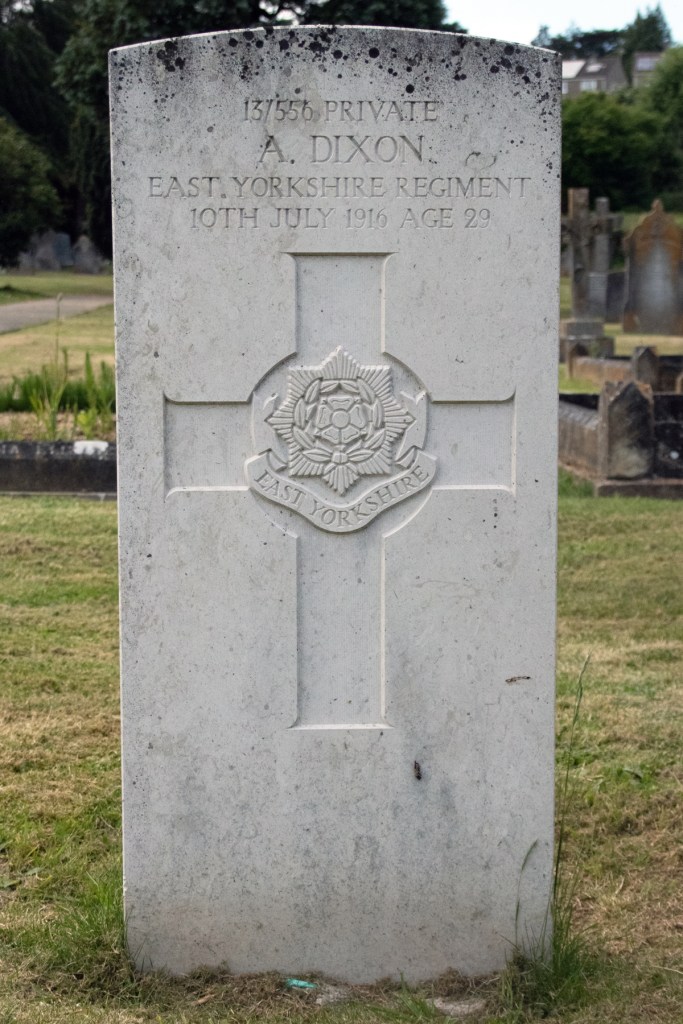
War was coming to Europe, and Alonsa was in one of the first waves of men to volunteer for King and Country. He enlisted in the East Yorkshire Regiment, and was assigned to the 13th Battalion. His service records show that he was 5ft 7.5ins (1.71m) tall, and weighed 144lbs (65.3kg). He was noted as being of good physical development.
Initially serving on home soil, Private Dixon was eventually dispatched overseas, arriving in Egypt in December 1915. Having spent just under three months in North Africa, he was moved to France in March the following year.
Alonsa had some health issues by this point, and was suffering from Bright’s Disease, or nephritis (inflammation of the kidneys). He was treated in a field hospital in Abbeville, but subsequently medically evacuated back to England for further care.
Private Dixon was admitted to the Monastery Hospital in Wincanton, Somerset in April 1916, but his condition proved too severe, and he passed away on 10th July 1916. He was just 29 years of age.
Alonsa Dixon was laid to rest in the cemetery of the town in which he passed away, Wincanton.
Joseph Aitken Graham was born in Kirkmichael, Dumfries, in 1894 and was the son of James and Bella Graham. There is little detail about his early life, but by the time war broke out, he was working with his father as a ploughman.
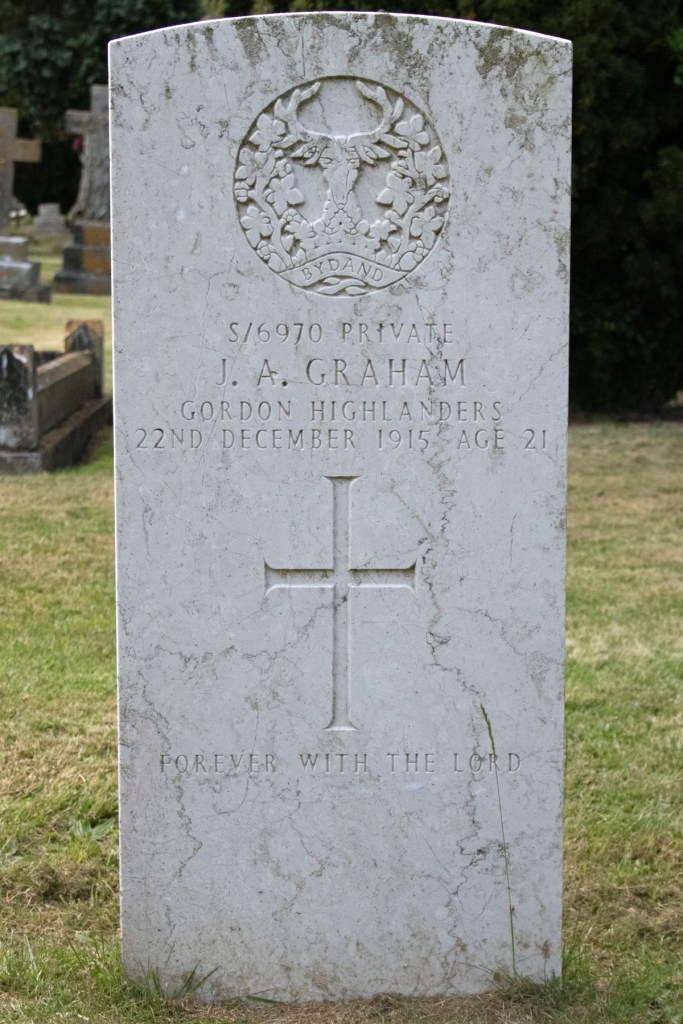
Joseph enlisted in November 1914, joining the 2nd Battalion of the Gordon Highlanders as a Private. His medical report records that he was 5ft 9.5ins (1.77m) tall, weighed 145lbs (65.8kg), had grey eyes, brown hair and a fresh complexion.
After a short period of training, Private Graham was sent to the Western Front, arriving in France on 2nd February 1915. He was involved in the fighting at Neuve Chapelle and Aubers Ridge. It was at Festubert, however, that things took a turn for the young private.
On the first day of the battle, 16th May 1915, Graham was badly injured, receiving gunshot and shrapnel wounds to his head and legs. He was initially treated at nearby Bethune, before being moved to Rouen. He was then evacuated to England in July, to further his recovery, and admitted to hospital in Wincanton, Somerset.
He was making such good progress that he was able to take a short walk each morning, and it was after one of these walks that he was taken ill. In spite of all that medical skill could do his condition became gradually worse, and it was thought advisable to send to Dumfries for his parents, who at once proceeded to Wincanton.
Dumfries and Galloway Standard: Saturday 8th January 1916
Sadly, nothing could be done for Private Graham: he passed away from a suspected brain haemorrhage on 22nd December 1915, at the age of just 21 years old.
Joseph Aitken Graham was laid to rest in the quiet and peaceful Wincanton Cemetery.
George Dove was born in Wincanton, Somerset, on 4th December 1883. One of five children, his parents were farm labourer George Dove and his wife, Jane.
George Jr did not follow his father into farm work: the 1901 census found him boarding with a family in Radstock, working in one of the coal mines in the area. Ten years later, he was living back with his family, employed as a groom.
His work with horses stood him in good stead when war was declared. George enlisted early on, and was assigned to the 19th (Queen Alexandra’s Own Royal) Hussars as a Private. By October 1914, he was in France, returning to England with his squadron the following spring.
At some point during the conflict, Private Dove transferred to the Reserve Regiment of Cavalry. He was posted to the 5th Regiment, which trained men for the Northumberland Hussars and Yorkshire Dragoons, amongst others.
Further details of George’s life are scarce; at some point, he married a woman called Emily, although records of the couple’s wedding no longer exist. The only thing that can be confirmed is that George was admitted to the Bermondsey Military Hospital in Surrey, where he passed away on 24th October 1918. He was 34 years old.
The body of George Dove was brought back to Somerset for burial. He lies at rest in the cemetery in his home town, Wincanton.
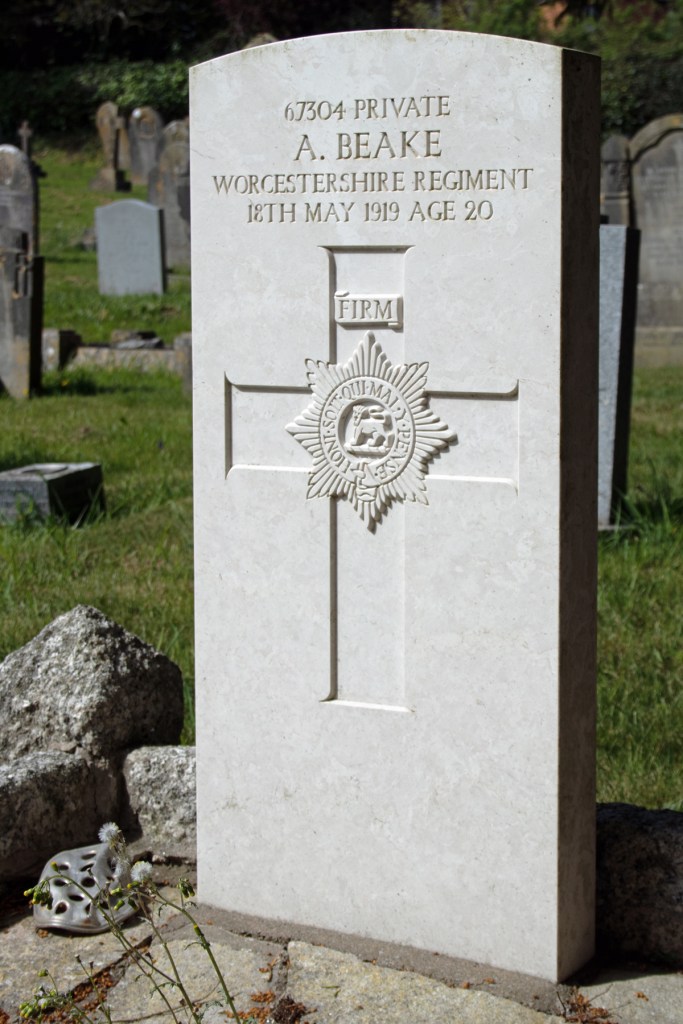
Alfred Beake was born in December 1898 and was one of nine children to Alfred and Charlotte Beake. Alfred Sr was a baker from Westonzoyland in Somerset, but it was in Chard that he and Charlotte had set up home and raised their family.
There is little documented about Alfred’s life. He played his part in the First World War, and had joined the Worcestershire Regiment by November 1918. His troop – the 5th (Reserve) Battalion – was a territorial force, and he would have split his time between Harwich, Essex, and Plymouth, Devon.
Private Beake survived the war and, by the spring of 1919 had been moved to Dublin. It was here on 18th May that he met with colleagues Private Simpson and Swindlehurst in the centre of the city. The trio caught a tram to the coastal town of Howth for a day out, where tragedy struck.
The Dublin Evening Telegraph reported on what happened next:
Private Sydney Simpson, Royal Engineers, stated… when they got to Howth, they walked along the Cliff Walk for about a mile, when they saw some seagulls down the cliff. [Beake and Swindlehurst] went out of witness’s sight for a while, when he heard a shout from Swindlehurst for help. On hurrying back, he saw Swindlehurst looking towards the sea, and he said the deceased had slipped down. The cliff was so steep that, although they tried to get down, they could not do so. Witness sent for help. None of the party had taken any drink.
Private Swindlehurst… said that he and deceased climbed down the grassy slope to get some seagulls’ eggs, but that the deceased suddenly slipped down. There was no horseplay going on at the time when the accident took place.
Captain Wynne, Royal Army Medical Corps, who made a post mortem examination, described the terrible injuries which the deceased had sustained. Death must have been instantaneous.
Dublin Evening Telegraph: Wednesday 21st May 1919
Private Beake had suffered a fractured skull from the fall. He was just 20 years of age.
Alfred Beake’s body was brought back to Somerset for burial. He was laid to rest in the family plot in Chard Cemetery.
Alfred’s oldest brother, Walter George Beake, had also served in the First World War.
Private Beake fought with the 7th Battalion of the Somerset Light Infantry, and was involved in some of the key skirmishes of the Somme. But it was at Ypres that he was buried alive during an attack, and the resulting shell shock left him totally incapacitated.
Walter was discharged from the army on medical grounds in September 1916. He returned home to try and piece his life together again. He never married, and passed away in December 1978, at the age of 87 years old.
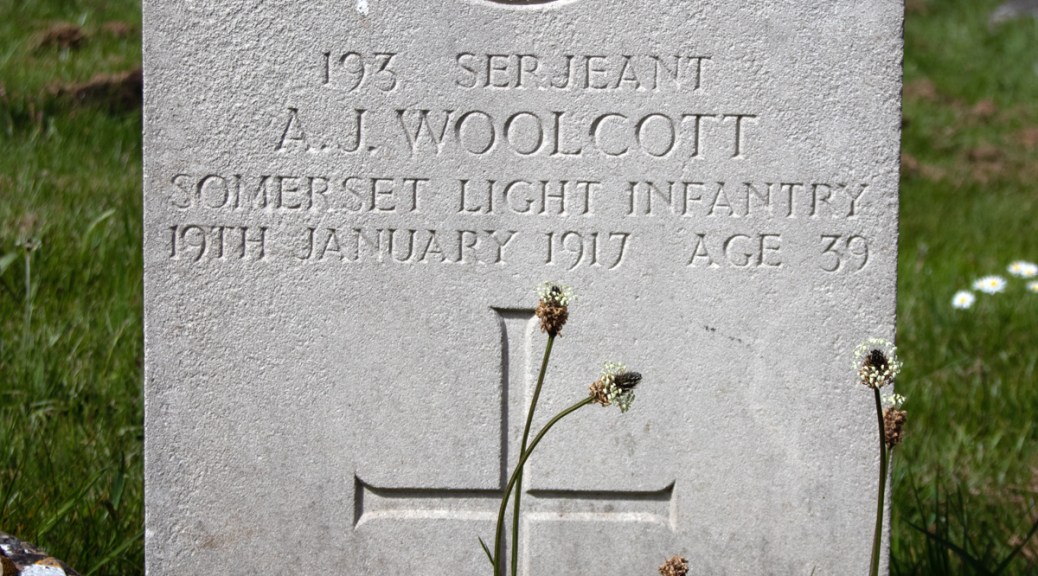
Albert John Woolcott was born in the spring of 1877 and was one of three children to Thomas and Mary. Thomas was a labourer for a spirit company, and both he and his wife came from Chard in Somerset, which is where Albert and his siblings were born.
When he finished school, Albert was apprenticed to a local iron foundry and, by the time of the 1901 census, he was recorded as being a blacksmith in his own right.
By this point, Albert had met local woman Mary Pattimore: the couple married in the local church on Boxing Day 1901, and went on to have four children, all of them boys. Albert continued with his ironwork: the 1911 census records him as being the blacksmith at Chard’s Gifford Fox & Co.’s lace factory.
Albert played a keen role in the local volunteer movement for the Somerset Light Infantry. Through the town’s Constitutional Club he took an active role in its rifle range and was known to be a particularly skilled marksman. He also played in both the Volunteer Band and Chard’s Municipal Band.
When war came to Europe in August 1914, Albert was already billeted on Salisbury Plain as part of the volunteers, and was promoted to the rank of Serjeant. He was sent to India with his troop – the 5th Battalion of the Somerset Light Infantry – and remained there until April 1916.
By this point, Serjeant Woolcott was suffering from dorsal abscesses on his hands, and was evacuated back to England for treatment. Over the next nine months he was in and out of Netley Hospital on the outskirts of Southampton, where he had a number of operations to try and fix the problem.
Sadly, his treatment proved unsuccessful: Serjeant Woolcott passed away in the hospital on 19th January 1917, at the age of 39 years old.
Albert John Woolcott’s body was taken back to Somerset for burial. He was laid to rest in his home town’s cemetery.









 Death and Service