Category Archives: Warwickshire

Lieutenant Frederick Bravery

Lieutenant Frederick Bravery

DISASTROUS FLYING ACCIDENT

Seven Airmen Killed

Lieutenant FJ Bravery’s “Great Skill and Fearlessness”

A sad bereavement has just been sustained by Mr & Mrs T Bravery, of 83, Chapel-road, in the death of one of their soldier sons, Lieutenant FJ Bravery, of the Royal Air Force, as the result of a flying accident near Birmingham in the early part of last week.

Together with a young Canadian Officer, Lieutenant Macbeth, of Toronto, and five air mechanics, Lieutenant Bravery was testing a large aeroplane, when, according to a farmer who was an eye-witness of the accident, the machine was seen to come nose down out of a cloud at great height.

The machine then righted itself and went about a mile, when it turned over while flying at a comparatively low altitude, and fell straight to earth, all seven occupants being instantaneously killed.

An inquest was held at a small town in the vicinity of the accident on Thursday afternoon, when evidence was given that both Lieutenant Macbeth (who was in charge of the machine) and Lieutenant Bravery were experienced pilots and accustomed to the type of machine they were flying, and that tests made with the machine before the flight was started were all satisfactory.

The Jury, in returning their verdict of “Accidental death” were unable to state the specific cause of the accident.

Lieutenant Bravery, who was only twenty-two years of age, joined the Army Pay Corps at the end of 1914, bur subsequently transferred to the Royal Flying Corps, where he had been engaged in flying for a little more than a year. A capable and experienced pilot, he had latterly been attached to the Central Dispatch Pool, where his duties mainly consisted of ferrying machines over to France; and his Commanding Officer, in a letter of sympathy to the bereaved parents, wrote that “he had done excellent work by his great skill and fearlessness. He was always popular and loved in his mess; and was absolutely unselfish, and a very brave gentleman.”

The funeral of the other victims of the tragedy took place on Friday near the scene of the accident: but the body of Lieutenant Bravery was brought home to Worthing, and was buried yesterday afternoon, at Broadwater Cemetery, with full Military honours.

[Worthing Gazette: Wednesday 28th August 1918]

Frederick James Bravery was born on 4th January 1896 in Brighton, Sussex. One of seven children, his parents were Thomas and Eugenie Bravery. Thomas was a pork butcher, and the 1901 census found the family lived at 3 Grenville Street in the centre of the town. Frederick and two of his sisters, meanwhile, were staying with their paternal grandparents on New Church Road in Aldrington.

By the time of the 1911 census, the Bravery family had taken a massive step up. They were now living in a 10-roomed Victorian villa at 15 Clermont Terrace in the Preston area of Brighton. Thomas was noted as having no occupation, and while three of Frederick’s older sibling were working – one as a milliner’s assistant, one as a chemist’s cashier and one as a clerk for a piano shop – their salaries would not have been enough to support such a change in status.

There is little that can be added to the newspaper’s account of Frederick’s military service. He seemed keen to enlist, and what remains of his army and air force documentation suggests that he added two years to his age. He was, therefore, just 22 years of age when he died, on 19th August 1918.

The body of Frederick James Bravery was laid to rest in Broadwater Cemetery, Worthing, Sussex, just a short walk from where his parents were now living in Chapel Road (Thomas now listed as being a sauce maker and pork butcher).


The newspaper report only highlighted the deaths of the two Lieutenants killed in the fatal accident. Alongside Lieutenant Bravery, the full list of crew lost were Air Mechanic 3rd Class George Greenland (buried at Tower Hamlets Cemetery Park, London); Air Mechanic 1st Class James May (buried in Basford Cemetery, Nottinghamshire); Air Mechanic 3rd Class Charles Offord (buried in Acton Cemetery, Middlesex); and Aircraftman 2nd Class Horrace Simmonds. Simmonds and Lieutenant Robert Macbeth were both laid to rest in St Michael’s Churchyard, Maxstoke, not far from the site of the crash.


Leading Seaman Henry Hudson

Leading Seaman Henry Hudson

Henry John Gerrard Hudson was born in Whitechapel, Middlesex, on 11th November 1873. The fourth of seven children – and one of five boys – his parents were John and Emma Hudson. John was a paper stainer, and the family were raised in rooms at 62 Fern Street, Tower Hamlets.

Money was seemingly tight, and Henry sought an escape. On 5th January 1889 he enlisted in the Royal Navy, and was sent to the Devon school ship, HMS Impregnable, for his training. As he was below the age to full enrol, he was given the rank of Boy 2nd Class.

Over the next couple of years, Henry learnt the tools of his trade. He spent a year training at HMS Ganges, the shore establishment near Ipswich, Suffolk, and rose to the rank of Boy 1st Class. On 20th November 1890, he was given his first sea-faring assignment, aboard HMS Ruby, and she would remain his home for the next eighteen months.

During his time with Ruby, Henry came of age. His service records show that he was 5ft 5ins (1.65m) tall with light brown hair, brown eyes and a fair complexion. He was also noted as having a number of abscess scars under his left arm.

The now Ordinary Seaman Hudson definitely showed signs of promise as, after just three months, he was promoted to Able Seaman, a rank he would hold for the next five years. During that time, he served on four further ships, including the torpedo boat depot ship HMS Vulcan.

On 1st June 1897, Henry was promoted to Leading Seaman, although he reverted to his previous role just nine months later, at his own request. In October 1898 he transferred to HMS Caesar and, presumably with further support, he was promoted to Leading Seaman again in August 1899.

By May 1902, Henry’s initial term of service came to an end, and he was stood down to reserve status.

In January 1907 Henry married Alice Martin. She was a carpenter’s daughter, and the couple were living on Grosvenor Terrace in Newington, Middlesex, when the exchanged vows. They would go on to have three children.

The 1911 census found the Hudsons living in Weymouth, Dorset. Henry, by this point, was working as a motor boat driver, and the family had a small cottage on South View Road, not far from the town centre. The document shows how they had travelled to where Henry’s work took them: their first child, Nancy, had been born in Walworth, Surrey, in 1908, while her sister, Gladys, was born in nearby Camberwell the following year.

The next couple of years provided a big upheaval for the Hudsons and, by the spring of 1914 the family had moved to Rugby, Warwickshire. There seems to be no family connection to the area on either Henry or Alice’s side. It can only be assumed, therefore, that an opportunity of work arose.

In June 1914, Alice gave birth to the couple’s third son, John. Just two months later, war was declared, and Henry was called back into service. Taking up his previous role, Leading Seaman was to spend the next few years on land. Initially sent to HMS Victory, the Royal Naval Dockyard in Portsmouth, Hampshire. From there he moved to a base in Gorleston, Norfolk, and would remain there until the autumn of 1916.

Leading Seaman Hudson spent six month at HMS President in London, before moving to the Royal Naval Dockyard in Chatham, Kent, also known as HMS Pembroke. By this point – the spring of 1917 – his health was suffering and, that May, he was admitted to the town’s Royal Naval Hospital, suffering from tuberculosis.

The condition was to prove too severe for Henry: he passed away from a combination of the lung condition and a gastric ulcer on 20th May 1917. Henry was 43 years of age.

Alice was still living in Warwickshire at this point. Her husband, Henry John Gerrard Hudson, was therefore laid to rest in the naval section of Woodlands Cemetery, Gillingham, Kent.


Private Joseph Tyler

Private Joseph Tyler

Joseph Tyler was born in the spring of 1882, and was the youngest of three children to Joseph and Sarah. Joseph Sr was a carter from Staffordshire, and the family were born and raised in Wordsley.

The 1901 census found the Tylers living in Brierley Hill, with Joseph Jr having found employment as a glass worker. His father passed away in 1907, and so he remained at home to support his now widowed mother.

By the 1911 census, Sarah and Joseph had moved to Birmingham, and were living at 32 Wiggin Street, a terraced house in the Ladywood area. Joseph listed his employment as a glassblower, while his mother gave no employment, presumably looking after the home.

When war came to Europe, Joseph stepped up to play his part. Full details of his service have been lost, but it is clear that he enlisted early on in the conflict. He joined the Hampshire Regiment, and was sent to Wiltshire for training.

Tragically, Private Tyler’s time in the army was not to be a lengthy one. Barracked near the village of Boyton, he was quickly admitted to the local military hospital. Suffering from heart failure, this would take his life: Joseph died on 13th October 1914, at the age of 32.

The body of Joseph Tyler was laid to rest in Boyton Cemetery, not far from the camp that had, so briefly, been his home.


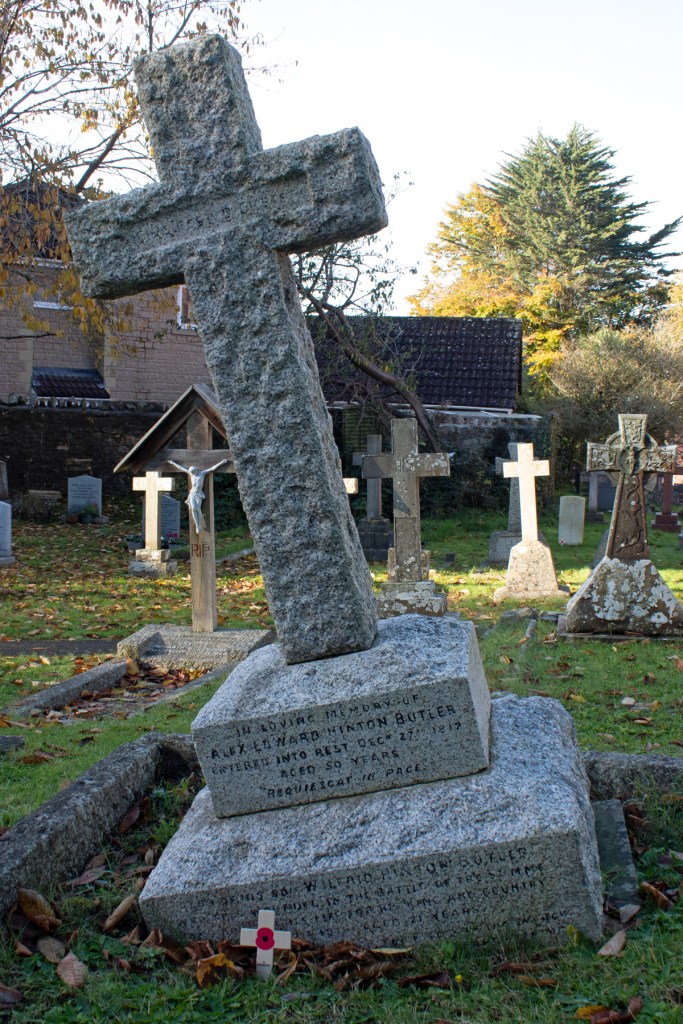
Private Wilfred Butler

Private Wilfred Butler

Wilfrid Hinton Butler was born on 11th June 1895 in Cowley, Oxfordshire, one of four children to Alexander and Mary Butler. Alexander was a foreign stamp importer who, by 1899, had moved the family to the outskirts of Clevedon, Somerset.

The 1911 census found Alexander and Mary living in Clevedon, with Wilfrid’s two younger siblings. Wilfrid himself is missing from the document and, intriguingly, his parents are noted as having only two children: this is likely an misunderstanding over the number of children, and the number residing at home.

At this point, Wilfrid drops off the radar completely, and it is only through later documentation that we can identify what became of him. When war broke out, he joined up, enlisting in the London Regiment. Initially assigned to the 15th (County of London) Battalion (Prince of Wales’s Own Civil Service Rifles), he moved across to the 13th (County of London) Battalion (Kensington) at some point during the conflict.

Private Butler was firmly ensconced in northern France by 1916 and his unit fought in some of the bloodiest battled of the Somme. He was not to come out unscathed, however, and it is likely that he was wounded during the Battle of Morval.

The injuries Private Butler had received were severe enough for him to be medically evacuated back to Britain for treatment. He was admitted to hospital in Kings Norton, Birmingham, but his wounds were to prove fatal. He passed away on 2nd October 1916: he was 21 years of age.

Wilfrid Hinton Butler was taken back to Somerset for burial. He was laid to rest in the graveyard of St Mary’s Church, Walton Clevedon.


Lance Corporal Charles Bayliss

Lance Corporal Charles Bayliss

Charles Bayliss was born in Birmingham in 1861. Little concrete information is available about his early life, but later documents confirm his father was called John, and he was one of at least five children.

Charles married Ellen Kimberley on 8th April 1888. The couple wed at St Mary’s Church in Kidderminster, Worcestershire, and went on to have four children – Nellie, Charles, Burt and Eva.

Charles took up manufacturing work, and ended up being a machine belt maker. He also served in the South Staffordshire Regiment, although whether this was on a paid or voluntary basis is not clear.

When was came to Europe, Charles felt the need to serve his country once more. He enlisted on 23rd August 1917, taking five years off his age to ensure he was accepted. He was assigned to the Royal Engineers, and attached to the Inland Waterways and Docks unit.

Private Bayliss was based at Portbury Camp near Bristol, and records suggest that Ellen moved to be near him, finding lodgings on Myrtle Hill in Pill.

Charles was respected for the work that he was doing, and was promoted to Lance Corporal in May 1918. His health was against him, however, and just two months later he collapsed and died from a heart attack while at work. He was 58 years of age.

Charles Bayliss was laid to rest in the graveyard of St George’s Church, Easton-in-Gordano, not far from the docks where he had served, and the riverside home in which his widow still lived.


Cadet Hubert Morley

Cadet Hubert Morley

Hubert Arthur Morley was born on 28th July 1900, the second of two children to Arthur and Annie Morley. The family were raised in Coventry, Warwickshire, but Arthur had been born in Manchester. The 1901 census recorded him as working as a cycle works timekeeper, but by 1911 he had found other employment as a dealer in hosiery and hats.

By the summer of 1918, the war was showing hints of coming to an end, and Hubert was keen not to miss out on the action. On 9th July, a few weeks before his eighteenth birthday, he enlisted in the Royal Air Force. His service record show that he was 5ft 7.5ins (1.71m) tall, with brown hair, greenish brown eyes and a fair complexion.

Cadet Morley had previously been employed as an engineer, and was sent to the No. 7 Observers School of Aeronautics in Bath, Somerset. His time here, however, was to be tragically short. Hubert contracted pneumonia, and was admitted to the Bath War Hospital. The condition was to prove his undoing: he passed away on 27th October 1918, at just eighteen years of age.

Finances may have limited Arthur and Annie’s ability to bring their son home. Hubert Arthur Morley was laid to rest in the military section of Bath’s sweeping Locksbrook Cemetery.


Private Herbert Griffith

Private Herbert Griffith

Herbert Griffith was born in the summer of 1883 in the Somerset village of Crowcombe. One of eight children, his parents were coachman James Griffith and his wife, Selina.

Herbert’s early life is a challenge to piece together. The 1901 census recorded him as living at Weacombe House, West Quantoxhead, where he was employed as a footman.

On 16th December 1909, Herbert married Selina May Davies. Also born in Crowcombe, she was the daughter of a tailor. The couple’s marriage certificate confirms the wedding was conducted at the village church. The couple went on to have two children, Dorothy in 1912, and Geoffrey four years later.

Herbert, at this point, was living in Farnborough, Warwickshire, where he was employed as a valet. (While no document remains to confirm this, it seems possible that this was actually Farnborough Hall, home to generations of the Holbech family.)

When war broke out, Herbert seemed keen to serve his country. He enlisted in the Royal Army Medical Corps, although his full service records no longer remain, so it is not possible to confirm whether he served on home soil or overseas.

The next record relating to Private Griffith is that of his passing. He died in Southampton, Hampshire, on 22nd February 1916, as a result of a combination of bronchitis, asthma and cardiac failure. He was 32 years of age, and would never get to meet his son, who was born two weeks later.

The body of Herbert Griffith was taken back to Somerset for burial. He was laid to rest in the peaceful surroundings of the Church of the Holy Ghost in his home village, Crowcombe.


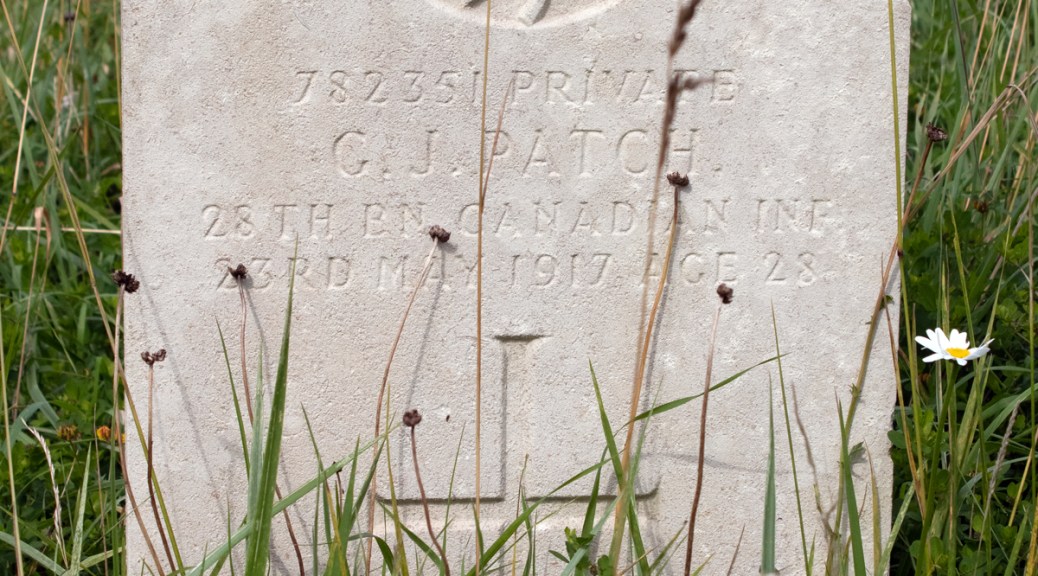
Private Gilbert Patch

Private Gilbert Patch

Gilbert John Patch was born in Winford, Somerset, on 3rd July 1888. The third of seven children, his parents were haulier Robert Patch and his wife Ann.

Gilbert followed his father into carting work, but the opportunity of a bigger and better life presented itself. In the spring of 1913, he emigrated to Canada, to find land and work as a farmer. He settled in the hamlet of Caron, Saskatchewan with a friend from home, Percy Worle.

Gilbert’s time overseas was not to be a length one, however. When Europe went to war, the empire was called upon and, on 1st April 1916, Gilbert enlisted in the Canadian Expeditionary Force. His service records show that he was 5ft 8ins (1.72m) tall, with blue eyes, fair hair and a medium complexion.

After his training, Private Patch arrived in France on 28th December 1916, and was assigned to the 28th Battalion of the Canadian Infantry – the same troop as his friend, Percy. During the Capture of Hill 70 in May 1917, Percy was killed and Gilbert himself was badly injured, receiving shrapnel wounds to his head, left arm and right leg.

Private Patch was medically evacuated to Britain for treatment. He was admitted to the Clopton House War Hospital in Stratford-upon-Avon, and while his wounds were treated, within a couple of weeks, he was dangerously ill with a kidney infection. The combination proved too much for his body to take, and Gilbert died on 23rd May 1917. He was 28 years of age.

Gilbert John Patch’s body was brought back to Somerset for burial. He was laid to rest in the graveyard of the local parish church, St Mary & St Peter’s, in his home village of Winford.


Guardsman Arthur Baguley

Guardsman Arthur Baguley

Arthur George Baguley was born in the autumn of 1897 in Warwick, and was one of six children to George and Rosa Baguley. George was a journeyman butcher who had moved his family to Frome, Somerset, by the time Arthur was three years old. George died in 1908, leaving Rosa to raise the younger members of her family alone.

Little information about Arthur’s life remains, and the only other documents that can be directly connected to him relate to his passing towards the end of the war. These confirm that he enlisted as a Guardsman in the Coldstream Guards at some point after April 1918.

Based in barracks in Hampshire, Guardsman Baguley was admitted to the Connaught Hospital in Aldershot, suffering from infective endocarditis, a bacterial infection of the heart. Sadly, he succumbed to the illness, passing away on 13th September 1918, aged just 20 years old.

Arthur George Baguley’s body was brought back to Somerset for burial. He was laid to rest in the graveyard of St John the Baptist Church, Midsomer Norton, where his mother was living by that point.


Guardsman Arthur Baguley
(from ancestry.co.uk)

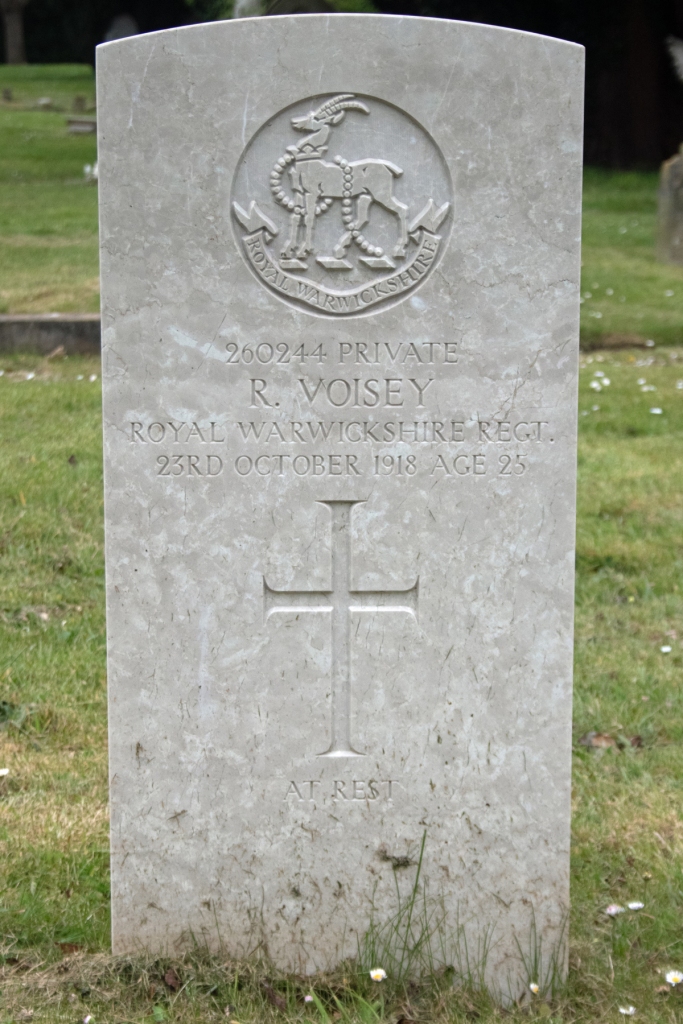
Private Robert Voisey

Private Robert Voisey

Robert Voisey was born towards the end of 1891, one of six children to Richard and Sophia. Richard was a tailor and, while both he and Sophia had been born in Cullompton, Devon, by the time Robert was born, they had moved to the Somerset town of Taunton.

When he left school, Robert followed his father’s trade and, by the time of the 1911 census, he was living with his parents and two of his sisters in a terraced house not far from the town’s station.

With the outbreak of the Great War, Robert was keen to do his bit. While full details of his military service are not available, it seems that he initially enlisted in the Somerset Light Infantry, but was subsequently transferred to the Royal Warwickshire Regiment. Joining the 6th Battalion as a Private, he saw action on the Western Front, and was wounded in April 1918.

Evacuated to England for treatment, Private Voisey was admitted to the 5th Northern General Hospital in Leicester. He seemed to be recovering well from his injuries, but then contracted influenza.

Sadly, this developed into pneumonia and Private Voisey subsequently died on 23rd October 1918, at the tender age of 25 years old.

Robert Voisey’s body was brought back to Somerset and he was laid to rest in the St James’ Cemetery in the town.


Robert’s funeral was written up in the local newspaper, and the report sheds more of a light on the Edwardian attitude towards some medical and mental health conditions than it does on the actual service.

The very fact of [Robert] ever having been a soldier, considering the great disability he was afflicted with through an incurable impediment in his speech, testifies abundantly to his high and noble interpretation of duty and patriotism.

Had he insisted he could at any time have evaded military service, but so eager was he to serve his country that it was not until he had actually been four times rejected as “physically unfit for military service” was he eventually accepted.

To the writer o this brief notice, who was his friend and fellow shop-mate for a long while, but who was at the time doing duty at Castle Green Recruiting Office, he often time used to express his indignation at not being accepted, and on the last occasion he spoke to the writer, it was to emphatically declare himself “as fit to be a soldier as anyone who had yet left Taunton.”

He dreaded the thought of being considered a shirker, and his opinion of many who have, even up till now, successfully evaded service, though far more physically fit than he was, was contemptuous to the bitterest extreme.

He was a true Britisher, a faithful friend and shop-mate, and a courageous soldier of whom no fitter epitaph could be written than “he gave himself in defence of home, country and liberty.”

Taunton Courier and Western Advertiser: Wednesday 6th November 1918