Lancelot Percival Cramp was born in the Kent village of Sutton on 7th June 1891. The youngest of five children, his parents were bootmaker Alfred Cramp and his wife Elizabeth.
Lancelot – who preferred to be called Lance – seems to have had a disjointed childhood. Neither of his parents are recorded in the 1901 census, while he is noted as living with his widowed aunt, also called Elizabeth, in Ticehurst, Kent.
By the time he completed his schooling, Lance found work as a tinsmith. However, he sought a bigger and better career and, on 30th April 1910, he enlisted in the Royal Navy. Assigned the role of Stoker 2nd Class, his papers note that he was 5ft 3ins (1.6m) tall, with auburn hair, grey eyes and a fresh complexion.
Stoker Cramp was sent to HMS Victory, the Royal Naval Dockyard in Chatham, Kent, for his training. He was then sent to the battleship HMS Renown for his first assignment.
Over the next four years, Lance would serve on seven ships in total, returning to Portsmouth in between assignments. His service record notes a very good character and satisfactory ability and, in September 1911, he was promoted to Stoker 1st Class.
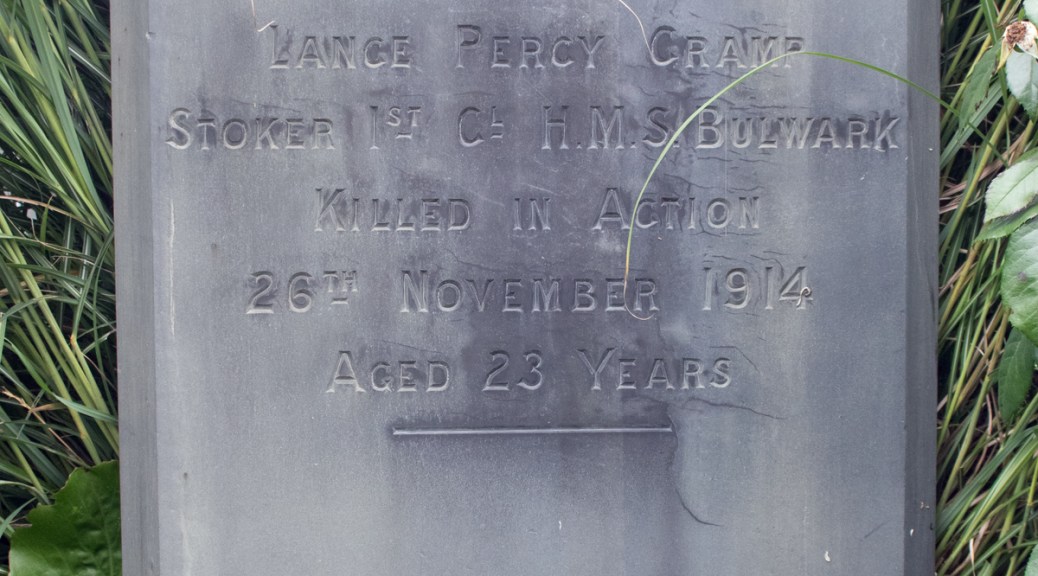
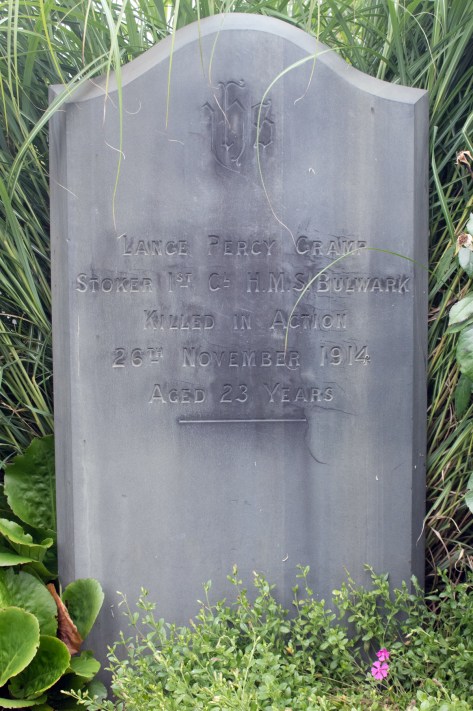
On 8 February 1914, Lance was given a new posting aboard the battleship HMS Bulwark. When war broke out, she was assigned to the Channel Fleet, which had the responsibility for patrolling and protecting Britain’s southern coastline.
On the morning of 26 November 1914, Bulwark lay anchored in the River Medway near Sheerness while taking on shells and ammunition. During the process, improperly stored cordite charges overheated and ignited nearby munitions. The massive explosion that followed tore the ship apart, killing more than 740 members of the crew. Stoker Lance Cramp was amongst those who died: he was 23 years of age.
Those who were killed in the explosion were buried in the naval section of Woodlands Cemetery, Gillingham, Kent. The body of Lancelot Percival Cramp was identified, and laid to rest in a marked grave.
William Ernest Gubbey was born on 21st February 1896 in Portsmouth, Hampshire. He was the only child to William and Alice Gubbey. William Sr was a Petty Officer in the Coastguard, and the family travelled to where he was needed. The 1901 census found them in Malinmore, County Donegal, while ten years later, they were living in Tara, County Down.
It seemed natural for William Jr to follow in his father’s footsteps and, on 3rd August 1912, he joined the Royal Navy. He was too young to formally enlist, and was given the rank of Boy 2nd Class. Sent to HMS Impregnable, the school ship based in Devonport, she would remain his home for the next ten months while he was trained.
William was promoted to Boy 1st Class on 17th June 1913, and was assigned to the cruiser HMS Gibraltar the following day. After six months on board, and a short stopover at HMS Victory, the Royal Naval Dockyard in Portsmouth, Hampshire, he received his next posting, the battleship HMS Bulwark.
Boy Gubbey would spend the next year attached to Bulwark and, during this time, he came of age. Now formally inducted into the navy as an Ordinary Seaman, his service papers show the young man he had become. He was recorded as being 5ft 5.5ins (1.66m) tall, with brown hair, blue eyes and a dark complexion.
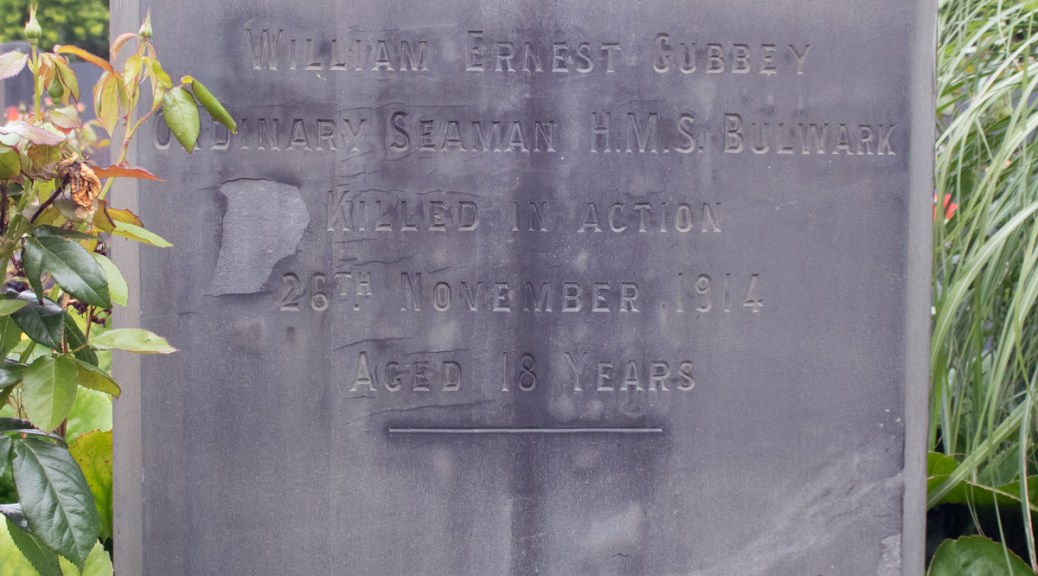
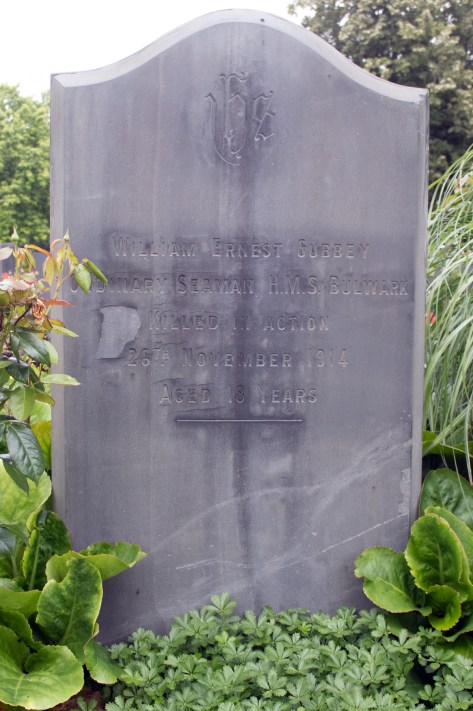
When was was declared in the summer of 1914, Bulwark was assigned to the Channel Fleet, patrolling and defending Britain’s southern coast. On 26th November 1914, she was moored in the River Medway, close to Sheerness, Kent, being reloaded with ammunition.
Some of the new cargo overheated and the resulting explosion ripped through the battleship. More than 740 crew were killed, including Ordinary Seaman Gubbey: he was just 18 years of age.
The bodes of the dead were laid to rest in Woodlands Cemetery, Gillingham, Kent. As his had been identified, William Ernest Gubbey was laid to rest in a marked grave.
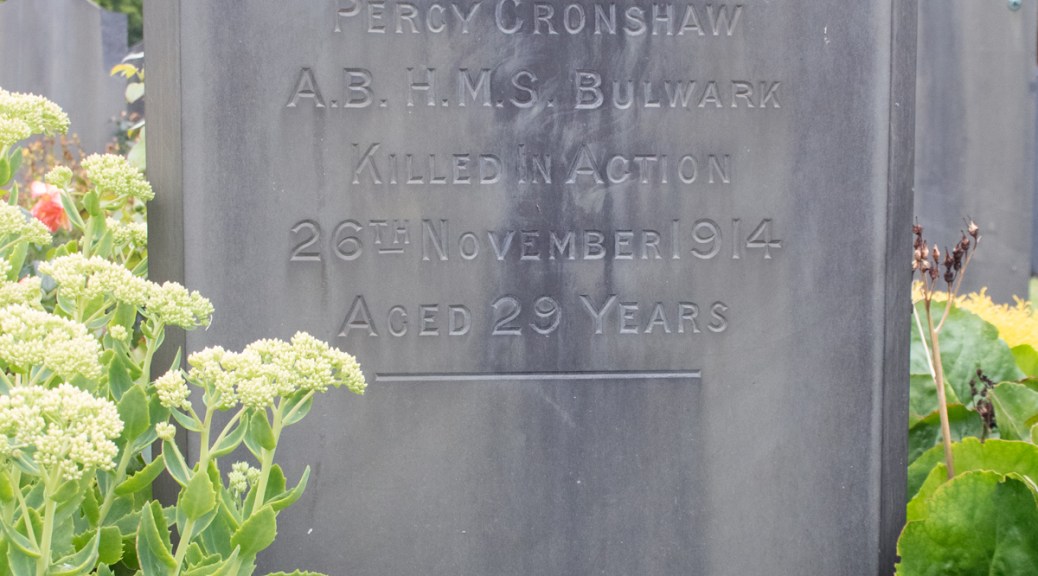
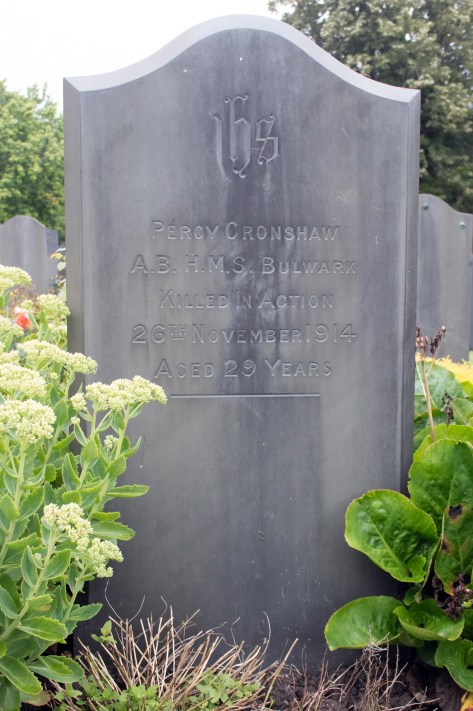
Percy Cronshaw was born in Ashton-under-Lyne, Lancashire, on 10th January 1885. The second of five children, he was the oldest son to Thomas and Alice Cronshaw. Thomas was a loom overseer in a local mill, and when Percy completed his schooling, he found work as a calico weaver. Alice had died by the time of the 1901 census, and the family has moved to a cottage on Loxham Street in Bolton.
Percy wanted a better life for himself and, on 12th February 1902, he joined in the Royal Navy. Too young to fully enlist, he was given the rank of Boy 2nd Class, and sent to HMS Northampton for his training. Over the next year he learnt the tools of his trade, rising to Boy 1st Class after just three months.
By the time of Percy’s eighteenth birthday, he had had three further postings: the shore bases HMS Calliope in Gateshead and HMS Victory in Portsmouth; and the cruiser HMS Good Hope. It was with her that he came of age, and was in a position to formally enlist in the Royal Navy.
The now Ordinary Seaman Cronshaw’s papers show the man he had become. He was 5ft 4.5ins (1.64m) tall, with auburn hair, black eyes and a fresh complexion. He was also noted as having moles on the right side of his face and neck, and two tattoos: his initials on his right forearm, and an anchor on his left.
Percy remained aboard HMS Good Hope until the spring of 1905. By this point, he had been promoted, taking the rank of Able Seaman. With his promotion came more training, and he spent the next year split between HMS Victory and HMS Excellent, another shore base in Portsmouth. His annual reviews noted a very good character and an ability to match.
Over the next seven years, Able Seaman Cronshaw would go on to serve on two further ships – HMS Venus and HMS Superb. In between voyages he returned to Portsmouth, with HMS Excellent becoming his home port. This land base offered some continuity, and the unexpected bonus of romance. On 28th January 1912, Percy married Frances Stubbington, a shoemaker’s daughter from the city: the couple would go on to have a child, Violet, who was born later that year.
By this point, Percy had been given a new posting, on board the battleship HMS Bulwark. When war was declared, she became a part of the Channel Fleet, tasked with patrolling and defending Britain’s southern coast.
On 26th November 1914, Bulwark was moored in the River Medway, close to Sheerness, and was being stocked with shells and ammunition. That morning, some poorly stowed charges overheated, detonating the shells stored nearby. The resulting explosion ripped through the battleship, and more than 740 crew were killed. Able Seaman Cronshaw was among those to be recovered: he was 29 years of age.
Percy Cronshaw’s body as laid to rest alongside his colleagues in Woodlands Cemetery, Gillingham, Kent. As his body had been identified, he was able to be buried in a marked grave.
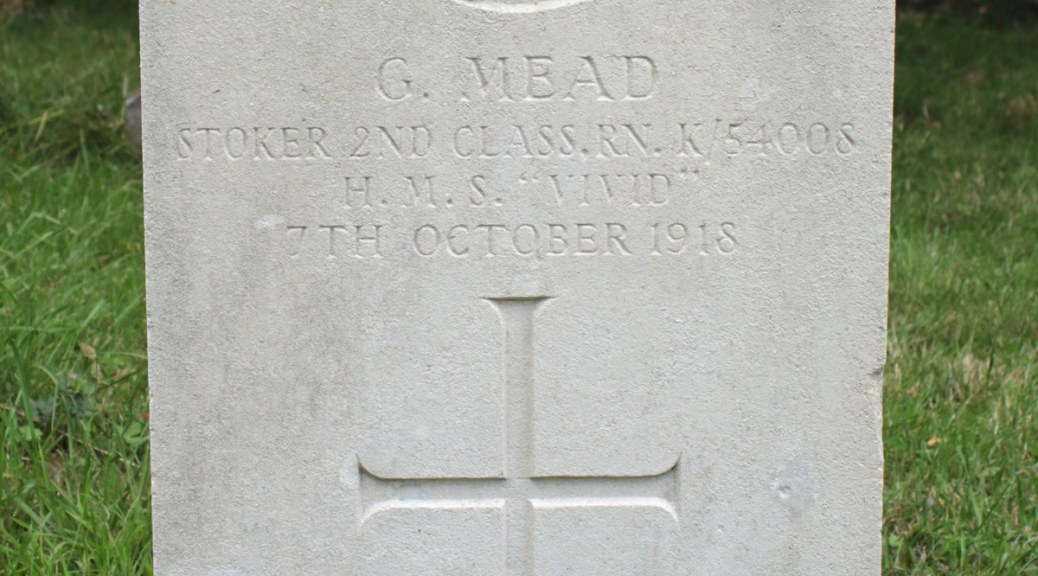
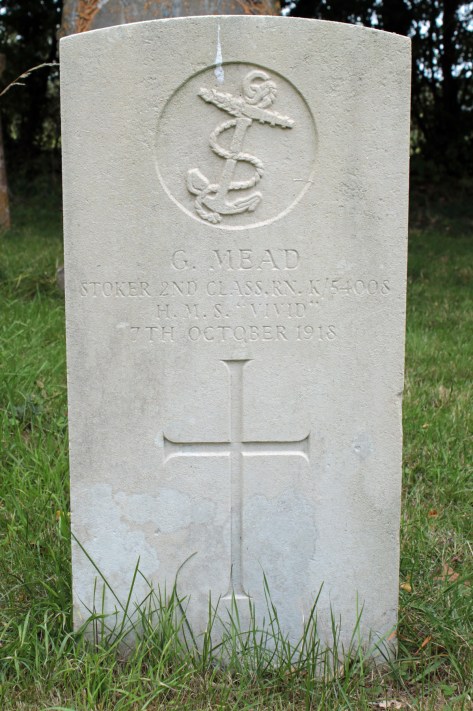
George Mead was born on 18th September 1900 in the Wiltshire village of Semley. The youngest of eleven children, his parents were police sergeant George Mead and his wife, Rebecca.
The 1911 census recorded the Mead family as having moved to Chapmanslade, near Westbury. George Sr and Rebecca were set up in a five-room cottage, Forest View, with George Jr and two of his older sisters – Edith and Margaret – also living there.
Rebecca passed away when her youngest was just sixteen years of age and, on 12th March 1917, George Jr’s older brother Charlie, a Private in the Worcestershire Regiment, was killed in action while fighting in France. It seems that his younger sibling was keen to prove his mettle before peace was declared and, on the day after his eighteenth birthday, he gave up his job as a carter and enlisted in the Royal Navy.
Stoker 2nd Class Mead’s service records show that he was 5ft 10.5ins (1.79m) tall, with brown hair, blue eyes and a fresh complexion. He was sent off to HMS Vivid – the Royal Naval Dockyard in Devonport, Devon – for his training.
Tragically, George Jr’s time in the navy was to be short. He contracted pneumonia and as admitted to the naval hospital in Plymouth. The illness was to prove too severe, and he passed away on 7th October 1918: he was eighteen years of age, and had been in the Royal Navy for just 18 days.
The body of George Mead Jr was taken back to Wiltshire for burial. He was laid to rest in the extension to St Margaret’s Church, Corsley, not far from where his grieving father still lived.
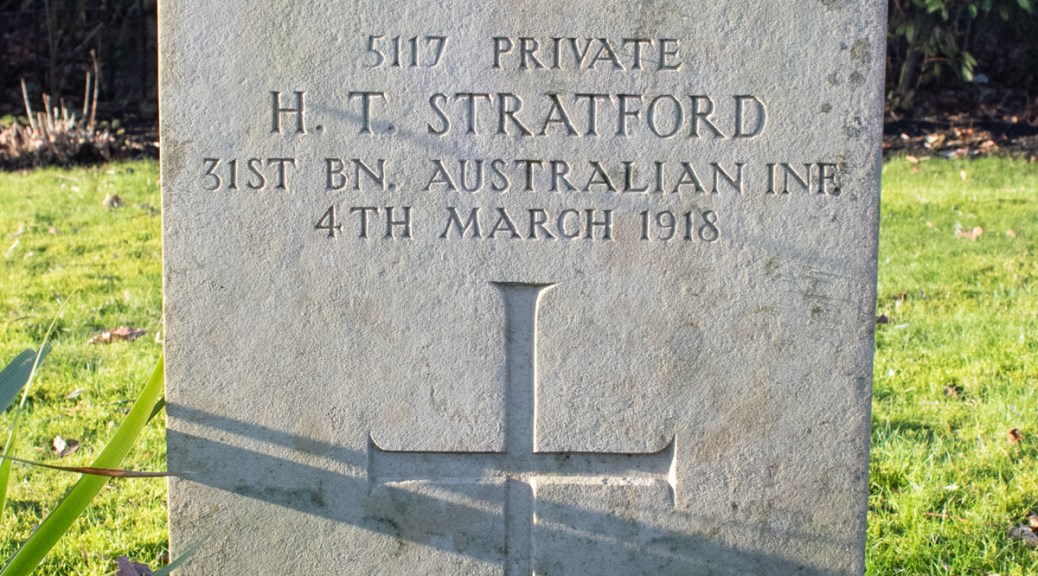
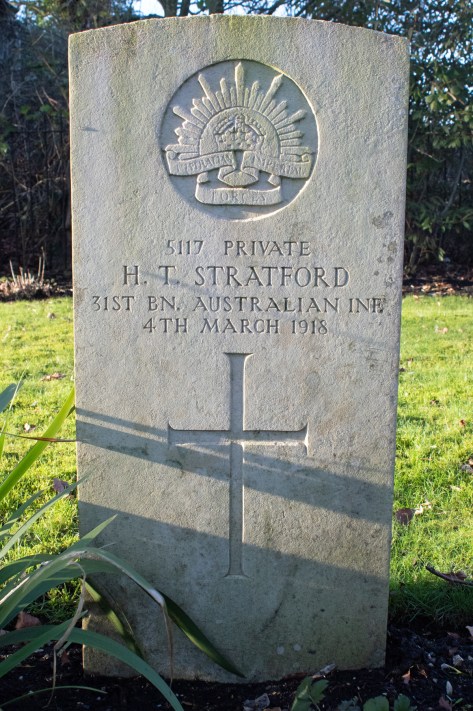
Henry Thomas Stratford was born in Southampton, Hampshire, in the autumn of 1870. The youngest of three children, his parents were John and Maria Stratford. When Henry’s father died in 1876, Maria re-married, and went on to have a further child with her new husband, James Simmons.
Maria’s husbands worked away, and likely served on ships: John was absent from the 1871 census, while James was missing from the 1881 return.
By the 1901 census, Maria had been widowed a second time. She was living at 29 Dock Street with her three youngest children – Henry, his older brother John, and his younger half-brother William. By this point, John was employed as a waterman on a barge, while Henry had also taken to the water, and was employed as a seaman.
Maria passed away in 1904, and there is little further information about Henry’s earlier life. His later army records suggest that he served in the Royal Navy for 14 years, although there are no records for his service at that time.
At some point, presumably after his time in the navy had expired, Henry emigrated to Australia. Again, details are scarce, but he was definitely there by the spring of 1917, having settled in Brisbane, and taken up work as a sailmaker.
When war broke out in Europe, Henry stepped up to serve his country, enlisting in the Australian Imperial Force on 3rd Mary 1917. His records confirm that he was 5ft 4ins (1.62m) tall, and weighed in a 152lbs (69kg). With light brown hair and blue eyes, he had a fair complexion and tattoos on both of his forearms.
Assigned to the 31st Battalion of the Australian Infantry, Private Stratford set sail from Sydney on 14th June 1917. After a ten week voyage, he was marched in to Hurdcott Camp near Fovant, Wiltshire, and would remain in the ANZAC base for his training.
On 23rd February, Henry was admitted to the No. 3 New Zealand General Hospital in Codford, Wiltshire, having fallen from a train. He remained in hospital for the next week, but his head injuries would ultimately prove fatal.
An inquest was held at the New Zealand Military Hospital on Wednesday concerning the death of Henry Thomas Stratford…
Mr FAP Sylvester (coroner) conducted the inquiry, and the evidence went to show that on the night of February 23rd last the deceased man met with an accident by trying to leave a train while it was in motion, before reaching Codford GWR Station. He was picked up in an unconscious state and conveyed to the Military Hospital where he died on Monday.
Corporal John Brooks, ASC Cyclist Section, of Codford, stated that he proceeded from Warminster on the 9:45pm train to Codford on February 23rd. He was in the company of Gunner E Ford, RFA, of Boyton, and they were in the came corridor carriage as the deceased man. After leaving Warminster deceased walked down the corridor, and some time later witness found that deceased had opened the carriage door and was sitting with his feet hanging outside, apparently trying to alight from the train. Just after passing Upton Lovel [sic] crossing, he suddenly disappeared, and witness just saw him fall off the footboard. Deceased never spoke or shouted, and when the train pulled up at Codford, witness reported the matter to the military police and stationmaster, and accompanied them to the spot where deceased was found lying face downwards, his head against the main line rail. First aid was rendered and he was moved to the military hospital.
Private Claude E Thompson, Australian military police, stated that deceased had a road pass, but he had no right to travel by train. He had probably endeavoured to leave the train before it reached Codford to evade the military police.
The jury returned a verdict that deceased came to his death by trying to alight from the train and that he accidentally fell and sustained a compound fracture of the skull.
[Warminster & Westbury Journal – Friday 08 March 1918]
Henry Thomas Stratford was 47 years of age when he passed away. His body was laid to rest in the ANZAC extension to St Mary’s Churchyard in Codford, Wiltshire, close to the hospital in which he had breathed his last.
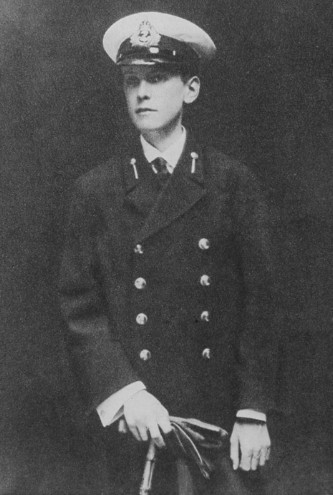
Gervase Anthony David Herewyt de Bless was born on 20th October 1897 in Westminster, Middlesex. One of two children, he was the surviving son of barrister Alfred de Bless and his wife Maud, born Maud Cary-Elwes. Both were renowned families – Maud’s brother going on to become the Bishop of Northampton. The family do not appear in the 1901 census, but by 1911 Gervase’s parents were living at 156 St James’ Court, with French lady’s maid Henriette Forestier.
Alfred died not long after the census was taken. Gervase, meanwhile, was installed as a boarder at Downside College, Somerset. One of 168 students, he was taught by twelve schoolmasters and a handful of Roman Catholic priests from the local abbey.
An exceptionally clever boy of very active minds and many interests, during his time in the School he distinguished himself in all branches of study, winning the Gregorian Medal in 1912. He passed the Higher Certificate three times, twice gaining distinction in French and twice in Roman History. For three years he played in the Junior Cricket Eleven, which he captained in 1912. From 1908 to 1912 he sang in the choir as a treble, and he took a leading part with much success in “The Gondoliers,” and in “HMS Pinafore.” In 1914 he was Editor of The Raven, and he was on the committee of the Petre Library. In this year also he was awarded the Higher Certificate Latin Prose Prize given by St Gregory’s Society. On leaving Downside he spent two terms at Cambridge under the tuition of Mgr Barnes. Sensitive and somewhat retiring, and with health far from robust, he faced the situation created by the war with splendid courage, and obtained a cadetship in the Royal Navy. A skilful angler, fishing had ever been his favourite recreation, and on this pleasant pastime he wrote some charming verses which were afterwards collected in a little booklet.
[Baliol College War Memorial Book]
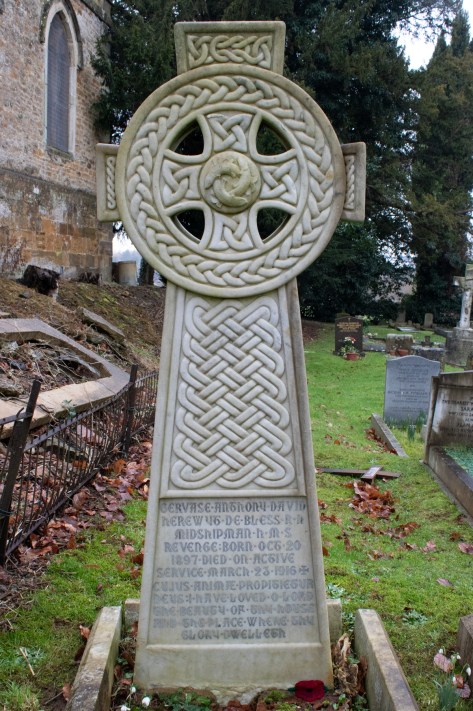
Gervase was given the rank of Midshipman in February 1916, and was assigned to the battleship HMS Revenge the following month. Before his posting he had suffered a bout of influenza, and had a relapse within days of boarding. He died from a combination of influenza and diabetes on 23rd March 1916, just two days after joining Revenge. He was just 18 years of age.
…rites of the Church… were administered to him by Dom Jerome Tunnicliffe, of St Mary’s, Liverpool, a monk of Downside.
[Baliol College War Memorial Book]
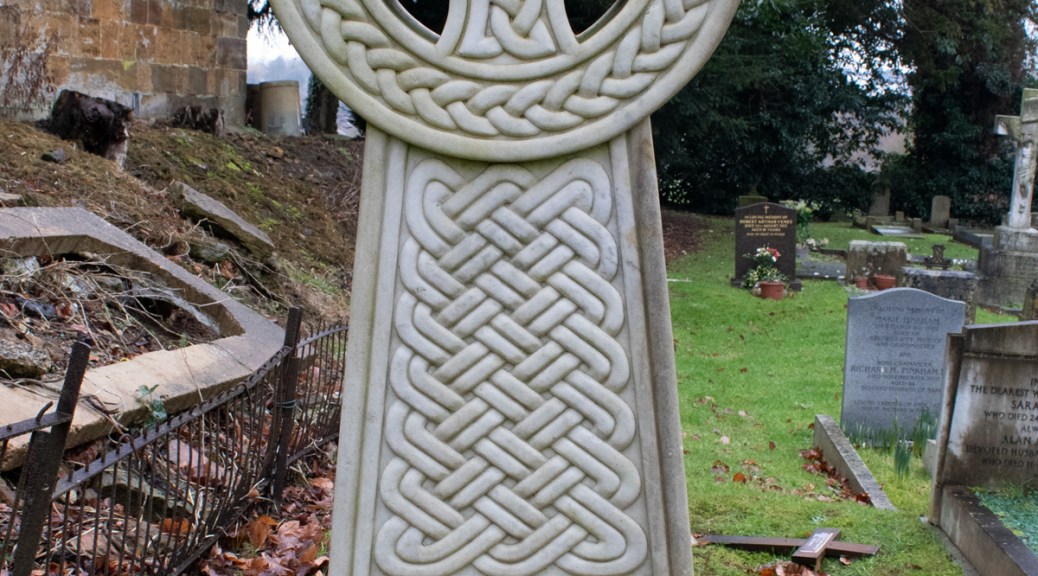
The body of Gervase Anthony David Herewyt de Bless was taken to Northamptonshire for burial. He was laid to rest in the ground of St Andrew’s Church, Great Billing, the last resting place of the Cary-Elwes family and de Bless families.
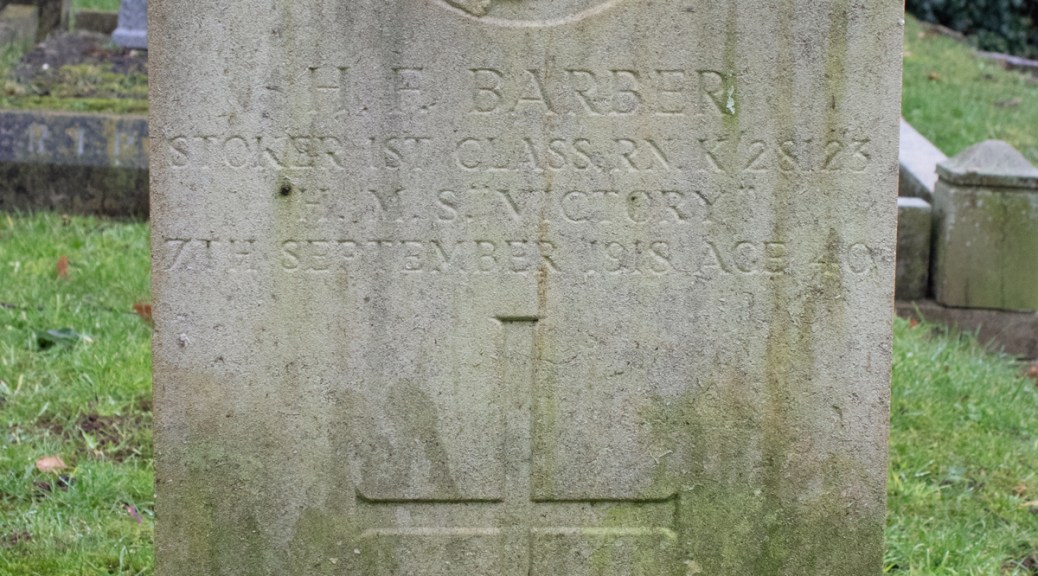
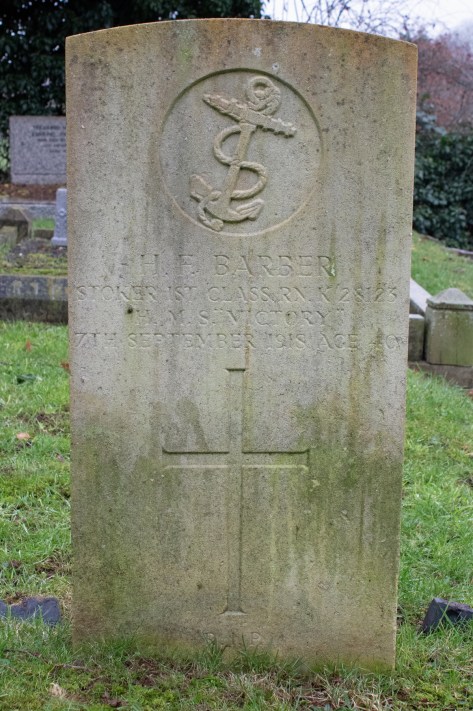
The early life of Herbert Frederick Barber is a challenge to unpick. His navy service papers confirm that he was born on 12th December 1877 in Great Billing, Northamptonshire. His is not an uncommon name for the area, and Herbert Barbers appear on a number of census records. His parents are likely to have been shoe maker Frederick Barber and his wife, Jane.
In the summer of 1898, Herbert married Agnes Wood. He had found work as a bricklayer’s labourer by this point, and had set up home in Weston Favell, to the east of Northampton town centre. Agnes was a farm labourer’s daughter from nearby Great Billing: the couple went on to have six children – of whom four survived infancy.
The 1911 census found the Barber family – Herbert, Agnes and children Edith, Lilian, Fred and James – living in a five-roomed house in Weston Favell. Herbert was still labouring, but gave his employer as the navy.
When war broke out, Herbert stepped up to serve his country. He enlisted on 22nd September 1915, and his service records give his occupation as a gas stoker (although this was crossed out and replaced with “feller’s mate”). He was recorded as being 5ft 8.5ins (1.74m) tall, with grey hair, blue eyes and a fair complexion.
Herbert took on the role of Stoker 1st Class, and was sent to HMS Victory – the Royal Naval Dockyard in Portsmouth, Hampshire – for his training. He remained there for six months – including ten days in the cells for an unrecorded offence – before being sent down the coast to Dartmouth in Devon.
Stoker Barber remained on-shore for his naval career. By July 1917 he had returned to Portsmouth, and this is where he would stay for the next fourteen months. In the summer of 1918 he fell ill, and was admitted to the Royal Naval Hospital in Haslar with pneumonia. The condition would prove his undoing: he passed away on 7th September, at the age of 40 years old.
Barber, Pte. [sic] HF, husband of Mrs Barber of Weston Favell, and son of Mr and Mrs F Barber, Great Billing, died of pneumonia on September 7, after four days’ illness at RN Hospital, Haslar.
[Northampton Mercury – Friday 20 September 1918]
The body of Herbert Frederick Barber was taken back to Northamptonshire for burial. He was laid to rest in the Great Billing Roman Catholic Cemetery.
Agnes was left to raise her children alone. The 1939 England and Wales Register found her living at 10 High Street, Weston Favell, next door to her son Fred and his family. Working as a small shop keeper, she also had two boarders to bring in some additional money.
Agnes lived on until the age of 98: she died on 27th February 1975.
Herbert Lee was born in the Herefordshire village of Dilwyn on 16th August 1896. The sixth of eight children, he was one of five sons to Charles and Frances Lee. Charles was a waggoner on a local farm and, when he finished his schooling, his son found work as a farm hand there.
When war broke out, Herbert was quick to step up and play his part. He enlisted in the Royal Navy on 14th October 1914, taking on the role of Stoker 2nd Class. His service papers show that he was 5ft 4.5ins (1.64m) tall, with brown hair, blue eyes and a fresh complexion.
Stoker Lee was sent to the Royal Naval Dockyard in Chatham, Kent – also known as HMS Pembroke – for his training. Over the next five years, he seems to have been mainly shore-based, transferring between units in Chatham and at HMS Victory, the navy dockyard in Portsmouth, Hampshire. In August 1915, he was promoted to Stoker 1st Class, and his records note a very good character with a superior ability.
Herbert survived the war and, by the start of 1919, he was back in Chatham. He had fallen ill by this point, and, having contracted the highly contagious tuberculosis, he was medically discharged from navy service on 19th March 1919.
Herbert Lee battled his condition bravely, but would ultimately succumb to it. He passed away on 8th October 1920, at the age of 24 years old. He was laid to rest in the tranquil surrounds of St Mary’s Churchyard in his home village of Dilwyn.
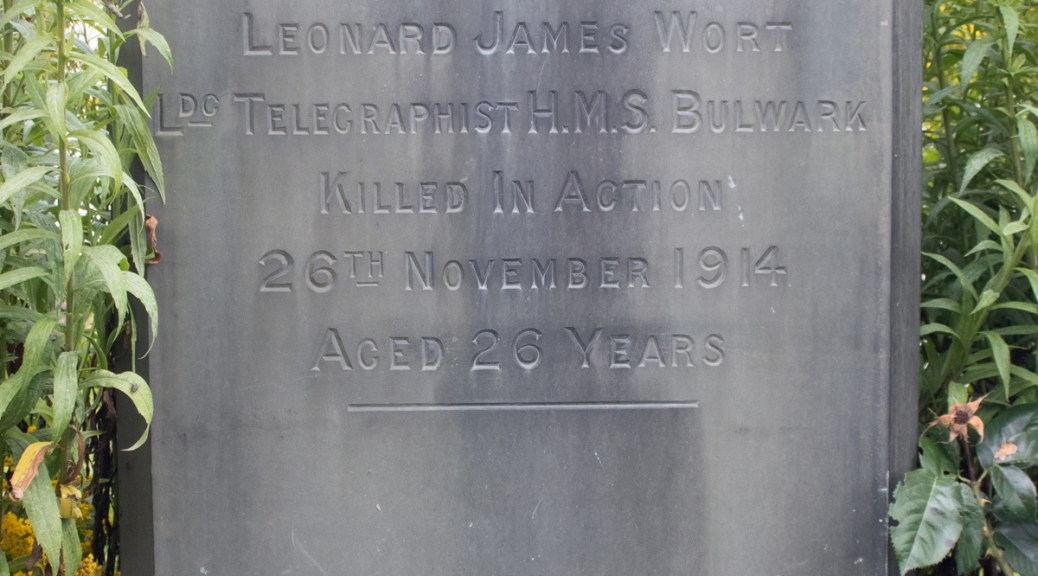
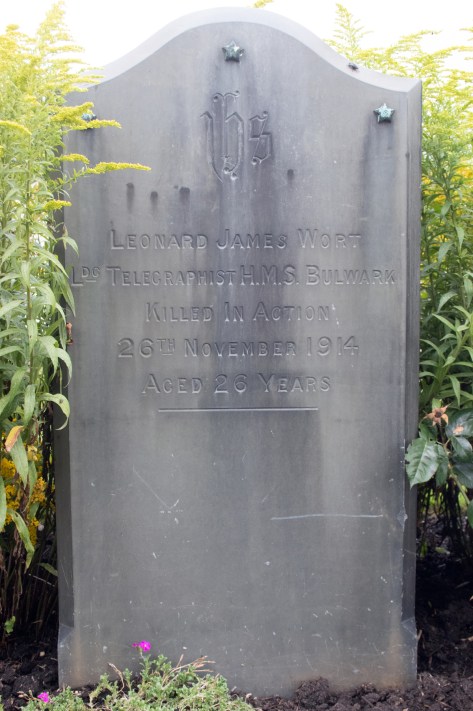
Leonard James Wort was born in the Wiltshire village of Woodfalls, on 28th September 1888. He was the second of eleven children – and the oldest son – to James and Annie Wort.
James was a sawyer, but Leonard sought a better life for himself. Initially finding work as a blacksmith’s mate when he completed his schooling, but took up a career in the Royal Navy at the start of 1907. Employed as a Stoker 2nd Class, documents show that he was 5ft 6.5ins (1.69m) tall, and that he had brown hair, hazel eyes and a fresh complexion. He was also noted as having scars on the thumb and finger of his left hand.
Leonard was sent to the training ship HMS Nelson for his initial induction. He remained there for four months, before being given his first sea-faring appointment, on board the cruiser HMS Spartiate. Over the next seven years, he would serve on nine ships in total, but his service took an unexpected route.
In February 1908, Leonard was promoted to Stoker 1st Class, and the next expected progression would have been to Leading Stoker. However, year later, while serving on HMS Hindustan, he took a different route, and became a Telegraphist. He appears to have enjoyed this role, and been more than capable of carrying it out: his annual reviews noted his superior ability on more than one occasion.
Over the next few years, Leonard spent time at HMS Victory – the Royal Naval Dockyard in Portsmouth, Hampshire – presumably to receive the training needed to undertake his role. At the start of 1911, he was promoted again, taking the rank of Leading Telegraphist.
Away from the sea, love was blossoming. Leonard had met Florence Bysouth, a casemaker’s daughter from Bankway, Hertfordshire. The couple exchanged their vows in Bromley, Kent, but had set up home in Poplar, East London.
In November 1912, Leading Telegraphist Wort was assigned to the pre-dreadnaught battleship HMS Bulwark. Part of the Channel Fleet, she was tasked with patrolling the southern coasts of Britain. On 26th November 1914, Bulwark was moored in the River Medway, close to Sheerness, and was being stocked with shells and ammunition. That morning, some of the cordite charges overheated, detonating the shells stored nearby. The resulting explosion ripped through the battleship, and more than 740 crew were killed. The body of Leading Telegraphist Wort was recovered: he was 26 years of age.
Those who were killed in the explosion were laid to rest during a mass funeral in Woodlands Cemetery, Gillingham, Kent. As his body had been identified, Leonard James Wort was laid to rest in a marked grave.
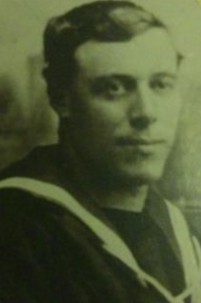
Leading Telegraphist Leonard Wort (from findagrave.com)
Leonard was not the only one of the Wort sons to sacrifice his life during the First World War. His younger brother, Alfred, also enlisted in the Royal Navy, giving up his role as footman and valet to serve as an Officer’s Steward.
Alfred’s service records show that he was attached to HMS Vivid – the Royal Naval Dockyard in Devonport – when, on 4th April 1918, he drowned. He was 26 years of age, and left a widow and son.
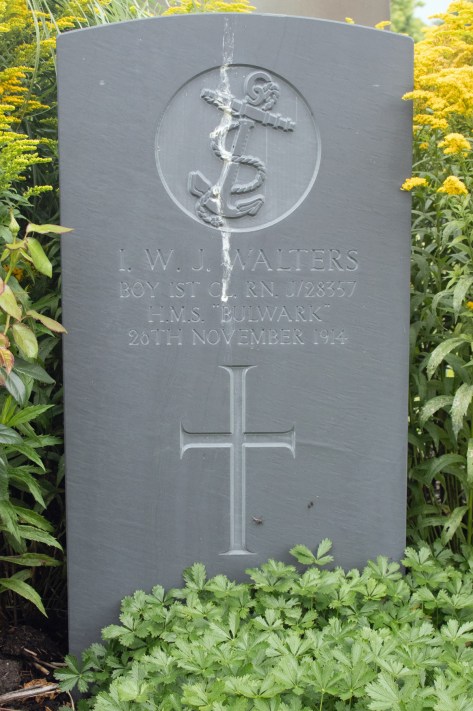
William John Walters was born in Portsmouth, Hampshire, on 9th July 1898. The fifth of nine children, his parents were Charles and Sarah Walters. Charles was a licensed boatman, and, for William’s short life, the family lived on Grange Street, Portsea.
Young William found work as a shop boy when he finished school, but he was drawn to the sea like his father and, on 22nd November 1913, he joined the Royal Navy. Too young to full enlist, he was given the rank of Boy 2nd Class and sent to HMS Impregnable, the navy’s school ship in Devonport, Devon.
Boy Walters’ service records show that he was 5ft 3.5ins (1.61m) tall, with brown hair, brown eyes and a dark complexion. He was also noted as having tattoos on both of his forearms.
By the summer of 1914, William has been promoted to Boy 1st Class. He returned to Hampshire, and was based at HMS Victory, the Royal Naval Dockyard in Portsmouth. This was just a staging post, however, as, on 26th August, he was assigned to the pre-dreadnaught battleship HMS Bulwark.
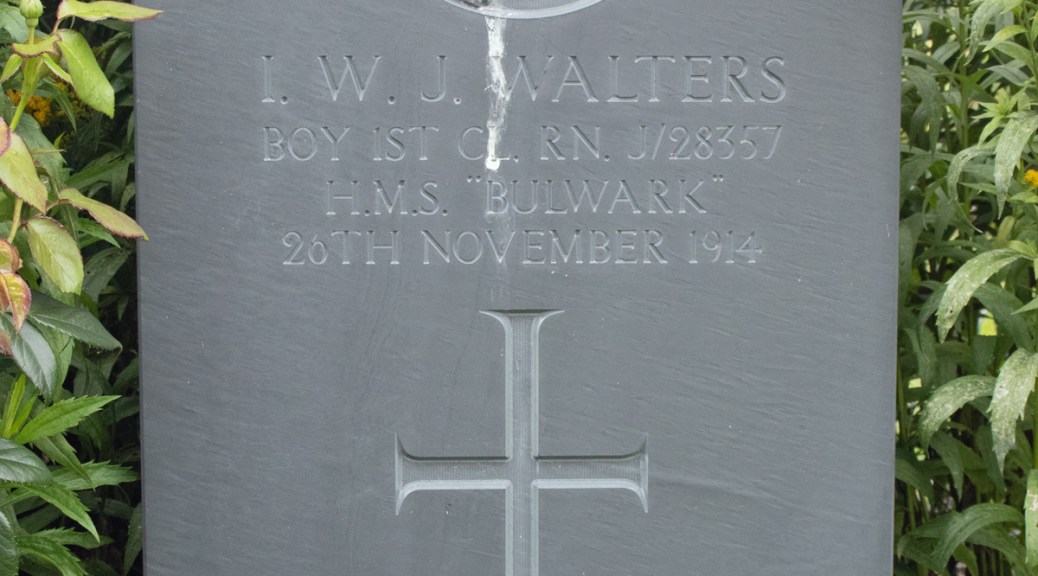
Part of the Channel Fleet, Bulwark was tasked with patrolling and defending Britain’s southern coast. On 26th November 1914, Bulwark was moored in the River Medway, close to Sheerness, and was being stocked with shells and ammunition. That morning, some poorly stowed cordite charges overheated, detonating the shells stored nearby. The resulting explosion ripped through the battleship, and more than 740 crew were killed. The body of Boy 1st Class Walters was among those to be recovered: he was 16 years of age.
Those who were killed in the explosion were laid to rest in the naval section of Woodlands Cemetery, Gillingham, Kent. As his body had been identified, William John Walters was laid to rest in a marked grave.
William’s headstone gives his name as IWJ Walters. There are no records to suggest that his forenames were anything other than William John, however.
William’s mother Sarah died around the same time as him. It is unclear whether she passed knowing her son had lost his life or not.


 Death and Service