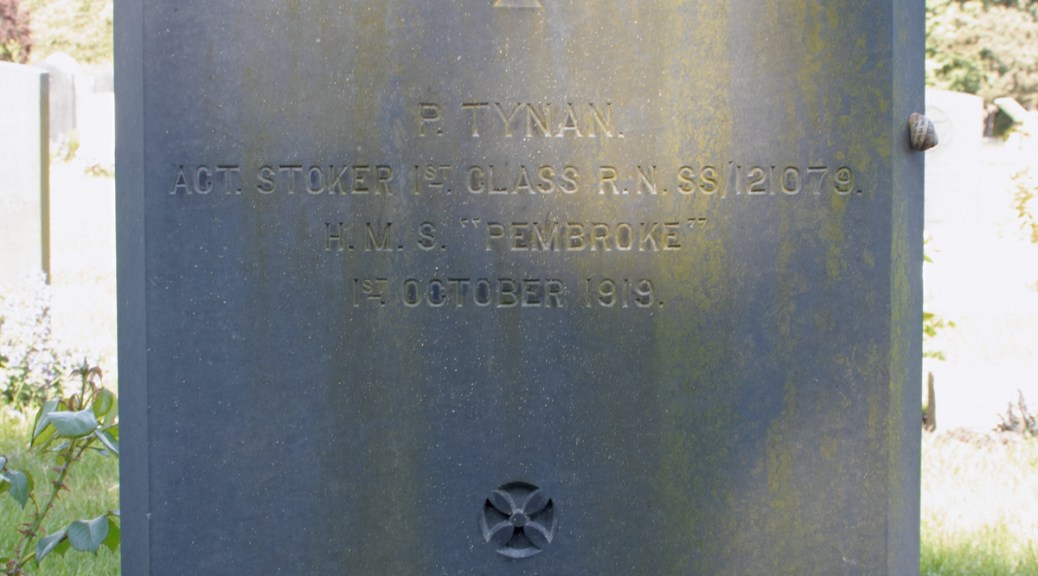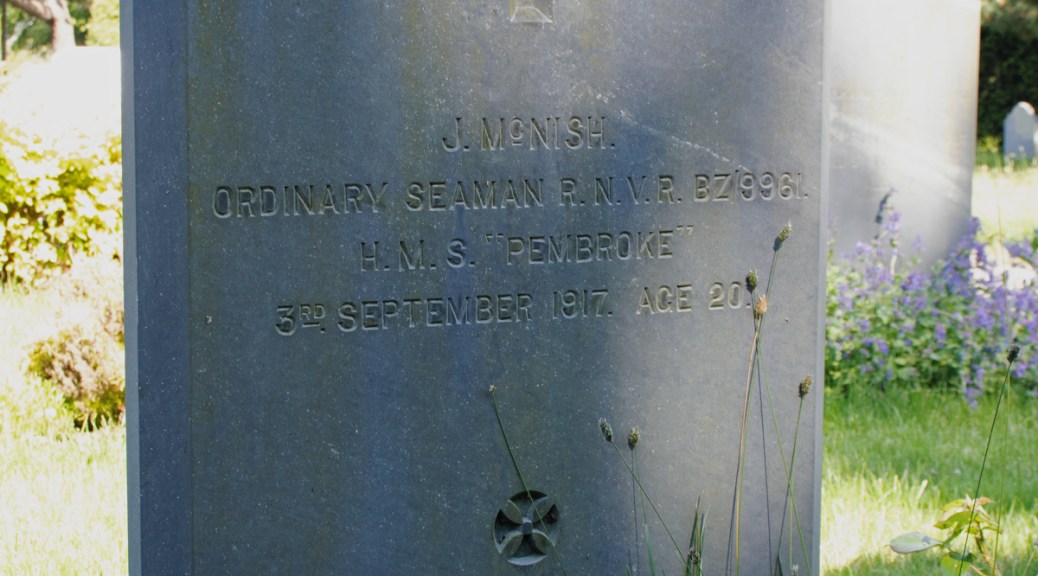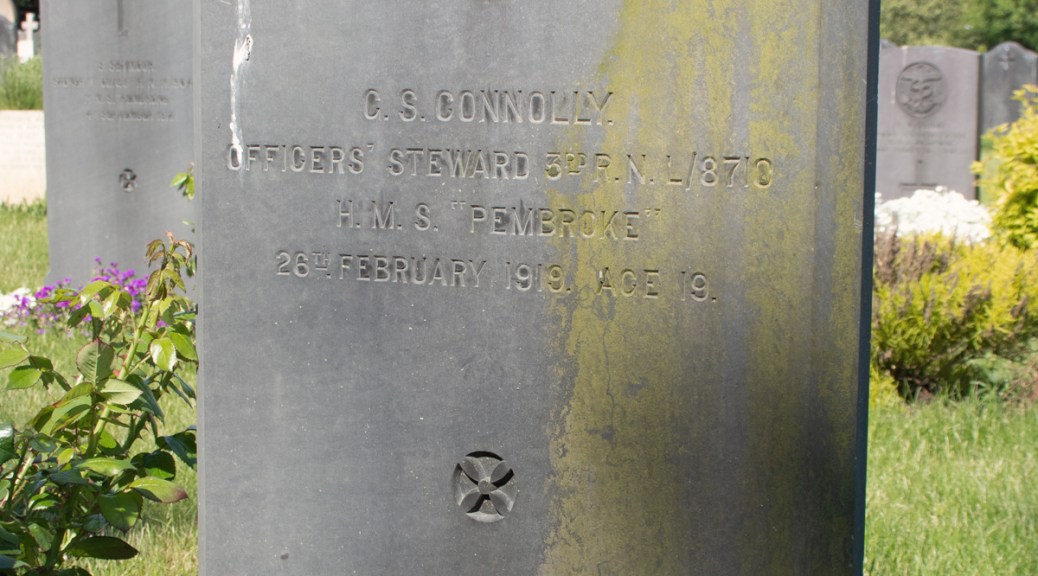
Category Archives: Royal Navy

Chief Artificer James Davidson

Chief Artificer James Davidson

There are some lives that just don’t want to be discovered, that just hide tantalisingly out of reach. James Davidson’s was one of those lives.

The main two research websites I use – cwgc.org and findagrave.com – only have his initial and surname, which is understandable, as this is what is inscribed on his headstone. Unfortunately, that doesn’t act as a good base on which to carry out further research.

HMS Gunner was the wartime moniker for Granton Harbour, near Edinburgh. A naval history website managed to identify Chief Artificer Davidson’s first name – James – but again, with no other information to go on, this is still too common a name – particularly in Scotland – to narrow down any real results.

Sadly, then, the story behind James Davidson is destined to remain a mystery. All that can be confirmed for certain is that he passed away on 23rd January 1919, though the cause of his passing is lost to time, as is his age.

James Davidson lies at rest in the Woodlands Cemetery in Gillingham, Kent.


Chief Engine Room Artificer 2nd Class Arthur Herring

Artificer Arthur Herring

Arthur Herring was born on 5th December 1877, the third of five children to William and Constance Herring. William was a sign writer at the Naval Dockyard in Chatham, Kent, and the family lived in neighbouring Gillingham.

Arthur joined the Royal Navy in September 1899, just short of his 22nd birthday. He worked as an Engine Room Artificer (ERA), and over the twelve years of his initial service, he crewed on board ten different ships. This was in addition to his service at HMS Pembroke, the shore vessel in his home town of Chatham.

Arthur was evidently a hard worker, and he rose through the ranks from ERA 5th Class to ERA 1st Class during this time.

In September 1912, Arthur married Angela Beck; she was also born in Chatham, and was the daughter of a naval Sergeant. The couple didn’t go on to have any children.

War was looming by the time Arthur completed his twelve years’ service. Arthur was recommissioned, serving as Chief Engine Room Artificer 2nd Class on HMS Aquarius and HMS Tyne during the conflict.

In February 1917, Artificer Herring transferred to HMS Torrent. This was a naval destroyer, part of the Harwich Force, patrolling the North Sea.

One of the duties of the Harwich Force was manning the “Beef Run”; the convoys between England and the Netherlands. It was on one of these runs that tragedy struck HMS Torrent.

At about 2am on 23rd December, the convoy, including HMS Torrent, ran into a German minefield, and Torrent struck a German mine. Two of the other ships in the convoy, HMS Surprise and HMS Tornado went to rescue Torrent’s crew, but Torrent struck a second mine and quickly sank. In an attempt to rescue survivors, Surprise and Tornado also struck mines and sank.

Only the fourth convoy ship, HMS Radiant was undamaged and picked up the survivors from the three ships. In total, 12 officers and 240 other ranks were killed from the three ships. On HMS Torrent, only three of the crew survived; sixty-eight others perished that night. This included Artificer Herring, although his body was rescued from the water; he was 40 years old.

Arthur Herring lies at peace in the Woodlands Cemetery in his home town of Gillingham, Kent.


Chief Engine Room Artificer 2nd Class Charles Miller

Artificer Charles Miller

Charles Frederick Caleb Miller was born on 12th December 1887 in Gillingham, Kent. His parents were Charles and Harriet Miller, and he had two younger siblings, Mabel and Harriet.

Tragically, Charles Jr’s mother died when he was only three years old; his father went on to marry again – to his widow’s younger sister, Jane – and the couple had two further children – Jane and Beatrice – who were Charles Jr’s half-sisters.

Charles Sr worked as a ship’s rigger in the Military Dockyard in Chatham, and naval life obviously caught his son’s eye. In 1903, having left school, he enlisted in the Royal Navy, started as a ‘boy artificer’, working in the engine and boiler rooms of ships.

His initial service was for twelve years, and he worked on a number of vessels, as well as being assigned to HMS Pembroke, the shore base in Chatham. He worked his way through the ranks to Engine Room Artificer 2nd Class by 1915.

In June of that year, Charles married Ellen Holden. the daughter of a dairyman from Chelsea. The couple went on to have a daughter, Joan, who was born in 1918. At the time of their wedding, Charles was based on HMS Lance, and his military service was to continue.

His period of service extended until the end of the war, Charles served on a number of other vessels, including HMS Surprise, Blenheim and Prince George and rose to Chief Engine Room Artificer 2nd Class.

It was while he was assigned to HMS Ganges in January 1920 that he became unwell, however. He had contracted bronchial pneumonia, and died of a combination of that and heart failure on 9th February 1920. He was 32 years old.

Charles Frederick Caleb Miller lies at rest in Woodlands Cemetery in his home town of Gillingham, Kent.


Charles Miller (from ancestry.co.uk)

Artificer William Brighton

Artificer William Brighton

William Brighton was born on 13th August 1877 in Peterborough, Northamptonshire. Sadly, details of his early life are lost to time, so his parents’ names, and details of any siblings are a mystery.

William chose a military life early on; he enlisted in the Royal Navy in October 1899 for twelve years’ service. Working as an Engine Room Artificer, he was an engine fitter and repairer on a number of vessels in his time, including the battleship HMS Repulse and the cruisers HMS Andromache and Scylla.

William married Lily Franklin in the autumn of 1904, and the couple went on to have three children; Mona, Lily and John. With William away at sea a lot of the time, Lily set up home in Gillingham, Kent, close to the shore facility – HMS Pembroke – where her husband was based.

The uncertainty around potential conflict meant that William extended his service when it initially came to an end in November 1911. He continued to serve on a number of vessels during the war and was based on a ship off the Scottish coast when he fell ill in May 1918.

William was transferred to the US Hospital in Strathpeffer, near Inverness, suffering from an abdominal aneurysm. Sadly the treatment did not work, and he passed away on 26th May 1918. He was 40 years old.

William Brighton lies at rest in the Woodlands Cemetery in Gillingham, Kent.


William Brighton (from ancestry.co.uk)

Lieutenant Commander William May

Lieutenant Commander William May

William Henry May was born on 10th August 1854, the oldest of three children to James and Selina May. James was a carpenter’s mate from Plymouth, and the family lived in the Stonehouse area of the city, right next to the dockyard.

Maritime adventure was obviously going to be in William’s blood; by the time of the 1881 census, at the age of 25, he is working as a gunner’s mate and instructor for the Royal Navy. He married a Mary Jane Channing, the daughter of a labourer and fishmonger, in 1879; the coupe were living in their home town of Plymouth.

There are definite gaps in the William’s trail; this may be because he was abroad, or because the documentation relating to him has been lost or destroyed. He next appears on the 1901 census.

By this point, William was a Warrant Officer in the Royal Navy. He is married to Kate Doling, from Gosport in Hampshire, and the couple were living in Sheerness, Kent.

William continued to live close to port; ten years on, and aged 56, he and Kate had moved along the Kent coast to Gillingham, not far from the dockyards at Chatham. The couple had been married 23 years by this point, but had had no children.

By this point, William’s naval service had come to an end. He had served for twenty years, and had reached the rank of Lieutenant, but the census lists him as retired.

War arrived, however, and William’s services were called upon once more. He was assigned to HMS Pembroke, the shore-based naval barracks in Chatham, and served with the rank of Lieutenant Commander.

From this point, however, William’s trail goes cold. His gravestone confirms that he passed away on 23rd March 1919, at the age of 64, but I have been unable to find a cause of death. His entry on the Commonwealth War Graves Commission site confirms he was the husband of the late Kate Emily May, so she too must have passed away at some point after 1911.

William Henry May lies at rest in the Woodlands Cemetery in his adopted home of Gillingham, Kent.


William May (from of ancestry.co.uk)

Private Oliver Chubb

Private Oliver Chubb

Oliver Job Chubb was born on 3rd December 1884 in the village of Smallbridge in Devon. He was one of six children to Job Chubb, who was an agricultural labourer, and his wife Louisa. Oliver did not seem to be one for settling down; after his parents had moved the family to Ilminster in Somerset when he was just a child, by 1901 he was living in Lyme Regis, working as a carter in a market garden.

In 1902, at the age of 17, Oliver enlisted in the Somerset Light Infantry. Eighteen months later he transferred to the Royal Navy, serving as a Stoker on a number of ships during what would become twelve years’ service, including the Royal Oak, Skirmisher and Newcastle.

In 1906 he married Rosina Keirle, a brickmaker’s daughter from Somerset. The wedding was in Bridgwater, and the couple went on to have three children, Olive, Albert and Cecil.

There is a sense that Oliver either had perpetually itchy feet, or that he was always running from something. The 1911 census found him aboard HMS Suffolk in the Mediterranean, where he listed himself as single. By the end of his naval service in November 1915, however, Stoker Chubb disembarked in the port of Victoria, British Colombia, and immediately signed up for military service with the Canadian Expeditionary Force.

Again, however, indecision seems to have set in. He listed his marital status as ‘single’ and confirmed his next of kin as his sister Elsie, but on his military will, he left everything to Rosina.

Private Chubb was assigned to the 29th Battalion of the Canadian Infantry; they served on the Western Front from early in 1915 through to the end of the war. He was involved in the fighting at Ypres, and, in September 1916, was treated in England for an inguinal hernia. After three months’ recover, he returned to the front.

While Private Chubb seems to have had a good overall manner, there were blips in his character. In May 1917, he was sentenced to three days’ field punishment for being absent without leave for 21hrs. In March 1918, he was sentenced to another five days’ field punishment for going AWOL for 48 hours. On 11th April 1918, Private Chubb received 14 days’ field punishment for drunkenness on duty.

In December of that year, Oliver was invalided back to England for medical treatment; he was admitted to the Fort Pitt Military Hospital in Chatham with lymphatic leukaemia. Sadly, Private Chubb passed away shortly after being admitted, dying on 17th December 1918. He was 34 years old.

Oliver Job Chubb lies at rest in St John’s Cemetery in Bridgwater, where his family still lived.


Ordinary Seaman Cecil Bowyer

Ordinary Seaman Cecil Bowyer

Cecil Henry Bowyer was born in October 1900, the oldest of four children to Harry and Bessie Bowyer. Harry was a carter and, at the time of the 1901 census, the family lived in a small house in the middle of Bridgwater, with Harry’s sister, Bessie’s mother and an additional boarder.

Bessie was keen to earn her way, becoming a musical instrument dealer, while her husband moved on to work as a foreman for a coal merchant. By this time, the family had moved round the corner from their former home, and Harry and Bessie lived there with Cecil, his younger siblings Leslie, Henry and Doris, and another boarder.

Harry found himself before the Bankruptcy Court in 1913. By this time, he was carrying on business as a gramophone and cycle agent, as well as his carter business. Bad debts and living expenses were his downfall, however, and he found himself with a deficiency of £83 15s 5d. The examination was declared closed, according to the Wells Journal, but no outcome was reported.

War was looming, and the family did their bit. Harry joined up, enlisting in the Royal Engineers as a sapper. He was shipped to Salonica, Greece, where he served for much of the war.

Cecil, however, chose the seafaring route. He had to wait until he came of age before enlisting, however, and so it was late September 1918 before he joined the Royal Naval Voluntary Reserve. He started his training at the training base in Crystal Palace, but was only there for a couple of weeks before he fell ill.

Contracting pneumonia, Ordinary Seaman Bowyer was admitted to hospital, but sadly this took him quickly, and he passed away on 11th October 1918 He had just turned 18 years old.

Cecil Henry Bowyer was brought back to Bridgwater to be buried; he lies at rest in the Wembdon Road Cemetery there.


Able Seaman Alfred Walters

Able Seaman Alfred Walters

Alfred Charles Walters was born in March 1900, one of six children to Alfred and Sarah Walters from Bridgwater, Somerset. Alfred Sr was a labourer in a brickyard, and the family lived in the centre of the town.

When war broke out, Alfred seemed very eager to be involved. Lying about his age (giving his date of birth as 26th August 1898), he enlisted in the Royal Naval Reserve. Training in Portsmouth – on HMS Victory II, HMS Excellent and HMS President III – he was assigned to the SS Tanfield.

The steamer was heading out of London en route for Bombay and Karachi in April 1918, and was making its way west through the English Channel. On 15th April, it was located and tracked by the German U-Boat UB74, under the command of Ernst Steindorff. The German fired a torpedo, which hit and crippled Able Seaman Walters’ ship. Thankfully, there was no loss of life, and the Tanfield managed to limp back to port.

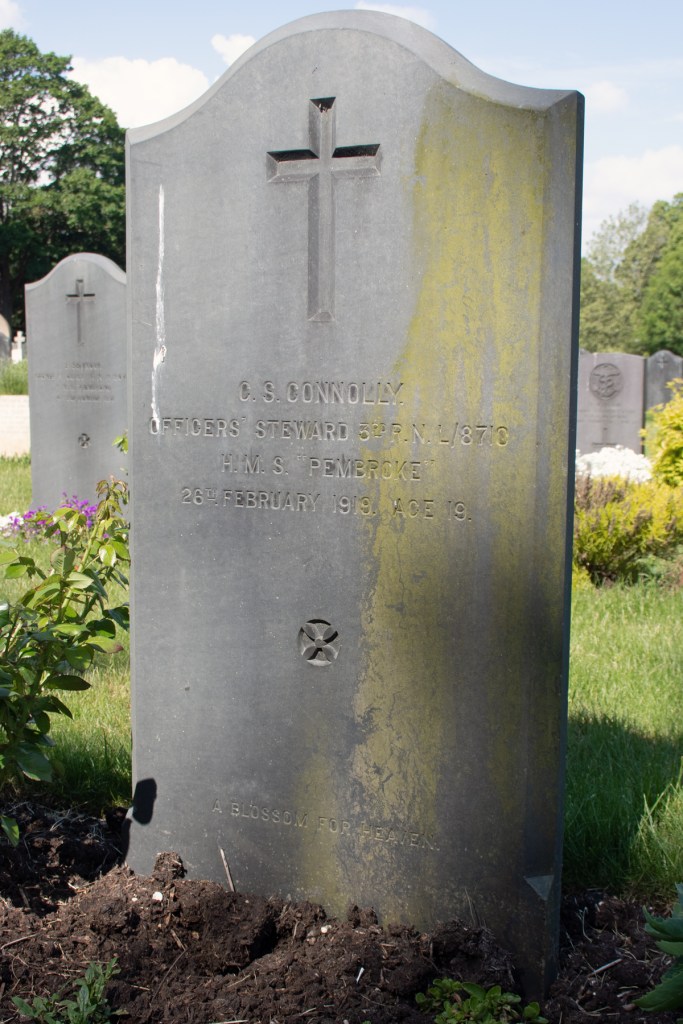
Little else remains of Able Seaman Walters’ military life. In February 1919, he was admitted to the Dreadnought Seaman’s Hospital in Greenwich, suffering from influenza and bronchial pneumonia. Sadly, he succumbed to the disease, passing away on 20th February 1919. He was just 18 years old (although his military record and gravestone give him as 19).

Alfred Charles Walters lies at peace in the Wembdon Road Cemetery in his home town of Bridgwater, Somerset.


Engine Room Artificer George Millard

Artificer George Millard

George Edmund Millard was born in 1887, one of seven children to Edmund and Annie Millard, from Bridgwater, Somerset. Edmund was an engineer by trade, something George’s elder brother followed him into.

Sadly, little of George’s life remains documented. He enlisted in the Royal Navy, in January 1915, working as an Engine Room Artificer (or engineer). Stationed in Kent, his initial training was at HMS Pembroke II base on the Isle of Sheppey.

Artificer Millard spent nine months on HMS Dido, which formed part of the Royal Navy’s force based in Harwich. At start of 1916, he was transferred back to HMS Pembroke II. This may have been for health reasons, as he was subsequently discharged with tuberculosis in April.

George’s records finish there, and it is likely that he succumbed to his lung condition after an 18-month fight. He died at home in Bridgwater on 26th January 1918, aged 21 years old.

George Edmund Millard lies at rest in the family grave at the Wembdon Road Cemetery in his home town of Bridgwater.


Petty Officer Stoker James Adams

Petty Office Stoker James Adams

James Adams was born in June 1883, son of Robert and Eliza Adams from Bridgwater in Somerset. Robert was an agricultural labourer; James was one of seven children.

James was keen to get out and see the world. In November 1905 – aged just 12 years old – he enlisted in the Royal Navy as a stoker. After training in Devonport, Plymouth, Stoker Adams served on a number of different vessels, including HMS Victorious, Ramillies, Amphitrite, Monmouth, Andromeda and Halcyon.

By the time war broke out, James has been promoted to Leading Stoker, and was assigned to HMS Cornwall. This was an armoured cruiser that was involved in the Battle of the Falklands in December 1914.

Promoted to Stoker Petty Officer in October 1915, James continued to serve on HMS Cornwall until he was transferred to the brand new ship, HMS Valkyrie. The vessel was involved in offensive sweeps and convoy escorts based out of Harwich.

On 22nd December 1917, the Valkyrie was part of the escort for a convoy travelling to the Netherlands, when she struck a mine. In total, nineteen men were killed, twelve instantly; this included Stoker Petty Officer Adams. He was 34 years old.

James Adams lies at rest in the Wembdon Road Cemetery in his home town of Bridgwater.