Category Archives: Somerset Light Infantry

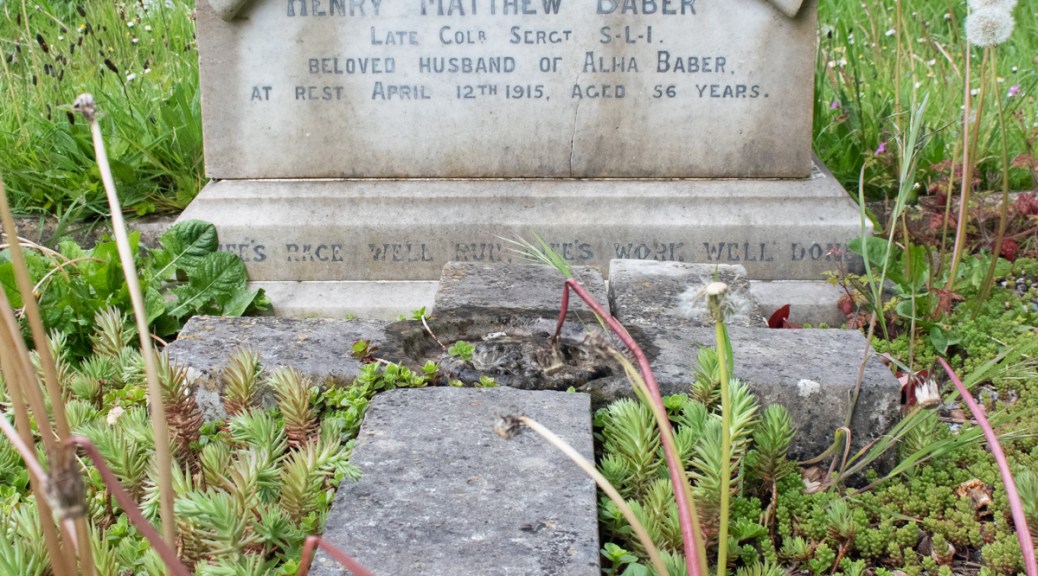
Private William Baber

Private William Baber

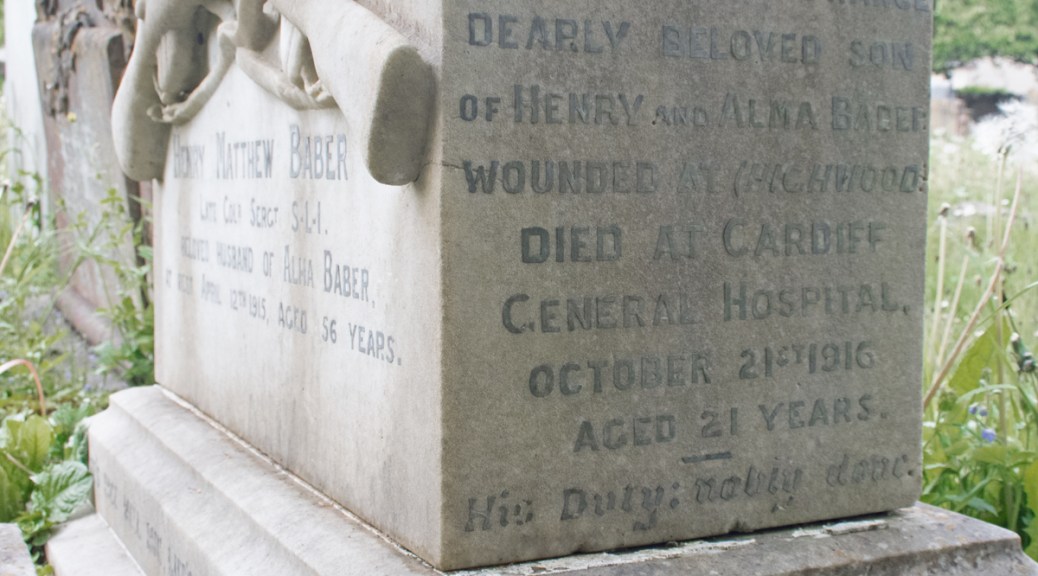
William Herbert Baber was born in May 1895, the oldest of six children to Henry and Alma Baber. By the time of William’s birth, Henry was an insurance agent for the Prudential insurance company and brought his family up in the Somerset village of Yatton. William’s father had been widowed early on, and so, in addition to his five younger siblings, he also had an older half-brother, also called Henry.

By the time of the 1911 census, William was working as a clerk in a coal office, and the family were living in a five room house not far from the village centre.

Little remains documented about William’s military service. He enlisted in the Somerset Light Infantry, but transferred to the 24th Battalion of the London Regiment. He was involved in the Battle of High Wood – part of the Somme offensive – and was wounded during the skirmish.

Evacuated back to home soil, Private Baber was treated in one of the military hospitals in Cardiff. Sadly, he was to succumb to his wounds, and passed away on 16th October 1916. He was just 21 years old.

William Herbert Baber lies at rest in the family grave in the churchyard of St Mary’s in Yatton.


William’s father Henry was also called up for war duty. You can read more about his story here.


Second Lieutenant Harold Hatcher

Second Lieutenant Harold Hatcher

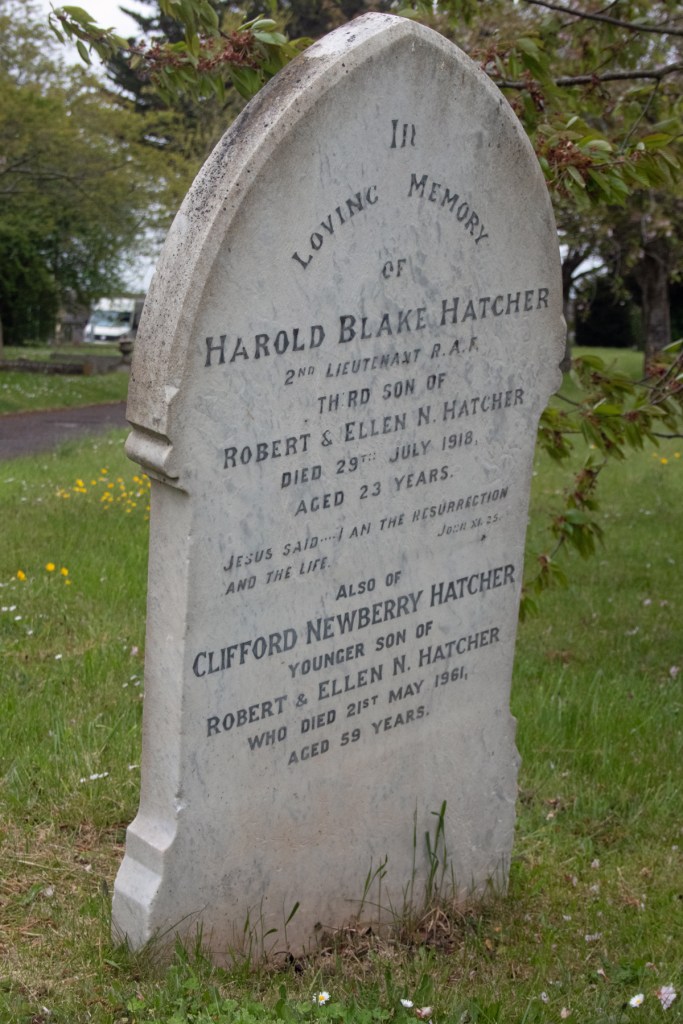
Harold Blake Hatcher was born on 11th February 1895, one of nine children to Robert Hatcher and his wife Ellen. Robert was a draper, and brought his family up in his home town of Taunton in Somerset. At least one of his children followed him into the cloth business, and, after he died in 1908, this seems to have fallen to Harold’s older brothers, Arthur and Ernest.

After leaving school, Harold became a dental student. Initially studying with Kendrick’s in his home town, he was about to begin training at Guy’s Hospital in London when war broke out.

Harold joined up in May 1915, and was initially assigned as a Lance Corporal to the 6th Battalion of the Somerset Light Infantry, before being transferred to the Middlesex Regiment.

In November 1917, he was badly injured in while fighting at Bourlon Woods, as part of the Battle of Cambrai. It was while he was recuperating that he transferred again, this time to the fledgling Royal Air Force.

Second Lieutenant Hatcher gained his wings in June 1918, and soon became a flying instructor. It was while he was working at RAF Fairlop in North West London, that an incident occurred. A local newspaper picked up the story.

Many in Taunton have learnt with sincere regret of the accidental death whilst flying of Lieutenant Harold Blake Hatcher of the Royal Air Force, third son of the late Mr Robert Hatcher of Taunton, and of Mrs Hatcher, now of Bristol.

The accident in which he met his death on Monday was a triple fatality, two other airmen being killed at the same time, Second Lieutenant Laurie Bell, of Bournemouth, and Flight Sergeant AR Bean, of Burslem.

At the inquest… it was stated in evidence that while Lieutenant Hatcher and Sergeant Bean were flying at a height of about 500ft, Second Lieutenant Bell, who w flying a single-seater, dived from a position some 700 feet higher, his machine striking and cutting clean through the double-seater, which folded its wings, hovered a few second, and then crashed to the earth. The three men were instantaneously killed.

A verdict of Accidental Death was returned.

Taunton Courier and Western Advertiser: Wednesday 7th August 1918

Further witness testimony described how the Sopwith Camel, piloted by Bell, cutting the AVRO airplane it in two. Hatcher fell out of the wrecked two-seater as the Camel’s wings slowly folded into a V and fluttered free following the fuselage to the ground. All three airmen lost their lives. Bean was found in a sitting position, still strapped in the front half of the AVRO’s fuselage, his instructor’s body was found unmarked thirty yards away in the grass where it had fallen. The wingless Camel crashed close by and Bell was found to have almost every bone in his body broken.

The accident took place on 30th July 1918. Second Lieutenant Hatcher was just 23 years old.

Harold Blake Hatcher lies at rest in St Mary’s Cemetery in his home town of Taunton, Somerset.


Private George Western

Private George Western

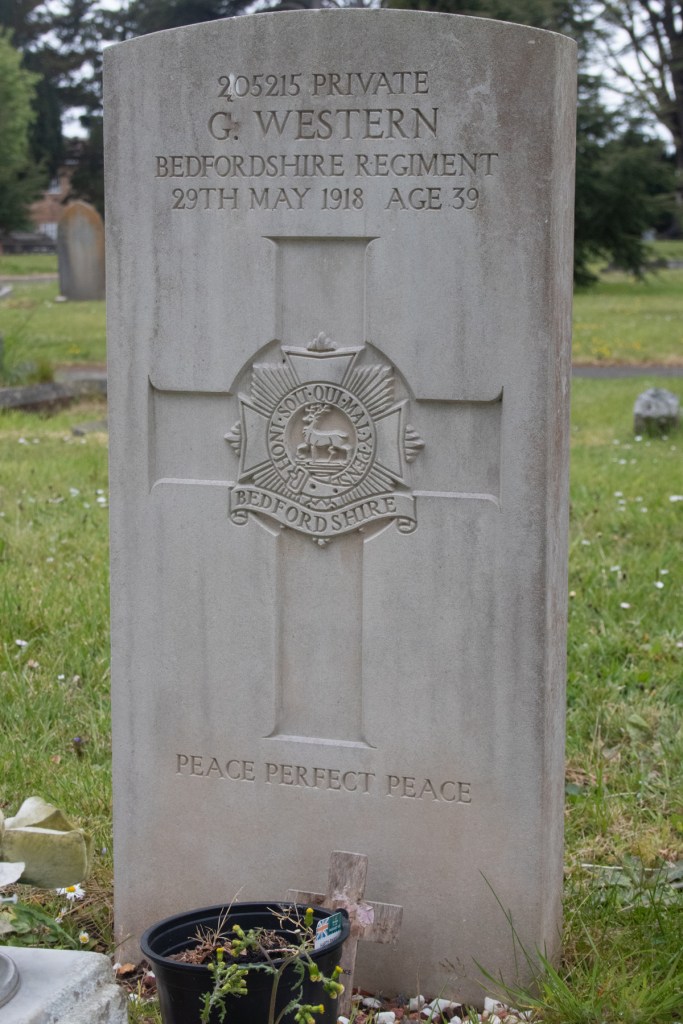
George Western was born on 18th September 1881, one of seven children to Alfred and Jane. Alfred worked as a labourer, and the family lived in Taunton, Somerset.

Alfred died when George was only 12 years old, so his mother found work as a hawker to make ends meet. George married local woman Sarah Pinnell in 1900, and the two of them lived with Jane and her younger children, George working as a labourer to help the extended family.

George and Sarah went on to have seven children, and, by the time of the 1911 census, they had set up home in the centre of Taunton, just off the main high roads.

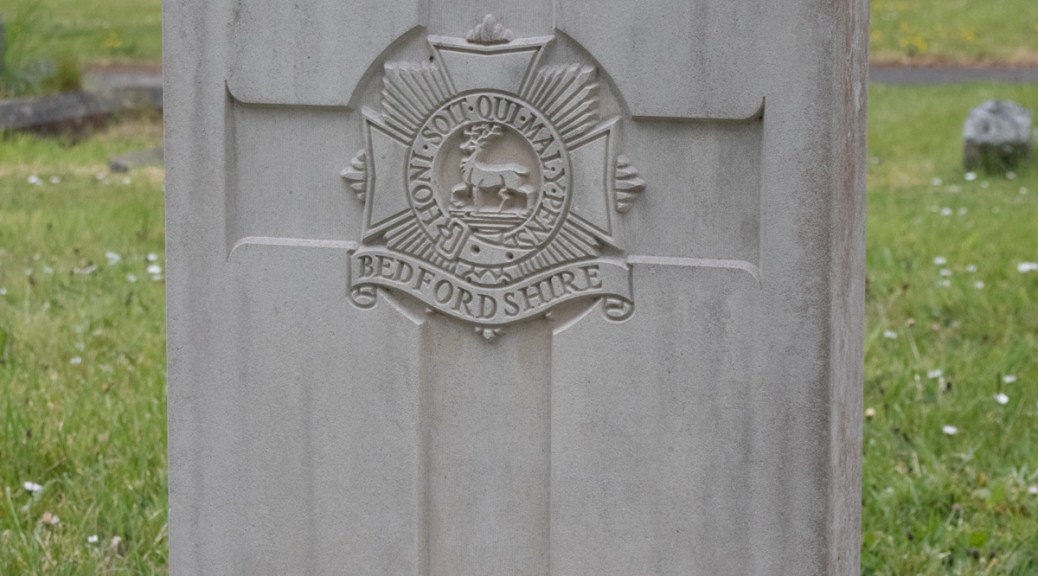
The Great War was on the horizon, though, and George was there to do his duty for King and Country. His service records no longer exist, so it is difficult to pin down any dates, but it seems that Private Western initially served with the Somerset Light Infantry, then then transferred to the Bedfordshire Regiment.

George was assigned to the 3rd Garrison Battalion of the Bedfordshire Regiment. While there is nothing to confirm his activities during the war, this particular battalion were formed in January 1917, and were stationed initially in India and then in Burma. Private Western’s medal records suggest, however, that he served his time on home soil.

By May 1918, George was definitely back in Somerset. He had caught an undisclosed illness by this point, and had been admitted to the Military Hospital in Bristol. Sadly, whatever the illness was (and it seems likely that it would have been one of the many lung conditions that were sweeping the country at the end of the First World War) it got the better of him. Private Western passed away on 29th May 1918 at the age of 36 years old. [The war grave gives an incorrect age.]

George Western lies at peace in St Mary’s Cemetery in his home town of Taunton, Somerset.


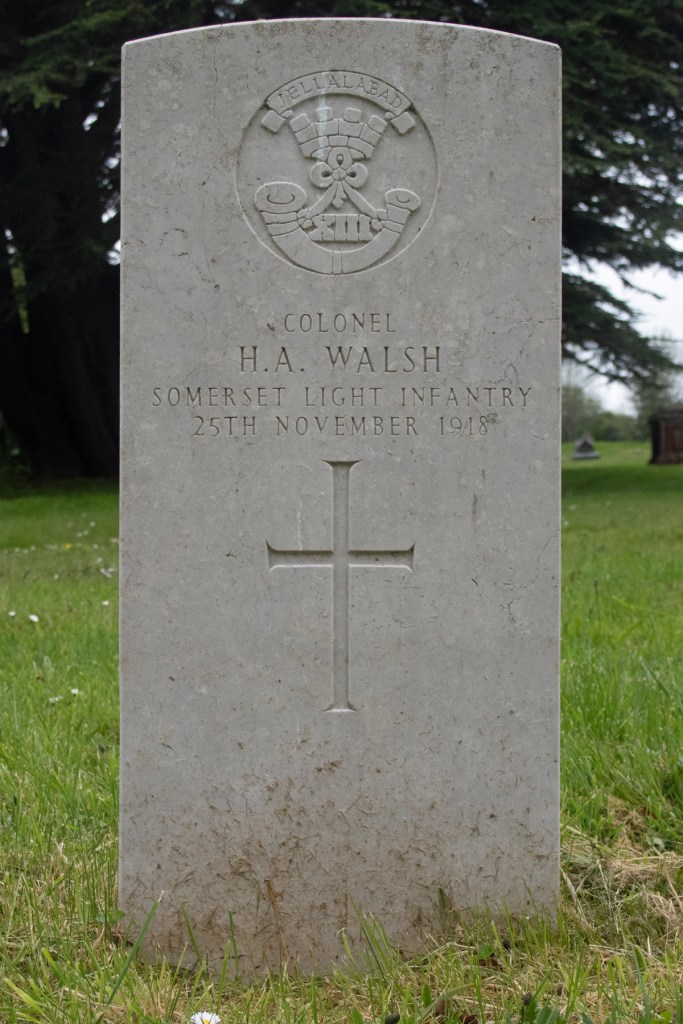
Colonel Henry Walsh

Colonel Henry Walsh

Henry Alfred Walsh was born near Taunton, Somerset, in September 1853, the eldest of five children to Theobald and Isabel Walsh. Theobald was a magistrate with some military connections, and it was military service that Henry went into.

While full details aren’t readily available, the 1881 census finds him living in Devon, with his employment simply as “military”. Presumably, he had enrolled in the Somerset Light Infantry, the regiment he had a lifelong commitment to.

By the early 1880s, Henry had married Ann Sparrow. The couple went on to have three children – Theobald, Gwladys and Archibald.

The 1891 finds Henry and his family in the Somerset Light Infantry Barracks at Farnborough. Henry was a Sergeant Major by this time, and was assigned to the 1st Battalion. Also living in the same accommodation – and presumably helping Ann with the running of the household – were a governess and cook.

The census also highlights the transient nature of army life. Henry, as mentioned before, was born in Taunton, while Ann came from Plymouth in Devon. Theobald was born in Taunton, while Gwladys and her younger brother were both born in Devon. Military service brought a sense of stability, but not necessarily geographically.

Henry eventually took a step back from the army; by the time of the 1911 census, he was living back in Bishop’s Hull, the village of his birth in Somerset, and listed as a retired colonel. When war broke out, however, he volunteered his services again, and was appointed the officer commanding the No. 8 District in Exeter.


While Henry came out of retirement to serve his country again, his two sons had also forged their own military careers. Theobald also joined the Somerset Light Infantry, also achieving the rank of Colonel. Archibald joined the Royal Horse Artillery; his story can be found by clicking here.


When Henry passed away in 1918, local newspapers were unanimous in their praise of the long-serving officer, outlining both his military service and his charitable work.

Colonel Walsh had had a distinguished military career, dating from 1870, when he joined the old Somerset Militia at Taunton. [He] was created a CB in 1905, and held the medal and clasp for Zululand, and the medal and two clasps and the Khedive’s Bronze Star for his services in Egypt.

He was a JP for Somerset and a member of the Army and Navy Club. [He] threw himself wholeheartedly into the work of the Boy Scout organisation.

The greatest work in which Colonel Walsh had been identified during the war, however, was undoubtedly that of feeding the Somerset prisoners of war in Germany, and his name will ever be linked in grateful memory with that of his honoured wife for having raised and maintained a fund capable of bearing the strain of over £3,000 expenditure per month to save the Somerset men in Germany from starvation.

Well Journal: Friday 29th November 1918

Ironically, for all this exultation, there is no immediate record of the cause of Henry’s death; given his age – he was 65 when he passed – it seems likely that he died following an illness.

Colonel Henry Alfred Walsh lies at rest in St Mary’s Cemetery in Taunton, Somerset. He is buried next to his son, Archibald.


Colonel Henry Walsh

Private Frank Stone

Private Frank Stone

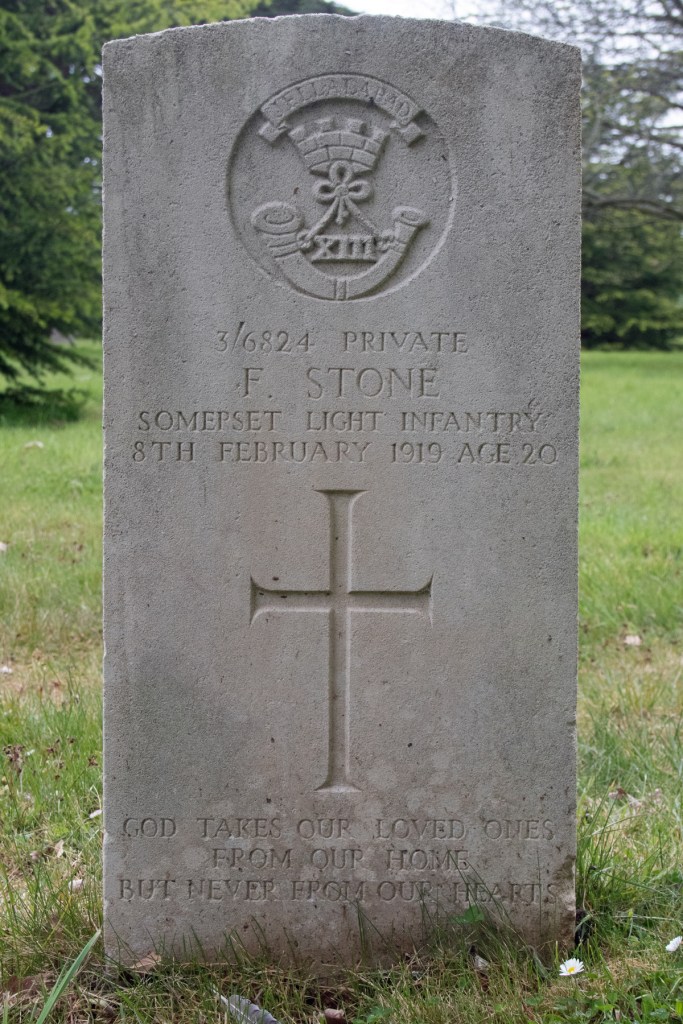
Francis Jesse Stone – known as Frank – was born in 1899, one of five children to William and Sarah Stone. William was a general handyman – his census records record him variously as a labourer, carpenter and carman (or carter) – and the family lived in the village of Bishop’s Hull, on the outskirts of Taunton, Somerset.

Given when he was born, documentation for Frank’s early life is limited to the 1901 and 1911 censuses. We are restricted, therefore, to the information provided by the medal rolls.

Frank was under age when he joined up. He enlisted in the Somerset Light Infantry on 27th December 1914, when he could only have been 15 years old. He was assigned to the Depot Battalion, and was shipped to France the following year.

Sadly, there is little other information about Private Stone. He survived the war and returned to England, but passed away on 8th February 1919. No cause of death is evident, but it seems likely to have been one of the lung conditions running rampant across the country at the time, probably influenza, tuberculosis or pneumonia. When he died, Frank was just 20 years old.

Frank Jesse Stone lies at rest in St Mary’s Cemetery in his home town of Taunton, Somerset.


Private Ernest Baker

Private Ernest Baker

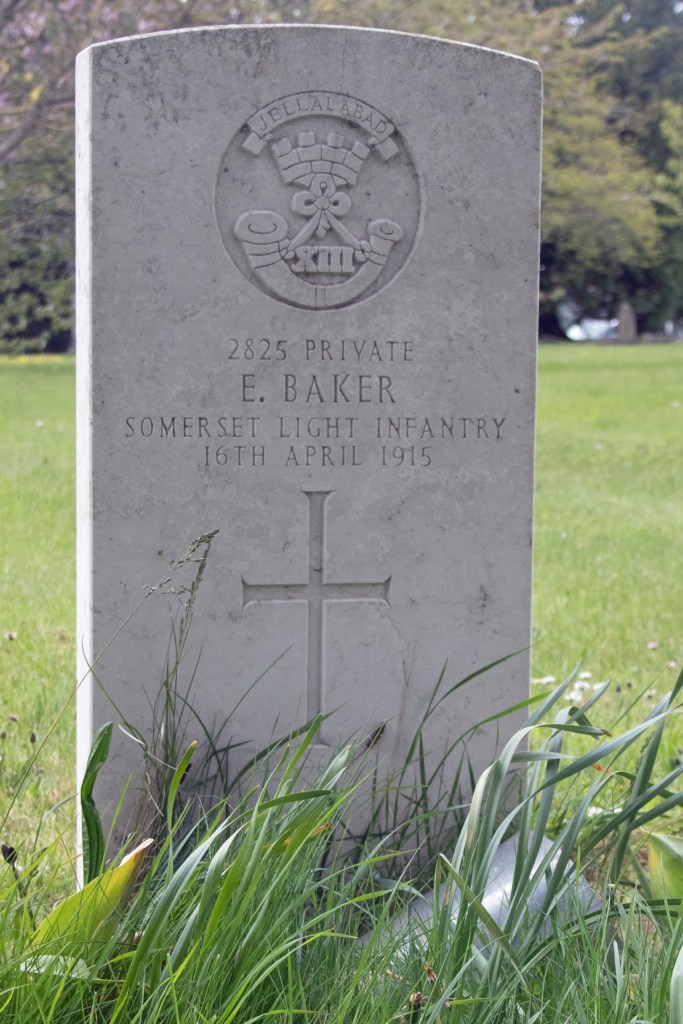
Ernest Baker’s early life is a bit of a muddle; Born in 1878 in Somerset, it’s a challenge to unpick specific details, as there are two Ernest Bakers, both of whom have parents of the same name – Henry and Sarah – and have siblings with similar names too. Was Ernest’s father, therefore, a thatcher from Meare near Glastonbury or a travelling draper from Taunton.

In fact, it was a newspaper article from April 1915 that helped unlock the confusion.

The Taunton Courier and Western Advertiser confirmed that Ernest’s full name was Ernest Bond Baker, and that his father – who had passed away by the time of Ernest’s death – was from Bishop’s Hull, a village near Taunton.

This would seem to confirm, therefore, that his father was a travelling draper.


Ernest was one of ten children. His father died when he was only fifteen years old, by which time Ernest had left school and found employment as a basket weaver, a trade which was prevalent on the Somerset Moors.

Sarah, a widow at only forty, took in laundry to make ends meet. Of Ernest’s two older brother, one had passed away as a teenager, while the other had gone on to have a wife and family of his own. It was left to Ernest, therefore, to remain at home and support his mother and younger siblings.

Ernest met and married local butcher’s daughter Bessie Glover in 1900, and the couple went on to have seven children. After a spell living in Wiltshire, the young family moved back to Somerset, settling in Bridgwater, where Ernest continued to ply his trade.

Ernest’s military service records are lost to time; he enlisted in the Somerset Light Infantry, joining the 5th Battalion at some point early in the war (certainly before October 1914). Private Baker’s battalion seems to have been part of a territorial/reserve force, and he was based in his home town of Taunton.

In early April 1915, Ernest fell ill, and was admitted to the Voluntary Aid Detachment Red Cross Hospital in Yeovil, suffering from bronchitis and pneumonia. Sadly, the lung conditions were such that he was succumb to them, and he passed away on 16th April 1915. He was just 36 years old.

Ernest Bond Baker lies at rest in St Mary’s Cemetery in his home town of Taunton, Somerset, the same cemetery where his father and brother were buried.


Private Ernest Baker

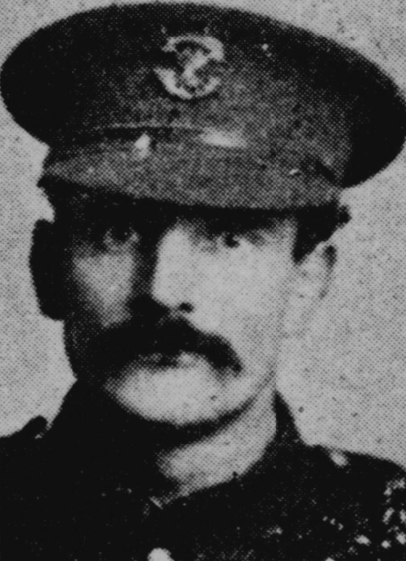
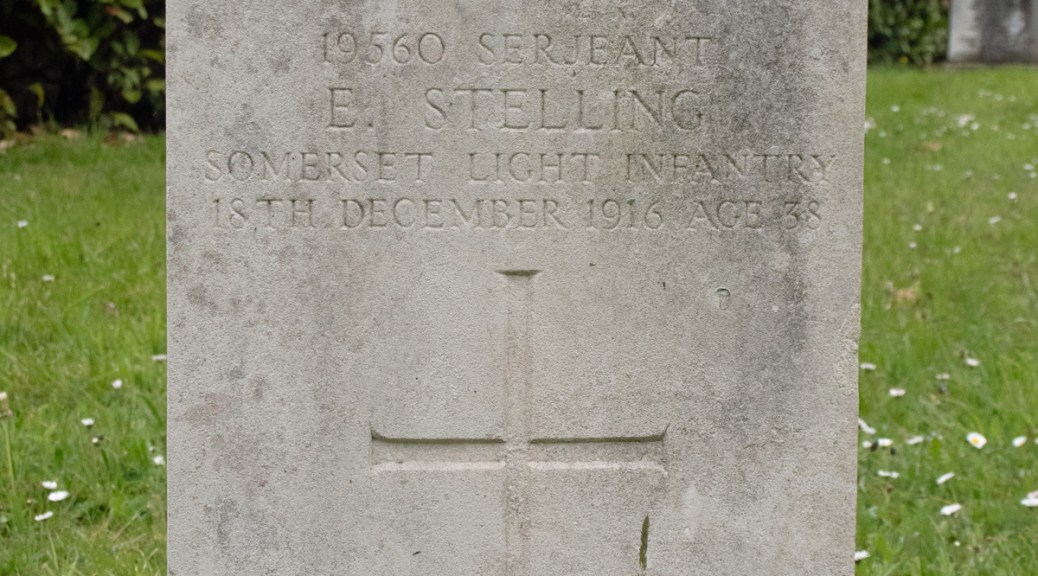
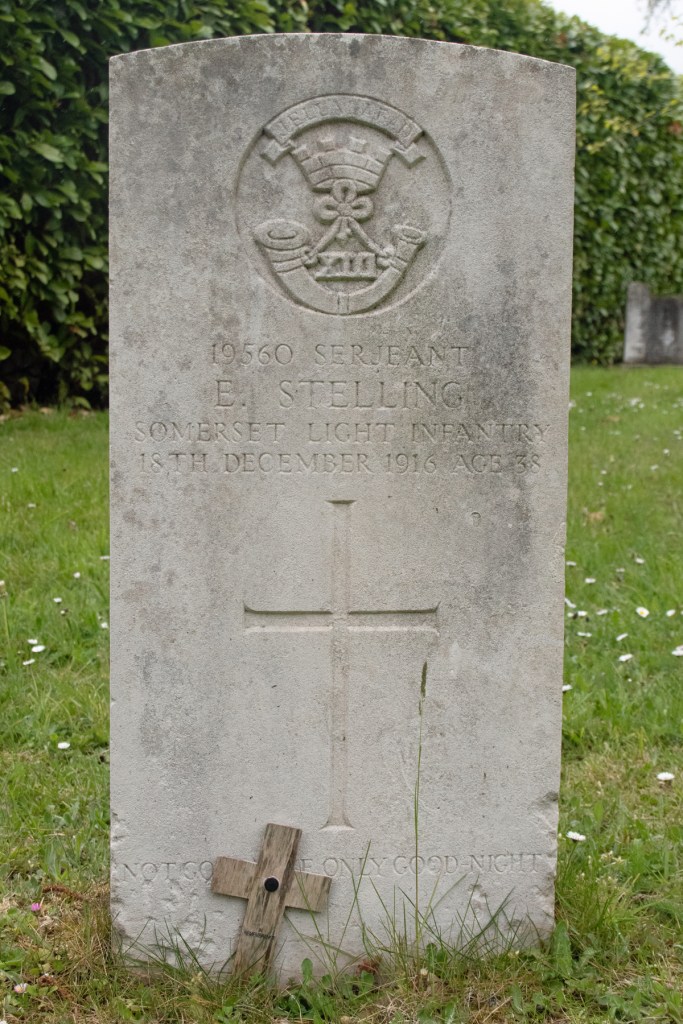
Serjeant Ernest Stelling

Serjeant Ernest Stelling

Ernest Leonard Stelling was born in the summer of 1881, the oldest of six children to Charles and Bertha Stelling. Charles was a tailor from London, and while Ernest was born in Suffolk, by the time of the 1891 census, the family had settled in Reading, Berkshire.

Ernest followed in his father’s footsteps, becoming a tailor and cutter in his own right. He met a woman from Reading called Lettie Eliza Mazey, and the couple married in 1904. The couple set up home with Lettie’s brother and his family in Tilehurst, but didn’t go on to have any children themselves.

Details of Ernest’s military service are a bit scarce. He initially enlisted in the Royal Berkshire Regiment, but quickly moved to the Somerset Light Infantry in the early stages of the First World War.

Sadly, no formal documents of Ernest’s time in the army are available, but a local newspaper gave a good insight into his Somerset service.

Death of a Master Tailor

After an illness of only seven days, the death took place at the military hospital on Monday afternoon of Sergeant EL Stelling, who has been master tailor of the Depot for the past two years. The cause of death was pneumonia, and the loss of so popular a member of the Depot staff is deeply regretted by all ranks.

Sergeant Stelling, who was 37 years of age, came to the Somersets from the Royal Berkshire Regiment, and succeeded the late Sergeant-Master-Tailor Chambers. He was a native of Reading, and one of four brothers serving their King and country. His father, Mr Charles Stelling, for many years carried on business as a master tailor in Reading.

Since he had been at Taunton barracks, Sergeant Stelling had made many friends, and actively identified himself with the social life of the sergeants’ mess, taking a prominent part in the arrangement of concerts, etc.

He was of a bright, generous disposition, and before his illness he was making a collection at the Depot on behalf of the Buffaloes’ Christmas treat to poor children of the town. He was a valued member of the local Lodge of the Royal Order of Buffaloes, and his death is greatly regretted by all the brethren.

He leaves a widow but no family. Much sympathy is felt for Mrs Stelling, who has for some years been a confirmed invalid.

The funeral took place with full military honours at St Mary’s Cemetery on Friday afternoon.

Taunton Courier and Western Advertiser: Wednesday 27th December 1916

This gives a real insight into Ernest’s personal life. He was obviously very active socially, and committed to the community. Whether Lettie’s infirmity contributed to the couple’s lack of family will never be known, but, from his support of the poor children of Taunton, it seems evident that he would have been a good family man.

The next document relating to Serjeant Stelling is his pension record; this confirms the news article’s report that he contracted pneumonia and influenza, and he succumbed to the conditions on 18th December 1916. He had, in fact, just turned 38 years old.

Ernest Leonard Stelling lies at rest in St Mary’s Cemetery in his wartime adopted home town of Taunton, Somerset.


Serjeant Ernest Stelling (from Ancestry.co.uk)

Private Jack Alston

Private Jack Alston

John Thomas Alston, also known as Jack, was born in Chorley, Lancashire, in 1865 and was one of thirteen children to Richard and Elizabeth Alston. Before he died in 1878, Richard was a stripper and a grinder in a cotton mill, and it was millwork that the majority of his and Elizabeth’s children went into.

When he left school, Jack and his siblings worked as cotton piecers in the mills, tying together any threads that broke on the machines. This was a job aimed at children, whose hands were often the only ones small enough to reach into the equipment.

By 1895, Elizabeth too had passed away. Jack, who was 30 by this point, had moved from Chorley to nearby Oswaldtwistle, and met Mary Ellen Wilcock. She was a widow with two children, and the couple married on 14th February 1897. Their marriage certificate shows that she was the daughter of a weaver, while Jack was working as a furnace man in the mill. The couple went on to have a child together, Amy, who was born in 1900.

The couple settled into if not a comfortable life, then a continued existence. While Mary and her two older children were working in the cotton mill, Jack began labouring at the local chemical works. The family lived in a small, two up, two down cottage right next to Mary and the children’s place of work, and life continued apace.

War was coming however, and Jack volunteered to do his bit. His service records no longer exist, but it can only be assumed that he joined of his own accord; he would have been 50 when hostilities commenced, and so exempt from the initial call-up.

Private Alston was assigned to the Somerset Light Infantry, and was based at their Depot in Taunton. Little information about his time there is available, and sadly, the next accessible document is his pension record. This confirms that he died on 7th April 1916, from “shock caused by a fall while on duty”. There is no other reference to what or how this happened, so the circumstances will remain a mystery. He was 51 years old when he passed away.

It seems that his widow may not have had the funds to bring Jack back home; instead he lies at rest in St Mary’s Cemetery in Taunton, Somerset, close to the depot where he was based.


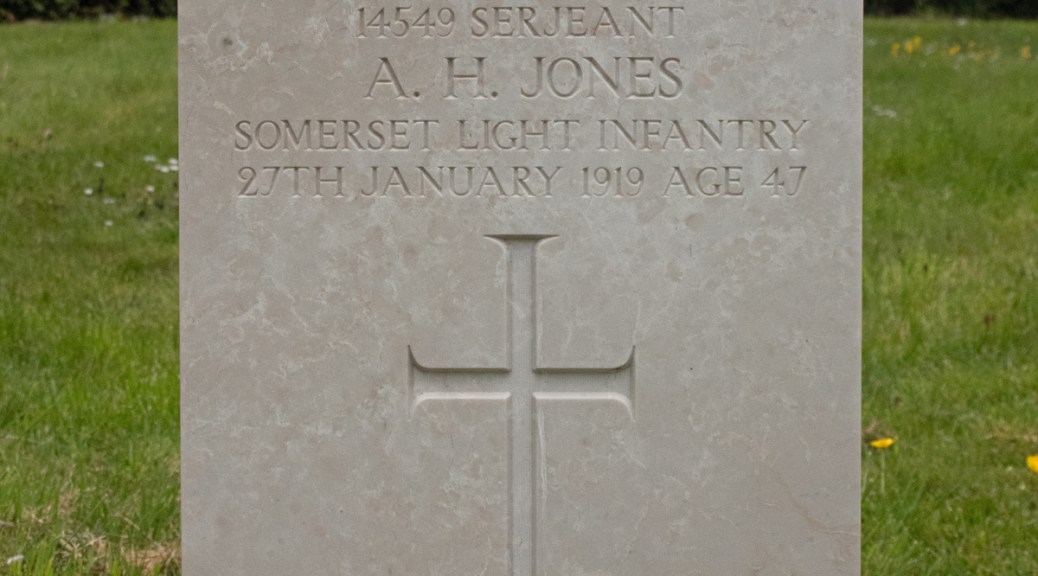
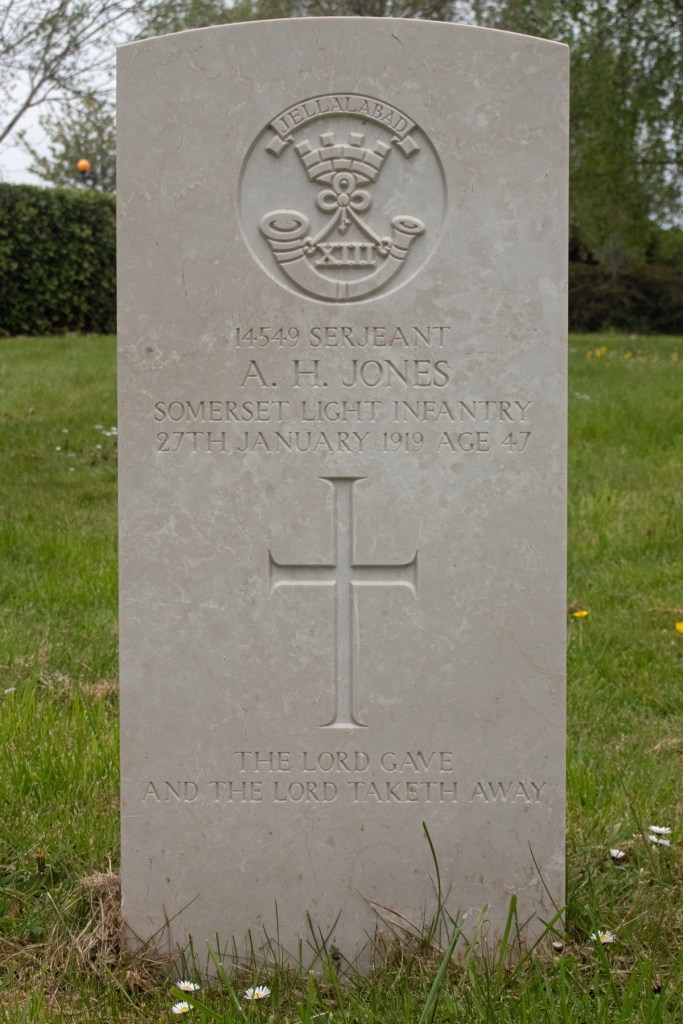
Serjeant Arthur Jones

Serjeant Arthur Jones

Arthur Henry Jones was born in 1874, the oldest of five children to James and Kate Jones. James worked as a coachman, and travelling seems to have been his thing.

Born in Wiltshire, he met and married Kate in Somerset, and this is where Arthur was born; by 1879, the young family had moved to Hampshire, and within a year they had relocated again, this time to Folkestone in Kent. Three years later, by the time James and Kate’s youngest two children were born, they were back in Wiltshire again, having competed their tour of the south of England.

Sadly, tragedy was to strike the Jones family, when Kate passed away in 1888, at the tender age of 31 years old. James had a family of boys to bring up, however, and he married again, this time to a Miriam Millard. The couple went on to have two children, giving Arthur a half-brother and half-sister.

At this point, Arthur falls off the radar. It may well be that he chose to take up a military career early on – if he was serving overseas, it is possible that the census documentation no longer exists. Twelve years’ service would certainly seem to account for his absence between 1881 and the next time his name appears on records.

These records relate to Arthur’s marriage to Fanny Hill. The couple were married by Banns in May 1906, marrying in Westbury, Wiltshire. They went on to have four children – Arthur, Kathleen, Gladys and Percival – between 1907 and 1911.

Again, at this point, Arthur falls off the radar. His service records no longer exist, but what evidence remains confirms that he enlisted in the Somerset Light Infantry and was assigned to the 7th (Service) Battalion. Initially formed in Taunton, they shipped out to France in July 1915, although there is no documentation to confirm when or if Arthur was involved.

Sadly, the only other reference to Serjeant Jones is his final pension record. This confirms that he succumbed to a combination of influenza and pneumonia on 27th January 1919. He was 44 years old.

Arthur Henry Jones lies at rest in St Mary’s Cemetery in Taunton, Somerset.


Lance Corporal Albert Burke

Lance Corporal Albert Burke

Sometimes, researching war graves can throw a bit of a curve ball, and the things you uncover can make you stop in your tracks. Such is the story surrounding Lance Corporal Albert Burke, and a media report surrounding his death in March 1921.


SCHEME OF VENGEANCE

Taunton Suicide’s Amazing Last Letter

Toll On Young Women

A sensational affair has occurred at Taunton Barracks. On Sunday morning, Albert (or Alfred James) Burke, aged 23, a Lance Corporal in the Somerset Light Infantry, was found to have taken his life by inhaling chloroform, his dead body being found on a bed at the military hospital, where he was employed as an orderly.

On Saturday night, according to the evidence, deceased appeared to be in his usual health and spirits. The next morning, a comrade found his dead body with a chloroform bottle by its side and near his face a large piece of cotton wool which he had evidently used for the purpose of inhaling the poison.

Some light was thrown on the tragedy by a letter addressed to a Taunton young woman, found on his clothing, and which was read at the inquest yesterday.

It was of an extraordinary character, and began “You wish to know what my intentions are in regard to you. Well, in the first place let me tell you I am not, as the coroner who holds the inquest will adjudge me, insane. In fact I don’t think I was ever so rational or level-minded as at the present moment, although I have had a glass or two.

“Well, Beatrice, mine is a rather long and interesting story. I married Louisa Wills some time in 1917, and I think the least said about her the better, but I wish to say this, that I have never knocked across a beast to equal her for violence. I am afraid the people around Brentford, Middlesex, could give you a far better account of her than I can.”

The writer went on to make certain allegations against the woman, and then referred to other towns where, he said, he had ruined girls before coming to Taunton and joining the Somerset Light Infantry. He added that he spent Friday night, when he was supposed to go out with Beatrice, with another girl in the barracks.

He said his father committed suicide owing to a “thing” who called herself a woman, and he (deceased) got a feeling with him that he would like to pay it back on a few girls. In conclusion, Burke expressed his satisfaction at knowing the condition Beatrice was in, and that he had been able to add another to the list of those on whom he wished to have his revenge.

Evidence was given by Alec Treeby, civilian orderly at the Barracks, who found deceased. In reply to the coroner, witness said that he knew the man was keeping company with a girl, but was not aware that there was any trouble about her.

PC Carter stated that the police had made enquiries, and a telephone message had been received that nothing was known of the man or of a wife and family of the name at Brentford…

[The] medical officer at Taunton Barracks said deceased was a steady, hard working man, and, so far as he knew, perfectly sane.

The jury returned a verdict of “suicide while of unsound mind”.

Western Times: Wednesday 16th March 1921

The newspaper report confirms the Lance Corporal’s name as either Albert or Alfred James Burke; the coroner also went on to say that he had also used the aliases of Povery and Pavey. Sadly, research around these names – and that of Louisa Wills – have either led to frustrating dead ends, or to results too vague to concretely connect them to Lance Corporal Burke.

The life and loves of Lance Corporal Burke are destined to remain a mystery. All that can be confirmed is that he took his own life on 13th March 1921; he was 23 years old.

Albert Burke lies at peace in St Mary’s Cemetery in Taunton, Somerset. He was accepted for commemoration as war dead on 27th May 2016 and was afforded a gravestone by the Commonwealth War Graves Commission.