Thomas Roberts was born in Llangollen, Denbighshire, in 1895. One of seven children, his parents were William and Ellen Roberts. William was a butter merchant, and his wife helped in the business.
When Thomas left school, he found work as a greengrocer’s assistant, but when war was declared he saw an opportunity for glory. While full details of his military service are no longer available, it’s clear that he enlisted in the Royal Welch Fusiliers.
Private Roberts was assigned to the 13th (Service) Battalion (1st North Wales) and on 1st December 1915, found himself in France. For the next eighteen months, he was firmly ensconced on the Western Front, and rose to the rank of Lance Corporal for his service.
In April 1917, Thomas was injured in fighting and was medically evacuated to Britain for treatment to his bullet wounds. Admitted to the Edmonton Military Hospital in North London, his injuries were to prove too severe. Lance Corporal Roberts passed away on 22nd April 1917. He was just 21 years of age.
Brought back to Wales for burial, Thomas Roberts was laid to rest in the family plot in Llangollen’s Fron Cemetery.
Thomas was buried along with his brother David, who had passed away in 1912. They were joined by their father William, who died in 1919, and their sister Elizabeth, who passed away in 1945. The family were finally reunited with Ellen, when she died in 1947, at the age of 86.
Thomas David William Denny was born on 26th December 1890 in Glasgow, Lanarkshire. There is little information on his early life, other than that his parents were Thomas and Annie Denny.
By the time of the 1911 census, Thomas Jr was serving as a Lance Corporal in the 2nd Battalion of the Gloucestershire Regiment, and was based at the Verdola Barracks in Malta.
When war broke out, the battalion was called back to mainland Europe. By 19th December 1914, Thomas found himself in France; two years later, he was in Salonika, Greece.
Thomas’ bravery was not in doubt. While serving in France, he received the Military Medal for conspicuous gallantry. This went hand in hand with a promotion to Sergeant. In 1917, he received a commission as Second Lieutenant and was moved to the regiment’s 3rd Battalion.
In the spring of 1918, Second Lieutenant Denny married Elsie, a woman from Bearsted, near Maidstone in Kent. Sadly, little else is known of her, and even a later newspaper report only referred to her as “a Bearsted lady” [East Kent Gazette: Saturday 15th March 1919].
By early 1919, Thomas was back in Britain. Whether he had been demobbed is unclear, but is seems more likely that he had returned home for medical treatment. On 6th March, he passed away in Maidstone. He was just 28 years of age.
Thomas David William Denny was laid to rest in the graveyard of Holy Cross Church in Bearsted close to where the now-widowed Elsie must have lived.
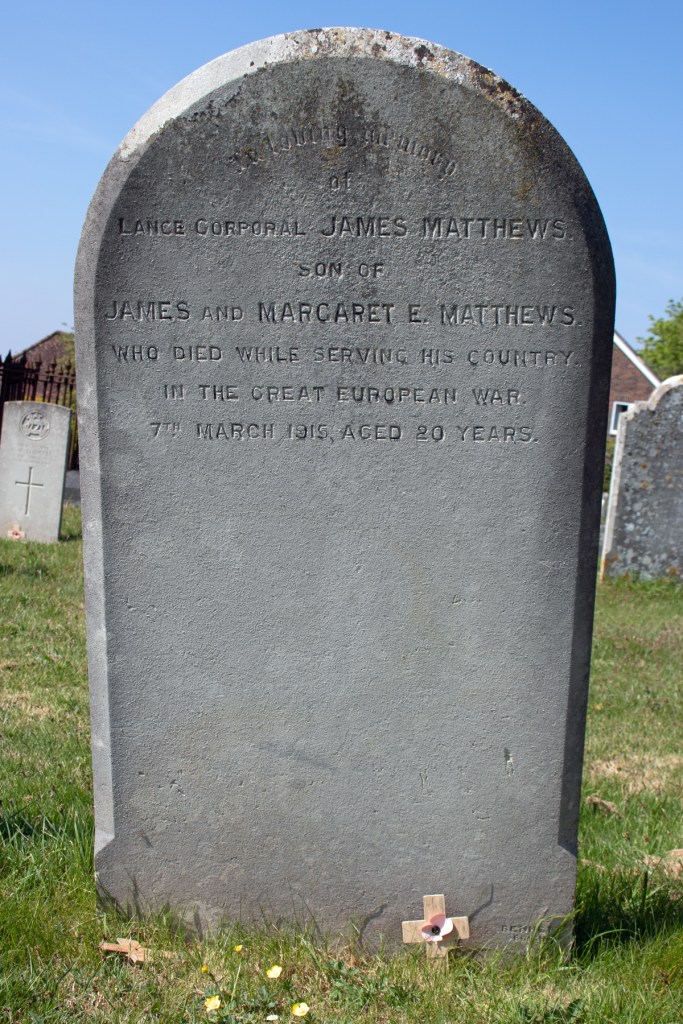
James Matthews was born in the summer of 1894, the youngest of five children to James and Margaret Matthews. James Sr was a farm worker from Cuckfield in West Sussex, and it was on Hodshrove Farm in nearby Ansty that the family were raised.
James Jr worked on the farm when he left school, but when war broke out, he found a bigger calling for himself. Full details of his military service are not available, but he seemed to have enlisted early on in the conflict, joining the 9th (Service) Battalion of the Royal Sussex Regiment. Originally formed in Chichester, West Sussex, he soon found himself billeted in the South Down near Portslade.
James must have impressed his superiors, as he was soon promoted to Lance Corporal for his work. All was not to go well, however, as, during the early months of 1915, he contracted pneumonia.
Lance Corporal Matthews was admitted to the 2nd Eastern General Hospital in Brighton, but the lung condition was to get the better of him, and he passed away on 7th March 1915. He was just 20 years of age.
James Matthews was brought back to his home village for burial. He lies at rest in Cuckfield Cemetery, in the shadow of Holy Trinity Church.
Colin Lewis Clarke was born in the spring of 1879 in Cardiff, South Wales. He was one of seven children to Bernard and Elizabeth Clarke. Bernard was a carpenter, but after Elizabeth died in 1886, he took over the running of the Windsor Hotel in Penarth.
When he left school, Colin found work as a clerk. Bernard also died in 1908, and the 1911 census records Colin and his brother Thomas living with his sister, Beatrice. They were sharing the house with Beatrice’s second husband, Charles, and her six children from her first marriage in the Cheshire village of Poulton.
Colin’s trail goes tantalisingly cold at this point. When war broke out, he enlisted to play his part, joining the 16th (Transport Workers) Battalion of the York and Lancaster Regiment by the summer of 1916. This troop was a territorial force, and Private – and then Lance Corporal – Clarke was based in the Yorkshire Dales.
At some point during the autumn Colin fell ill, and was admitted to the Military Hospital in Middlesbrough. His condition is unclear, but he was to succumb to it, passing away on 5th November 1916, the age of 37 years old.
Colin Lewis Clarke’s body was brought back to Wales for burial. He was laid to rest in the graveyard of St Augustine’s Church in Penarth, Glamorganshire.
Tom Simmons was born early in 1889, one of fourteen children to William and Elizabeth Simmons. William was a farm labourer from Devon, who had moved to Runnington, near Wellington in Somerset, with Elizabeth in the late 1880s. This was where their growing family was born and raised.
Tom found work away from Somerset when he left school and, by the time of the 1911 census, he was lodging in a house in Llanwonno, Glamorgan. He was employed as an assistant machine repairer at the local colliery.
War was beginning to encroach on England’s shores, and Tom was to play his part. Full service details are not available, but he enlisted in the Royal Army Service Corps and served as part of a territorial force. For the part he played, he was awarded the Victory and British Medals and the Silver War Badge.
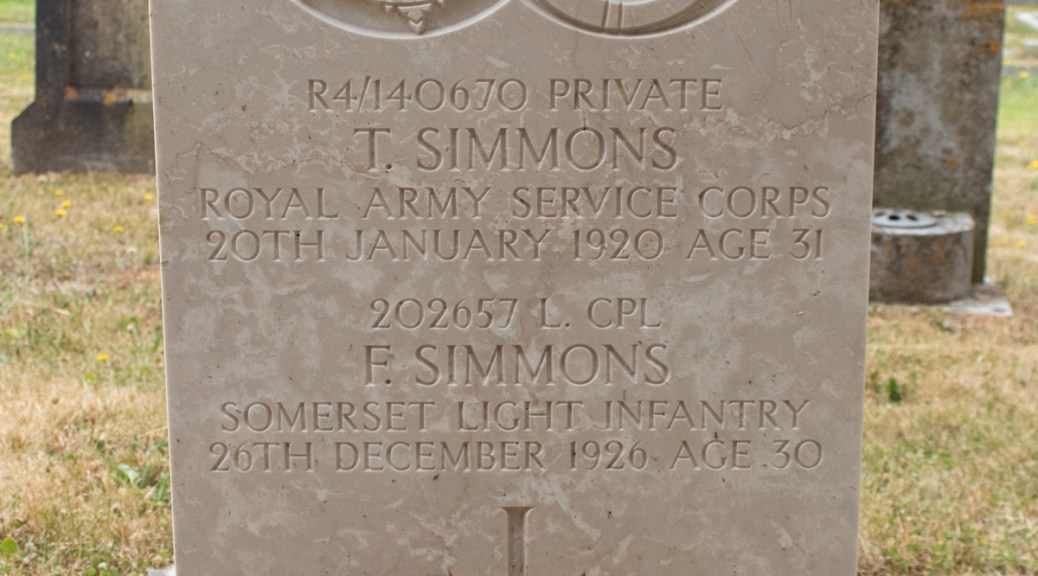
It would seem that Private Simmons survived the war and was demobbed, returning to Somerset at some point by the end of 1919. Sadly, his trail goes cold: the next record available is of his death – through causes unspecified – at home on 20th January 1920, at the age of 31 years old.
Tom was buried in Wellington Cemetery, not far from his family home.
Tom’s headstone also includes a dedication to a Lance Corporal F Simmons.
Frederick Simmons was seven years younger than his brother. When he left school, he worked as a wool spinner in the local wool mill. When war came to Europe, he too played his part. Again, full details of his service are sketchy, but he enlisted in the Somerset Light Infantry.
Like Tom, Frederick served as part of the territorial force, and worked his way to the rank of Lance Corporal. After the war he returned home, but his life there was not set to be a long one. He passed away, through causes not noted, on 26th December 1926. He was just 30 years of age.
Frederick was laid to rest in the same grave as his brother. Technically not entitled to an official Commonwealth War Grave (the rules are laid out here), his service was remembered alongside that of Tom’s.
Frederick William Twist was born in around 1884, the older of two children to William and Clara Twist. William had been born in Faversham, Kent, and was a labourer in the cement works there.
Frederick did not follow his father’s trade, however, and, on leaving school, he found work in the printing office of the Faversham News, before moving on to Filmer Bros., a local nursery and bulb grower. He was a keen member of the Salvation Army, and played in the local Corps’ band. After more than a decade at Filmer Bros., Frederick took up new employment with Salvation Army Insurance, and worked out of the Whitstable office.
In the spring of 1909, Frederick married Helen Bedster, a bargeman’s daughter from Faversham. At the time of their wedding, she was working as a servant for a brewer manager in the town. The couple settled down in a terraced house in the centre of the town, and went on to have two children.
When war broke out, Frederick was called upon to play his part, but his time in military service was to be a troubled one. A contemporary newspaper expanded on this:
The toll of war continues through nearly a year has elapsed since the war practically ceased… [following] the death of Lance Corporal Frederick William Twist, 16th Lancers, a Faversham man, who passed away at the Military Hospital Woolwich, after a great deal of suffering.
Lance Corporal Twist enlisted under the Derby Scheme and being called up in May 1916, he joined the 16th Lancers and was sent to Ireland. At the end of that year he was drafted to France but in the following May he was invalided home with trench fever.
On his discharge from hospital in Devonshire he returned to Ireland. Then in March of last year there came the great offensive on the Western Front and for the second time deceased was drafted to France. He was not, however, at all fit, and the result was that he was obliged to fall out.
After a further spell in hospital and convalescent camp at the base he was employed on light duty – stores keeping and clerical work – to which he stuck with dogged spirit until in June last he again broke down and was once more in hospital.
Later he was transferred to the Royal Herbert Hospital, Woolwich, where he died on October 7th – a fine example of a British soldier who had struggled, even against weakness and suffering, to do his duty to the very last.
Faversham News: Saturday 18th October 1919
Lance Corporal Frederick William Twist was 35 years of age when he passed. He was laid to rest in the Borough Cemetery of his home town, Faversham.
Ernest Albert Hills was born in December 1877, and was the fifth of ten children to Benjamin and Elizabeth Hills. Benjamin was a labourer for a brick maker from the Kent village of Upnor, but it was along the coast in Faversham that he and Elizabeth were to raise their young family.
When he left school, Ernest followed in his father’s footsteps, working in the local brick kiln. By the time of the 1911 census, however, he had moved to South East London and was boarding with his younger brother, William, working with him as a stoker for a Greenwich gas company.
War came to Europe, and Ernest wanted to play his part. On 20th April 1915, he enlisted, joining the Queen’s Own (Royal West Kent Regiment) as a Private. His service records give his height as 5ft 9.75ins (1.77m) and note that he had a scar on the right side of his abdomen.
Private Hills’ service was carried out on home soil: he was assigned to the 3rd (Reserve) Battalion, which was based in Maidstone and Chatham. Ernest was obviously well thought of: within six months of enlisting, he was promoted to Lance Corporal.
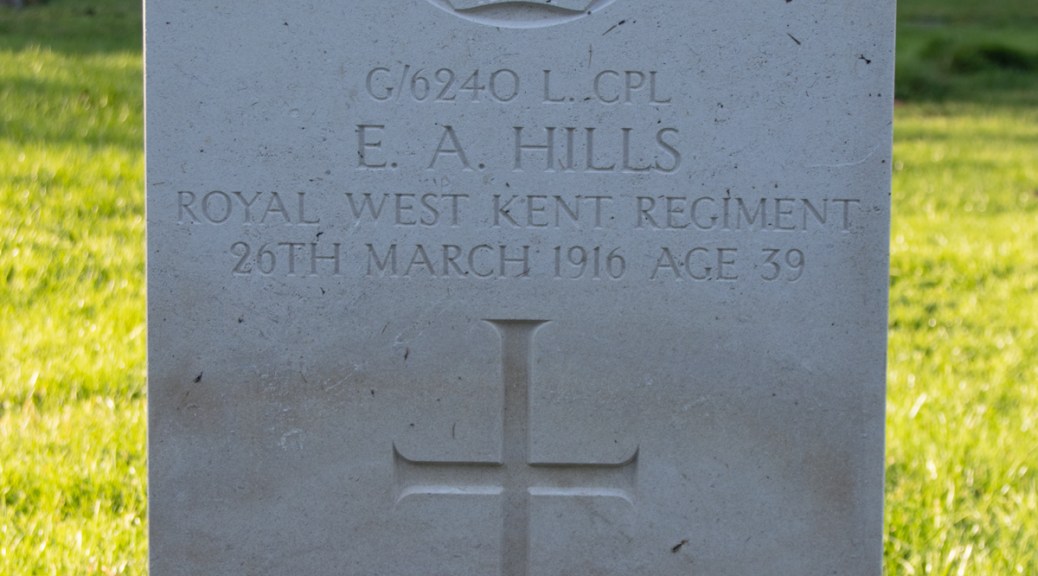
His good fortune was not to last for long, however, in the spring of 1916, he fell ill and, while at his family home in March, he passed away, having been suffering from Addison’s disease, a rare disorder of the disorder of the adrenal glands. He was 39 years of age.
Lance Corporal Ernest Albert Hills was laid to rest in the Faversham Borough Cemetery, not far from his family home, and where his father – who had passed away in 1903 – had also been laid to rest.
Edmund George Durnford was born in the spring of 1881 in the Somerset village of Pitcombe. The second oldest of twelve children, he was the oldest son to Edmund and Eliza Durnford. Edmund Sr was an agricultural labourer who travelled with the work – the 1891 census recorded the family living in Mells, near Frome.
When Edmund Jr left school, he found work at an ironmonger’s. He moved to Midsomer Norton and, in 1907, he married local carter’s daughter Bessie Welch. The young couple set up home in a terraced house on the road to nearby Radstock, and went on to have two children: Ian, who was born in 1908, and Ronald, born the following year.
War came to Europe, and Edmund was keen to play his part. He enlisted in the Royal Army Service Corps as a Driver, and was assigned to the 827th Company. Full details of his service are not available, but he remained a part of the territorial force and was promoted to Lance Corporal.
The local newspaper of the time reported on what became of Edmund:
Lance Corporal Edward [sic] G Durnford, Army Service Corps… son of Mr and Mrs EG Durnford… died suddenly on April 18 at Duston Hospital, Northampton, from shell shock and hemorrhage [sic] of the brain, was 38 years of age. The body was brought back from Northampton, and the deceased accorded a military funeral at Midsomer Norton last week.
Somerset Guardian and Radstock Observer: Friday 3rd May 1918
There are a couple of inconsistencies with the report. The newspaper has Edmund’s name wrong, while his pension record does not mention shell shock as the cause of death (it confirms the cerebral haemorrhage, but also cites a granular kidney). Given that Lance Corporal Durnford did not serve abroad, it seems unlikely that shell shock was a contributing factor.
The same article also places three of Edmund’s brothers in the war, and gives an insight into what had become of them before the conflict. Gunner Percy Durnford was with the Canadian Field Artillery, training in the South of England; Sergeant Major Arthur Durnford, of the Australian Light Horse, was based in Sydney; Bombardier Horace Durnford, of the Royal Garrison Artillery, had served in France, where he had been gassed, but was, at the time of his oldest brother’s death, based in Egypt.
Edmund George Durnford died in Northampton on 18th April 1918. He was 38 years of age. His body was brought back to Somerset, and he was laid to rest in the graveyard of St John the Baptist Church in Midsomer Norton.
Edmund’s younger son, Ronald, served in the Second World War. He joined the Royal Artillery, reaching the rank of Lance Bombardier. Ronald was serving in the Far East early in 1942, and for the next year, no news was heard of him.
However, contact was made in March 1943, confirming that Ronald had been captured by the Japanese, and was a prisoner of war in Borneo. Three months later, his wife, Kathleen, received a postcard from him, confirming he was a prisoner of war, well and unwounded.
Tragic news was quick to follow, however:
In last week’s issue it was stated that Mrs [Bessie] Durnford… had received through her daughter-in-law news that her son, Lance Bombardier Ronald Durnford, was a prisoner of war in Jap hands and was unwounded.
On Saturday she received the sorrowful news that he was dead in the following messages, which her daughter-in-law had sent on:
“I deeply regret to inform you a report has been received from the War Office, that [Ronald], who was reported a prisoner of war in Borneo Camp, had died from dysentery. The date of his death is not yet known, but you may rest assured as soon as any further information is received, I will immediately let you know.”
Somerset Guardian and Radstock Observer: Friday 30th July 1943
Lance Bombardier Durnford was laid to rest in the Labuan War Cemetery in Malaysia.
Further family tragedy, albeit with a life well-lived, was to follow as, on 6th September 1943, Bessie too died at the age of 86. She was laid to rest alongside Edmund in the family plot. Her obituary confirmed that “She leave a husband, seven daughters, and four sons to mourn her loss. One son and one daughter are in Canada, and one son in Australia, and one daughter and son in London.” [Somerset Guardian and Radstock Observer, Friday 17th September 1943]
Bessie had not, in fact, remarried: the husband was, in fact, the one who had died some 25 years before.
Thomas George Taylor was born in the summer of 1886, and was the youngest of five children to George and Sarah Taylor. George was a gamekeeper in Clutton, Somerset, and he and Sarah raised their family in Rudges Cottage opposite the village church.
Thomas’ older brother John found a variety of jobs, from boot finisher to coal miner, but Thomas followed in his father’s footsteps, and, by the 1911 census, was recorded as a butcher’s apprentice.
Storm clouds were brewing across Europe by this point and, when war broke out, Thomas was one of the first to enlist. Sadly, there is little information on his military service, but it is clear that he joined the 7th Battalion of the Somerset Light Infantry and was quickly promoted from Private to Lance Corporal.
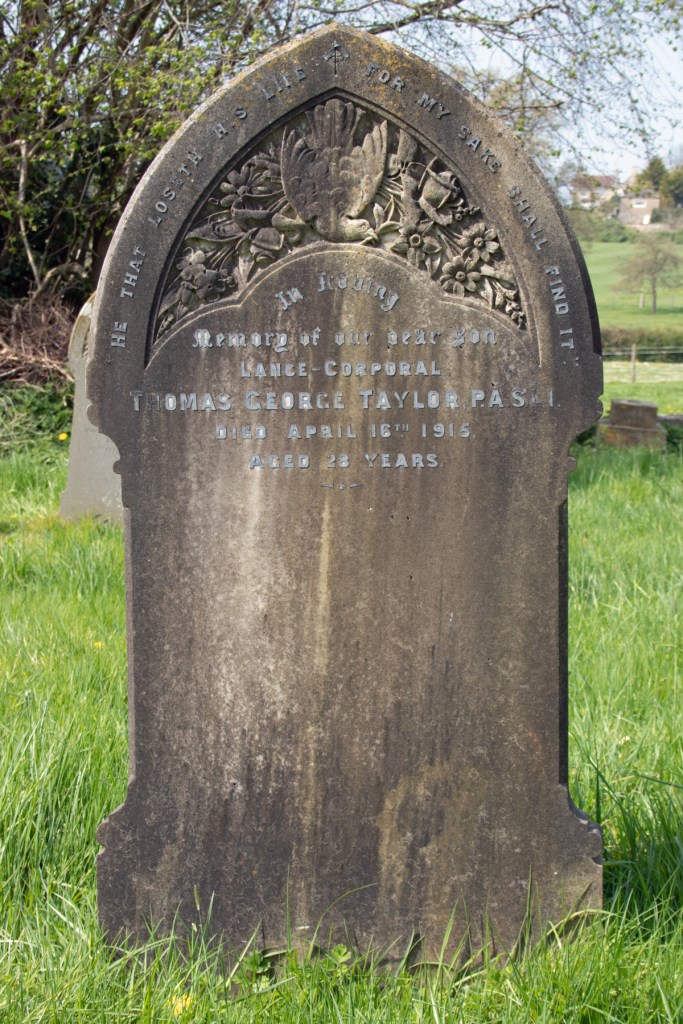
The only other documentary evidence for Thomas is his entry in the Army Register of Personal Effects. This confirms that he was admitted to the Isolation Hospital in Aldershot, suffering from meningitis. Lance Corporal Taylor passed away from the condition on 16th April 1915, aged just 29 years old.
Brought back to Somerset for burial, Thomas George Taylor was laid to rest in the graveyard of St Augustine’s Church, across the road from his family home in Clutton.
Frederick Davis was born in Street, near Glastonbury, in February 1876. One of four children, his parents were Frank and Ann. Frank was an agricultural labourer, while Ann worked as a shoe binder in the local Clark’s Factory.
By the 1891 census, Frederick had left school, and had also left home, boarding with a farmer in nearby Walton, where he also worked as a labourer on the farm. Ten years later, he was living with his paternal grandmother and his older brother in the village, with both brothers working as labourers.
During this time, it seems that Frederick had his sights on bigger and better things. Full details are not available, although it appears that he enlisted in the Army and served in India and South Africa between at least 1897 and 1902. He was awarded the Distinguished Conduct Medal in 1902 for his actions, although again little information around this survives.
Confirmation of his service overseas at this time appears on Frederick’s later military service records as, in January 1909, he again enlisted in the army. Frederick’s 1909 records show that his next of kin was his wife, Mrs AL Davis, although no marriage documents are apparent. He is also recorded as living in Castle Cary, just to the south of Glastonbury.
This time he was assigned to the 4th Battalion of the Somerset Light Infantry, serving for five years on home soil. During this time, he rose through the ranks from Private to Lance Corporal to Corporal to Sergeant.
When war was declared, the 4th Battalion was sent out to India. Sergeant Davis spent the next eighteen months there, before being moved to the Persian Gulf. He was obviously well thought of as, with the move came a further promotion, this time to Company Sergeant Major.
In June 1917, Frederick returned to England from overseas, and, at the end of his term of service two months later, he was demobbed. He returned home to Somerset, but, within a couple of months, on 2nd October 1917, he passed away. The cause of his death is not recorded, but he was 42 years of age.
Frederick Davis was laid to rest in the peaceful surrounds of the Castle Cary Cemetery.











 Death and Service